What is Bashkir Honeycomb Felt Ornament?
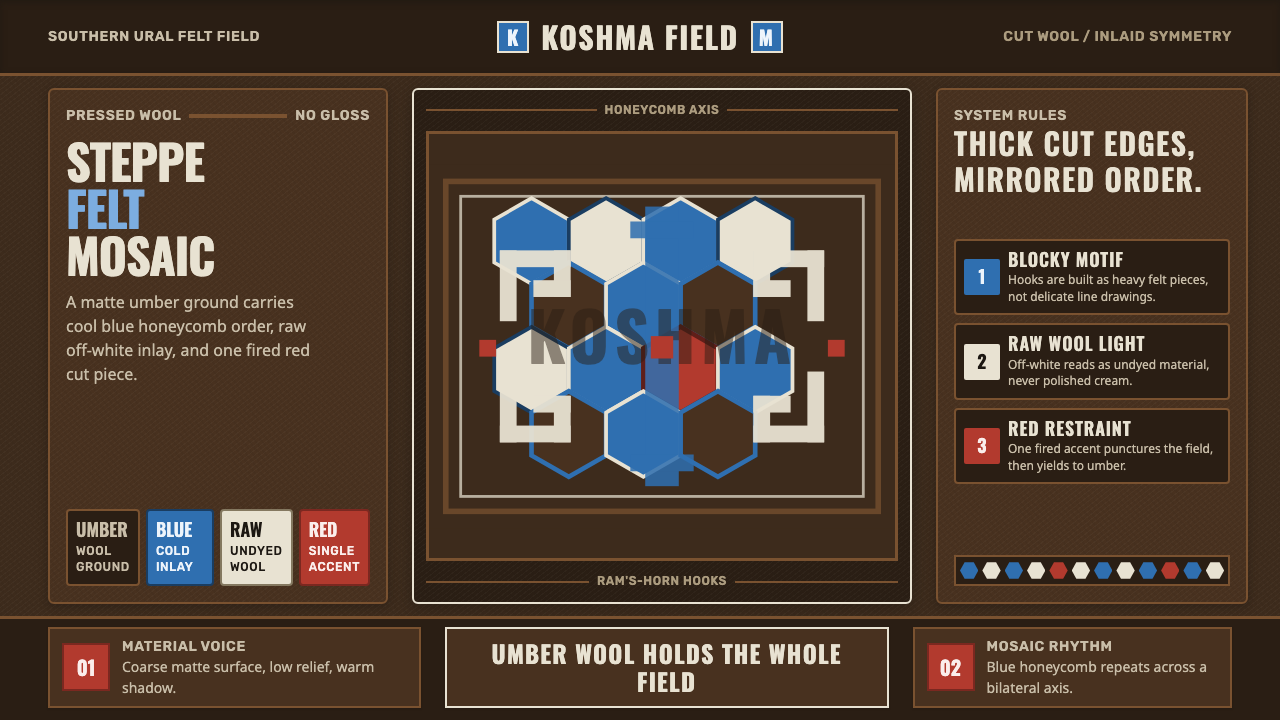
Bashkir Honeycomb Felt Ornament brings the compact force of steppe woolwork to the screen: dense umber ground, cool blue inlay, and hooked forms that feel cut from the flock rather than drawn on top.
Bashkir Honeycomb Felt Ornament in brief
Bashkir felt ornament belongs to the koshma tradition: thick sheets of pressed sheep wool are cut into separate shapes and inlaid to form geometric mosaics. Its visual language is substantial rather than delicate. A dark umber-brown field holds pale raw wool, saturated cool blue, and occasional red, producing an image that feels assembled from material pieces rather than painted as surface decoration.
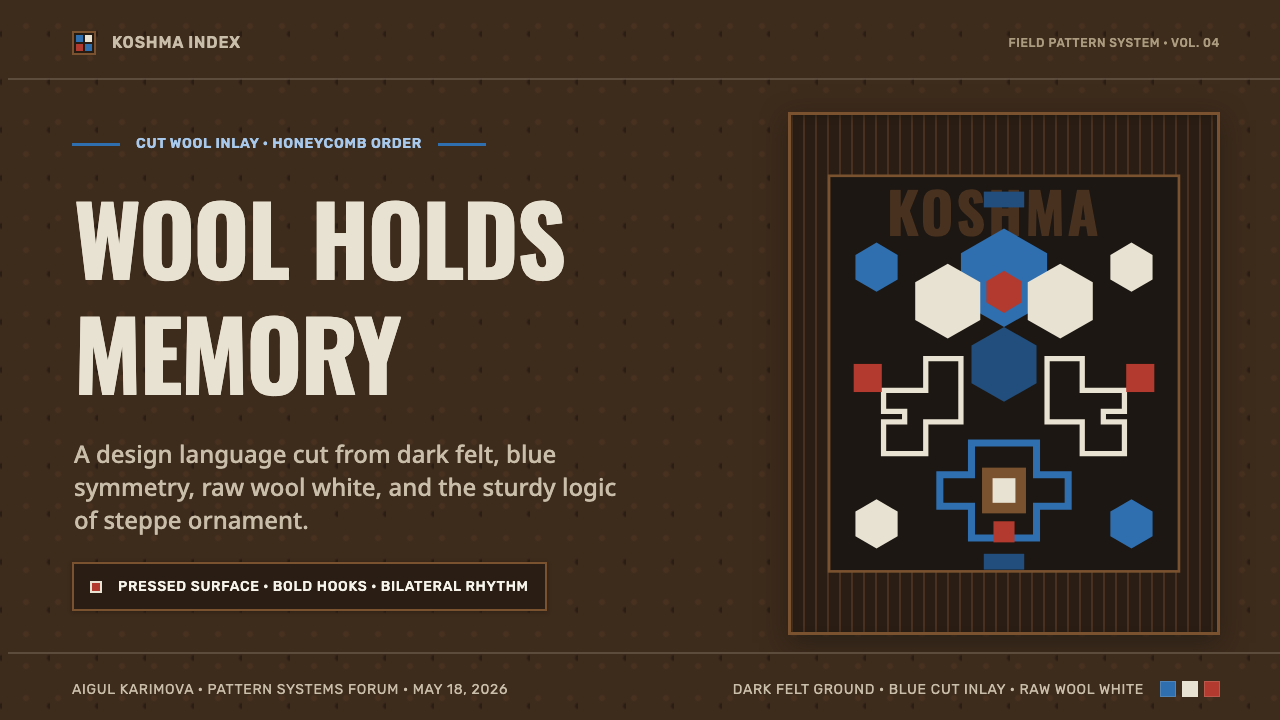
The defining motifs are honeycomb symmetry and angular ram’s-horn hooks, known as koshkar-muyiz or kuskar. The honeycomb creates an ordered, repeating field; the horn form interrupts that order with a directional, zoomorphic curve. Together they make a system that is both geometric and animal-derived, rooted in the southern Ural steppe rather than in a purely abstract decorative tradition.
In a digital setting, the style should preserve the logic of felt. Forms need broad silhouettes, firm joins, and visible visual weight. The background is matte and pressed, the light tone recalls undyed wool rather than polished ivory, and blue reads as an inserted textile layer. Gloss, hairline ornament, airy translucency, and generic folk flourishes all weaken the material character that gives the style its authority.
Where does Bashkir Honeycomb Felt Ornament come from?
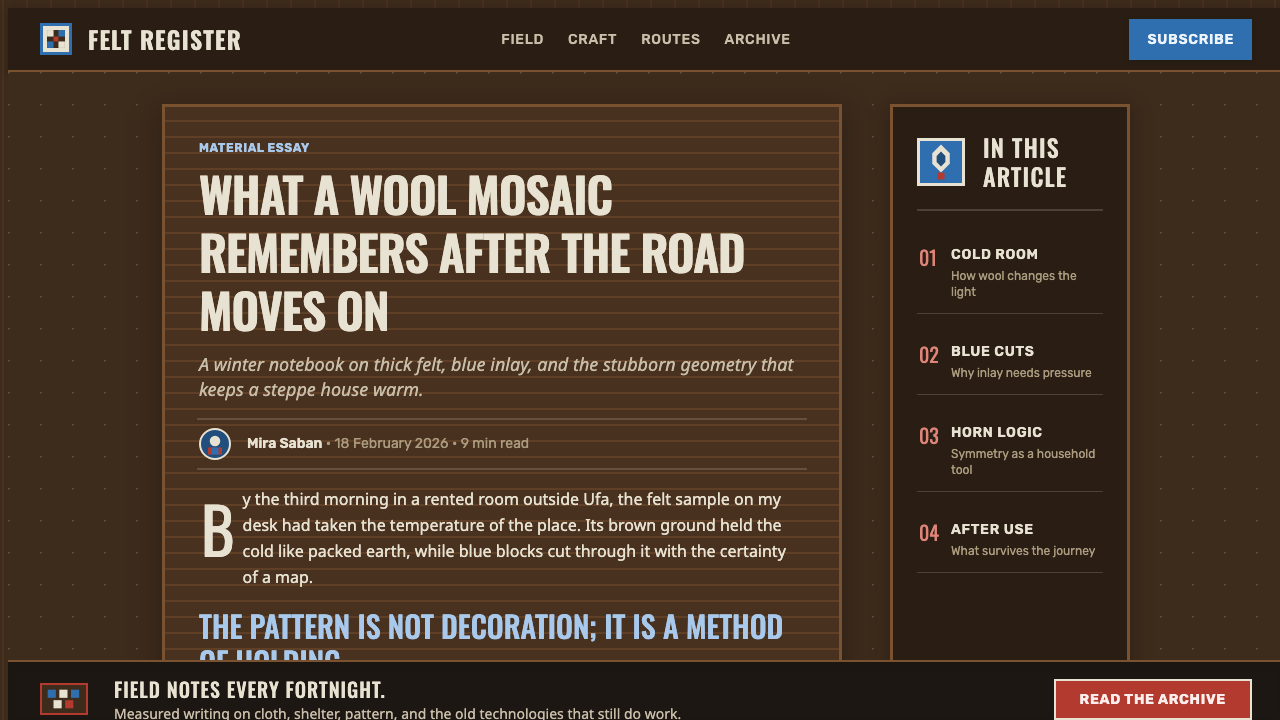
The tradition comes from Bashkortostan and the southern Ural steppe, a Central Asian setting where felt was not an incidental decorative medium but a substantial craft material. Koshma names the thick pressed sheep-wool sheets from which ornament can be cut and assembled. The finished pattern therefore begins with compression, cutting, and inlay rather than with line drawing.
Its steppe character is visible in the relation between structure and animal reference. Honeycomb arrangements establish a stable mosaic field, while koshkar-muyiz ram’s-horn hooks introduce a zoomorphic sign associated with southern Ural ornament. The horn does not become naturalistic illustration. It is reduced into an angular hook whose recognition depends on rhythm, repetition, and placement within the larger field.
Bashkir felt-makers are the central makers of this visual system. Their cut-and-inlay technique joins differently colored wool components into a single thick surface, making color inseparable from construction. This matters when adapting the tradition: the pattern should retain the sense that every blue, pale, or red element has been fitted into the brown ground, not merely printed over it.
What defines the Bashkir Honeycomb Felt Ornament look?
Pressed Wool Ground
The base should read as deep umber felt: matte, dense, slightly coarse, and physically quiet. It is not a paper background and not a luxury leather substitute. The darkness gives pale wool and blue inlay their contrast while establishing the heavy, grounded mood of the style.
Raw Wool Light
The light tone is undyed off-white wool, never creamy polish or sterile white. It should feel fibrous and natural against the brown field. This distinction keeps the palette tied to sheep wool and prevents the interface from drifting into a generic rustic or vintage treatment.
Cool Blue Inlay
Blue is a cool, saturated inlay color rather than atmospheric decoration. It works best in broad honeycomb cells, bands, or paired fragments where it can appear physically inserted into the felt. Used this way, it creates crisp contrast without making the composition glossy or lightweight.
Honeycomb Order
Honeycomb symmetry supplies the system’s stable framework. Repeated cells create a tactile sense of fitting and joining, like pieces cut from a shared sheet. The repetition should remain bold and legible, with enough open field around it for the pattern to read as structure rather than wallpaper.
Ram’s-Horn Hooks
Koshkar-muyiz hooks provide the zoomorphic counterpoint to the honeycomb grid. They are angular, compact, and directional, not flowing botanical curls. Place them as emphatic turns, borders, or focal marks so the animal reference remains present without competing with the mosaic’s larger order.
Single Red Accent
Red is an accent, not a competing field color. A limited red intervention can identify an action, a key marker, or a visual turn within the blue-and-pale composition. Its scarcity is essential: once red spreads through the layout, the restrained textile hierarchy collapses into a more conventional decorative palette.
Who shaped Bashkir Honeycomb Felt Ornament?
Bashkir felt-makers are the makers identified with the koshma cut-and-inlay technique. Their importance lies in treating ornament as construction: colored wool components are cut, placed, and joined into a thick whole. A digital interpretation should preserve this sense of fitted material relationships.
Koshma is the technical and material foundation of the style. Thick pressed sheep-wool sheets establish the craft’s weight, while cutting and inlay turn separate pieces into a mosaic surface. It explains why authentic forms feel broad, decisive, and structurally bounded.
Koshkar-muyiz, also called kuskar, is the ram’s-horn zoomorphic motif associated with southern Ural steppe ornament. Its hooked, angular reduction carries animal reference without naturalistic depiction. Within the system, it gives the geometric field movement and a distinctly steppe-derived identity.
How do you use Bashkir Honeycomb Felt Ornament today?
For presentation covers, use the umber felt field as a decisive ground and let one oversized honeycomb fragment or ram’s-horn hook establish the composition. Set the title with strong, uncomplicated type that leaves the motif room to carry the visual identity. On content slides, treat blue inlay and pale wool shapes as sectional anchors rather than as constant decoration; the information should remain as solid and legible as the felt construction.
Data slides can use the honeycomb principle to organize categories, comparisons, and grouped information. Repeated cells are useful when they describe related units, while a red accent can isolate the finding that deserves immediate attention. Avoid making every chart ornate. The strongest result comes when the ornamental logic clarifies grouping and emphasis instead of disguising the data beneath a textile pattern.
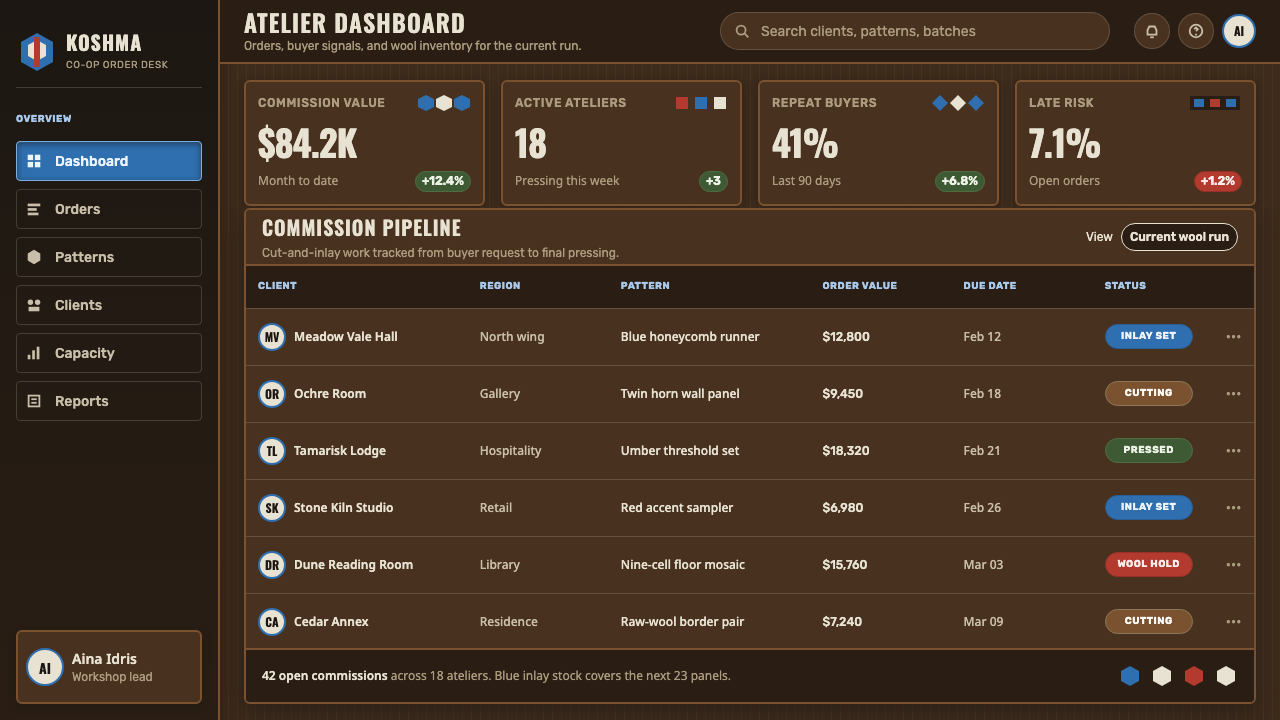
For web interfaces, this style suits dashboards, collections, and pricing or membership pages that benefit from a grounded, crafted sense of hierarchy. Keep the primary interface field dark and matte, reserve pale wool tones for reading surfaces and labels, and use blue for selected states, categories, or high-value structural elements. Cards and controls should feel cut into the system with firm silhouettes, not like translucent floating panels.
For editorial and marketing work, the style is especially effective where place, material, craft, or durable value matter to the story. Use large cropped motif fields to open sections, then let text occupy calmer areas of the umber ground. A common mistake is to turn the visual language into generic bohemian decoration by adding soft beige, ornate florals, shine, or many competing accent colors. The discipline is bolder: raw wool, cool blue, an occasional red signal, and motifs with the weight of cut felt.
Bashkir Honeycomb Felt Ornament — FAQ
Is this style simply a dark folk pattern?
No. Its identity comes from koshma construction as much as from motif. The umber field, raw wool light tone, cool blue inlay, honeycomb order, and ram’s-horn hooks need to work as a material system. A dark background with unrelated decorative symbols will not convey the same tradition.
Why should the pale tone avoid cream?
The intended light material is raw, undyed sheep wool. Cream introduces a polished, domestic softness that changes the craft reference and weakens the contrast with the dark felt ground. Off-white wool should feel natural, fibrous, and pressed rather than refined or glossy.
Can blue be used as a large background area?
Blue is strongest when it reads as inlay within the umber field. It can occupy substantial honeycomb or banded forms, but the brown felt ground should remain visually dominant enough for blue to feel inserted. If blue replaces the ground entirely, the cut-and-inlay logic becomes much less clear.
How should ram’s-horn hooks be drawn digitally?
Keep them blocky, angular, and clearly bounded. Their purpose is not to imitate a flowing animal silhouette but to introduce a compact zoomorphic turn into a geometric field. Avoid thin curlicues, floral substitutions, and overly smooth ornamental curves; these remove the motif from its felt-mosaic character.
Related design styles
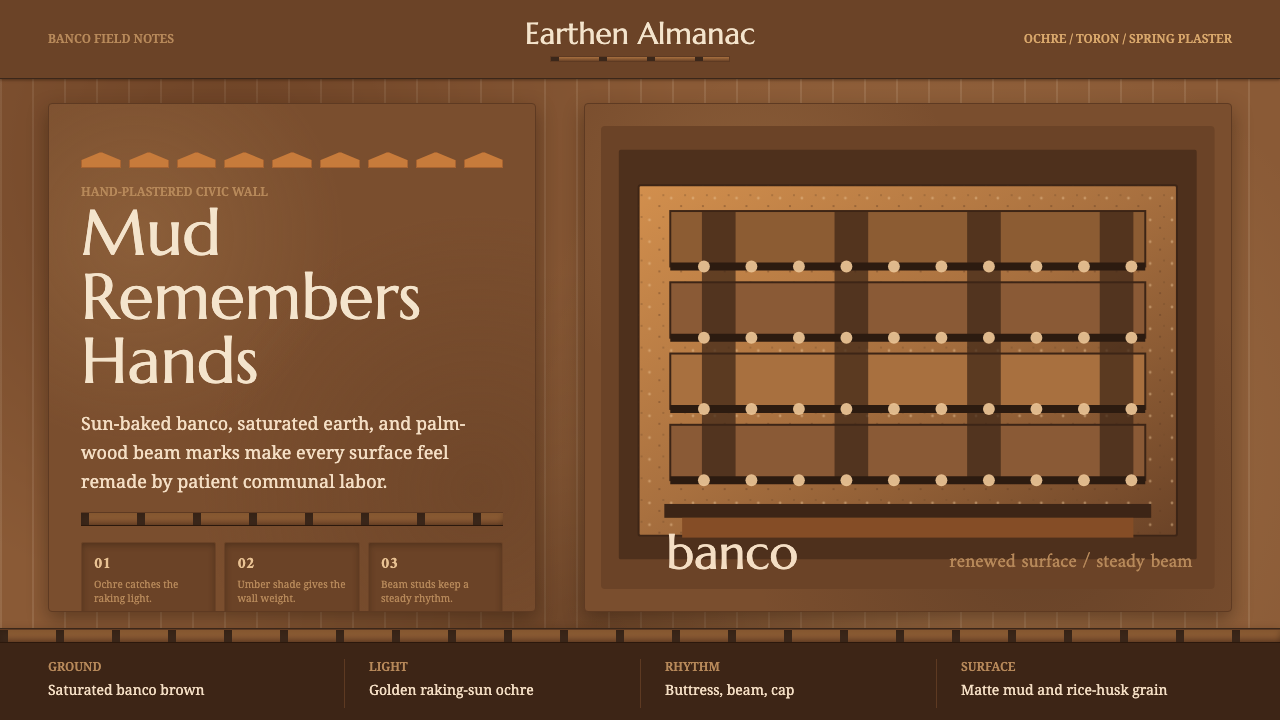 Djenné Mud MosqueBuilt from renewal. Banco brown, ochre caps, and toron grids feel hand-plaste…
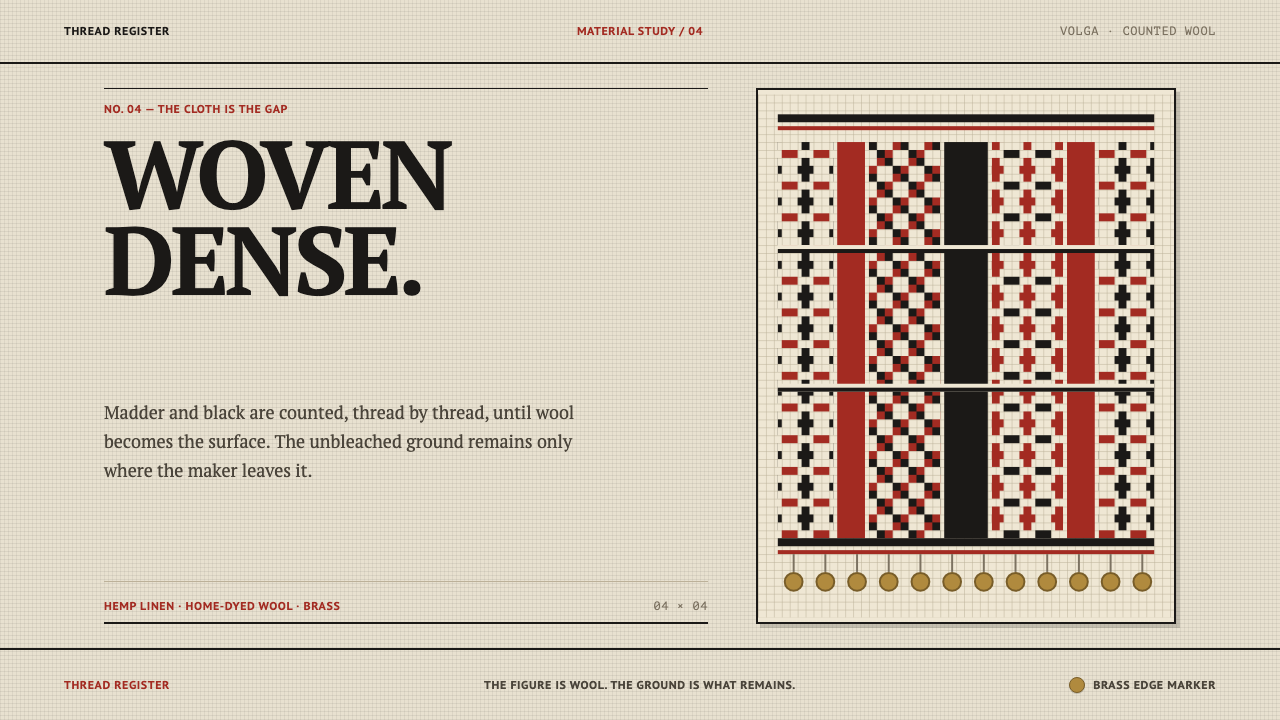 Erzya PangaDensity is the ornament. Madder and black stepped stitches crowd unbleached l…
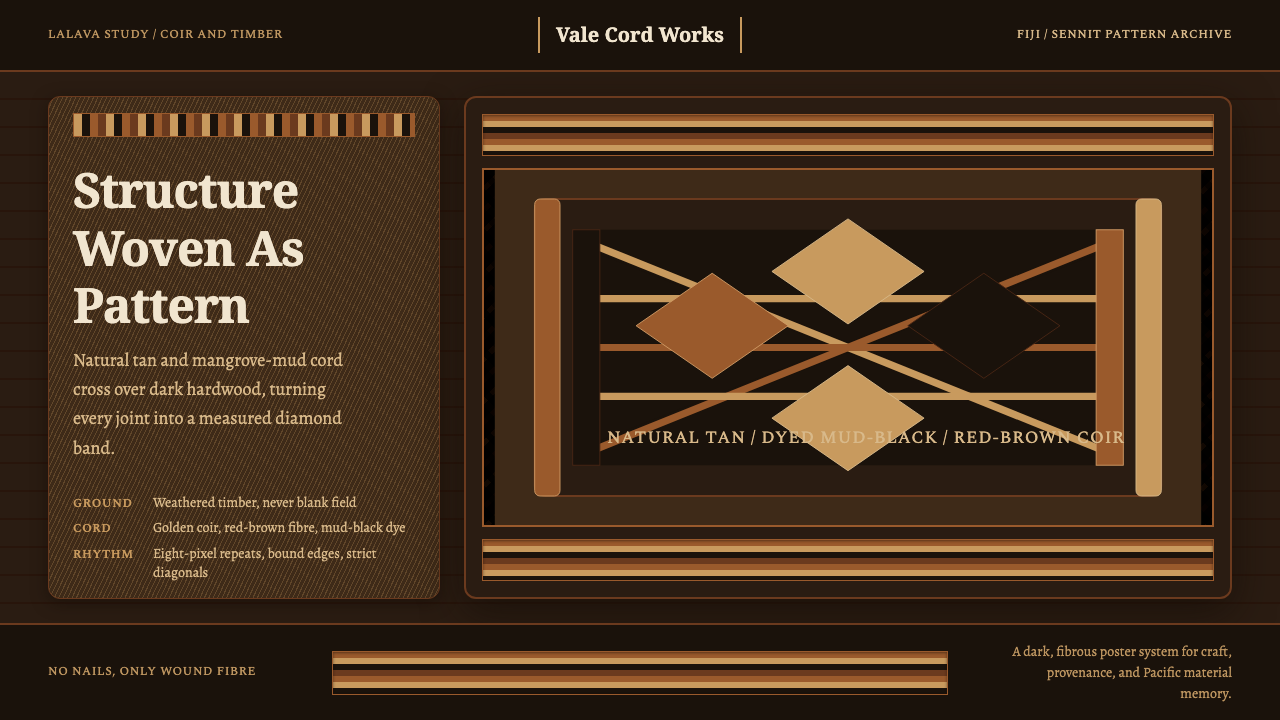 Fijian Magimagi LashingStructure becomes ornament. Tan coir diamonds bind mud-black timber in a stri…
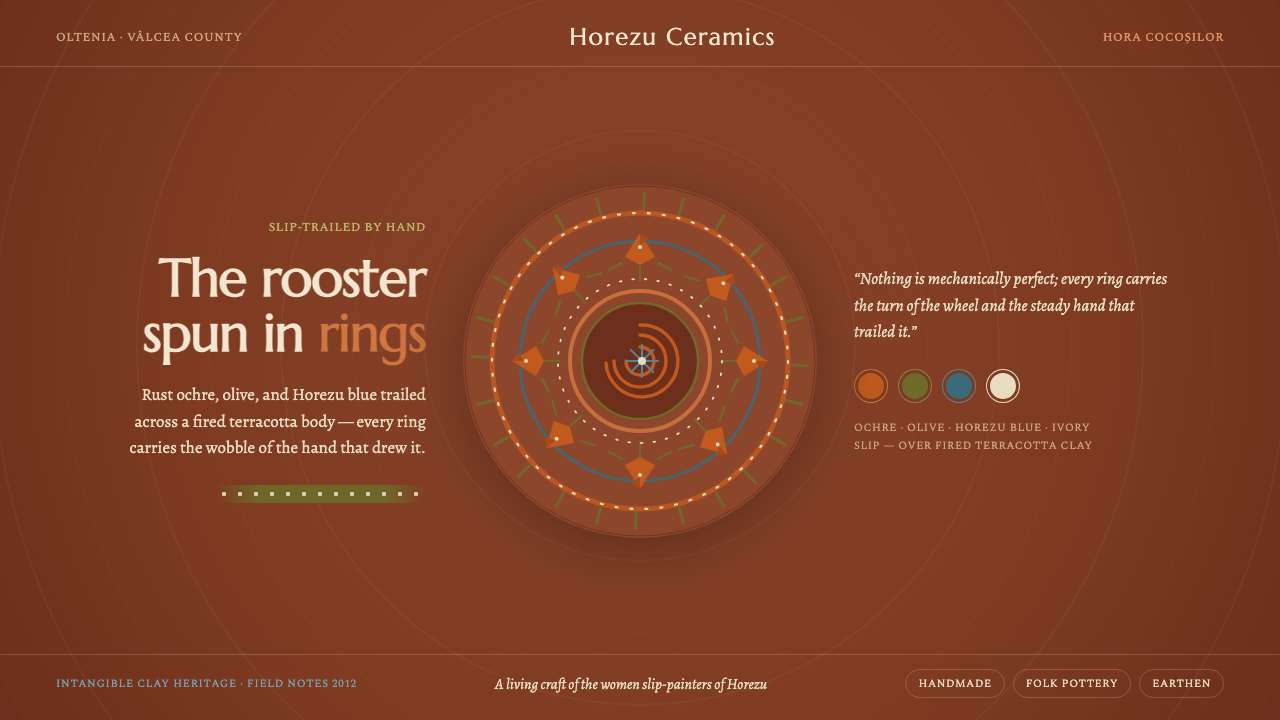 Horezu CeramicsWarm earth, steady hand. The Horezu rooster spun in ochre and olive slip acro…
 Kashubian Seven ColoursMeaning is stitched into the palette. Seven threads cross undyed linen in a m…
 Kazakh Shanyrak Yurt FeltDomestic warmth, engineered. Ram-horn red felt curls around a radial shanyrak…