What is Fijian Magimagi Lashing?
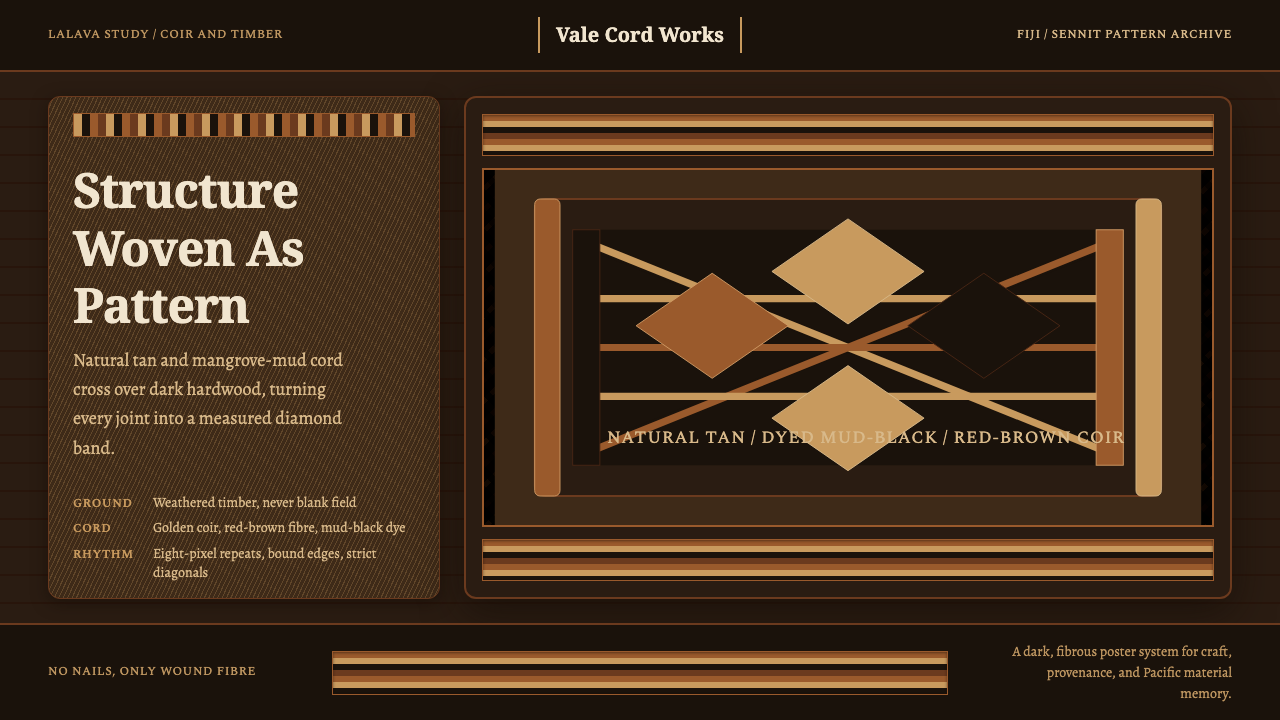
Fijian magimagi lashing turns the act of holding a house together into a disciplined field of fibre, darkness, and repeating diamonds.
Fijian Magimagi Lashing in brief
Fijian magimagi is a building craft in which coconut-husk coir is twisted and plaited into sennit cord, then wound around the timbers of a bure house using lalava decorative lashing. The binding performs two roles at once: it joins and secures structural members, while its repeated crossings form an ordered geometric surface. Ornament is therefore not applied after construction. It emerges directly from the method by which the building is assembled.
Its visual identity rests on a concentrated material palette. Natural coir contributes tan and golden-brown strands, while fibre soaked in mangrove mud supplies a deep black. These cords cross over dark hardwood poles in alternating bands, producing diamonds, diagonals, and tightly controlled changes of tone. The contrast is strong but never synthetic: every color belongs to fibre, mud, or timber, and every visible line records a physical path taken by the cord.
As a contemporary design language, Fijian Magimagi Lashing should preserve this relationship between structure and pattern. Dense woven borders, interlocking diagonals, dark timber-like fields, and grounded serif typography can evoke the craft without reducing it to a decorative motif. The essential quality is rhythmic accumulation: individual strands remain legible, yet together they establish a larger grid whose authority comes from repetition, tension, and material weight.
Where does Fijian Magimagi Lashing come from?
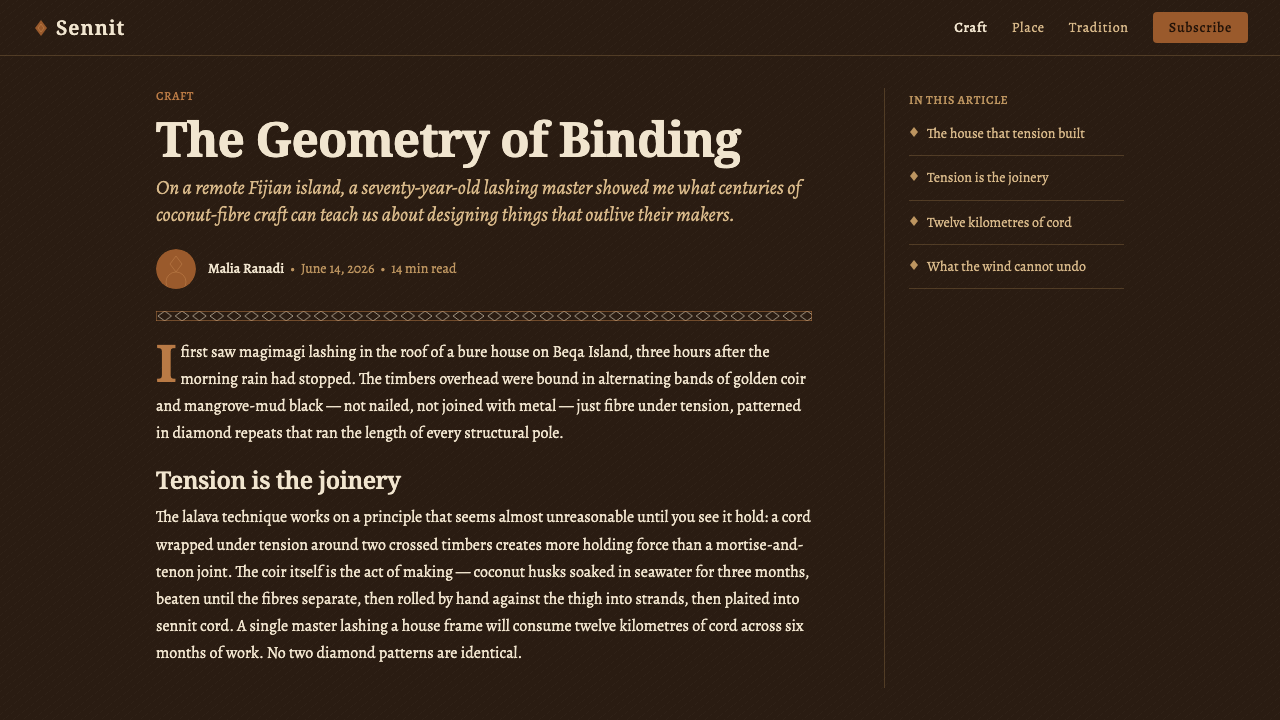
Magimagi lashing belongs to the traditional building culture of Fiji in Oceania and was established before 1900, although lalava practice continues into the present. Its setting is the bure house, where timber members require binding and the joint itself becomes a visible part of the architecture. Rather than conceal the connection beneath another surface, the craft makes the connection legible. Coir cord wraps the poles, crosses itself, changes direction, and gathers into bands whose visual order expresses the care invested in the structure.
The process begins with coconut husk, transformed through twisting and plaiting into durable sennit cord. This cord is magimagi: both a working material and the basis of the finished pattern. Some fibre retains its natural tan or golden-brown appearance; some is darkened by soaking it in mangrove mud. Alternating the natural and dyed strands gives the lashing a tonal grammar before any decorative arrangement is considered. Material preparation, color, and construction are therefore stages of one continuous craft rather than separate design decisions.
The knowledge belongs to a community of skilled makers rather than to a named individual. Fijian master builders, or matai ni vale, work within the broader practice of bure construction, while lalava lashing artisans and bure house craftsmen carry the binding methods through making. Their expertise lies not only in producing an attractive crossing pattern but in understanding how cord passes around timber, how repeated bands organize a joint, and how the visible weave can remain geometrically clear while serving the building.
Within Pacific vernacular architecture, magimagi demonstrates a principle with wide design significance: necessity can generate visual identity. The strict woven grid is not an abstract pattern imposed on a neutral support. It is the record of cord moving over wood in repeated acts of binding. Diamond bands emerge from crossing diagonals; tonal contrast emerges from natural and mud-blackened fibre; depth emerges from real strands layered under tension. Its continuity to the present preserves a craft in which construction, surface, and cultural expression remain inseparable.
What defines the Fijian Magimagi Lashing look?
Coir and Mud Color
The palette grows entirely from material: tan and golden-brown natural coir, deep black fibre colored in mangrove mud, and the near-black presence of dark hardwood. Warm strands appear luminous against the timber without becoming bright or polished. Black is not an empty background but another crafted substance, giving the composition an earthy depth and allowing small changes in fibre tone to remain visible.
Diamond Lashing
Crossing diagonals form the defining diamond bands. Their power comes from sequence rather than from a single isolated emblem: one crossing establishes a direction, the next reverses it, and continued repetition turns the joint into a woven grid. Diamonds may act as borders, dividers, or structural frames in a derived layout, but they should always appear built from interlaced paths rather than stamped onto the surface.
Fibrous Texture
Magimagi should feel twisted, plaited, and tactile. Slight variations in strand tone and the visible logic of overlap prevent the pattern from becoming sterile geometry. Texture remains disciplined: it belongs to the cord and timber rather than appearing as unrelated distress or atmospheric noise. The surface should suggest patient handwork, friction, and tension while retaining enough clarity for every crossing to be understood.
Structural Rhythm
Repetition is regular, compact, and purposeful. Lashing bands establish intervals along a dark support, creating a cadence comparable to joints along a timber frame. In graphic use, this rhythm can organize sections and guide reading, but it should not fill every available space. Dense woven passages gain authority when they alternate with quieter dark fields, just as a bound joint is distinguished from the timber it secures.
Grounded Typography
A substantial serif voice suits the material gravity of coir, mud, and hardwood. Letterforms should feel rooted and deliberate, with clear differences between commanding titles, explanatory text, and small labels. Typography is not woven into illegibility or treated as another strand. It occupies stable fields beside the lashing, allowing the fibrous pattern to carry cultural and material character while the type carries information.
Layering under Tension
Depth comes from one cord passing visibly over or beneath another and from the lashing wrapping a solid timber support. It is physical depth, not atmospheric illusion. Edges remain distinct, overlaps are intelligible, and shadow is subordinate to the strands that cast it. In digital interpretation, flat decorative diamonds without an interlacing order lose the essential sense that every line is pulling, binding, and contributing to a joint.
Who shaped Fijian Magimagi Lashing?
Fijian master builders stand at the center of the bure construction tradition represented by magimagi. Their role joins architectural understanding with practical command of materials and joints. In this context, the lashing is not merely an embellishment entrusted to the end of a project; it belongs to the knowledge of how the house is assembled, how its timbers meet, and how those meetings become visible expressions of craft.
Lalava lashing artisans carry the specialized intelligence of decorative binding. Their work coordinates direction, overlap, tonal alternation, and repetition so that a practical wrap becomes a coherent geometric band. The artisan's contribution is visible in the consistency of the rhythm and in the controlled transition between natural and mud-blackened cord, where disciplined execution produces ornament without separating it from structure.
Bure house craftsmen provide the broader making context in which magimagi has meaning. Timber preparation, assembly, and binding belong to a continuous building process, and the finished lashing remains attached to the members it secures. Their collective practice demonstrates why the style cannot be understood through diamonds alone: the pattern gains significance from its placement on wood, its participation in a joint, and its relationship to the whole house.
How do you use Fijian Magimagi Lashing today?
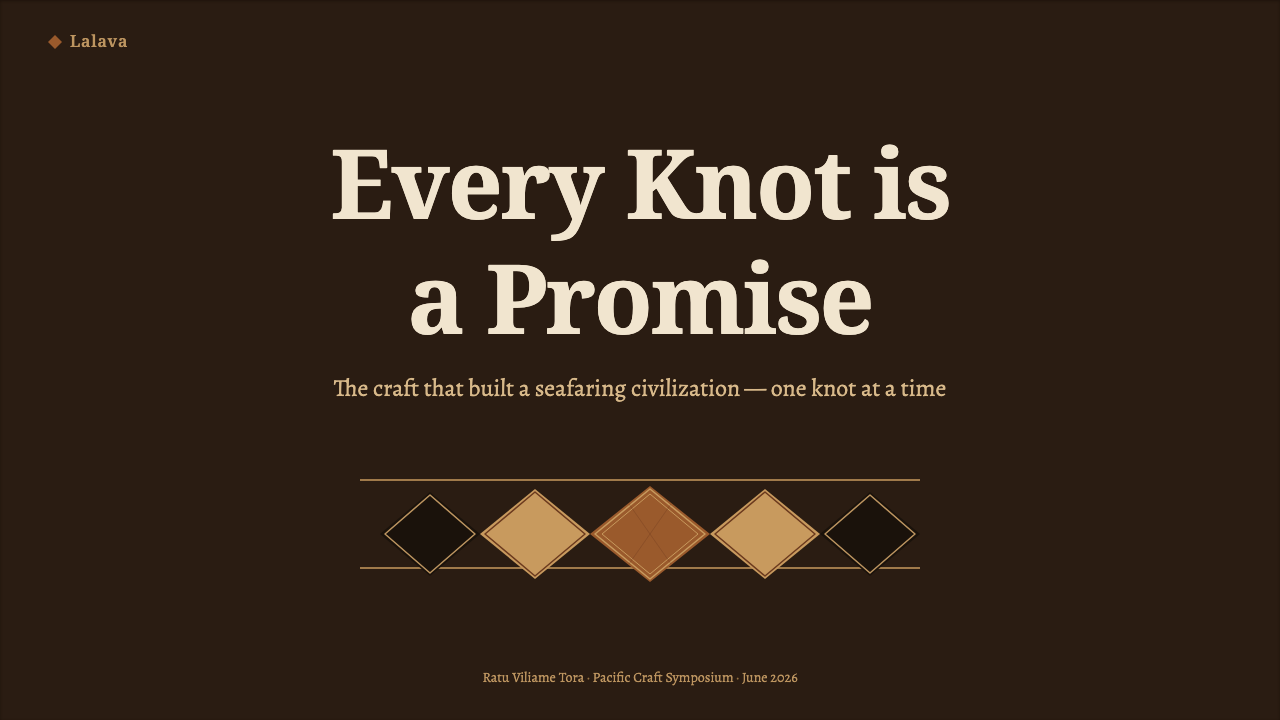
For presentation slides, begin with the lashing as a framing system. A cover can place a broad diamond-woven band along one edge or around a title field, set against a mud-black timber-like ground. The title should be substantial and calm, with warm coir tones reserved for the woven structure and essential emphasis. Content slides work best when the pattern marks section boundaries rather than surrounding every text block. Use clear typographic levels, generous dark breathing fields, and repeated alignment that echoes the regularity of bound poles.
Data slides should translate the craft's logic without turning information into costume. Natural tan, golden coir, and deep black can distinguish categories, while repeated diagonal marks or compact woven bands can establish grouping. Charts should remain direct and readable; the magimagi influence belongs in the ordered intervals, strong contrast, and visible relationship between parts. A diagram of connected elements is especially appropriate because the style already treats connection as its central visual event.
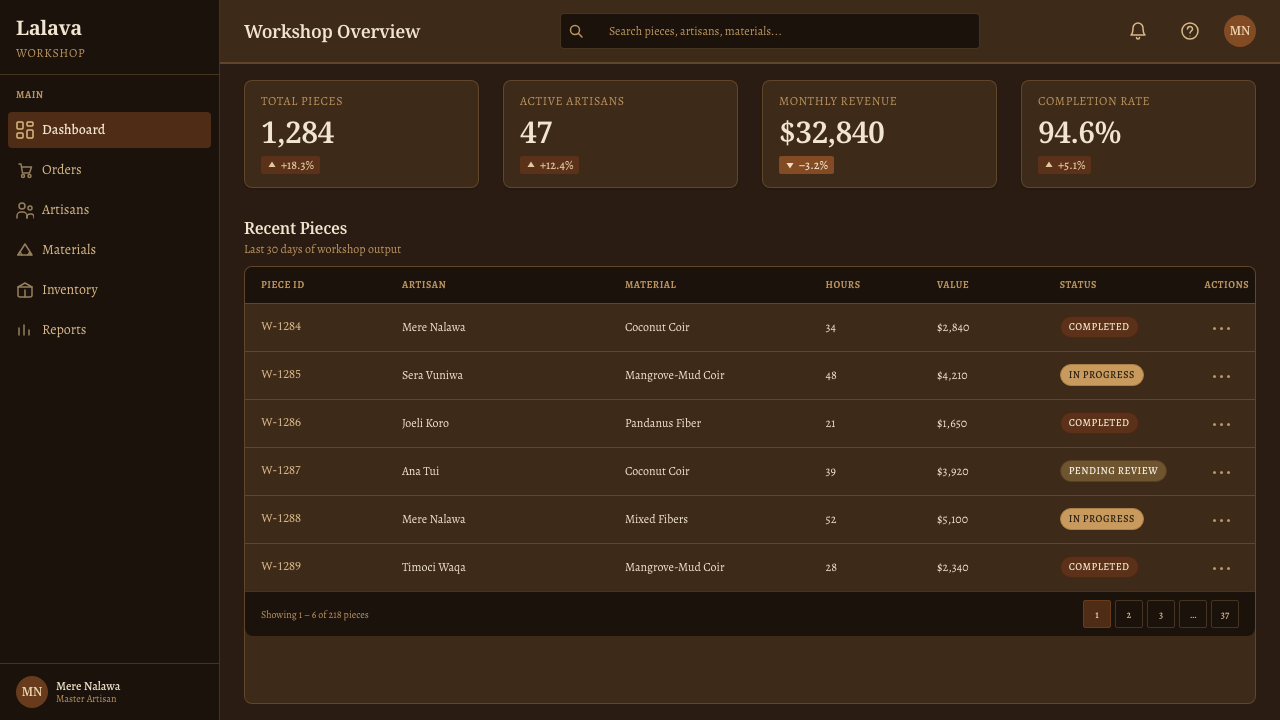
For web interfaces, Fijian Magimagi Lashing suits dashboards, archive interfaces, and pricing pages that benefit from a dark, substantial atmosphere. Navigation and primary content can occupy quiet near-black fields, while woven bands identify major regions or active states. Cards should feel like panels secured within a larger framework, using firm boundaries and restrained material texture. On pricing pages, tonal changes in coir can separate tiers, but the recommended choice should be emphasized through placement and structural framing rather than excessive ornament.
Editorial and marketing layouts can use the style to connect narrative with making. Long-form articles benefit from dark chapter openings, grounded serif headings, narrow lashing rules, and photographs or illustrations framed as material evidence rather than floating decoration. Marketing compositions can alternate dense woven passages with open text fields, allowing the pattern to signal craftsmanship, continuity, and structural care. Product claims should sit close to the visual feature that supports them, following the lashing's own principle that meaning is strongest when connection remains visible.
The common mistake is to extract the diamond and discard the craft. A repeated tan lattice on an arbitrary black background may resemble magimagi at a glance, yet it loses the distinction between fibre and symbol, binding and surface. Avoid filling every panel with identical pattern, adding unrelated tropical imagery, or smoothing the material into immaculate abstraction. Preserve visible interlacing, tonal variation, dark hardwood context, and purposeful intervals. The result should feel assembled and held in tension, not merely decorated with geometry.
Fijian Magimagi Lashing — FAQ
Is magimagi the cord or the diamond pattern?
Magimagi is coconut-husk coir twisted and plaited into sennit cord. The recognizable diamond pattern arises when that cord is wound around timber through lalava decorative lashing. Treating the term as the name of a free-floating geometric motif misses the material sequence: fibre becomes cord, cord becomes binding, and repeated binding becomes pattern.
Why is the lashing both structural and decorative?
The cord secures the timbers of a bure house, so its path is determined by a real act of joining. Lalava organizes that necessary wrapping into controlled crossings and repeated bands. The resulting geometry does not disguise the joint; it clarifies and dignifies it. Structure and decoration are simultaneous because the visible pattern is made by the same cord performing the binding.
Where do the tan and black colors come from?
Tan and golden-brown belong to the natural coconut fibre. The deep black is produced by soaking fibre in mangrove mud, while dark hardwood adds another near-black material field beneath the cord. This origin matters in visual adaptation: the palette should feel fibrous, earthen, and timber-based, not like a set of glossy decorative colors selected independently of the craft.
Can the style be used on a light background?
It can, but a light treatment changes the balance of the source material. The documented visual relationship places natural and dyed cord over dark hardwood, so a dark ground most directly preserves the lashing's contrast and weight. On a light field, use dark structural bands and limited coir accents, keeping the woven crossings dense enough to retain their sense of binding rather than drifting into delicate ornament.
How can designers avoid turning magimagi into a generic woven theme?
Keep the complete relationship visible: coconut fibre, natural and mud-black tones, dark timber, interlaced diagonals, repeated bands, and an evident structural purpose. Generic weaving often becomes an all-over texture with no hierarchy or point of attachment. A magimagi-derived composition should show where the binding begins, what it organizes, and how dense pattern alternates with the support beneath it. Connection, not texture alone, is the governing idea.
Related design styles
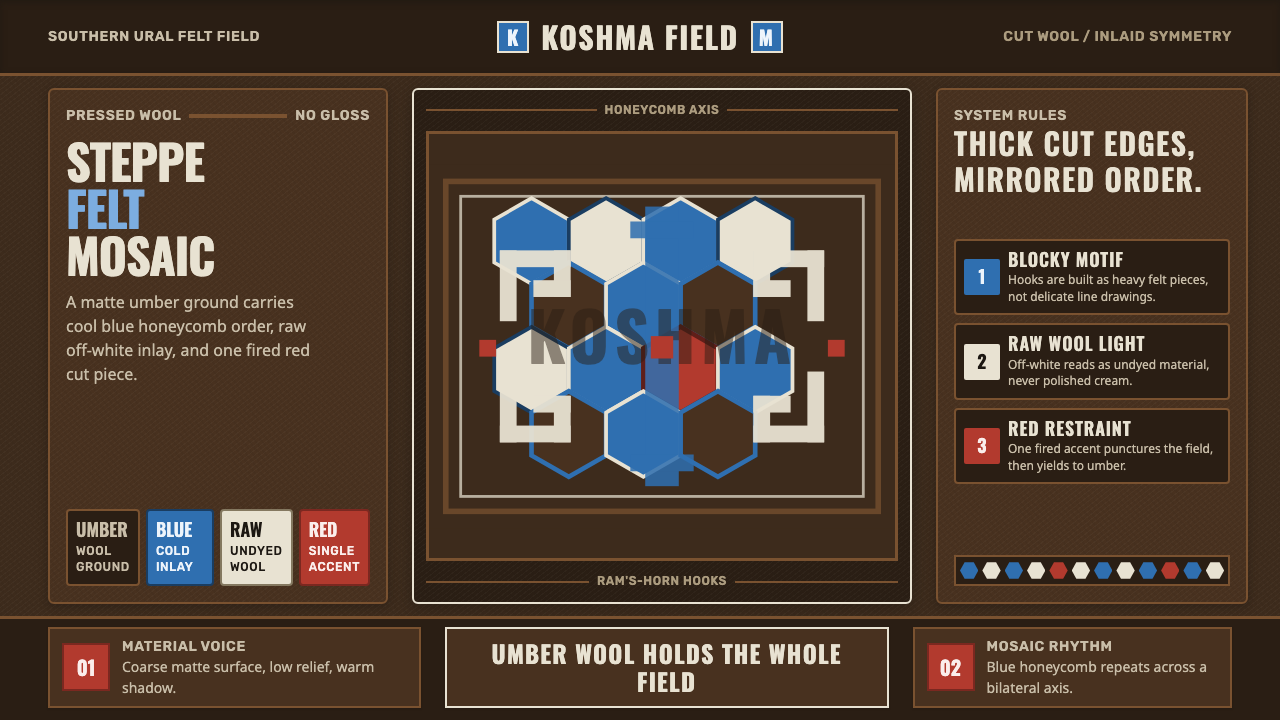 Bashkir Honeycomb Felt OrnamentSteppe craft feels weighty. Umber felt holds blue honeycomb and raw-wool hook…
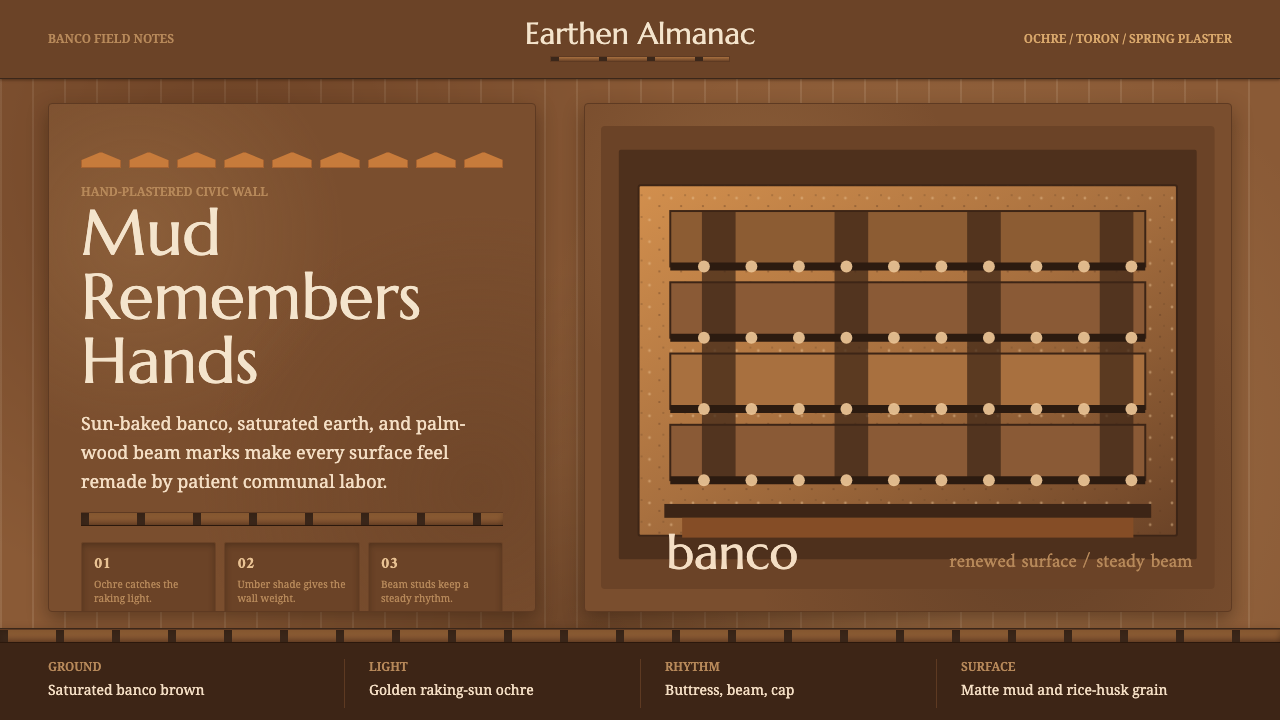 Djenné Mud MosqueBuilt from renewal. Banco brown, ochre caps, and toron grids feel hand-plaste…
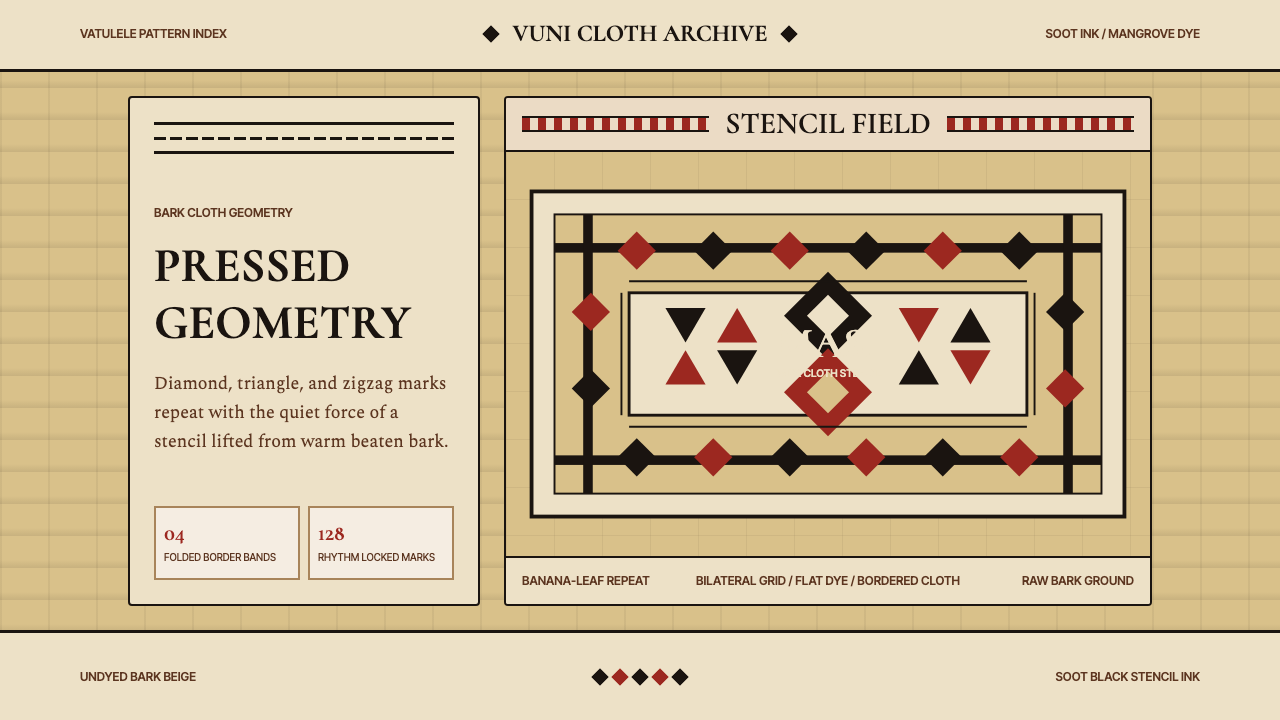 Fijian Masi Tapa StencilGeometry keeps ceremony. Soot-black diamonds repeat on bark beige with rust-r…
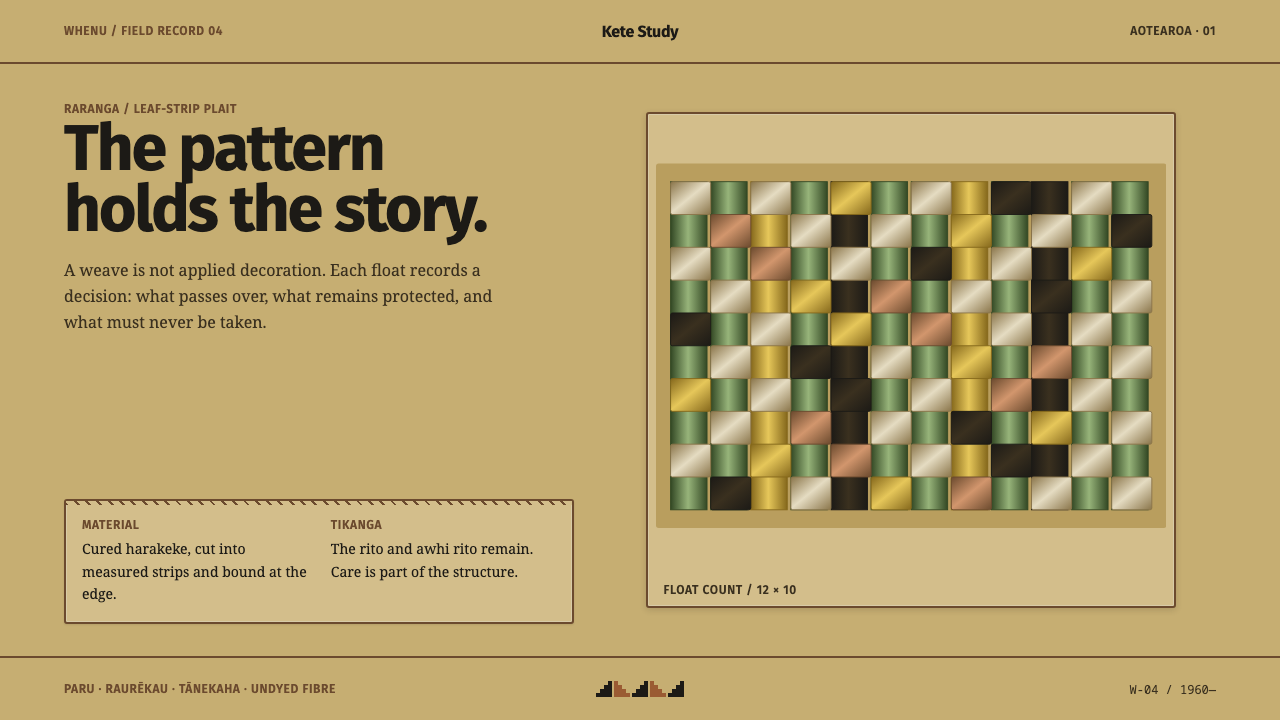 Harakeke Raranga WeavingStructure carries care. Honey-straw grids expose each green, bark and fibre s…
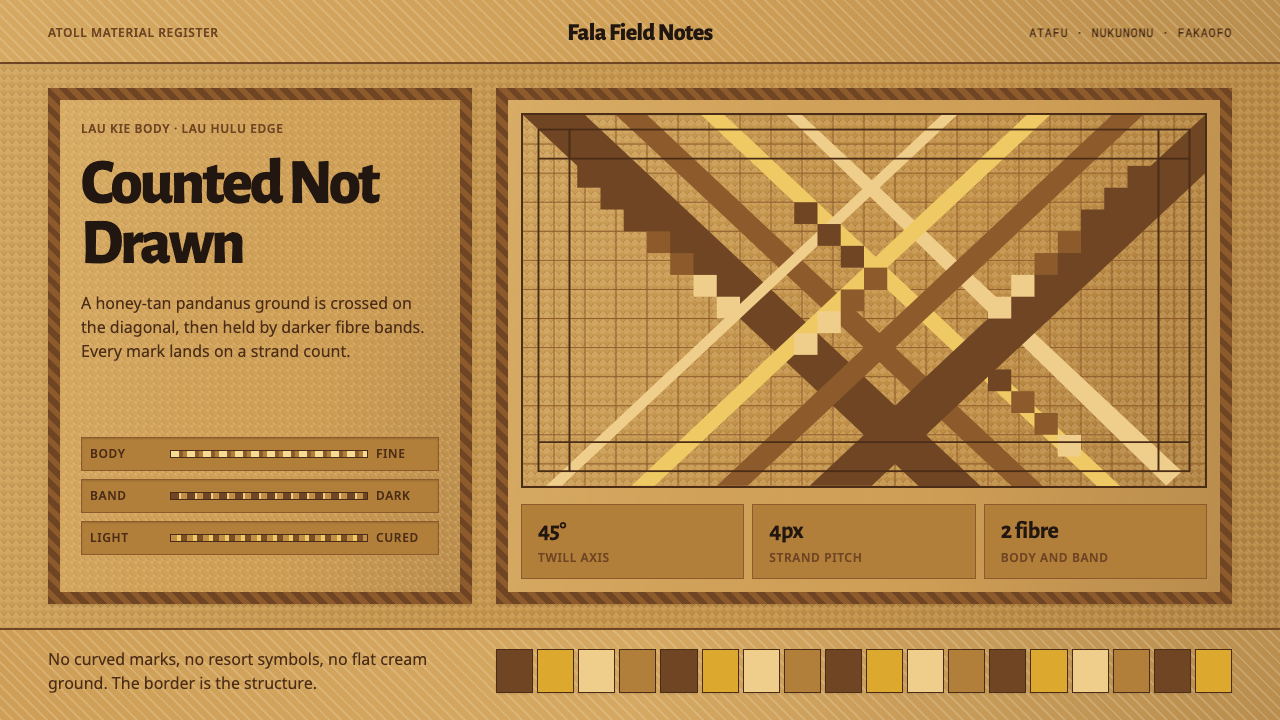 Tokelau Fala MatCounted, never drawn. Honey pandanus twill meets dark lau hulu border bands.
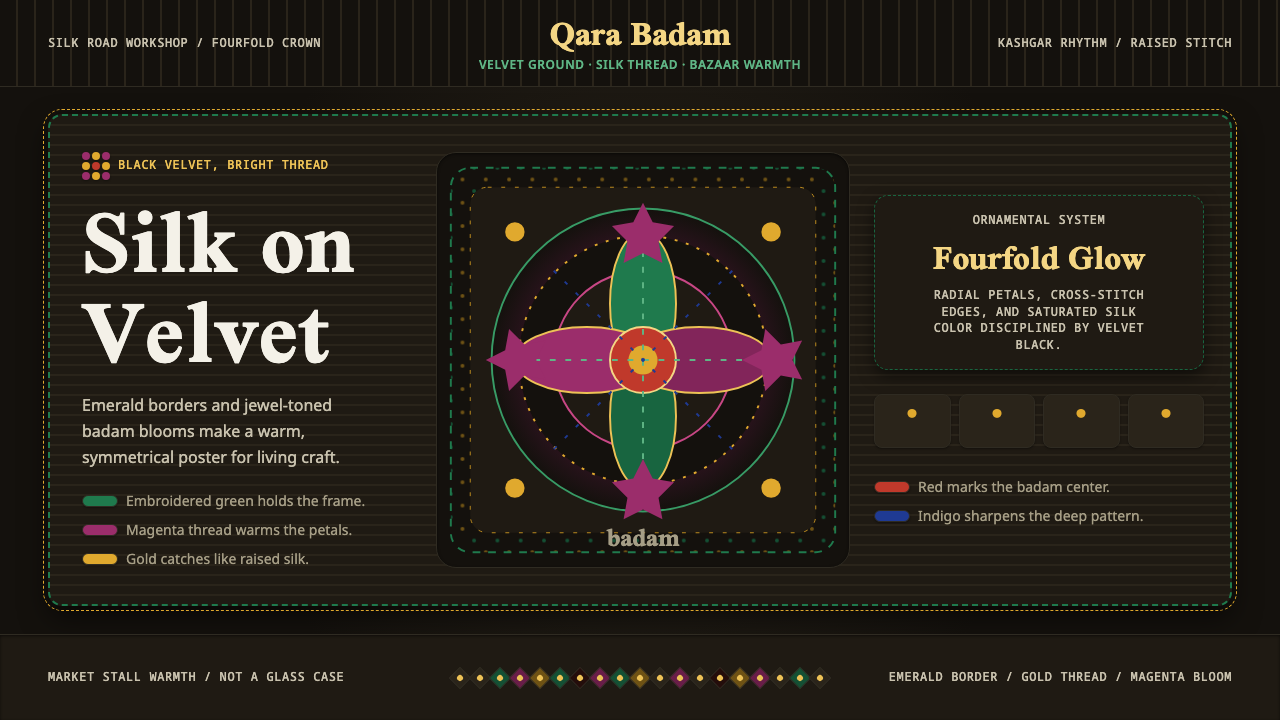 Uyghur Kashgar DoppaVelvet carries the blaze. Emerald borders, gold thread, and badam symmetry gl…