What is Tokelau Fala Mat?
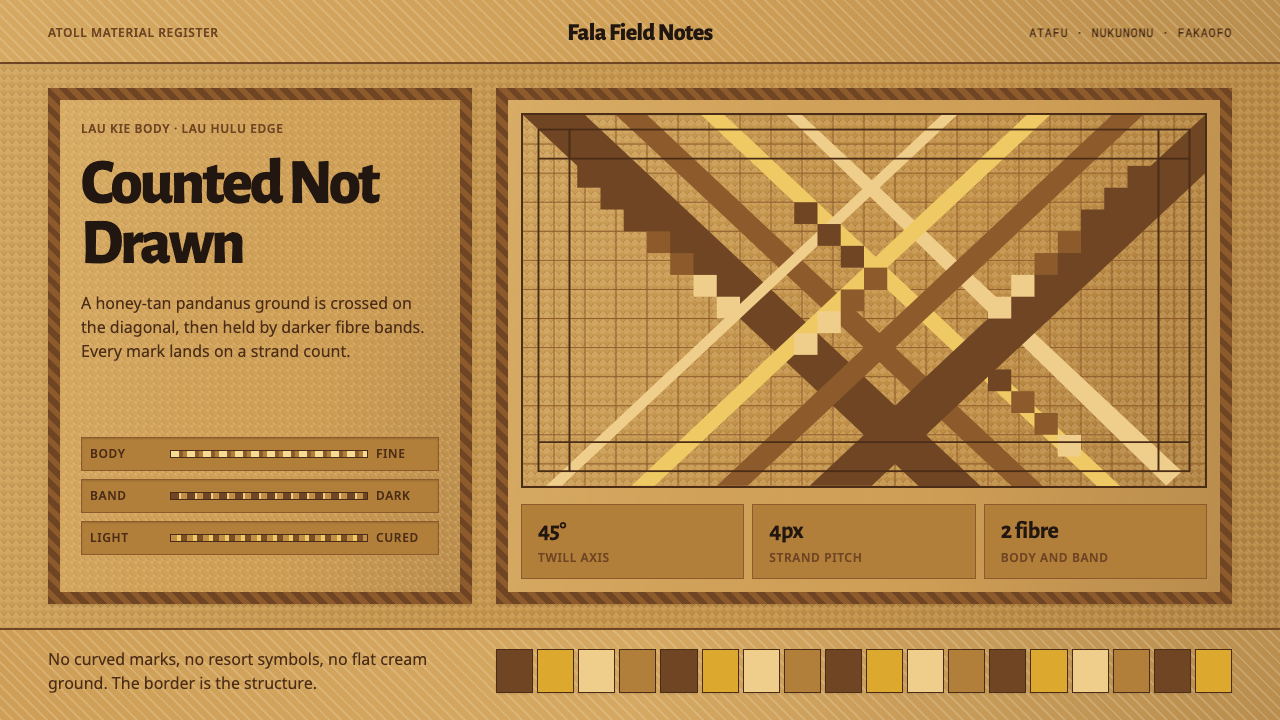
A Tokelau fala is counted, never drawn: sun-dried pandanus plaited on the diagonal into a honey field, held in by darker border bands.
Tokelau Fala Mat in brief
The Tokelau fala is a woven mat from the atolls of Atafu, Nukunonu and Fakaofo, made from sun-dried pandanus leaf plaited on the diagonal so tightly that the finished surface reads as a graded honey field rather than a printed pattern. As a visual style it is warm, light, quiet and entirely structural: colour comes from fibre, pattern comes from counting, and nothing is added on top.
Its logic rests on a two-fibre split. The body of the mat is worked in the finer lau kie; the border and the motifs are worked in the darker lau hulu. That contrast between a light field and a dark band is the entire structure. Remove the border and the mat is only an area of colour; with it, the field becomes a bounded object with an edge, an inside and a design.
Everything in the style follows from the grid. Motifs step along strand crossings, so they are always diagonal and never curved. Tone drifts across a field the way sun-curing drifts across a real mat, and the surface carries a slight sheen along the strand direction. The result is a design language of patience: measured, tactile, and free of any gesture a hand could not count.
Where does Tokelau Fala Mat come from?
The fala belongs to the great tradition of Pacific fine-mat plaiting, known as raranga and lalaga in different island languages, in which leaves are prepared and plaited into mats that serve for sleeping and sitting and, just as importantly, for gift and exchange. Tokelau's three atolls, Atafu, Nukunonu and Fakaofo, have kept the practice going from before 1900 to the present; the technique is continuous and unbroken.
Preparation is half of the work. Pandanus leaf is gathered, treated, dried in the sun and cut into strands, and the fineness of the strand decides what a mat can become. The finer lau kie goes into the body; the darker lau hulu is reserved for borders and motifs. Because the fibre is prepared by hand and cured by the sun, no two mats take the light in quite the same way, which is why the tonal drift across a field is a signature rather than an error.
Fala also sit inside a culture of ceremonial exchange. Fine mats mark occasions and pass between families, which is part of why borders and motifs are worked with such care. The mat is at once a floor covering and a statement, and it is made by Tokelauan women weavers, whose knowledge of fibre, counting and finish is the real source of everything the style looks like.
Outside Tokelau the fala is known partly through museum collections, notably the Pacific Cultures collections of Te Papa Tongarewa, the Museum of New Zealand, whose curators document and interpret these mats. That work is valuable, but a museum label can also flatten a living object into a specimen. The style described here comes from the practice, not the display case, and any design that borrows from it should keep that origin in view.
What defines the Tokelau Fala Mat look?
Diagonal Plait
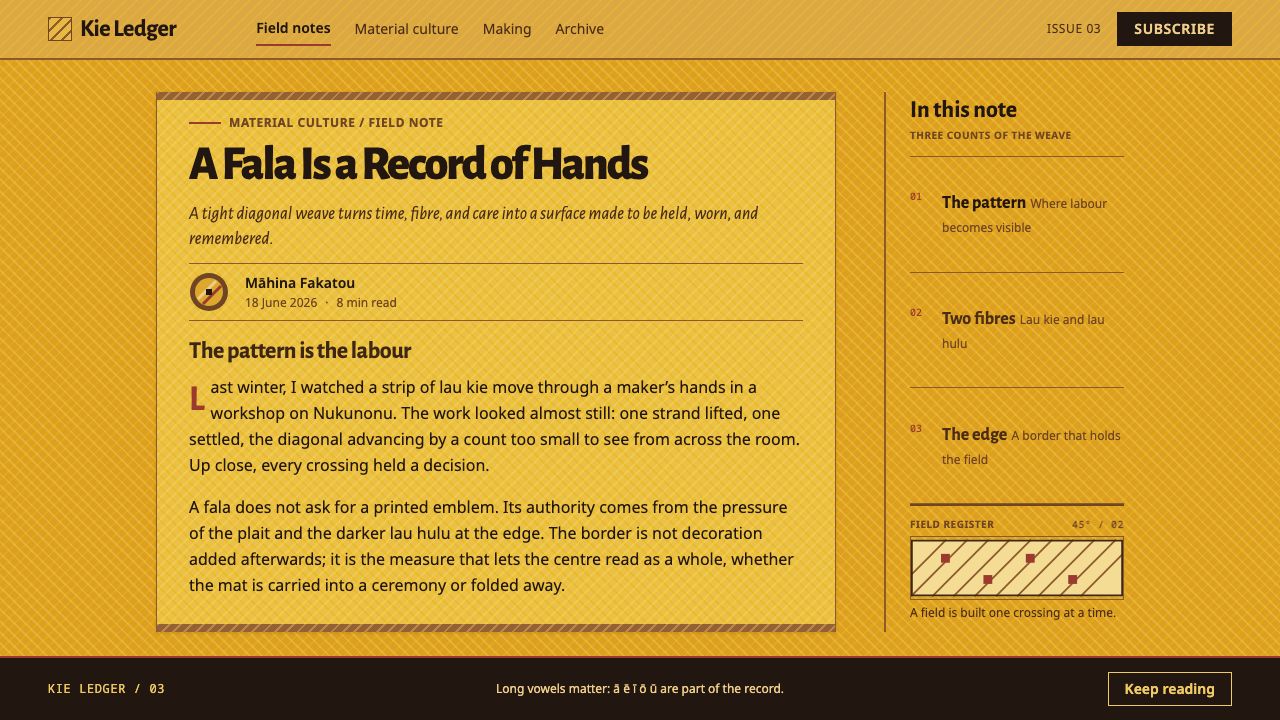
The strands cross on the diagonal, so the whole surface carries a faint slanted weave instead of a horizontal and vertical grid. That slant is what gives the field its quiet rhythm. Layouts in this style should lean on diagonal structure for texture and borders, and keep the main reading axes calm and straight.
Honey Field
The body of the mat reads as a graded honey colour, not a flat fill. Tone shifts across the field the way sun-curing shifts across a real mat, so there is warmth at one edge and a slightly paler passage elsewhere. The ground is warm and organic and never a clinical white or an even tint.
Two-Fibre Split
Lau kie works the body and darker lau hulu works the border and the motifs. This pairing is the entire colour system: a light honey field and a dark brown band, with nothing in between that needs a name. The light-and-dark split is a structural decision, the way a frame is, and it should be applied consistently.
Counted Motifs
A motif is not drawn and then fitted; it is counted strand by strand. Shapes therefore step along the crossings, always diagonal, never curved. A diamond, a chevron or a stepped band is natural here, while a circle or a wave would have to be faked. The discipline of the count is what makes the pattern look inevitable.
Woven Border Bands
The border does the structural work of a frame. Without it the mat is only an area of colour; with it the field becomes a bounded object. In an interface, that means cards and panels are wrapped in a plaited band, and a divider is a narrow plaited strip rather than a hairline. The border is part of the thing, not decoration added afterwards.
Sheen and Thin Shadow
Light behaves like it does on a real fibre: the surface carries a soft sheen along the strand direction, and where strands overlap a very thin shadow settles into the gap. This is texture rather than depth. It keeps the surface tactile without ever lifting an object far above the ground, so shadows stay shallow and close.
Restrained Imagery
Imagery stays close to the object: weaving in macro, a mat edge, the grain of a strand. There are no coconut palms, no beach holidays and no postcard sunsets. Tokelau is the source of the style, not a backdrop for it, and a design that wears the mat while illustrating a vacation has misunderstood what it borrowed.
Who shaped Tokelau Fala Mat?
The makers of the fala and the true authors of the style. They prepare the pandanus, decide the fineness of each strand, count the motifs along the crossings and finish the borders. Their knowledge passes hand to hand, and it is the reason the technique is described as continuous and unbroken from before 1900 to today.
Curators of the Pacific Cultures collections at the Museum of New Zealand, where Tokelauan mats are held, documented and interpreted. Their work gives many people outside the atolls their first close look at the structure of a fala: the two fibres, the border and the counted motifs. It is a useful record, best read alongside the living practice.
The three atolls of Tokelau are the places where the technique has been carried on without a break. Each is a small community in which mats are made, given and used, and the style should be understood as belonging to them. Naming the atolls, and not a vague idea of the tropics, is part of using the style honestly.
How do you use Tokelau Fala Mat today?
This style suits work that wants to feel warm, handmade and calm without drifting into rustic cliché. It is a light style, so it belongs on honey and cream grounds with dark brown for structure and text. The guiding rule is that every decision should be explainable by the weave: if a shape could not be counted along diagonal crossings, or a colour did not come from one of the two fibres, it probably does not belong.
For presentation slides, a cover works as a large honey field with a darker plaited band along one edge and the title in a plain, dark face. Content slides keep the honey ground and use the dark band to frame a section or set a heading apart. Data slides adapt well to the idea of counting: bars made of visible units, progress shown in strand counts rather than a smooth fill, and chart borders that look plaited and not drawn.
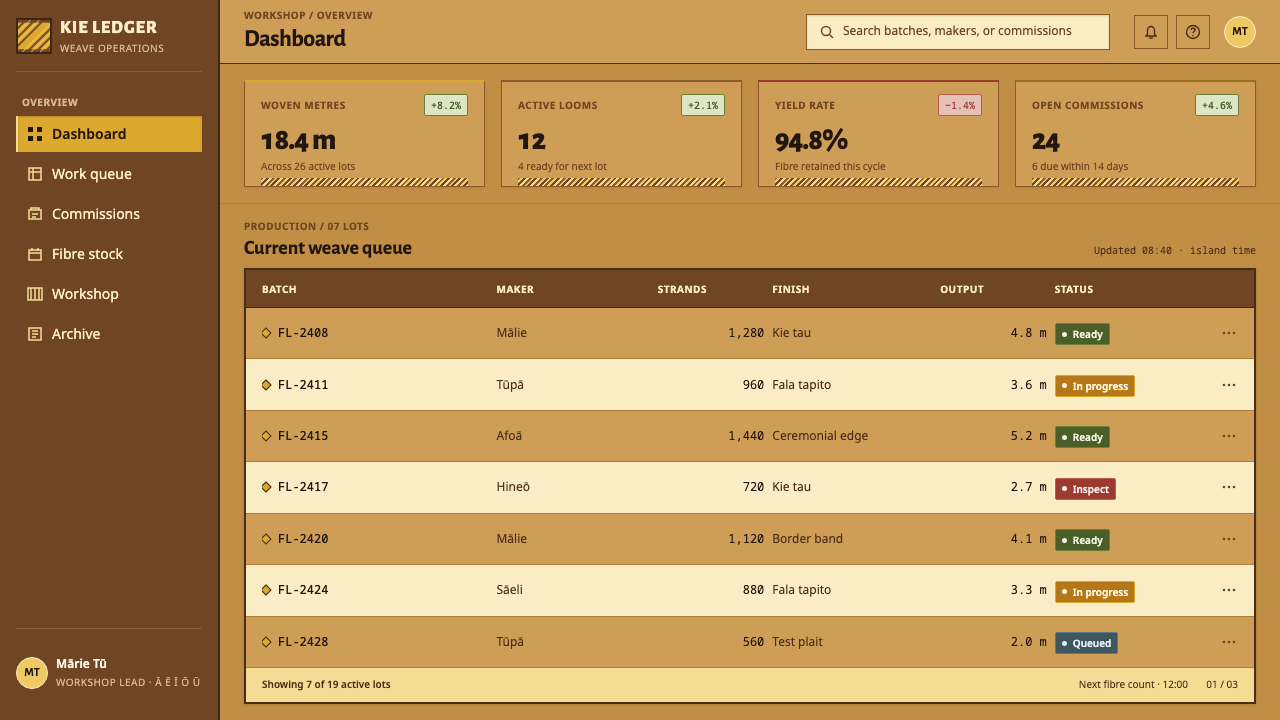
For web interfaces, the style suits wellbeing, craft commerce, cultural archives and calm productivity tools. Wrap cards in a woven border band, let a narrow plaited strip do the work of a divider, and read progress bars as counted units. Keep surfaces matte with a gentle directional sheen, shadows shallow and close, and corners straight, since a diagonal weave does not round into pills.
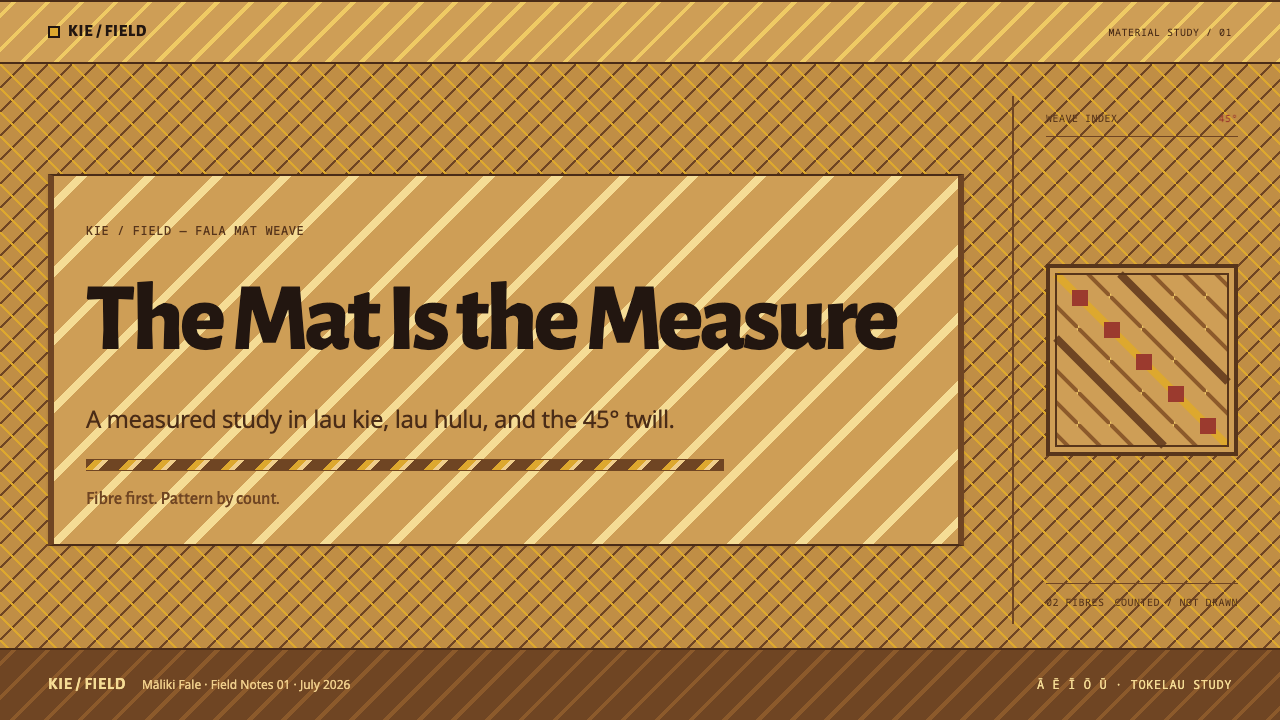
For editorial and marketing work, use imagery that stays near the object: macros of strand and crossing, a mat edge, hands at work if consent and credit are in place. Compose pages with a plaited border around the main block and keep the reading column calm. Never fill the page with palm trees, turquoise water or holiday photography, since the style is the mat and not the place the mat is imagined to come from.
The most common mistake is to treat the honey palette as a tropical mood and then add curves, gradients and glossy depth. Round blobs, wavy dividers and heavy soft shadows all contradict a surface built on counted diagonal steps. Another is using a single flat tan for the whole page, which loses the tonal drift that makes the field feel sun-cured. A third is removing the dark border band, which leaves only an area of colour and no structure.
Tokelau Fala Mat — FAQ
What exactly is a fala?
A fala is a woven mat from Tokelau, made from pandanus leaf that is dried in the sun and plaited on the diagonal. It is used in daily life and in exchange between families. The mat is the object that this style takes literally: the honey field, the darker border and the counted motifs are all faithful to how it is made, and that fidelity is what separates the style from a generic warm palette.
Why does the style avoid curves completely?
Because the pattern is counted, not drawn. Each motif advances along strand crossings, so it can only be a diagonal or a step. A true curve would have to be approximated and would then fail to look like weaving. Treating diagonals as the only legitimate line makes the style instantly recognisable and keeps every shape honest to the fibre it comes from.
Why are the borders and motifs darker than the body?
Because they are made from a different fibre. The body is the finer lau kie and the border and motifs are the darker lau hulu, so the contrast is built into the material rather than painted on. In a design this means the dark band should be an actual structural element that frames and separates, applied with the same logic everywhere, not a decorative stripe that can be moved around at will.
How do I avoid the tropical-holiday cliché?
Keep every image and every decision tied to the object. Use close-ups of weave, strand and border, and credit the makers. Leave out palm trees, beach scenes and generic island decoration, none of which appear in the mat. Name Tokelau and its three atolls where the context calls for it. If a layout would look the same with a stock holiday photograph in place of the weaving, it has drifted away from the style.
Can this style work on a dark background?
It is built as a light style, with a honey field held in by dark bands, so a full dark inversion changes its character. If a dark surface is required, keep the field honey and let the dark fibre tone do the framing and the text, instead of flipping the whole ground. That preserves the central relationship between a light field and a dark border, which is the actual structure of the mat.
Related design styles
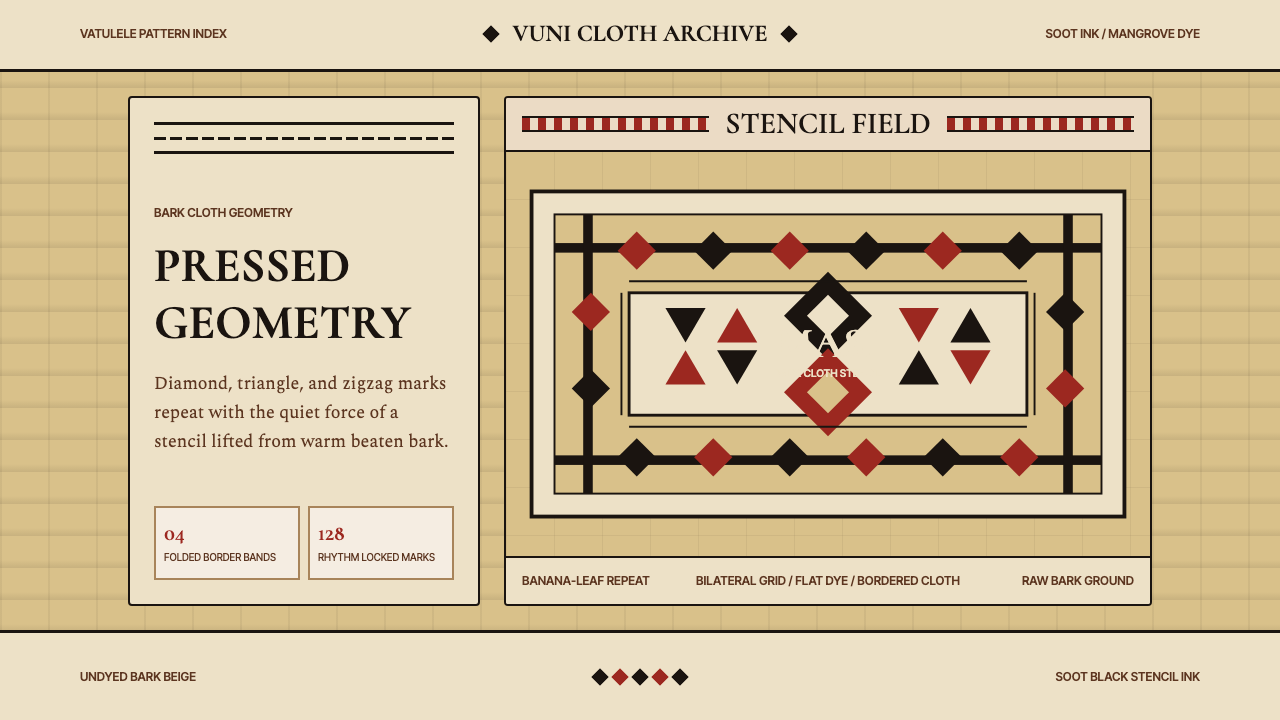 Fijian Masi Tapa StencilGeometry keeps ceremony. Soot-black diamonds repeat on bark beige with rust-r…
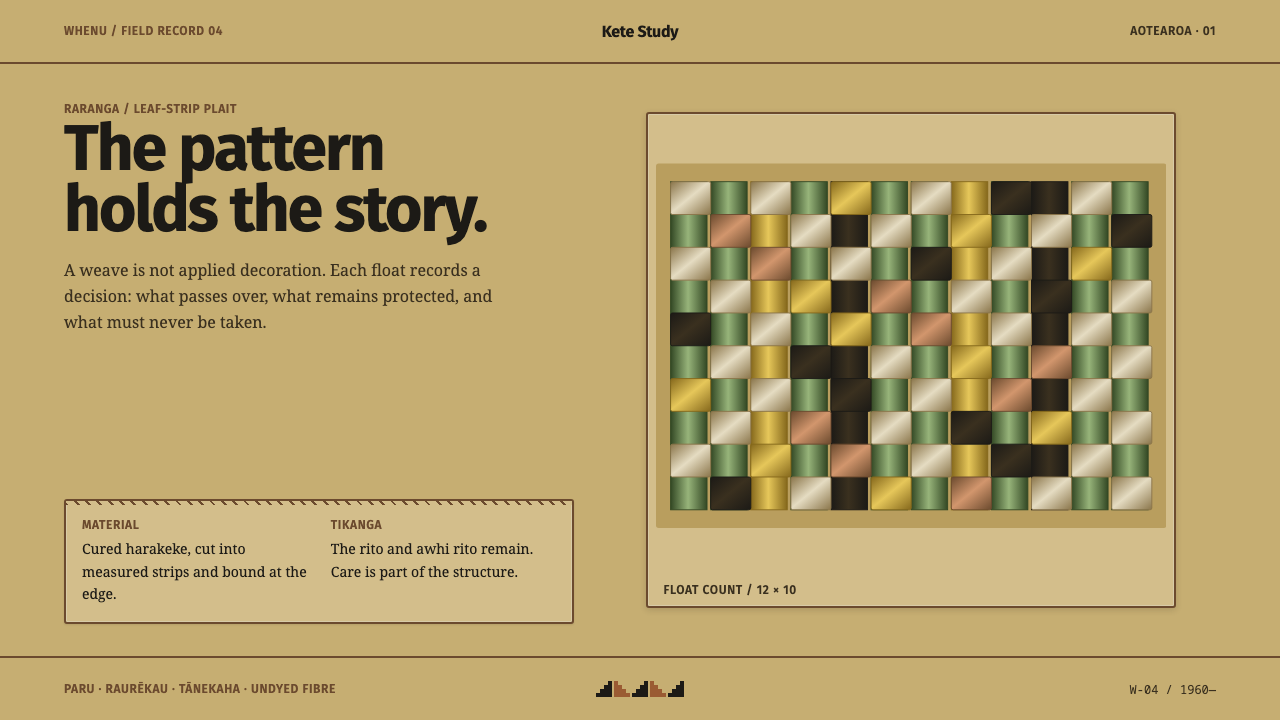 Harakeke Raranga WeavingStructure carries care. Honey-straw grids expose each green, bark and fibre s…
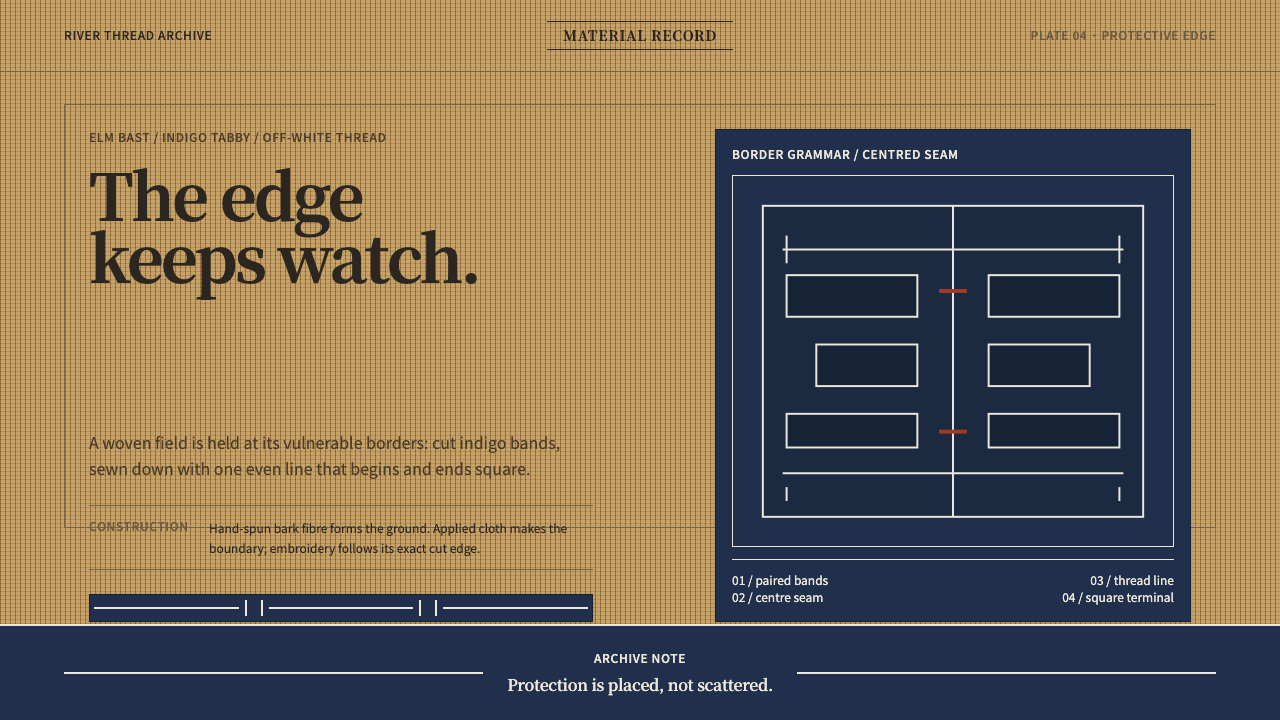 Ainu Attus RobeProtection is cut, not painted. Indigo bands and square-ended thread hold elm…
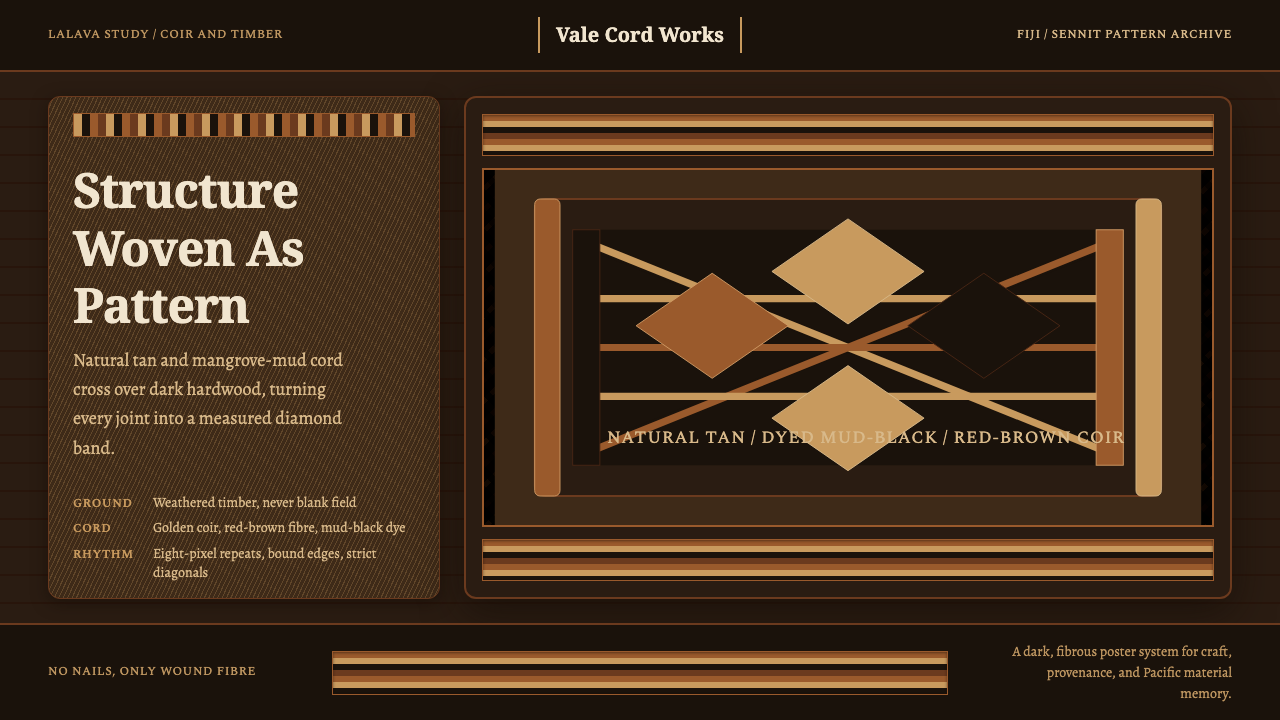 Fijian Magimagi LashingStructure becomes ornament. Tan coir diamonds bind mud-black timber in a stri…
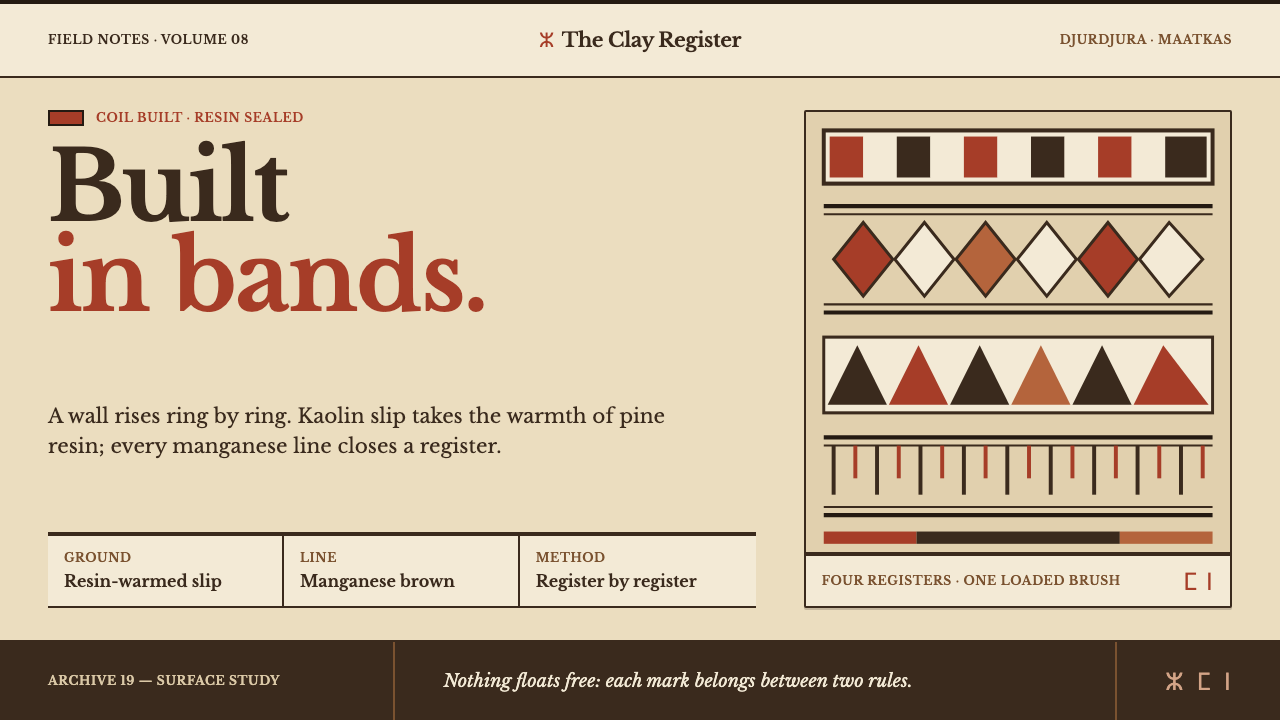 Kabyle PotteryBuilt band by band. Resin-warm kaolin carries manganese rules and iron-red ge…
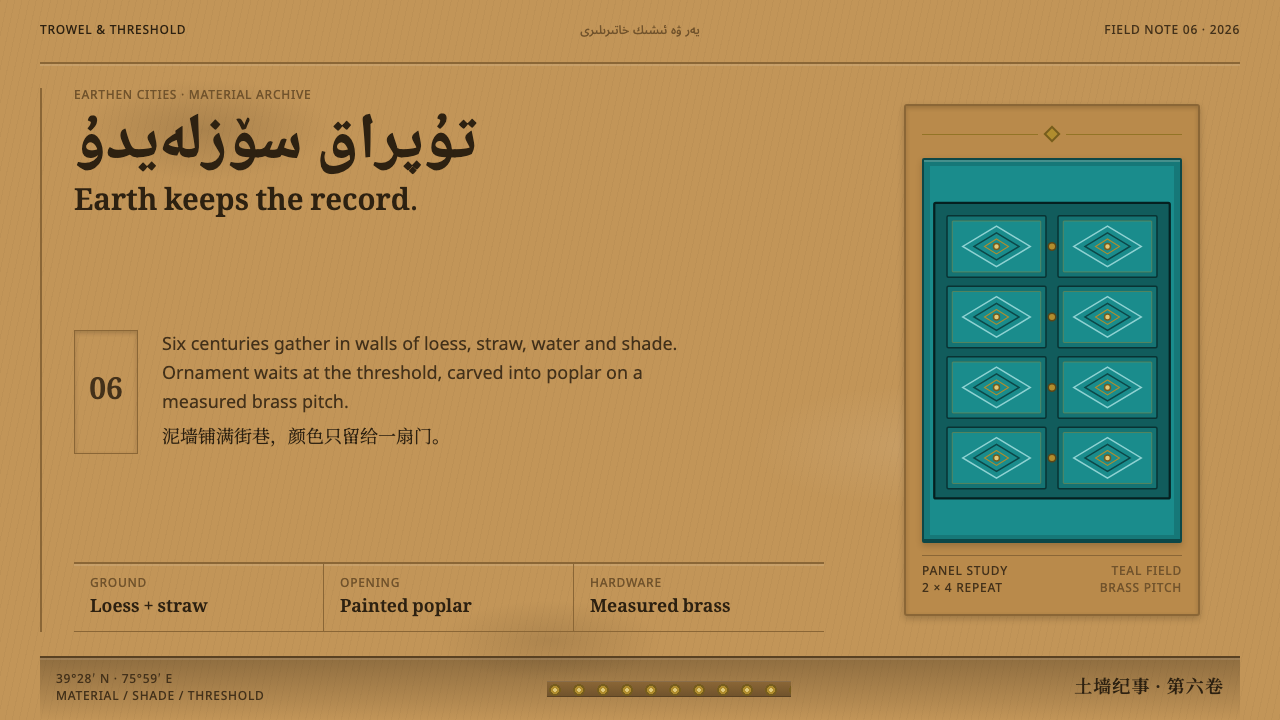 Kashgar Old TownEarth holds the field; ornament waits at one teal door, cut in a strict brass…