What is Tongan Lakalaka?
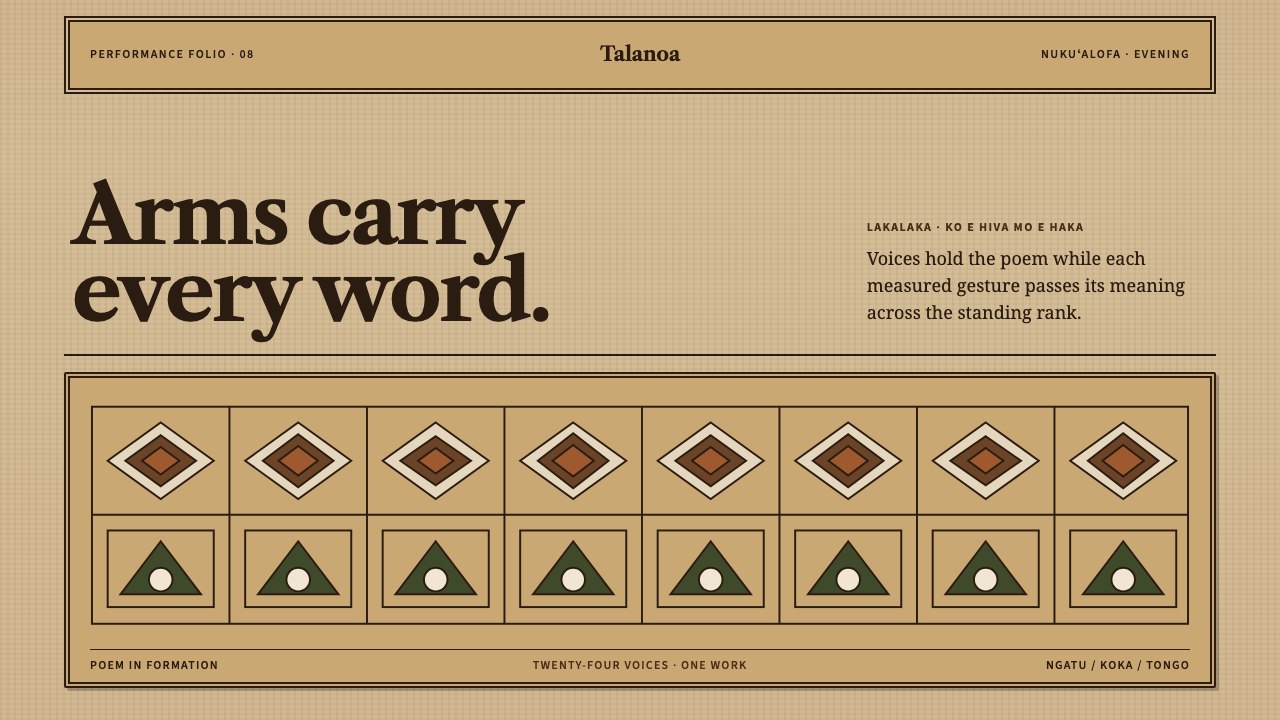
Tongan Lakalaka treats a sheet of beaten barkcloth as a page — warm earth dyes, soot-drawn outlines, and meaning arranged in ranks, the way the dancers stand.
Tongan Lakalaka in brief
Tongan Lakalaka is a warm, light, hand-made design language drawn from the national dance of the Kingdom of Tonga and from the barkcloth that dresses its performers. It translates a costume into a layout: a field of tan cloth, long horizontal rows of ruled panels, earth-colored fills, and dark hand-drawn lines. The page behaves like a garment made of ngatu, the beaten paper-mulberry barkcloth that is central to Tongan ceremonial life.
The core principle is that meaning stands in ranks. In the lakalaka, a large group of performers stands in formation and communicates through the arms, while the feet barely move. The design does the same: content sits in orderly panels arranged in rows, and variation lives inside the repetition rather than in motion or ornament. Each panel is a unit of meaning, and the rank is the grammar that joins them.
Visually, the style is calm, earthy and tactile. Colors come from natural dyes and pigments, outlines are in a single soot-dark line, and the surface feels made by hands, not printed by machine. There are no glossy gradients, no glass effects and no perfectly uniform tiling. What replaces them is a patient rhythm of rows, closely related to the way the dance is actually seen.

Where does Tongan Lakalaka come from?
Lakalaka is Tonga's national dance. Around two dozen performers stand in ranks, men to the audience's right and women to the left, and sing a poem that was composed for the occasion. The words carry the content, and the arms carry the meaning of the words, while the feet barely move. The source places its development in the nineteenth century, growing out of an older dance form called the meʻelaufola, and records its inscription on UNESCO's list of intangible cultural heritage in 2008. It is not a museum piece; it is still performed today.
The dance belongs to the wider Tongan performing tradition called faiva, in which poetry, music and movement are inseparable. At the center of the lakalaka stands the punake, the composer-choreographer who creates the text, the melody and the movements together. The chorus is not a group of soloists but a single body: the formation is the instrument, and the unity of the ranks is the point. This is why the design treats alignment and repetition as meaning, not as monotony.
The costume is built on ngatu, barkcloth made from the beaten inner bark of the paper-mulberry tree and worn in warm tan. A large sheet is wrapped at the waist, and on top of it the dancers layer plaited pandanus mats, skirts of hibiscus fibre, and garlands of fragrant leaves and flowers, with a tuft of feathers on the head. The result is a body dressed in stacked natural materials, each with its own texture and scent. A second tradition behind the theme, kokaʻanga, is the making of the barkcloth itself: the dyeing and patterning of the sheet.
This design system takes the cloth as the page. The red-brown of koka bark dye fills the fields, a clay called umea adds a second earth tone, and tongo, soot from mangrove wood, draws every outline. Content sits in ruled kupesi panels, patterned units like those that organize a decorated sheet of ngatu, arranged as long horizontal rows that echo the standing ranks of the dance. Repetition appears with small variation, and the hand shows. The system is a translation of a way of arranging meaning, and it asks to be used with the respect that the tradition itself deserves.
What defines the Tongan Lakalaka look?
Warm Tan Ground
The ground is a warm, matte tan, the color of beaten barkcloth, slightly uneven rather than flat and sterile. It is not white and not cream; it has the density of fibre. Everything else is placed upon it as if dyed into the cloth, which gives the page a unified, tactile feel and keeps text comfortable to read.
Koka and Umea Earth Tones
Two natural dyes fill the fields: the red-brown of koka bark dye, and the warmer, more orange-red of umea clay. They are used as flat fills inside panels or as broad bands, never as gradients. Because both come from the earth, they sit comfortably together and against the tan ground, giving a palette that is warm but not loud, and distinctly of one place.
Soot-Drawn Outlines
Every outline is drawn in a single dark soot line, the color of tongo from mangrove wood. It is used for panel borders, dividers and any drawn shape, and it is never replaced by a second dark or a colored line. The line is slightly irregular, with the character of something drawn by hand, which keeps the system from feeling like a technical diagram.
Ruled Kupesi Panels
Content lives in rectangular panels bounded by doubled hand-drawn rules, named after the kupesi that pattern a sheet of ngatu. Each panel is a self-contained unit: a card, a section, a data cell. The doubled rule gives each unit a quiet frame without a shadow or a fill, and it makes the page read as a cloth made of sewn pieces.
Meaning in Ranks
Panels are arranged in long horizontal rows, like dancers standing in formation. Reading moves along a row before it moves down to the next. This favors lists, timelines, tiers, galleries and comparisons, where items are parallel and equal, and it discourages the scattered, asymmetric compositions typical of editorial layouts. The ranks are the structure that lets many parts speak with one voice.
Repetition with Variation
Patterns repeat, but never as mechanical duplicates. Each panel differs slightly in its fill, ornament or line, as in cloth that has been drawn by many hands over many days. This is the line between the style and a plain tiled background: the repetition creates rhythm, the small differences create life. Perfectly identical copies would belong to a different, machine-made aesthetic.
Layered Natural Materials
The costume stacks barkcloth, plaited pandanus, hibiscus fibre and fragrant leaves, and the design echoes this with layering that stays flat: one panel overlapping another, a band of fill crossing a row, a border placed on a field. Depth comes from stacked, opaque layers rather than blur or shadow. The result feels woven and worn, not rendered.

Who shaped Tongan Lakalaka?
Queen Sālote Tupou III, who reigned for nearly five decades in the twentieth century, is named in the source as a key figure of the tradition. She is remembered as a poet and composer who gave the lakalaka new life and standing; many texts are associated with her. For the design, she stands for the idea that a ceremonial art form can carry history, values and genealogy through poetry that is made to be sung together.
A punake is a composer-choreographer, the figure who creates the poem, its music and its movements as a single work. The source lists the punake as a key figure rather than any one individual. The role matters to the design because it embodies authorship as arrangement: the artistry lies in how many voices and bodies are organized into one coherent rank, just as a layout organizes many panels into one page.
Ngatu is made through kokaʻanga, the communal work of beating bark into cloth, joining sheets, and dyeing and patterning them. The source names this tradition among the movements behind the style. It is traditionally the collective work of women working together, which is part of why repetition with variation is the central visual principle: the pattern is the trace of many hands, not a single stamp.
How do you use Tongan Lakalaka today?
Tongan Lakalaka suits work that is about people, community and craft, and information that is naturally parallel. It rewards patience: the warmth and the hand-made look need space and a steady rhythm. Because it comes from a living tradition with its own meanings, it should be adopted with care, as a way of arranging content rather than as surface decoration.
For presentation slides, a cover can be a tan field with a single band of earth-colored panels along one edge and the title set above in dark soot. Content slides should use rows of ruled panels with one idea in each, so that a talk about a team, a timeline or a set of principles reads as a rank of equals. Data slides work well as tables of panels, where each cell is a bordered unit, and charts in flat earth fills with dark outlines.
For web interfaces, the style suits cultural organizations, museums, community and education sites, craft and handmade marketplaces, and any product that wants to feel human and unhurried. Build the page as stacked horizontal rows of equally sized panels, using doubled rules as borders in place of shadows. Pricing tiers, team pages, event schedules and galleries are natural fits, since their items are parallel and benefit from the rank structure.
For editorial and marketing work, it supports features about culture, craft, heritage, travel and community stories, and campaigns that want warmth without sentimentality. Pair long reading columns with a row of panels that summarize the main points, and use dark outlines and earth fills sparingly for emphasis. If the subject is Tongan or Pacific culture itself, work with people from that community and credit them, rather than borrowing the look alone.
The most common mistake is to treat the system as an all-purpose tribal or Polynesian pattern pack, pasting motifs onto unrelated products as decoration. The structure, rows, ruled panels and earth tones, is what the design borrows, and the specific patterns on traditional cloth carry meanings tied to people and places. The second mistake is mechanical perfection: copying one panel exactly, using bright digital colors, or adding gradients and glossy shadows. The warmth disappears the moment the hand does.

Tongan Lakalaka — FAQ
What is the lakalaka?
It is Tonga's national dance, performed by around two dozen people standing in ranks, men on the audience's right and women on the left. They sing a composed poem while the arms express its meaning and the feet barely move. It developed in the nineteenth century from an older dance, the meʻelaufola, was inscribed on UNESCO's intangible heritage list in 2008, and is still performed today.
What are ngatu and kupesi?
Ngatu is Tongan barkcloth, made by beating the inner bark of the paper-mulberry tree into sheets and then dyeing and decorating them, a craft called kokaʻanga. Kupesi are the patterned units that organize a decorated sheet. In this design system the cloth becomes the page and the kupesi become ruled panels arranged in long horizontal rows.
Is it appropriate to use this style commercially?
It can be, with care. The safest approach is to borrow the grammar, meaning rows, ruled panels, earth tones and repetition with variation, rather than copy specific traditional patterns, which have meanings tied to families and places. When a project is about Tongan or Pacific culture, involve people from that community and credit the tradition. Do not use the patterns as generic exotic decoration.
Why not repeat each panel exactly?
Because the source of the style is hand work. Barkcloth patterns are made by many people over many days, so repetition always carries small differences. If every panel is an exact copy, the page turns into an ordinary tiled background and loses the sense of rhythm that gives the style its life. Vary the fill, the ornament or the line slightly from panel to panel.
Does it work on dark backgrounds?
Not well. The system depends on a warm tan ground that stands for the cloth itself, with earth dyes and dark soot lines laid on top. On a dark ground, the soot outlines disappear and the earth tones turn muddy, so the whole logic of dye on cloth is lost. If you need a dark context, keep the tan ground inside a bordered area of the page instead.
Related design styles
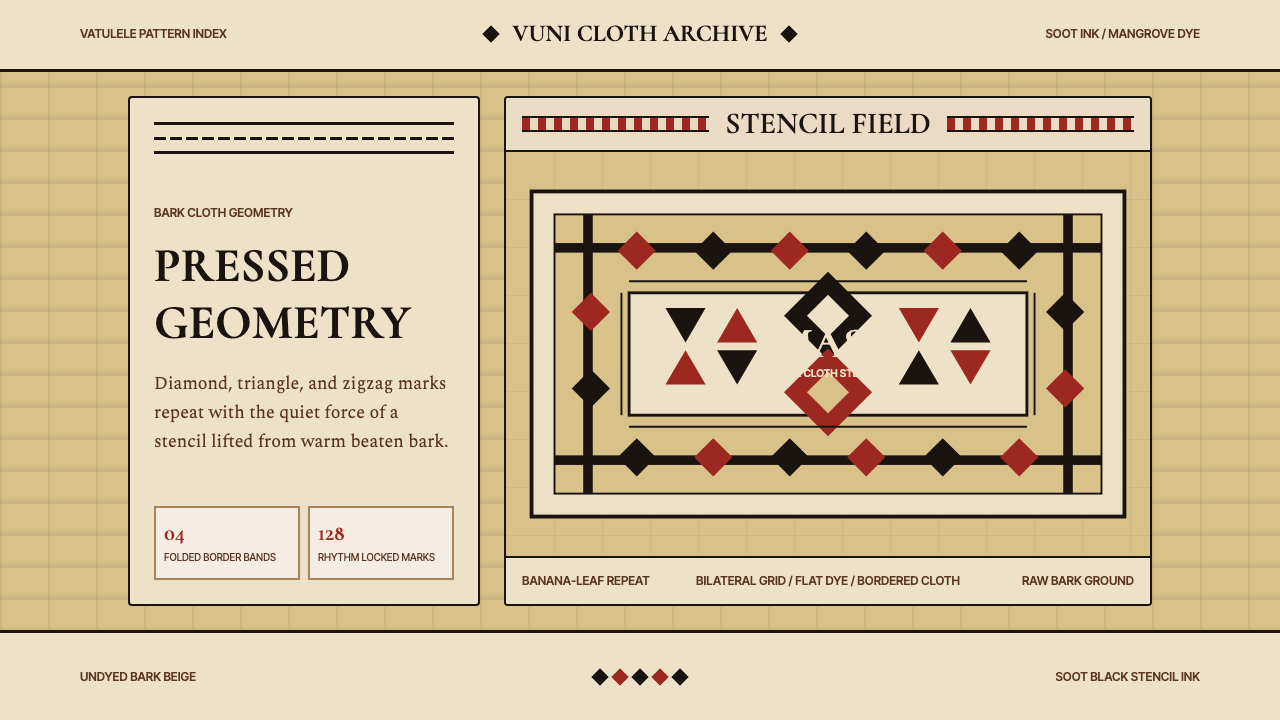 Fijian Masi Tapa StencilGeometry keeps ceremony. Soot-black diamonds repeat on bark beige with rust-r…
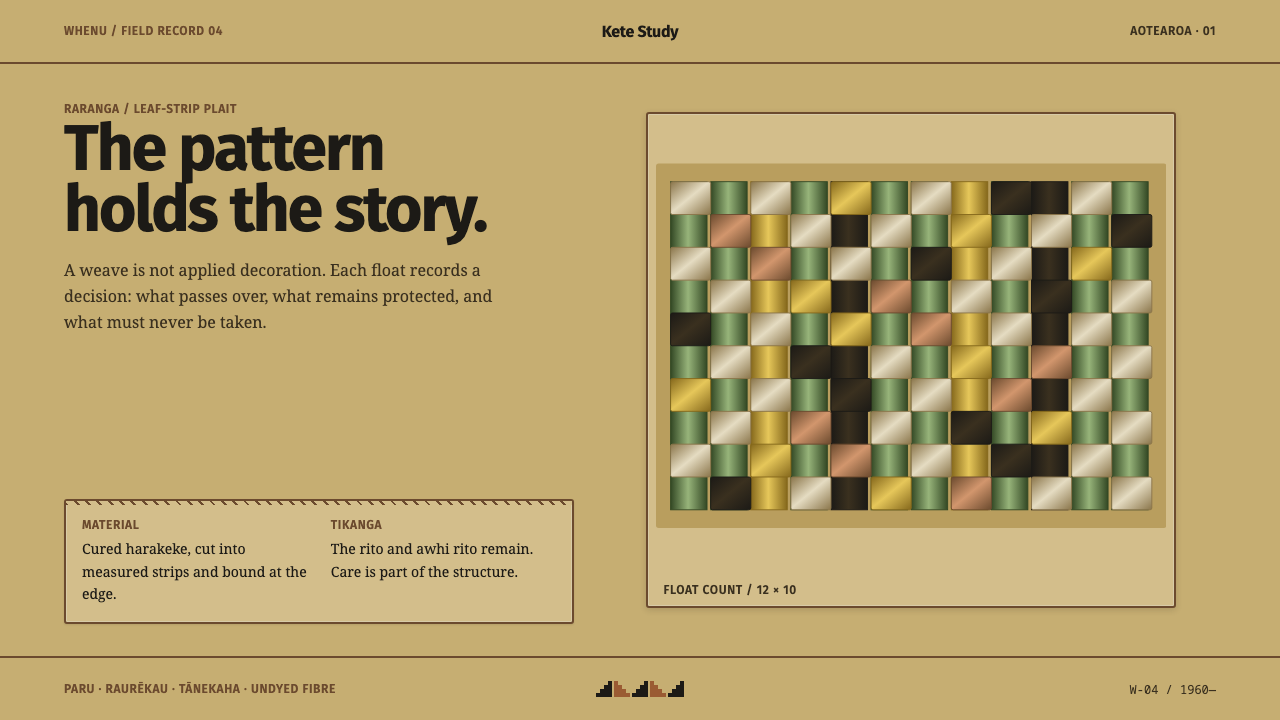 Harakeke Raranga WeavingStructure carries care. Honey-straw grids expose each green, bark and fibre s…
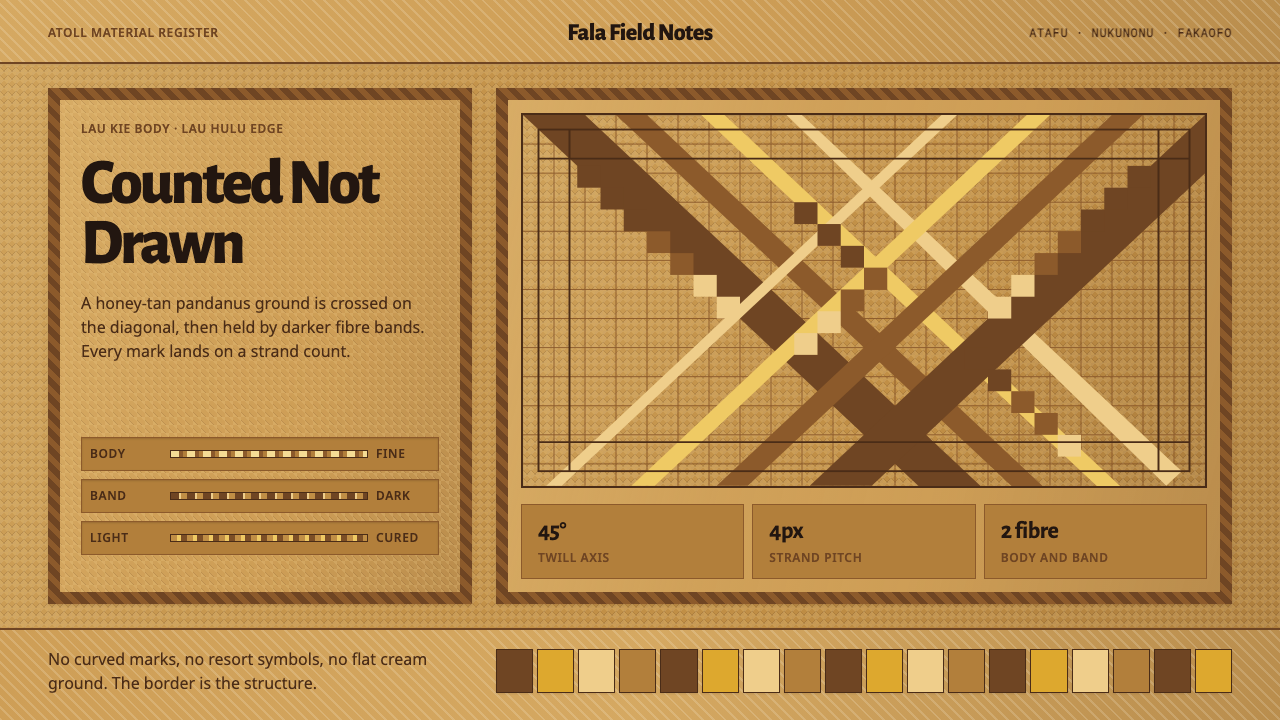 Tokelau Fala MatCounted, never drawn. Honey pandanus twill meets dark lau hulu border bands.
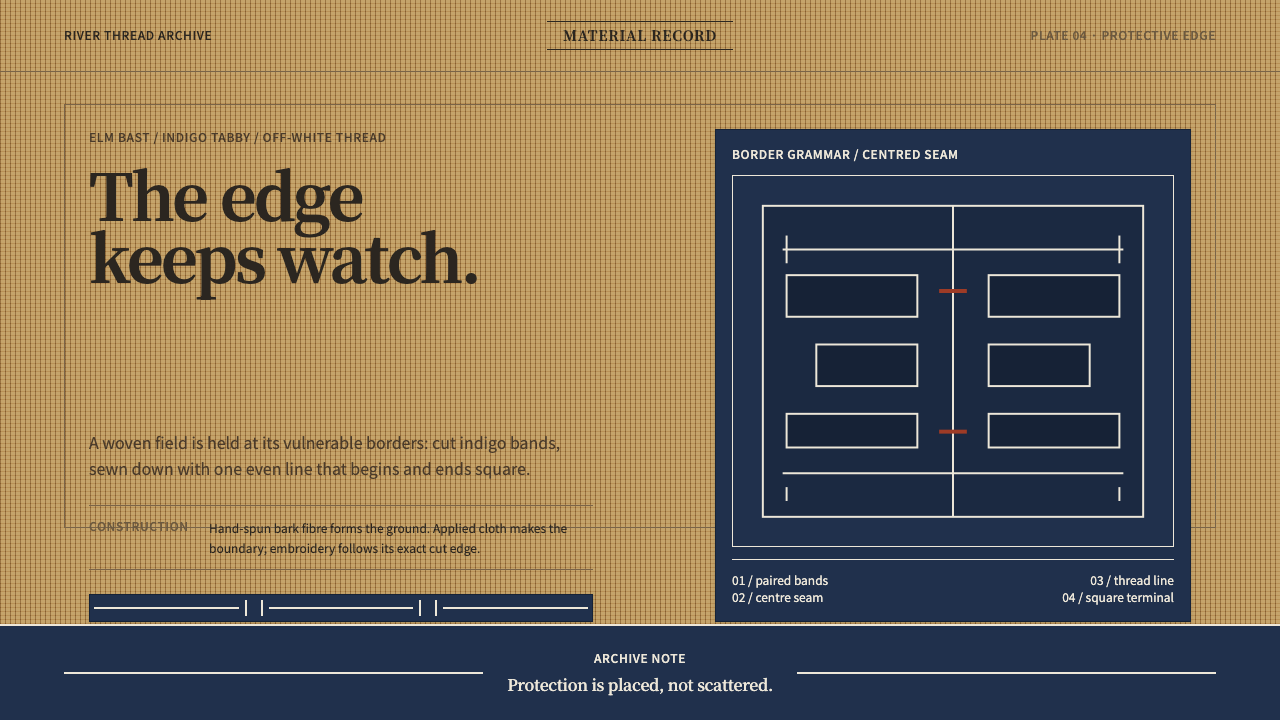 Ainu Attus RobeProtection is cut, not painted. Indigo bands and square-ended thread hold elm…
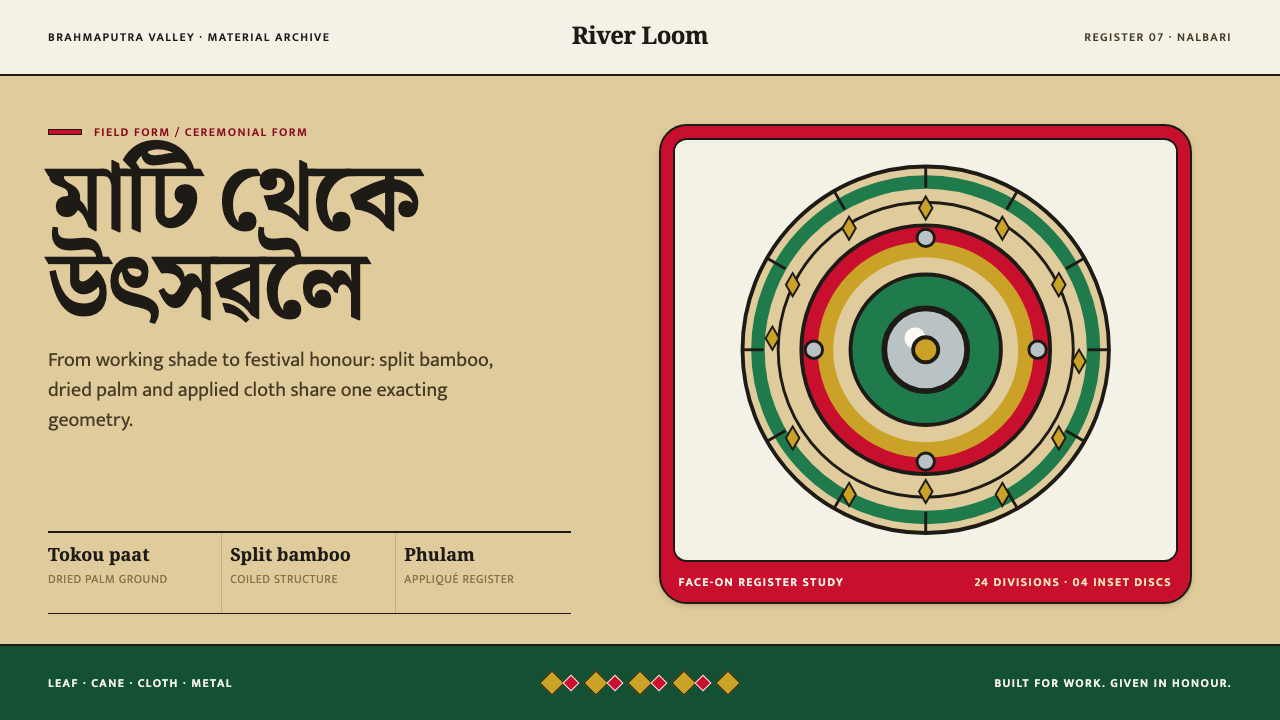 Assamese JapiWork becomes ceremony. Straw-gold rings carry green appliqué, festival red an…
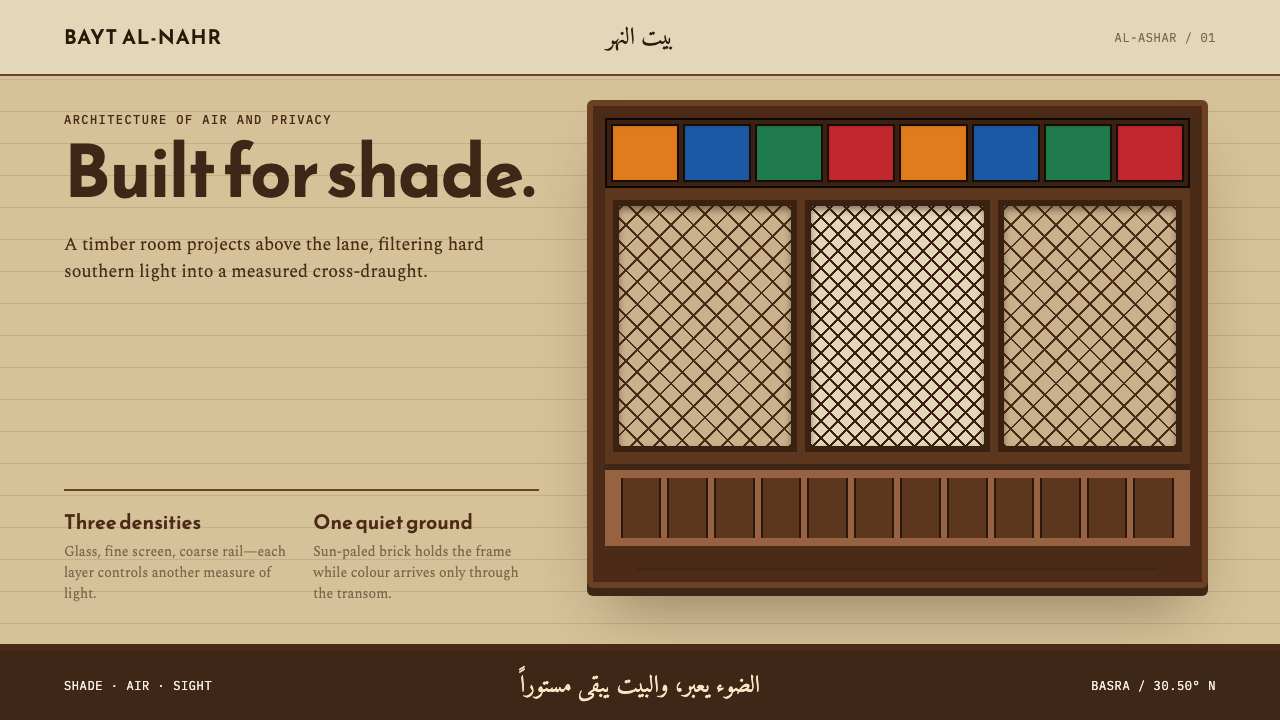 Basra ShanasheelClimate craft becomes ornament. Dark timber lattice projects over sun-paled I…