What is Harakeke Raranga Weaving?
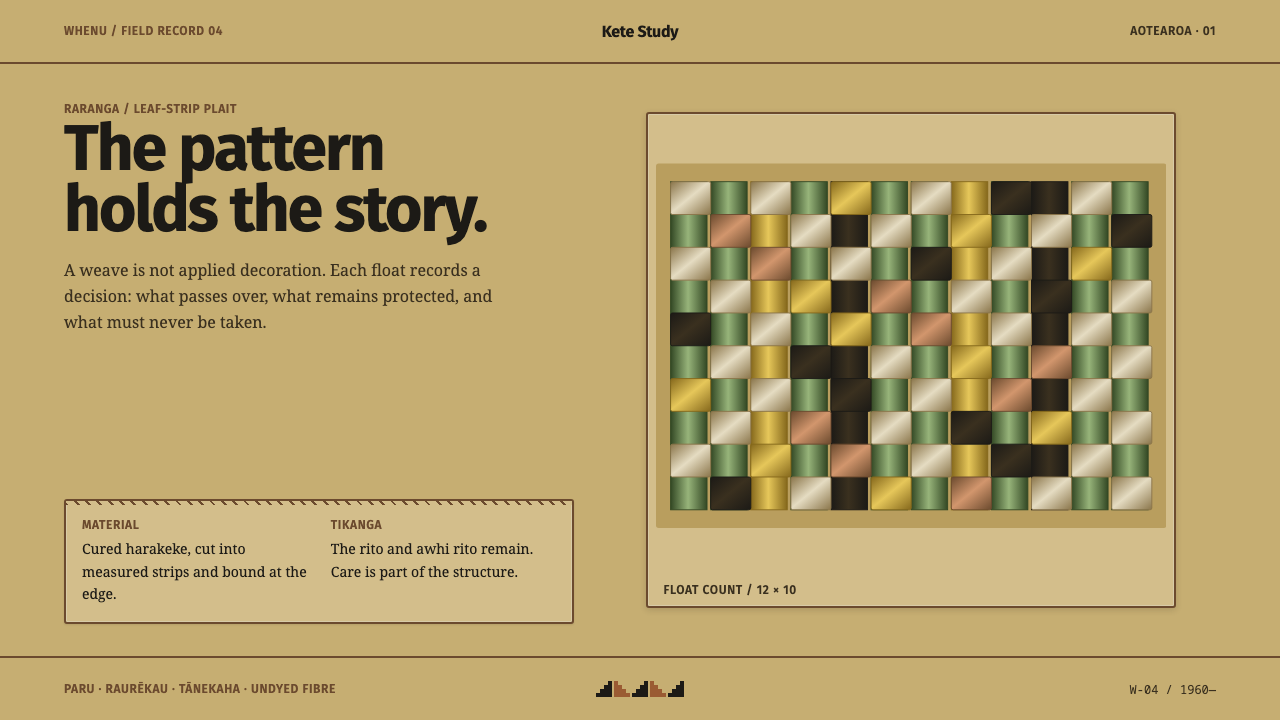
Raranga is Māori plaiting: strips of harakeke leaf worked over and under until the pattern is the structure itself, and the structure is held by care.
Harakeke Raranga Weaving in brief
Raranga is the Māori art of plaiting, in which strips cut from the leaf of the harakeke plant, New Zealand flax, are worked over and under one another to make kete (baskets), whāriki (floor mats) and kono (food containers). As a design style it is a honey-straw field built from a visible grid of woven strips, in which each green, bark and fibre tone shows as its own band, and the pattern is made by the weave rather than drawn onto the surface.
The colours of the living leaf run from blue-green through yellow-green to bronze, and a finished kete cures as it dries to a honey-straw khaki. That dried, cured colour is the base of the system. Pattern comes from the weave itself: change how many strips a strand floats over before it passes under, and a diagonal, a chevron or a block appears without any added line. Some of these patterns carry names, niho taniwha among them.
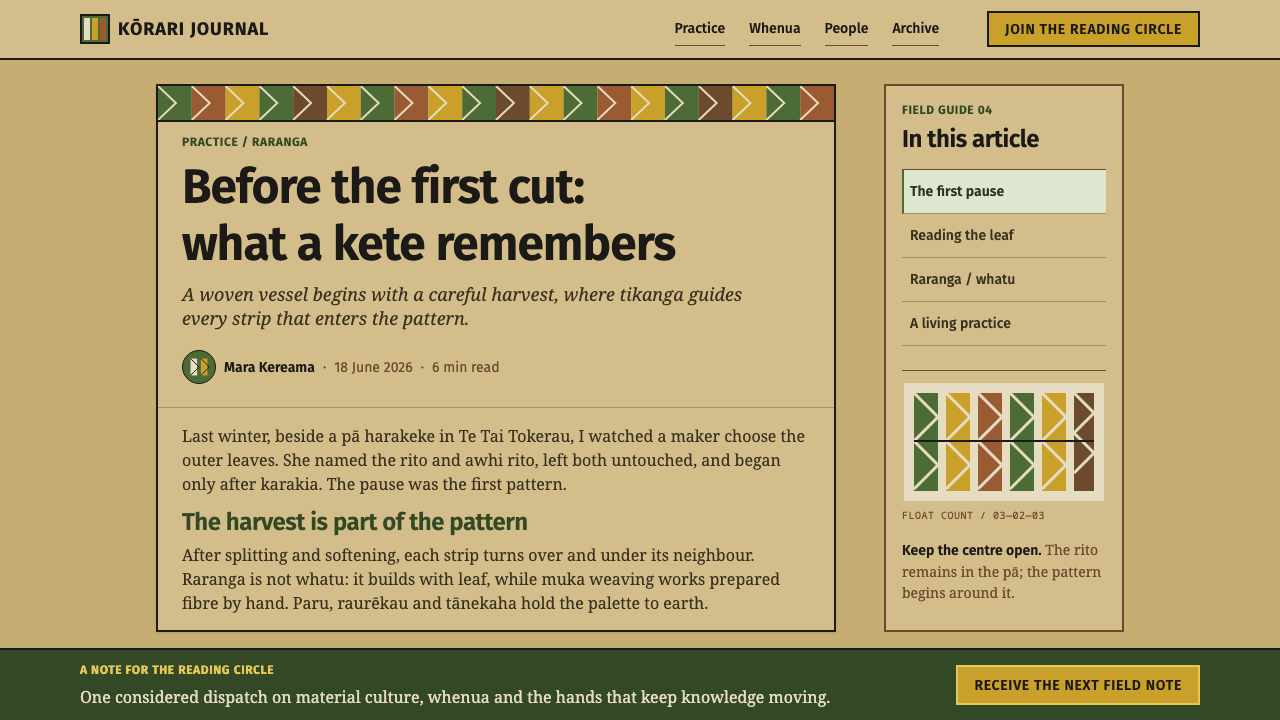
The dye set is closed. There are four possibilities: paru, a mud that dyes black; raurēkau, a bark that dyes yellow; tānekaha, a bark that dyes tan to reddish brown; and the undyed fibre. Nothing else belongs. Harvest carries tikanga, the customary rules: a karakia, or prayer, is said before cutting, and the central shoot (rito) and the shoots on either side of it (awhi rito) are never taken. In this tradition, structure, ethics and surface are one thing.
Where does Harakeke Raranga Weaving come from?
Raranga comes from Aotearoa New Zealand, where it is recorded in unbroken practice from before 1900. Harakeke is the plant at the centre of it, a native flax whose long, strong leaves are cut into strips, prepared and plaited. The craft makes everyday objects, kete, whāriki and kono, which are used for carrying, sitting and eating from. Pattern in this setting is bound to use, and it is structural before it is decorative.
Raranga sits within a wider family of Māori fibre arts. Whatu, the finger-weaving technique used for cloaks and other fine work, is its neighbour among the movements the style draws on, and the two are often spoken of together under the heading of toi raranga, the weaving arts. Raranga is the plaiting side of that pair: it works with strips of leaf crossing over and under one another, rather than with threads twined around a row of hanging warps. The difference is why the style shows its construction so openly.
The twentieth century brought a revival. The toi raranga revival is dated here from the 1960s, and the names most often attached to it include Rangimārie Hetet, Diggeress Te Kanawa and Rene Orchiston. In practice a revival means experienced weavers teaching others, so that knowledge of materials, patterns and the tikanga that governs harvest did not thin out. Part of what a designer gets from this tradition is therefore a living standard of care, and not only an old set of patterns.
As a design system, harakeke raranga keeps three things in step. The surface is a honey-straw base with a visible grid of strips, each green, bark and fibre tone allowed to read as its own band. The structure produces the pattern, so nothing is drawn on top of the weave. And the ethics shape the palette, which is closed, and the attitude, which is one of care rather than display. The system takes the tradition's restraint as its rule: a way of making in which nothing decorative is applied, and the maker's discipline can be seen in the result.
What defines the Harakeke Raranga Weaving look?
Honey-Straw Ground
The base is the colour of cured harakeke: a warm honey-straw khaki, the tone a kete reaches once it has dried. It is quiet, natural and slightly golden, and it lets every other fibre tone read clearly. The ground is chosen for what the material becomes after curing, not for the green it was when alive.
The Visible Weave
Surfaces are built from individual strips that cross over and under one another in a grid you can see. Each strip is its own unit, with its own tone and edges. In layout terms, panels and sections are composed of distinct bands that interlock, instead of a single undivided fill with texture printed on top.
Pattern from Structure
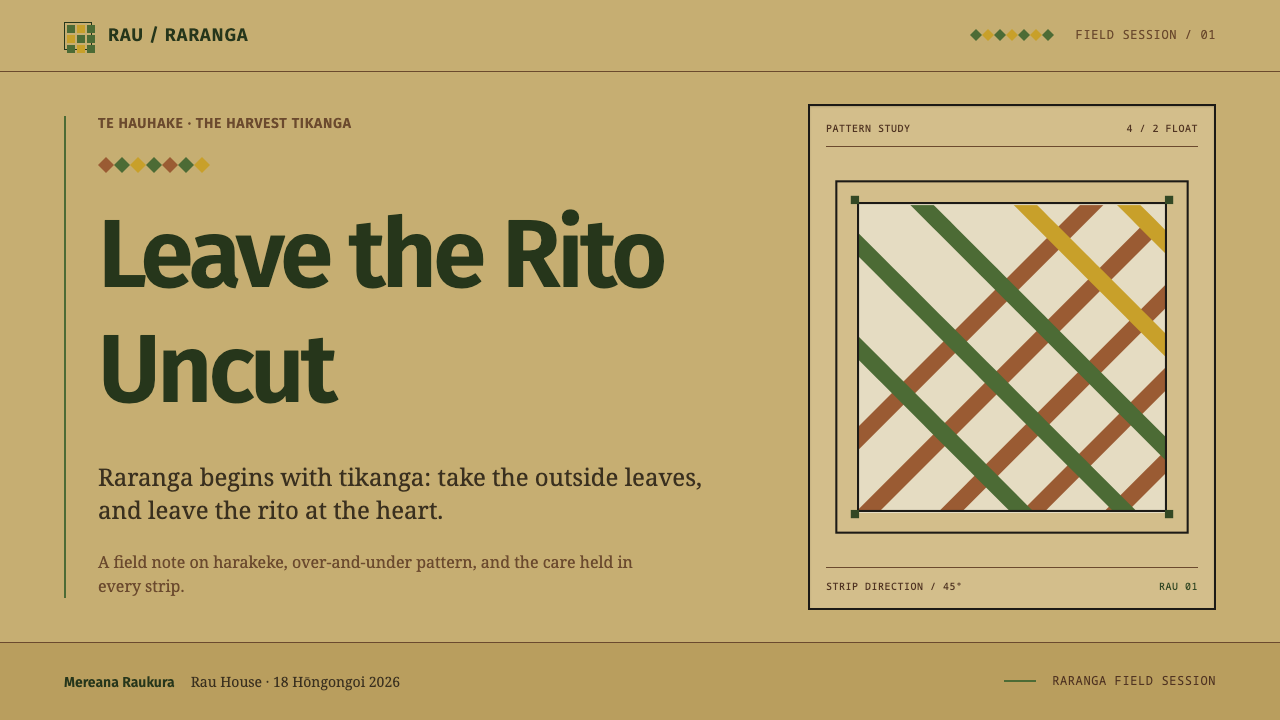
Diagonals, chevrons and blocks appear when the float count changes, not because a line was drawn. The same logic carries into design: a rhythm of repeated units, shifted step by step, can generate a pattern without any applied ornament. If a pattern can be removed without changing how the layout is built, it was decoration, and it does not belong.
A Closed Palette
Beyond the natural green, bark and fibre tones, the dye set has exactly four members: paru black from mud, raurēkau yellow from bark, tānekaha tan from bark, and undyed fibre. There is no fifth. The discipline matters more than the individual hues, because a palette that cannot grow forces every colour to justify itself.
Care Built In
A karakia is said before cutting, and the central shoot and the shoots beside it are never taken. The harvest rule is part of the craft, not background story. As a design attitude it translates into restraint: take only what the work needs, leave the centre intact, and let the evidence of care show in a clean, honest structure.
Made to Be Used
Kete, whāriki and kono are for carrying, sitting and eating. Their patterns bear weight, which keeps the aesthetic practical and unshowy. Applied to interfaces, that means the grid and the rhythm are doing real organising work: separating groups, signalling category, guiding the eye. Nothing is included only to look woven.
Who shaped Harakeke Raranga Weaving?
Hetet is one of the best-known names of twentieth-century Māori weaving and is listed here with the toi raranga revival. Her work as a weaver and teacher helped keep fine weaving knowledge, including the materials and protocols that go with it, in circulation while the craft was being renewed, and she remains a reference point for how deep that knowledge runs.
Te Kanawa is closely linked with Hetet: she was Hetet's daughter, and she carried the weaving and its teaching forward. Her presence in the list shows how the revival worked as a line of transmission from one generation to the next, a pattern of passing knowledge hand to hand that is itself part of what this style respects.
Orchiston is named alongside Hetet and Te Kanawa among the figures of the toi raranga revival. The inclusion is a reminder that the revival was broad, carried by several practitioners rather than a single lineage, and that a designer who cites this style should name the tradition and its living practitioners rather than a single master.
Every kete, whāriki and kono in this tradition is the work of a weaver who knows the plant, harvests with a karakia and takes only what may be taken. The closed dye set and the harvest rules are the rules of these weavers' practice, not a marketing flourish. A design that borrows the look without that discipline has borrowed only the surface.
How do you use Harakeke Raranga Weaving today?
Harakeke raranga suits work that values structure, transparency and care: planning and documentation tools, community and wellbeing products, craft and food brands, sustainability communication, cultural and educational projects. It is a poor fit for neon, aggressive or high-gloss contexts, where a calm woven field would feel like a costume. It works best when the thing being designed also wants to be honest about how it is built.
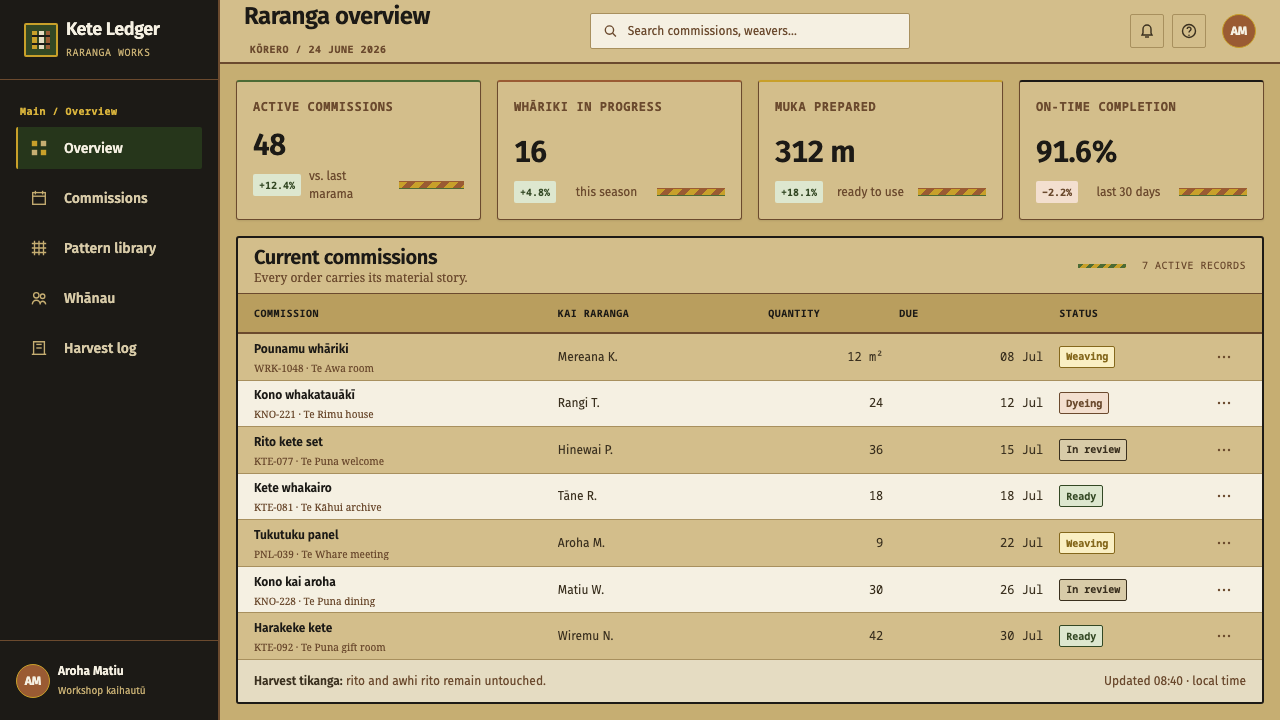
For presentation slides, a cover can be a honey-straw field with a woven band of strips along one edge and a plain title set below. Content slides can be organised as grids of woven tiles, each strip a section. Data slides turn bars into strips: each series takes one natural tone from the palette, stacked bars read as plaited bands, and dark paru black is kept for text and axes. Label values directly on the strips so that no legend is needed.
For web interfaces, the style fits dashboards and catalogue pages built on a clear grid. Cards read as woven panels with distinct edges, categories take different fibre tones, and table rows can alternate in tone like the over-and-under of a plait. Use raurēkau yellow for highlights and focus, tānekaha tan for secondary surfaces, and paru black for text. Pricing tiers become adjacent strips of different tones. Skip gradients, glow and gloss; the surface should feel matte and natural.
For editorial and marketing work, use woven bands as section breaks and let photography show the actual materials: leaf, fibre, hands, finished kete. Long-form pages gain from the style's calm rhythm, and a short note on the weaving tradition and its harvest rules fits naturally into the story. Credit the tradition by name when the work leans on it, rather than leaving the weave as unattributed texture.
The commonest mistake is to treat the weave as a printed texture laid over an ordinary layout, so that the page looks woven but is not built like a weave. Others follow: adding colours outside the closed palette, drawing chevrons as lines on top instead of letting them arise from structure, making the strips so fine that they stop reading as strips, and using named patterns such as niho taniwha as casual ornament without knowing what they are. The style depends on its restraint.
Harakeke Raranga Weaving — FAQ
What is the difference between raranga and whatu?
Both are Māori fibre arts and are often spoken of together under toi raranga, the weaving arts. Raranga is plaiting: strips of harakeke leaf cross over and under one another to make objects such as kete, whāriki and kono. Whatu is the finger-weaving technique used for cloaks and other fine work, with threads worked across a row of hanging warps. This style draws on raranga, which is why its surface looks like an over-and-under grid of strips.
Why is the base khaki rather than green?
Because the system is built on the cured colour of the material. The living leaf runs from blue-green through yellow-green to bronze, but a finished kete dries to a honey-straw khaki, and that is the surface people actually handle and use. Green and bronze remain in the palette as strip tones that read against the base, which keeps the fibre's whole life visible without making it the ground.
Can I add more colours to the palette?
The tradition's dye set is closed at four: paru black, raurēkau yellow, tānekaha tan and undyed fibre. Adding a fifth colour does not break any technical rule, but it removes the discipline the style is built on. If you need another hue, the better question is whether the work can change its structure to carry the distinction, using tone, width or position, before it reaches for new colour.
Why does a design style mention prayers and shoots that are never cut?
Because in raranga, harvest rules and surface are not separate topics. A karakia is said before cutting, and the central shoot and its neighbours are never taken, so the finished object is the result of a practice of care. The system keeps that logic as a design attitude: use only what the work needs, leave a centre intact, and let restraint show in the structure. It is part of the aesthetic, not a footnote.
Can I use named Māori patterns such as niho taniwha in my design?
Be cautious. Named patterns carry meaning within the tradition, and using them as casual decoration can flatten that meaning. The safer approach is to borrow the underlying logic, where the weave itself generates diagonals and blocks, and to name the tradition. If a named pattern is central to your project, learn what it signifies, credit the weavers and, where the work speaks about Māori culture, involve Māori people in the decisions.
Related design styles
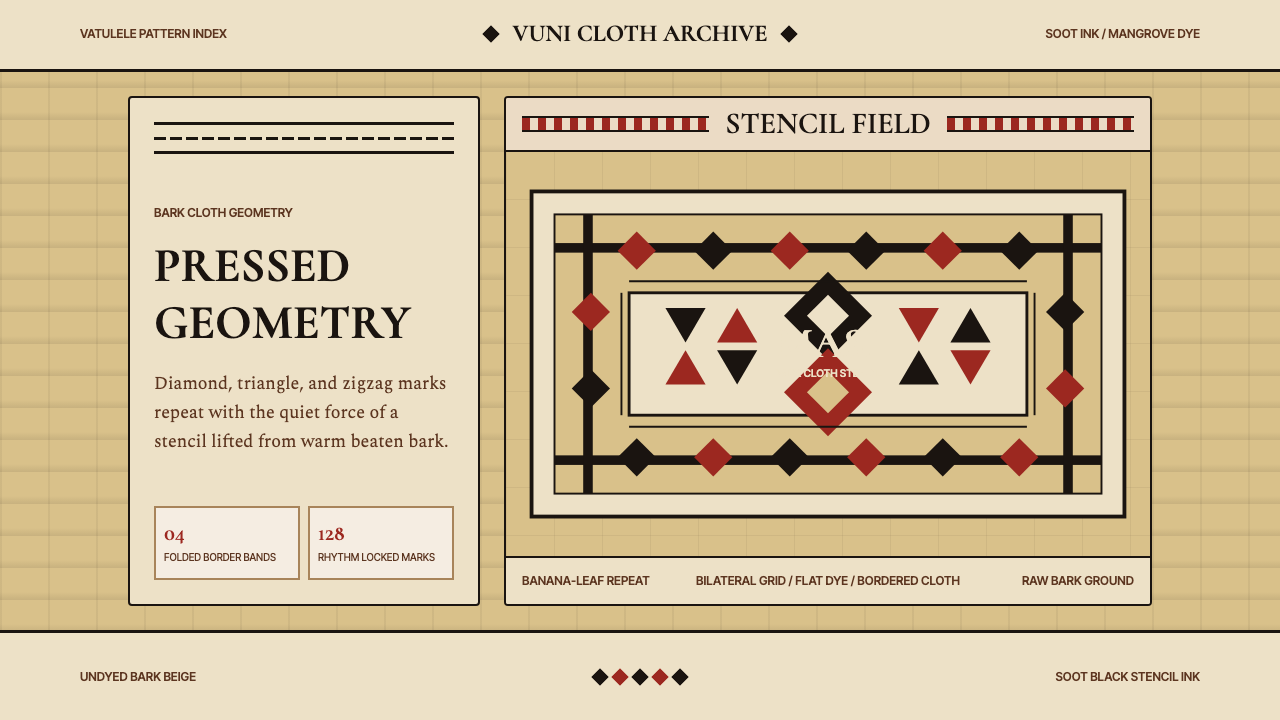 Fijian Masi Tapa StencilGeometry keeps ceremony. Soot-black diamonds repeat on bark beige with rust-r…
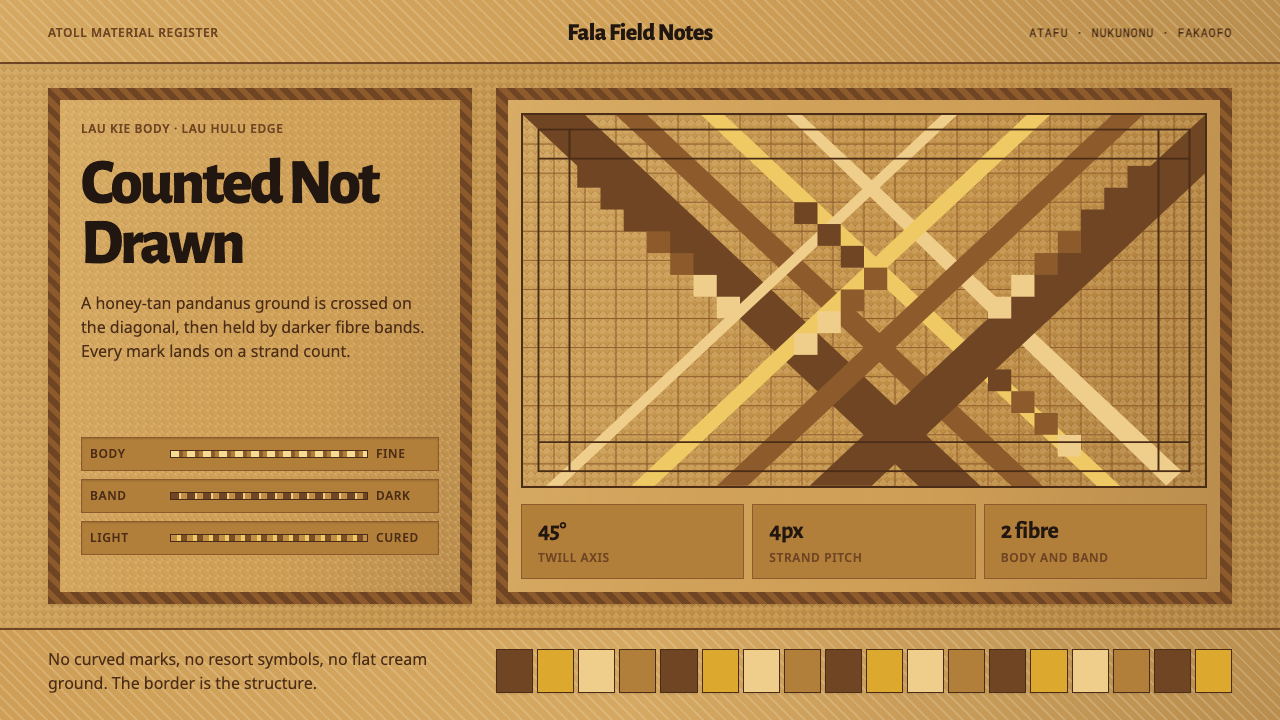 Tokelau Fala MatCounted, never drawn. Honey pandanus twill meets dark lau hulu border bands.
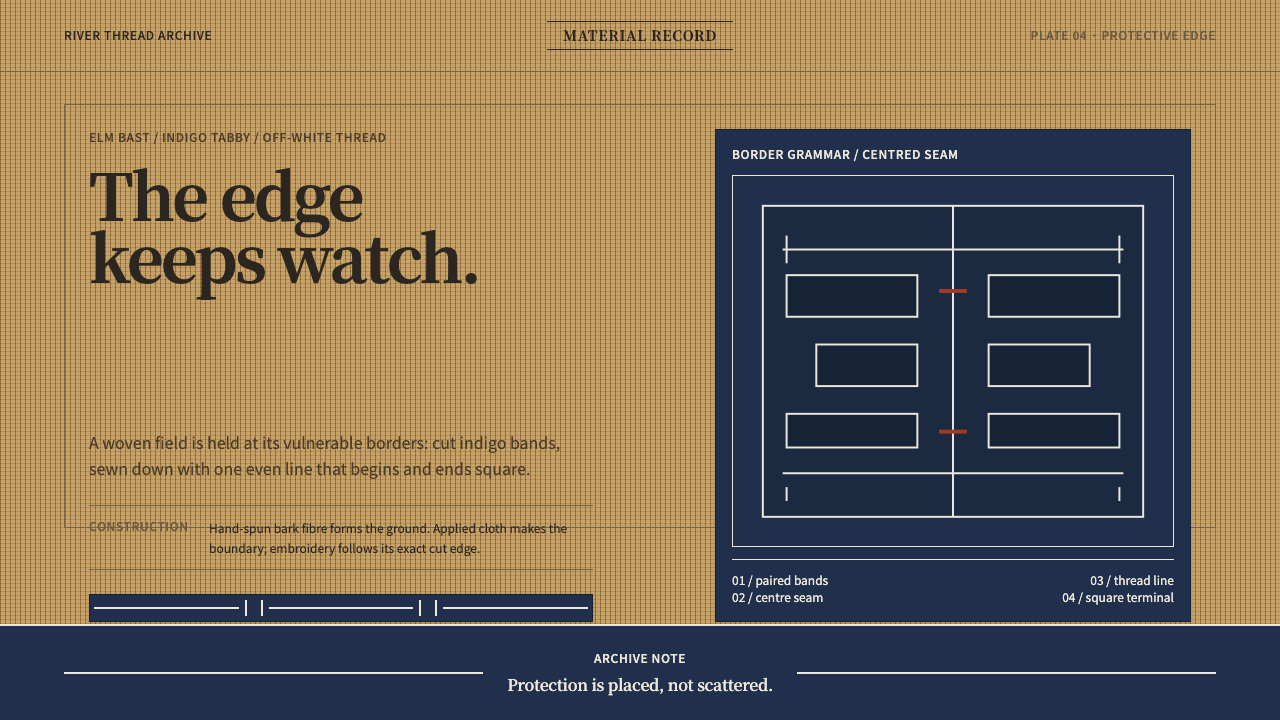 Ainu Attus RobeProtection is cut, not painted. Indigo bands and square-ended thread hold elm…
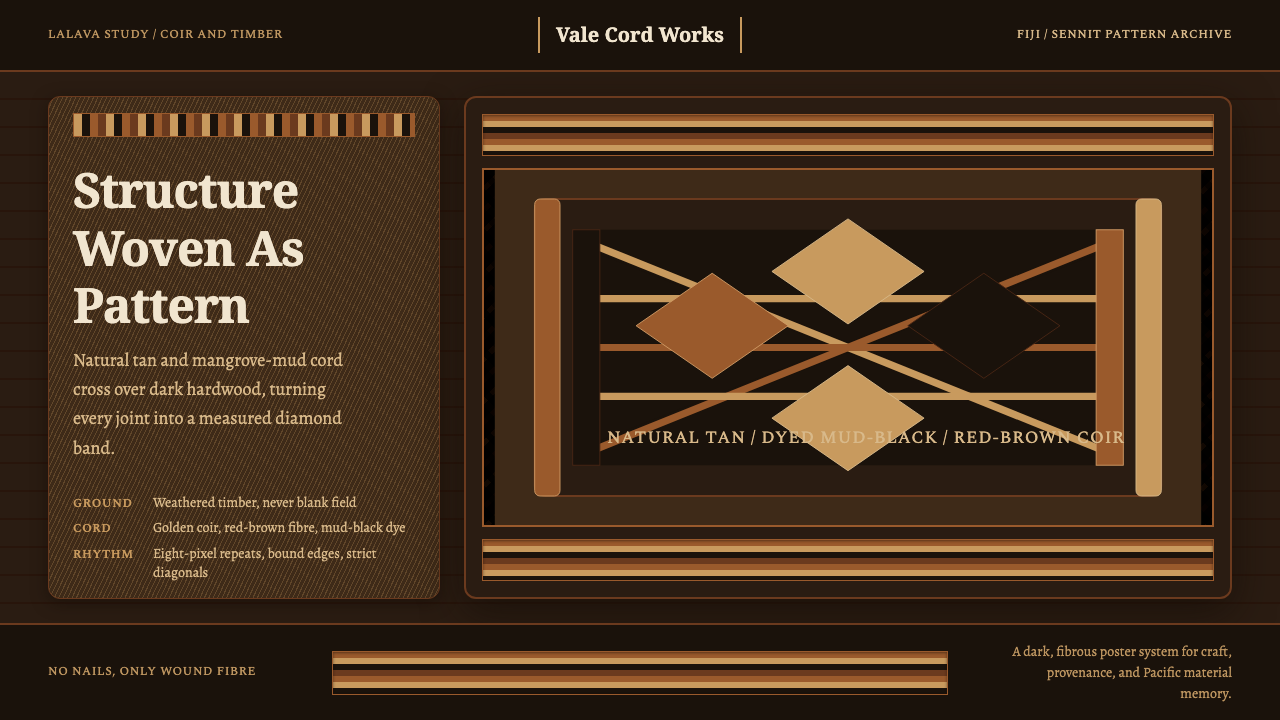 Fijian Magimagi LashingStructure becomes ornament. Tan coir diamonds bind mud-black timber in a stri…
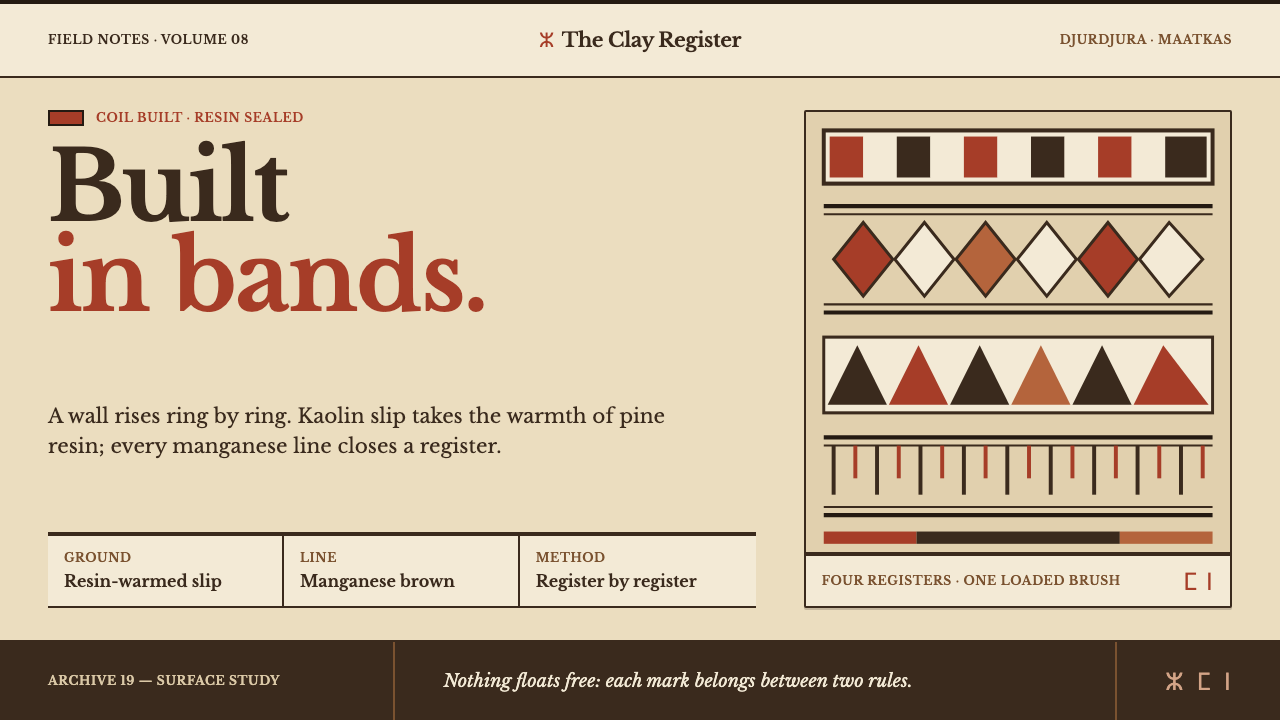 Kabyle PotteryBuilt band by band. Resin-warm kaolin carries manganese rules and iron-red ge…
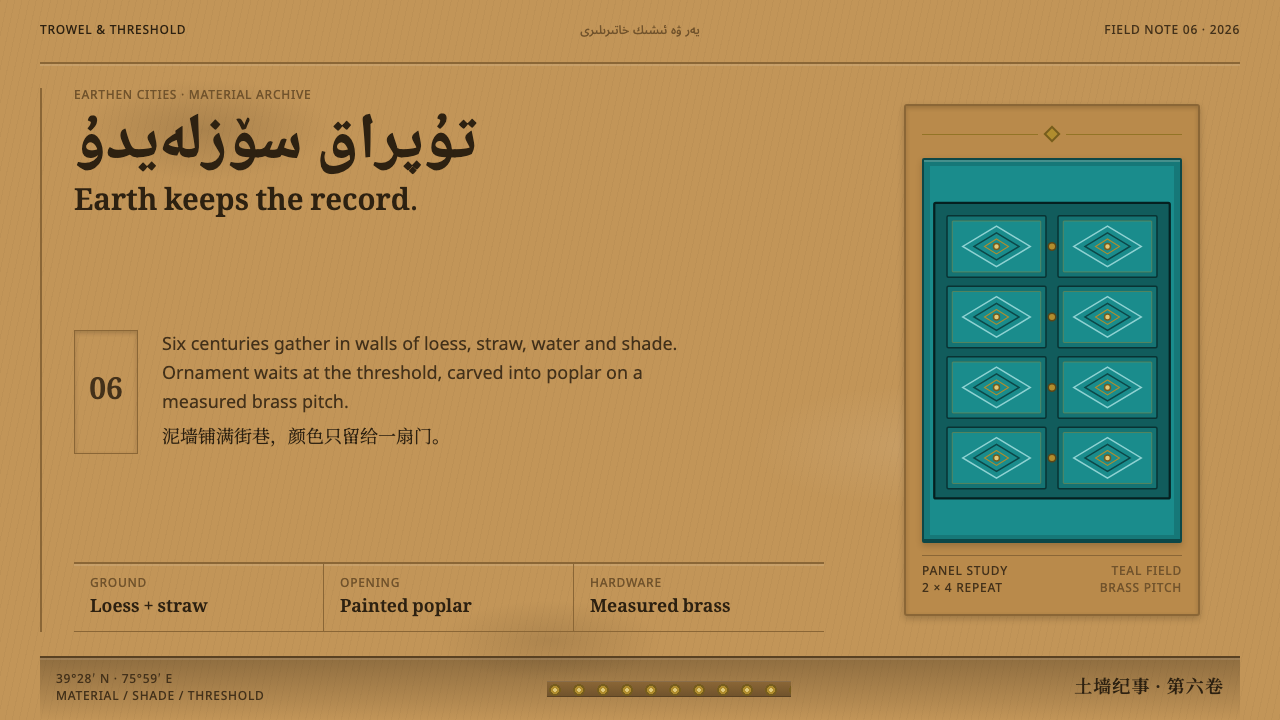 Kashgar Old TownEarth holds the field; ornament waits at one teal door, cut in a strict brass…