What is Ukrainian Vyshyvanka Embroidery?
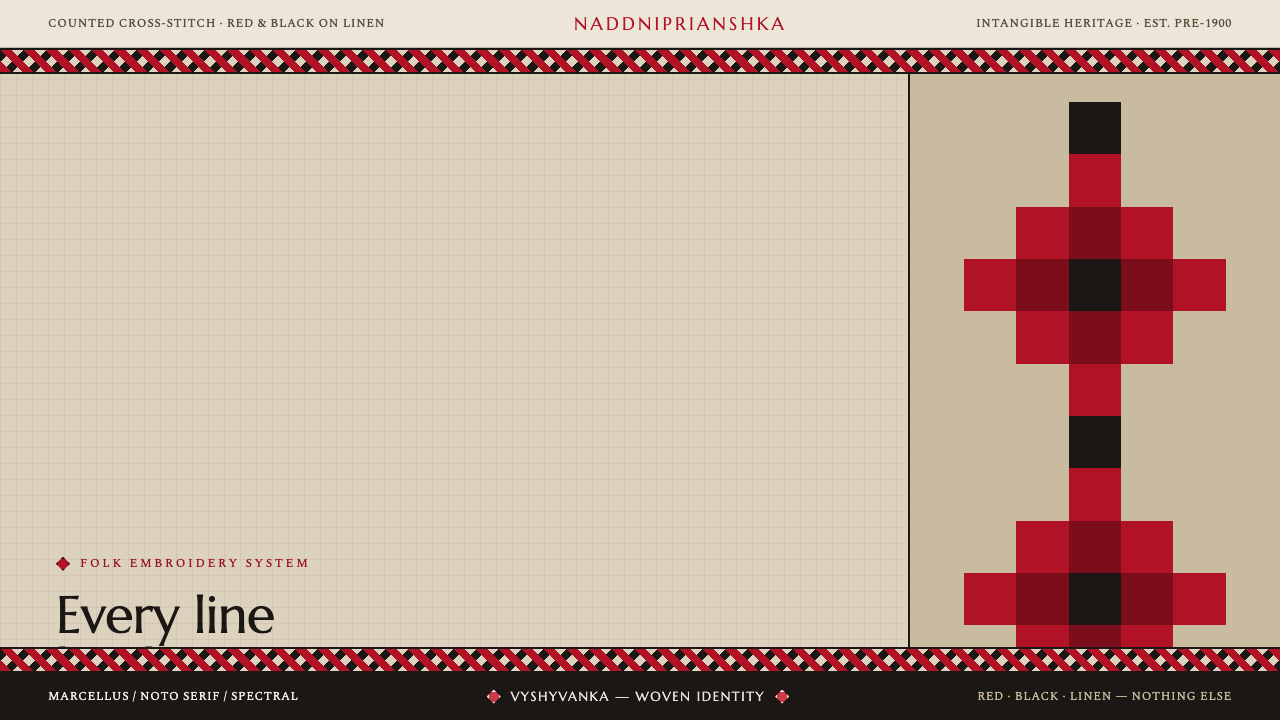
Ukrainian Vyshyvanka embroidery turns thread, symmetry, and a restrained red-and-black vocabulary into a visual language of life, love, and protection.
Ukrainian Vyshyvanka Embroidery in brief
The vyshyvanka is the Ukrainian embroidered shirt, traditionally worked in bold geometric cross-stitch on hand-woven natural linen. Its visual character begins with the cloth itself: not a bleached white surface, but a warm greige, homespun ground with the quiet, practical presence of oatmeal-colored flax. Against it, red and black thread read with unusual directness. The result is neither ornamental excess nor rustic casualness. It is a highly ordered textile language in which every visible mark belongs to a counted structure.
In the Carpathian and Naddniprianshchyna traditions represented here, the core vocabulary includes rhombuses, oak leaves, rosettes, and rhombuses with hooks. These motifs are assembled from stepped units rather than smooth outlines. A diagonal is not drawn as a flowing line; it is built as a sequence of deliberate thread positions. Curves are consequently translated into angular rhythm, and each form appears to emerge from the weave rather than sit loosely on top of it.
The color system is compact but expressive. Red signifies life and love; black signifies protection. That symbolic pairing gives the style its emotional force. In a digital interpretation, the principle is not merely to place red and black decorations on a neutral background. It is to preserve the embroidery’s discipline: lines should feel counted, motifs should be mirrored or structurally balanced, and every accent should look necessary to the pattern rather than added for visual variety.
Where does Ukrainian Vyshyvanka Embroidery come from?
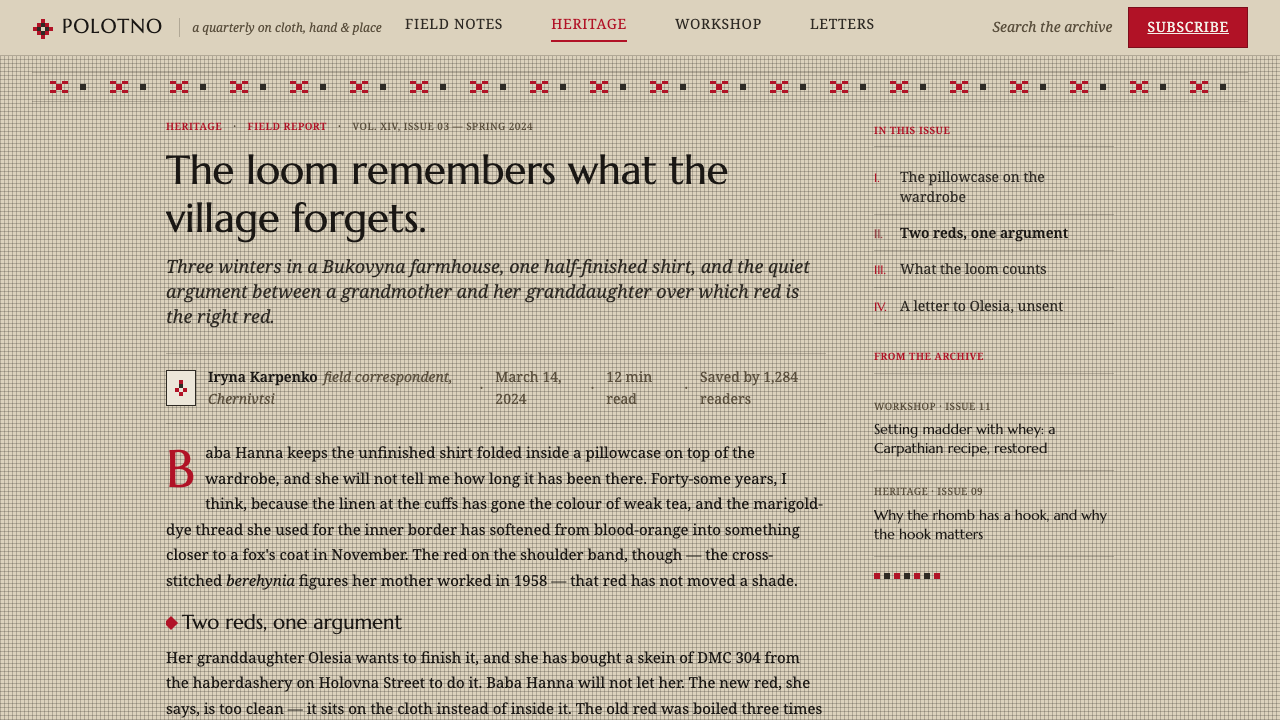
Vyshyvanka belongs to a deep Ukrainian folk tradition that predates modern design categories. Its history is carried not through a single named author or a centralized school, but through anonymous village embroiderers and regional pattern lineages. This matters for interpretation: the style is not a signature look devised for a poster or a brand. It is a living textile practice in which cloth, stitch, motif, and symbolic color are inseparable.
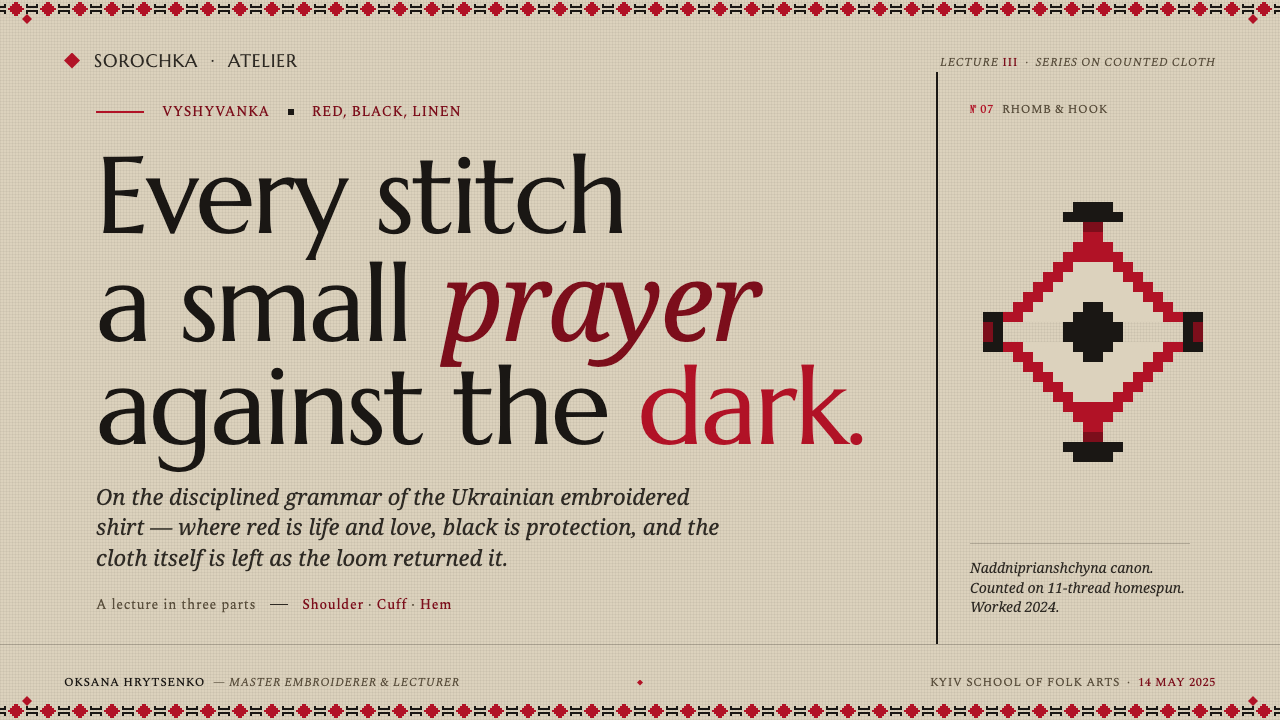
The source tradition is rooted in Ukraine in Eastern Europe, especially the Carpathian and Naddniprianshchyna regions. Within that canon, recurring geometric and vegetal motifs establish a recognizable visual family: rhombuses provide a framework of symmetry and enclosure, while oak leaves and rosettes introduce a more organic subject without abandoning the counted grid. The rhombus-with-hook motif makes the logic especially visible, because its directional extensions remain squarely bound to the underlying weave.
The method of construction explains much of the aesthetic. Cross-stitch asks the maker to count along warp and weft, producing a pattern from repeated, discrete decisions. Mirroring gives motifs ceremonial stability; stepped edges give them force; the unbleached linen ground lets the embroidery retain the material honesty of hand-woven cloth. In 2018, Ukrainian vyshyvanka embroidery was recognized by UNESCO as Intangible Cultural Heritage, affirming the cultural importance of a practice sustained through community and regional continuity.
What defines the Ukrainian Vyshyvanka Embroidery look?
Greige Linen Ground
The field should feel like unbleached, hand-woven natural linen: warm, muted, and materially present. It is not a blank white canvas. Its subdued greige quality gives red and black their contrast while keeping the composition grounded in cloth rather than in polished digital neutrality.
Red and Black Symbolism
Red carries life and love; black carries protection. Use them as meaningful forces, not interchangeable decorative accents. Red should create vitality and emphasis, while black supplies anchoring, contour, and a sense that the pattern is guarded by a stable structure.
Counted Grid
Every line belongs on the implied warp-and-weft grid. Diagonals advance in visible steps, corners turn decisively, and spacing follows the logic of counted thread. Smooth, flowing vector curves weaken the style because they conceal the constructive discipline that makes embroidery legible.
Rhombus Vocabulary
Rhombuses are the structural center of the motif system. They may stand alone, repeat as a border, contain a rosette, or develop into the rhombus-with-hook form. Their strength comes from their ability to create enclosure, direction, and rhythmic repetition without losing the strict geometry of the stitch.
Mirrored Balance
Motifs should be mirrored or visibly balanced around a central axis. This is not decorative symmetry for its own sake. It gives the pattern a measured, inherited order, allowing even dense embroidery to read as composed rather than busy.
Motif Restraint
The recognizable motifs — rhombus, oak leaf, rosette, and rhombus with hooks — should do the visual work. Avoid adding unrelated colors, smooth ornament, or illustrative detail. The style gains richness through repetition, variation, and thread-like rhythm, not through accumulating effects.
Who shaped Ukrainian Vyshyvanka Embroidery?
The tradition is carried by unnamed makers rather than a canonical individual author. Their counted stitches preserve the relationship between natural linen, geometric motif, mirrored composition, and the symbolic force of red and black. Treating them as the central creative presence keeps the style connected to its folk origin rather than reducing it to a generic pattern.
Carpathian pattern lineages contribute a recognized canon of geometric embroidery motifs. Their importance lies in the continuity of the visual grammar: stepped construction, strong rhombus-based order, and motifs that remain inseparable from the counted structure of cross-stitch.
The Naddniprianshchyna lineages share the canon of rhombus, oak-leaf, rosette, and hooked-rhombus motifs. They demonstrate that the style is a regional inheritance, where recognizable forms can persist through repetition and variation without relying on a single fixed illustration.
How do you use Ukrainian Vyshyvanka Embroidery today?
For presentation covers, use the greige linen ground as the atmosphere rather than as a literal fabric photograph. Let a mirrored red-and-black rhombus field frame or interrupt the title area, leaving enough open cloth-like space for the words to breathe. The strongest covers treat the motif as an inherited structural border or central emblem, not as a wallpaper spread uniformly across the page.
For content and data slides, translate the counted grid into information structure. Section dividers can use stepped rules, compact rosettes, or a single rhombus marker; charts can inherit the red-and-black hierarchy against the warm neutral field. Keep labels calm and readable. Data should remain data, while embroidery-derived marks establish grouping, emphasis, and progression without turning every chart into decoration.
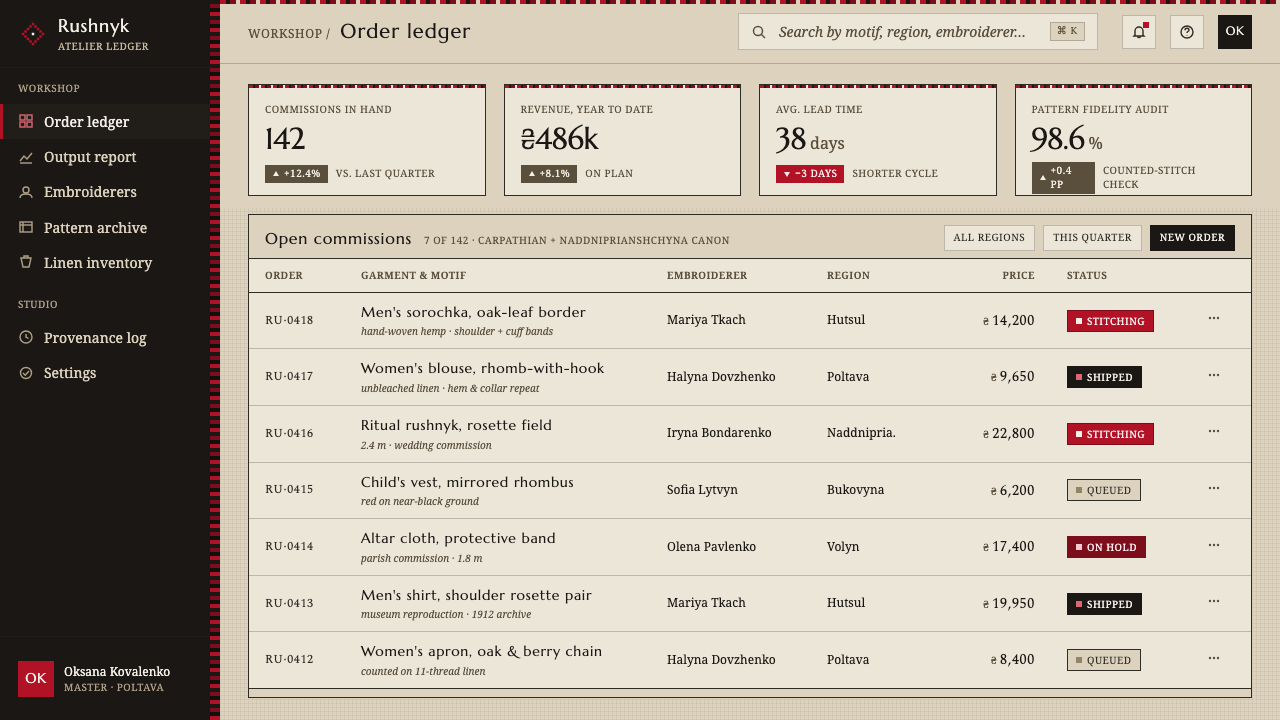
For web interfaces, this language suits dashboards and pricing or membership pages that benefit from visible order and cultural warmth. Use a textile-like neutral ground, reserve red for decisive calls to action or active states, and use black for navigation, boundaries, and durable information hierarchy. Cards and panels should align to a clear grid, with stepped motif fragments placed at meaningful transitions rather than scattered as generic icons.
For editorial and marketing work, the style works best when the page gives motifs a ceremonial role. An article can open with a rhombus band, use oak-leaf or rosette marks for recurring metadata, and allow the natural-linen ground to support long reading. A campaign can use a large mirrored motif as its visual signature, then repeat smaller related marks across formats so that the system feels woven together rather than merely branded.
The common mistake is to imitate embroidery through random folk decoration, overly smooth floral curves, or a crowded palette. That breaks the logic of vyshyvanka. Start instead with the counted grid, the restrained red-and-black symbolism, the warm greige field, and mirrored geometry. If an added element cannot plausibly belong to a deliberate stitch pattern, it is probably outside the style.
Ukrainian Vyshyvanka Embroidery — FAQ
Is Vyshyvanka embroidery simply a red-and-black folk pattern?
No. Red and black are central in this interpretation because red signifies life and love while black signifies protection, but the style depends equally on hand-woven natural linen, counted cross-stitch construction, stepped geometry, mirroring, and specific motif families. Removing that structural logic leaves a color scheme, not a vyshyvanka-derived design language.
Why should the background be greige rather than bright white?
The traditional base cloth is unbleached natural linen, described as a warm greige homespun oatmeal rather than white or cream. That ground is part of the visual meaning: it makes the work feel woven and material, and it gives the red-and-black embroidery a grounded contrast. A bright white field can make the result feel detached from the textile source.
Can smooth curves or many accent colors be added for a more contemporary look?
They should be avoided if the goal is a faithful translation. The source language is built from counted, stepped thread positions: every line sits on the grid, and motifs gain expression through geometry and repetition. Smooth curves conceal that logic, while extra colors dilute the direct symbolic relationship between red, black, life, love, and protection.
Which motifs are most appropriate for this style?
The approved visual canon favors rhombus, oak-leaf, rosette, and rhombus-with-hook motifs associated with Carpathian and Naddniprianshchyna traditions. Rhombuses are especially useful as a structural starting point because their stepped sides, mirrored possibilities, and repeated units naturally express the discipline of counted embroidery.
What does UNESCO recognition mean for using the style today?
Its recognition as Intangible Cultural Heritage in 2018 emphasizes that vyshyvanka is a living cultural practice, not merely a surface aesthetic. Contemporary work can learn from and respectfully translate its visual principles, but should preserve the relationship between motif, stitch discipline, natural linen, and symbolic color instead of treating the tradition as interchangeable decoration.
Related design styles
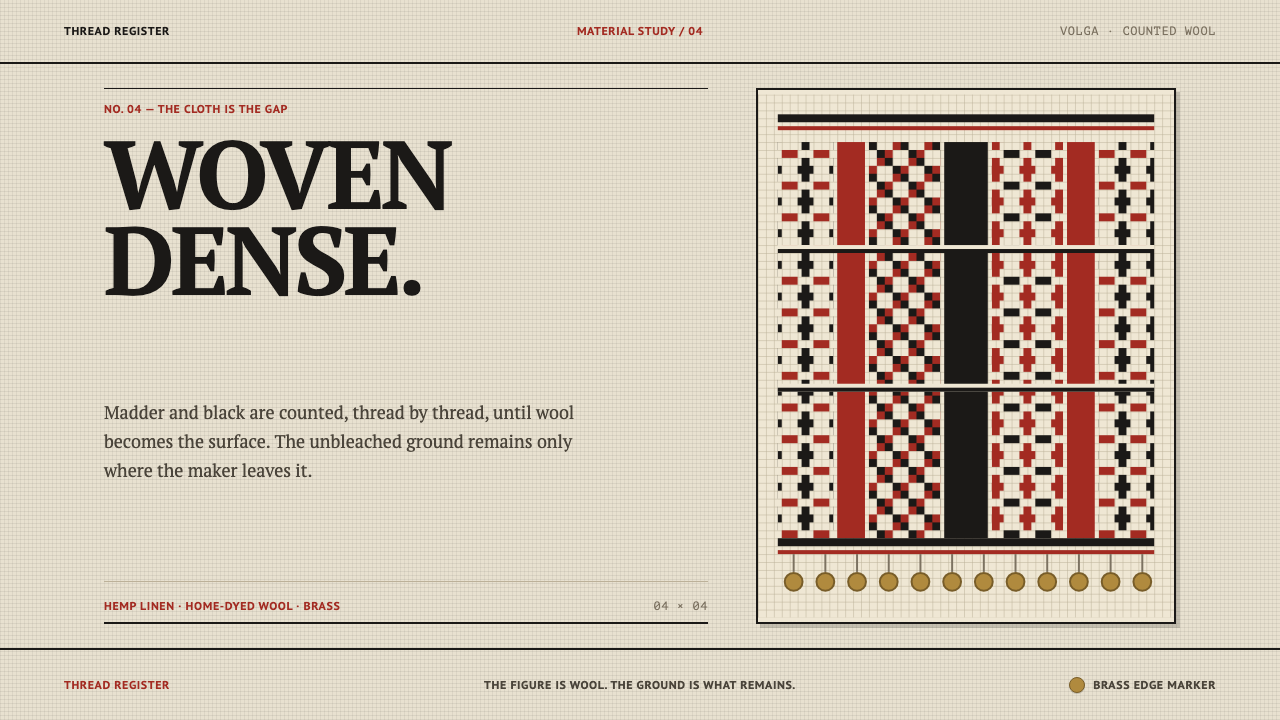 Erzya PangaDensity is the ornament. Madder and black stepped stitches crowd unbleached l…
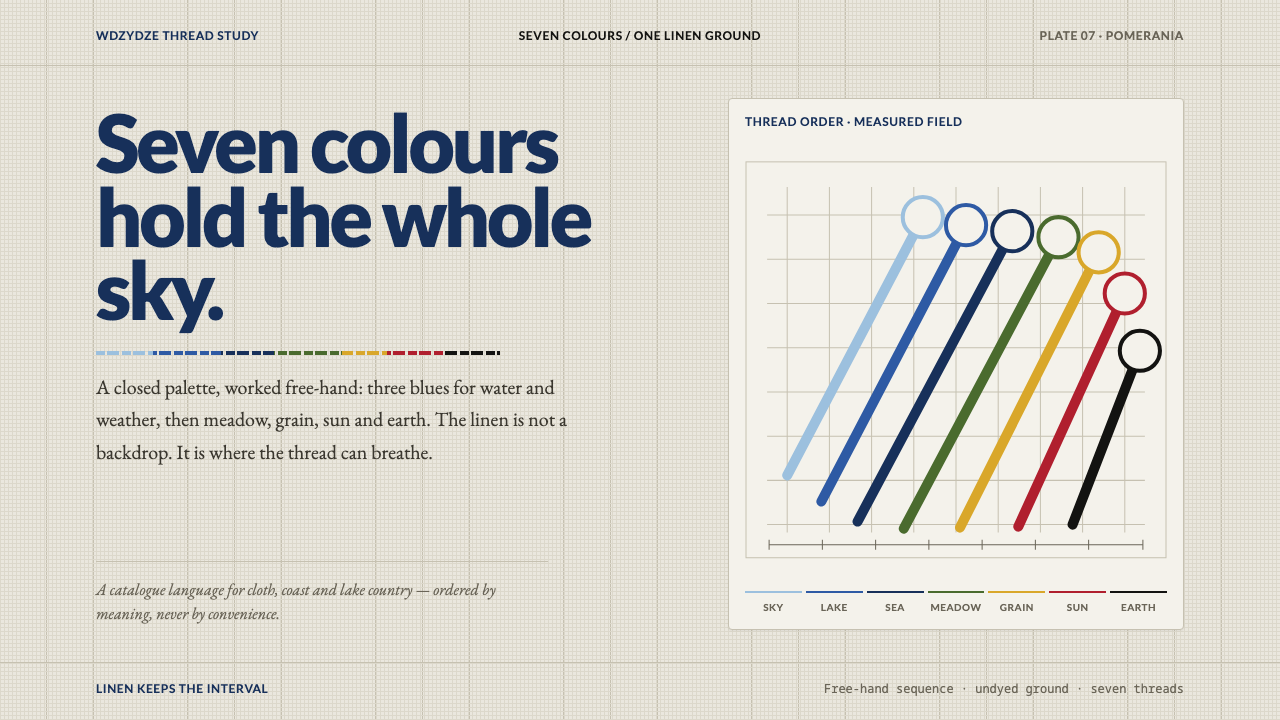 Kashubian Seven ColoursMeaning is stitched into the palette. Seven threads cross undyed linen in a m…
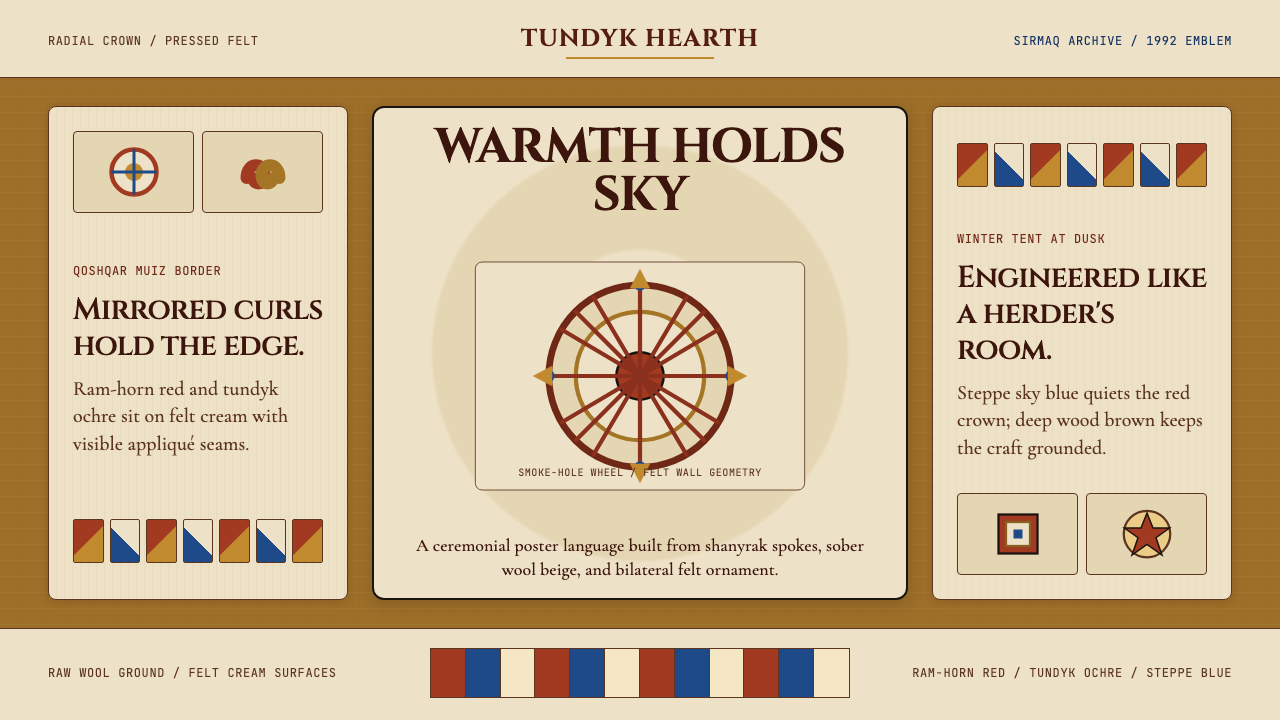 Kazakh Shanyrak Yurt FeltDomestic warmth, engineered. Ram-horn red felt curls around a radial shanyrak…
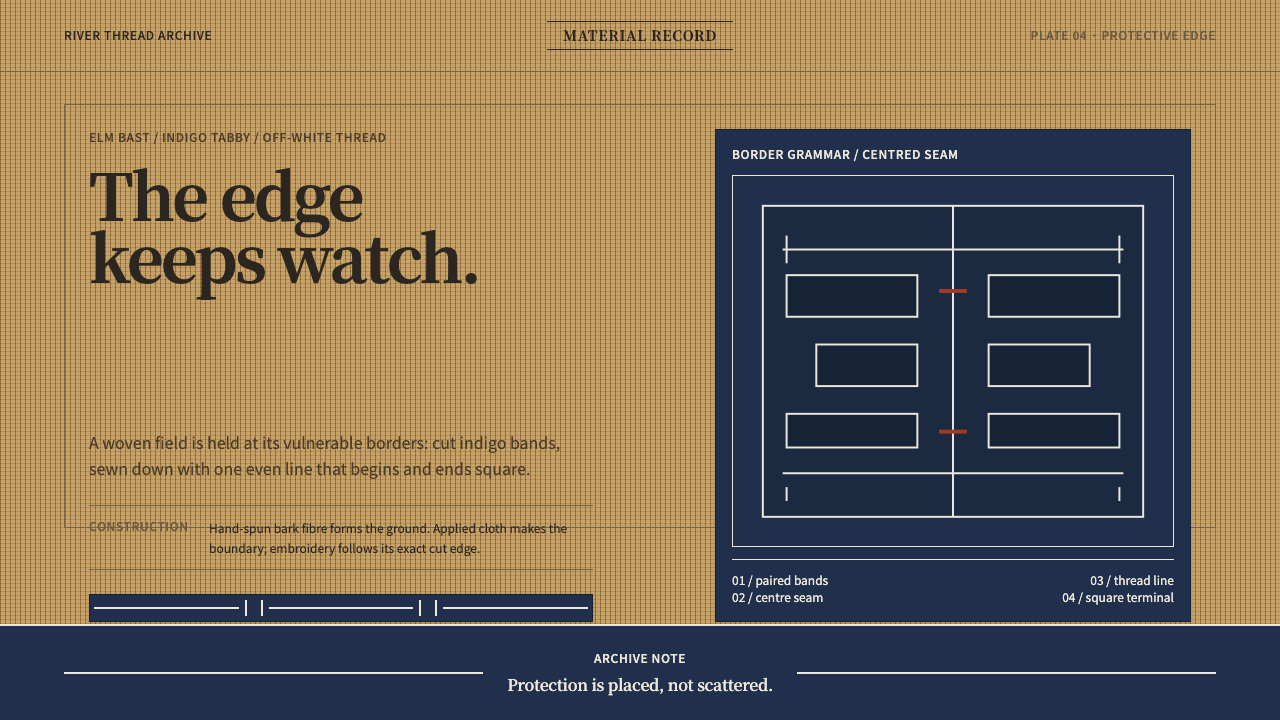 Ainu Attus RobeProtection is cut, not painted. Indigo bands and square-ended thread hold elm…
 Bashkir Honeycomb Felt OrnamentSteppe craft feels weighty. Umber felt holds blue honeycomb and raw-wool hook…
 Fijian Masi Tapa StencilGeometry keeps ceremony. Soot-black diamonds repeat on bark beige with rust-r…