What is Turkmen Telpek?
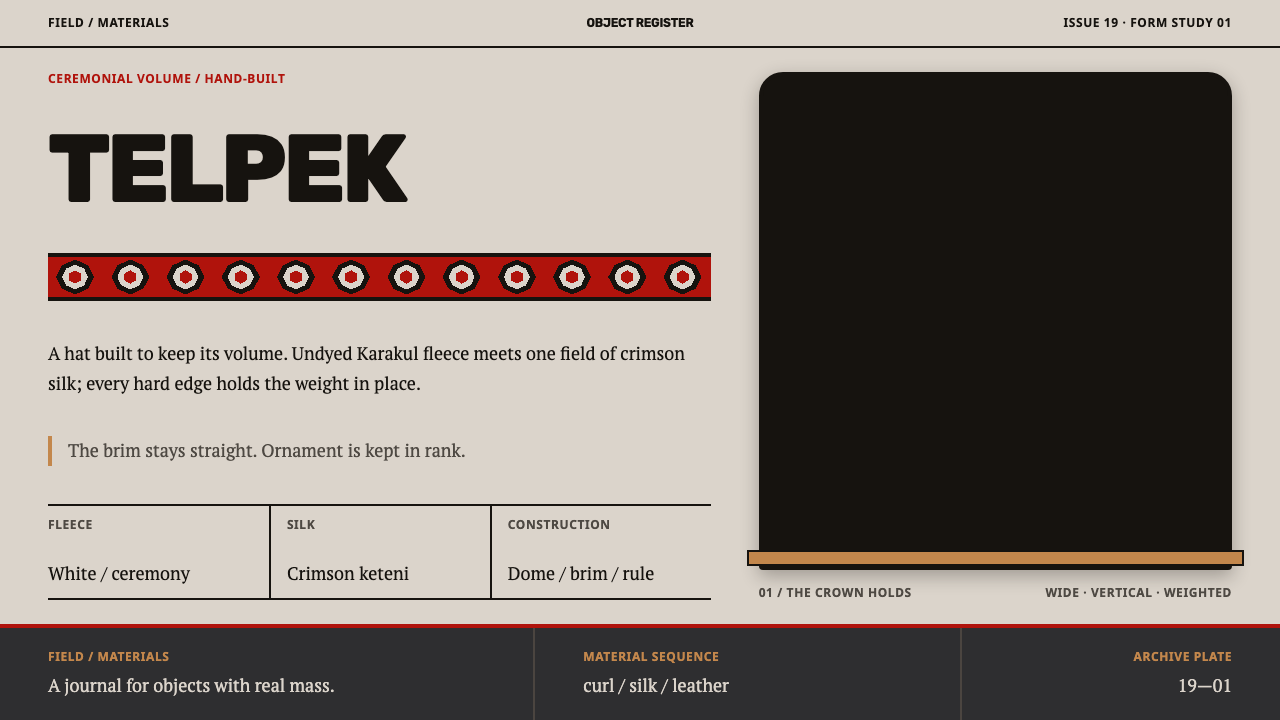
The telpek is a tall sheepskin hat wider than the head beneath it: one dominant volume, a straight brim, and ornament placed only where Turkmen weaving puts it.
Turkmen Telpek in brief
The telpek is the tall, rounded sheepskin hat of the Turkmen, a people whose homeland lies in the deserts and oases of Turkmenistan and whose communities extend into Iran and Afghanistan. It is built from the fleece of Karakul lambs stitched over a soft leather cap, and it is wider than the head it sits on, so the wearer carries a great dome of curled wool. Beneath it goes a small oil-absorbing skullcap called a takhya; when the hat comes off, it is set on a mulberry-wood form so that its bulk does not collapse.
The colour of the fleece is a sentence in itself. White fleece is worn for ceremony and belongs to younger men; black and brown are the everyday colours and belong to elders. Below the hat there is often a robe of crimson keteni silk, a red that matches the ground colour of Turkmen carpets. The whole costume can be read as a few large fields of colour, pale or dark fleece above and crimson below, with fine ornament held back for the textiles.
As a design language, the telpek supplies a rule of weight. There is one dominant volume, a straight brim line, and nothing fussy underneath. Undyed fleece becomes the page, black becomes the type, and crimson cuts across it the way a red field cuts across a carpet. Ornament, when it appears, sits in strict rows of stepped gül medallions held inside banded borders, exactly where weaving would place it. Heavy type and thick lines complete the picture: this is a substantial object, and it is never drawn with a hairline.

Where does Turkmen Telpek come from?
The telpek belongs to the pastoral world of Central Asia, where the flock supplied meat, milk, wool and skins, and where a hat was both a practical answer to a harsh climate and a statement of age and standing. The form is documented from the nineteenth century and continues into the national dress of present-day Turkmenistan. Two regions stand out in the record: Ahal, whose households are known for hat-making, and Mary, whose households tend the herds. Between them they cover both ends of the chain, from living flock to finished hat.
Making the hat is a slow sequence of skills. The pelts are salted, dried in the shade, fermented in dairy for a week or two, and then scraped back with stone, a process that leaves a supple skin with the fleece still attached. The skin is cut and stitched over a soft leather cap, and the finished hat is stored on its wooden form. None of these steps needs a machine, and each depends on a maker’s judgment about timing, temperature and touch. The result is a garment whose strength is visible in its mass.
The same Karakul pelts that made hats also fed a wider pelt trade, which tied herding households at the desert margins to markets far from the oases. Alongside that trade ran the great Turkmen textile arts, carpet weaving and keteni silk weaving, and the hat borrows from them without apology. The crimson of the robe is the ground colour of the carpets, and the gül, the stepped, octagonal medallion repeated in strict rows, is the carpet’s signature motif. The word gül itself means flower, and the Turkmen tribes were traditionally known by their own versions of it.
Today the telpek is as much a marker of Turkmen identity as a piece of clothing. It appears in national dress and at ceremonies, in Turkmenistan and in the Turkmen communities of Iran and Afghanistan, and the carpet gül is carried onto the national flag. That is why any design borrowing from it deserves care. The style takes its logic from the hat’s proportions and the weaver’s grid; it does not need to reproduce a costume, and it should not treat a living form of national dress as a picturesque prop.
What defines the Turkmen Telpek look?
Fleece-White Ground
The page is the colour of undyed fleece: a warm, slightly creamy white rather than a stark paper white. It gives the layout depth and a tactile quality without any texture being added, and it makes black type and crimson accents read as strong and deliberate.
Heavy Black Type
Type is dark, bold and set generously large. Weight is the main tool of hierarchy: a headline is not merely bigger than body text, it is visibly heavier. Light, hairline-thin letterforms are out of place here, because a substantial object calls for substantial marks.
Crimson Keteni Band
A single strong crimson, recalling keteni silk and the ground of Turkmen carpets, cuts across the page as structure: a header band, a divider, a solid block. It is not sprinkled as decoration. Used sparingly and in large, flat areas, it behaves like a field of colour in a carpet, not like a highlight.
One Dominant Volume
The telpek is read as a single mass, and the layout follows. Each view has one dominant element, a large title block, a hero band or a single bold panel, with everything else subordinate. There is no crowd of equal-sized parts competing for attention beneath it.
Straight Brim Line
The brim is a level, uncompromising edge, and the style echoes it with straight horizontal lines: section edges, band boundaries and table rules that stay perfectly level. Curves are rare and never decorative. The result is a calm, authoritative horizontal rhythm.
Stepped Gül Rows
Ornament appears where weaving would put it: stepped, octagonal gül medallions in strict rows, enclosed within narrow banded borders. Repetition is orderly and quiet rather than ecstatic, and the motif works as a unit of rhythm, not as a scattered pattern covering the whole surface.
Thick Lines and Banded Borders
Rules, outlines and frames are thick, and borders are organised as bands rather than single hairlines. This gives forms their edge the way the stitched seam gives the hat its shape. Nothing floats in a faint outline; everything is held within a firm, visible frame.

Who shaped Turkmen Telpek?
Households in the Ahal region are named in the source record as hat-makers. They carry the whole sequence of skills that turns pelts into a finished telpek, from the preparation of the skin to the stitching over the leather cap. Their standard of work is the benchmark for this style: a solid, symmetrical, unfussy object whose beauty lies in mass and proportion.
The herding households of the Mary region stand at the other end of the chain, raising the flocks whose Karakul lambs supply the fleece. Their role is a reminder that the hat is the end of a pastoral economy, and that its weight, warmth and colour all begin with animals and grazing land rather than with a workshop.
The weavers of carpets and keteni silk supply the hat’s visual vocabulary: the crimson ground, the stepped gül and the discipline of banded borders. The style’s ornament and colour come from their work, which is why the telpek design keeps pattern in rows and bands rather than letting it run across the whole surface.
The pelt trade linked herding households to markets far beyond the oases and made Karakul fleece a recognisable commodity. It sits in the source record as one of the movements behind the telpek, and it explains why a regional hat could also be a traded good with a reputation to protect.
How do you use Turkmen Telpek today?
The telpek style suits products that want weight, authority and warmth at once, such as heritage brands, craft and outdoor goods, travel, hospitality, cultural institutions and anything built on materials and making. Its strength comes from commitment: one big idea per screen, executed firmly, with no apology.
On slides, a cover works best as a warm off-white page with a very large, heavy black title and a single crimson band running across it like the hat’s own colour change. Content slides use strict rows, with the band as a header, and keep the number of competing elements low. Data slides suit thick, solid bars and tables with firm rules, and a row of equal tiles can echo the gül rows if each tile carries real information.
In web interfaces, the style works for dashboards and pricing pages that want to look dependable. Use thick rules and banded section dividers, set headings in heavy type, and make pricing tiers a row of equal, firmly framed cards. Buttons should be solid black or crimson, not thin ghost outlines. Navigation can stay plain and heavy, with the crimson band reserved for the single most important state on the page.
In editorial and marketing work, the style is a natural fit for leather, wool, outerwear, rugs, regional food and travel stories. A long article can open with a heavy headline over a warm page, use the crimson band as a section marker, and let photographs of fleece, hands and textiles carry texture, while the layout itself stays flat. Campaign pages benefit from the same one-dominant-element rule: a single large panel, a short line of text, a solid call to action.
The most common mistake is to spread crimson across everything, which destroys the band’s structural force and turns the page into a red wash. Others are to use light or hairline type, to sprinkle fine gül motifs across the page as wallpaper, and to illustrate a literal hat on every screen. The last of these also drifts into costume exoticism. The style is about weight, line and placement, and it works best when the hat is felt, not shown.

Turkmen Telpek — FAQ
What is a gül?
Gül means flower, and in Turkmen weaving it names the large medallion repeated in rows across a carpet. The traditional gül is stepped and octagonal, and Turkmen tribes were each known by their own version. In this style the gül is a unit of rhythm: it appears in orderly rows inside banded borders, as it would on a carpet, rather than as a loose decorative scatter.
Why is the ground a warm white rather than pure white?
Because the page is meant to read as undyed fleece. A warm, slightly creamy white feels tactile and substantial, and it gives black type and crimson a softer but still firm contrast. Pure paper white tends to feel clinical and thin, which undermines the idea of a heavy, handmade object.
Can the style work in a dark theme?
Yes, and the tradition itself suggests how. Black and brown telpeks are the everyday hats of elders, so a dark variant can treat a deep, warm black as the ground and keep the heavy type in a warm off-white. The crimson band stays as the one strong accent. The key is to preserve the weight and the straight lines; a dark theme with thin type and glowing effects would lose the point.
How does this differ from a Turkmen carpet-led style?
A carpet-led style fills the whole field with pattern, since a carpet is a pattern from edge to edge. The telpek style comes from a hat, an object that is mostly one big plain mass, so it keeps the surface calm and confines gül motifs to rows and bands. Think of it as the carpet’s grammar applied with far more restraint and far more empty space.
How should designers treat the cultural source of this style?
With acknowledgement and restraint. The telpek is part of living Turkmen dress, and its colours and patterns have meanings within Turkmen communities. Name the source when you adapt the style, borrow its proportions and structure instead of imitating a costume, and avoid using hat imagery as a shorthand for an entire region. A good adaptation shows what the object teaches about weight and line, without turning the culture into decoration.
Related design styles
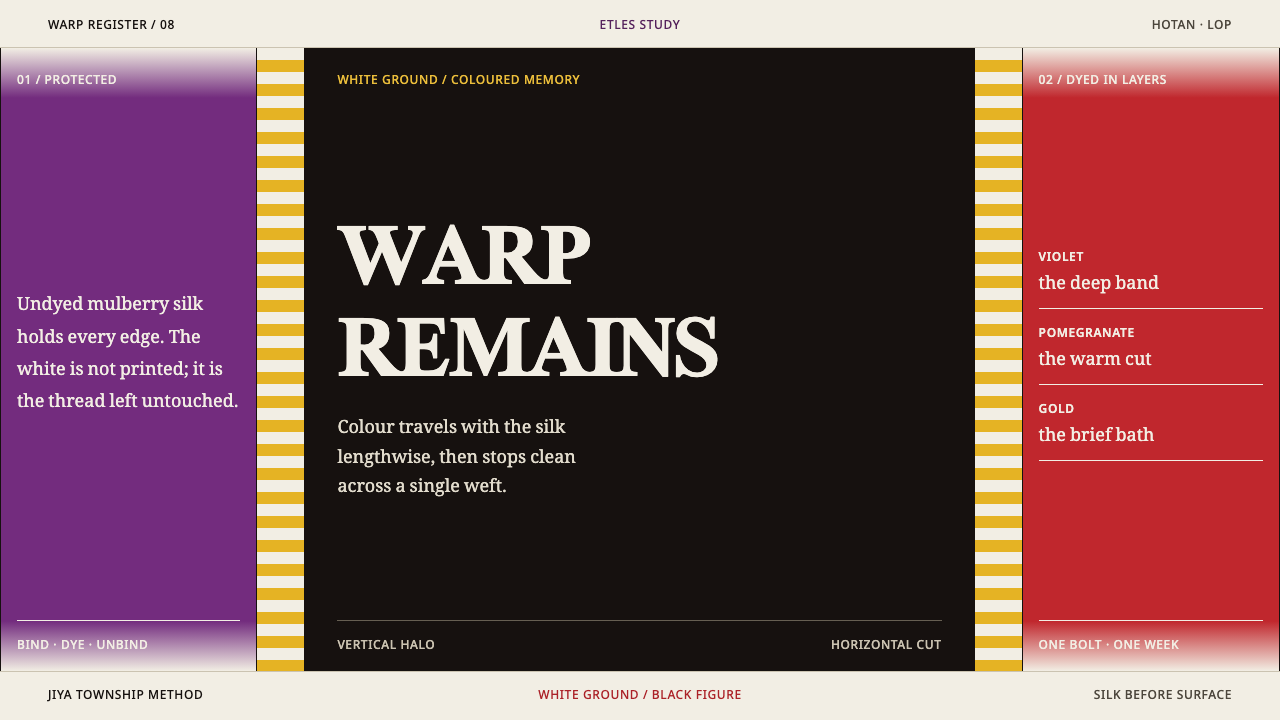 Uyghur Etles SilkColour follows the warp. Violet and pomegranate bands feather only along the…
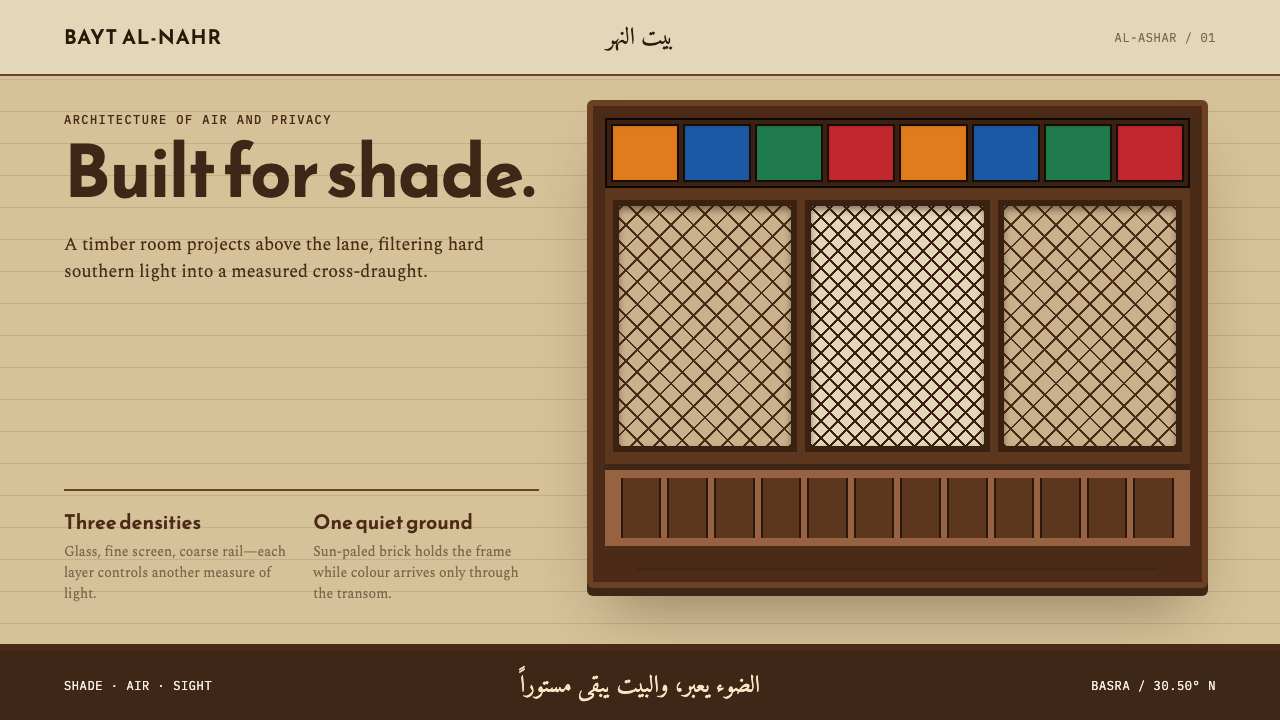 Basra ShanasheelClimate craft becomes ornament. Dark timber lattice projects over sun-paled I…
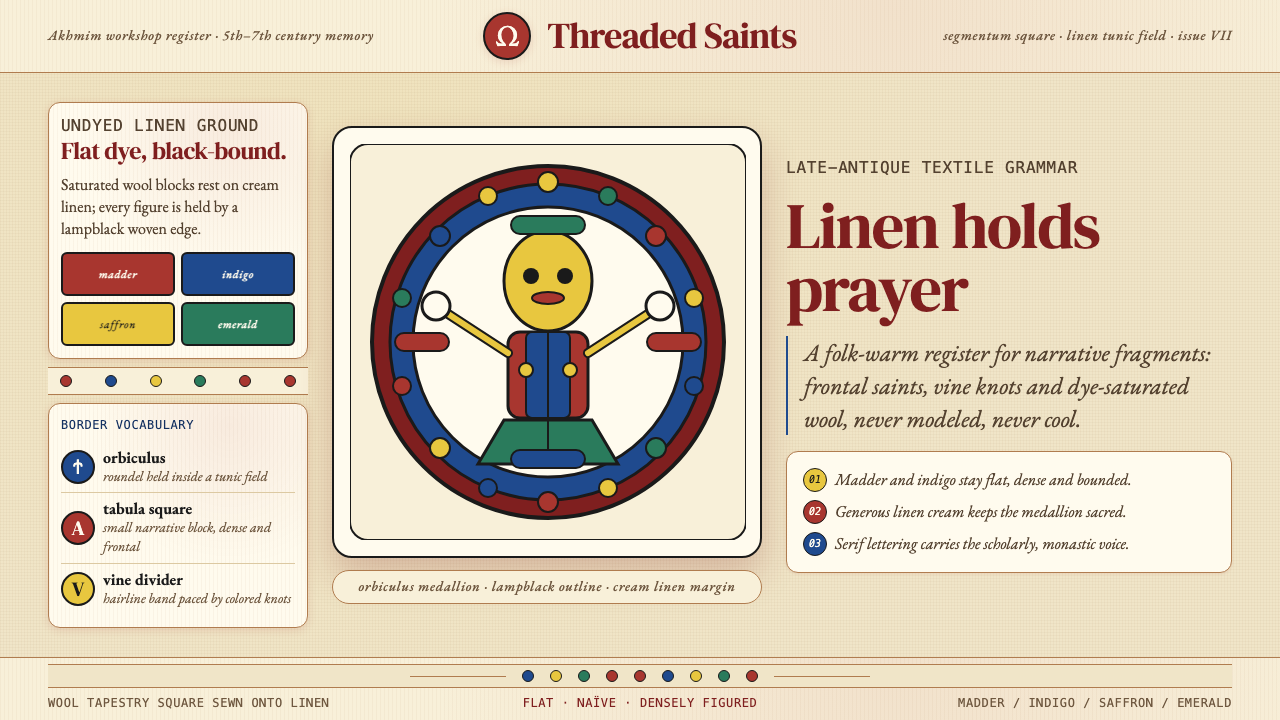 Egyptian Coptic TextileWarmth woven flat. Madder, indigo and saffron medallions sit on linen cream.
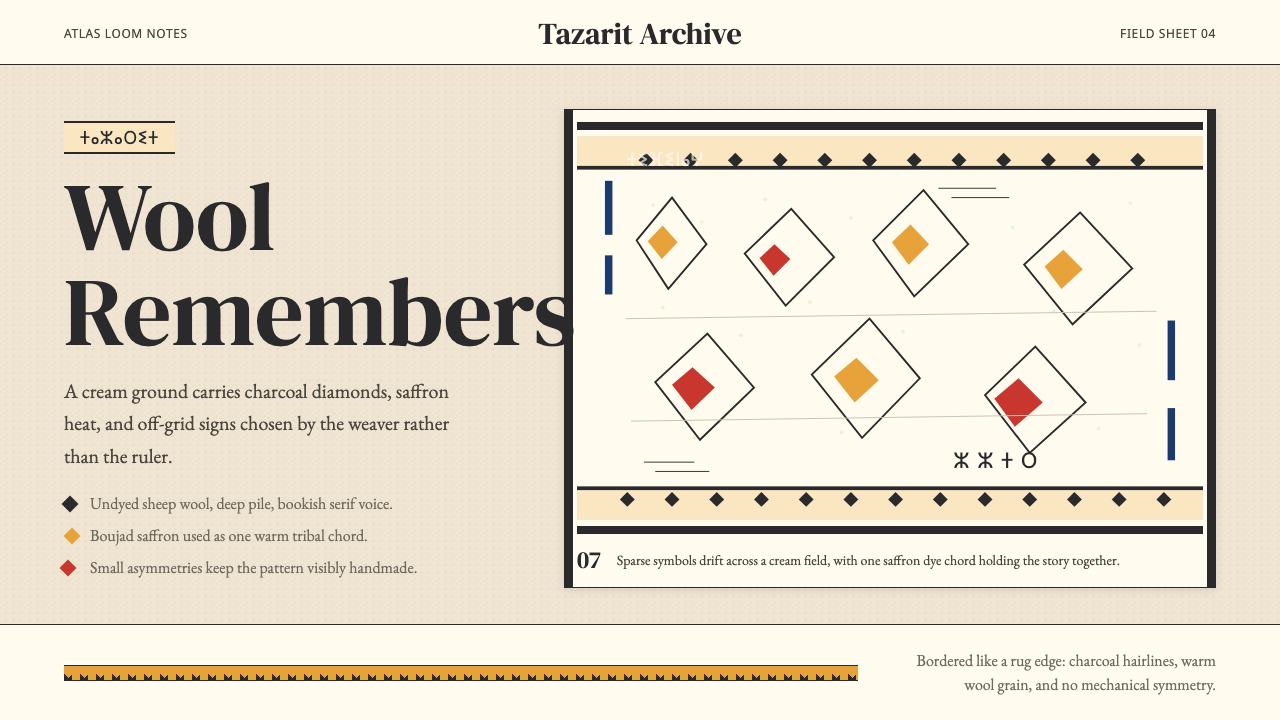 Moroccan Amazigh Berber RugAutobiography in wool. Cream ground, charcoal diamonds, saffron bands drift o…
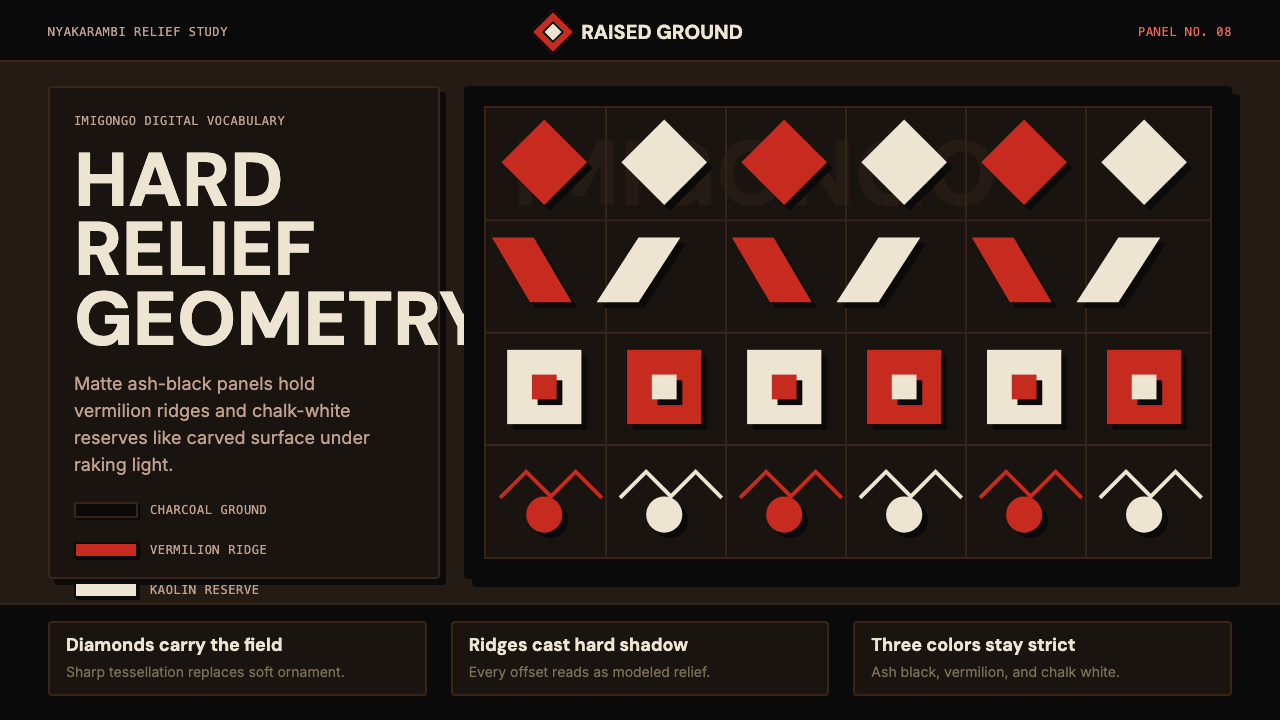 Rwandan Imigongo Cow-Dung ReliefRelief becomes digital. Ash-black grids, vermilion ridges, chalk-white reserv…
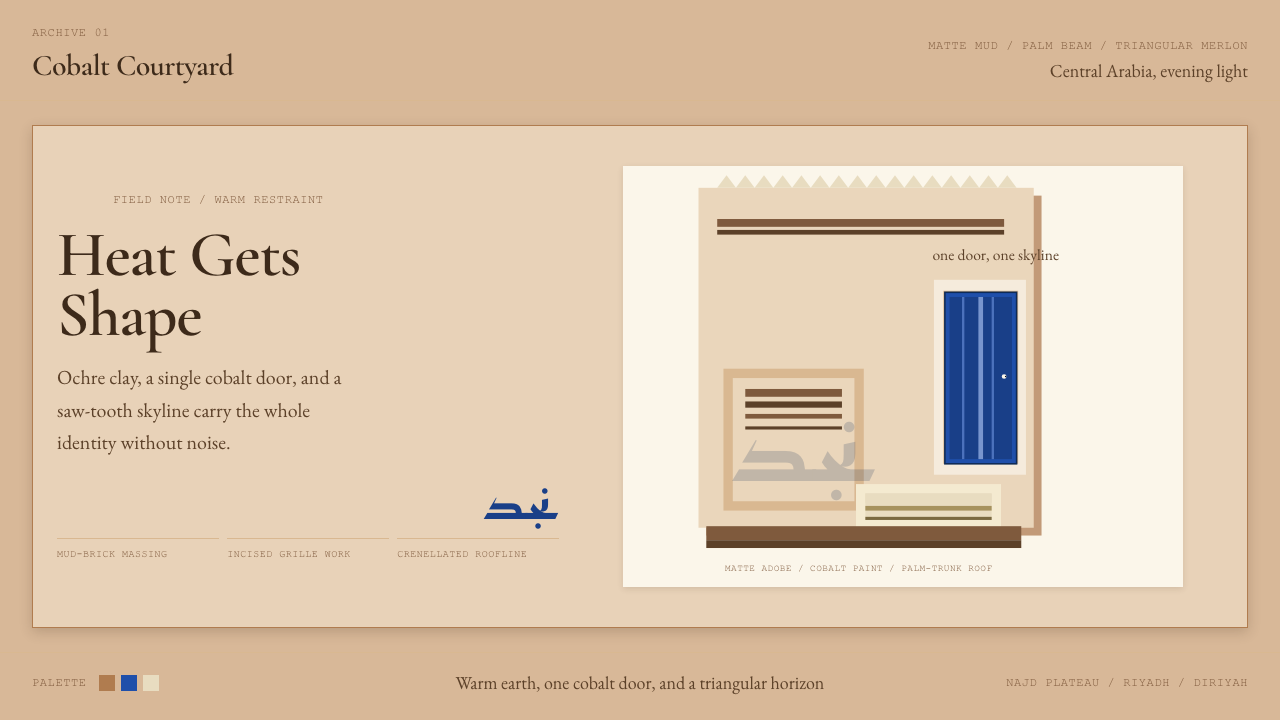 Saudi Najdi Vernacular ArchitectureHeat gets shape. Ochre clay, a single cobalt door, and a saw-tooth skyline.