What is Uranium Vaseline Glass?
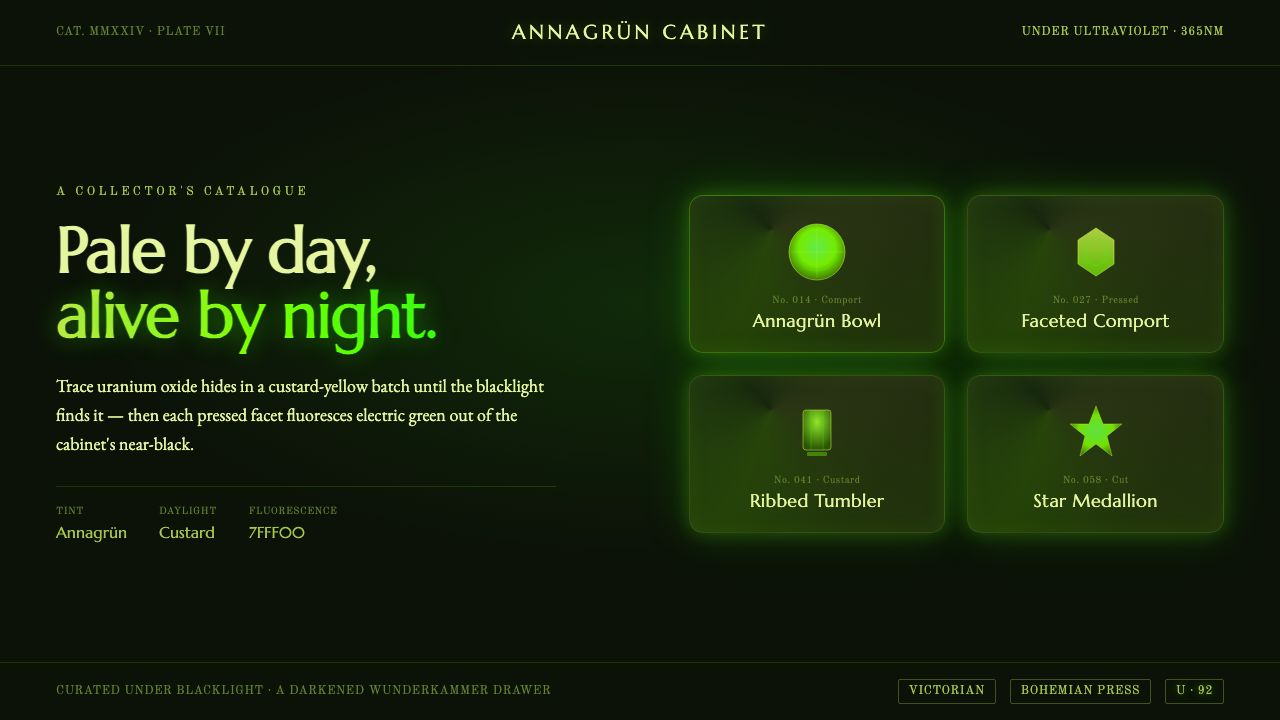
Pale by day, electric green under ultraviolet light: Uranium Vaseline Glass turns a collector’s cabinet into a quiet theatre of illumination.
Uranium Vaseline Glass in brief
Uranium Vaseline Glass is nineteenth-century decorative glassware whose pale custard-yellow to yellow-green body becomes a vivid electric green under ultraviolet light. The glow comes from trace uranium oxide in the glass batch. Its appeal lies in this double identity: an object that can appear gentle, domestic, and almost understated in daylight, then reveal an uncanny intensity when viewed under blacklight.
As a visual style, it stages that material transformation rather than treating glass as a neutral decorative surface. The background recalls the near-black interior of a cabinet or Wunderkammer drawer. Against it, translucent forms emerge as prismatic specimens: faceted, luminous, and isolated enough for their glow to feel discovered rather than displayed loudly.
The mood is refined rather than industrial. Victorian serif typography acts as a catalogue caption, giving each object the gravity of a collected artifact. Darkness is not empty space here; it is the condition that makes the green radiance legible. The result is quiet, curious, faintly radioactive, and deliberately museum-like.
Where does Uranium Vaseline Glass come from?
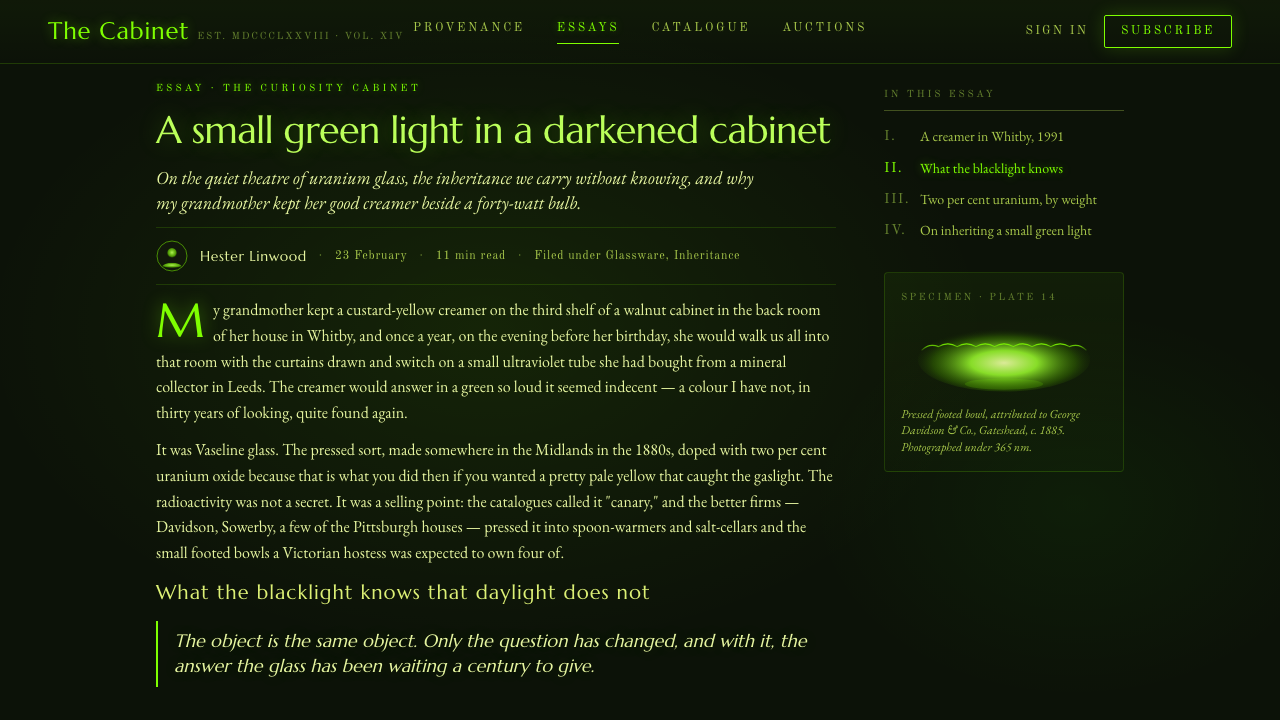
The material reference belongs to nineteenth-century Victorian and Edwardian glassmaking in Western Europe, especially Bohemia and England. In that setting, decorative glass was not merely functional tableware; it could also be a vehicle for color, surface interest, novelty, and collecting. Uranium Vaseline Glass belongs to that culture of crafted domestic objects whose visual character could reward close inspection.
Its daylight appearance is central to its historical and aesthetic identity. The glass does not announce itself with the same intensity in ordinary conditions that it does under ultraviolet light. That delayed revelation gives it a natural affinity with cabinets, drawers, labels, and the rituals of the collector: looking, identifying, comparing, and bringing an object into a different kind of light.
Franz Xaver Riedel is named among the key figures associated with this world, alongside Bohemian pressed-glass makers and English pressed-glass houses. The emphasis is therefore not on a single isolated author but on a broad glassmaking culture in which makers, workshops, and houses could shape a recognizable family of luminous decorative objects.
The style also carries a later collecting revival from roughly the 1990s to the present. That revival reframes uranium glass as both historical glassware and a visual phenomenon. Contemporary treatments can draw on Victorian decorative arts, pressed glassware, and uranium-glass collecting while translating the cabinet encounter into editorial, digital, or exhibition-like compositions.
What defines the Uranium Vaseline Glass look?
Cabinet Darkness
The field should feel like the interior of a dark collector’s cabinet: dense, quiet, and almost lightless without becoming visually flat. Darkness creates containment, protects the sense of rarity, and gives every luminous object a clear silhouette. It should read as a place where specimens are kept, not as a generic dramatic backdrop.
Uranium Green Glow
The electric green is the event, not a general-purpose accent. It should seem to radiate from within pale glass, becoming strongest at facets, edges, and overlapping translucent planes. Reserve it for objects, signals, and moments of discovery so that the glow retains its chemical, uncanny charge.
Prismatic Glass Form
Forms should suggest pressed or cut glass through angular facets, restrained translucency, and crisp changes in reflected light. They need not imitate a particular vessel literally. What matters is the impression of a solid object whose planes catch illumination differently, producing a specimen-like presence rather than a soft digital blob.
Victorian Catalogue Type
Refined Victorian serif typography provides the counterweight to the fluorescent spectacle. Use it as a captioning voice: measured, archival, and observant. Titles may feel ceremonious, while supporting text should resemble a collector’s note that identifies an object without competing with its radiance.
Specimen Isolation
Each glowing form benefits from generous surrounding darkness and from separation from neighboring elements. The composition should imply a drawer of individually regarded curiosities, not a crowded display of effects. Isolation makes the material feel precious and allows the eye to register both the pale body and its ultraviolet transformation.
Quiet Radioactivity
The atmosphere should be faintly radioactive, never loud or apocalyptic. Pair the green emission with stillness, careful labeling, and restrained contrast elsewhere. The tension comes from knowing that an elegant historical object contains an unexpected source of fluorescence, not from turning the composition into science-fiction hazard imagery.
Who shaped Uranium Vaseline Glass?
Franz Xaver Riedel is identified as a key figure in the Western European glassmaking context associated with Uranium Vaseline Glass. Within this style’s historical framing, his name anchors the work in nineteenth-century decorative-glass culture rather than treating the luminous effect as a contemporary visual invention. The emphasis remains on the crafted object, its material batch, and its collectible presence.
Bohemian pressed-glass makers represent the workshop tradition behind the style’s faceted, decorative, specimen-like character. Their presence in the source material points to glassmaking as a collective practice of forms, surfaces, and repeatable objects. For contemporary interpretation, the lesson is to let prismatic structure and material behavior carry the visual identity.
English pressed-glass houses locate Uranium Vaseline Glass within another important Western European production setting. In the design language, they support the cabinet-and-catalogue perspective: glassware is presented as an artifact with a place, a label, and a history of making. This encourages composed restraint instead of a purely decorative use of luminous green.
How do you use Uranium Vaseline Glass today?
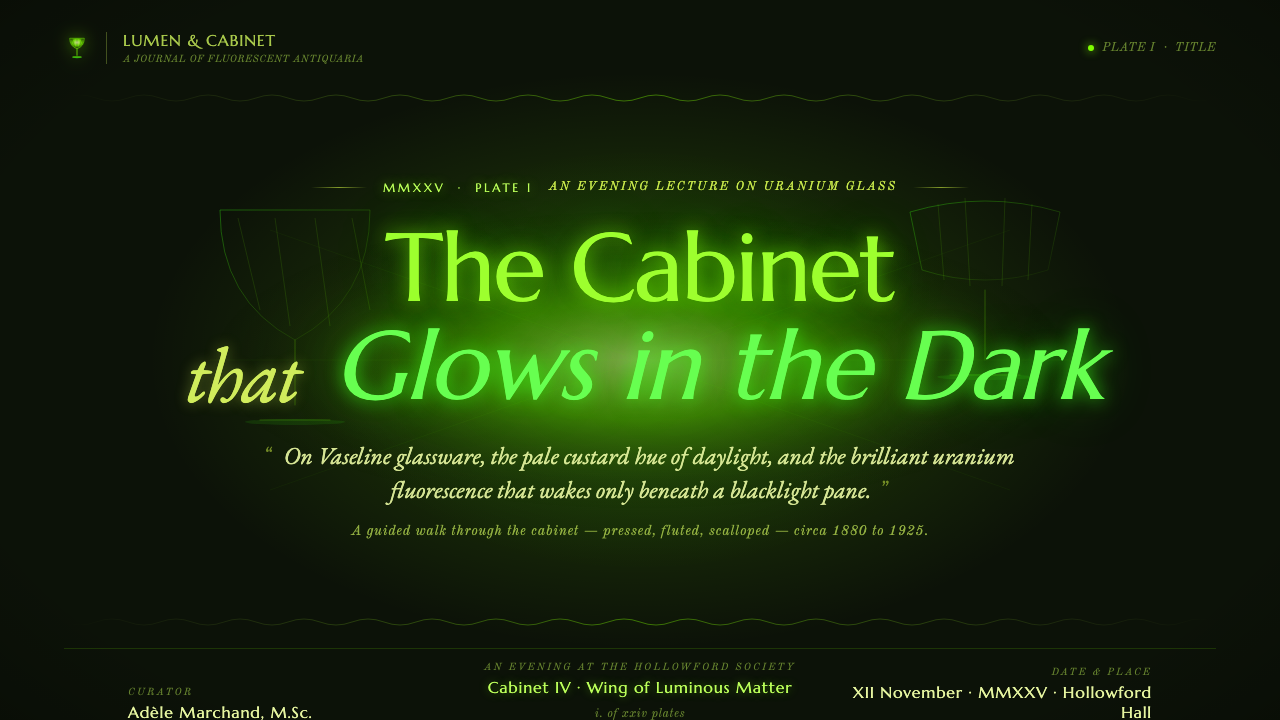
For presentation covers, build the scene around one enlarged luminous glass-like form emerging from cabinet darkness. Let a Victorian serif title sit as a restrained catalogue inscription, with supporting information kept secondary. The cover should feel like an object has been uncovered under blacklight, not like a neon poster. On content slides, preserve that discovery through a stable dark field, clear captions, and generous separation between ideas.
For data slides, treat charts as collected specimens rather than brightly decorated infographics. Keep the analytical structure calm and legible, then allow a single uranium-green series, point, or highlighted finding to carry the fluorescent role. Faceted framing devices can suggest glass without obscuring values. The contrast between sober catalogue typography and selective glow makes data feel observed and classified.
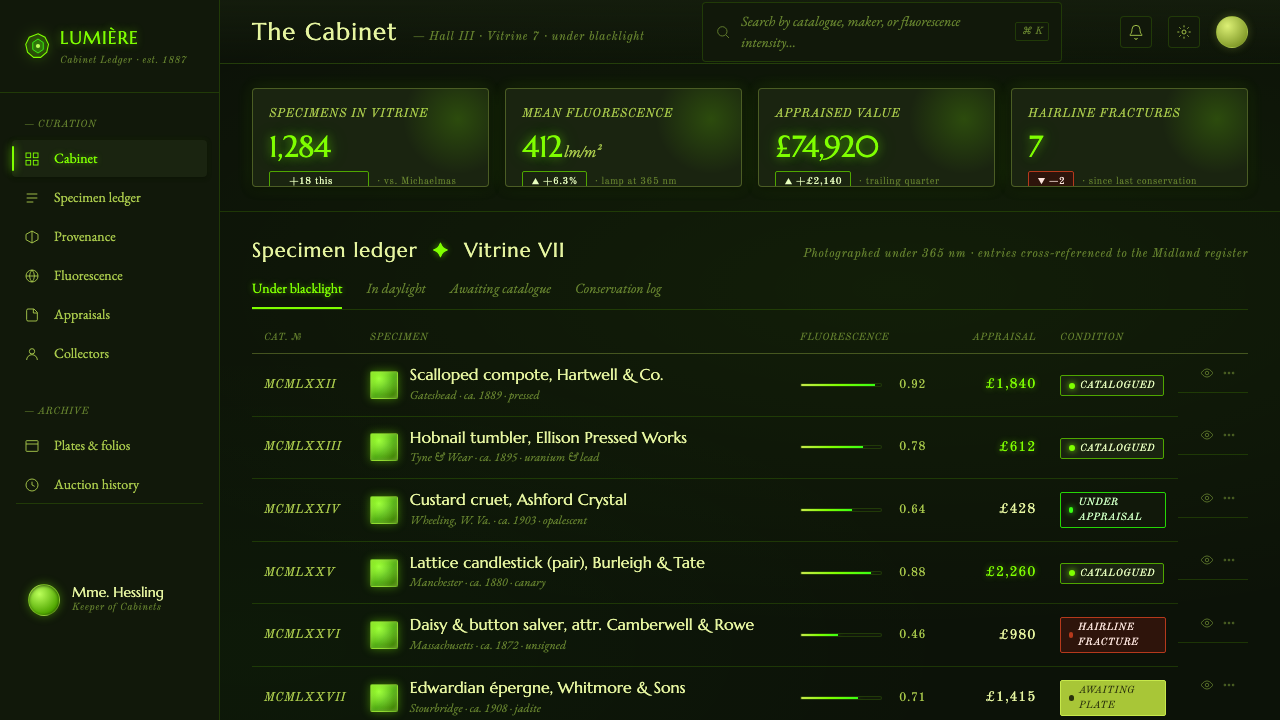
For web interfaces, this style is especially useful for collection browsers, inventory dashboards, archive views, and pricing or membership pages that benefit from rarity and discovery. Use near-black surfaces as a containing environment, Victorian serif display text for names or category headings, and luminous green only for selected states, featured artifacts, or active paths. Functional information should remain more restrained than the specimen imagery.
For editorial and marketing work, the style excels at long-form stories about objects, provenance, collecting, and material culture. Pair large isolated images or abstract glass forms with compact labels, quiet descriptive copy, and sections that feel like entries in a collector’s catalogue. Marketing can use the blacklight reveal as a narrative device: pale object, hidden property, luminous discovery, then a clear invitation to explore further.
The common mistake is to turn uranium green into a universal neon theme. When every border, heading, button, and background glows, the material story disappears and the result becomes generic cyberpunk. Another mistake is using ornate Victorian decoration everywhere. The style needs the discipline of a catalogue: darkness, sparse labels, carefully isolated forms, and a glow that remains rare enough to feel chemically surprising.
Uranium Vaseline Glass — FAQ
Is Uranium Vaseline Glass a bright-green style in every context?
No. Its defining drama depends on contrast between a pale daylight identity and an electric ultraviolet reveal. In a design system, green should therefore be concentrated in luminous specimens and meaningful highlights, while the surrounding cabinet darkness and quiet typography create the conditions for it to register. Constant glow weakens the central phenomenon.
Why use Victorian serif typography with such an unusual fluorescent effect?
The serif voice places the phenomenon in the world of nineteenth-century decorative arts and collecting. It makes the composition feel catalogued, named, and preserved rather than merely illuminated. The contrast is useful: typography supplies historical restraint and careful observation, while the glass supplies the unexpected electric event.
Does the style require literal images of antique glassware?
No. Literal objects are one route, but the system can also work through abstract prismatic facets, translucent silhouettes, and specimen-like composition. The essential cues are material transformation, cabinet darkness, selective electric green, and catalogue restraint. Abstracting the object can make the style more adaptable while preserving its collecting logic.
Where does this style work less well?
It is less suitable when a product needs immediate warmth, broad everyday friendliness, or a bright and frictionless visual tone. The cabinet-dark setting and faintly radioactive mood can make ordinary tasks feel too theatrical or too rarefied. It works best when the product genuinely benefits from curiosity, rarity, archive logic, material discovery, or a sense of contained mystery.
Related design styles
 Burgundy VineyardRead by candlelight in a wine-lees cellar. Aged purple-red Pinot on near-blac…
 Chartreuse Liqueur GreenAcid glow rules the cellar. Cormorant Garamond and brass hairlines frame yell…
 Bidriware Black MetalMonochrome luxury, hammered by hand. Matte-black Deccan patina threaded with…
 Bird of Paradise MonographTheatrical plate-book darkness. Flame plumes blaze from a bordered forest-bla…
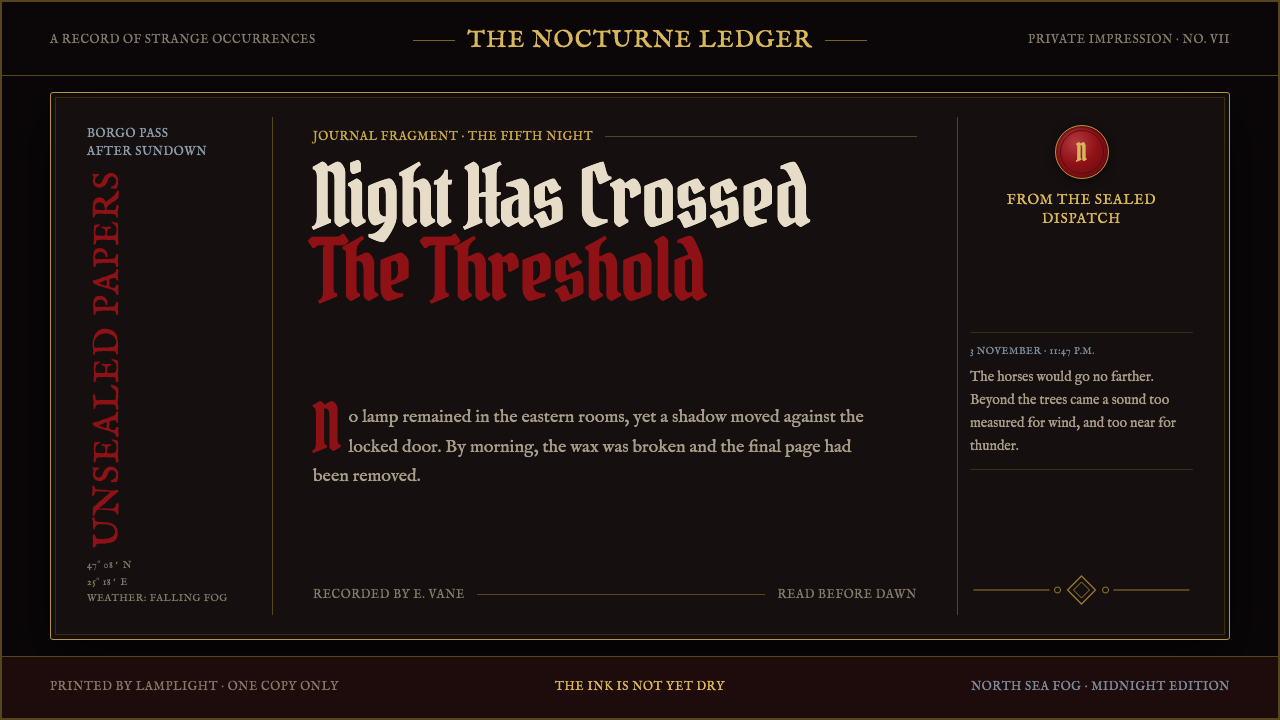 Dracula Gothic (1897)Victorian dread after dark. Blood-red initials and tarnished gilt haunt coffi…
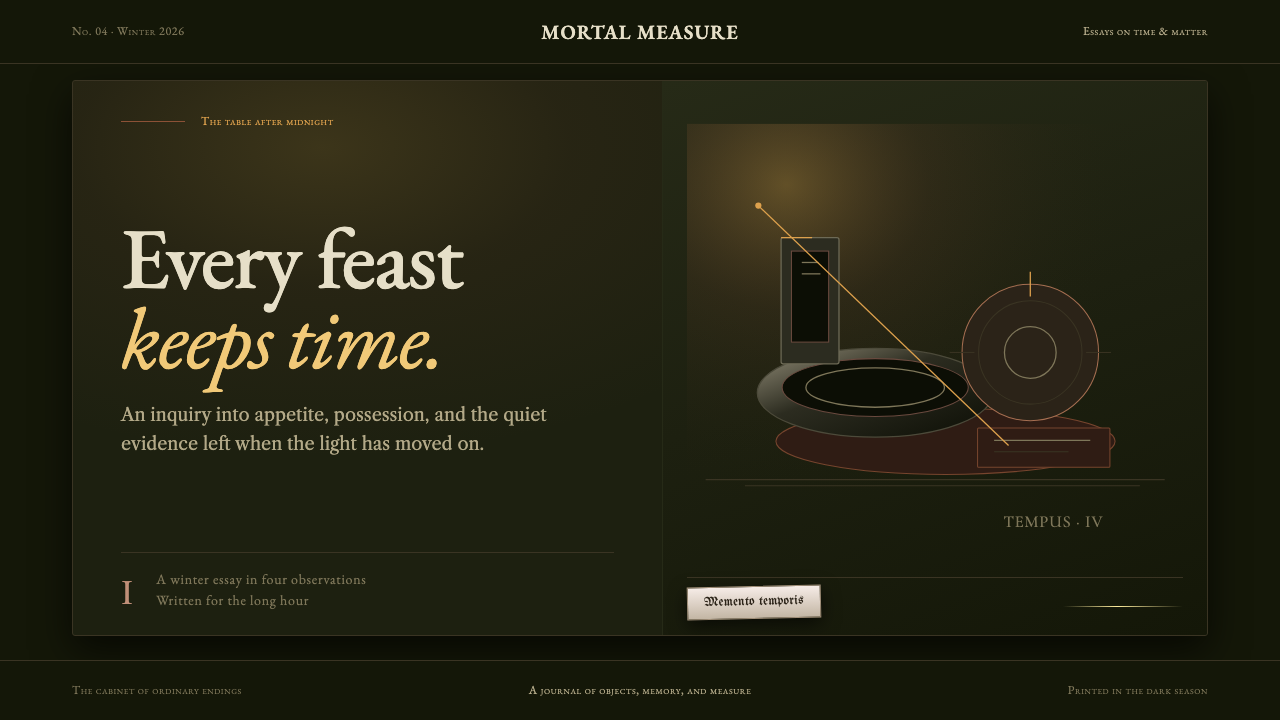 Dutch VanitasTime waits at the table. Olive-black depths, earth-brown type, and one candle…