What is UK Acid House (1989)?
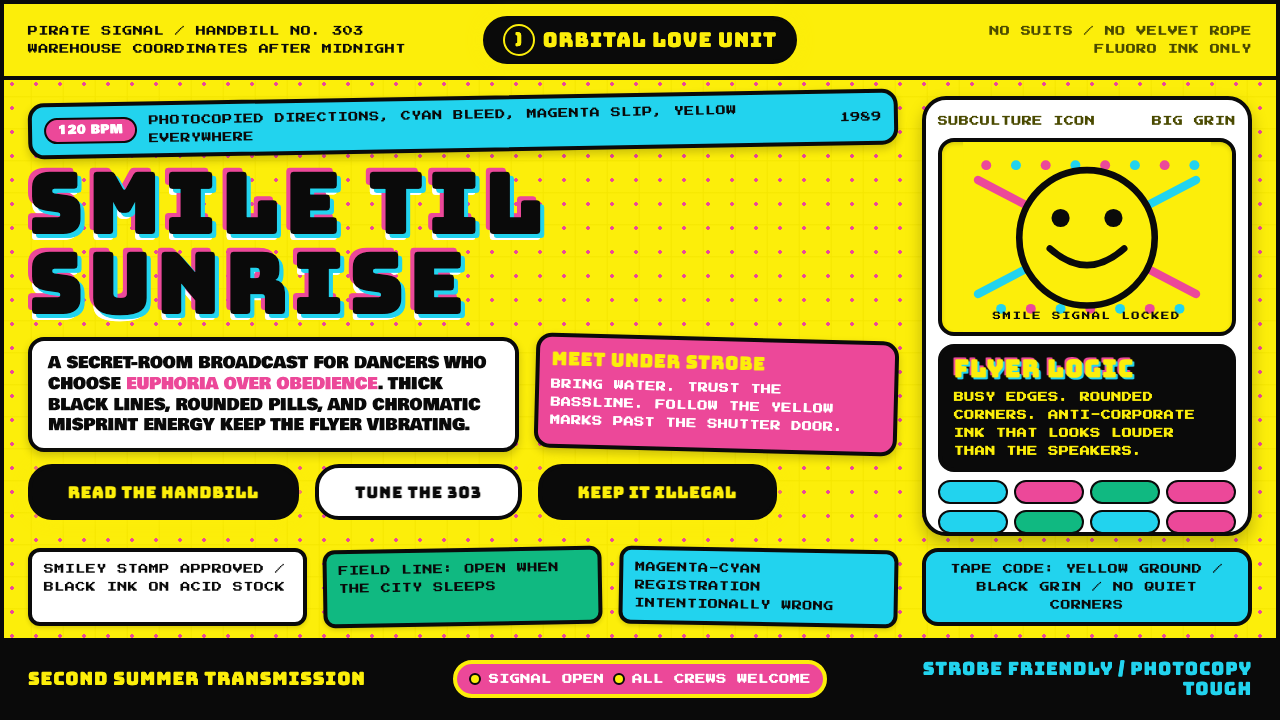
Acid House gave Britain its Second Summer of Love — and gave graphic design fluorescent yellow, melting type, and a smiley face that changed everything.
UK Acid House (1989) in brief
UK Acid House is the visual and sonic eruption that defined British youth culture between 1988 and 1990. Where punk had used torn newsprint and anger, Acid House used photocopied flyers and euphoria. The aesthetic is immediate and overwhelming: fluorescent acid yellow grounds, chunky outlined smiley faces, type that appears to melt under a strobe, and a collision of hot magenta and cyan that mimics the chromatic aberration of a cheap offset press pushed too hard. Nothing about it is restrained, and that is entirely the point.
The graphic language emerged from necessity as much as from aesthetics. Illegal warehouse parties and unlicensed raves could not advertise through conventional channels. Promoters printed their own flyers on photocopiers, using whatever fluorescent paper stock was available, layering imagery and text until the page pulsed with energy. The technical limitations of photocopying — loss of tonal range, flattening of detail, blurring of fine lines — became aesthetic virtues. The look was loud, cheap, democratic, and impossible to ignore.
As a design system, Acid House sits at the opposite pole from movements like Bauhaus or Swiss International Style. It does not seek clarity or rational structure. It seeks sensation. The style is deliberately anti-corporate and anti-authoritative, rooted in a subculture that the British government actively tried to suppress through the 1990 Entertainments (Increased Penalties) Act. That adversarial relationship with mainstream culture is baked into every design decision.

Where does UK Acid House (1989) come from?
The story begins not in Britain but in Ibiza. In the summer of 1987, four London DJs — Danny Rampling, Paul Oakenfold, Nicky Holloway, and Johnny Walker — encountered a new kind of party at the Amnesia club in Ibiza, where DJ Alfredo was mixing American House music, Balearic pop, and electronic dance tracks to a crowd united by ecstasy and open-air euphoria. When these four returned to London, they brought the music, the spirit, and the intent to recreate it. Rampling opened Shoom at a small London fitness club in January 1988; Oakenfold launched Spectrum at Heaven. These were the ignition points.
The visual identity of the early scene was shaped almost entirely by informal, guerrilla means. Shoom's flyers — hand-drawn, photocopied, distributed by hand in record shops and on the street — established the template: smiley faces, bold block lettering, bright yellow, and an energy that seemed to vibrate off the paper. Garry Mouat, who produced many of the early Shoom flyers, became one of the scene's first graphic voices. The smiley face itself — a simple circle with dot eyes and a curved line — predated Acid House by decades, but the scene adopted it as its universal emblem, the rave equivalent of the CND symbol for an earlier generation.
Manchester's contribution was equally decisive. The Haçienda, owned by Factory Records and New Order, became the northern home of the movement from 1988 onward. The Madchester scene that grew around it fused Acid House with indie guitar music, producing a distinctly British mutation of the original American genre. The graphic output from Factory Records and the associated design studio Designers Republic — based in Sheffield, closely linked to the extended rave ecosystem — pushed the visual language in a more sophisticated direction, introducing structured grid chaos, information overload as an aesthetic strategy, and a deadpan ironic tone that contrasted with the pure hedonism of the London flyer scene.
By 1989 — the year the movement reached its peak and its first mass-media moment — the visual aesthetic had spread across Britain via a network of orbital rave promoters who organized parties along the M25 motorway ring road encircling London. Events like Energy, Biology, and Fantazia drew tens of thousands of attendees to fields and warehouses across the home counties. Each event generated its own flyers, and the cumulative visual output of that single year represents one of the most concentrated bursts of amateur graphic energy in British cultural history. The government crackdown that followed — culminating in the Criminal Justice and Public Order Act of 1994 — pushed the scene underground and accelerated its commercialization, eventually producing the mainstream rave aesthetic that would dominate the mid-1990s. But the original 1988–1990 window remains the defining period.
What defines the UK Acid House (1989) look?
Color
The palette is built on a foundation of saturated acid yellow — a yellow so intense it reads as almost radioactive — used as the dominant background or ground color. Against this, hot magenta and electric cyan appear as primary accents, often in close proximity to create a chromatic vibration effect that mimics cheap print misregistration. Black is heavy and structural, used for outlines and bold type. White appears as a breathing point rather than a neutral ground. Fluorescent versions of all these colors were common on printed flyers, where the paper stock itself glowed under ultraviolet light at club venues.
The Smiley
The acid smiley face — a circular form with minimally suggested eyes and a wide upturned mouth, almost always outlined in thick black strokes — is the movement's most persistent visual icon. It is not used decoratively; it functions as a symbol and an attitude. The face is typically rendered without refinement: imprecise curves, uneven weights, and hand-drawn quality are features, not flaws. Repeated at different scales and angles across a layout, it creates rhythm and visual noise simultaneously. Its deliberate naivety signals community membership and rejection of professional polish.
Typography
Type in the Acid House aesthetic is aggressive, rounded, and physical. Heavy display letterforms — often with rounded terminals and thick strokes that echo the smiley's visual weight — dominate compositions. Condensed and expanded variants are mixed freely, scale is exaggerated for emphasis, and baseline alignment is treated as optional. Letters appear to vibrate, inflate, or melt; this distortion is achieved through photocopying, manual stretching, or layering. All-caps is common for headers; when lowercase appears, it tends to be in soft, rounded forms. Legibility is secondary to impact.
Density and Overload
Acid House layouts are dense to the point of crowding. Text, imagery, and graphic elements compete for space rather than cooperate within a hierarchy. This is not an accident or failure of composition — it is a direct translation of the sensory environment of the rave itself, where bass frequencies, strobe lights, and crowd density all operate simultaneously at overwhelming levels. Negative space is minimal; when it appears, it reads as a momentary pause rather than a compositional choice. The goal is saturation.
Chromatic Aberration and Misregistration
A defining technical signature of the style is the deliberate simulation — or actual occurrence — of chromatic aberration and print misregistration. When two or more color layers are offset from each other, edges appear to bleed or ghost in contrasting colors, creating a visual vibration that reads simultaneously as error and energy. In original rave flyers, this effect was often genuinely accidental, the result of cheap printing. In contemporary applications of the style, it is recreated deliberately as a period-accurate marker of authenticity and as a tool for generating optical tension.
Hand-Made and Photocopied Texture
Authenticity in the Acid House aesthetic comes from evidence of the human hand and the mechanical imperfection of reproduction. Rough cut-and-paste collage, visible photocopy grain, ink bleeds, uneven registration, and hand-lettered passages all signal that this was made by people for people, outside the commercial design apparatus. In contemporary digital applications, this texture is recreated through grain overlays, halftone patterns, and deliberate imprecision in spacing and alignment. The anti-refinement principle is central: too much polish kills the energy.
Circular and Pill Forms
Beyond the smiley face, the broader formal vocabulary of Acid House favors curved and rounded shapes over angular or rectilinear ones. Circular badges, oval text containers, pill-shaped buttons, and bubble-like speech forms recur across the visual landscape. This preference for roundness connects to both the physical feel of the scene — pills, balloons, the soft geometries of inflatable decor — and to the psychedelic visual culture that informed it. Sharp corners and straight edges, associated with corporate and governmental authority, are systematically avoided.

Who shaped UK Acid House (1989)?
Rampling is widely credited as the central figure in importing the Ibiza sound and atmosphere to London. His club night Shoom, launched in January 1988 at a small fitness club in Southwark, is the event most frequently cited as the starting point of UK Acid House culture. The Shoom flyers — produced with his wife Jenni — established the visual template for the entire movement: smiley faces, fluorescent yellow, ecstatic energy. Shoom drew a small, devoted crowd that functioned as the scene's first inner circle, and its members went on to become promoters, DJs, and designers across the British rave landscape.
Oakenfold was one of the four London DJs who experienced the Ibiza scene in 1987 and returned to transform British dance music. His club night Spectrum at Heaven — later renamed Land of Oz — was Shoom's more accessible counterpart, drawing larger crowds and helping spread Acid House beyond its initial inner circle. As a producer and DJ, Oakenfold also shaped the sonic identity of the movement, and the visual language of his events — large-format flyers with psychedelic imagery and bold type — contributed to the developing graphic vocabulary of the scene.
Mouat was the graphic designer most closely associated with the early Shoom visual identity and is one of the few people who can be called a trained designer within the otherwise amateur graphic landscape of early UK Acid House. His flyers for Shoom and other early London events brought a degree of intentional composition to a scene that was largely improvised. The smiley face iconography that became the movement's emblem was developed and disseminated primarily through his work during this period.
Founded in Sheffield in 1986 by Ian Anderson, Designers Republic (tDR) became the most internationally visible graphic studio to emerge from the extended British rave ecosystem. Though not strictly a Shoom-generation outfit, tDR's work for Warp Records, the Sheffield rave scene, and numerous electronic music labels developed the visual language of post-Acid House into a more systematic, ironic, and globally-legible form. Their approach — combining information overload, brand pastiche, grid chaos, and sharp typographic wit — influenced graphic design internationally through the 1990s and into the 2000s.
Not a designer but an organizer, Colston-Hayter was the most prominent of the M25 orbital rave promoters whose events in 1989 brought Acid House to tens of thousands of people across Britain. His promotion company Sunrise organized events that were, by the standards of the time, logistical feats: thousands of people directed via phone trees and pirate radio to remote locations at short notice. The flyers and communications for these events — distributed through a network of record shops and word of mouth — constitute a significant portion of the visual archive of peak Acid House.
How do you use UK Acid House (1989) today?
UK Acid House is a high-intensity style that works in specific contexts and fails in others. Its power lies in creating immediate visceral impact — the visual equivalent of a bass drop. Applied correctly, it signals energy, authenticity, subcultural knowledge, and deliberate anti-establishment attitude. Applied incorrectly, it reads as chaotic, untrustworthy, or simply noisy. Understanding what the style is communicating is a prerequisite for using it effectively.
For presentation slides, Acid House works best in contexts where the subject matter can sustain the energy: launch decks for entertainment, music, nightlife, fashion, or youth-culture brands; internal culture decks that need to break through institutional tedium; pitch materials for creative agencies where the style itself demonstrates capabilities. Cover slides should commit fully to the aesthetic — acid yellow ground, oversized chunky type, smiley motif or chromatic aberration effect as the primary graphic statement. Content slides require more restraint: a strong accent color on white or cream, one level of type hierarchy done in a bold rounded face, and a clear reading hierarchy beneath the surface noise. Data slides benefit from the aesthetic's print-heritage — bar charts and graphs rendered with thick strokes and bold color fills read as confident, physical, and immediate rather than corporate.
For web and digital interfaces, the style is well-suited to landing pages, event pages, and promotional micro-sites for music, nightlife, festival, or streetwear brands. A dashboard or SaaS product interface in Acid House would be exceptional and risky — the style communicates attitude over utility, and overuse in functional contexts creates fatigue quickly. Where it does appear in web UI, it tends to work in single-screen promotional contexts: a splash page, a ticket purchase flow, an artist profile. Pill-shaped buttons, rounded input fields, and bold color hover states are natural translations of the style into interactive components. Navigation should use heavy type with generous letter-spacing rather than icon-based menus.
For editorial and marketing work — especially for music releases, brand campaigns targeting younger audiences, and any content positioned as culturally aware — Acid House offers strong visual differentiation in a landscape saturated with clean sans-serif minimalism. A print or digital editorial layout using this style might feature a full-bleed acid yellow opening spread, a body text treatment using a bold rounded typeface at tight leading, section breaks marked with smiley icons or thick color rules, and pull-quotes set in large, distorted display type. Marketing campaigns can use the style's poster heritage effectively: a single overloaded image panel with layered type makes a stronger social media asset than a composed minimal layout, because it rewards scrutiny and stopping-the-scroll.
A common mistake when applying Acid House is treating it as merely a color palette exercise. Adding fluorescent yellow and a smiley face to an otherwise conventional layout does not produce Acid House design — it produces a layout with a yellow accent and a smile icon. The style's power comes from the totality of its approach: density, texture, typographic aggression, chromatic collision, and above all a resistance to the refinement instincts that modern design education instills. The second common mistake is applying it uniformly across all touchpoints regardless of context. Acid House is a statement style, not a system style — it works as a moment of intensity, not as the ambient register for an entire brand.

UK Acid House (1989) — FAQ
How is UK Acid House different from other rave or club aesthetics from the same era?
The 1988–1990 Acid House peak has a specific visual signature that distinguishes it from subsequent rave aesthetics. It is rougher, more hand-made, and more rooted in photocopied print media than the later hardcore, jungle, or drum-and-bass scenes that followed. It relies on the smiley face as a specific icon — something later scenes largely dropped. The color palette, centered on acid yellow, is more restricted than the rainbow polychromy of early 1990s rave. Compared to Madchester — its northern British contemporary — it is less ironic and more purely hedonistic. Compared to the Detroit techno visual tradition it was influenced by, it is warmer, louder, and more communal.
Can Acid House work for professional or corporate contexts?
Only with significant modulation. The style's core identity is anti-corporate, and deploying it in conventional business contexts creates an inherent tension that can read as either ironic (which may be the intention) or simply incoherent. It works best when the brand genuinely inhabits the attitude the style communicates — youth culture, entertainment, creative industries, or any context where subversiveness is a genuine value proposition rather than a borrowed veneer. Modulated Acid House — where the palette is retained and the density is reduced, the smiley dropped, and the typographic aggression dialed back — risks losing the style's energy entirely. Half-measures rarely succeed here.
Is the smiley face always necessary when using this style?
The smiley is the style's most recognizable signifier and using it makes the cultural reference immediately legible. But it is not always necessary, and in some contexts it can feel like a costume rather than a design decision. The underlying visual system — acid yellow grounds, chromatic aberration, dense rounded typography, fluorescent accent palette — can function as a coherent Acid House aesthetic without the literal smiley icon. This approach is useful when the design needs to evoke the energy and period without foregrounding the specific cultural reference, or when the smiley has been so widely commercialized in the surrounding context that its use would read as generic rather than specific.
How do you prevent the style from looking like a pastiche or costume?
The distinction between authentic use and pastiche usually comes down to whether the visual choices are driven by the design problem or by the desire to signal awareness of the reference. Pastiche announces itself: it reaches for the smiley, the yellow, and the misregistration as proof of cultural knowledge, then stops. Authentic application asks what the style is actually doing structurally — how density creates energy, how color collision creates tension, how typographic imprecision signals community — and uses those mechanisms to solve the specific design problem at hand. The historical source material also matters: designers who have engaged with actual rave flyers and record sleeves from 1988–1990 produce visually different results from those who have only seen the style filtered through contemporary references.
Does the style work equally well in light and dark modes?
The canonical Acid House palette is light-ground: acid yellow is a foreground and background color against which dark outlines and fluorescent accents operate. A dark-mode inversion is historically less accurate but not incoherent — many record sleeves and some flyers from the period used black grounds with neon accents. On a dark ground, the style's characteristic palette shifts: acid yellow becomes a dominant highlight rather than a background wash, magenta and cyan retain their vibrancy, and white type replaces black outlines. The key risk in dark inversion is that the density and layering that gives the style its energy can become harder to read at low brightness, where fluorescent colors lose their apparent luminosity. Testing the palette under different ambient light conditions is more important for this style than for most.
Related design styles
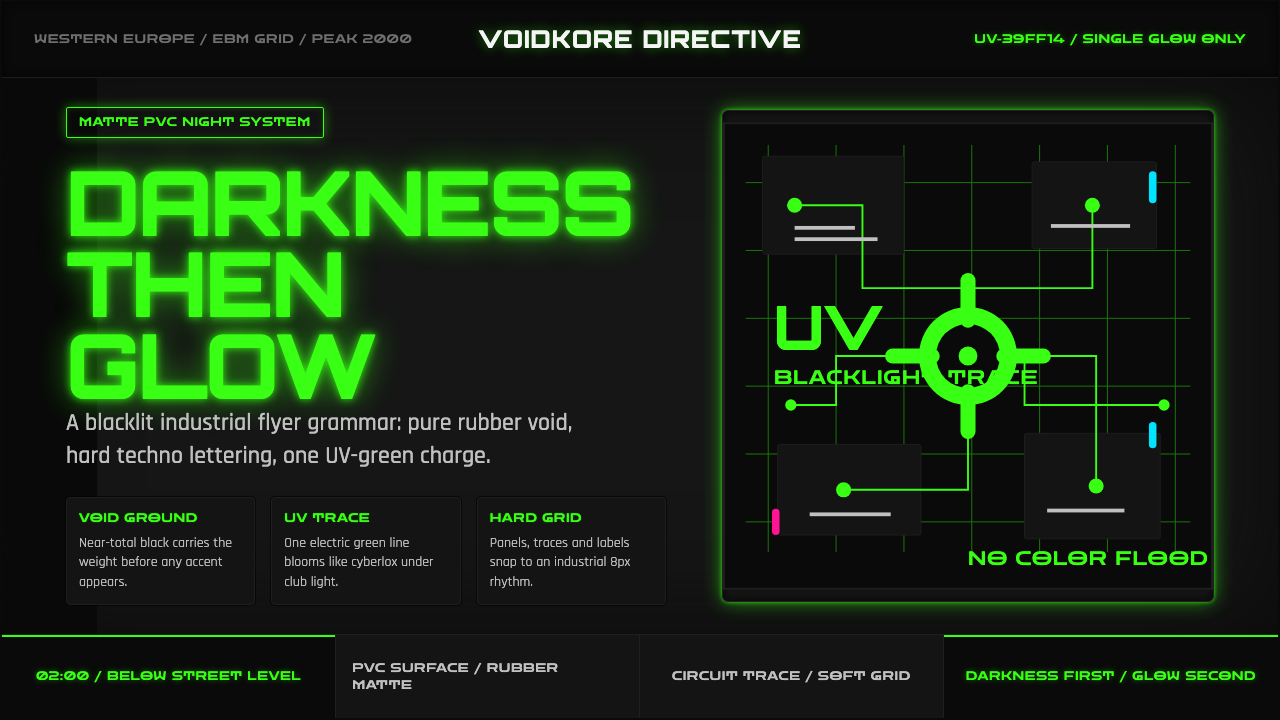 Cybergoth RaveDarkness rules. Pure black PVC is split by one UV-green circuit glow.
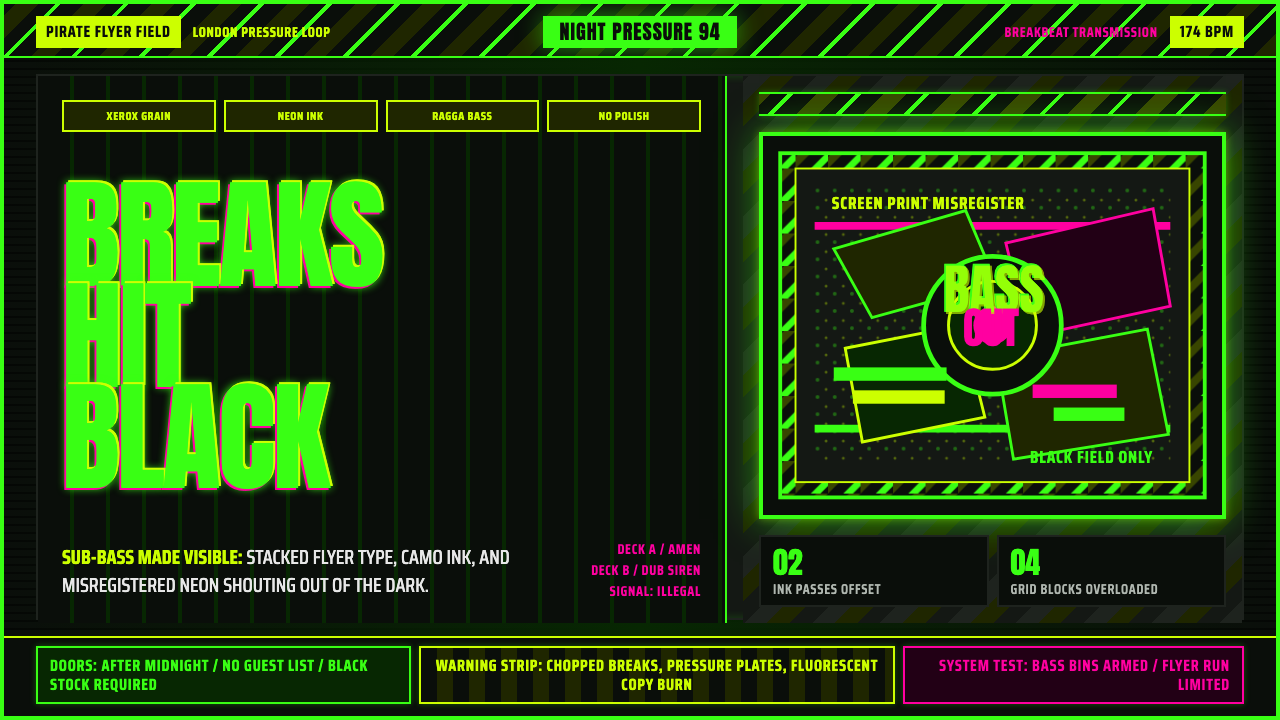 Jungle / Drum & BassRaw rave voltage. Neon green Anton, camo strips, and xerox grain hit black.
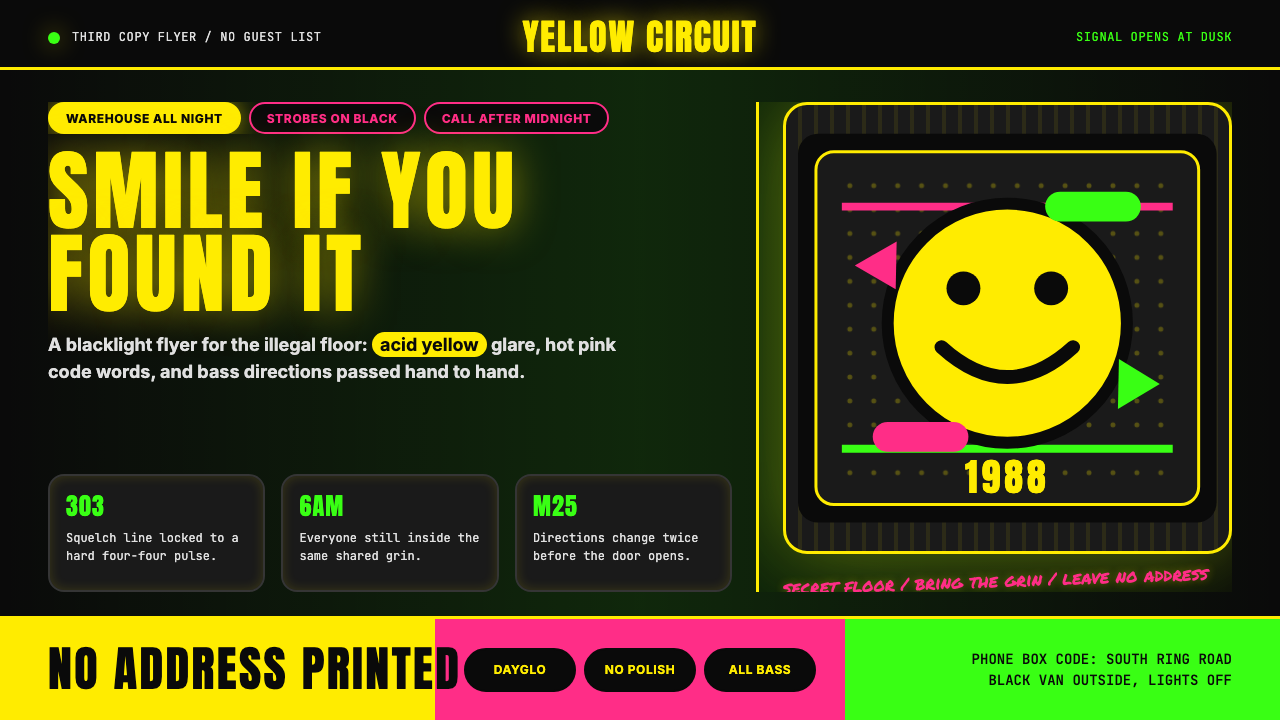 Acid House Smiley (1988)Rave energy hits first. Acid yellow on black, Anton caps, smiley glow.
 Akira (Otomo)Cyberpunk at impact. Kaneda red, cyan kanji, halftone concrete, and diagonal…
 Arcade Cabinet MarqueeToo loud to ignore. Black-indigo glass, violet glow, cyan grids, hot-pink arc…
 Detroit TechnoCold machines dream. Electric cyan circuits and chrome display type lock to a…