What is Neon Genesis Evangelion?
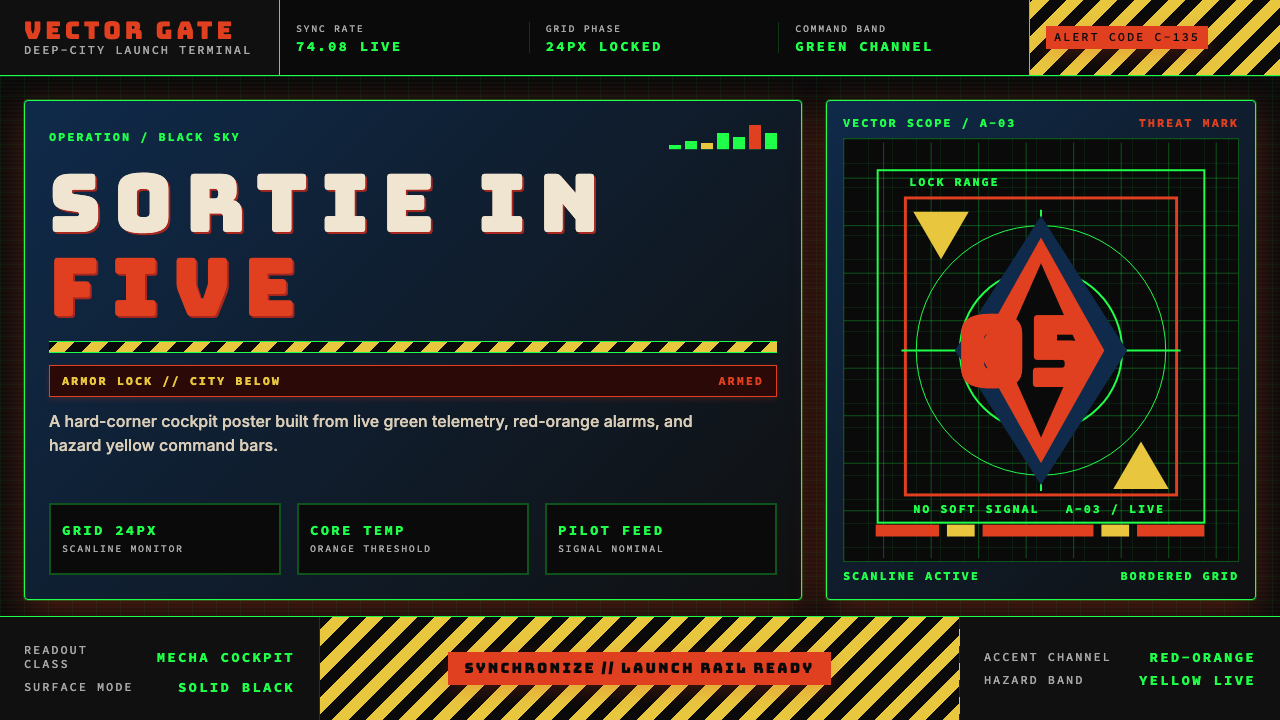
Evangelion turns the cockpit into a design system — deep-black surfaces, tech-green readouts, and saturated-red-orange alarms that make every screen feel like a sortie countdown.
Neon Genesis Evangelion in brief
Neon Genesis Evangelion is the 1995 mecha-anime television series created by Hideaki Anno at Gainax studio that fused giant-robot spectacle with existential dread. Its visual language — NERV's tech-green UI grids, EVA-01's saturated red-orange armor plating, Tokyo-3's deep-black sky, and the hazard-yellow chevrons stenciled across everything operational — became the gravitational center of every mecha and post-apocalyptic anime that followed, and has since escaped its medium entirely to influence game UI, dark-mode web design, and industrial-themed brand identities.
As a design vocabulary, Evangelion is cockpit aesthetics under pressure. Deep-black grounds are interrupted by sparse, high-contrast readouts in tech-green — not a decorative green but the specific, slightly cold green of phosphor monitors and radar screens. Against that ground, saturated red-orange explodes for alarms and warnings, and hot yellow marks hazard zones and structural boundaries. Type is monospaced and terse, as though rendered on cathode-ray terminals. The overall effect is of a system built for life-or-death legibility: everything visible has a reason to be visible, and nothing is decorative.
The aesthetic draws from multiple real-world sources that Anno and character designer Yoshiyuki Sadamoto absorbed in production: cold-war military control rooms, NASA mission displays, industrial safety signage, and the phosphor-screen UIs of early 1990s workstations. Evangelion synthesized these references into a coherent and emotionally charged visual system — one where the relentlessness of the interface communicates the relentlessness of the world the characters inhabit.

Where does Neon Genesis Evangelion come from?
Neon Genesis Evangelion aired on TV Tokyo from October 1995 to March 1996, produced by Gainax, the independent studio founded by anime fans that had already made its name with Gunbuster (1988) and Nadia: The Secret of Blue Water (1990). Hideaki Anno, who directed the series, entered production in a state of severe depression — a biographical fact the show absorbed and transformed into its central subject matter. What began as a commission for a conventional mecha property mutated, episode by episode, into something far stranger: a series that weaponized its own production constraints, broke its visual grammar deliberately in the final episodes, and insisted on treating its teenage pilots as psychologically realistic human beings rather than genre archetypes.
The visual design emerged from a collaboration among several key figures. Anno directed and conceived the overall visual tone. Yoshiyuki Sadamoto, the character designer, gave the series its distinctive human proportions — elongated, angular figures that contrast sharply with the massive, inhuman scale of the Evangelion units. Ikuto Yamashita was responsible for the mechanical design of the EVA units and the angular, biomechanical structures of NERV's underground headquarters, drawing on aerospace engineering sketches, submarine interiors, and images of industrial infrastructure. The UI and screen graphics — the cascading kanji text, the hexagonal targeting overlays, the MAGI supercomputer readouts — were developed under Anno's supervision as a coherent fictional interface language, drawing on real computer-terminal aesthetics of the early 1990s.
Composer Shiro Sagisu's score contributed an unexpected dimension to the visual identity: the contrast between propulsive orchestral action themes and Beethoven-era classical works used in moments of psychological collapse created an emotional dissonance that the visual system mirrors. The show's willingness to hold still on a static image — a single architectural frame, an empty corridor, a close-up on an eye — for dramatically extended periods also defined the aesthetic, proving that restraint and emptiness could be as expressive as action.
The original 1995–1996 broadcast series was followed by the theatrical film The End of Evangelion in 1997, which provided an alternate conclusion that pushed the visual language toward its logical extreme — hallucinatory sequences that dissolved the tech-green cockpit aesthetic into psychological abstraction. Then came the Rebuild of Evangelion tetralogy, produced by Anno's new studio Khara, released across 2007 to 2021, which reconstructed the original story with contemporary production values while preserving the core color vocabulary intact. The persistence of the visual system across three decades — original broadcast, the 1997 film, and four Rebuild features — is testimony to how precisely it was originally conceived.
What defines the Neon Genesis Evangelion look?
Color Palette
The Evangelion palette is structured around three functional color roles deployed against deep black. Tech-green — the cool, slightly desaturated green of phosphor monitors — carries all informational readouts and ambient interface glow: it reads as data, as machine intelligence, as operational status. Saturated red-orange appears exclusively for alerts, warnings, and critical states: it is the color of danger acknowledged and escalated. Hot yellow marks physical hazard boundaries, structural warnings, and industrial chevrons. The three together operate like a traffic signal hierarchy, but one designed for cockpit panic rather than pedestrian safety. Deep black is not a neutral ground but an active void — the visual weight of absolute darkness against which the three accent colors detonate.
Typography
Evangelion typography is defined by monospaced, terminal-derived letterforms — the visual grammar of machine output rather than human authorship. Text appears in tight, controlled clusters: status labels, coordinate readouts, unit designations. Hierarchy is established not through expressive typeface choices but through scale contrast and color assignment: large designations in tech-green, small metadata in dimmer tones. The occasional intrusion of Japanese kanji in cascading readout columns adds a layer of cultural density and controlled illegibility — the user understands that there is more data than they can process, and that the machine is always producing it. All type behavior communicates system state, never personality.
Grid and Interface Structure
Evangelion interfaces are organized by tight, modular grids — panels, hexagonal cells, overlapping translucent layers — that suggest a sophisticated underlying information architecture. The grid is not decorative: each cell has a designated function, and the visible boundaries between cells communicate that the data is organized, classified, and under control even when the content is dire. Hexagonal grid overlays, targeting reticles, and circular radar sweeps introduce organic geometry — forms drawn from nature and from weapons systems — that contrasts with the rectangular panel grid and prevents the aesthetic from feeling purely orthogonal.
Depth and Layering
Unlike flat design systems that eliminate all depth cues, Evangelion aesthetics depend on the controlled use of translucency and overlay. Interface panels are semi-transparent, allowing darker background information to bleed through; alert overlays appear on top of operational displays without completely obscuring them. This layering communicates that all information is simultaneously present and that the operator must manage multiple channels at once. The depth is functional rather than decorative — it is the visual representation of information overload held just barely under control.
Hazard Markings and Industrial Signage
Evangelion borrows heavily from industrial safety culture: the yellow-and-black chevron stripe, the stenciled warning label, the bold clearance marking. These elements appear throughout NERV's architecture and EVA unit surfaces, and they serve a double function. Operationally, they communicate that this is a real environment with real physical dangers. Aesthetically, they prevent the tech-green-and-black palette from becoming purely sleek — the hazard markings are rough, physical, analog interventions in a digital environment. They are the trace of the human hand in a machine world.
Psychological Darkness
Evangelion's visual system is not just a technical interface style — it carries an emotional tone specific to the series. The combination of deep black, cold green, and harsh red-orange produces an atmosphere of constant threat and fatigue. Unlike cyberpunk neon, which tends toward energetic spectacle, Evangelion's palette is weighted and oppressive: the lights in this world are not decorative illuminations but warning signals and survival indicators. When applying this aesthetic, the underlying emotional register — anxiety, vigilance, the sense of operating under conditions of extreme stress — is part of what the palette communicates, not an accidental byproduct.
Motion and Urgency
Even in static applications, Evangelion aesthetics imply motion and urgency through compositional decisions. Diagonal cuts, alert borders that suggest animation, text positioned at the edge of readable space, and numerical countdowns embedded in layouts all create the impression that the current state is transitional — that something is about to happen. This is the aesthetic of the moment before sortie: a state of suspended but imminent action. Effective static applications of this style lean into that quality of held breath, using composition and scale contrast to create visual tension without relying on actual animation.

Who shaped Neon Genesis Evangelion?
Anno directed and conceptually shaped every dimension of Evangelion's visual language. His decision to draw interface aesthetics from real-world military control rooms, early-1990s computer terminals, and industrial safety signage — rather than purely from prior anime conventions — gave the series a visual credibility that distinguished it immediately from its contemporaries. His willingness to hold still on empty architecture, negative space, and deliberately degraded imagery in the final episodes proved that the aesthetic could absorb psychological disruption and become more powerful for it. The visual system Anno built has outlasted the series itself and remains a live reference in game design, dark-mode UI, and post-apocalyptic brand identity.
As character designer, Sadamoto established the human scale against which the series' inhuman scale is measured. His elongated, angular figures — with their large eyes and psychologically legible expressions — carry the series' emotional weight in counterpoint to the cold machine aesthetic of the interface systems. Sadamoto's design work ensures that the viewer always feels the human cost embedded inside the technical spectacle. He later adapted the series into a manga that ran from 1994 to 2013, demonstrating how the visual system translates to a static, ink-on-paper medium — and confirming that the aesthetic depends on color and form relationships rather than on the animation medium specifically.
Yamashita's mechanical designs for the EVA units and NERV's underground infrastructure translated the series' conceptual ambiguity — the EVAs are both weapons and living beings — into visual form. His approach drew on aerospace engineering blueprints, submarine schematics, and biological cross-sections simultaneously, creating machines that read as both constructed and grown. The angular, stressed-surface quality of his mechanical designs established the material vocabulary that the UI elements were then required to coexist with: a world of extreme physical engineering in which the interface systems are just another layer of engineered control.
Sagisu's score for Evangelion is directly relevant to understanding the visual aesthetic because it operates by the same logic of tonal collision. His juxtaposition of propulsive orchestral action music with Beethoven-era classical works — heard in moments of psychological breakdown and introspective paralysis — created an emotional dissonance that the visual system mirrors in its own terms: the cold, legible clarity of the interface against the psychological chaos of the characters inhabiting it. The score demonstrated that the Evangelion aesthetic is not simply a dark color palette but a complete sensory argument about the relationship between operational clarity and existential despair.
Gainax, the studio that produced the original 1995–1996 series, was itself an institution whose visual culture shaped Evangelion's aesthetic. Founded by anime fans, it brought a reverence for technical detail and a willingness to experiment with visual grammar that conventional broadcast production studios rarely attempted. When Anno founded Studio Khara to produce the Rebuild of Evangelion tetralogy (2007–2021), the studio's approach was to preserve the core visual vocabulary while upgrading the production means — demonstrating that the aesthetic was a principled system capable of surviving a generational production shift, not a period artifact of mid-1990s anime.
How do you use Neon Genesis Evangelion today?
Evangelion aesthetics translate powerfully into presentation and slide design, particularly for technology products, security platforms, and any context where conveying operational authority and technical depth is more important than warmth or approachability. A cover slide benefits from the full weight of the palette: a deep-black full-bleed background with a bold tech-green headline, a single red-orange accent element — a structural line, a category tag, a geometric border — and sparse, monospaced metadata in a dimmer tone. The effect is immediately distinctive and communicates seriousness without needing any figurative imagery. Content slides should restrain the palette: keep backgrounds near-black, use tech-green for headlines and active states only, and use white or light gray for body text to maintain readability. Data visualization slides are where the aesthetic earns its keep — bar charts and line graphs rendered with tech-green bars, red-orange alert thresholds, and yellow reference lines map directly onto the cockpit readout language and make data feel urgent and operational.
For web UI and dashboard design, the Evangelion aesthetic is particularly well-suited to monitoring dashboards, developer tools, security consoles, and dark-mode applications where the interface needs to communicate that it is always-on, always watching, and always processing. Define a strict panel grid — modular rectangular sections separated by thin structural lines rather than heavy borders — and treat each panel as a distinct data zone. Use tech-green sparingly for active metrics, current values, and primary interactive states. Reserve red-orange for error states, critical thresholds, and destructive actions; reserve yellow for warnings and caution states. Everything else should be near-black, dark gray, or very low-contrast white. Navigation and labels should be monospaced or at minimum geometric, never humanist.
For pricing pages and feature comparison tables, the aesthetic works well when the product being sold has genuine technical complexity and a professional buyer. A dark-background pricing table with tech-green highlights on the recommended tier, red-orange badges for enterprise or critical features, and monospaced type throughout communicates that this is software built by people who understand the domain deeply. Avoid using the palette for consumer products where the buyer's primary decision factor is emotional confidence — the aesthetic reads as imposing rather than inviting in those contexts.
For editorial, marketing, and campaign design, Evangelion aesthetics support strong information hierarchy and a distinctive visual voice, but require careful scope management. A full-bleed dark background with tech-green headlines and red-orange call-to-action elements creates high-impact hero sections and announcement banners. The hazard-chevron motif — alternating yellow and black diagonal stripes — works as a structural divider or border accent in editorial layouts, communicating urgency without using explicit language. Poster and social card applications benefit from the palette's natural tension: even a single bright accent against deep black reads as high-stakes and immediate.
The most common mistake when applying this aesthetic is over-illuminating the design — using too many bright accent colors at once, across too many elements, until the deep-black ground disappears and the result looks like generic cyberpunk rather than Evangelion's specifically controlled cockpit language. The palette's power comes entirely from restraint: most of the composition should be dark, with tech-green, red-orange, and yellow deployed as precise, purposeful signals in a field of darkness. A second common error is using rounded corners and soft shadows, which contradict the aesthetic's angular, mechanical grammar — all container edges should be sharp, and any shadow used should be hard and directional. A third is decorative use of the monospaced type convention: in this aesthetic, monospaced type communicates machine output and system data; using it for body text or marketing copy without that functional justification breaks the internal logic and reads as costume rather than system.

Neon Genesis Evangelion — FAQ
How is Evangelion different from generic cyberpunk?
The distinction is in emotional register and compositional discipline. Cyberpunk neon aesthetics — think Blade Runner or Akira — tend toward sensory abundance: multiple colors, high-density visual information, the spectacle of the future made overwhelming. Evangelion's palette is deliberately impoverished by comparison: three functional colors against deep black, with the black dominant. The emotional tone is not energy and possibility but vigilance and dread. Compositionally, cyberpunk embraces visual maximalism — layered signage, dense crowds, glowing advertisements — while Evangelion's interfaces are sparse and controlled, communicating that every visible element has earned its presence. If a design feels exhilarating, it is leaning cyberpunk; if it feels oppressive and precise, it is closer to Evangelion.
Can this aesthetic work on a light or white background?
It can adapt, but with significant concessions. The palette's power comes from the contrast between bright functional signals and an absorptive dark ground — deep black is not a stylistic choice but a structural necessity. On a white or light ground, tech-green becomes an accent color competing with black body text rather than an ambient glow reading against darkness; the result loses the cockpit-readout legibility logic entirely. A practical adaptation for light-mode contexts is to treat the Evangelion palette as a dark-panel system within a light UI: sections, cards, or callout blocks in near-black can carry the full palette while the surrounding page remains light. The pure dark version is always stronger.
Does the monospaced type convention apply to all text, or only certain elements?
Only to elements that have a machine-output or system-data function in the layout. Status labels, coordinates, numerical readouts, timestamps, version numbers, unit designations — these are natural candidates for monospaced treatment because they are communicating system state. Body text, descriptive copy, and marketing language are not machine output; applying monospaced type to them breaks the internal logic of the aesthetic and produces something that reads as styling rather than system. A well-executed Evangelion-aesthetic layout might mix monospaced type for data elements with a geometric or condensed sans-serif for headings and body, with the monospaced type reserved as a marker for machine-generated or operational content.
Is this aesthetic appropriate for consumer-facing products?
It depends entirely on what emotional contract the product is making with the user. Evangelion aesthetics communicate operational authority, vigilance, and technical seriousness — they are appropriate when those qualities align with the product's promise. A cybersecurity platform, a developer tool, a financial data terminal, a game or entertainment product with a military or post-apocalyptic theme — these contexts invite the palette. Consumer products built on trust, warmth, accessibility, or sensory pleasure — food, wellness, social, children's products — will find the aesthetic hostile to their goals. The palette's inherent message is that the system is in control, not the user; in contexts where user empowerment and delight are primary values, that message is counterproductive.
How do you avoid the aesthetic feeling dated or tied to 1990s anime specifically?
The 1995 origin is a strength, not a liability, if the design commits to the underlying functional logic rather than quoting surface details from the show itself. The aesthetic becomes dated when it relies on specific iconography — the distinctive NERV logo, direct EVA unit references, recognizable kanji panels — because those elements are nostalgic callbacks rather than functional design choices. The version that ages well is the one that understands what the visual system is actually doing: using dark grounds and sparse, color-coded signals to create a high-contrast, high-legibility operational interface. That logic is timeless because it derives from military and industrial design practice that preceded the anime and has continued to evolve since. Applied at the level of system logic rather than surface quotation, the aesthetic reads as contemporary dark-mode interface design with a disciplined visual personality.
Related design styles
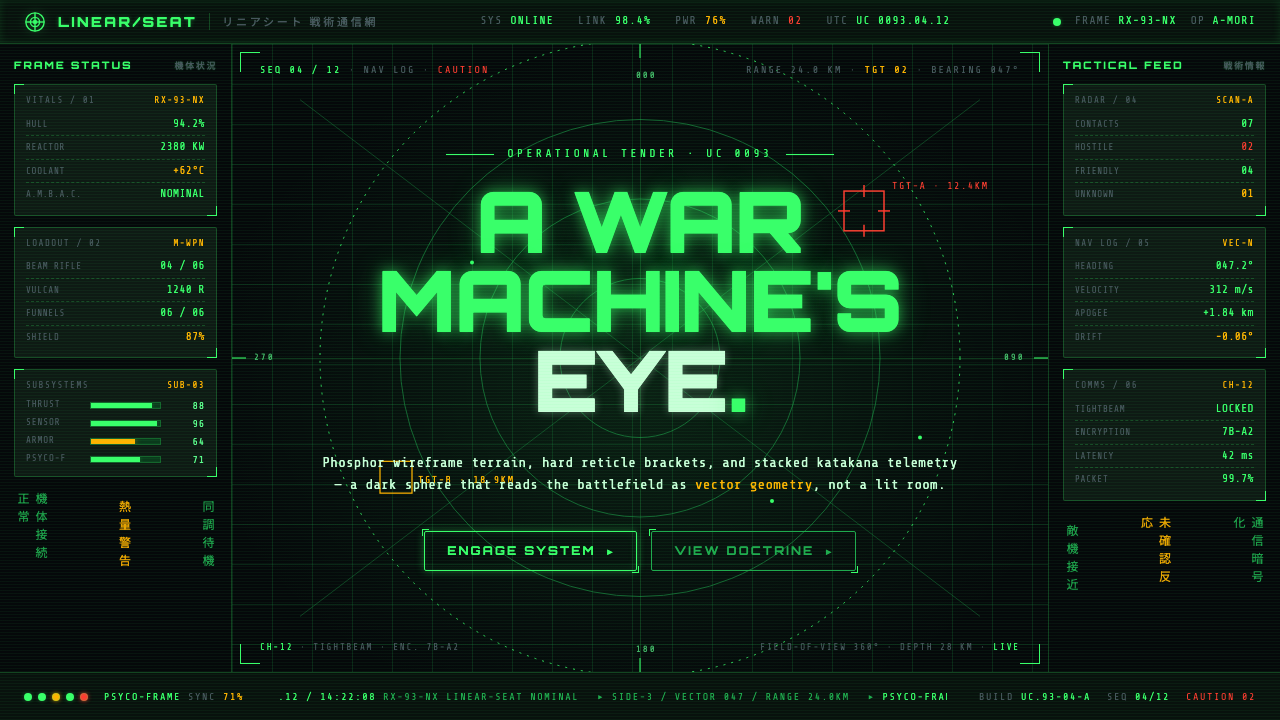 Gundam Universal Century UIA war machine's eye. Phosphor wireframe and katakana telemetry glow inside a…
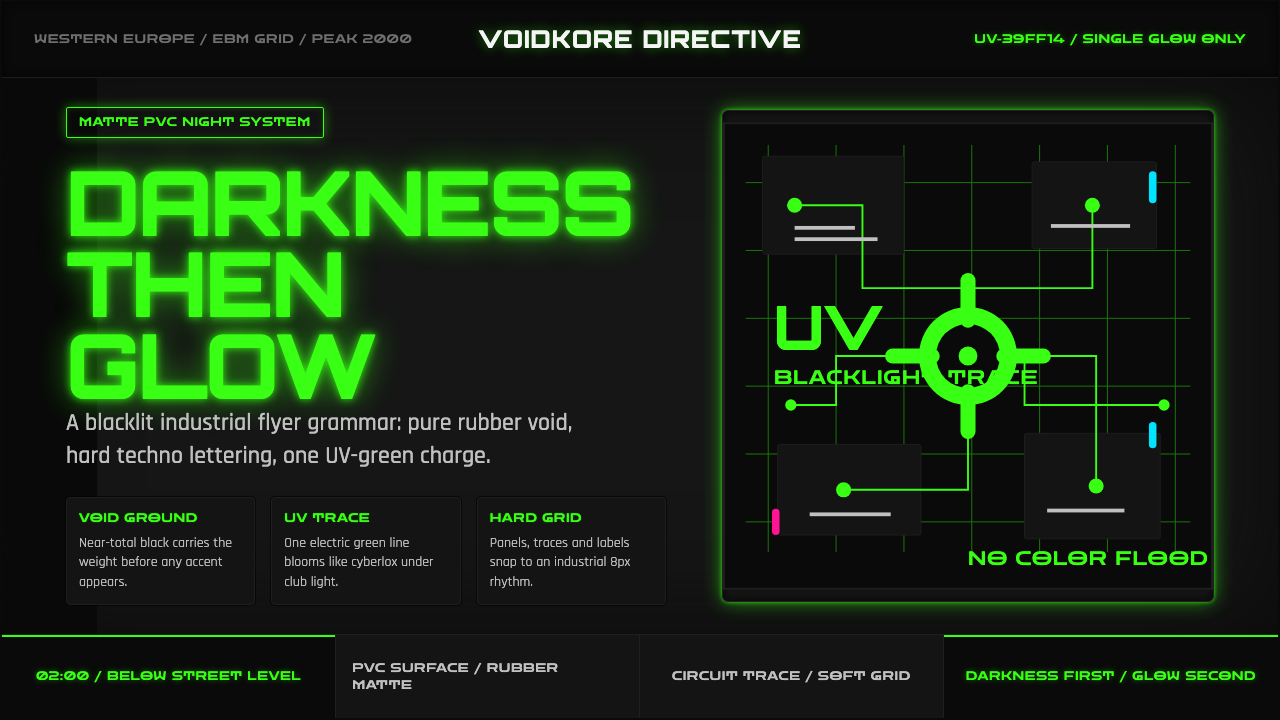 Cybergoth RaveDarkness rules. Pure black PVC is split by one UV-green circuit glow.
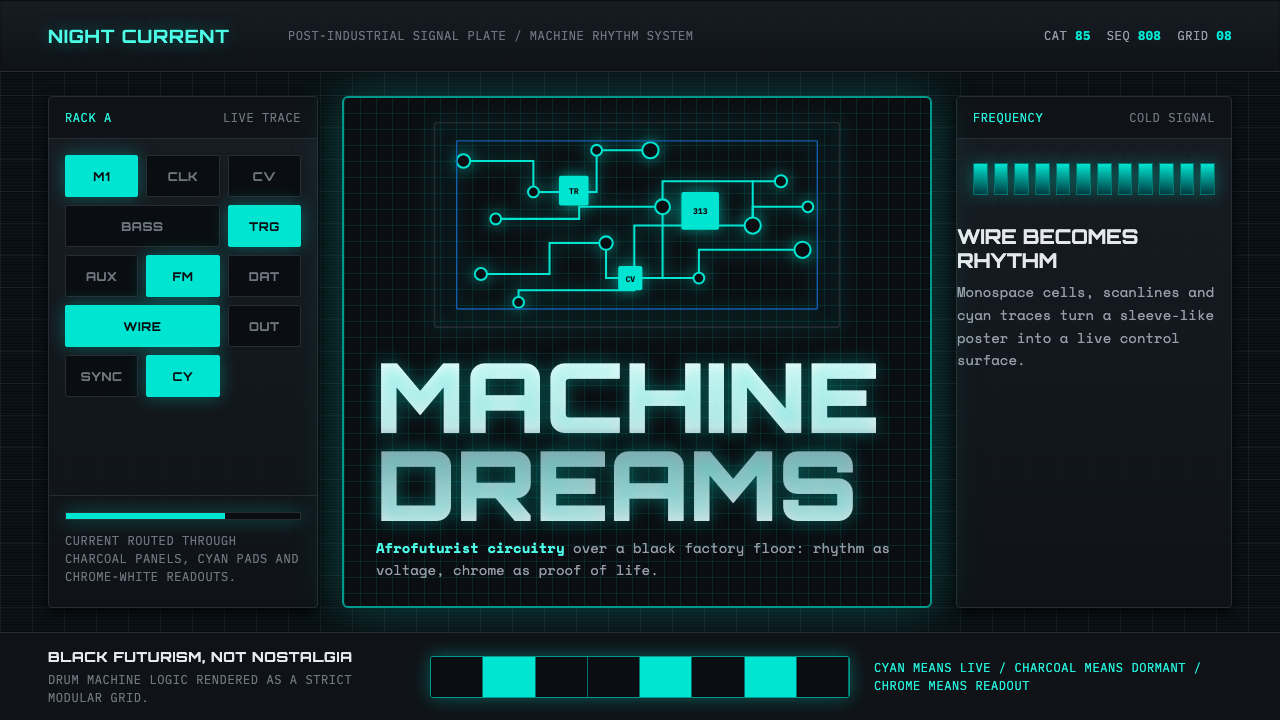 Detroit TechnoCold machines dream. Electric cyan circuits and chrome display type lock to a…
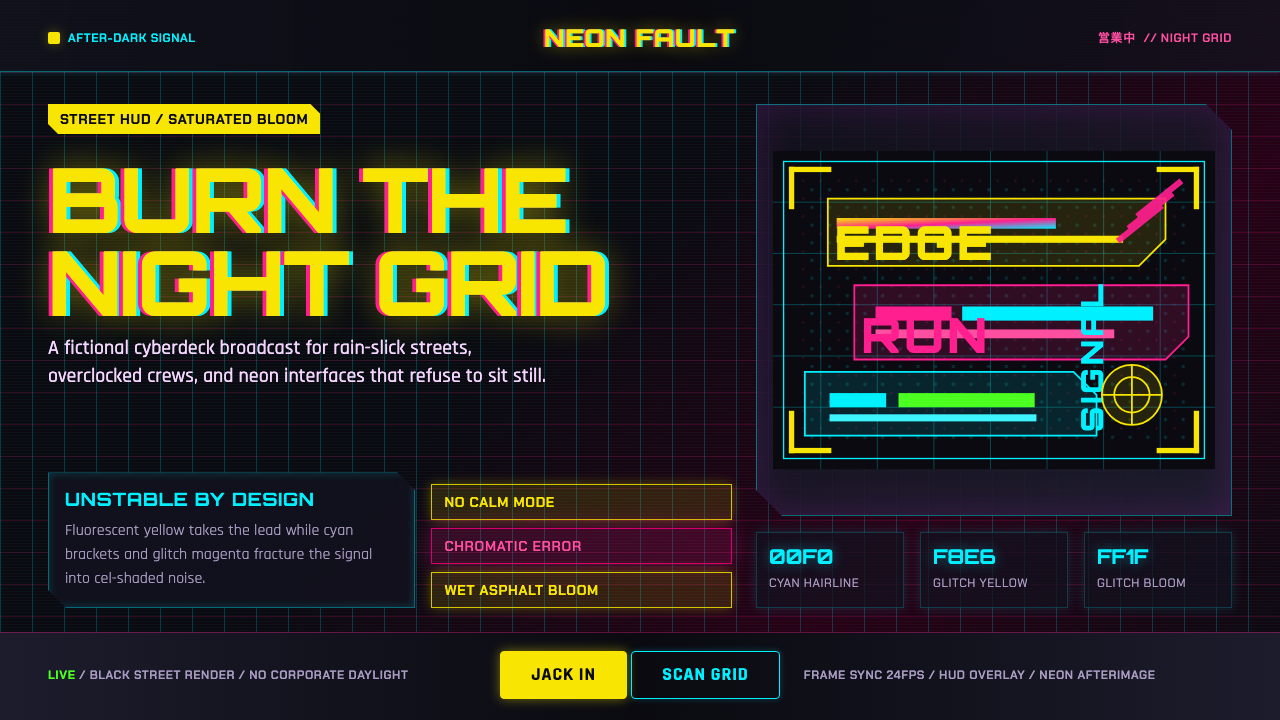 Edgerunners NeonNeon overload. Fluorescent yellow, cyan HUD grids, and magenta glitches burn…
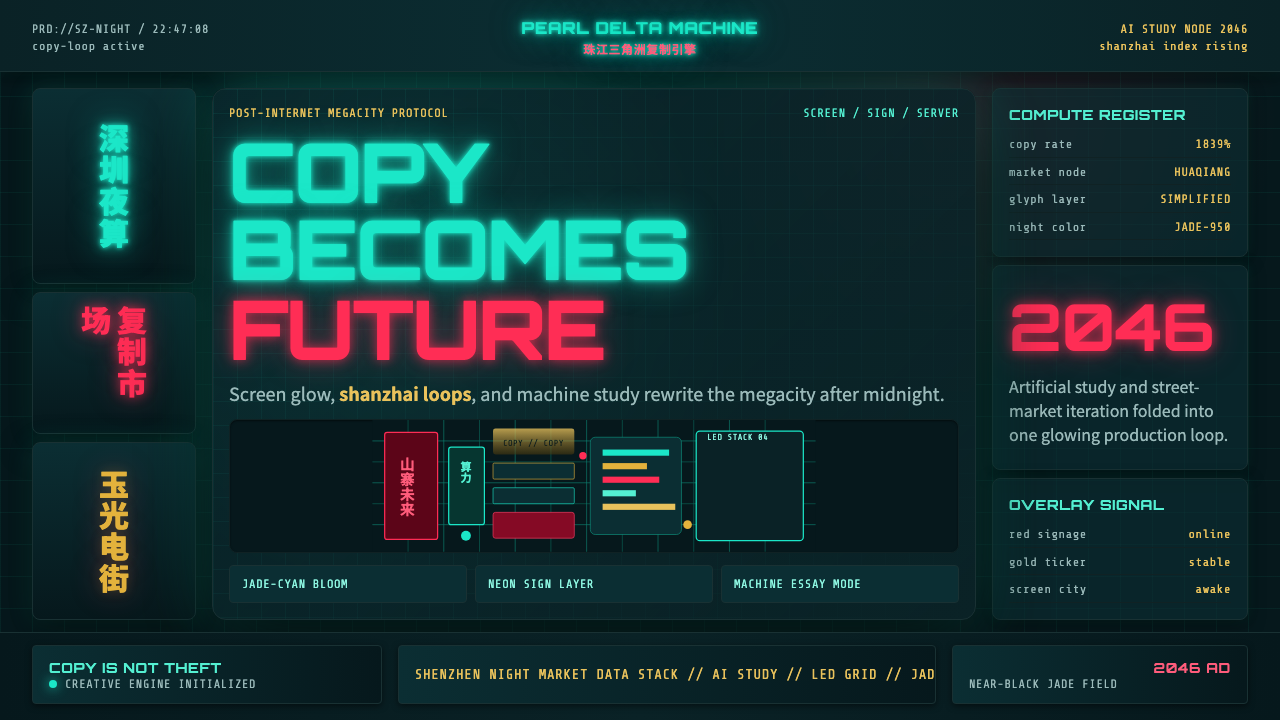 SinofuturismCopy becomes future. Jade-cyan grids, red signage, and Orbitron data stack th…
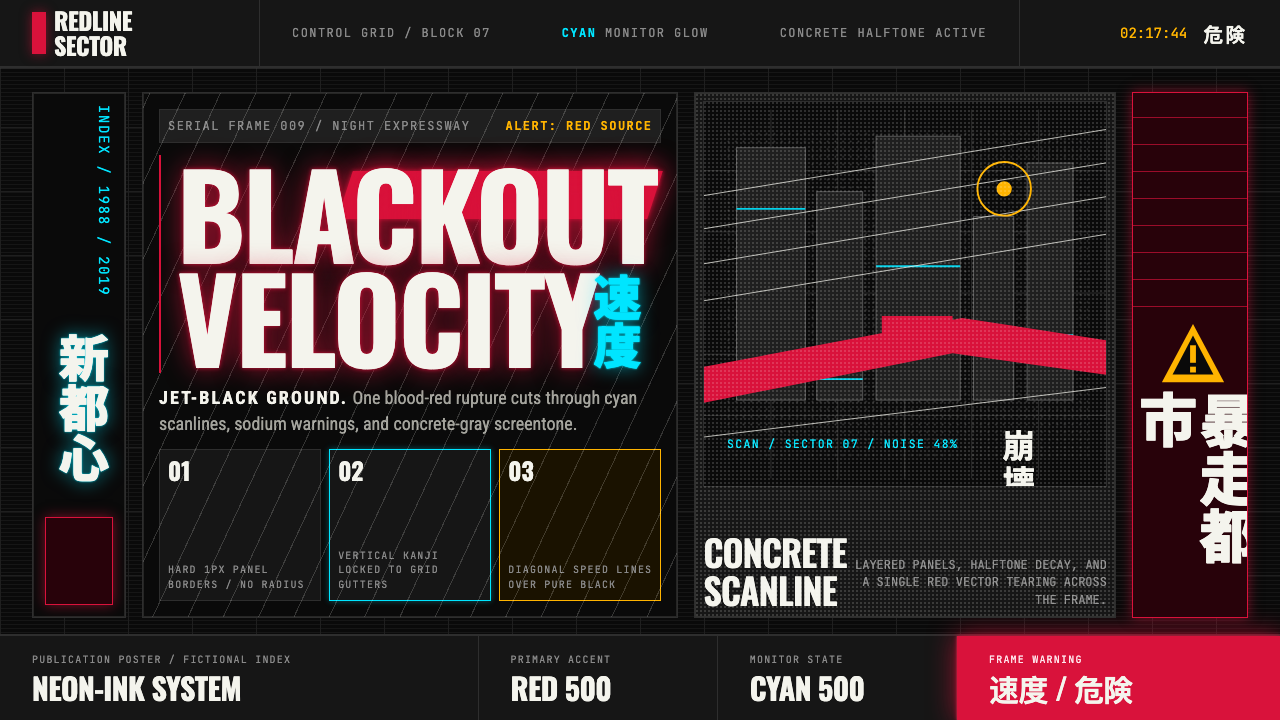 Akira (Otomo)Cyberpunk at impact. Kaneda red, cyan kanji, halftone concrete, and diagonal…