What is Trulli Alberobello?
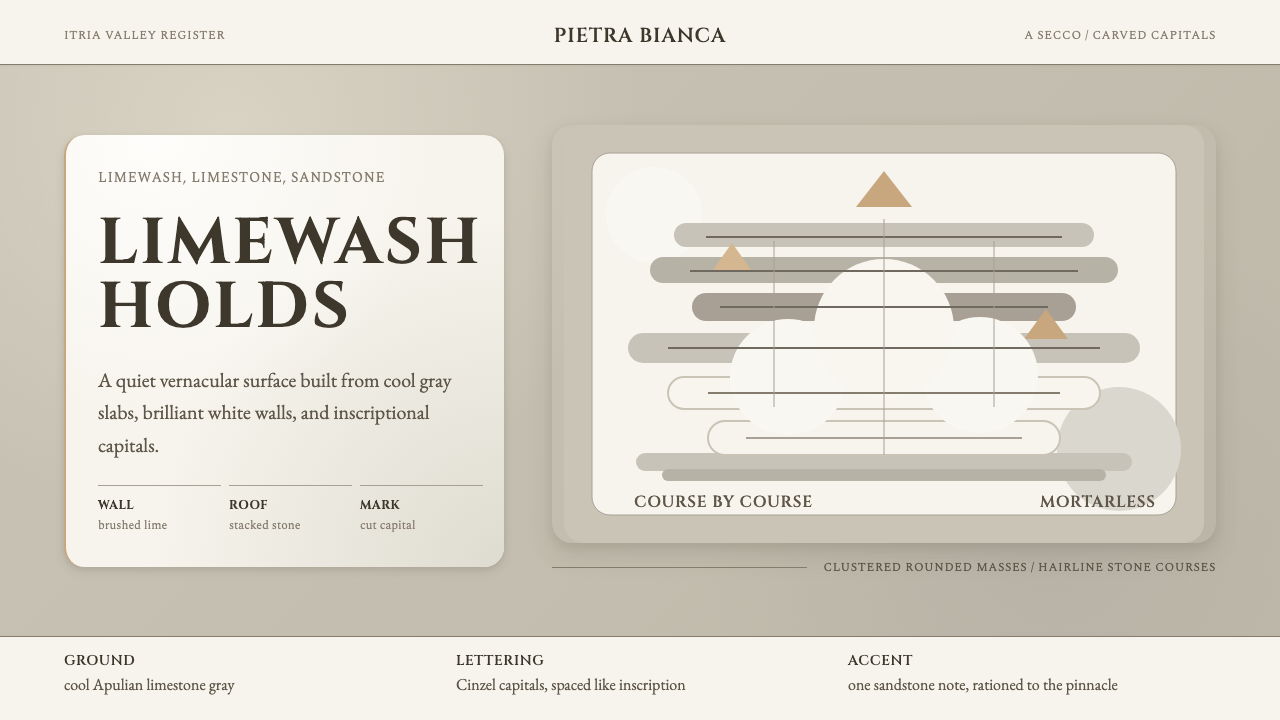
Trulli Alberobello is quietly monumental — cool limestone gray, limewash white, and carved Roman capitals, built up by hand, course by course, without a drop of mortar.
Trulli Alberobello in brief
Trulli Alberobello style is drawn from the trulli of Alberobello, the dry-stone, conical-roofed dwellings of the Itria Valley in the Puglia region of southern Italy — a UNESCO World Heritage vernacular building tradition that predates 1900. A trullo's most striking feature is the contrast between its two building materials: brilliant-white limewashed cylindrical walls beneath a bare gray cone built from stacked local limestone slabs, known regionally as chiancarelle, each roof crowned by a carved sandstone pinnacle and marked with hand-painted symbols.
As a design register, this is humble, handmade, and quietly monumental rather than showy. Cool gray stone functions as the grounding material, limewash white as the primary wall surface, and headings are rendered in carved Roman capital letterforms, as though cut directly into a pinnacle rather than printed on a page. Nothing in the system is glossy or smooth in the industrial sense; texture is rough, irregular, and clearly the product of hand labor rather than machine production.
The defining discipline of the style is its rejection of mortar and its embrace of visible, course-by-course construction. Every element — from the stacked stone cone to the carved capital letters — should read as though it was built up layer by layer by a craftsman working with the material's own limits, rather than poured, printed, or smoothed into uniformity.

Where does Trulli Alberobello come from?
The trulli tradition of the Itria Valley predates 1900 and was formalized as a distinct vernacular building practice between the seventeenth and nineteenth centuries, though its dry-stone construction method — corbelled stonework assembled without mortar, known as a secco construction — draws on much older Mediterranean building techniques found across the region. The valley's town of Alberobello, whose historic center consists almost entirely of trulli dwellings, was inscribed as a UNESCO World Heritage site in recognition of this unbroken vernacular tradition.
The mortarless, corbelled construction method was not merely a stylistic choice but a practical and, according to local tradition, sometimes a tax-driven one: buildings without mortar could reportedly be dismantled quickly, which some local histories connect to taxation practices of the period that assessed permanent structures differently from temporary ones. Whatever the precise historical motivation, the building method produced a structural logic — stone stacked in narrowing rings to form a self-supporting cone — that required no binding material and left every course of stone visible.
The anonymous Apulian dry-stone masons who built and maintained these structures worked within a strict material vocabulary: local limestone for the conical roof, limewash for the cylindrical walls, and carved sandstone for the pinnacle finials that crown each roof. Many pinnacles and roof surfaces carry hand-painted symbols, often religious or astrological in reference, applied directly onto the roughly conical stone surface rather than onto a smoothed or prepared substrate.
This vernacular tradition sits within the broader lineage of Mediterranean dry-stone and corbelled architecture found across the region, but Alberobello's version is distinctive for the density and completeness of its surviving urban fabric — an entire town built in this idiom rather than isolated examples. That completeness is part of why the trulli aesthetic reads today as a coherent design system rather than a single architectural curiosity.
What defines the Trulli Alberobello look?
Cool Limestone Ground
A cool, neutral gray drawn from the region's local limestone functions as the system's structural material color, most often appearing in roof-cone or roofing-adjacent surfaces. It carries weight and permanence without warmth, grounding the brighter limewash white against something solid and quarried.
Limewash White Walls
The cylindrical wall surfaces are rendered in a brilliant, slightly chalky white — the product of traditional limewash rather than a flat, uniform industrial paint. This white should read as applied by hand, with the faint irregularity of a brushed or washed surface rather than a perfectly even digital fill.
Carved Roman Capitals
Headings are set in carved-letterform capitals evoking Roman inscriptional lettering, as though cut into stone rather than printed. The letterforms should feel monumental and formal without excess ornament, echoing the carved sandstone pinnacles that crown each conical roof.
Course-by-Course Texture
Surfaces and structural elements should visibly reveal the layered, course-by-course logic of dry-stone construction — a stack of distinguishable, slightly irregular horizontal bands rather than a smooth monolithic surface. This visible layering is the system's most distinctive structural signature.
Mortarless Discipline
Nothing in the system should suggest a smooth, seamless, poured or molded quality. Every joint, seam, or transition should read as a dry-stacked junction between two distinct, hand-placed elements — a discipline that separates authentic trulli-derived work from a generic "stone texture" filter applied over a smooth base.
Hand-Painted Symbols
Small hand-painted marks, often geometric or symbolic in character, appear sparingly and directly on rough surfaces rather than on a prepared, smooth substrate. These marks function as personal or ritual signifiers rather than decorative pattern, and they should never be repeated into a dense, wallpaper-like tiling.
Cone-and-Cylinder Geometry
The underlying spatial logic pairs a cylindrical base with a conical crown, a proportional relationship that can be echoed structurally in layout — a rounded, grounded lower section paired with a narrowing, pointed accent above it — rather than through literal illustration of a building.

Who shaped Trulli Alberobello?
The trulli of Alberobello have no single named architect; they were built and maintained over generations by anonymous local masons working within a shared, orally transmitted building vocabulary — local limestone for the roof, limewash for the walls, carved sandstone for the pinnacle. Their collective, uncredited craftsmanship is the sole authorship behind the entire visual and structural system this style draws from.
How do you use Trulli Alberobello today?
Trulli Alberobello style suits any product or communication that wants to feel humble, handmade, and quietly monumental rather than polished and corporate. Applying it well means preserving the visible layering of dry-stone construction and resisting the urge to smooth textures into a uniform digital surface.
For presentation slides, a cover slide benefits from pairing the cool limestone gray with a large area of limewash white, title set in carved Roman capitals as though cut into a pinnacle. Content slides should use the cone-and-cylinder proportional relationship as a compositional device — a grounded lower section of text paired with a narrower, pointed accent element above — while data visualizations can use the course-by-course texture idea, rendering stacked or layered charts as distinguishable horizontal bands rather than smooth gradients.
For web interfaces, the style is well-suited to heritage, craft, hospitality, and slow-living brands that want to signal authenticity and human labor rather than machine-made uniformity. Card components should carry visible, slightly irregular edges rather than perfectly smooth borders; navigation and headings work well in the carved-capital letterform treatment, while body text should remain plain and legible to avoid over-ornamenting the system.
For editorial and marketing work, the register suits travel, architecture, and craft content with genuine cultural grounding. Full-bleed sections using the limewash white against the limestone gray work well as chapter breaks, and marketing hero sections benefit from committing to the rough, hand-applied texture throughout rather than mixing it with glossy, machine-smooth elements.
The most common mistake is treating this as a generic "stone texture" filter layered over a smooth, modern grid, which loses the course-by-course, mortarless discipline that gives the style its authenticity. A second frequent error is over-decorating with the hand-painted symbol motif, repeating it into a dense pattern rather than using it sparingly as an occasional, personal mark.

Trulli Alberobello — FAQ
Why does the style forbid mortar-like smooth joints even in a digital, non-physical context?
Because the visible, mortarless joint is the structural signature that gives trulli architecture its authenticity — every course of stone stands on its own weight rather than being bound by a smoothing agent. Rendering joints or transitions as seamless in a digital layout erases the exact quality that makes this style recognizable, reducing it to a generic "rustic stone" look rather than a specific vernacular building logic.
Is this the same as generic Mediterranean or rustic Italian design?
No. Generic Mediterranean or rustic Italian design typically draws on terracotta, olive groves, and warm ochre tones from central and northern Italy. Trulli Alberobello style is specifically cooler and more monumental — gray limestone and white limewash rather than warm terracotta — and its defining discipline is the mortarless, course-by-course construction logic unique to the Itria Valley's vernacular tradition.
Can this style be adapted for a dark-mode or dark-background product?
It resists inversion more than most styles because the brilliant limewash white and cool limestone gray are central to its identity as a light-ground, sun-bleached aesthetic. A dark adaptation would need to treat the carved capital letterforms and course-by-course texture as luminous marks against a near-black field, but much of the style's specific character — the whitewashed wall, the sun-exposed stone — is inherently tied to daylight.
How should the hand-painted symbol motif be used without overdoing it?
The historical precedent uses these marks sparingly — a single symbol on a roof, not a repeating pattern across an entire surface. In application, the motif should appear as an occasional, small-scale detail on an otherwise plain limestone or limewash surface, functioning as a personal or ritual signature rather than a decorative wallpaper pattern repeated at scale.
Where does this style struggle or feel out of place?
It struggles in contexts that demand a sleek, high-tech, or futuristic feel — fintech, software infrastructure, or any brand built on speed and digital-native slickness. The style's deliberate roughness and handmade quality can read as slow or dated in those settings. It performs best when the product's actual values align with authenticity, craft, heritage, or human labor rather than machine precision.
Related design styles
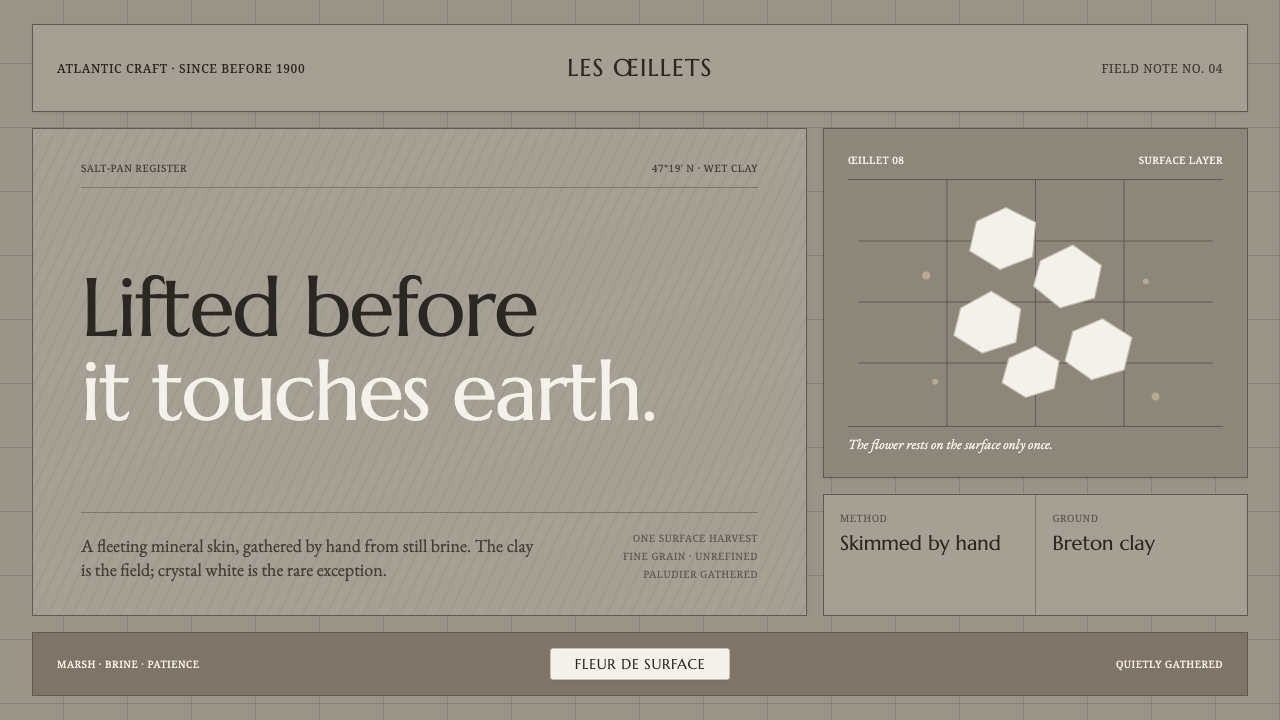 Guérande Fleur de SelCrystal white is the exception. Mineral serif and hairline grids rise from we…
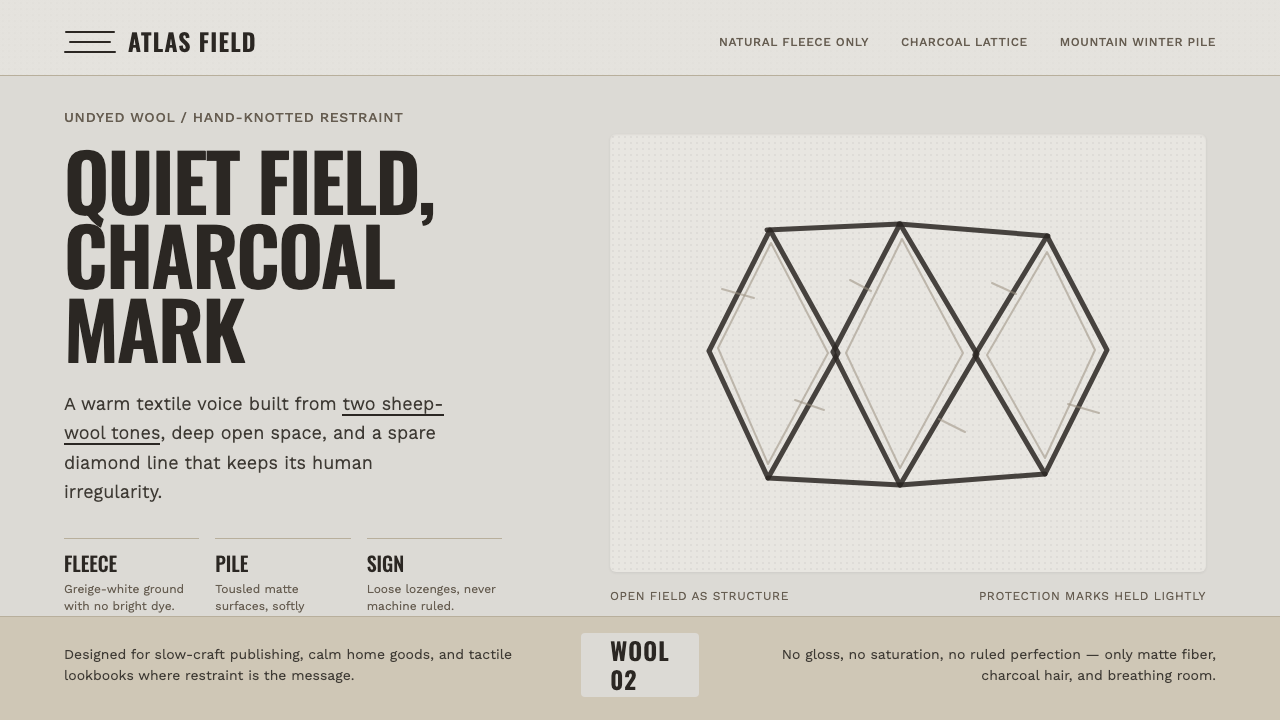 Beni Ourain Berber CarpetRestraint feels tactile. Greige wool field, Oswald type, and a loose charcoal…
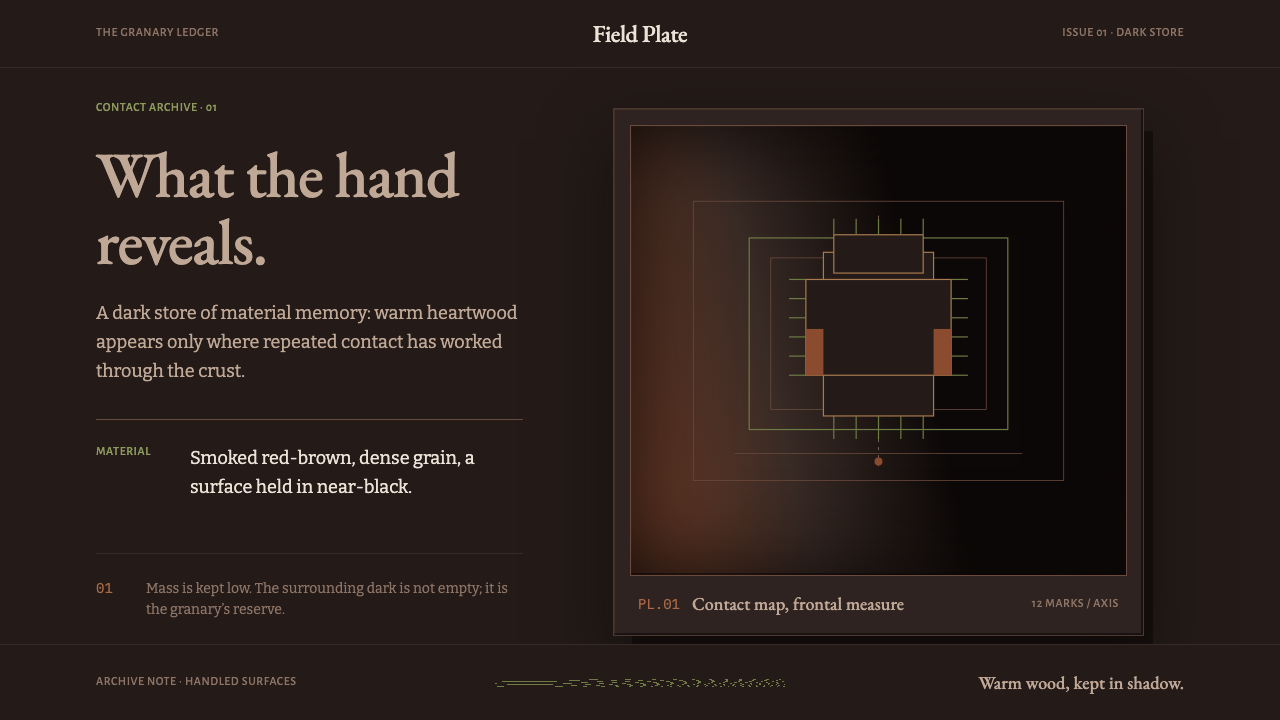 Ifugao BululTouch reveals the archive. Narra red breaks through near-black patina in a qu…
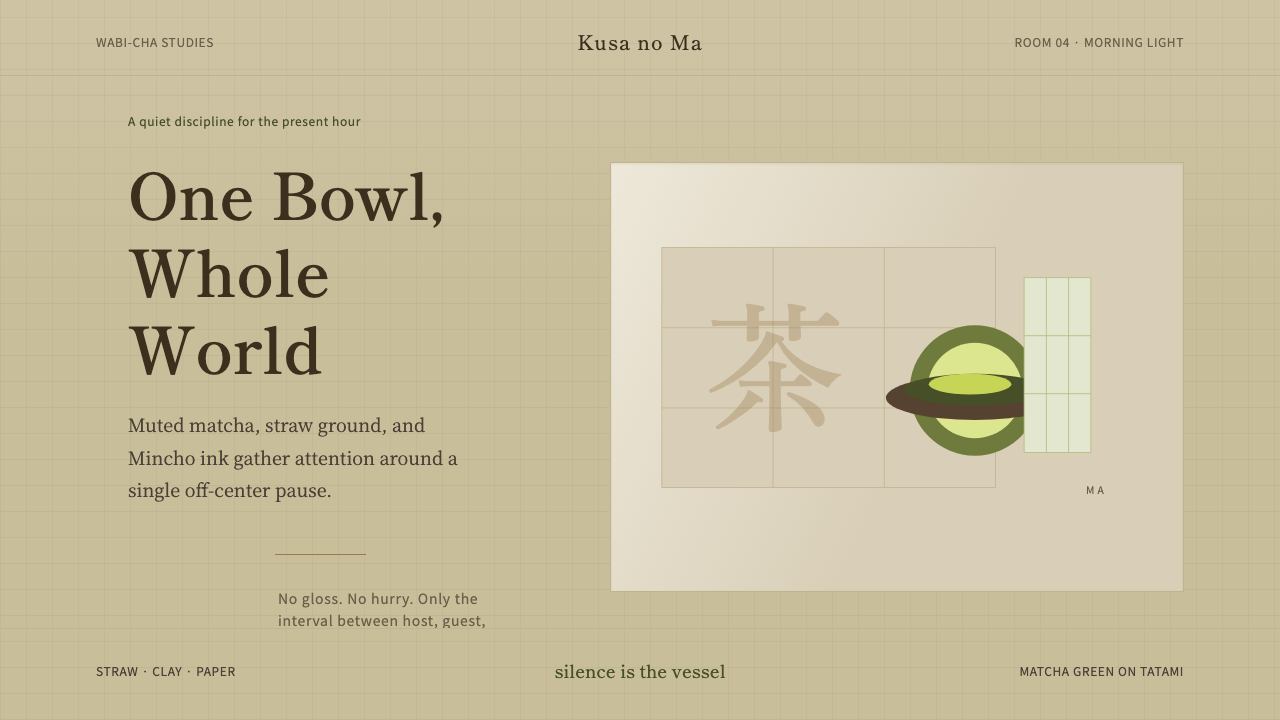 Japanese Tea CeremonyStillness has weight. Tatami straw, matcha green, and Mincho type leave room…
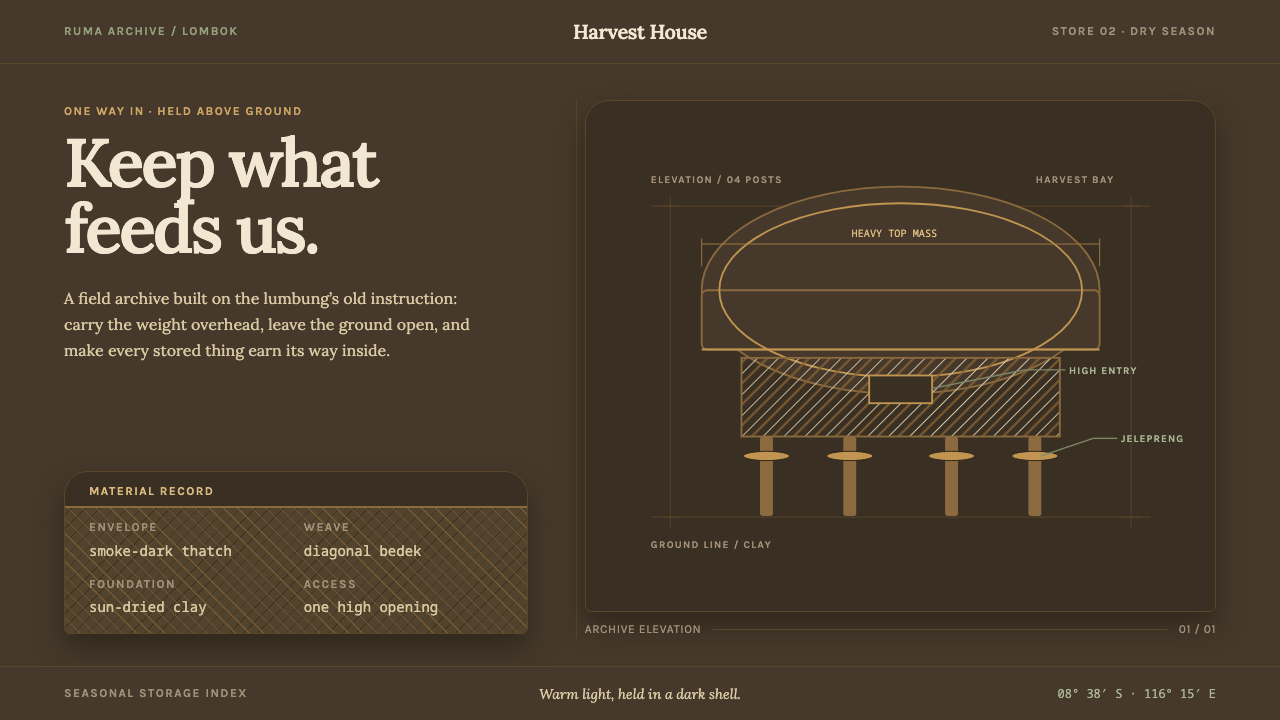 Sasak Lumbung GranaryStorage carries its weight. Smoke-dark ground, warm Lora type, and a four-pos…
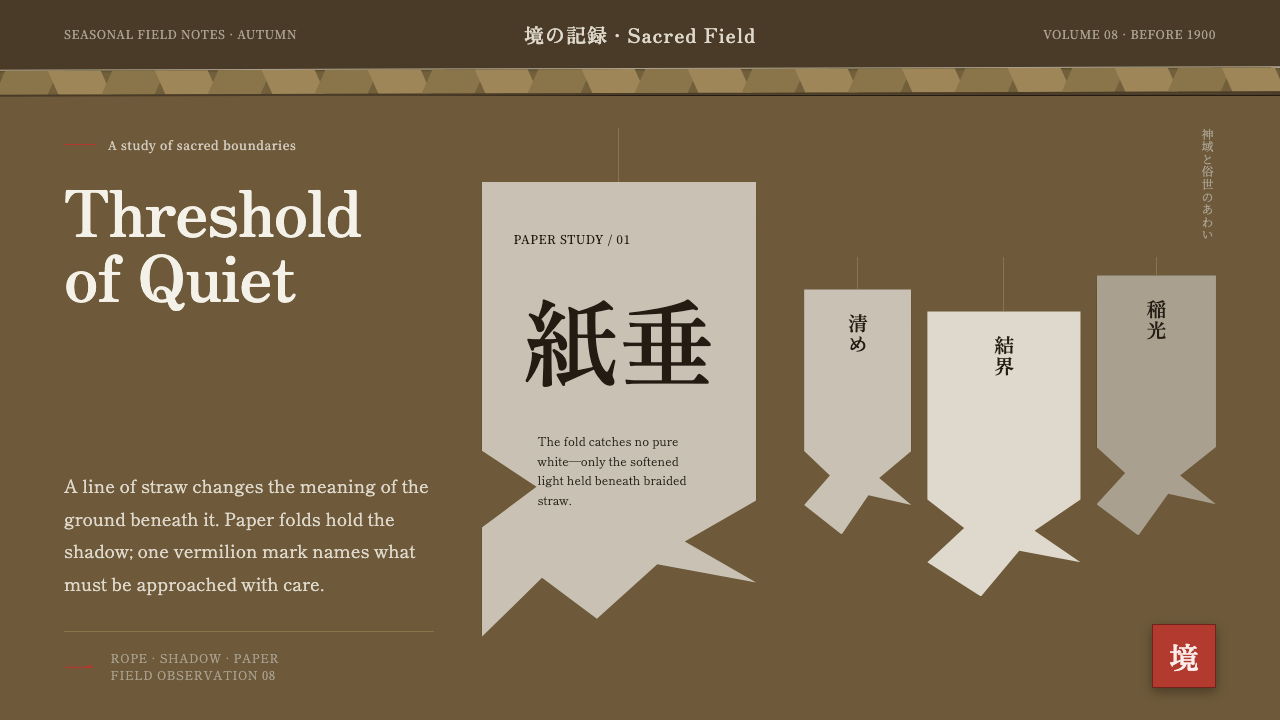 Shinto Shide Paper StreamerQuiet becomes sacred. Shadowed washi hangs from a straw-gold line, marked onc…