What is Trinidad Steelpan Chrome?
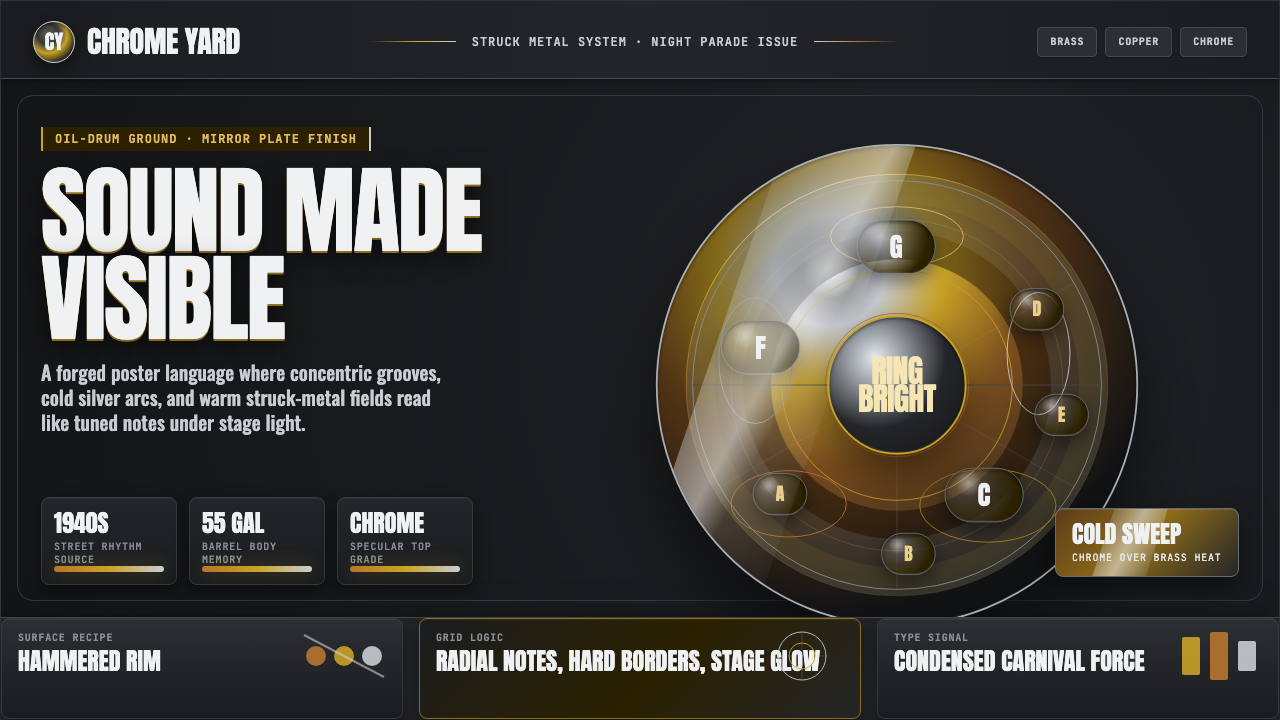
Trinidad Steelpan Chrome turns a struck oil drum into a visual instrument: warm metal, cold mirror shine, and tuned geometry poised to ring.
Trinidad Steelpan Chrome in brief
Trinidad Steelpan Chrome is an interface language drawn from the steelpan: the tuned metal instrument that emerged from Carnival street percussion in Trinidad and Tobago during the 1940s. Its central image is not generic chrome decoration, but a worked drumhead. An oil drum becomes a musical surface through hammering, stretching, and groove-cutting; the resulting pattern of raised note areas turns force, pressure, and sound into visible structure.
The style begins on a dark oil-drum ground. Against that depth, brass and hammered copper bring warmth, while mirror-silver chrome introduces a colder, more precise kind of brightness. The contrast should feel physical rather than merely fashionable: warm metals suggest touch, age, and impact; chrome suggests finish, reflection, and the elite instrument whose surface has been polished to a mirror-like sheen.
Its defining geometry comes from the steelpan’s tuned surface. Convex note ovals sit within concentric groove divisions, with larger note areas associated with lower pitches. In a digital composition, those forms become cards, controls, frames, diagram fields, or focal ornaments. Every accent should retain the suggestion of resonance. The test is simple: it should look as though a mallet could strike it and release a clear note.
Where does Trinidad Steelpan Chrome come from?
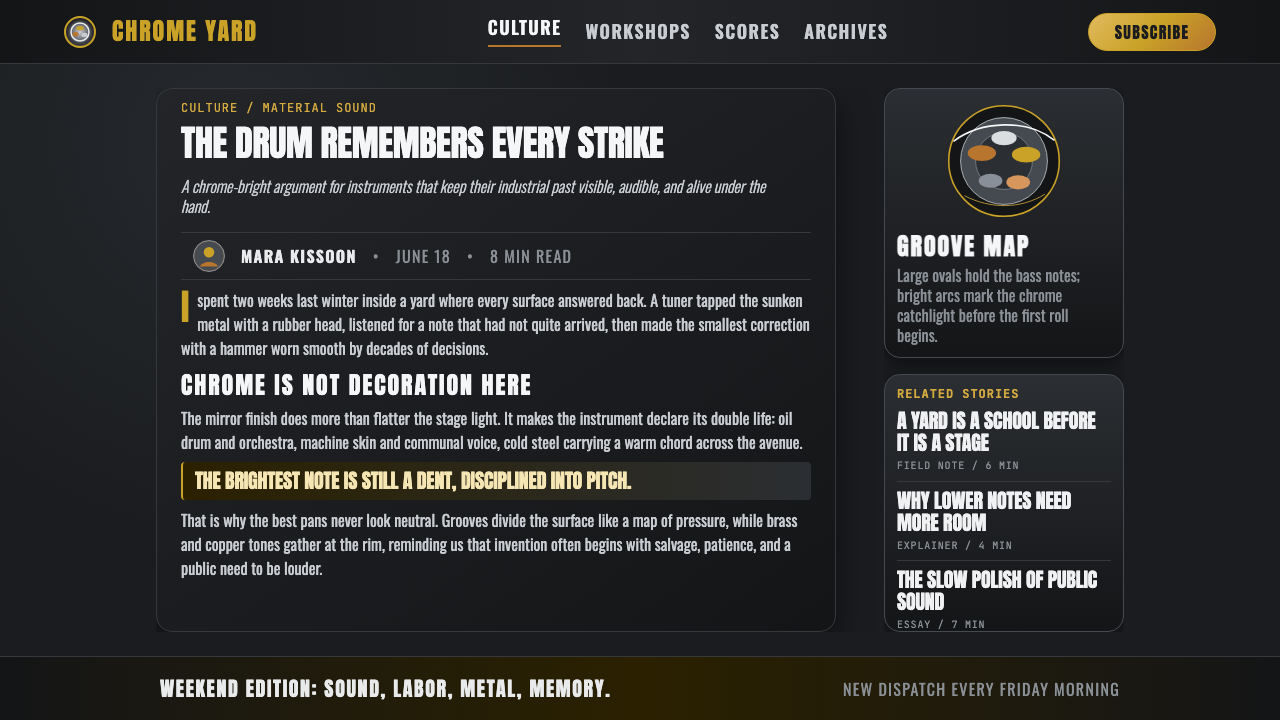
The steelpan was born in Trinidad and Tobago in the 1940s, within Carnival street percussion and steelband music. Its material origin was unusually direct. Wartime conditions left discarded oil drums widely available, and those industrial containers became the raw material for a new instrument. The transformation matters to the aesthetic: it is a story of practical salvage becoming sonic invention, not of an ornamental object borrowing an industrial look.
Making a steelpan involved reshaping the drumhead through hammering and stretching, then cutting grooves that separated its tuned zones. The surface was organized into convex note ovals, each intended to ring as part of an instrument rather than simply fill a pattern. Larger ovals produced lower pitches. This relationship gives the style a useful discipline: scale is expressive because it implies a musical role, and divisions should resemble tuned territories rather than arbitrary decoration.
Chrome plating became associated with the finest steelband pans, bringing a mirror-silver finish to the instrument’s working metal surface. In this visual system, chrome is therefore not a neutral metallic effect. It is a signal of refinement applied after labor, tuning, and physical transformation. Its cold highlights work best when they appear to catch light across a substantial form, in tension with the warmer brass and copper notes around them.
The cultural frame remains steelpan and steelband music alongside Carnival Panorama culture. Trinidad Steelpan Chrome should preserve that connection by treating rhythm, impact, and collective performance as organizing ideas. Repeated forms may feel percussive; concentric divisions may suggest ordered vibration; a polished focal surface may feel stage-ready. But the system remains rooted in the pan itself: a dark oil-drum ground, grooves, raised note zones, and metal made visibly capable of sound.
What defines the Trinidad Steelpan Chrome look?
Oil-Drum Ground
The foundation is dark, dense, and materially specific. It should recall the depth of an oil drum rather than an abstract dark mode. Broad near-black fields create the acoustic chamber around brighter elements, giving chrome and warm metals room to register as surfaces under light. Empty space should feel like unstruck metal awaiting contact.
Warm and Cold Metal
Brass and hammered copper carry the warm side of the system; chrome supplies the cold counterpoint. Their contrast should be deliberate and sparing. Warm metal can establish emphasis, active states, or musical warmth, while chrome resolves edges, frames significant surfaces, and catches the eye with controlled precision. Neither material should dissolve into a generic glossy gradient.
Tuned Ovals
Convex note ovals are the principal shape vocabulary. They should appear embedded within a larger surface, as though pressed outward from the drumhead. Differences in scale can imply differences in pitch, with larger zones carrying a lower, fuller visual voice. Avoid treating them as ordinary pills or decorative bubbles; their power comes from sounding engineered and struck.
Concentric Grooves
Grooves divide, guide, and imply vibration. Concentric or radiating lines should organize a panel’s internal logic, separating note-like zones without becoming a neutral grid. They can frame a key figure, segment data, or draw attention toward a central action. The most convincing grooves feel pressed into metal and maintain a coherent relationship to the surrounding ovals.
Struck Highlights
Highlights should suggest impact and curvature rather than ambient softness. A bright chrome edge, a copper glint, or a concentrated reflective arc can make an element feel tuned and tactile. Keep these accents directional: they should reveal a surface turning toward light, not coat every object with equal shine. Selective reflection creates hierarchy and preserves the sensation of physical metal.
Resonant Restraint
The system is rich in material cues but should not become cluttered. Use a small number of metal focal points against the dark ground, then let groove structure and spacing carry the rhythm. If every panel shines, every oval is outlined, and every edge glints, the instrument loses its tuning. The visual composition should feel arranged for performance, with silence between notes.
Who shaped Trinidad Steelpan Chrome?
Winston “Spree” Simon is named among the key figures associated with the Trinidad and Tobago steelpan tradition. Within Trinidad Steelpan Chrome, his presence anchors the system in the human musical culture from which its dark drum surfaces, tuned zones, and struck-metal imagery arise.
Ellie Mannette is identified as a key figure in the steelpan and steelband tradition. The style’s attention to shaped metal, divided note areas, and refined chrome finish should be understood as attention to an instrument-making culture, not simply to a Caribbean-inspired surface treatment.
Anthony Williams is also named among the central figures connected to Trinidad steelpan culture. His inclusion reinforces the style’s relationship to steelband music and Carnival Panorama culture, where an individual instrument exists within rhythm, ensemble, and public performance.
How do you use Trinidad Steelpan Chrome today?
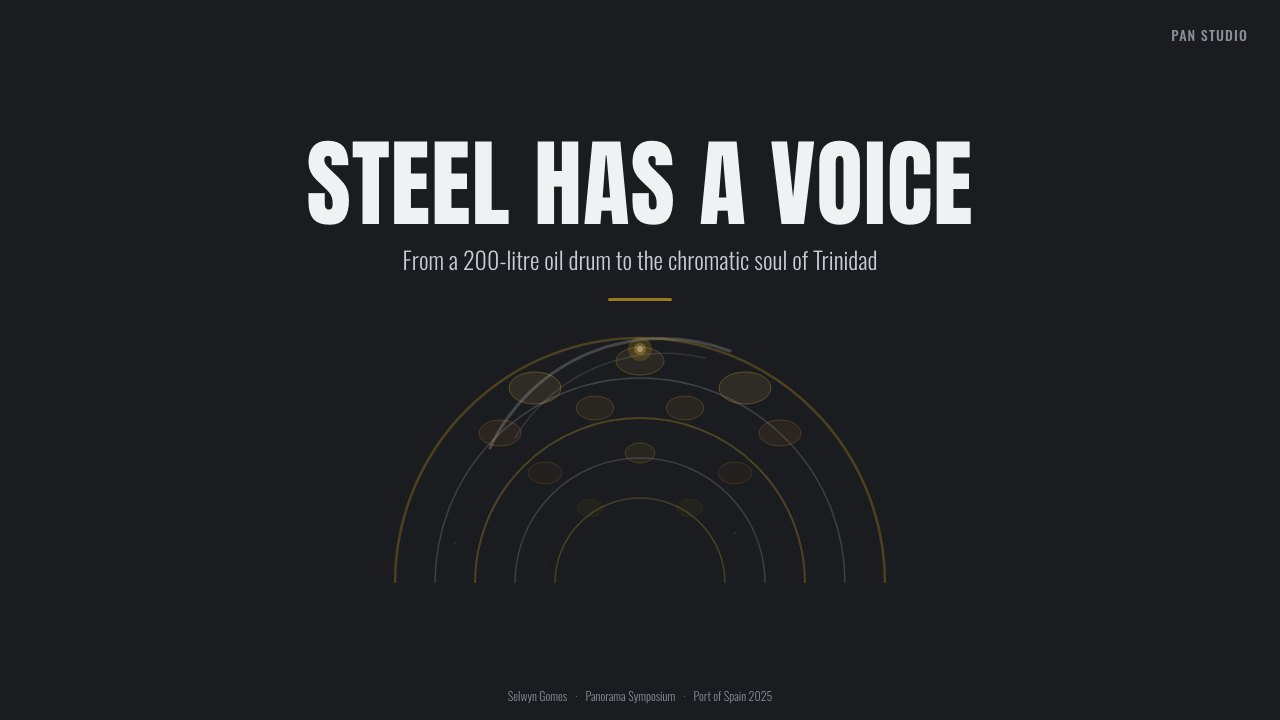
For presentation covers, use the dark oil-drum field as a stage and give one tuned oval or chrome-edged metal form a clear leading role. A title can sit beside or within the groove structure, while brass or copper marks a single directional cue. The cover should feel like the first visible beat: concentrated, physical, and ready to resonate rather than crowded with multiple competing metallic ornaments.
Content and data slides benefit from the pan’s divided-surface logic. Treat concentric grooves as sectional organizers, using them to contain a summary, a metric group, or a sequence of related points. Data marks can inherit the tuned-oval language, with larger forms reserved for visually lower or more substantial values where that metaphor aids comprehension. Keep labels calm and readable; the metal system should frame information, not turn every chart into sculpture.
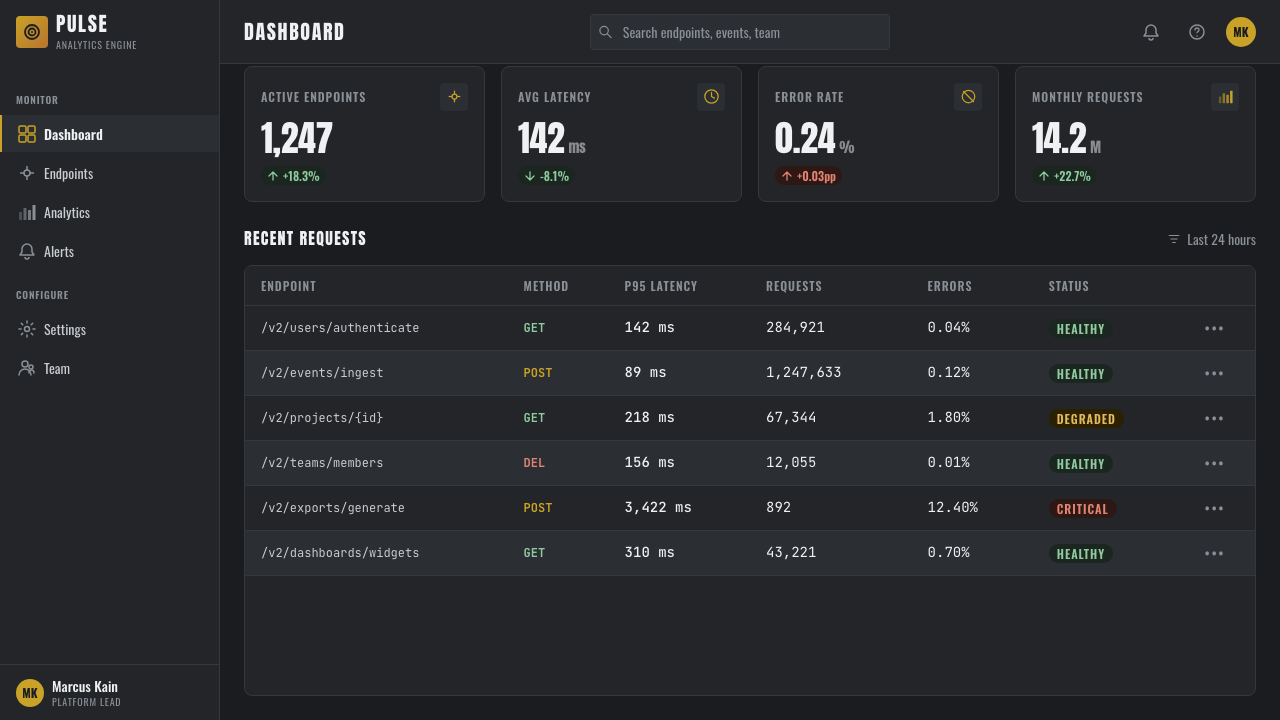
For web interfaces, this style is particularly effective for dashboards, player-like tools, event spaces, and premium pricing experiences that need a strong sense of crafted performance. Dark panels can function as drum surfaces, while warm-metal accents identify active controls, important offers, or selected states. Chrome should be reserved for significant boundaries, key modules, and moments of confirmation, so its reflective authority is not spent on routine interface furniture.
For editorial and marketing work, build rhythm through alternation. A dark introductory field can be followed by calmer reading sections, then interrupted by a large groove-divided pull quote, a brass callout, or a polished chrome visual anchor. Campaign pages should make the steelpan source explicit through language and form rather than relying on a vague tropical mood. The desired tone is crafted, percussive, and ceremonial, grounded in metal and music.
The common mistake is mistaking Trinidad Steelpan Chrome for an invitation to cover every surface in silver gloss. Excess chrome flattens the hierarchy, while indiscriminate copper and brass make the interface feel decorative rather than tuned. Another mistake is using concentric rings as a generic futuristic motif without convex note areas, groove logic, or a dark oil-drum foundation. The system works when each bright element seems earned by structure and each form appears capable of ringing.
Trinidad Steelpan Chrome — FAQ
Is Trinidad Steelpan Chrome simply a metallic dark theme?
No. The dark ground and chrome finish are only part of the system. Its identity comes from the steelpan’s material history and tuned geometry: an oil-drum surface reshaped through hammering, stretching, grooves, and convex note ovals. A generic metallic interface may be shiny; this style should feel organized around resonance, divided playing zones, and the contrast between worked warm metal and refined cold chrome.
Why are the note areas oval and convex?
The steelpan drumhead is tuned into convex note ovals separated by grooves. Those forms are functional parts of the instrument’s sound-making surface, and larger ovals ring at lower pitches. In design, preserving their convex and embedded character distinguishes them from ordinary rounded UI shapes. They should read as areas pressed into, and rising from, a larger sheet of worked metal.
When should brass, copper, and chrome each be used?
Use brass and hammered copper where warmth, emphasis, or active energy is needed. Use chrome where a surface needs precision, reflective finish, or premium finality. The dark oil-drum field holds both together. Their roles should remain distinct: warm metals create the felt presence of impact and craft, while chrome creates the colder flash associated with a mirror-silver top-tier steelband pan.
Can the style work for information-heavy dashboards?
Yes, provided the steelpan language is used as structure rather than ornament. Groove divisions can organize related groups, dark fields can establish clear visual chambers, and restrained metal accents can identify the most important state changes. Keep ordinary text and routine controls quieter than the tuned focal areas. A dashboard succeeds when users can scan its hierarchy before noticing its material richness.
What makes an application feel inauthentic?
It feels inauthentic when it borrows chrome, dark backgrounds, or tropical associations while losing the pan’s worked logic. Random rings, equal gloss on every element, and undifferentiated warm colors do not suggest a tuned instrument. Return to the source object: a discarded oil drum transformed by hammering and grooves into distinct resonant zones, then refined in chrome for a top-tier steelband finish.
Related design styles
 BSL-4 Biohazard LabContainment feels lethal. Black airlock grids glow with culture green and haz…
 Gulf Oil Derrick IndustrialEngineered, not decorative. Soot-darkened gunmetal, derrick lattice, condense…
 Lunar RoverBuilt for the vacuum. Kapton-gold foil and stencil part-numbers against void-…
 Land Rover DefenderUtility refuses polish. Bronze green panels, rivets and brass grid data do th…
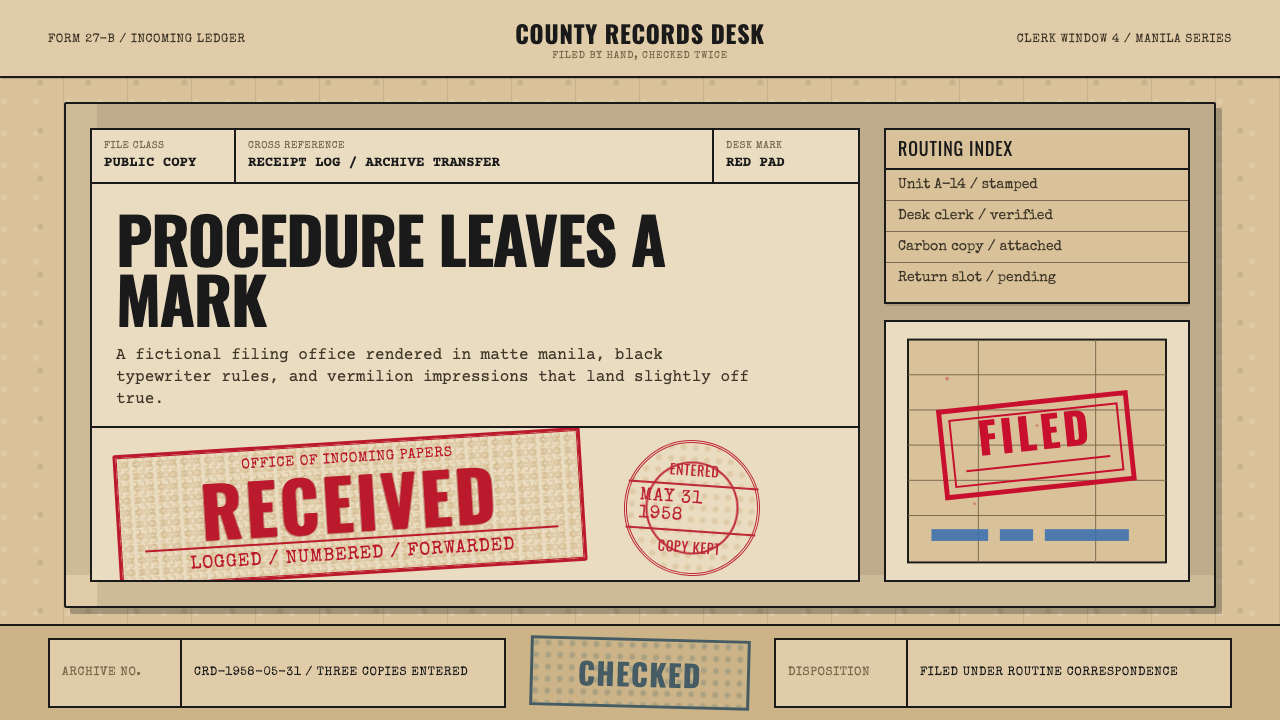 Office Rubber StampsProcedure made visible. Vermilion Oswald stamps strike a manila logbook grid.
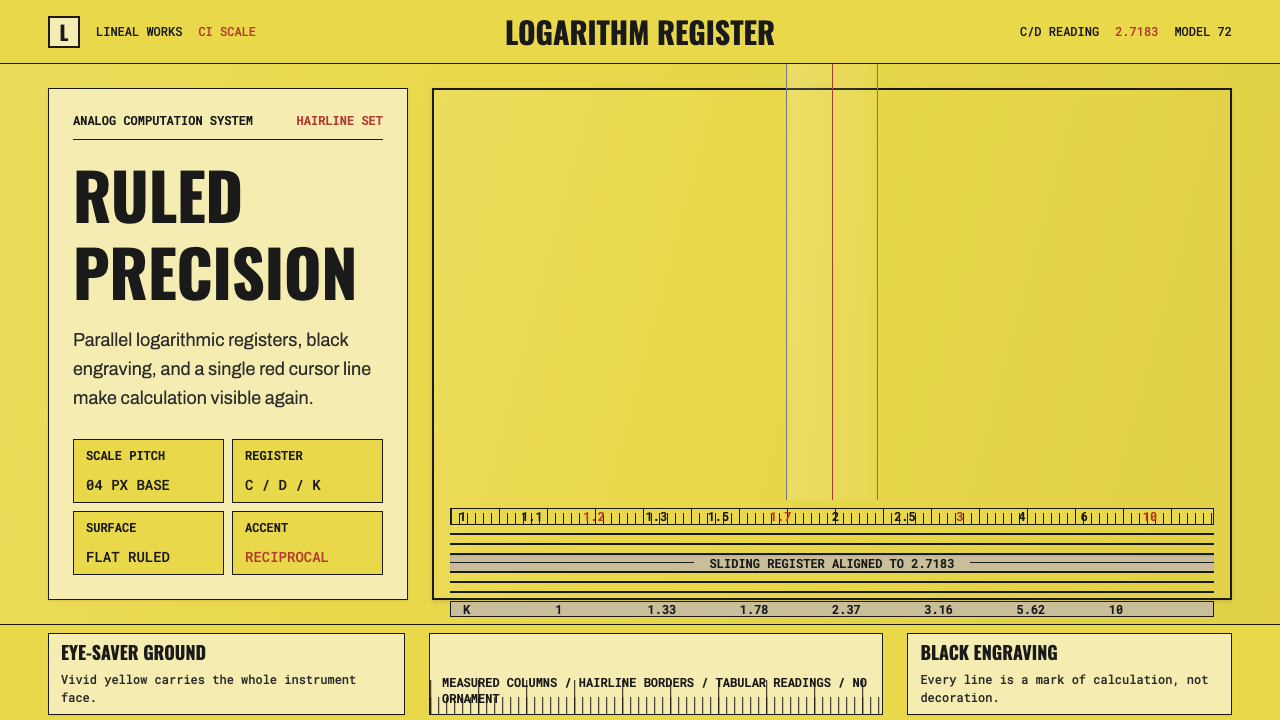 Slide RulePrecision made visible. Eye-saver yellow, black ticks, and one red hairline d…