What is T-Mobile Magenta?
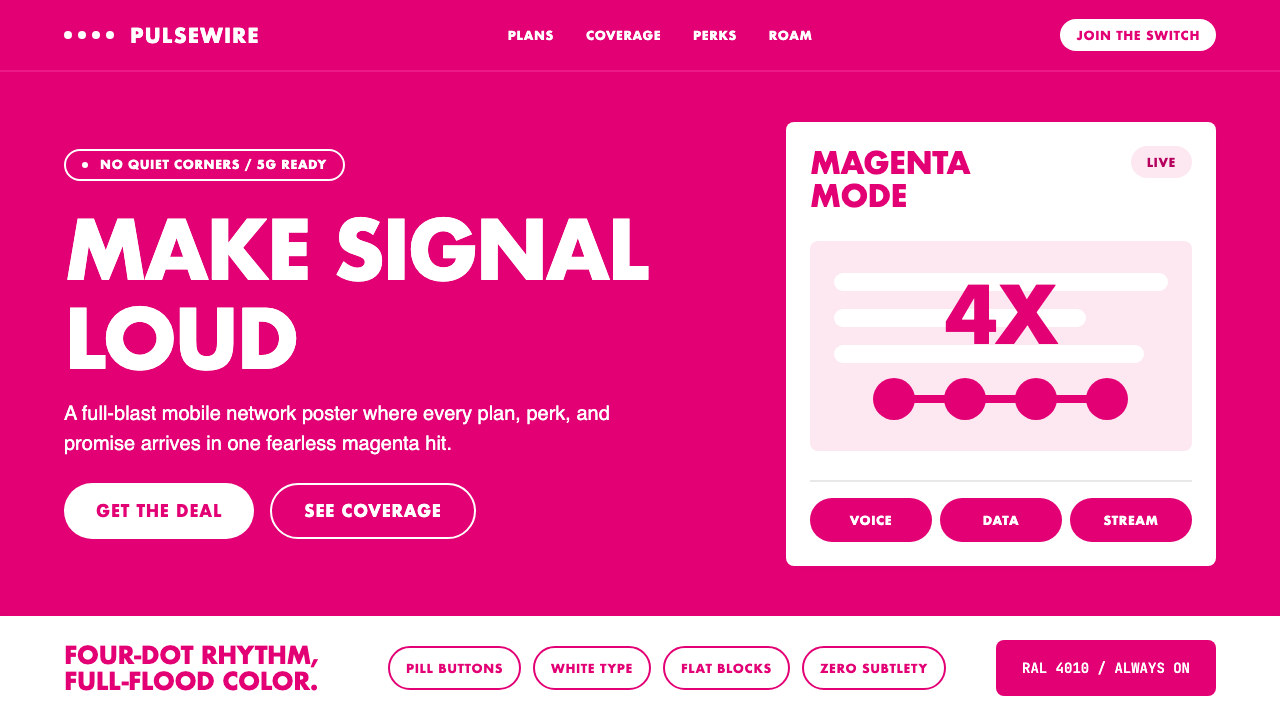
T-Mobile turned a single shade of pink-red into a trademarked territorial claim — and then used it to conquer the American wireless market.
T-Mobile Magenta in brief
T-Mobile Magenta is one of the most aggressive chromatic identities in contemporary brand design: a vivid, high-energy pink-leaning red that saturates every surface it touches. Unlike most corporate color systems that pair a signature hue with a wide supporting palette, Magenta operates as a near-monocolor system — the hue itself is the message. White type, white icons, and white negative space are its only permitted companions at full intensity, creating a contrast so stark it reads across any medium, from billboard to smartphone notification badge.
The system's visual logic is built around saturation dominance. Where most brands reserve their hero color for accents and calls to action, T-Mobile inverts the convention: Magenta floods the entire canvas — hero sections, navigation bars, physical store facades, employee uniforms, device packaging — and leaves white to perform the functional roles of type and spacing. The effect is simultaneously unmistakable and, for competitors, unreplicable: the shade has been actively defended through trademark litigation across multiple countries, making it one of the few colors in commercial history to be legally owned in a specific industry context.
Visually, the design system pairs this chromatic dominance with a small set of sharp geometric elements: pill-shaped button forms, clean sans-serif type at confident weights, and a recurring four-dot motif that functions as both pattern element and brand rhythm. The combination produces an aesthetic that reads as bold, accessible, and slightly irreverent — qualities that mapped precisely onto the brand's positioning as a disruptive challenger in a market dominated by more sober corporate blues and reds.

Where does T-Mobile Magenta come from?
The story of T-Mobile Magenta begins in Bonn, Germany, not in Bellevue, Washington. Deutsche Telekom — T-Mobile's parent company — was founded in 1990 as Germany's state-owned telecommunications monopoly was privatized following reunification. The company needed a visual identity capable of embodying both institutional solidity and the dynamism of a newly liberalized market. In 1996, the brand consultancy Wolff Olins was commissioned to develop a new corporate identity, and the result was a magenta — specifically a vivid pink-red registered under the German RAL color system — that would become one of the most recognized brand colors on earth.
The choice of magenta was neither arbitrary nor purely aesthetic. Magenta sat outside the conventional telecom palette of the mid-1990s, which leaned heavily on corporate blues, greens, and neutral grays. By choosing a color associated with energy, visibility, and a certain deliberate loudness, Deutsche Telekom staked a claim to difference in a sector historically characterized by conservative institutional design. The color was trademarked not as a logo but as a standalone hue — making it illegal for other telecommunications companies in Germany and later across the European Union to use the same shade in their branding. This legal protection became a competitive asset: as the brand expanded into new markets through the T-Mobile subsidiary, the color arrived with enforceable exclusivity.
The American chapter of the story accelerated dramatically under the leadership of CEO John Legere, who took charge of T-Mobile USA in 2012. At that point, the carrier was a distant third or fourth in the American market, hemorrhaging subscribers to AT&T and Verizon. Legere's response was the "Un-carrier" strategy, launched in 2013: a series of moves designed to eliminate the industry's most despised consumer pain points — annual contracts, international roaming charges, data throttling — while simultaneously adopting a brand voice that was deliberately combative, irreverent, and loud. Magenta became the visual emblem of this strategy, and the brand leaned further into chromatic dominance: full-bleed magenta advertising, magenta-painted store interiors, magenta-dyed corporate culture.
The acquisition of Sprint in 2020 — completed after years of regulatory battles — transformed T-Mobile into the second-largest wireless carrier in the United States and gave the brand a new phase of visual consolidation. The combined company unified under the Magenta identity, retiring Sprint's yellow and accelerating the rollout of T-Mobile's chromatic system across thousands of additional retail locations. By the mid-2020s, Magenta had transcended mere brand color to become a cultural shorthand for disruption in the American wireless industry, its loudness now read not as brash upstart energy but as the confidence of market leadership.
What defines the T-Mobile Magenta look?
Chromatic Dominance
The defining visual principle of T-Mobile Magenta is saturation at scale. Rather than reserving the signature hue for accents, the system deploys it as the primary ground — flooding full-bleed surfaces, large UI panels, and physical environments entirely. This inversion of the conventional figure-ground relationship means that Magenta is never a highlight; it is the environment itself, with white serving as the only counterpoint. The psychological effect is one of total chromatic ownership: viewers cannot partially associate the color with the brand because there is never a neutral ground from which it emerges.
Pill-Form Geometry
Across the T-Mobile visual system, interactive elements — buttons, tags, badges, and call-to-action components — consistently favor the pill shape: a rectangle with fully rounded ends that reads as approachable and energetic rather than corporate or rigid. This form choice is not merely decorative; it reinforces the brand's anti-establishment positioning by softening the edges of what might otherwise be a harsh, high-contrast visual field. The pill shape, combined with Magenta as fill, produces a component vocabulary that is immediately legible as a single system across wildly different contexts.
The Four-Dot Motif
One of the more quietly powerful elements in the T-Mobile visual toolkit is the four-dot pattern — a tight cluster of four circular marks that appears as a recurring textural and rhythmic device across print, digital, and environmental applications. The motif functions at multiple scales: dense and tiled, it creates a halftone-like surface texture; isolated and enlarged, it becomes an abstract focal point. Its consistent appearance across contexts reinforces brand recognition without requiring the logotype and serves as a subtle visual signature that operates even in peripheral vision.
White as Infrastructure
In most design systems, white is the default ground — the neutral field against which colored elements are placed. In T-Mobile Magenta, white's role is inverted: it functions as infrastructure within a chromatic environment. White type on Magenta, white icons within Magenta panels, white negative space carving breathing room from Magenta floods — all treat white not as default but as an active design decision. This reversal produces a visual system where conventional hierarchy (colored element on neutral ground) is abandoned in favor of a single chromatic statement punctuated by white.
Typographic Confidence
The typographic register of T-Mobile's visual language is one of deliberate weight and directness. Headlines appear at bold, unflinching scale — all-caps callouts are a recurring device in campaign and retail contexts. Body text and informational copy step back to a supporting role, set in clean sans-serif forms at a comfortable reading weight. The contrast between the aggressive headline presence and the restrained informational text creates a natural reading hierarchy: brand statement first, detail second, which aligns precisely with the company's marketing philosophy of leading with attitude before fact.
Flatness and Anti-Ornament
For all its chromatic loudness, the T-Mobile visual system is remarkably restrained in its surface treatment. Gradients are largely absent — the system commits to flat Magenta rather than tonal transitions that might dilute the purity of the hue. Shadows, where they appear in digital interfaces, are clean and functional rather than decorative. Illustration and photography, when used, are subordinated to the chromatic system: imagery is typically cropped aggressively, placed against Magenta grounds, or treated with high contrast to maintain the system's overall flatness. Ornamentation for its own sake finds no home here.
Deliberate Loudness
Perhaps the most unusual aspect of the T-Mobile design system is that its loudness is not a failure of restraint but an intentional strategic principle. In an industry where competitors typically compete on understated professionalism, T-Mobile's visual aggression is a calculated posture. The system is designed to be impossible to ignore: in a retail environment, at a trade show, in a digital feed, or on a billboard, Magenta does not coexist quietly with its surroundings. This deliberate refusal of visual modesty is inseparable from the brand's competitive positioning and cannot be neutralized without undermining the entire identity logic.

Who shaped T-Mobile Magenta?
The British brand consultancy Wolff Olins was commissioned by Deutsche Telekom in 1996 to create the visual identity that would eventually become one of the most legally protected color systems in commercial history. Wolff Olins brought the same philosophy to Telekom Magenta that it would later apply to other transformative brand projects — the conviction that a singular, extreme visual commitment creates stronger long-term brand equity than a diverse, modular palette. The Magenta they specified was deliberately chosen for its rarity in the corporate landscape of the time, giving Deutsche Telekom's subsequent subsidiaries a visual asset with genuine competitive moats.
John Legere served as CEO of T-Mobile USA from 2012 to 2020 and is credited with engineering the brand's most dramatic period of growth through the Un-carrier strategy. As important as his policy changes were, Legere's personal embodiment of the Magenta brand — wearing it publicly, performing its irreverence on social media, positioning himself as a loud counterpoint to the suited executives at Verizon and AT&T — accelerated the color's cultural resonance in ways that conventional advertising could not. Under his tenure, Magenta ceased to be a corporate color and became something closer to a competitive ideology made visible.
Mike Sievert succeeded Legere as CEO in 2020 and presided over the post-Sprint merger integration — the most consequential visual consolidation challenge in the brand's history. Under Sievert, the Magenta identity underwent a process of maturation: the loudness was preserved but refined, the system extended to absorb Sprint's customer base and retail footprint without losing the chromatic coherence that made the brand recognizable. Sievert's tenure represents the transition from disruptor identity to market leader identity — and the design system's ability to stretch to cover both phases without breaking is testament to the robustness of the original chromatic commitment.
As the parent company and originator of the Magenta identity, Deutsche Telekom has been the consistent steward of the system's legal and creative integrity since 1996. The company's trademark enforcement actions — pursued across Germany, the European Union, and international markets — have made Magenta one of the most litigated colors in brand history. Deutsche Telekom has successfully challenged competitors ranging from local carriers to satellite services to streaming platforms who have used similar shades. This legal infrastructure is as much a part of the brand's design system as any visual specification, because it defines and enforces the competitive space the color occupies.
How do you use T-Mobile Magenta today?
T-Mobile Magenta translates most directly to presentation contexts where the goal is to communicate confidence, disruption, or market leadership. A cover slide benefits enormously from committing fully to the chromatic system: a full-bleed Magenta background with a single, bold white headline and the brand's four-dot motif as a subtle texture communicates authority without decoration. The risk — and the distinction between authentic application and pastiche — lies in how much the Magenta is allowed to breathe. Overcrowding a Magenta field with multiple competing elements breaks the system's core logic of saturation plus restraint.
For content slides within a presentation, the system calls for clean alternation: Magenta as section dividers or emphasis blocks, white as the field for body content and data. Data visualizations in this system should avoid introducing multiple new colors — a Magenta primary with white or near-white as the only secondary produces bar charts, progress indicators, and pie segments that feel native to the system. Where additional data categories genuinely require differentiation, a muted dark tone works better than introducing a second bright hue that would compete with Magenta for dominance.
In web interface and dashboard design, T-Mobile Magenta works best when the chromatic intensity is concentrated in the navigation bar, primary buttons, and selected states, with the content area reserved for white or very light grounds. This approach preserves the brand's chromatic character at the interaction layer — the places users look when taking action — without fatiguing the eye across extended reading sessions. Pricing pages and comparison tables particularly benefit from this approach: Magenta highlights the recommended tier, white grounds the alternatives, and the pill-shaped CTA button becomes the natural convergence point for user attention.
For editorial and marketing applications — social content, campaign landing pages, out-of-home advertising, and event graphics — the system permits its most maximalist expression. Full-bleed Magenta with large, confidently-spaced white all-caps headlines is the canonical campaign treatment, echoing the visual language of the brand's retail environments. The four-dot motif can be deployed as a background texture at low opacity or as a compositional accent. Photography, when used, should be placed on a Magenta ground or treated with Magenta overlays rather than allowed to compete with the system's chromatic dominance from within a neutral field.
The most common mistake when applying this system is hedging on the Magenta. Designers accustomed to using color as an accent instinctively reduce it — moving from full-bleed to thirty percent coverage, introducing grays or secondary colors, softening the contrast with tonal backgrounds. Each compromise of this kind makes the system progressively less itself: Magenta at reduced saturation or area coverage begins to resemble pink, which carries entirely different brand associations. The system's power is binary: either you commit to chromatic dominance and gain all of its recognition benefits, or you dilute it and produce something that has the palette's associations without its authority.

T-Mobile Magenta — FAQ
Can T-Mobile Magenta work for a brand that is not a telecom company?
The chromatic system is fully transferable as a design approach — the principles of saturation dominance, white-as-infrastructure, and pill-form geometry are not property-specific. However, the specific shade carries enormous brand recognition in the telecom context, so any application in that sector would read as derivative. Outside telecom, a designer can adopt the system's structural logic — full-bleed primary color with white as the only complement, pill-shaped interactive elements, deliberate typographic loudness — while using a different high-saturation hue. The system's DNA is the commitment to monochromatic dominance, not the specific color, and that commitment can be ported to any palette.
How does T-Mobile Magenta differ from other high-saturation brand colors like Barbie Pink or Coca-Cola Red?
All three are high-saturation identity colors defended through trademark or cultural ownership, but their systems differ significantly. Coca-Cola Red operates within a warm, nostalgic system that pairs the hue with script typography, ribbon motifs, and photography of joyful human moments — the color is emotional and narrative-dependent. Barbie Pink functions within a maximalist, playful system that tolerates many additional colors and textures — the pink creates a chromatic tent under which variety flourishes. T-Mobile Magenta, by contrast, is a reductive system: it eliminates rather than accumulates. The magenta is not the emotional anchor of a warm story; it is a territorial statement, paired with almost nothing, designed to communicate dominance rather than delight.
Is there a light or dark mode equivalent for T-Mobile Magenta design systems?
The canonical T-Mobile system is a light-mode construct — the hero ground is Magenta (which reads as saturated mid-value) and the type ground is white, together creating a perceptually active rather than restful surface. A dark mode variant exists in practice — primarily in entertainment and streaming contexts where darker grounds reduce eye strain during extended viewing — and is most often executed by pairing a deep near-black or dark charcoal with Magenta as the accent and interactive element color. In this inversion, Magenta shifts from ground to figure, which reduces its dominance but preserves brand recognition. The risk is that a dark background with Magenta accents begins to resemble many other tech-brand dark mode systems, sacrificing the distinctiveness that full-bleed Magenta provides.
Why does the four-dot motif matter — can it simply be omitted?
The four-dot motif is not load-bearing in the way the Magenta color is — no single application will collapse without it. But its cumulative effect across the system is meaningful. It provides a secondary visual layer that operates at a scale below the headline elements, giving the system depth and texture without introducing new colors or competing complexity. In contexts where Magenta alone might feel monolithic or undifferentiated — large physical surfaces, event installations, video graphics — the four-dot pattern introduces visual rhythm that prevents perceptual fatigue. Omitting it consistently produces a simpler but also somewhat flatter brand expression; using it occasionally and without system logic makes it feel like decoration rather than identity.
Does T-Mobile Magenta work in print contexts where color reproduction varies?
Color-accurate reproduction of the Magenta is essential and can be challenging in uncoated paper, textile, and large-format printing contexts where the hue can shift perceptibly toward either orange or purple depending on substrate and ink type. Deutsche Telekom's approach has historically been to maintain precise color specifications across production contexts — the RAL registration that anchors the hue is precisely this kind of production standard. For designers applying the system outside official T-Mobile production pipelines, the practical guidance is to over-saturate slightly in digital preparation for print, and to request proofs before committing to large runs. A Magenta that lands too light reads as pink and loses the territorial quality that makes the system work; one that lands too dark reads as a warm red and loses the pink-red tension that distinguishes it.
Related design styles
 Rappi DeliveryOrdering, made joyful. A hot red-orange wash floods the page; white pill card…
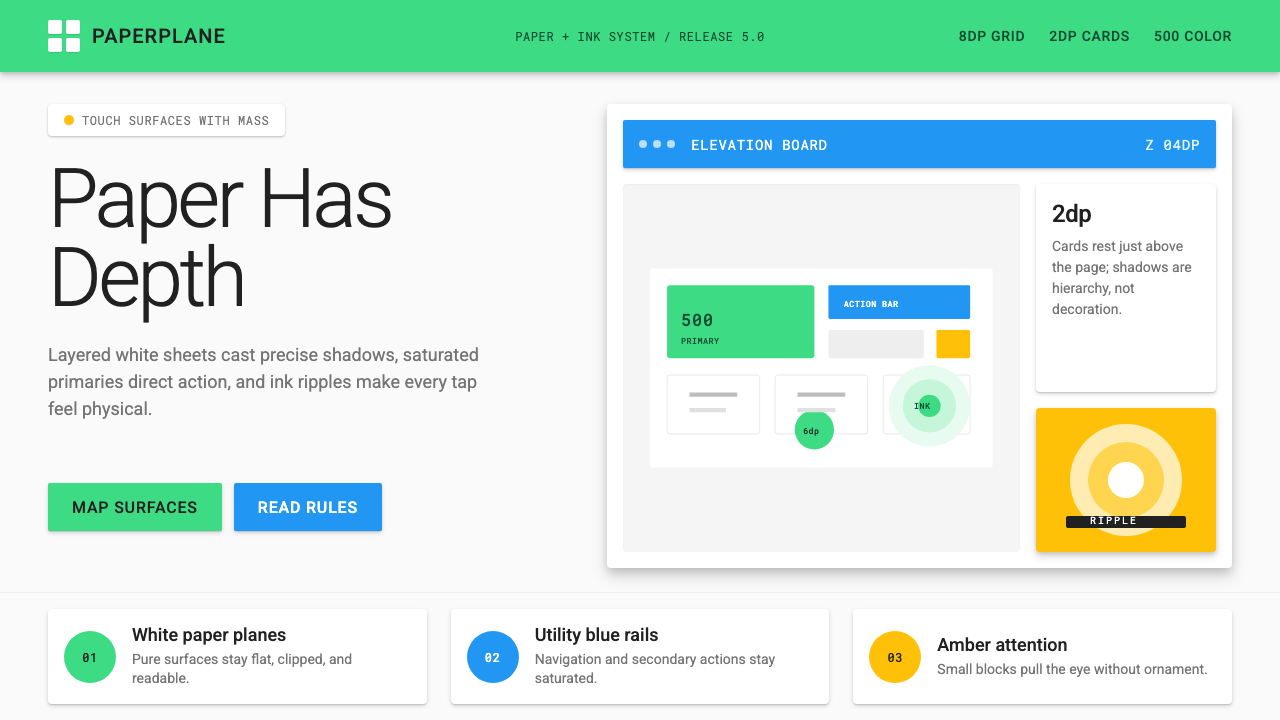 Android Lollipop (Material 1.0)Paper becomes physical. Roboto, green FABs and sharp shadows give white cards…
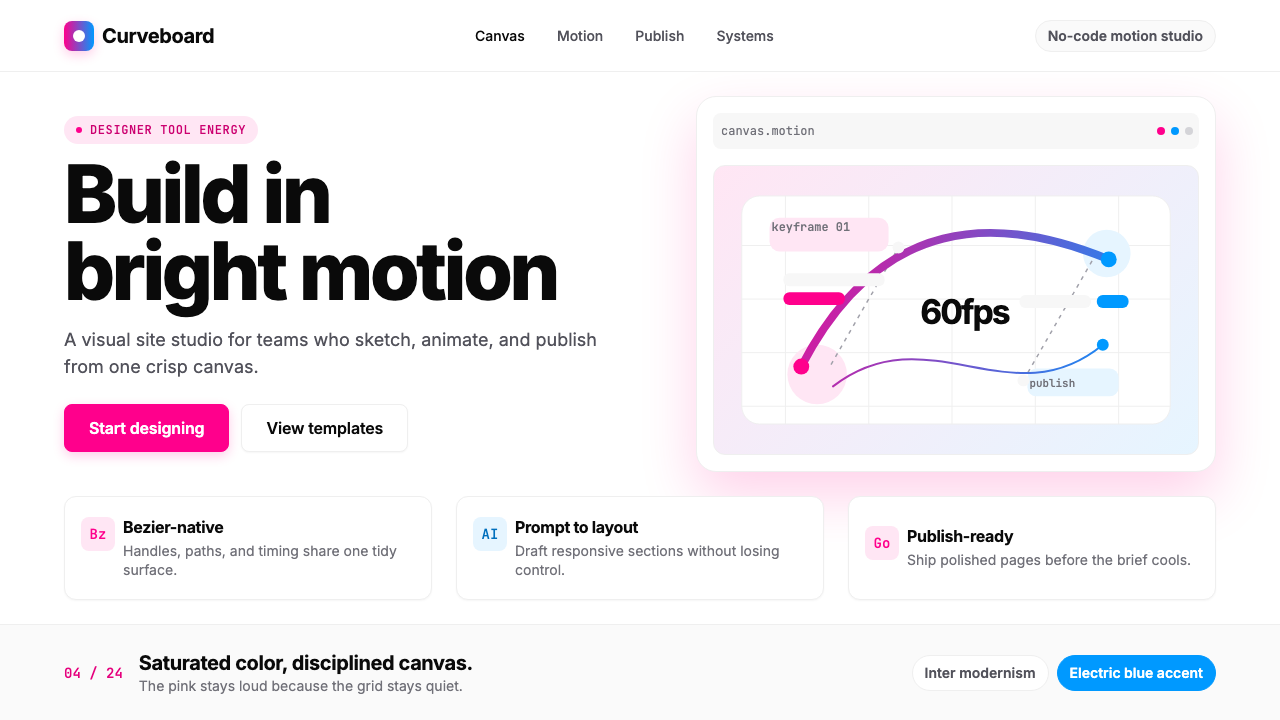 Framer Motion PinkDesigner-tool pink stays sharp. Inter whitespace frames electric blue Bezier…
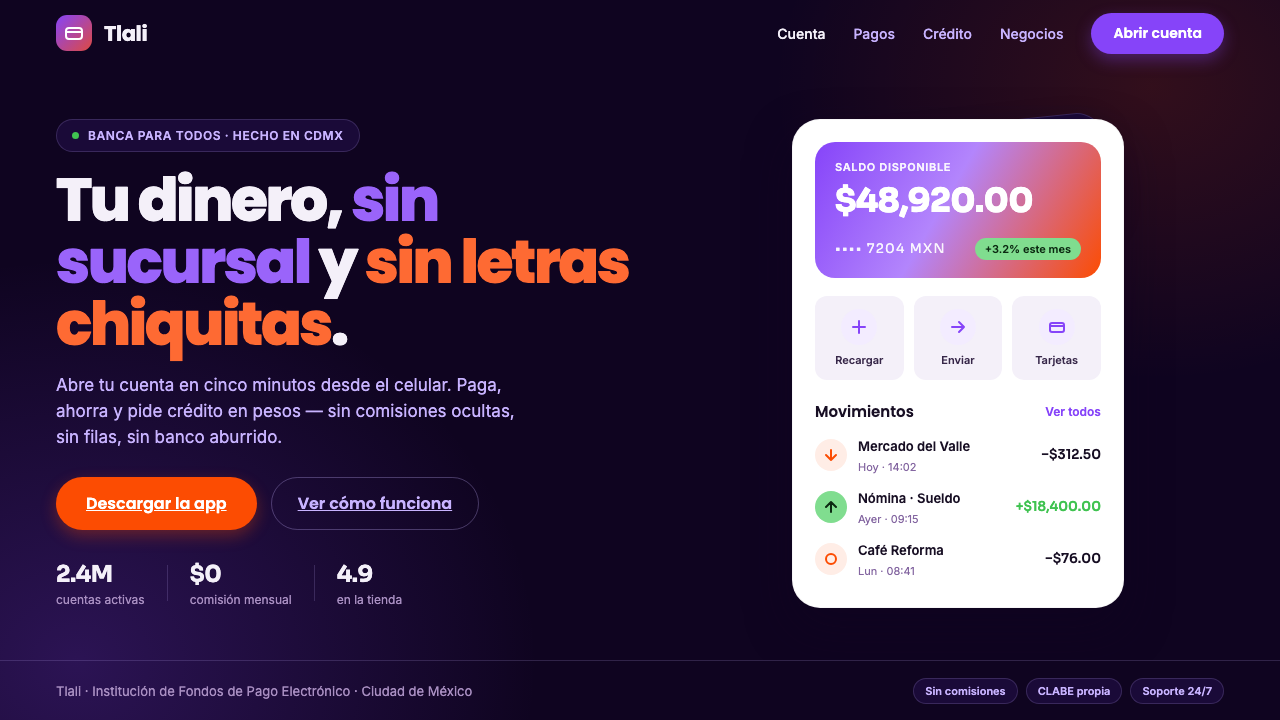 Mexican Fintech StartupNeobank, not legacy bank. White rounded cards float on near-black plum, lit b…
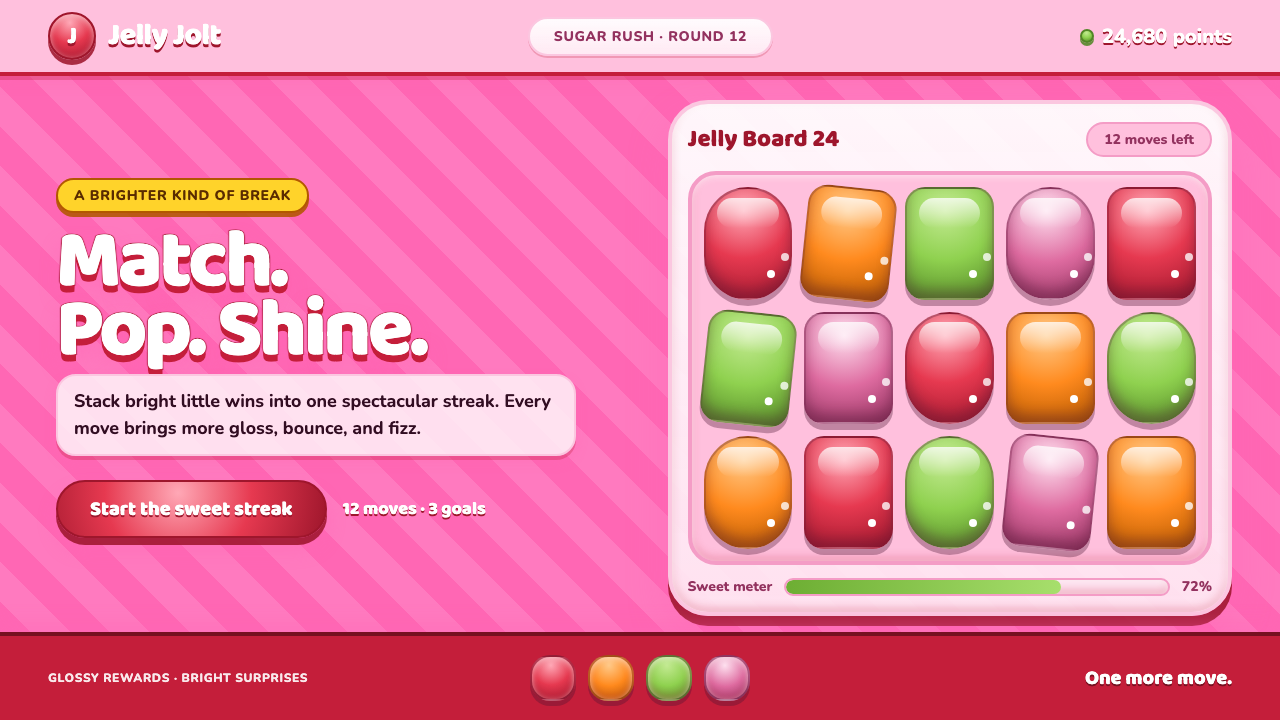 Candy Crush (2012)Sugar rush without restraint. Glossy candy tiles pulse across a striped bubbl…
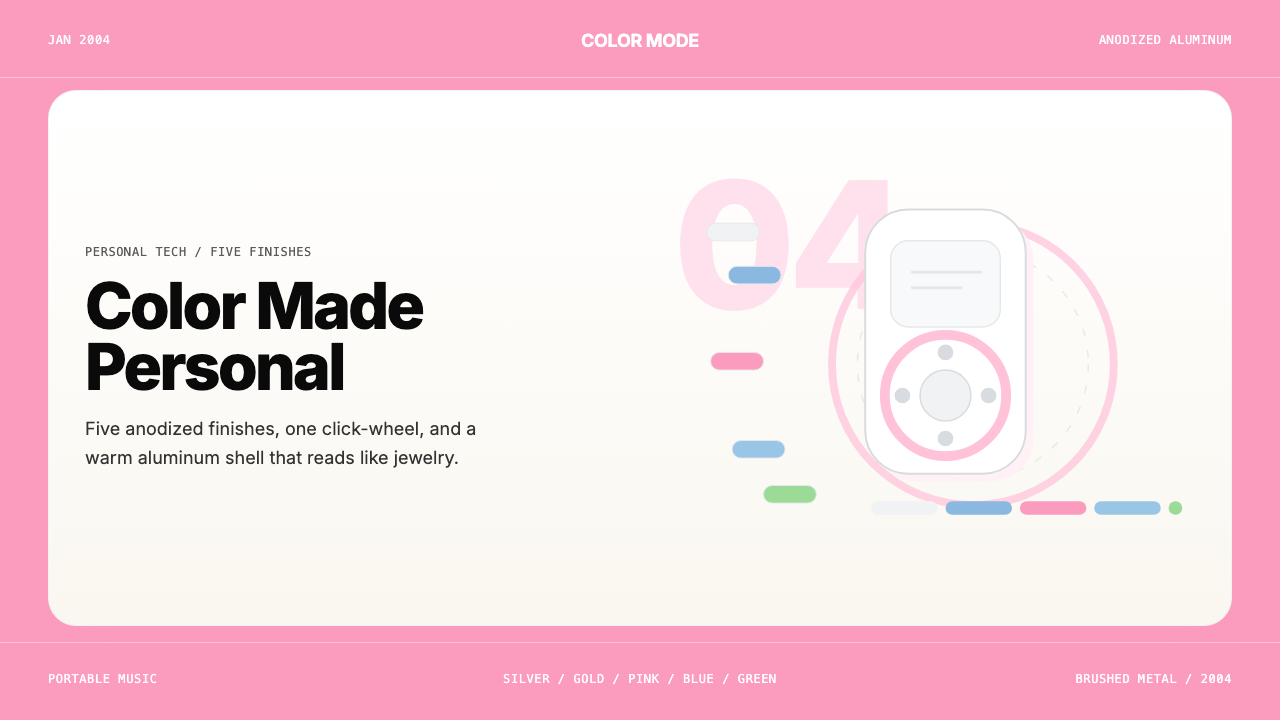 iPod Mini Anodized (2004)Color becomes identity. Pink panels, clean sans, and click-wheel geometry kee…