What is Framer Motion Pink?
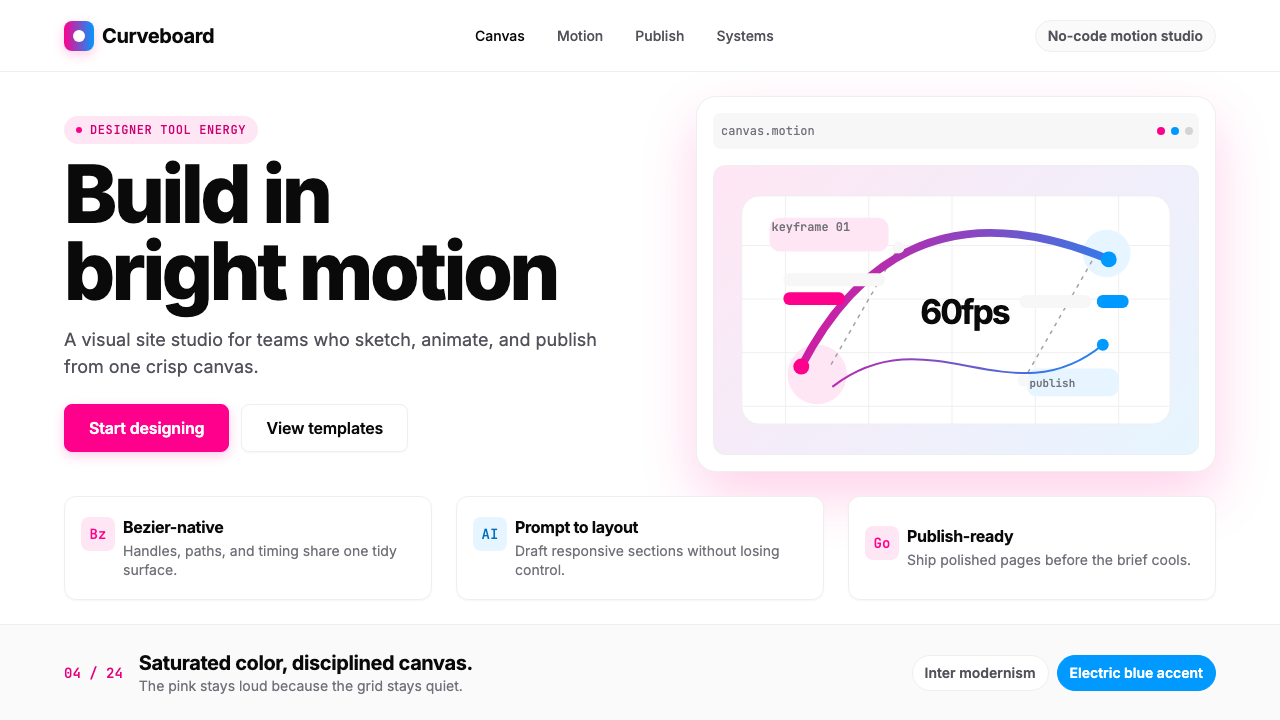
Framer's electric pink is a designer's signal flare — saturated, disciplined, and unmistakable in a sea of neutral SaaS interfaces.
Framer Motion Pink in brief
Framer Motion Pink is the visual identity system of Framer, an Amsterdam-based no-code and AI design platform. The style is built on a tight, deliberate pairing: a saturated bright pink and an electric blue, deployed on pure white backgrounds with near-black type. Together these two colors function as a brand signature that reads simultaneously as playful and professional — warmth without softness, energy without noise.
What distinguishes the style from generic pastel-tech or candy-colored consumer apps is its discipline. The pink is not a tint or a softened blush; it is fully saturated and commands attention. The blue is its counterweight — cooler, more spatial, used for interactive cues, animated bezier-curve motifs, and moments of technical precision. White space does much of the compositional work, keeping the palette from overwhelming the layout.
The typographic system centers on a clean, geometric sans-serif rendered at generous scale with deliberate weight contrast. Headlines are set large and confident; body copy is airy and well-spaced. Rounded corners on component frames soften what would otherwise be a stark modernist grid. The overall effect is a visual language that belongs to the world of professional tools but refuses the anonymity of enterprise software — it is specific, branded, and immediately recognizable.

Where does Framer Motion Pink come from?
Framer was founded in Amsterdam in 2014 by Koen Bok and Jorn van Dijk. In its earliest form, the product was a code-based prototyping toolkit aimed at designers who wanted to express complex interactions beyond the reach of static mockup tools. The brand of this period was functional and subdued — appropriate for a developer-adjacent product where credibility came from technical depth rather than visual personality.
The company's visual identity began to shift decisively around 2022, when Framer repositioned from a prototyping tool to a Webflow-class visual website builder with AI-assisted design capabilities. This pivot demanded a new brand register: one that could attract a broader audience of designers, freelancers, and agencies while signaling that Framer was not merely another builder but an opinionated design platform with a clear point of view. The saturated pink and electric blue emerged as the anchors of this repositioned identity.
The 2023 and 2024 brand expression codified what would become the recognizable Framer aesthetic. Hero imagery made extensive use of two-dimensional bezier-curve motifs and design-mockup compositions — a knowing self-reference that positioned the tool's output as its own best advertisement. The pink, specifically, was chosen to occupy a precise register: neither the gentle blush of consumer wellness apps nor the neon aggression of gaming brands, but a designer-tool pink that signals craft, intentionality, and a slight irreverence toward the sea of blue-and-gray enterprise software.
The cultural context matters. The 2020s saw a broader movement in design-tool branding away from corporate neutrality and toward expressive, opinionated color. Competitors in the design-tool space had long gravitated toward dark backgrounds and muted palettes, making Framer's white-ground, high-saturation approach a deliberate counter-positioning. The style draws loosely on a lineage of playful modernism — the warmth of mid-century Swiss graphics, the boldness of contemporary design-forward software brands — while remaining firmly rooted in its own moment and medium.
What defines the Framer Motion Pink look?
Color Pairing
The style lives or dies on two colors: a saturated, fully-committed bright pink and a clear electric blue. Neither is softened with white nor deepened with black — they are presented at full intensity against white, creating maximum chromatic contrast without competing with each other. The pink functions as the brand's primary signature and emotional anchor; the blue carries the sense of motion, technology, and interactive precision. A near-black is used for body type and structural elements, keeping legibility uncompromised.
Typography
The typographic approach pairs a clean geometric sans-serif for display and UI text with generous spacing that lets each element breathe. Scale contrast is substantial: headline type runs large and confident, creating an immediate visual hierarchy, while body copy settles into a quieter, highly legible register. The system favors slightly more letter-spacing than strictly necessary — a choice that reads as airy and design-conscious rather than compressed. Bold weight is used selectively, not habitually, making its appearance carry genuine emphasis.
Bezier and Motion Motifs
Flowing two-dimensional curves — references to the bezier paths that are the building blocks of vector design — appear as decorative and structural elements in hero imagery, feature illustrations, and marketing compositions. These motifs function as the style's most distinctive ornamental gesture: they are simultaneously abstract and self-referential, alluding to the tooling that Framer provides. The curves are typically rendered in the electric blue on white, sometimes in pink, and carry a sense of kinetic potential even when static.
White Space and Breathing Room
The generosity of white space is not accidental — it is one of the primary devices that stops the saturated colors from overwhelming the composition. Sections are given room to exist as discrete visual moments; components do not crowd each other. This disciplined airiness is a quality most associated with premium design tools and editorial design, and it lends the Framer identity a sense of confidence: the design does not need to fill every corner to assert itself.
Refined-Rounded Corners
Component frames, card containers, and interface elements carry rounded corners that are perceptible but not exaggerated — the rounding is calibrated to communicate approachability without sliding into the soft, toy-like quality of heavily-rounded consumer apps. This precise calibration is part of what places the style in the playful-professional register: the edges are friendly, but they do not suggest naivety. The rounded corners also harmonize with the curves of the bezier motifs, giving the system visual coherence.
Design-Mockup Heroics
A recurring compositional strategy places actual design mockups — interface screenshots, component previews, canvas compositions — as the primary hero imagery. This is a form of honest product advertisement: the tool shows what it can make. The mockups are typically arranged in layered, slightly-overlapping compositions that suggest depth without resorting to strong three-dimensional perspective. They are lit consistently, cropped to reveal partial frames, and integrated with the bezier motifs to create a sense of a live, working design environment.
Playful-Professional Tone
The style occupies a carefully maintained middle ground between the seriousness of enterprise software and the exuberance of consumer apps. It is warm but not casual, energetic but not frantic, opinionated but not alienating. This tonal balance is achieved through the combination of disciplined white space, a restrained palette that never uses more than two of its colors prominently at once, confident typography, and motion references that feel intelligent rather than decorative. The result is a brand that appeals to designers who think of themselves as both creative professionals and discerning technologists.

Who shaped Framer Motion Pink?
Koen Bok co-founded Framer in Amsterdam in 2014 and has served as its CEO. He guided the company through its most significant strategic pivots: from a React-based code prototyping tool toward an AI-assisted visual website builder capable of competing in the no-code market. His product vision shaped the decision to invest in a distinct, opinionated visual identity at a time when most design-tool competitors favored anonymous, neutral brand presentations. The current pink-and-blue brand system reflects a company direction he helped set: unapologetically design-forward, warm but precise.
Jorn van Dijk co-founded Framer alongside Koen Bok and contributed deeply to the product's early design philosophy. With a background as a product designer, he helped define the experience principles that would eventually underpin the visual identity: the belief that a design tool's own interface should demonstrate the quality of design it enables, and that the tool's brand should be an honest expression of its values rather than a neutral container. His influence is most visible in the way Framer's visual language treats its own design artifacts — mockups, curves, components — as first-class citizens of the brand system.
The current brand identity — the specific pink, the electric blue pairing, the bezier-curve hero motifs, the generous whitespace system, the rounded-corner component language — was developed and refined by Framer's in-house design team across the 2022 to 2024 period. This team made the decisions that define the style at its most characteristic: the choice not to soften the pink, the commitment to white grounds over dark ones, the use of the company's own design output as its primary marketing imagery. Their work demonstrates the style's central thesis — that a design tool's brand should be its best portfolio piece.
Webflow, the San Francisco-based visual website builder that Framer is often compared to and positioned against, maintained a more subdued and neutral brand identity through much of the period when Framer was developing its own. This contrast is instructive: Webflow's relative neutrality created space for Framer's saturated, opinionated palette to function as a differentiating signal. Understanding the Framer style benefits from understanding it as a deliberate act of market positioning — not just a visual preference, but a statement about what kind of design platform Framer intends to be.
How do you use Framer Motion Pink today?
Framer Motion Pink is well-suited to presentation work where the designer wants to signal technical sophistication alongside visual warmth — a combination that positions the sender as a design-aware professional rather than a generic agency. For slide covers, the style rewards full-bleed compositions in which the saturated pink or electric blue anchors one zone of the frame while white space and large-scale type hold the rest. A bezier-curve motif or abstract two-dimensional shape can introduce the motion reference without requiring animation. Content slides work best with a grid that is strict but not rigid: two or three columns, generous top and bottom margins, and a typographic hierarchy built purely on scale and weight without decorative dividers or icon clusters.
Data slides in this style carry a diagrammatic quality that earns trust. Bar charts and line graphs should be rendered with the electric blue as the primary data color and the pink reserved for the highlighted value or call-out point — never both at high weight simultaneously on the same chart. Keep chart backgrounds white and axes typographically quiet; the data should speak through the color pairing, not through visual decoration. Tables benefit from thin ruling lines and alternating row tints that stay within the white-and-very-light-gray range, with the pink appearing only in header cells or total rows.
For web interfaces, the style is particularly effective on product landing pages, pricing tables, and dashboard-style interfaces where scannable hierarchy matters more than emotional warmth. Define a grid with clear column gutters, use white as the ground throughout, and apply the pink as the primary call-to-action color — buttons, active states, selected tabs, pricing tier highlights. The electric blue handles secondary interactivity: links, hover states, progress indicators, and the decorative bezier motifs that might appear in background illustrations. Card components should have gently rounded corners consistent with the brand's component language, with subtle borders rather than heavy shadows.
In editorial and marketing contexts, the style brings poster-like confidence to feature announcements, case study headers, and social media assets. A single large typographic statement in near-black on white, punctuated by a pink accent word or underline, achieves the right combination of legibility and brand personality. Marketing pages work in alternating full-width bands: white-ground sections for copy-heavy content, pink-ground sections for key claims or testimonials. The electric blue enters primarily as an illustration element — the bezier curves and design-mockup compositions that remind the viewer what product is being advertised.
A common mistake is misreading the style's energy as a license to use both pink and blue at full saturation simultaneously across large areas of a layout. In the Framer brand system itself, the two colors rarely appear at equal visual weight in the same composition — one leads, the other accents. Overuse of the pink in particular creates layouts that feel loud rather than confident. Similarly, abandoning the generous white space to accommodate more content destroys the premium register the style depends on. The airiness is not a stylistic luxury; it is load-bearing. Reducing it undermines the entire tonal balance.

Framer Motion Pink — FAQ
Is this style only appropriate for design-tool or SaaS products?
Not exclusively, but its associations are strong. Framer Motion Pink carries a clear signal of the professional designer-tool world, and that signal will feel resonant or misaligned depending on the product's own context. For a design agency's portfolio, a product-launch site aimed at design-aware audiences, or a developer tool with design sensibilities, the fit is immediate. For a food brand, a healthcare provider, or any context where the pink reads as clinical rather than warm, the associations become liabilities. The style's energy is confident and modern, but it is not universally neutral.
How does Framer Motion Pink differ from other tech-brand pinks like Dribbble or Product Hunt?
Dribbble's pink sits in a warmer, softer register — it evokes community, creativity, and the sharing of finished work. Product Hunt's orange-pink is more appetizing and consumer-oriented, closer to a warm sunset than a design tool. Framer's pink is cooler, more saturated, and more purposefully paired with an electric blue counterpart, which pushes it toward the technical and kinetic rather than the social. The bezier-curve motifs and the white-ground discipline further separate the style: it references digital making rather than human connection, precision rather than warmth.
Can the style work on a dark background?
The canonical Framer identity is a white-ground system, and that white ground is one of the structural reasons the saturated palette works — the colors have room to vibrate against a neutral field. A dark inversion is possible but requires rethinking the color roles. On a dark background, the pink can retain its energy, but the electric blue tends to recede. White or near-white becomes the dominant typographic color, which shifts the tonal register away from the airy, professional warmth that defines the style at its best. Dark variants work for specific moments — full-bleed section breaks, data visualization backgrounds — but a sustained dark-ground application of the style risks losing the distinctive whitespace-driven breathing room that gives it its character.
How should animation be approached when applying this style?
The style's bezier-curve motifs already carry an implicit sense of motion, which means animation is a natural extension rather than a forced addition. When adding animation, the appropriate vocabulary is smooth, spring-physics transitions rather than linear or ease-in-out mechanical movement — the curves should feel alive, not mechanical. Color transitions work well as animated state changes: a button shifting from white with pink border to pink-filled on hover, a card lifting with a soft-offset shadow on interaction. Avoid particle effects, heavy parallax, or anything that competes with the white space — the motion should feel like the design is breathing, not performing.
Is it possible to apply this style without using the exact brand colors?
Yes — the style's logic does not depend on any single specific color but on the relationship between the colors. A different saturated primary paired with a contrasting secondary at similar saturation levels, on white grounds with generous spacing and geometric sans-serif type, can evoke the same tonal register. What must be preserved is the structural relationship: one dominant color that anchors brand identity, one secondary that handles motion and technical cues, white as the ground, and near-black for type. Softening the saturation of either primary color is the most common way to lose the style's character — the commitment to full-intensity color is what separates it from the pastels and muted palettes that surround it.
Related design styles
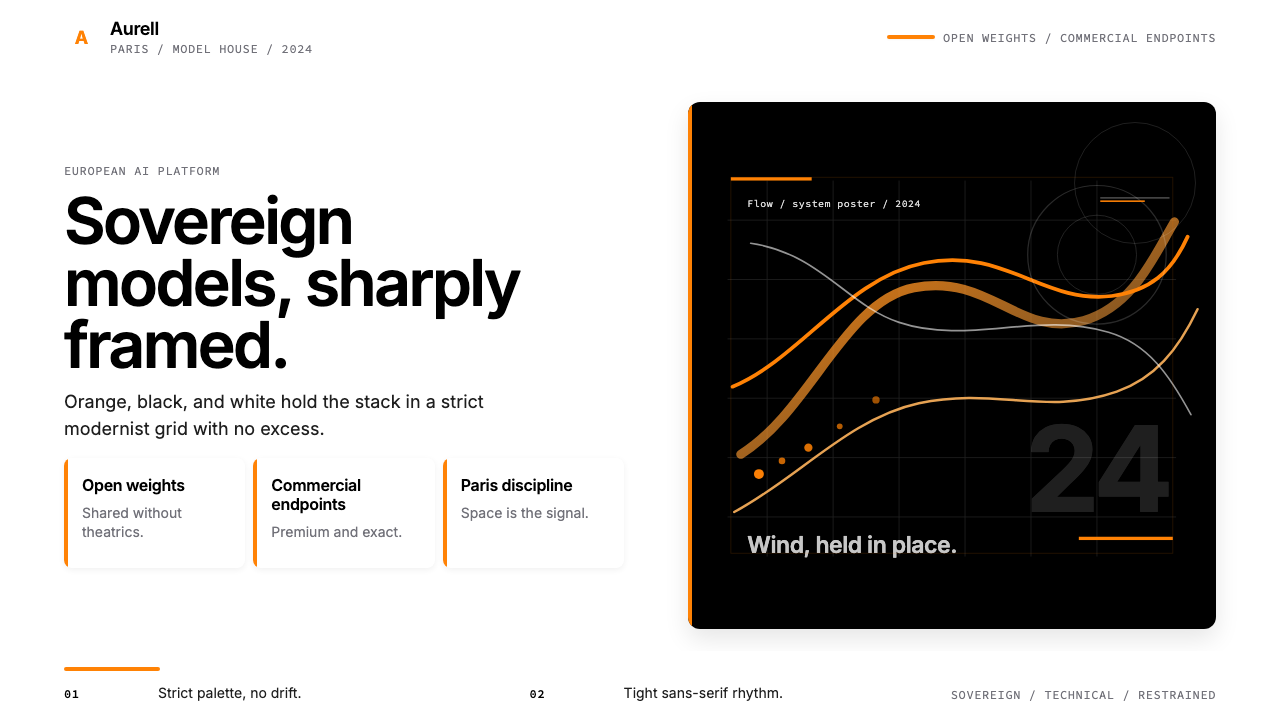 Mistral AI OrangeSovereign AI with restraint. Orange, black, and white lock the grid.
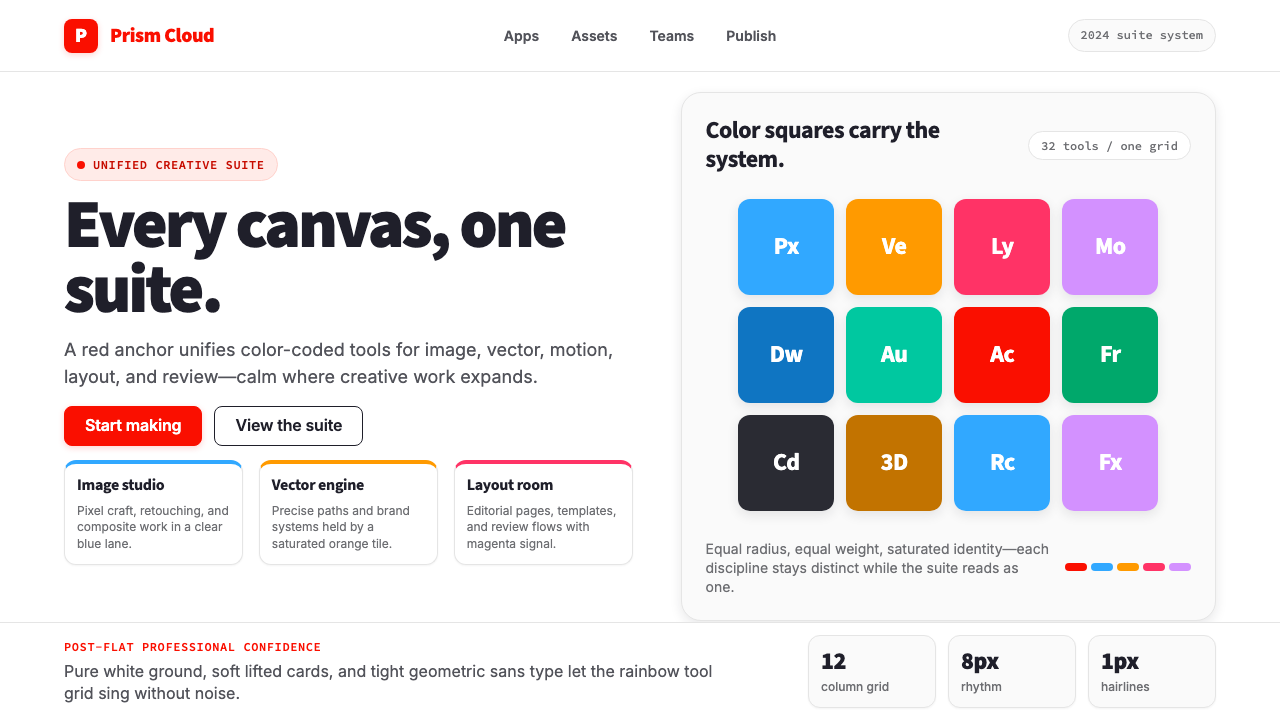 Adobe Creative CloudUnified, not uniform. Red anchor, white space, and saturated app tiles organi…
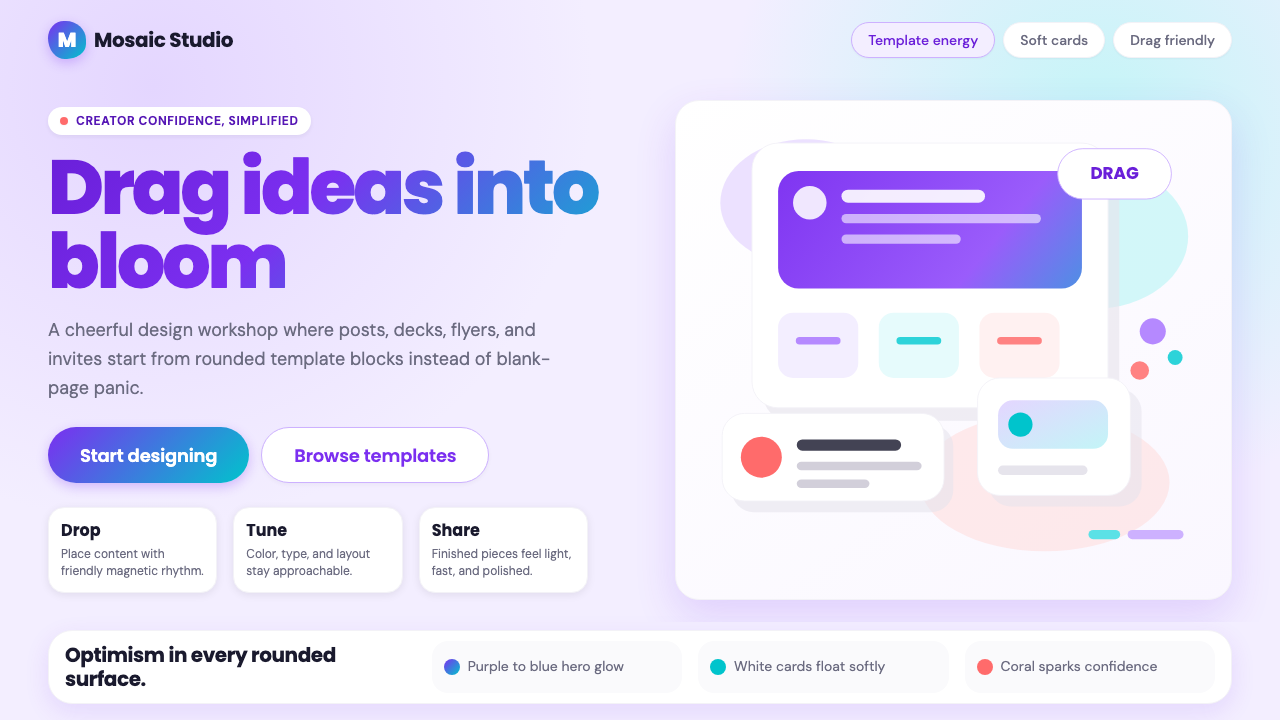 Canva 2024Confidence feels draggable. Purple-blue gradients and floating white template…
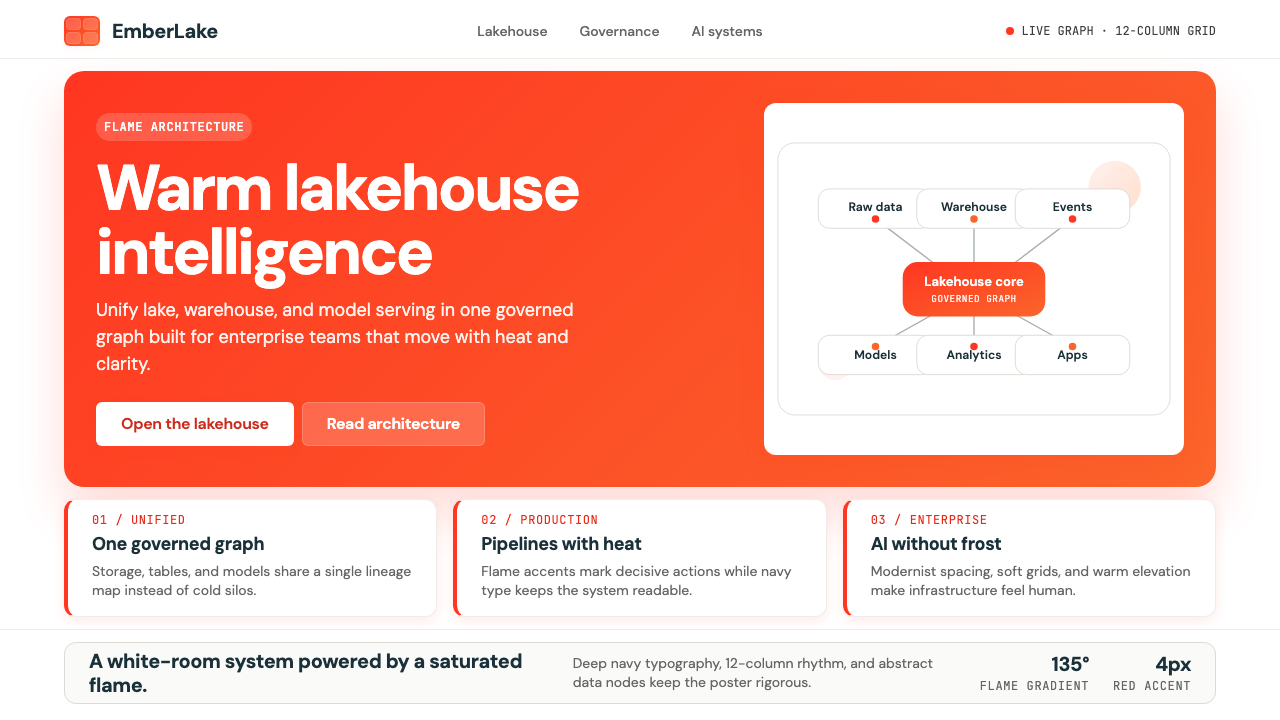 Databricks LakehouseWarm enterprise confidence. Flame red-orange gradients meet DM Sans and clean…
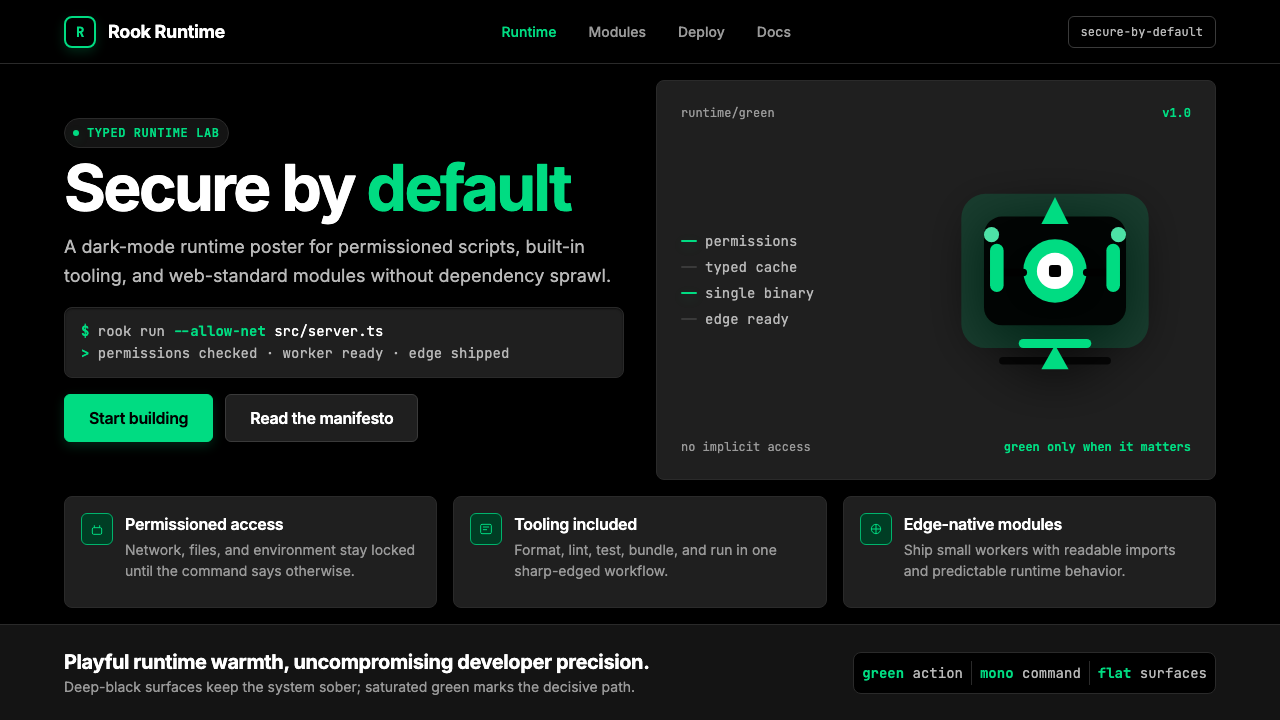 Deno Runtime-GreenWarm precision on black. Saturated green, Inter, and mono code turn security…
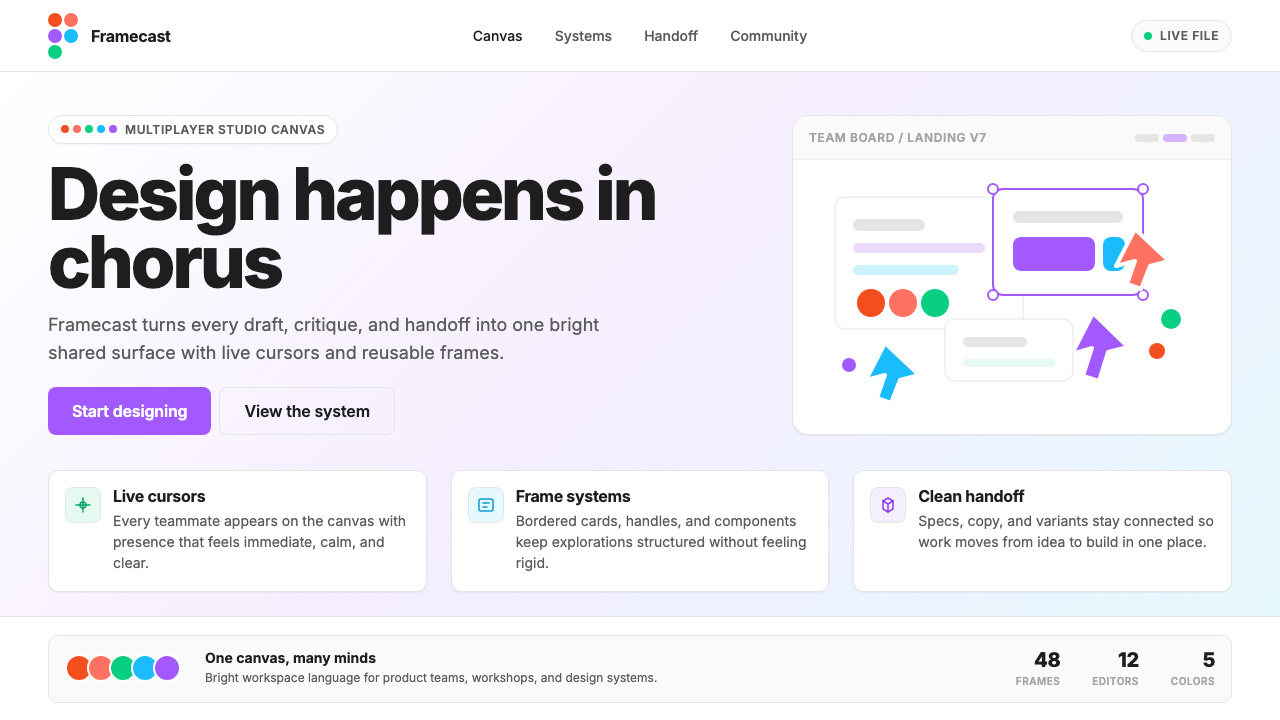 Figma 2024A brand that looks like its canvas. Five dots scatter like cursors, soft card…