What is iPod Silhouette 2004?
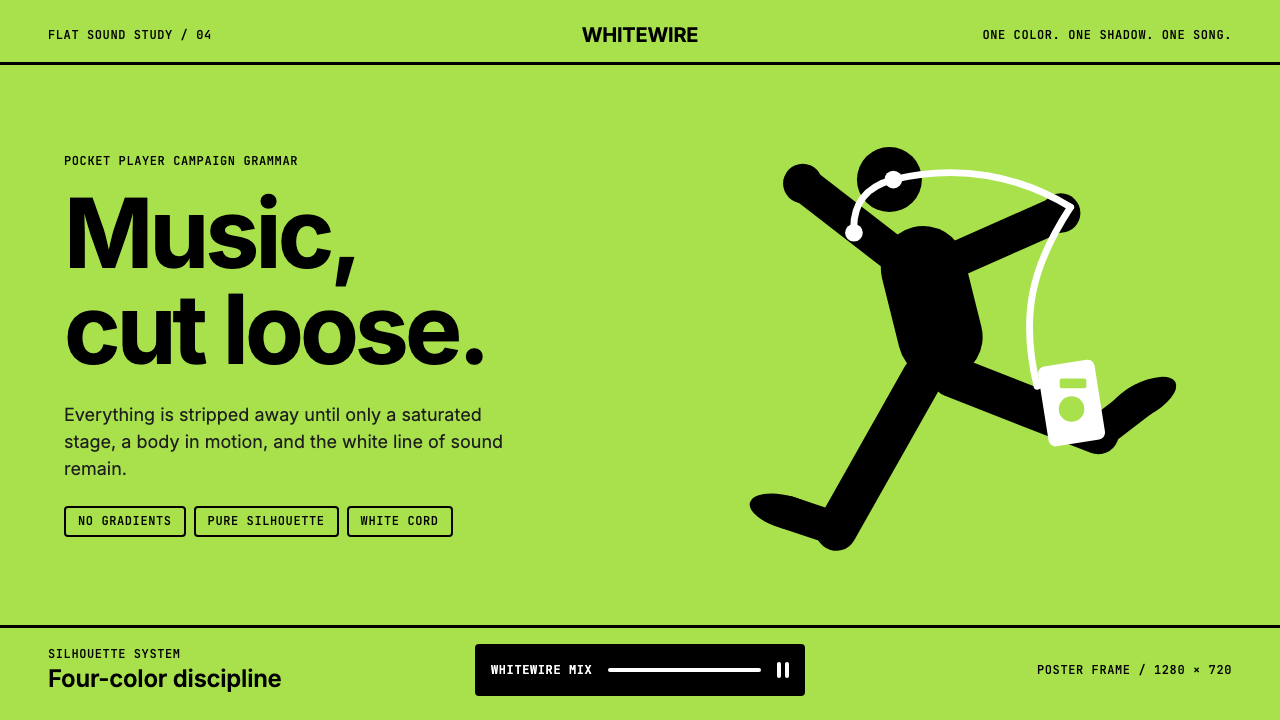
Three ingredients — a saturated flat field, a black dancing silhouette, and a single white cord — turned Apple's iPod campaign into the defining poster language of the early 2000s.
iPod Silhouette 2004 in brief
iPod Silhouette is the visual design language codified by Apple's 2003–2006 advertising campaign: saturated flat-color backgrounds — lime green, magenta, cyan, electric orange — serve as stages for anonymous black silhouette figures frozen in ecstatic, mid-dance poses. Tethering each silhouette to the only representational object in the frame is a white cord ending in white earbuds and a white iPod. The entire composition operates with exactly three layers: background, silhouette, and white device.
What makes the system remarkable is its absolute economy. No gradients, no textures, no drop shadows, no facial features, no clothing detail. The silhouette is not a specific person — it is the universal experience of losing yourself in music, abstracted to its geometric shadow. The white cord functions as both a literal product shot and a compositional line that leads the eye. Typography — where it appears — is set in a clean sans-serif at minimal size, deliberately subordinate to the image. The poster communicates before a single word is read.
As a design vocabulary for contemporary work, iPod Silhouette translates into a precise set of decisions: use one dominant saturated color per composition, render any figures or focal objects as flat black silhouettes against that field, reserve white exclusively for the hero element or key typographic message, and enforce zero-texture discipline throughout. The result is work that reads instantly at any size — from a thumbnail to a billboard — because every element is legible at its most reduced form.

Where does iPod Silhouette 2004 come from?
In 2001, Apple released the first iPod alongside the memorable slogan '1,000 songs in your pocket.' The product was a technological statement, but the advertising that would define it culturally came two years later. In 2003, Apple's long-standing creative partner TBWA\Chiat\Day — the Los Angeles agency led by creative director Lee Clow — developed the Silhouette campaign under the direction of art director Susan Alinsangan. The brief was to communicate not the device's specifications but the emotional state it produced: freedom, movement, joy, the total absorption of music. The silhouette concept answered that brief with unusual precision.
The visual strategy drew from a tradition of flat poster art — the kind of simplified, high-contrast graphic language seen in mid-century travel posters and constructivist propaganda — but fused it with the energy of contemporary street and club culture. The dancing figures were shot as live performers in studio conditions, then reduced photographically to pure black shapes. The flat color backgrounds were chosen for maximum saturation and differentiation: each colorway would become its own seasonal variant, allowing the campaign to refresh while maintaining instant recognition. By the time the campaign reached its peak in 2004 through television spots, outdoor advertising, and retail environments, the silhouette format had become so recognizable that the product itself did not need to be named.
Steve Jobs's involvement shaped the discipline of the campaign. Apple's design culture under Jobs operated by elimination — removing every element that was not strictly necessary until what remained was as close to pure function as possible. The Silhouette posters embody this logic: the human figure is stripped to shadow, the product is stripped to outline, the environment is stripped to color. What survives is not minimalism as aesthetic gesture but reduction as argument: the music matters, the body responds, and the device is the only manufactured object in the world worth showing.
The campaign ran through approximately 2006, with hundreds of color and figure variations. Its legacy extended well beyond advertising. The visual language entered the broader culture as shorthand for a certain kind of confident, bold simplicity associated with Apple's design philosophy in that era. When designers today invoke the iPod Silhouette aesthetic, they are drawing on a system that was not designed as a fine-art exercise but as a commercial communication solution — one that solved the problem of making a small electronic device feel like an invitation to dance.
What defines the iPod Silhouette 2004 look?
Saturated Flat Background
The background of any iPod Silhouette composition is a single, fully saturated flat color — no gradient, no vignette, no texture. The color functions as the entire environment: sky, floor, and atmosphere collapsed into one unbroken field. The specific hues associated with the campaign — lime green, hot magenta, bright cyan, electric orange — sit at the outer boundary of sRGB saturation, chosen to maximize visual energy while remaining unambiguously flat. Any approach that introduces gradation or lightfall into the background immediately exits the system.
Black Silhouette Figure
The human figure is rendered as a flat, featureless black shape — no interior line work, no facial detail, no clothing texture. The silhouette communicates through posture alone: the arc of a raised arm, the tilt of a head, the spread of fingers holding earbuds. Figures are typically shown in mid-motion, conveying liberation and physical response to music rather than posed stillness. The anonymity of the silhouette is intentional: it is not a portrait but a mirror, inviting the viewer to project themselves into the figure.
The White Cord
The white earphone cord is the most distinctive single element of the visual system. Against a saturated background, white reads with maximum contrast and pulls the eye with line energy. The cord traces a path from the silhouette figure's ears or hands down to the white iPod — a compositional arc that narrates a story in a single gesture: human, connected, device. The cord also serves as the only color in the composition that is neither background hue nor black, making it function simultaneously as product identification, compositional rhythm, and emotional symbol of the musical connection.
Three-Layer Absolute Discipline
The system operates on exactly three layers and refuses a fourth. Layer one: the flat color field, which fills every pixel of the background with no variation. Layer two: the black silhouette, which is pure foreground against that field with no shadow, blur, or glow beneath it. Layer three: the white device and cord, which float above the silhouette in compositional terms and serve as the sole detail carrier. Typography, when present, belongs to the white layer and is kept secondary to the figures. Introducing any fourth visual layer — a texture overlay, a gradient band, a decorative border — breaks the fundamental tension that gives the system its power.
Typography as Whisper
When type appears in the iPod Silhouette system — typically a product name, tagline, or album title — it is set in a clean, geometric sans-serif at a scale that is deliberately quiet relative to the image. The type does not compete with the silhouette; it annotates it. Weight is kept light to medium, and the text is typically positioned at the very bottom of the composition or tucked into a corner, respecting the primacy of the visual. This restraint stands in contrast to most advertising typography of the era, which used type as the dominant communication layer.
Per-Color Compositional Completeness
Each colorway in the campaign functions as a complete, self-contained composition. Lime green is not interchangeable with magenta — the specific background hue was chosen to complement the energy and posture of each figure. This means that applying the system correctly requires treating color not as a brand color to be consistently reproduced across all applications, but as an expressive environment tailored to each composition. Multiple colorways exist in the campaign because each dance, each posture, each musical mood calls for its own background.
Zero Decorative Ambiguity
Every element in an iPod Silhouette composition earns its presence through a specific communicative function. The background color sets emotional register. The silhouette conveys human experience. The white device names the product. Nothing exists for decoration. There are no abstract geometric overlays, no ornamental patterns, no badge treatments, no visual noise. This austerity is not a consequence of the medium — it is the medium. The style's power depends entirely on the clarity produced by the removal of everything that is not doing functional work.

Who shaped iPod Silhouette 2004?
Jobs's role in the iPod Silhouette campaign was less as a visual author and more as the enforcer of the philosophy that made the visuals possible. His insistence that every Apple product and communication achieve the highest clarity through elimination — removing buttons, removing menus, removing visual noise — gave the advertising team the organizational permission to strip the posters down to three elements. The campaign's commercial success under Jobs validated a design approach that most advertising executives of the era would have considered dangerously underspecified.
Lee Clow was the creative director at TBWA\Chiat\Day who oversaw the Apple relationship from the iconic '1984' Super Bowl commercial through the iPod era. His contribution to the Silhouette campaign was the strategic conviction that the most powerful advertising Apple could run was advertising that felt nothing like advertising — that communicated a cultural and emotional truth rather than a product feature list. Clow's influence ensured the campaign maintained its radical simplicity against the institutional pressure that inevitably accompanies large-scale media buys.
Alinsangan served as the art director credited with developing the visual execution of the Silhouette campaign at TBWA\Chiat\Day. The specific decisions that define the system — the choice to use flat color rather than graduated backgrounds, the reduction of performers to pure black shapes, the elevation of the white cord to compositional protagonist — emerged from her creative direction. Her work on the campaign established a visual template that was immediately recognizable, endlessly reproduced, and influential enough to define the visual culture of the mid-2000s consumer technology space.
Although Jony Ive's primary domain was hardware industrial design, his visual philosophy — that a product should declare its function through the clarity of its form — provided the theoretical underpinning that the advertising team translated into the Silhouette campaign. The white iPod itself, with its monochromatic body and minimal controls, was the physical object that made the campaign's three-layer logic work: it was already designed to be the single white element in any composition, its form inseparable from its role in the poster.
The Los Angeles office of TBWA\Chiat\Day was the institutional structure within which the Silhouette campaign was developed, and its culture of preserving radical creative concepts against client-side risk aversion was essential to the campaign's integrity. The agency's history of producing conceptually ambitious work for Apple — from '1984' to 'Think Different' to the Silhouette series — created an accumulated trust that allowed the team to present and execute an advertising campaign that, stripped to its essentials, showed almost nothing about the product it was selling.
How do you use iPod Silhouette 2004 today?
The iPod Silhouette system translates with unusual directness into contemporary design work because its logic is structural rather than era-specific. The core constraint — one saturated flat background, black silhouette forms, white hero element — is a compositional rule that produces high-impact work across media. However, the system is easy to misread as a simple recipe, and that misreading produces weaker results. Correct application starts with understanding that the three layers must all be present and each must do its assigned work exclusively: background carries color and energy, silhouette carries human presence and motion, white carries product identity or primary message.
For presentation slides, the system works exceptionally well on cover pages and section dividers where impact takes priority over information density. A cover built in this language uses one saturated background color that sets the emotional tone of the presentation, places a silhouette that relates metaphorically to the subject matter, and reserves white for the title and any essential metadata. Content slides should not attempt to replicate the full silhouette treatment — instead, they borrow the palette discipline: single dominant background hue, black for body text and data labels, white for structural dividers and key callouts. Data visualization adopts the three-color logic: bars and chart segments in the background color, comparison bars in black, annotations in white. The result is a slide deck with visual consistency without forcing every slide to be a poster.
For web interfaces — dashboards, pricing pages, product landing pages — the system informs layout and color hierarchy without requiring literal silhouette imagery on every screen. Establish a primary saturated background hue as the brand anchor color; use it for hero sections, feature blocks, and primary calls to action. Reserve black for body text and structural elements. Use white for cards, input fields, and content areas that require legibility at extended reading lengths. Interactive states — hover, active, selected — are ideal candidates for the silhouette treatment: a user avatar that becomes a flat black shape on a saturated hover state, for instance, directly applies the campaign's logic at a micro-interaction level.
For editorial layouts and marketing materials, the style supports strong, poster-like communication in a way that few contemporary design systems permit. A marketing page section built in this language places a full-width saturated color block containing a black silhouette illustration above the fold, with white headline text positioned to work compositionally with the figure's posture or gaze direction. Print materials — event posters, product announcements, conference branding — translate directly: the three-layer rule works as well on a physical A2 poster as on a social media card. The critical discipline for editorial application is that the silhouette must be a genuine figure — a person, a hand holding a device, an animal, a recognizable object reduced to outline — not an abstract blob. The system depends on the viewer's ability to read the black shape as a human presence.
The most common mistake when applying iPod Silhouette is treating it as a color-and-contrast recipe without honoring the three-layer discipline. Designers frequently add a fourth element — a soft drop shadow beneath the silhouette figure, a gradient in the background color, a secondary texture behind the white device — each of which individually seems like a minor enhancement but collectively dissolves the tension that gives the system its power. A related error is using the silhouette treatment for static, upright, or formally posed figures: the campaign's figures were always in dynamic motion, and a silhouette standing at attention reads as corporate iconography rather than joyful energy. When using this system, commit to motion, commit to flatness, and commit to the rule of three layers — any accommodation in those three areas dilutes the result.

iPod Silhouette 2004 — FAQ
Can the system work with colors outside the original campaign palette?
Yes, with important qualifications. The original lime green, magenta, cyan, and orange were chosen for maximum saturation within a specific color space, and they carry cultural associations with the early iPod era that some applications may want and others may want to avoid. The system's underlying rule is not about specific hues but about saturation level and flatness: the background must be a single fully saturated color, whichever hue is chosen. Deep navy, rich violet, and warm coral can all work as background fields if deployed at full saturation with zero gradient. Pastels, mid-tone neutrals, and muted hues break the system because they lack the chromatic intensity that gives the background its stage-like quality.
Does the style require actual silhouette photography, or can illustrated shapes work?
Illustrated silhouettes work and are often more practical for contemporary applications. The system's requirement is not photographic origin but visual fidelity to the silhouette principle: the figure must read as a flat, featureless black shape with no interior detail. Vector illustrations that capture dynamic human posture — a figure in mid-leap, a hand raised with earphones — translate the system's logic precisely. What does not work are silhouettes with internal detail lines, hatching, or tonal variation, as these reintroduce descriptive complexity that the system is specifically designed to eliminate. The silhouette's power comes from what it withholds.
How does this style relate to contemporary flat design and Material Design?
The iPod Silhouette campaign (2003) is an important historical precedent for the flat design movement that became dominant in digital interfaces around 2012–2013, but the relationship is one of influence rather than equivalence. Flat design adopted the no-gradient, no-texture principles that the Silhouette campaign embodied, but distributed them across a much broader color range and removed the silhouette figure as a compositional device. Material Design (2014) then reintroduced depth through elevation shadows and z-axis metaphors — a direct departure from the Silhouette system's absolute flatness. If flat design is a descendant, it is a diluted one. The Silhouette system's specific contribution — the three-layer structural constraint and the use of human motion as the primary communicative element — has no direct parallel in any contemporary design system.
What happens when the system needs to carry more than one message?
The honest answer is that the system is not well-suited to multi-message compositions. Its power is built on singular focus: one background, one figure, one device. When multiple messages are required — for instance, a landing page that must communicate a product name, a key benefit, a price point, and a call to action — the correct approach is to break the content into multiple distinct zones, each treated as a separate iPod Silhouette composition with its own background color and figure, rather than attempting to crowd all information into one three-layer field. A pricing page, for example, might use lime green with a dancing figure for the entry tier, magenta with a different figure for the mid tier, and cyan with a third figure for the premium tier — each card complete in itself, the variety of color signaling the differentiation.
Is iPod Silhouette appropriate for serious or formal contexts?
The system's origins in consumer advertising and its association with music, dance, and physical liberation make it a natural fit for contexts that want energy, joy, and cultural immediacy. It can be applied in more serious contexts — a conference keynote, a product launch for a professional tool, a brand campaign for a technology platform — but those applications work best when the silhouette figures are chosen to reflect the professional activity rather than dance. A silhouette of a person at a standing desk, a coder gesturing at a screen, or a designer holding a stylus deploys the system's three-layer discipline while redirecting its emotional register from euphoric to purposeful. The underlying grammar of the style is neutral; the emotional connotation is carried by the figure's posture and the background color's temperature.
Related design styles
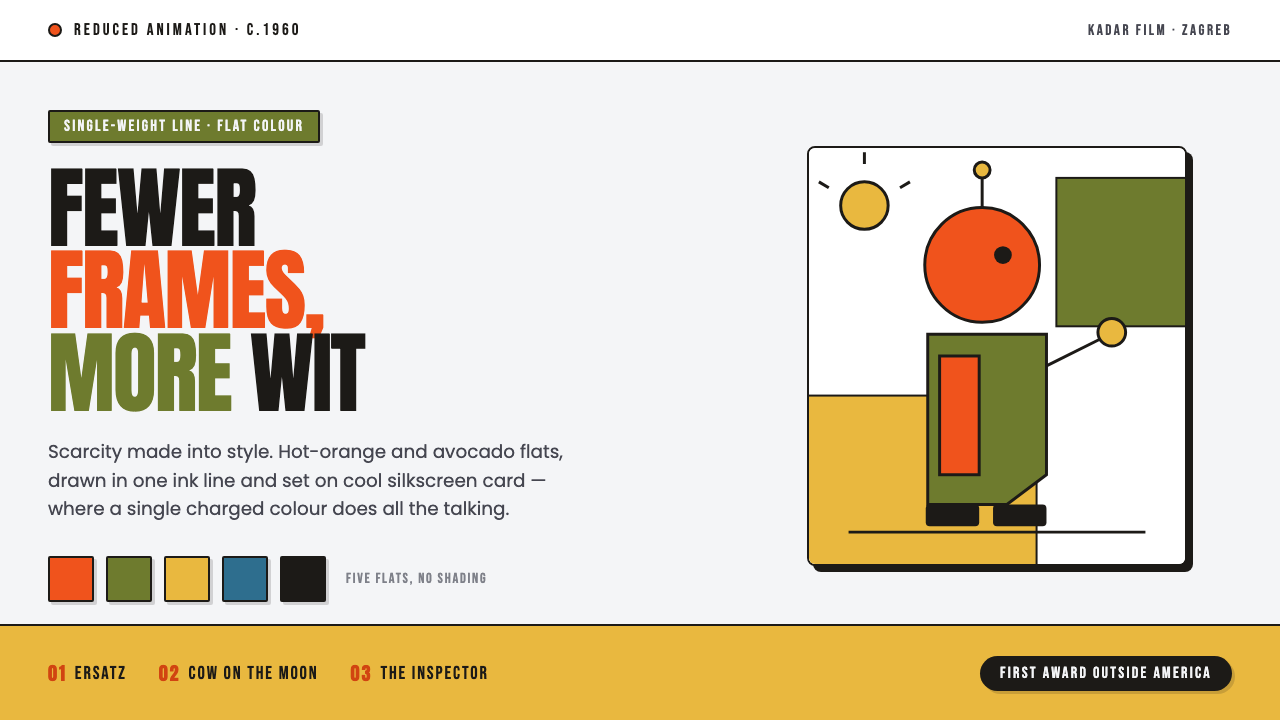 Zagreb School of AnimationScarcity made into style. Hot-orange and avocado flats in single-weight ink o…
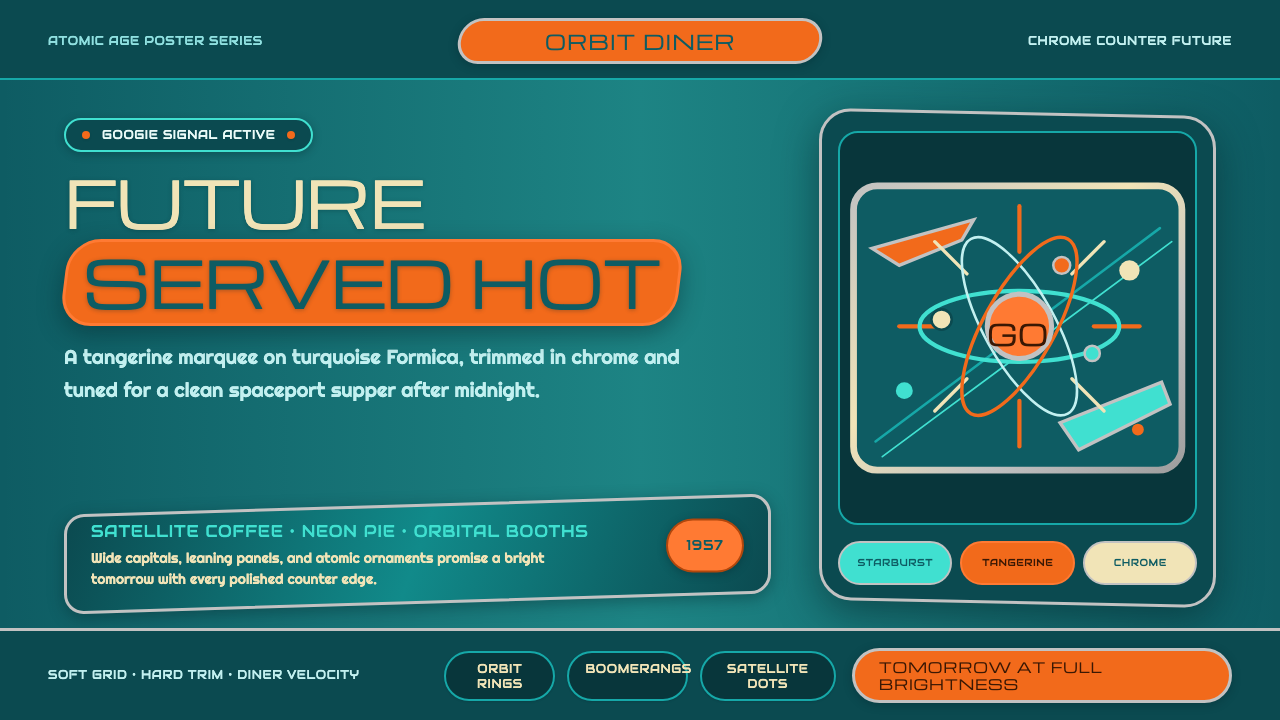 Atompunk / Raygun GothicTomorrow shines loud. Tangerine marquee type cuts through turquoise chrome ge…
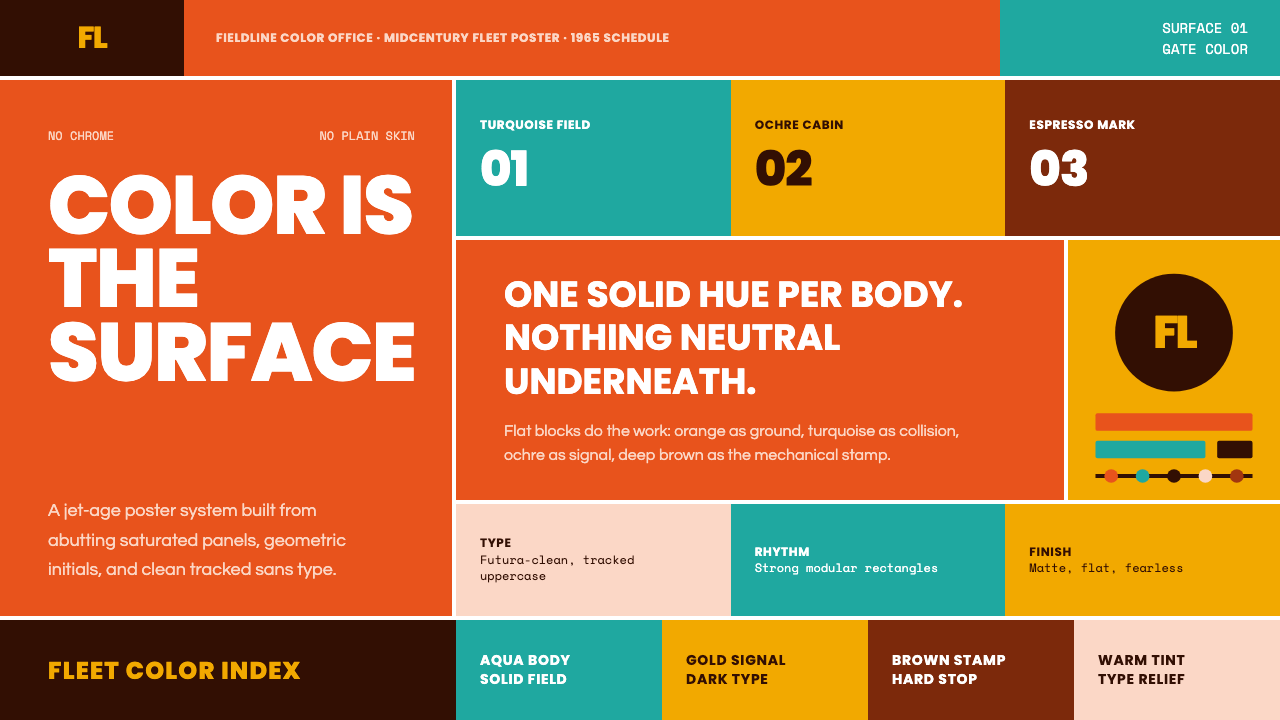 Braniff (Girard)Color becomes fuselage. Jellybean orange, turquoise blocks, and geometric san…
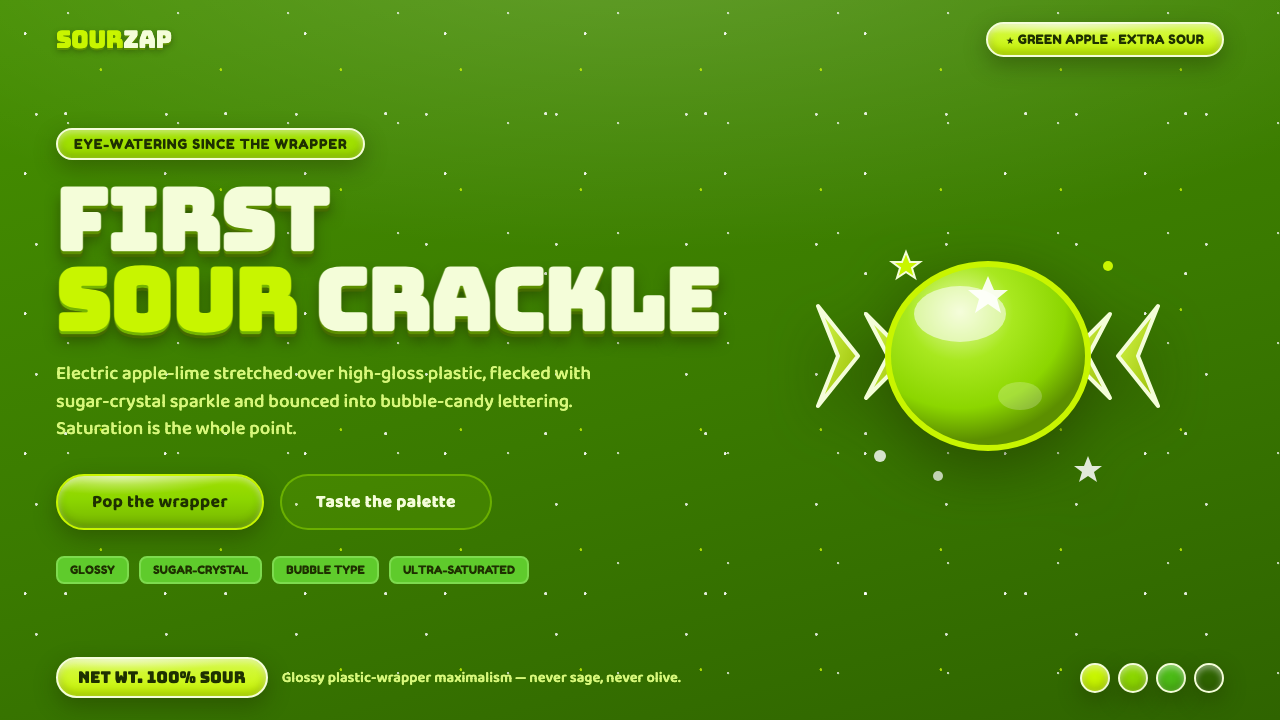 Sour Apple Candy GreenSaturation is the point. Electric apple-green on glossy plastic, sugar-crysta…
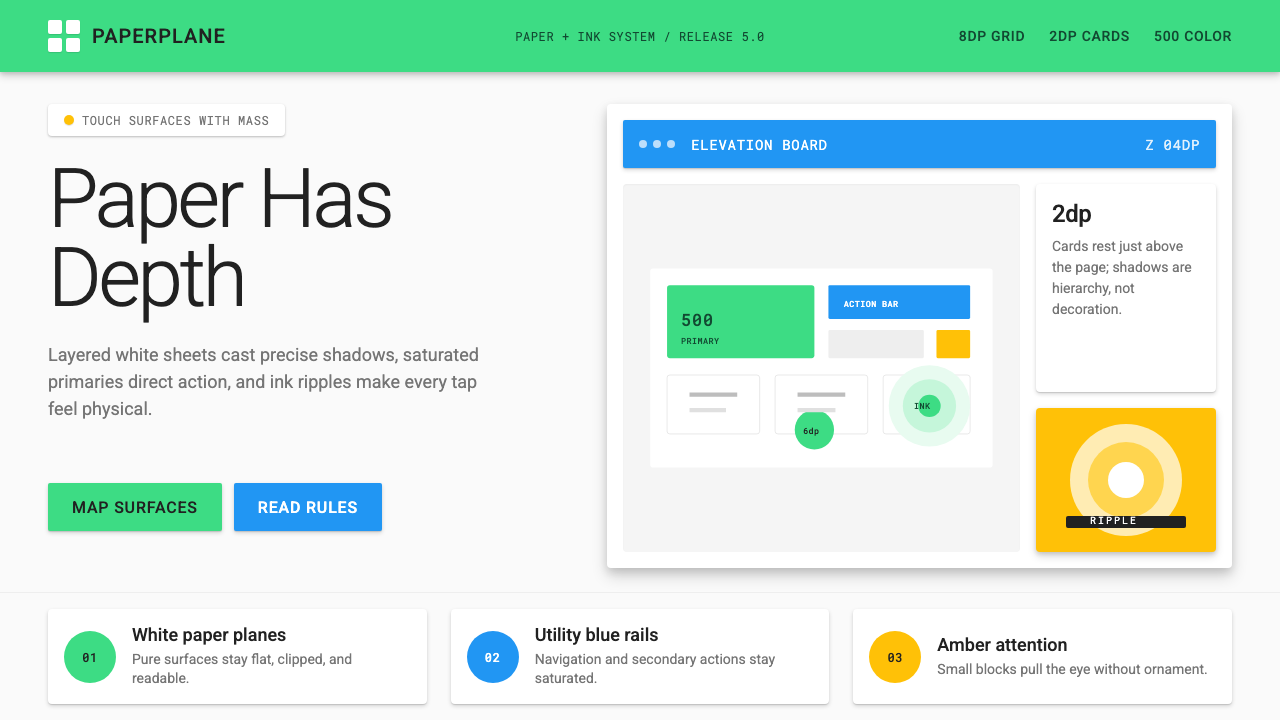 Android Lollipop (Material 1.0)Paper becomes physical. Roboto, green FABs and sharp shadows give white cards…
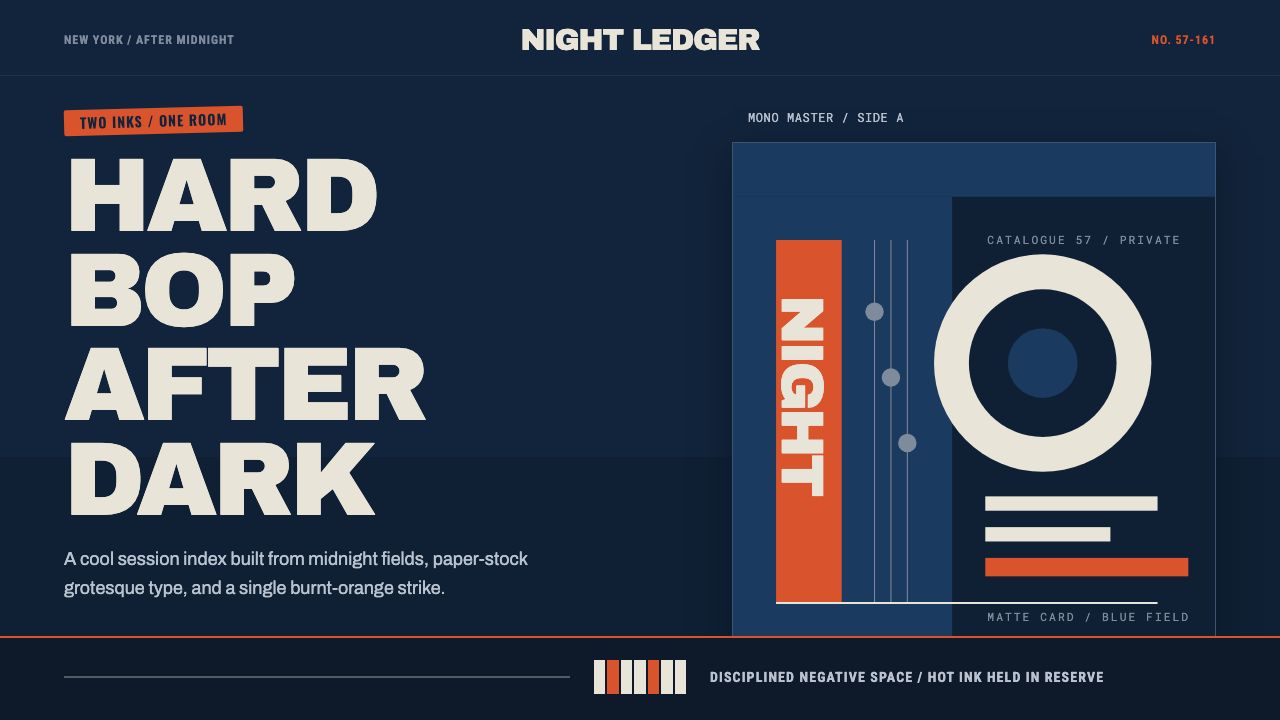 Blue Note JazzCool intelligence, printed flat. Midnight blue, paper type, and one burnt-ora…