What is iPod Mini Anodized (2004)?
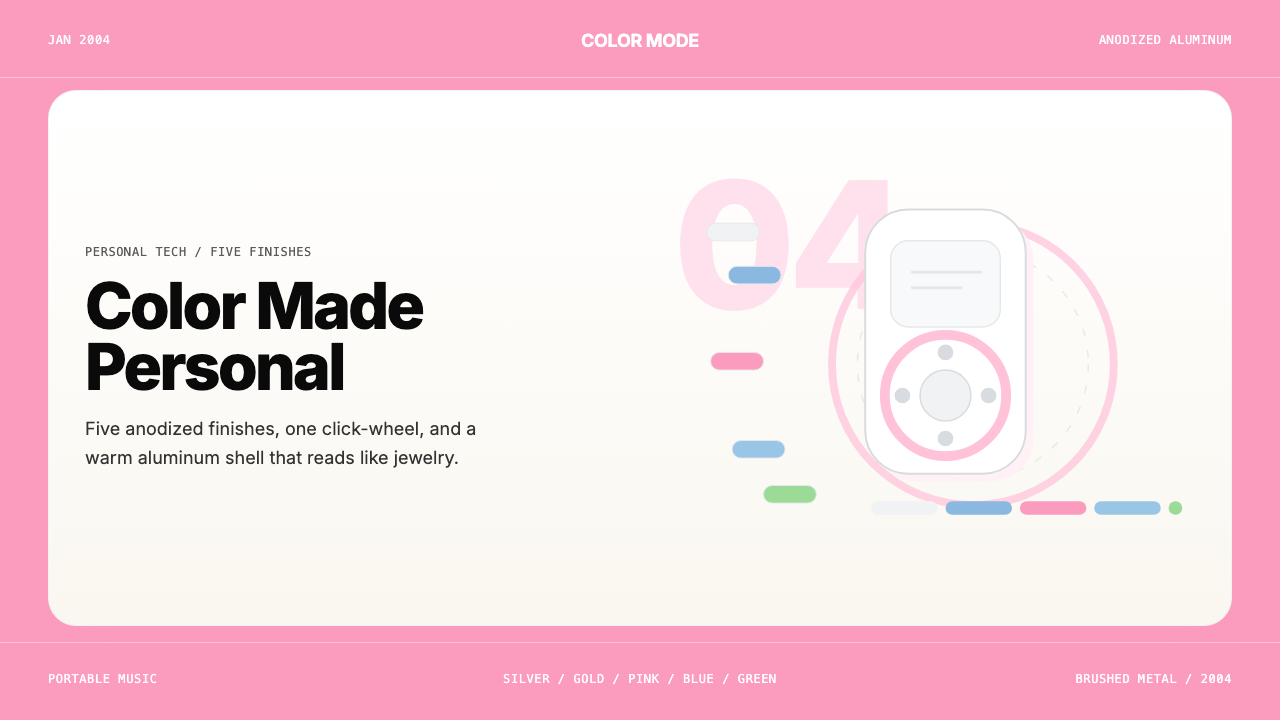
Five anodized-aluminum finishes launched in January 2004 turned a music player into a personal color statement — and set the template Apple would repeat for two decades.
iPod Mini Anodized (2004) in brief
The iPod mini Anodized design system translates the tactile warmth of mid-2000s Apple hardware into a visual language for screens. Its defining quality is a palette rooted in soft, pastel-saturated tones — the pinks, blues, silvers, and greens of brushed aluminum — balanced against generous amounts of clean white or near-white space. The palette is warm rather than cool, muted rather than saturated at full intensity, and always reads as friendly rather than clinical.
Typography in this system is rigorously sans-serif: letterforms are round-shouldered and open, conveying approachability without sacrificing legibility. There is a deliberate restraint in typographic weight — the system avoids heavy, compressed, or condensed cuts in favor of regular and medium weights that echo the quiet confidence of the iPod mini's own silkscreened labeling. Scale does the organizational work that other systems accomplish through decorative dividers or color banding.
The system's spatial logic is defined by breathing room. Cards, panels, and containers favor rounded corners — not the sharp ninety-degree edges of utilitarian design, but the softly radiused corners that mirror the iPod mini's chamfered chassis. Whitespace is not an afterthought but a material in itself, used to give color fields and typographic elements room to feel considered rather than crowded.

Where does iPod Mini Anodized (2004) come from?
The iPod mini debuted at Macworld Expo San Francisco in January 2004, priced below the standard iPod and offered in five anodized-aluminum finishes: Silver, Gold, Pink, Blue, and Green. The choice of anodized aluminum was not merely cosmetic. Anodizing is an electrochemical process that bonds a colored oxide layer directly into the surface of the aluminum, making the color durable, scratch-resistant, and integral to the material itself rather than applied on top. This gave the iPod mini a finish that felt both premium and permanent — the color was the object, not a coat over it.
The visual identity that accompanied the launch drew on Apple's existing clean-white aesthetic but inflected it with the specific pastel warmth of the hardware palette. Advertising campaigns shot each iPod mini against white backgrounds with colored silhouette dancers — the same campaign grammar Apple had been developing since the original iPod's launch in 2001. The anodized colors gave the campaign a new register: personal, choice-driven, identity-forward. A Blue iPod mini and a Pink iPod mini were not just different colors; they were different personalities.
The key figures behind the iPod mini's design were Steve Jobs, who personally championed the smaller, more affordable form factor; Jony Ive, whose industrial design team developed the precision-milled aluminum enclosure; Tony Fadell, who led the broader iPod engineering effort; and Phil Schiller, whose marketing instincts shaped the color-as-identity communications strategy. Ive's team had been exploring aluminum as a premium consumer-electronics material since the PowerBook G4, and the iPod mini represented the first time that exploration met a full-spectrum color system.
The iPod mini's anodized color approach proved so successful that Apple extended it to subsequent product lines. The iPod nano (introduced in 2005, replacing the mini) expanded the color options further. The iPod shuffle adopted bright solid colors. The iPhone 5c in 2013 revisited the idea of a plastic body in five consumer colors, citing the same logic: the device as personality vehicle. By the time the iPhone 7 introduced jet black and matte black as finish differentiators, Apple had been in the color-as-identity business for over a decade — a lineage that runs directly through the iPod mini's January 2004 launch.
What defines the iPod Mini Anodized (2004) look?
Anodized Pastel Palette
The defining palette draws from the five original iPod mini finishes: a soft blush pink, a warm sky blue, a cool silver-white, a muted sage-to-mint green, and a restrained champagne gold. These are not fully saturated primaries — each hue carries a subtle warmth or coolness that keeps the overall effect approachable and tactile. Pink functions as the signature accent; silver-white anchors most background fields; the remaining hues appear as differentiation or accent layers.
Brushed-Aluminum Texture Logic
Even in purely digital applications, the system evokes the visual logic of brushed metal: subtle directional grain implied through tonal gradients that run along a single axis, light reflections that feel soft rather than specular, and surfaces that appear to have physical weight without relying on heavy drop shadows. The effect is material warmth translated into screen language — not a literal skeuomorphic simulation but an atmospheric reference.
Rounded Corner Geometry
Every container — cards, buttons, panels, image frames — uses a consistently generous corner radius that echoes the iPod mini's physical chassis. The rounding is not merely decorative; it signals approachability and suggests that the interface has been considered from every angle, including the human hand. Sharp right angles are reserved for structural dividers and data tables where precision reading is required.
Whitespace as Material
The system treats negative space with the same deliberateness as color or type. Large white or near-white fields surround content islands, giving each colored element room to register as a considered choice rather than one item in a crowded list. The spatial generosity mirrors the iPod mini's own design discipline, where a single click wheel and a handful of controls occupied a chassis that felt edited rather than stripped.
Clean Sans-Serif Typography
Letterforms are round, open, and consistently sans-serif throughout. The system favors slightly humanist sans-serif shapes — forms that feel friendly without being playful — at weights that remain readable at small sizes. Hierarchy is established through size and color rather than through competing typefaces or decorative ornament. Text on colored fields is typically set in white or very dark neutral tones to maintain legibility against the warm palette.
Color as Identity Differentiator
Following the iPod mini's product logic, the system uses color not as decoration but as identity marker. In a multi-product or multi-tier context, each option receives its own anodized hue: pink for one tier, blue for another, silver for a third. This approach gives users an immediate visual handle on differentiation and encourages the same kind of personal identification that made customers choose their iPod mini by color before anything else.
Soft, Restrained Luminosity
Highlights and light effects in the system are soft and directional rather than specular or explosive. A subtle top-edge sheen on a card or button suggests that the surface has been polished without crossing into glossy skeuomorphism. The overall light quality reads as diffuse natural light on a matte metal surface — bright and clean, but never harsh or chrome-like.

Who shaped iPod Mini Anodized (2004)?
As Apple's Senior Vice President of Industrial Design, Jony Ive led the team that developed the iPod mini's precision-milled aluminum enclosure and chose anodizing as the finishing method. Ive had been pushing aluminum as a premium consumer material since the PowerBook G4 Titanium and earlier; the iPod mini represented the first time his team applied full-spectrum anodized color to a mainstream consumer device at volume. His insistence that color be integral to the material — not painted over it — established the design principle that carried through to the iPhone 5c, the MacBook Air color options, and beyond.
Jobs personally championed the iPod mini concept at a time when the standard iPod was Apple's best-selling product and many within Apple questioned whether a smaller, cheaper variant would cannibalize sales rather than expand the market. His judgment that consumer electronics could function as personal fashion accessories — differentiated by color and size rather than purely by specs — proved correct and opened a design philosophy that Apple has pursued ever since. The launch of the iPod mini at Macworld 2004 was one of Jobs's signature product introductions.
Known internally as the 'father of the iPod,' Tony Fadell led the hardware engineering team responsible for miniaturizing the iPod platform to fit the mini's smaller chassis. The engineering challenge was substantial: the iPod mini used a 1-inch Hitachi microdrive rather than a standard hard disk, and every component had to be redesigned to the new form factor. Fadell's team made the anodized color strategy viable by ensuring that the aluminum enclosure could be manufactured to tight tolerances at scale — a prerequisite for consistent color across production runs.
Apple's Senior Vice President of Worldwide Marketing, Phil Schiller shaped the communications strategy that made color synonymous with the iPod mini's identity rather than a secondary specification. Under Schiller's direction, Apple's advertising centered the color choice as the primary decision a customer would make — not storage capacity or price, but personality. The silhouette advertising campaign, which had debuted with the original iPod, was extended and inflected with the mini's pastel palette, cementing the association between Apple hardware colors and personal expression that defined the mid-2000s iPod era.
Though Susan Kare's foundational work on Apple's visual language predates the iPod era — she designed the original Macintosh interface icons and typefaces in the early 1980s — her influence on Apple's approach to friendly, warm, and humanist digital aesthetics is woven into the broader design culture from which the iPod mini's interface emerged. The mini's on-screen menus, with their clean sans-serif labels and generous spacing, owe a cultural debt to Kare's conviction that computers should feel approachable rather than intimidating. She represents the longer thread of Apple human-interface philosophy that the iPod mini's color system extended into hardware.
How do you use iPod Mini Anodized (2004) today?
The iPod mini Anodized system transfers most naturally to contexts where warmth, personality, and approachability are as important as clarity and hierarchy. It works well where a design needs to feel consumer-grade in the best sense — considered, tactile, and personal — rather than enterprise-neutral or purely utilitarian. The key to applying it correctly is treating the palette as the primary carrier of brand personality, the way Apple treated each iPod mini color as a distinct personality rather than a variant.
For presentation slides, the system excels on cover pages built around a single dominant anodized hue — a full-bleed pink or blue field with white type, or a white ground with a generous pink or blue geometric block anchoring one quadrant. Content slides should lean heavily on whitespace: one or two content columns with wide margins, section labels in the palette's muted tones, and no decorative borders. Data slides translate the color differentiation logic directly: use the anodized hues to distinguish data series, keeping each series to one consistent color and letting the white background provide the neutral ground against which the colors register clearly.
For web interfaces, the system is particularly well-suited to consumer product pages, pricing tiers, and feature comparison sections. The color-as-identity logic maps directly onto tier differentiation: each plan or product receives its own anodized color, making the choice feel personal rather than hierarchical. Dashboards benefit from a predominantly silver-white background with anodized accent colors used for status indicators, progress elements, and primary action buttons. Card components should use the rounded-corner geometry consistently and rely on subtle tonal shifts rather than heavy borders to define their edges.
For editorial and marketing work, the style supports a warm, magazine-quality aesthetic that reads as premium without being austere. Feature sections alternate between white-ground layouts with a single anodized color as accent and full-color panels where one palette hue fills the background and white type sits above it. Pull quotes and callouts can take the pink or blue field treatment. Marketing emails benefit from the system's natural sense of sectioning: each section block uses either a white ground or one of the soft anodized hues, creating a scannable rhythm without needing visual separators.
A common mistake when applying this system is pushing the palette toward full saturation. The anodized hues work because they are warm and slightly muted — they carry the quality of light on a real material surface rather than the intensity of a pure color swatch. Increasing saturation in search of vibrancy undermines the tactile, material warmth that makes the system distinctive. Similarly, abandoning the system's commitment to whitespace by filling every available surface with color destroys the breathing room that gives the palette colors their individual weight. Use one dominant hue per composition and let the white field do most of the heavy lifting.

iPod Mini Anodized (2004) — FAQ
How does this system differ from other Apple-derived design systems like the original iMac G3 or iOS 7 flat design?
The iMac G3 system (1998) is defined by translucent candy colors and a playful, slightly retro-futurist energy — the color is literally see-through, implying the technology inside. The iPod mini Anodized system is its opposite: the color is opaque, material, and rooted in a real manufacturing process. iOS 7 flat design (2013) prioritizes pure color at full saturation and the complete elimination of material metaphor — it is resolutely two-dimensional. The iPod mini system, by contrast, retains a quiet material warmth even in digital applications and uses softer, slightly muted tones rather than flat primaries. Think of it as sitting between the warmth of the G3 era and the austerity of flat design.
Can this system work effectively in dark-mode interfaces?
The iPod mini Anodized system is fundamentally a light-ground system — white and near-white fields are structural, not optional. A dark inversion is possible but requires significant adaptation. On a dark background, the anodized pastels tend to lose their material warmth and read instead as slightly washed-out or uncertain — the quality that makes them feel like real aluminum in a light context works against them in darkness. A dark variant works best when the background is a very dark warm neutral rather than pure black, and when the palette is reduced to the most saturated of the anodized hues — typically the blue or pink — with silver used for structural elements and white reserved for primary text.
What types of products or brands is this system poorly suited for?
The system struggles wherever authority, technical rigor, or cultural gravity are the primary desired values. Financial services requiring serious gravitas, legal or medical platforms, industrial B2B tools, luxury goods positioning themselves through restraint and heritage — all of these benefit from color systems with more tonal depth, less warmth, and stronger associations with institutional permanence rather than personal choice. The iPod mini system is optimized for contexts where the user's personal identification with the product is a feature rather than a distraction. When the product needs to recede behind its function rather than invite identification, a different system serves better.
How should the system handle more than five product tiers or color options?
The original iPod mini offered exactly five colors — a number that maps cleanly to five differentiated choices without overwhelming the visual field. When a design context requires more than five tiers, the anodized logic extends through tonal variation within the established hues: light and dark variants of each primary anodized color, or combinations of hue and texture (matte versus polished finishes translated as flat versus lightly shimmering fields). Beyond seven or eight options, the color-as-identity principle begins to break down, and it becomes more effective to use one anchor color per product family with secondary differentiation through typographic or structural variation rather than hue.
Is the rounded-corner requirement strict, or can sharp corners coexist with this system?
The corner radius is one of the system's strongest structural signals, and abandoning it entirely would substantially change the feel of the output. That said, sharp right angles can coexist when used for elements where precision and data density are primary: data tables, specification grids, inline code blocks, and fine-print legal sections. The rule of thumb is that containers which hold content intended to be experienced (narrative text, images, feature descriptions, pricing cards) use the generous rounded corners, while containers that hold data to be read and compared (tables, charts, detailed lists) can use tighter or square corners. This creates a hierarchy of warmth: the experiential layer is soft and rounded, the analytical layer is crisp and exact.
Related design styles
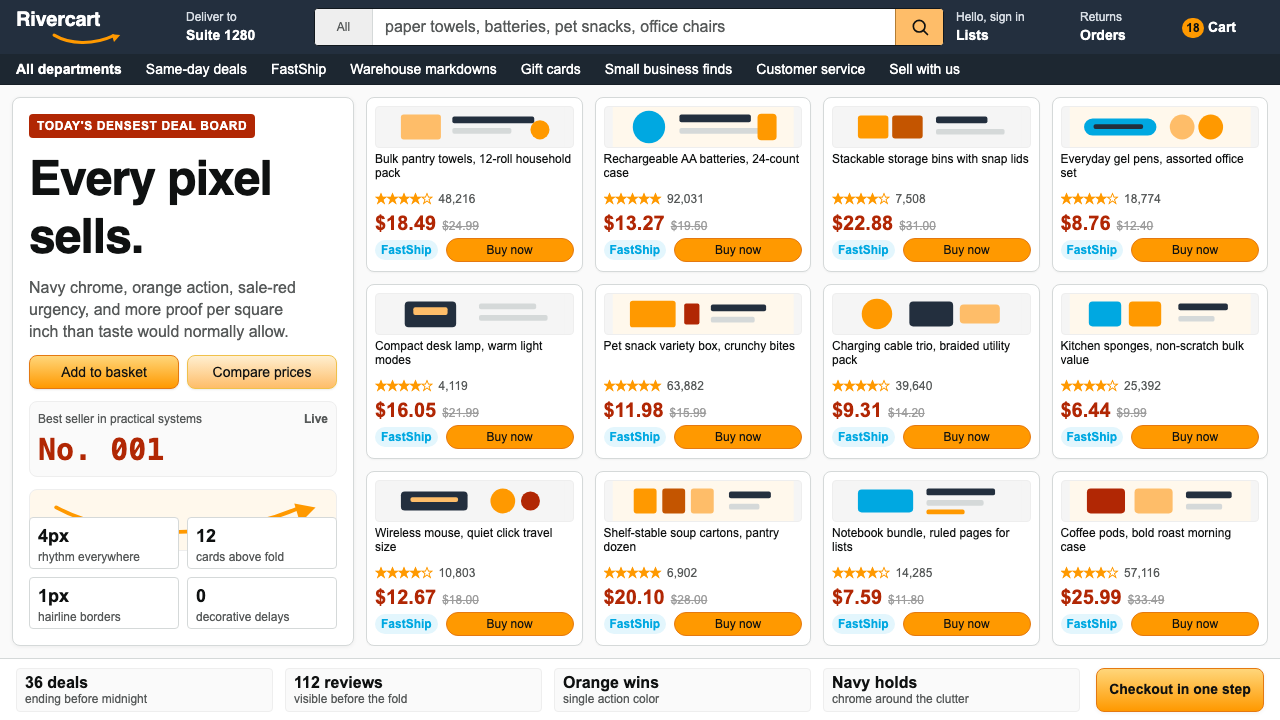 AmazonUgly sells efficiently. Navy chrome, orange buttons, red prices crowd a dense…
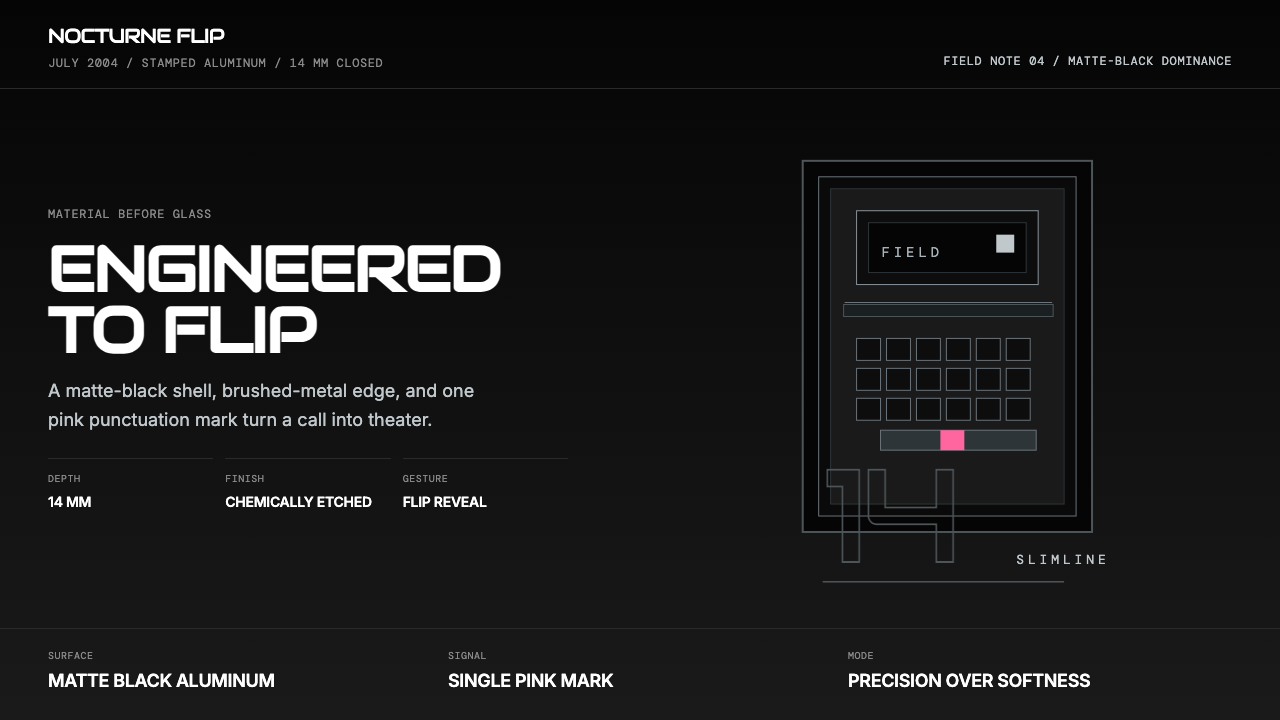 Motorola RAZR Flip (2004)Precision beats glamour. Matte black, brushed steel, and one pink accent.
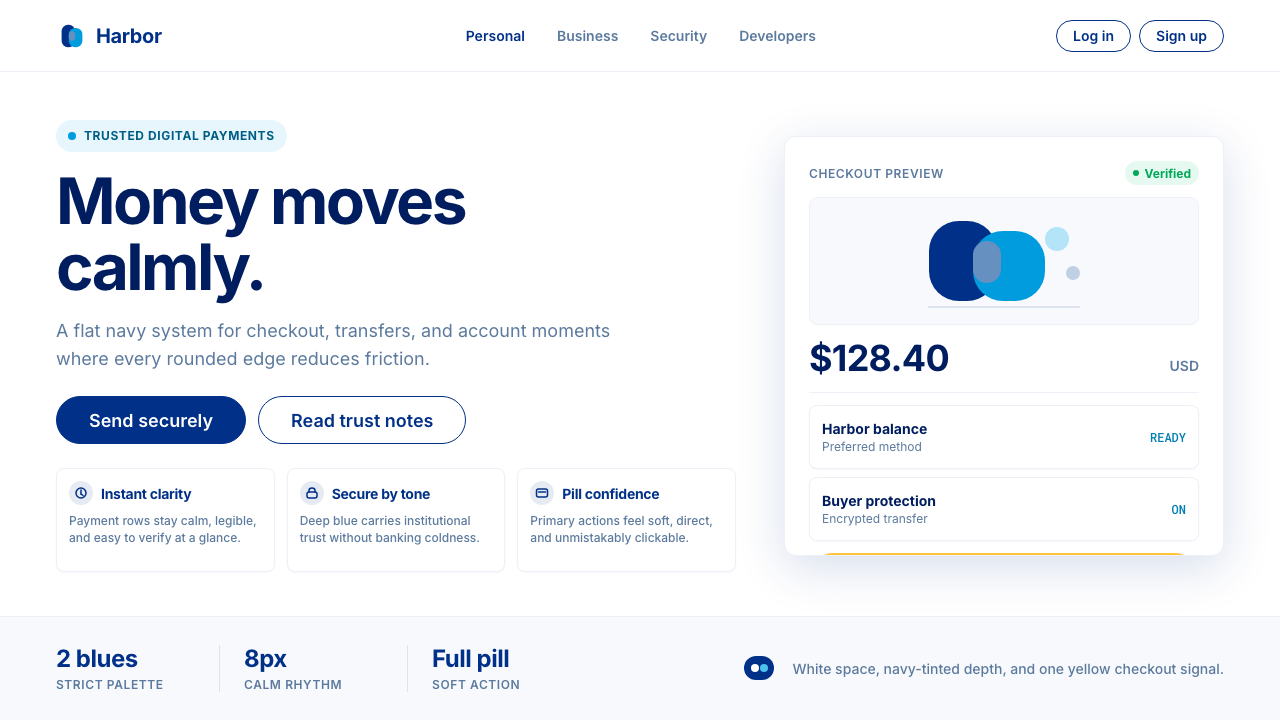 PayPalTrust without coldness. Deep navy, sky cyan, white cards, and pill checkout c…
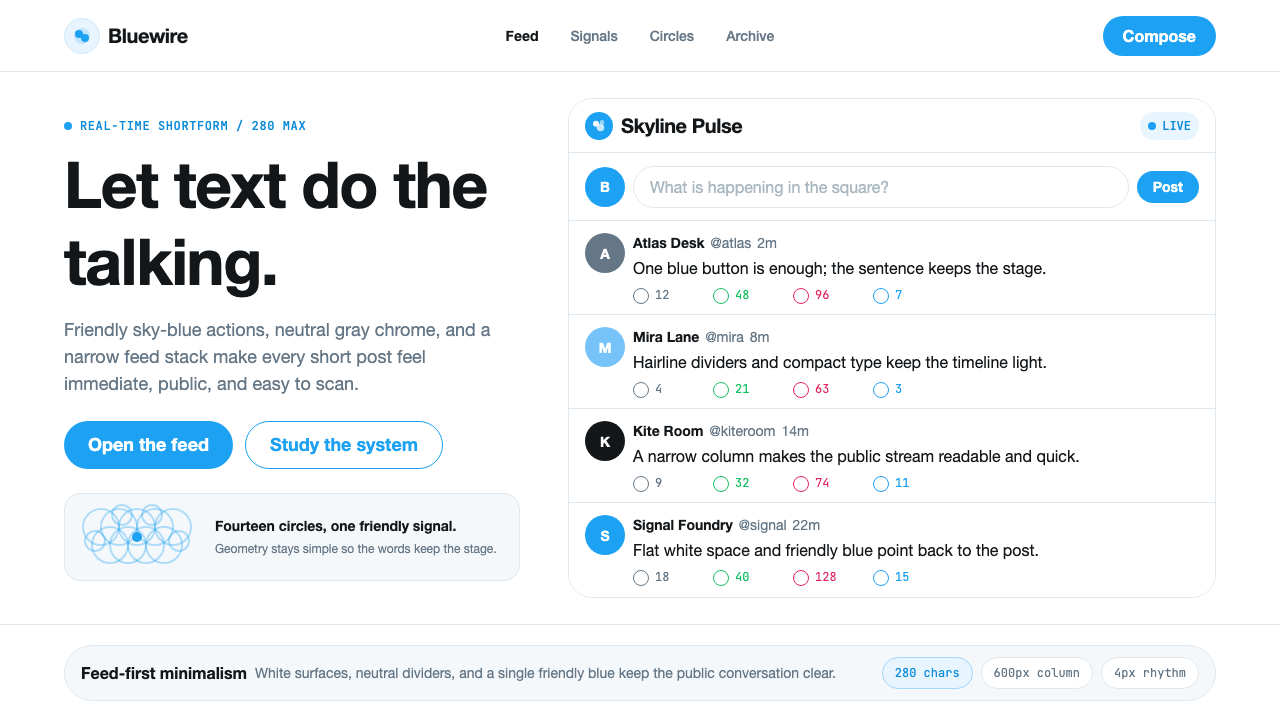 Twitter (Classic Bird)Text takes the stage. Sky blue actions, white feed stack, and hairline divide…
 WhatsAppConversation is the interface. Cream wallpaper, green bubbles, and tiny blue…
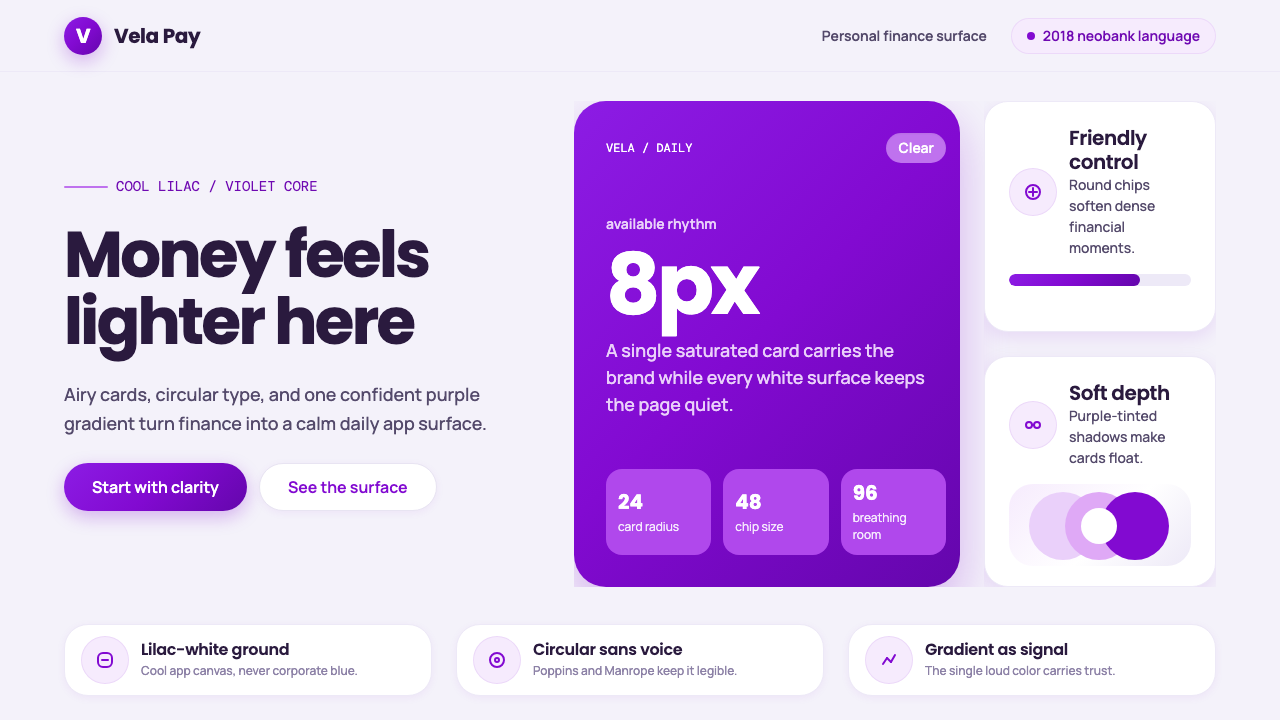 Circular FintechFinance feels light. Lilac-white space, rounded cards, and one vivid purple g…