What is Tiffany & Co?
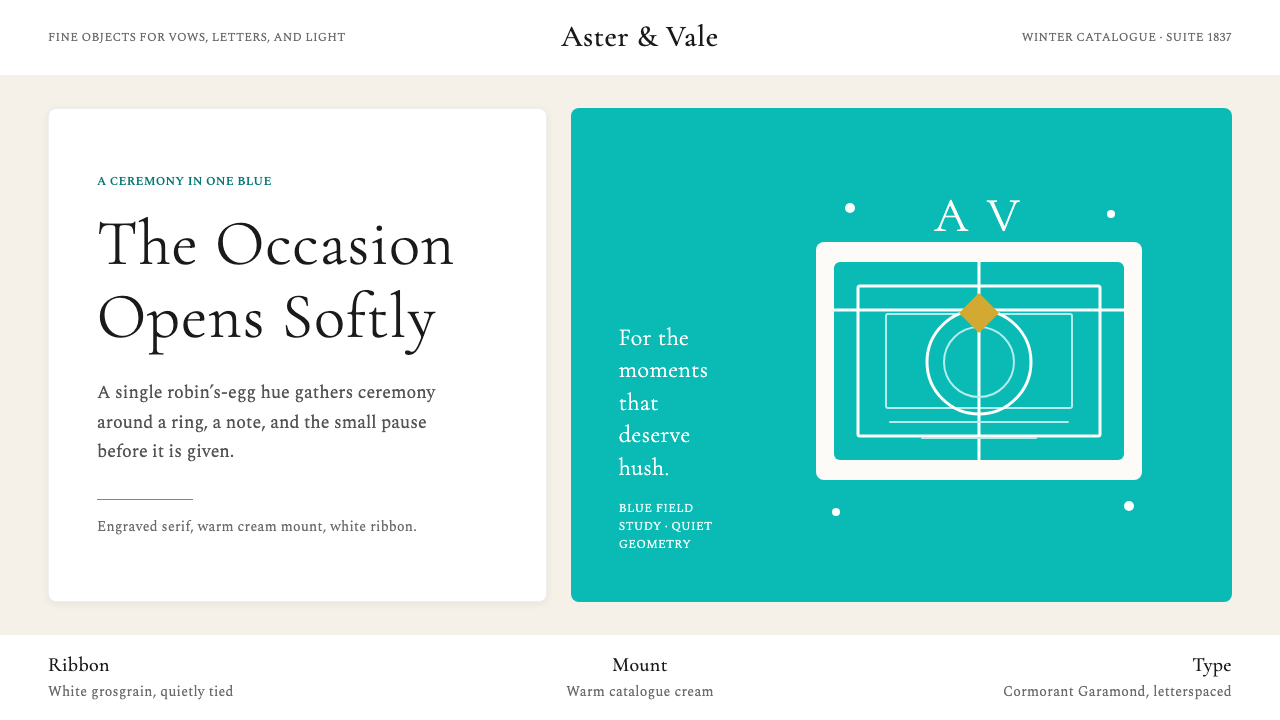
Tiffany Blue is the rarest kind of brand asset — a single color so precisely associated with one company that its mere glimpse promises romance, occasion, and nearly two centuries of jeweled heritage.
Tiffany & Co in brief
Tiffany & Co is one of the world's most recognized luxury jewelry brands, but its visual identity is defined less by logo or typography than by a single, unmistakable color. The robin's-egg blue — registered as a trademark and identified by Pantone as shade 1837, the year the company was founded — is among the most legally protected and culturally resonant colors in commercial history. It transforms any surface it touches: a box, a bag, a ribbon, a splash of digital paint. To see it is to understand the occasion immediately.
The design language built around this color is one of studied restraint. Tiffany Blue serves as the singular chromatic anchor, paired with warm cream or ivory for editorial depth and classical serif typography for timeless formality. Decoration is present but never excessive — the system leans on the color itself to carry emotional weight rather than competing visual elements. The result is an aesthetic that communicates luxury through simplicity: confident, unhurried, and unmistakably romantic.
As a design inspiration, Tiffany & Co represents the principle that true brand identity can be distilled into a single visual commitment. The palette is not broad; the forms are not bold or geometric. Instead, the system trusts a perfectly calibrated color, classical letterforms, and generous white space to do all the communicative work. It is an object lesson in how restraint, applied consistently across nearly two centuries, accumulates into something that feels inevitable.

Where does Tiffany & Co come from?
Tiffany & Co was founded on September 18, 1837, when Charles Lewis Tiffany and John Young opened a stationery and fancy goods store at 259 Broadway in New York City. The timing placed the store squarely in the emerging culture of American aspiration — a young nation newly rich enough in some quarters to desire European-style luxury, but self-confident enough to want an American version of it. Tiffany's early years were spent selling imported European goods, building the reputation for quality and discretion that would define the brand for generations.
The precise origins of the robin's-egg blue shade are not entirely documented, but Tiffany Blue made its first appearance as a branded color on the cover of the Blue Book, Tiffany's annual catalog of jewelry and silverware, beginning in 1845. Charles Lewis Tiffany is said to have selected the color specifically because of its association with the robins common to American gardens and parks — birds whose eggs were a symbol of spring, renewal, and good fortune. The color appeared consistently on packaging and printed materials throughout the nineteenth century, cementing its association with the brand through sheer repetition long before formal trademark registration.
The cultural reach of Tiffany Blue expanded dramatically in the twentieth century, driven in part by the commissioning of extraordinary design talent. Elsa Peretti joined Tiffany in 1974 and created some of the brand's most iconic jewelry forms — the Bone Cuff, the Bean pendant, the Open Heart — which brought a sculptural modernism to the brand's classical heritage. Paloma Picasso, daughter of Pablo Picasso, began her collaboration with Tiffany in 1980, adding bold Mediterranean color and form to the collection. Both designers worked in dialogue with the Tiffany Blue identity without displacing it.
The brand's cultural apotheosis came in 1961 when Audrey Hepburn, playing Holly Golightly in the film adaptation of Truman Capote's Breakfast at Tiffany's, stood before the Fifth Avenue flagship window in a black Givenchy gown, looking at jewelry she could not afford. The image — melancholy, beautiful, aspiring — compressed the entire Tiffany promise into a single frame. The brand had always sold romance as much as jewelry; the film confirmed that Tiffany Blue was the color of longing made tangible. The trademark for the color was formally registered in 1998, and in 2021 LVMH acquired Tiffany & Co for approximately sixteen billion dollars — the largest luxury goods acquisition in history at that time.
What defines the Tiffany & Co look?
The Anchor Color
The Tiffany palette is built around a single chromatic anchor: a clear, luminous blue in the robin's-egg range — neither sky blue nor teal, but something precisely between, with a quality that reads as both fresh and precious. This color does not compete with other elements; it is the element. Supporting tones are intentionally quiet — cream, ivory, and warm white — chosen to flatter the blue rather than challenge it. When black appears, it does so as a typographic foil, never as a primary surface color.
Classical Serif Typography
The typography of the Tiffany system is rooted in classical serif letterforms — the kind historically associated with engraved stationery, formal correspondence, and the masthead traditions of established institutions. Letters have visible stroke contrast, bracketed serifs, and a vertical stress axis that conveys formality and stability without rigidity. Headlines are typically set at a restrained weight — neither the hairline of ultra-light fashion typography nor the gravitas of heavy newspaper heads — allowing the letterforms themselves to carry elegance without extra muscular effort.
Generous White Space
Tiffany design consistently allocates more space than it needs to. Elements breathe. Headlines sit well away from adjacent text. Product photography floats in open fields of cream. This spatial generosity is not merely aesthetic — it is a signal of confidence and class. Brands that cannot afford to waste space crowd their layouts; brands that trust their own desirability can afford to say less. The wide margins and quiet backgrounds create a hush around each element, elevating even a small typographic detail into something worth examining.
Restrained Ornament
Unlike more austere design philosophies, the Tiffany system does not prohibit decoration entirely — it curates it. A thin ruled line beneath a headline, a delicate botanical motif in a corner, a subtle embossed texture on packaging: these are the ornamental notes that distinguish Tiffany's restrained luxury from raw minimalism. The key is that each decorative element is purposefully light-handed, clearly secondary to the color and typography, and rooted in classical jewelry and engraving traditions rather than contemporary graphic trends.
Occasion and Ceremony
Tiffany design encodes the feeling of occasion into every component. The blue box is not just packaging — it is a ritual object that signals the importance of what is inside. This ceremonial quality carries through to digital and print applications: a Tiffany-styled layout suggests that the content within deserves reverence, attention, and time. Nothing is casual, nothing is hurried. Transitions, reveals, and information hierarchies are structured to feel like the unwrapping of something precious, with anticipation built into the pacing.
Photography as Romance
When photography enters the Tiffany visual system, it is styled with the same restraint as every other element. Backgrounds are clean and near-neutral. Jewelry is lit to show brilliance and depth, but the overall quality of images tends toward soft, diffused warmth rather than hard studio sharpness. Lifestyle imagery — where it appears — favors intimate moments over grand gestures: two hands, a quiet table, morning light through a window. The photography reinforces the brand's core emotional proposition: that the most important moments in life deserve to be marked.
Color as Legal Territory
Perhaps the most distinctive conceptual aspect of the Tiffany design system is that its central element — the blue — is intellectual property. Trademarked since 1998, the specific shade cannot be used by other jewelers in commercial contexts in ways that would create consumer confusion. This legal dimension has shaped how the color is deployed: with the confidence of ownership rather than the caution of imitation. The Tiffany Blue appears at full saturation, in large fields, with no apology — because it belongs to them alone.

Who shaped Tiffany & Co?
The founder of Tiffany & Co, Charles Lewis Tiffany opened the original store in 1837 and spent his career building it into America's preeminent luxury goods house. He had an instinct for publicity that was remarkable for his era: in 1887, Tiffany purchased a portion of the French Crown Jewels when they were auctioned following the fall of the Third Republic, which earned him the title 'King of Diamonds' in the American press. It was under his leadership that the blue color became a consistent element of the brand's presentation — on catalogs, boxes, and printed materials — establishing the visual identity that would outlast him by generations.
Italian-born designer Elsa Peretti joined Tiffany in 1974 and created one of the most productive and enduring partnerships in luxury design history. Her work was characterized by organic, body-conscious forms that contrasted with and complemented the brand's classical heritage: the Bone Cuff that wraps a wrist like a living thing, the Bean pendant in its smooth ovoid simplicity, the Bottle pendant that abstracts a perfume container into pure sculptural form. Peretti brought the design language of modernist sculpture into everyday wearability. She worked exclusively with Tiffany for nearly five decades until her death in 2021, and her designs remain among the brand's strongest sellers.
Paloma Picasso, daughter of Pablo Picasso and Françoise Gilot, began her collaboration with Tiffany in 1980 and brought an entirely different sensibility to the brand — bold, Mediterranean, vivid in color and form. Her signature designs use oversized scale, strong geometric references, and rich colored stones in ways that would seem at odds with Tiffany's classical restraint but instead expanded the brand's emotional range. The Loving Heart and Kiss collections, and her signature X collection, demonstrated that the Tiffany Blue identity was robust enough to contain multitudes — that jewelry could be exuberant within the same house that prized understatement.
Though Audrey Hepburn had no formal design relationship with Tiffany, her portrayal of Holly Golightly in the 1961 film Breakfast at Tiffany's may have done more for the brand's cultural standing than any campaign or collection launch. The image of Hepburn in black Givenchy, pearls at her throat, coffee and pastry in hand, gazing at the Fifth Avenue window display — wistful, beautiful, aspiring — compressed the entire Tiffany emotional proposition into a single frame: that the brand's objects are worthy of longing, that they represent something precious and just out of reach. The film cemented Tiffany Blue as a color of romance in the popular imagination in a way that five decades of catalog covers had not quite accomplished.
French-born jewelry designer Jean Schlumberger joined Tiffany in 1956 and created some of the most extravagant and imaginative pieces in the brand's history — fantastical brooches and bracelets inspired by natural forms: sea creatures, flowers, birds in flight. His work brought a surrealist theatricality to Tiffany that complemented rather than displaced the brand's core elegance. Schlumberger is perhaps best known for the Bird on a Rock brooch, which has been produced in numerous variations since its introduction and which perfectly embodies the Tiffany balance of craftsmanship, fantasy, and restraint.
How do you use Tiffany & Co today?
The Tiffany aesthetic is one of the most potent templates available for any presentation, publication, or interface that needs to communicate luxury, romance, or considered quality. Applying it well requires understanding that the system is color-forward and typographically classical — the blue does the heavy lifting emotionally, while the typography provides credibility and structure. Before any other decision, establish the blue as the dominant chromatic presence and ensure everything else defers to it.
For presentation slides, the Tiffany system excels at cover pages and section dividers more than dense content pages. A cover built in this style uses the blue as a full or partial background, with a title set in elegant serif type centered or positioned in the upper third — understated, spacious, and unhurried. Section dividers work well as near-monochrome blue fields with minimal type. Content slides should shift to cream or white backgrounds with black body text, using the blue exclusively for highlighted data points, key terms, or call-out labels. Data slides in this style treat charts as refined, uncluttered objects: thin axes, sparing color — blue for primary series, cream or warm gray for secondary — and no decorative chart furniture.
For web UI, the Tiffany aesthetic is well suited to luxury e-commerce product pages, high-end editorial sites, jewelry and beauty brand interfaces, and any context where the emotional register is romantic and aspirational. In a dashboard or pricing context, the palette works best when the blue is reserved for primary calls to action, selected states, and active indicators — not distributed across all interactive elements simultaneously. Navigation should be typographic and restrained, using the serif vocabulary with generous letter-spacing for menu items. Input fields, modals, and cards benefit from thin borders rather than filled backgrounds, maintaining the light and airy feeling that defines the system.
For editorial and marketing work, the Tiffany system supports layouts that feel like beautiful catalogs or magazine spreads. An editorial page in this style uses a wide outer margin for captions and pull quotes, a narrow measure for body text in a classical serif, and the Tiffany Blue reserved for section headings, initial capitals, or thin horizontal rules that mark divisions. Marketing pages work well with alternating rhythm: a blue-background hero section followed by a cream content section, followed by a white feature section. The pacing should feel generous — no section should feel crowded. Campaign imagery should always be warm-toned and intimate rather than cool or expansive.
A common mistake when applying the Tiffany aesthetic is treating the blue as one color among several rather than as the organizing principle of the entire system. Designers who add competing accent colors — a gold, a deep navy, a blush pink — dilute the singular authority that makes Tiffany Blue work. The correct approach is near-monochromatic: the blue, cream, white, and black cover almost every need. A second common error is choosing sans-serif typography in the belief that it reads as modern and refined — in this system, sans-serif type typically reads as generic rather than luxurious. The classical serif is non-negotiable if the romantic, heritage dimension of the aesthetic is to be preserved.

Tiffany & Co — FAQ
Can the Tiffany aesthetic work for brands outside the jewelry and luxury sector?
Yes, but with careful positioning. The aesthetic works well for any brand or product that wants to communicate considered quality, romance, and occasion — wedding and event planning services, high-end hospitality, luxury real estate, premium beauty, artisan food and drink, editorial publishing, and high-stakes financial services like private banking or wealth management all have contexts where the Tiffany visual language reads as appropriate and credible. It works less well for consumer-facing products that need to feel accessible and everyday — grocery retail, mass-market software, athletic wear — where the system's deliberate exclusivity can feel cold or alienating rather than aspirational.
Does the Tiffany style work in dark mode or on dark backgrounds?
Not in its canonical form. The Tiffany visual system is fundamentally a light-ground aesthetic — the luminosity and freshness of the blue depends on being seen against cream, ivory, or white. On a black or very dark background, Tiffany Blue can still appear beautiful, but it reads differently: harder, cooler, more editorial fashion than romantic jewelry. If a dark variant is required, the more successful approach is to use the blue very sparingly as an accent on black — a single typographic element, a fine rule, a highlighted term — and to rely on white or cream type for all primary text. Attempting a full dark-mode version of the Tiffany palette typically loses the warmth and romance that make the system distinctive.
How does Tiffany Blue relate to other famous brand colors — is it a kind of category?
Tiffany Blue occupies a rare category: colors so precisely associated with a single brand that they function as trademarks rather than general design choices. Very few colors achieve this status — Hermès orange, Caterpillar yellow, and UPS brown are sometimes cited alongside Tiffany Blue as examples of true color ownership in commercial identity. What distinguishes genuine brand-color ownership from mere brand association is the combination of legal protection, consistent long-term application, and cultural saturation sufficient to make the average person identify the color with the brand even without seeing a logo or name. Tiffany Blue achieves all three, which is why it functions as a design system's foundation rather than just an element within one.
What is the biggest mistake designers make when trying to evoke the Tiffany aesthetic without copying it exactly?
The most common mistake is substituting a different blue — a similar aqua, a comparable teal, a pale cyan — and expecting the result to carry the same emotional charge. The Tiffany effect is not merely a function of blue-green hues in general; it is the result of that specific shade accumulated through cultural repetition over nearly two centuries. Any substitute reads as generic. The second common mistake is pairing the Tiffany-adjacent blue with sans-serif typography to modernize it, which immediately destroys the system's heritage dimension. The third is adding gold as a luxury signal, which competes with the blue rather than supporting it. The honest approach when designing in this space without direct reference: choose the blue precisely, commit to classical serif type, leave enormous amounts of space, and resist any impulse to add elements the system does not need.
How should data-heavy or information-dense content be handled within the Tiffany aesthetic?
Data density is the Tiffany system's greatest challenge, because the aesthetic is built around spaciousness, and dense information inherently resists space. The solution is strict hierarchy rather than compression: identify the single most important number or insight on each page and give it visual prominence — large, centered, set in the blue — while all supporting data is reduced to quiet, small serif type in near-neutral tones. Tables, if necessary, should use very fine horizontal rules between rows rather than colored alternating bands; columns should have generous padding. Charts should be stripped of all decorative elements: no backgrounds, no rounded corners, no gradient fills, no shadows. The Tiffany approach to data density is always 'show less, say more clearly' — which often means ruthlessly editing the data presented rather than redesigning how much data is shown.
Related design styles
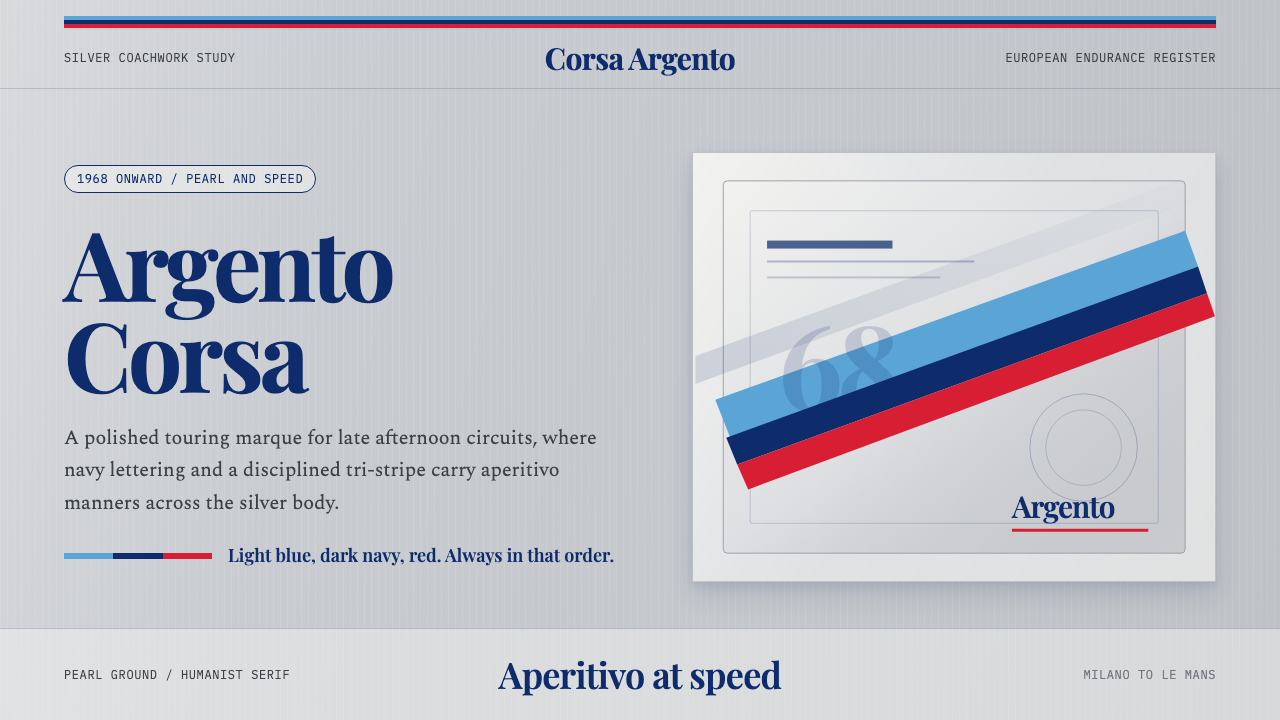 Martini Racing StripesAperitivo elegance at speed. Silver ground, Playfair serif, and a blue-navy-r…
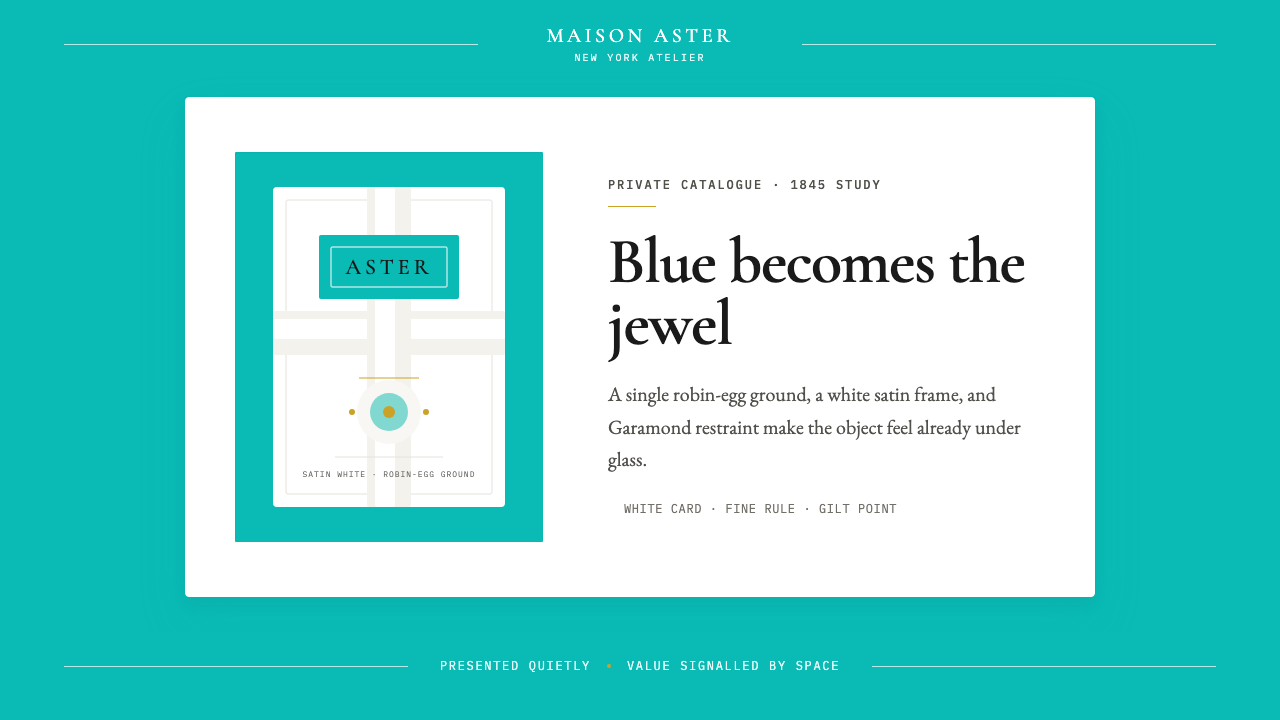 Tiffany Robin-Egg BlueBlue is the luxury signal. Robin-egg ground, white satin rules, Garamond rest…
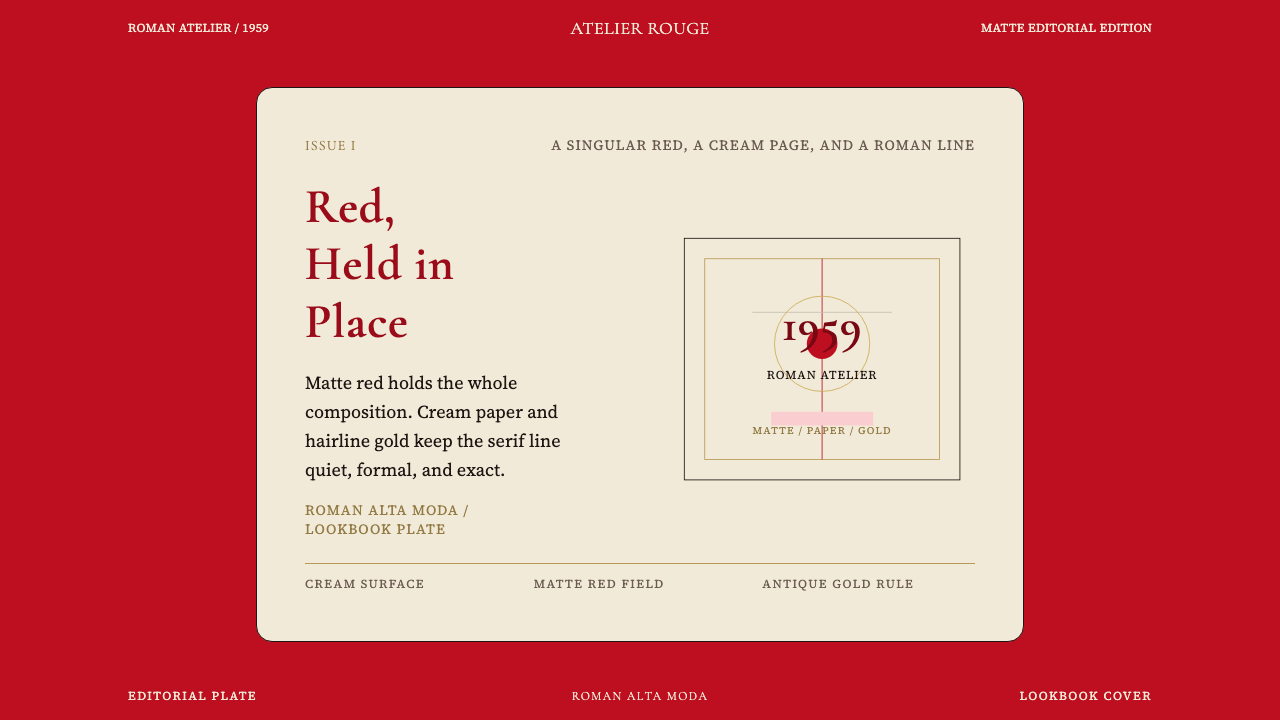 Valentino Rouge Couture (1959)Matte couture red holds the page. Cream paper and hairline gold keep it cerem…
 Argentine Malbec WineAltitude turned austere. Burgundy panels, engraved Garamond, oxidized copper.
 Grand Piano ActionMechanism as luxury. Brass screws and felt hammers lit out of ebony gloom, se…
 HermèsTwo centuries of restraint in orange. Brown serif on cream, gallery-quiet, ne…