What is Valentino Rouge Couture (1959)?
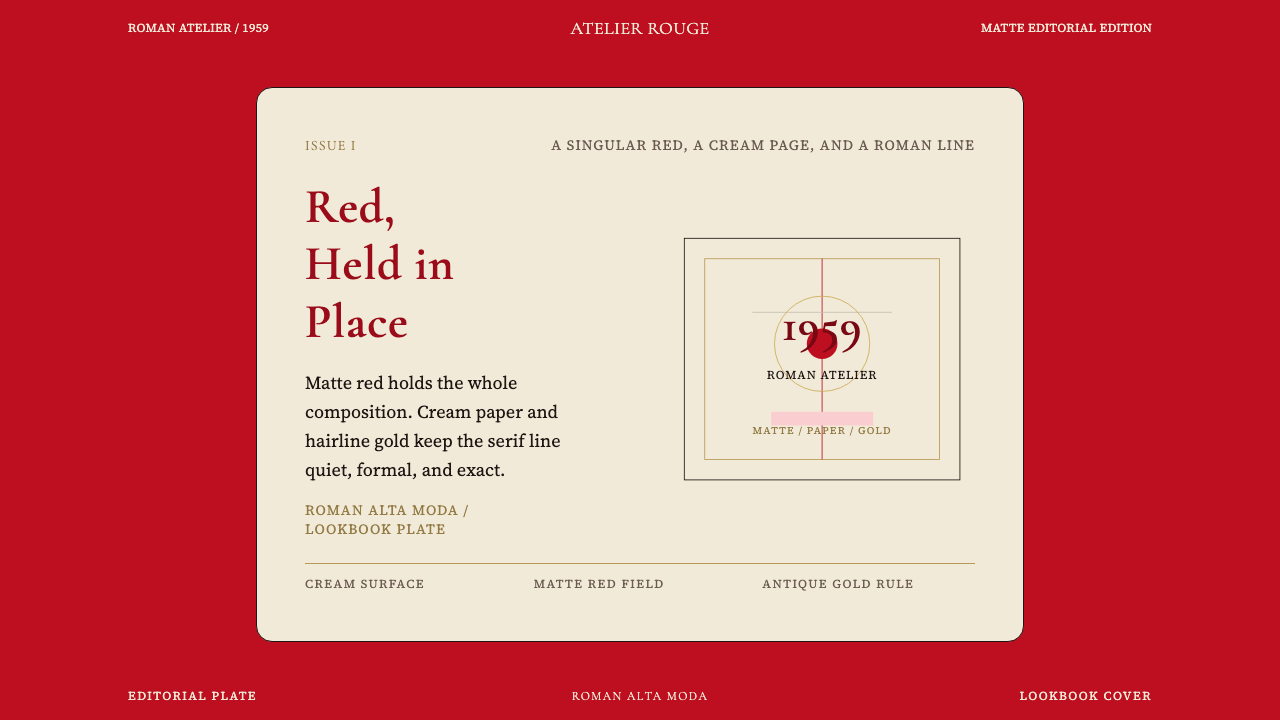
A single matte red encountered at a Barcelona opera became the most recognized couture signature of the twentieth century.
Valentino Rouge Couture (1959) in brief
Valentino Rouge Couture (1959) is a design system built around Rosso Valentino — the deep, non-negotiably matte red that Valentino Garavani first encountered at a Barcelona opera performance in the 1950s and formally established as his house signature when he opened his atelier on Via Condotti in Rome in 1959. The system is not simply a color choice; it is an entire editorial sensibility in which one saturated hue dominates, supported by cream paper surfaces, transitional serif letterforms, and the disciplined gold ornament of Roman alta moda.
What makes the visual language distinctive is the character of the red itself. It is neither the pure primary red of graphic modernism nor the warm orange-shifted red of consumer packaging. It occupies a specific zone — fully saturated, tonally rich, and decisively matte — that reads as ceremonial rather than loud. Everything else in the system exists to preserve and amplify that reading: cream grounds that soften contrast without undermining authority, gold accents that signal craftsmanship without competing for attention, and typography drawn from the transitional serif tradition that bridges classical Roman letterforms with the editorial clarity of modern fashion publishing.
The system encodes a particular hierarchy of luxury: understatement achieved through restraint, not absence. Where other high-fashion houses have periodically chased trend cycles, the Valentino visual identity has maintained a continuity across six decades that is itself a form of authority. The design language does not shout; it assumes the viewer will recognize what it means, and that assumption is part of the statement.

Where does Valentino Rouge Couture (1959) come from?
Valentino Garavani was born in 1932 in Voghera, a small town in Lombardy, and developed his passion for fashion as a teenager watching American films and copying dress designs from cinema magazines. He trained in Paris — at the Chambre Syndicale de la Couture Parisienne and subsequently at the ateliers of Jean Dessès and Guy Laroche — absorbing the rigorous construction methods and editorial perfectionism of French haute couture. But his visual imagination remained attached to the color world he had encountered as a young man: specifically, to the concentrated, velvety red of operatic stage lighting and velvet upholstery.
The founding event most frequently cited in accounts of the house is Garavani's visit to the Gran Teatre del Liceu in Barcelona in the mid-1950s, where an entire audience dressed in red — gowns, accessories, flower arrangements — produced what he later described as an overwhelming sensory impression. The red he observed was not a single flat hue but a family of deep, saturated values unified by their refusal of orange-warmth or blue-coolness: a red that existed entirely on its own terms. He returned to Paris and Rome determined to work toward that color. When he opened his Via Condotti atelier in July 1959, the house signature was already implicit in his first collection's palette.
The formal consolidation of Rosso Valentino as a recognized brand identity element came gradually through the 1960s, as Garavani's business partner and lifelong collaborator Giancarlo Giammetti — who joined the house in 1960 — helped develop the operational and visual infrastructure that would carry the color identity into advertising, packaging, and retail environments. The iconic red dress worn by Jacqueline Kennedy at a 1962 White House dinner brought international attention, and from that moment the association between Valentino and a particular register of red became self-reinforcing in the cultural imagination.
The broader context is the post-war renaissance of Italian fashion. In the late 1940s and 1950s, a deliberate effort by Italian industrialists, press, and the government-backed promoter Giovanni Battista Giorgini positioned Italy as a rival to Paris in high fashion. The Sala Bianca shows at the Palazzo Pitti in Florence from 1951 onward gave Italian couture a collective international stage. Into this environment, the Rome-based Valentino house — with its unambiguous reference to the grandeur of Roman history, the quality traditions of Italian tailoring, and the decorative richness of the Baroque — offered a distinct proposition: neither the intellectual rigor of French couture nor the casual sportswear idiom developing in American fashion, but the specific sensory opulence of the Mediterranean alta moda tradition.
What defines the Valentino Rouge Couture (1959) look?
The Dominant Red
Rosso Valentino is the system's absolute center of gravity. Its specific character — fully saturated but emphatically matte, neither orange-warm nor blue-cool, carrying the visual weight of velvet without its texture — distinguishes it from every adjacent red in the design spectrum. It is used at commanding scale: as a background that fills the entire field, as an object color applied to the primary garment or product, or as the dominant block in a layout. The system is designed to support this red, not to compete with it.
Cream and Ivory Ground
Where the red does not dominate, the ground is cream or warm ivory — never cold white. This choice is not arbitrary: it references the specific warmth of couture paper, the aged surfaces of Roman architecture, and the warm parchment of atelier sketches. Against cream, the red reads with slightly more depth and less harshness than it would against a cold white ground. The cream surface also gives the system its tactile association — the layout suggests a physical material, a letterhead, a certificate, rather than a backlit screen.
Restrained Gold Accent
Gold appears in the system as a fine signal, not a field. It reads in hairline rules, in the fine lines of embossed ornament, in the weight of a letterform at display scale, or in a narrow band that frames rather than fills. The gold is always restrained — it is a mark of craft and ceremony, not a statement of wealth. Used excessively, it collapses into ostentation; used as a hairline or a narrow rule, it elevates the surrounding elements by suggesting the atelier's manual precision.
Transitional Serif Typography
The typographic register is the transitional serif — the category of letterforms that emerged in the eighteenth century, characterized by moderate stroke contrast, slightly angled stress, and bracketed serifs that give the type both editorial authority and approachable warmth. This choice anchors the system in a tradition that predates modernism and references the history of European fine printing. Type is set with generous line spacing at display scale, allowing each letterform to be read as an individual object, and with disciplined measure in text settings that conveys deliberateness rather than abundance.
Matte Surface Aesthetic
The system refuses shine at every level. The red is matte, not lacquered. The gold is satin, not reflective. Background surfaces carry no gloss. This matte character is not an accident of production but a deliberate signal: in couture culture, a matte finish is understood as more refined than a glossy one, because it asks the viewer to look rather than to be dazzled. Applied to digital surfaces, this means no specular highlights, no gradients that simulate three-dimensionality, no elements designed to catch the eye through surface reflectance.
Ceremonial Composition
Layouts in this system observe a formal, centered gravity when a single subject is presented, or a deliberate asymmetric balance when hierarchy must be articulated across multiple elements. There is always significant negative space — the couture atelier does not crowd. White or cream margins are treated as part of the composition, not as empty leftover. Borders, where they appear, are fine rather than bold, suggesting the ruled line of a printed card rather than the assertive frame of a poster.
Roman Alta Moda Reference
The system carries a specific cultural geography: Rome, not Milan, not Paris. Roman alta moda is characterized by a decorative richness inherited from Baroque and Neoclassical visual culture, a sense of historical continuity that manifests as confidence rather than nostalgia, and an alignment with the ceremonial occasions of Italian civic and religious life. These references surface in the choice of ornamental vocabulary — the fine acanthus border, the seal-like logo treatment, the ceremonial red that functions like the red of a cardinal's vestment or the wax seal of a formal document.

Who shaped Valentino Rouge Couture (1959)?
Garavani founded the house on Via Condotti in Rome in 1959 after training at the ateliers of Jean Dessès and Guy Laroche in Paris. His personal aesthetic — shaped by a childhood passion for cinema glamour and a formative encounter with a Barcelona opera audience dressed entirely in red — gave the house its irreducible visual signature. Over the following decades he dressed royalty, film stars, and political figures, and the consistency with which he returned to his signature red established it as one of the most recognized proprietary colors in fashion history. He retired in 2007 after fifty years at the helm of the house.
Giammetti met Garavani in Rome in 1960 and joined the house immediately, becoming the business and operational counterpart to Garavani's creative vision. Over nearly five decades of partnership, Giammetti built the infrastructure that transformed the atelier into an international luxury brand — overseeing the visual identity system, the expansion of retail and licensing operations, and the translation of the couture house's aesthetic values into communications and marketing. The consistency and discipline of the Valentino visual identity across its first fifty years owes a substantial debt to his stewardship.
Chiuri served as co-creative director of Valentino alongside Pier Paolo Piccioli from 2008, following Garavani's retirement, and left for Dior in 2016. During her tenure the house maintained the foundational red signature while expanding its vocabulary with influences from Roman art history, folk embroidery, and archival couture references. Her work demonstrated that the Valentino visual identity could absorb new cultural material without losing the gravitational pull of the original color system.
Piccioli became sole creative director of Valentino in 2016 and led the house through a period of significant critical and commercial renaissance. His most commented contribution to the visual identity was the 2022 Pink PP collection, in which the entire range — clothing, set design, accessories, and show environment — was executed in a single ultra-saturated fuchsia pink. The collection demonstrated that the Valentino monochrome strategy — establishing absolute chromatic dominance as a compositional principle — was transferable beyond Rosso Valentino to any hue when applied with sufficient commitment and coherence.
Kennedy's role in the Valentino house's history is as much semiotic as biographical. When she appeared at a 1962 White House dinner in a Valentino red dress, the image was reproduced internationally and permanently linked the house's signature color to a specific register of public, ceremonial authority. The association was reinforced when she wore Valentino for her 1968 wedding to Aristotle Onassis. Kennedy was not a designer or a cultural theorist, but her choices constituted a form of cultural endorsement whose effect on the Valentino color identity was lasting and precise.
How do you use Valentino Rouge Couture (1959) today?
Valentino Rouge Couture works best when the red is allowed to be sovereign. The most common error in applying this system is treating it as a red accent scheme — a red button here, a red headline there — when the logic of the system is actually the reverse: red is the ground from which cream, gold, and dark neutral elements emerge. Correct application means committing to chromatic dominance on at least one major element per composition: a full-bleed red cover slide, a red sidebar that occupies a third of the page, a red hero section on a landing page.
For presentation slides, the system produces strong cover and section-break pages. A cover built on this system places the title in cream or ivory serif type against a full-bleed matte red field, with a hairline gold rule as the sole decorative element. Section breaks follow the same logic at reduced scale. Content slides should use a cream or warm white background, with the red reserved for a single call-out, a chart series, or a category label — never scattered across multiple elements simultaneously. Data visualizations take on a ceremonial quality when bar series and pie segments are built from the red-cream-gold family, with dark neutral used for text and axis labels.
For web interfaces, the system is well-suited to luxury brand pages, editorial publications, premium subscription landing pages, and high-end service dashboards where the goal is to communicate authority and refinement rather than approachability. The approach: a cream or warm white base for content areas, red used for primary calls to action and hero sections, gold used only as a border or rule element, and transitional serif type for headings. Navigation should be restrained and typographic. Pricing tiers benefit from the system's natural hierarchy: the recommended tier presented against a red card ground, alternatives on cream.
For editorial and marketing work, the system is strongest in contexts that already carry a cultural association with formality and ceremony: invitations, program covers, campaign hero images, annual report covers, fashion editorial spreads, and luxury product photography backdrops. Marketing copy set in this visual environment reads with higher authority because the surrounding visual signals prime the reader for a register of seriousness. For social media cards and email headers, a tight crop of the red field with cream type at large scale produces immediate recognition without requiring the full system to be present.
A common mistake is importing warmth-diffusing elements that undermine the system's matte authority: soft drop shadows, gradient overlays on the red, ambient glows, or photographic elements with heavy warm filtering. Each of these choices softens the red's character and shifts the register from couture authority toward generic luxury warmth. A second mistake is pairing the system with a condensed or geometric sans-serif typeface in the belief that this modernizes it — the transitional serif is not a period detail but a structural choice that balances the red's weight. Removing it destabilizes the system's tonal range.

Valentino Rouge Couture (1959) — FAQ
Is Rosso Valentino just a branded name for a standard red, or is it a genuinely distinct color?
It is genuinely distinct in character, though its distinctiveness is qualitative rather than reducible to a single technical specification. The Valentino red sits in a specific zone of the red family: fully saturated but not garish, without the orange warmth of tomato reds or the blue undertone of crimson, and consistently rendered in a matte or near-matte finish. What makes it recognizable is less the precise hue than the combination of saturation level, temperature, and surface quality. Applied in the wrong finish — high-gloss, for instance — or shifted toward orange or toward blue-pink, it immediately becomes something else. The identity lives in the whole combination.
How is this system different from other red-based luxury design languages, such as those used in watch or automotive brands?
The key difference is in what surrounds the red and what role the red plays. Automotive and watch brands that use red typically deploy it as an accent against dark grounds — charcoal, black, or deep navy — which gives the red a high-energy, performance-oriented character. Valentino Rouge Couture inverts this: the red is the ground, and it is surrounded by cream, gold, and dark neutrals that soften its energy into something ceremonial. The typographic register is also different: those brands typically use geometric sans-serifs or condensed display faces that suggest engineering precision, while Valentino uses transitional serifs that reference the history of printed culture.
Can this system work in dark-mode or dark-background contexts?
With significant adaptation, yes, but the canonical system is light-ground and the adaptation involves real trade-offs. On a dark ground, the matte red loses some of its ceremonial weight and risks reading as aggressive or overly saturated. The cream tones that moderate the red on a light ground have no equivalent in a dark scheme. The most workable dark variant uses the red as the dominant background element rather than as an accent — a red panel within a dark layout, for instance — with gold used only as a hairline separator and all body text set in cream or warm white. A full dark inversion of the system is possible but should be considered a distinct sub-system rather than the primary mode.
What distinguishes this system from generic Italian luxury branding?
The specificity of the commitment to a single color at commanding scale. Generic Italian luxury design tends to use red as one element among several — alongside gold, black, and cream, all at similar visual weight — which produces a sense of opulent multiplicity. The Valentino system instead achieves its effect through chromatic singularity: one color dominates, and everything else serves it. The matte quality of the red is also specific — it sets the system apart from the lacquered, high-gloss reds common in Italian automotive and accessories design. Finally, the Roman rather than Milanese reference gives the typographic and ornamental register a different historical weight: more ceremonial, less commercial.
How should this system be applied to data-heavy or information-dense content without losing its luxury register?
The key is preserving the hierarchy of the color: the red must remain the most powerful element in the composition even when the layout is complex. In practice this means using the red only for the single most important data category, a primary call-out number, or the dominant chart series — not as a color-coding system across multiple categories. Tables and dense text should sit on cream grounds with dark neutral type, with thin gold rules used as row separators or section dividers. Restraint in the number of chart types used is also important: one dominant visualization per page, treated with the same compositional singularity as the color. The moment the red is distributed across five or six elements of equal weight, the system's authority collapses into clutter.
Related design styles
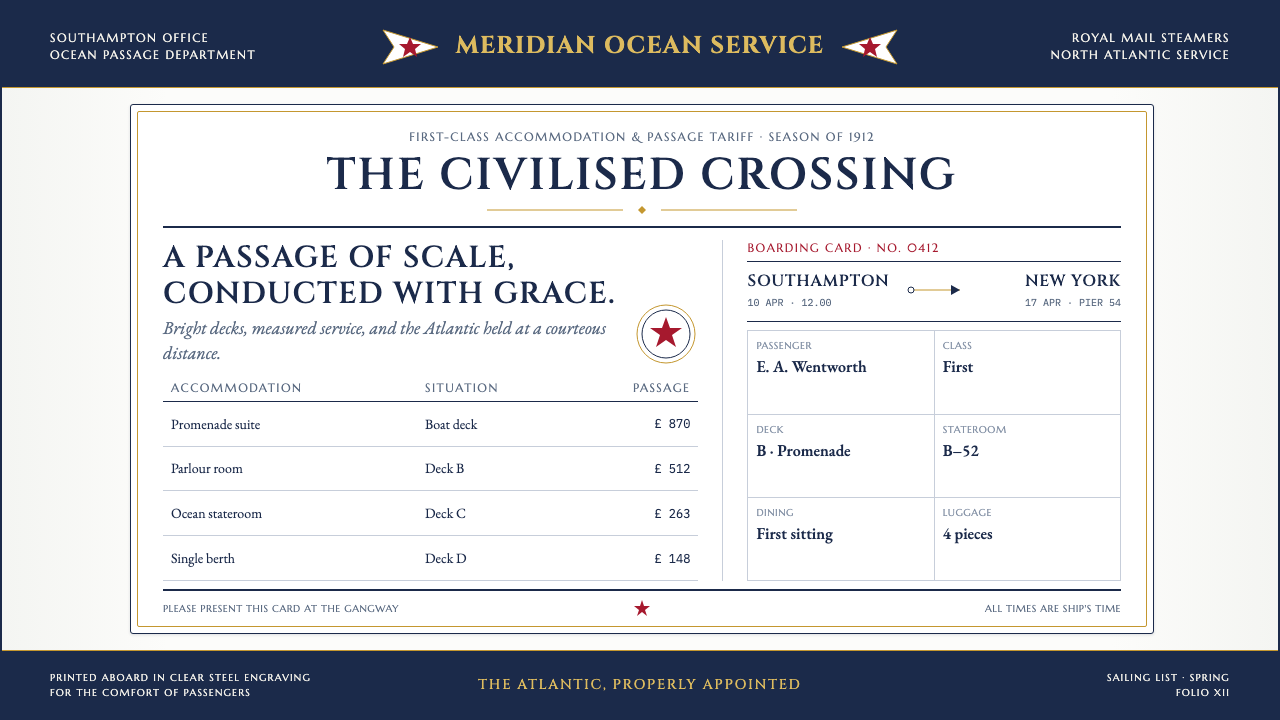 Titanic White Star Line (1912)Service made ceremonial. Navy rules, gilt capitals and a lone red star order…
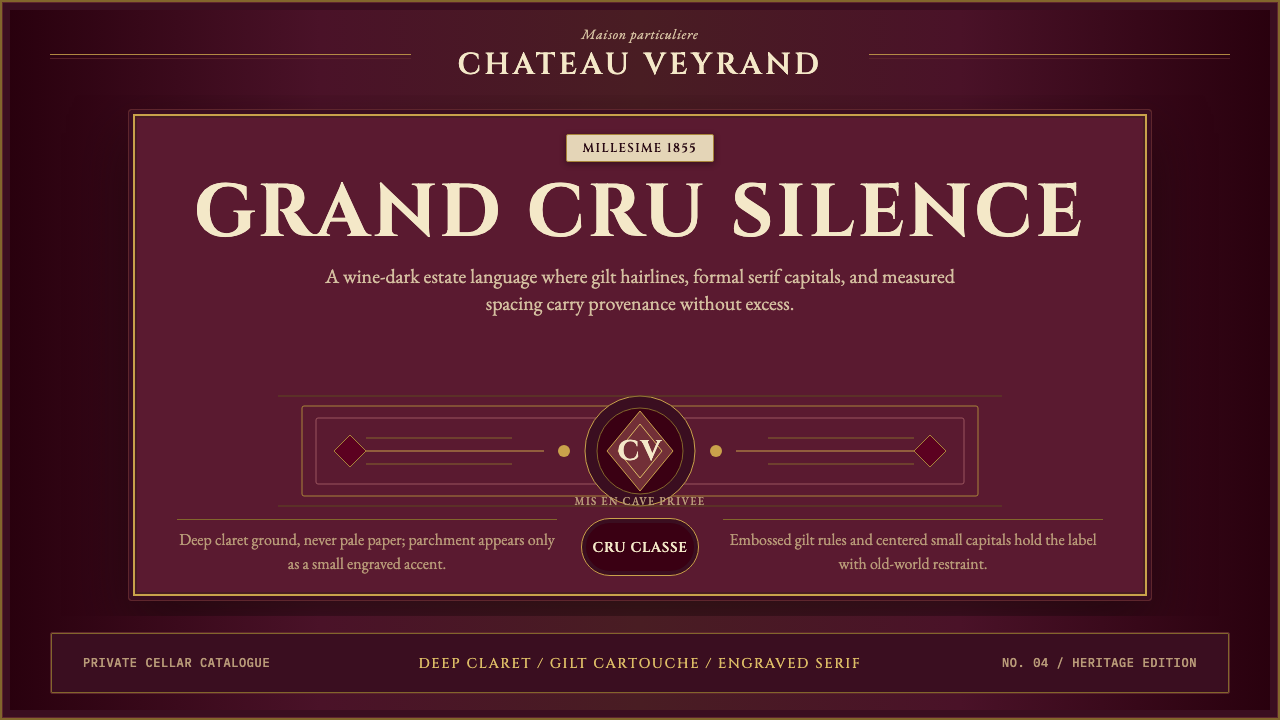 Bordeaux Wine ChâteauAged claret authority. Cinzel capitals, gilt rules, and label symmetry on win…
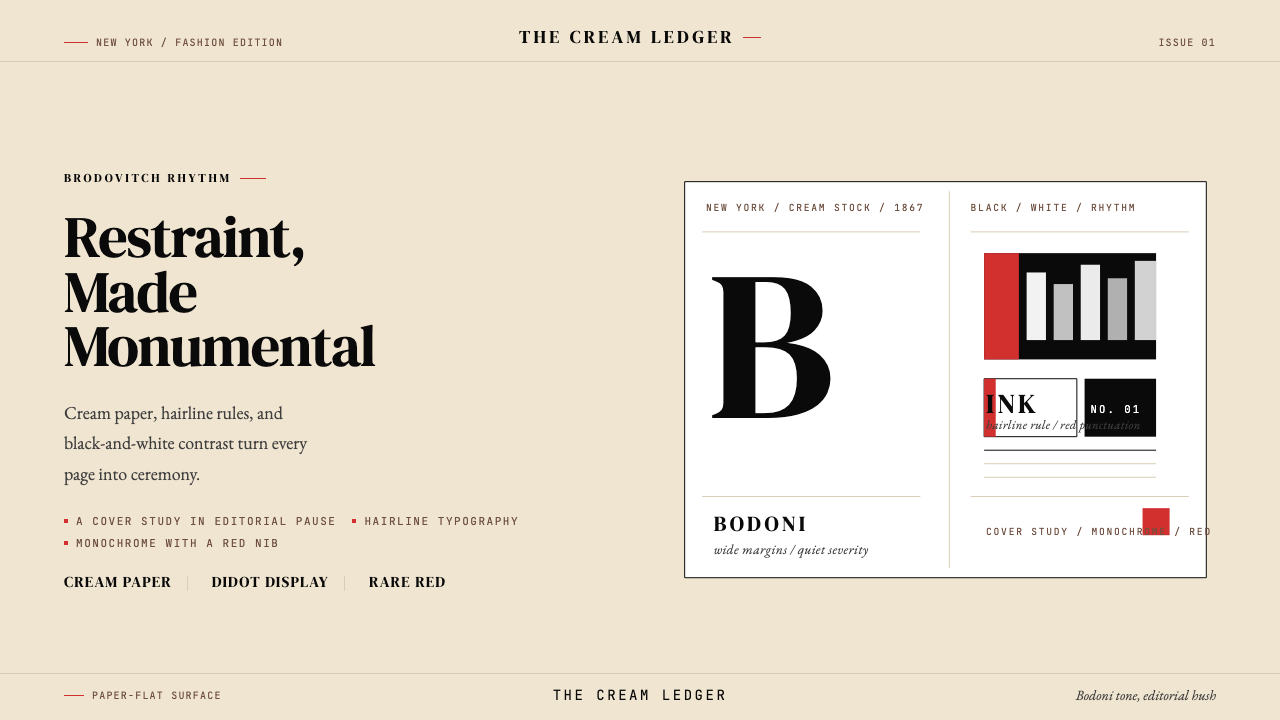 Harper's BazaarLuxury through restraint. Cream paper, Didot scale, and hairline rules carry…
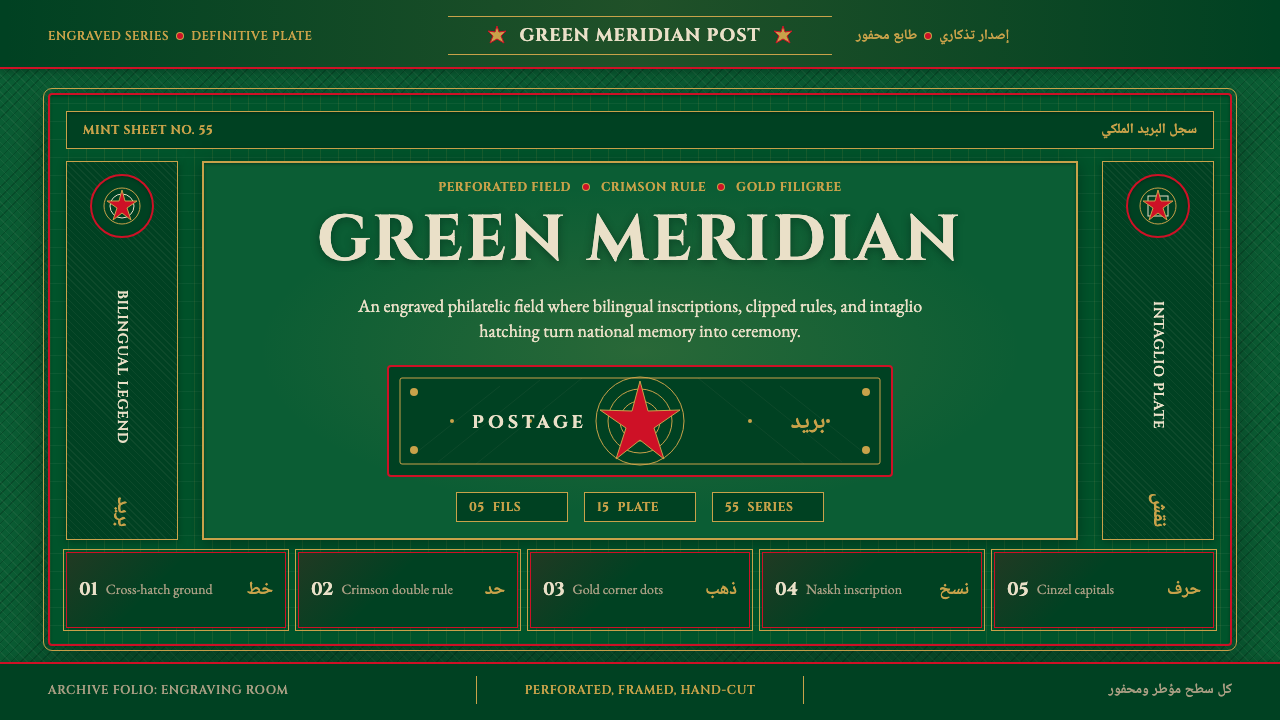 Hashemite Jordan PostageState-postal ceremony. Deep green field, crimson rules, gold filigree, biling…
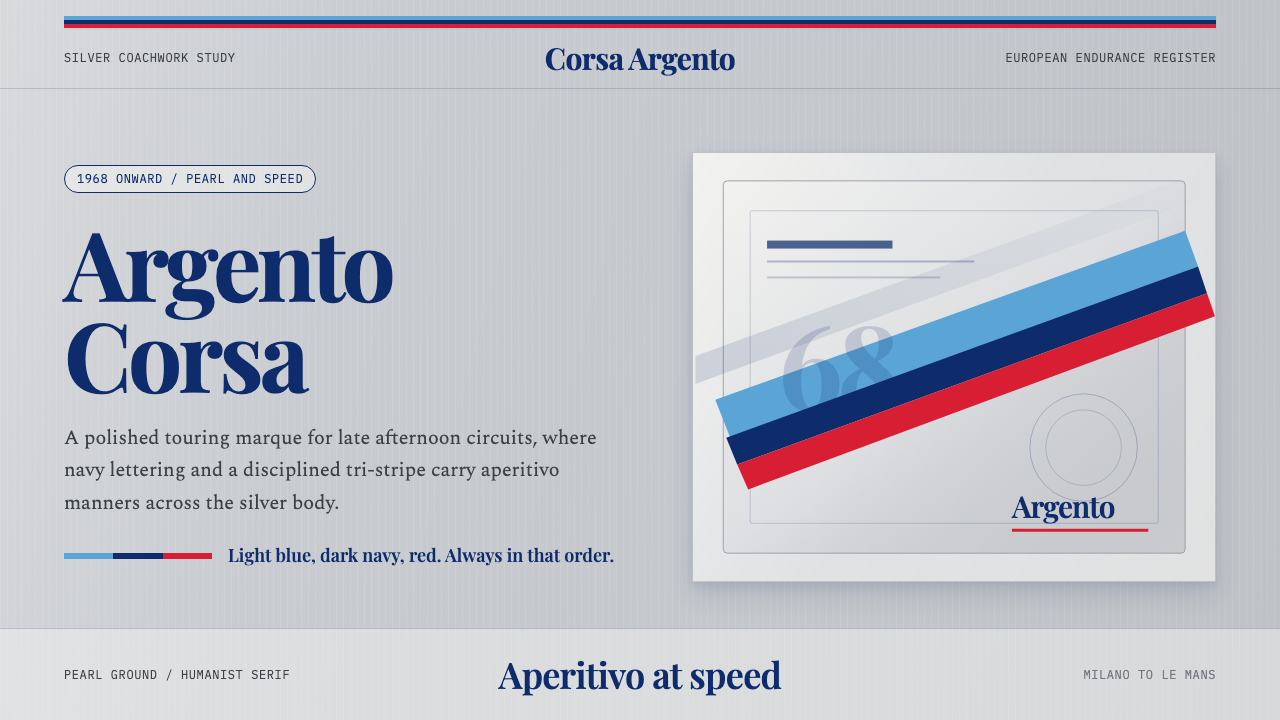 Martini Racing StripesAperitivo elegance at speed. Silver ground, Playfair serif, and a blue-navy-r…
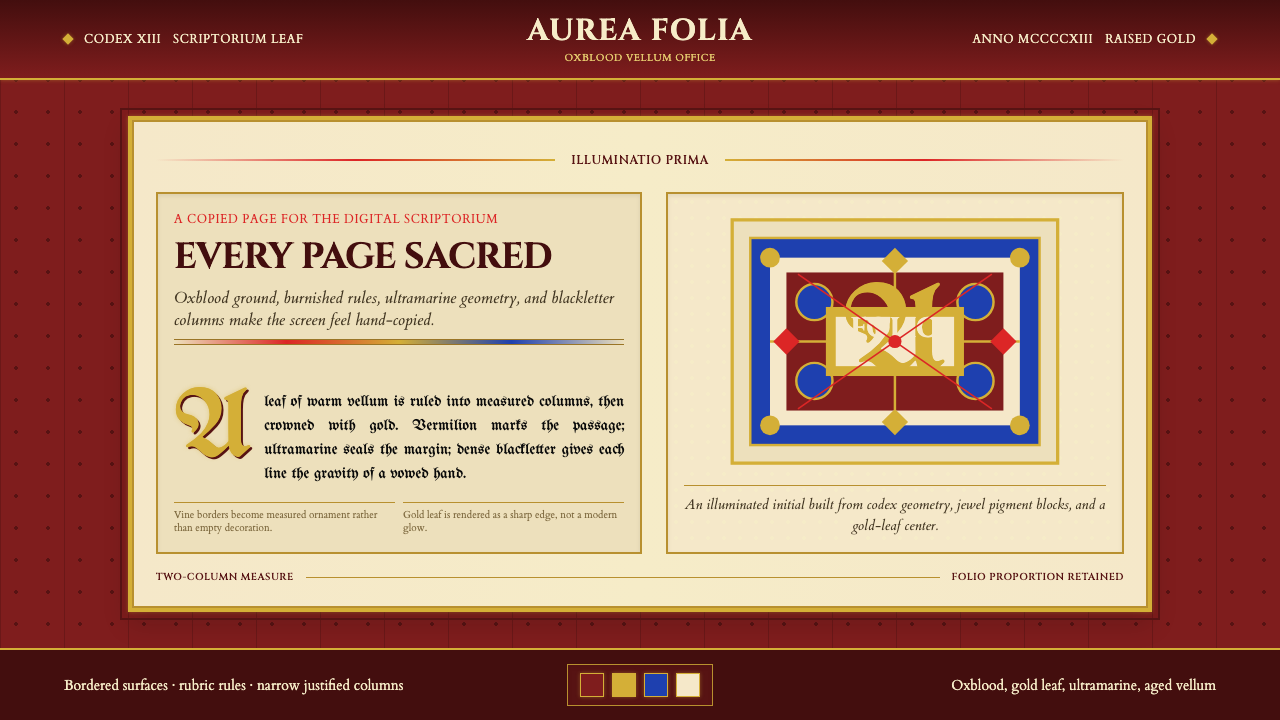 Medieval Illuminated ManuscriptTreats every page as sacred. Oxblood vellum, Cinzel capitals, gold-rule borde…