What is Harper's Bazaar?
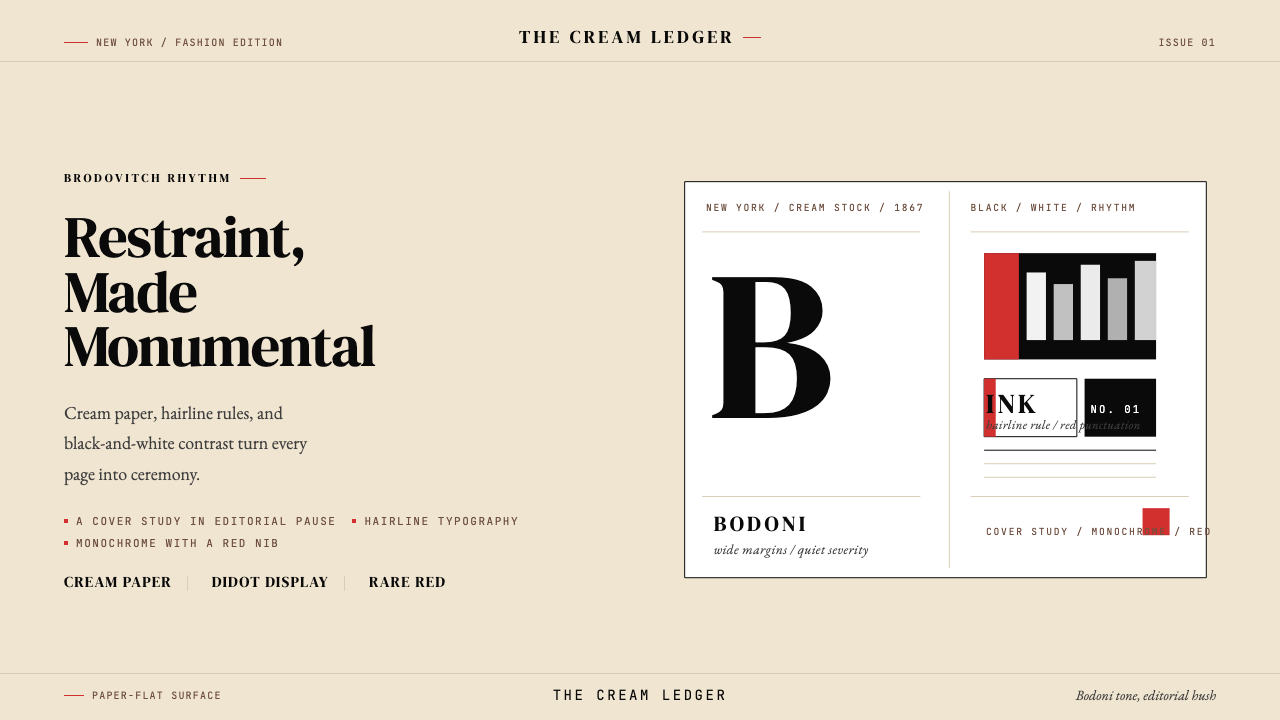
Harper's Bazaar proved that true luxury lives not in decoration but in discipline — cream paper, monumental type, and a single slash of red doing more than a dozen ornaments ever could.
Harper's Bazaar in brief
Harper's Bazaar is the visual language of American luxury-fashion publishing — a system in which warm cream paper, monumental high-contrast display type, hairline ruling lines, and dramatic black-and-white photography combine to project authority through restraint rather than abundance. Every element earns its place by carrying weight; nothing exists for decoration alone.
The style is immediately legible: vast white-to-cream fields give the eye nowhere urgent to go except exactly where the layout directs it. A single headline, set wide and light in a high-contrast serif, occupies the top third of a spread with the confidence of a building facade. Below it, a fashion photograph — frequently cropped aggressively or bled to the edge — commands its rectangle without caption clutter. A hairline rule, so thin it barely registers as ink, separates zones. The rare appearance of what is known as Bazaar-red — a saturated, unmodulated crimson — reads as a thunderclap precisely because it has been withheld everywhere else.
What distinguishes this aesthetic from generic luxury minimalism is its particular relationship to scale and whitespace. Brodovitch-era layouts do not simply use large type — they use type at a scale that feels slightly wrong by conventional magazine standards, and then hold that discomfort inside an ocean of white until it resolves into conviction. The tension between the monumental and the empty is the design.

Where does Harper's Bazaar come from?
Harper's Bazaar was founded in New York City in 1867 by the publishing house Harper and Brothers, predating its great rival Vogue by more than two decades. It was conceived from the outset as a vehicle for the fashionable woman of taste, importing European couture news to an American audience that had little other means of receiving it. Its early pages were dense with woodcut illustrations, social reportage, and pattern supplements — visually busy by any contemporary standard, reflecting the Victorian editorial sensibility of its founding decade.
The magazine's visual identity was fundamentally transformed between 1934 and 1958 by art director Alexey Brodovitch, a Russian-born designer who had trained amid the Paris avant-garde and absorbed the lessons of Constructivism and Surrealism without becoming beholden to either. Brodovitch brought to Bazaar an eye trained by Diaghilev's Ballets Russes — he had designed sets and costumes — and a conviction that movement, surprise, and white space were more powerful editorial tools than decoration or illustration. He laid out spreads in which photograph and type coexisted as equal formal partners, often running images across the gutter or cropping them in ways that violated illustration conventions entirely. He commissioned work from Man Ray, Cartier-Bresson, Richard Avedon, and Irving Penn, giving their photographs the space to function as images rather than documentation.
Diana Vreeland served as fashion editor from 1936 to 1962, overlapping extensively with Brodovitch and contributing an editorial sensibility as extreme as his visual one. Vreeland's editorial voice — imperious, telegraphic, devoted to the maximally specific — pushed art direction toward ever-greater economy. The words she wanted printed demanded space; the photographs she commissioned demanded space; the tension between those demands and a finite page produced the characteristic Bazaar compression: very little saying a very great deal.
Later editors and art directors sustained the visual vocabulary while adapting it to successive media environments. Liz Tilberis, who edited the magazine through the 1990s, returned Bazaar to a classical elegance after a period of competition with the louder registers of rival titles, working with photographers including Patrick Demarchelier and Helmut Newton. Glenda Bailey, who edited from 2001 onward, navigated the transition to digital-era publishing while preserving the essential typographic and chromatic commitments: the high-contrast serif at monumental scale, the cream-white ground, the red as punctuation rather than wallpaper.
What defines the Harper's Bazaar look?
Ground and Paper Feel
The foundational surface is warm cream to off-white — never the clinical cool white of newsprint or the stark brightness of coated stock at full saturation. This warmth gives the layout a tactile implication: it reads as heavy paper, as material cost, as the implicit promise that what is printed here is worth the substrate. The ground is not neutral; it is the first layer of luxury.
High-Contrast Display Type
The headline typeface belongs to the Didot and Bodoni tradition — hairline-thin strokes contrasting with bold stems, pronounced bracketed serifs, and an overall geometry that feels architectural at large sizes. Set wide, at a scale that most publications would consider excessive, these letterforms generate visual drama through pure typographic means. The contrast between the thinnest stroke and the thickest is so extreme that at certain sizes the hairlines seem almost to disappear, making the word appear to float rather than sit.
Hairline Rules
The ruling line in Bazaar layouts is as thin as the printing process will hold — the narrowest possible mark that still registers as deliberate rather than accidental. These lines do not divide the page so much as articulate it, the way a crease in a starched garment articulates the fabric. They separate columns, frame photographs, and provide scale reference for the surrounding type without ever thickening into a structural statement.
Dramatic Black-and-White Photography
The photographic aesthetic that Brodovitch cultivated — and that remains the style's primary visual register — privileges high contrast, unusual framing, and the elimination of middle tones in favor of stark blacks and luminous whites. Fashion subjects are photographed in motion or in extreme stillness, never in the documentary repose of catalog imagery. The photograph is treated as a formal object with its own compositional logic, not as an illustration of editorial text.
Bazaar Red as Punctuation
The red associated with Harper's Bazaar — a saturated, unmodulated crimson without warmth toward orange or coolness toward burgundy — functions not as a color in the conventional decorative sense but as a punctuation mark. It appears in mastheads, in initial capitals, in a single ruled line, in a typographic pull-quote. Its power is entirely a function of its rarity: a chromatic event against an otherwise achromatic field. Used more broadly, it would cease to be Bazaar red and become simply red.
Generous White Space
White space in Bazaar layouts is not emptiness — it is expensive real estate deliberately left unoccupied, signaling that the publication can afford not to fill every square centimeter with content. Margins are wide; gutters between columns are generous; the space above a headline and below it is treated as structurally essential rather than as filler waiting to be displaced. This use of space is itself a class signal, distinguishing the magazine from busier, more anxious publications that fill every gap.
Asymmetric Elegance
Bazaar layouts are never symmetrically balanced in the classical sense. A photograph bleeds off the left edge while type floats right with generous margin. A headline occupies the full column width on one page while its facing page is nearly blank. The asymmetry is not restless or dynamic in the Bauhaus sense — it is languid, deliberate, aristocratic. The page does not try to balance itself; it assumes that the viewer will accommodate the imbalance as a mark of confidence rather than error.

Who shaped Harper's Bazaar?
Brodovitch served as art director of Harper's Bazaar from 1934 to 1958, a tenure that defines the magazine's visual identity more than any other single period. Born in Russia and trained in the artistic ferment of post-World War One Paris, he absorbed the lessons of Constructivism, Surrealism, and the Ballets Russes before emigrating to the United States. At Bazaar, he transformed the magazine from a fashionable but visually conventional publication into the international benchmark for editorial design. His methods included commissioning artists and photographers who had never worked in magazines, designing layouts that used white space as a primary element, and insisting that every spread feel like a visual event rather than a page of illustrated content. He also taught the legendary Design Laboratory at the New School in New York, where students including Richard Avedon and Irving Penn developed under his influence.
Vreeland was fashion editor at Harper's Bazaar from 1936 to 1962, then editor-in-chief of Vogue, and later a special consultant to the Costume Institute at the Metropolitan Museum of Art. Her relationship to the Bazaar visual system was one of mutual amplification: her editorial voice — imperious, hyperbolic, and devoted to specificity — demanded visual layouts with equal conviction. The famous line attributed to her, that the bikini is the most important thing since the atom bomb, captures the register: she dealt in maximum statements, and the visual system Brodovitch maintained was the only one capable of containing them. Her influence on how fashion is written about and photographed extends far beyond any single publication.
Avedon began photographing for Harper's Bazaar in 1945 and continued his association with the magazine for over two decades, becoming the defining photographer of the Brodovitch era. Trained under Brodovitch's Design Laboratory, he absorbed the art director's conviction that a fashion photograph should be an image first and a document second. His Bazaar work is characterized by movement — models caught mid-leap, coats swirling, figures photographed against Parisian street life rather than studio backdrops — and by an emotional directness that conventional fashion photography of the period avoided. He later moved to Vogue and then worked for decades as a portrait photographer and advertising artist, but the Bazaar years defined the terms on which contemporary fashion photography still operates.
Tilberis edited Harper's Bazaar from 1992 until her death in 1999, a period in which she positioned the magazine in deliberate contrast to the high-energy maximalism then associated with its competitors. Working with photographers including Patrick Demarchelier and Helmut Newton, she returned Bazaar to an editorial register emphasizing classical elegance, restraint, and the kind of quietly expensive authority that Brodovitch had established decades earlier. Her tenure is remembered as a return to first principles — proof that the magazine's visual identity was durable enough to survive competitive pressure and editorial fashion without essential change.
Man Ray contributed to Harper's Bazaar during the Brodovitch era, bringing the aesthetic strategies of Surrealism — double exposure, solarization, unexpected juxtaposition — into the context of fashion publishing. His Bazaar work demonstrated that the magazine's visual commitment to surprise and tension was not simply a matter of graphic design but extended to a fundamental relationship with avant-garde image-making. The willingness to commission artists operating outside fashion-photography conventions was central to Brodovitch's method and to the identity of the magazine as something more than a trade publication.
How do you use Harper's Bazaar today?
The Harper's Bazaar visual system is among the most directly applicable historical styles for contexts where perceived luxury and editorial authority are the core communication goals. Applying it correctly means understanding that every element exists in relation to the space around it — and that the space itself is doing at least as much communicative work as the elements. Stripping out the white space to fit more content is the single most common mistake and the one that most completely destroys the style.
For presentation slides, the Bazaar approach yields unusually strong cover and section-break designs. A cover slide should be treated as a magazine cover: a single image bled to the edges or positioned to command the majority of the frame, a title in a tall high-contrast serif set at a scale that feels slightly large by conventional slide standards, and a masthead-style element — company name, date, or subtitle — in a hairline smaller weight. Color should be restrained to near-black, cream, and a single red accent, used only once. Content slides work well as two-column spreads in which the left column carries a single large statement or image and the right column holds supporting body text at modest scale. Data slides should treat charts as editorial objects — white or cream background, black axes, bars or segments in the near-black and cream palette, with a single red bar used to mark the most significant data point.
For web interfaces — particularly dashboards, pricing pages, and premium landing pages — the Bazaar system rewards literal application of its spatial logic. Background colors should read as warm near-white rather than pure bright white. Navigation should be typographic and spare: wordmarks and section labels in a high-contrast serif, with no icon decoration beyond the essential. Cards and content modules should have either visible thin borders or hard-edge offsets rather than soft drop shadows. Typography hierarchy should be extreme — the headline type at a monumental scale relative to body text, with little or nothing at intermediate sizes. The red accent color appears at most once per viewport: in a call-to-action button, in the active navigation state, or in a single emphasized label.
For editorial and marketing work, the style supports brand positions that want to communicate heritage, authority, and discernment without irony. A Bazaar-derived long-form article layout uses wide margins — often wider than the text column itself — to create the sense of a printed luxury publication. Pull quotes are set in the large high-contrast serif, separated from body text by hairline rules rather than color boxes. Marketing campaigns draw on the poster-like quality of the Brodovitch era: a single strong image, a short declarative headline in monumental type, and a logo or brand mark reduced to the scale of a discreet signature. The red should appear at most once in any composition, and only where maximum attention is genuinely warranted.
A common mistake when working in this aesthetic is mistaking restraint for emptiness. Designers who understand that the style uses very little color and very little decoration sometimes compensate by reducing the scale and ambition of the typography, producing layouts that read as timid rather than confident. The opposite error is correct: the type should be larger than feels comfortable, the white space should be more generous than feels efficient, and the red — if used at all — should appear exactly once and in the position where it will be seen last. The discipline of the style is not in using less; it is in making less do more.

Harper's Bazaar — FAQ
How is Harper's Bazaar different from Vogue's visual identity?
The two magazines are often treated as interchangeable luxury-fashion references, but their visual systems differ in fundamental ways. Bazaar, shaped by Brodovitch, favors extreme scale contrasts, asymmetric compositions, and a chromatic restraint that reserves color for a single punctuating red. Vogue has historically been more willing to use color decoratively, more formally symmetrical in its cover compositions, and more aligned with the conventions of high-gloss commercial photography. Bazaar feels like a designed artifact; Vogue feels like a curated showcase. The distinction matters when applying either style: Bazaar is the right reference when the goal is editorial authority and quiet confidence; Vogue when the goal is glamour and aspirational fantasy.
Can this style work for digital interfaces, or is it inherently a print aesthetic?
The style translates to digital with some adaptation but not without loss. The qualities that make it powerful in print — the tactile implication of cream paper, the physical thinness of hairline rules at magazine scale, the light-and-shadow quality of high-contrast Didot letterforms — are harder to fully replicate on screens. That said, the spatial logic translates directly: generous white space, extreme typographic scale contrast, color used as punctuation, and asymmetric composition all work on screen. The most successful digital applications treat the style as a set of proportional and spatial principles rather than a direct copy of print conventions, and they choose typefaces whose structural character approximates the high-contrast serif tradition even if the exact historical fonts are unavailable.
Does this aesthetic work for brands that are not in the fashion or luxury industry?
It can work outside fashion, but the stylistic register carries strong connotations of fashion-editorial authority that not every brand wants. It is a natural fit for premium cultural institutions — museums, opera companies, concert halls, literary publishers — where the visual language of discernment and cultural authority is appropriate. It also works for high-end service businesses where perceived expertise and exclusivity matter: law firms, wealth management, private healthcare, bespoke hospitality. It is less suited to technology products that want to project speed, innovation, or democratic access, and it actively undermines brands built on warmth, community, or casual accessibility. The key test is whether a brand genuinely occupies the register of quiet authority; if not, the style reads as pretension.
How should the red accent be handled — what constitutes using it correctly?
The red functions correctly when it appears in exactly one place per composition and marks the single element that most needs to be seen last — or remembered longest. In a magazine cover, it is the masthead. In a slide, it is the key data point or the call to action. In a web page, it is the primary button or the active navigation state. The test is: if you remove the red, does the composition become noticeably weaker in one specific place? If yes, that is where the red belongs. If the composition seems equally valid without any red, either the red was decorative rather than structural — in which case it should be removed — or it has been distributed too widely to register as an event. Red that appears in multiple places simultaneously is no longer Bazaar red; it is simply red, and the system has collapsed into generic color use.
What makes the Brodovitch era so frequently referenced compared to other periods of the magazine's history?
Several factors converge. First, the Brodovitch period coincided with the emergence of modern editorial design as a discipline — his Bazaar was among the first publications to treat the magazine spread as a designed object with its own compositional logic rather than as a container for editorial content. Second, the photographers and artists he collaborated with — Avedon, Man Ray, Cartier-Bresson, Penn — were simultaneously defining what ambitious photography could be, so the magazine became a record of a particular moment in both editorial and photographic history. Third, the visual system he developed was sufficiently coherent and restrained that it has proved highly durable: it can be applied in contemporary contexts without feeling historical or pastiche because its principles are spatial and structural rather than decorative. Other periods of the magazine's history produced excellent work but did not codify a system with equivalent transferability.
Related design styles
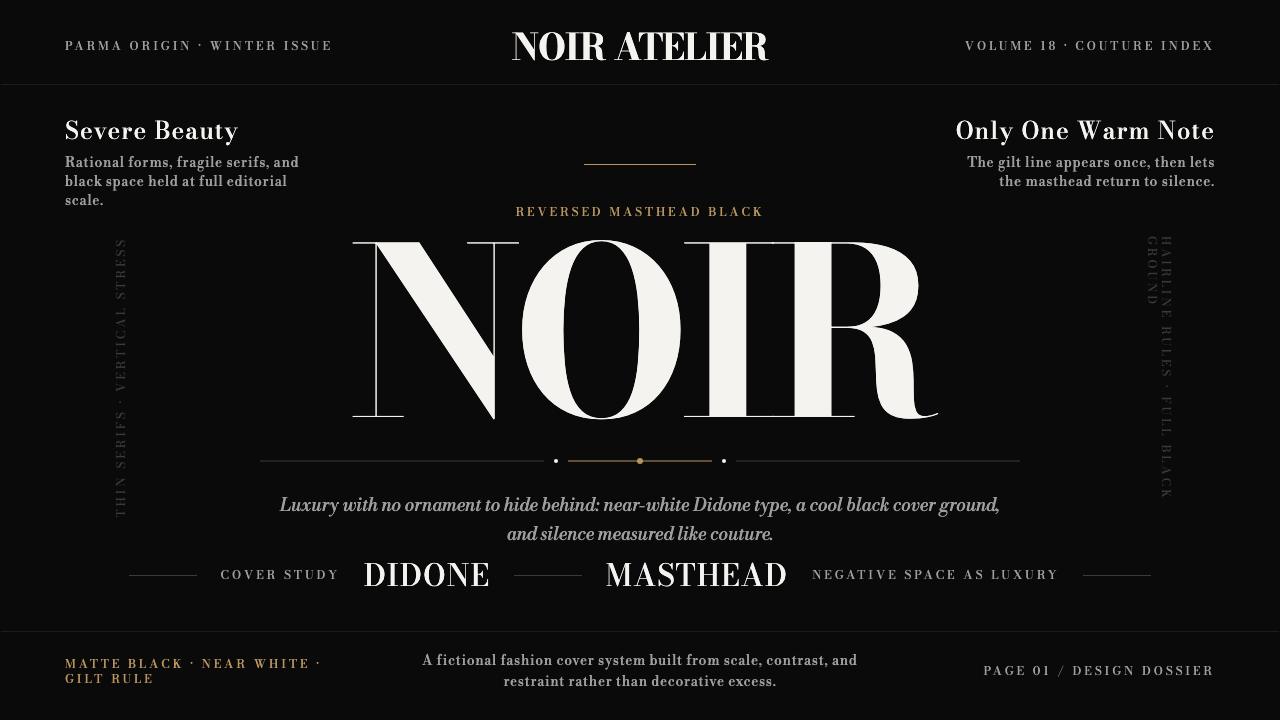 Bodoni Didone Fashion MastheadLuxury as black silence. White Bodoni, tiny coverlines, and one gilt hairline…
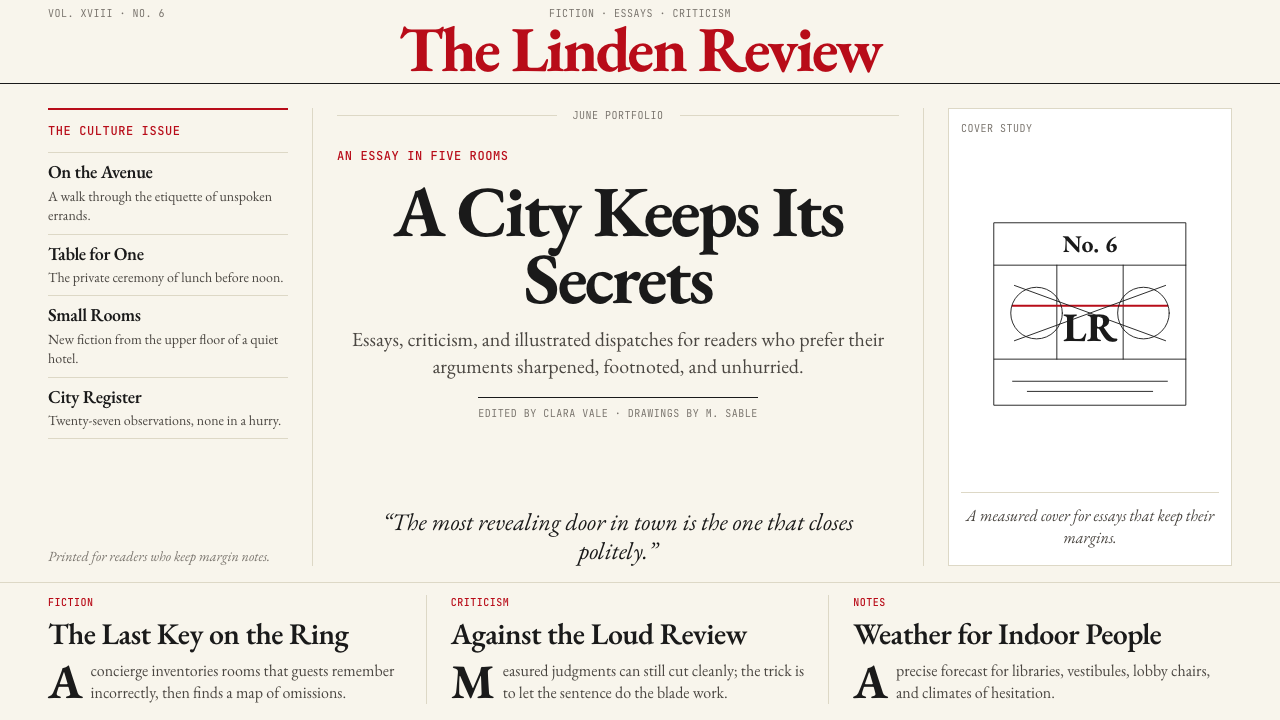 The New Yorker ClassicQuiet authority. Cream paper, EB Garamond columns, ink cartoons, and one red…
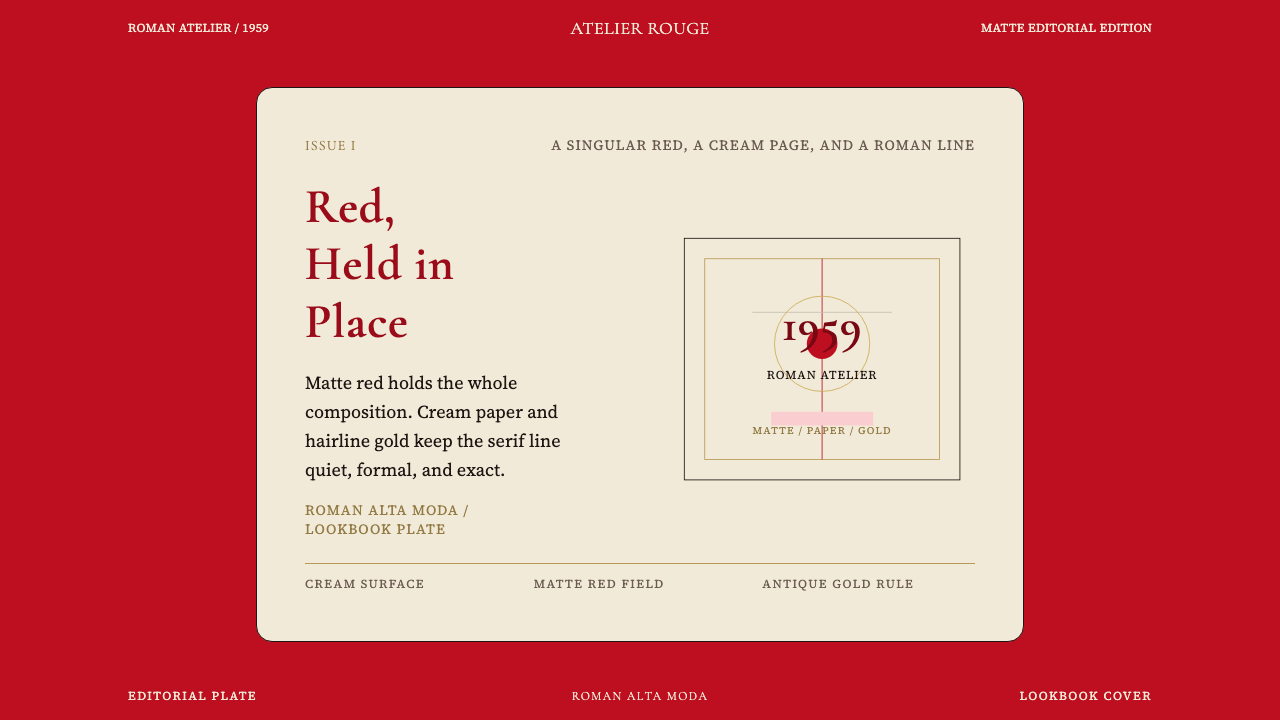 Valentino Rouge Couture (1959)Matte couture red holds the page. Cream paper and hairline gold keep it cerem…
 Baku Oil Boom MansionsWealth made tactile. Almond limestone, Old Standard TT, and recessed bays car…
 Benin Bronze (Edo, 1500)Royal memory, cast in bronze. Cream plaques and gilded lines carry museum gra…
 Charro SuitOrnament is structure. Gala-grey wool and chased silver studs hold a strict v…