What is Target — Bullseye Red?
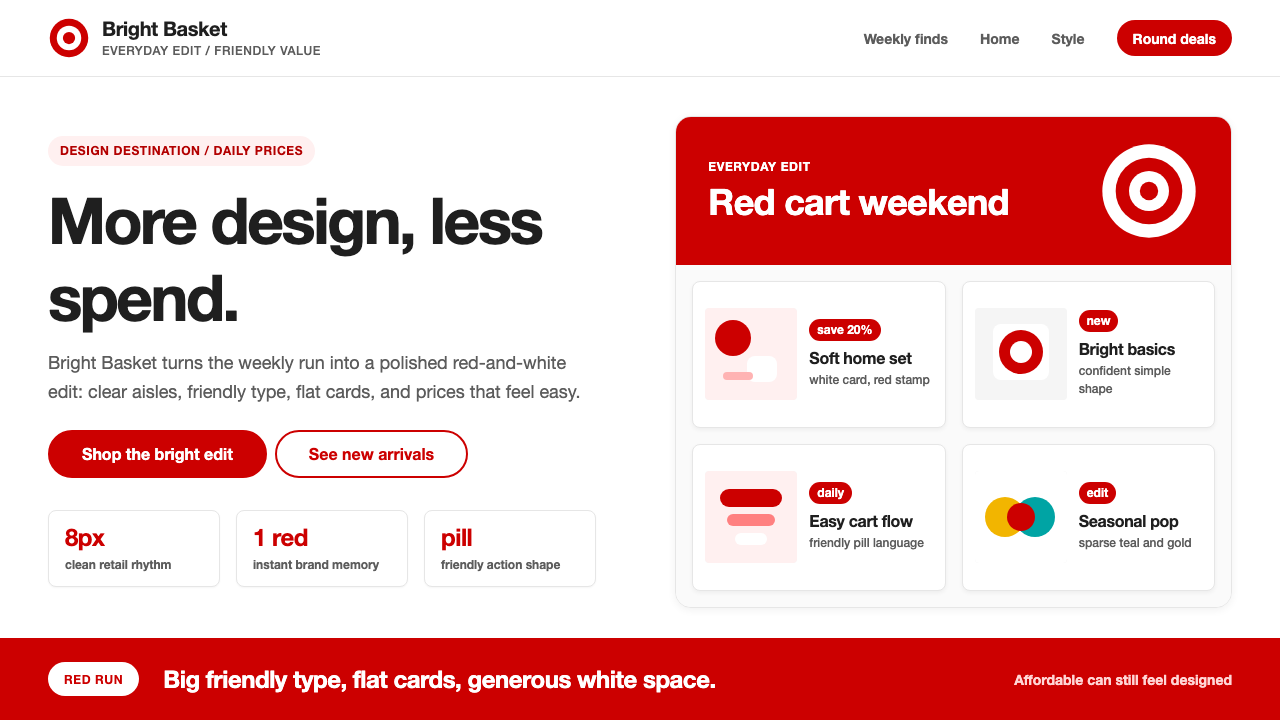
Target proved that a single fearless red, an open white field, and a perfectly round bullseye could turn a discount store into America's most beloved design brand.
Target — Bullseye Red in brief
Target — Bullseye Red is the visual design system built around Target Corporation's iconic brand identity: a saturated, warm red paired with generous white space, approachable rounded typography, and lifestyle imagery that feels aspirational yet grounded. The system communicates that good design is not a luxury reserved for the wealthy — it is a right that belongs to every shopper pushing a cart through a big-box aisle.
At its core, the aesthetic is radically restrained. The dominant red reads as cheerful and confident rather than aggressive or alarming, anchoring every touchpoint from store signage to digital interfaces. White space is used with unusual generosity for a mass-market brand, giving the composition room to breathe and lending each visual element far more presence than its modest price point might suggest. The result is a look that feels simultaneously warm and polished.
Where most discount retail design piles on noise — competing promotional bursts, crowded grids, clashing color accents — Target's system practices discipline. Pill-shaped buttons, bold confident headline type, and clean product photography work together to signal that affordability and aesthetics are not opposites. The brand's famous designer collaborations made this argument concrete: the same visual system that carried a five-dollar spatula carried a Michael Graves kettle with equal elegance.

Where does Target — Bullseye Red come from?
Target opened its first store in Roseville, Minnesota, in 1962, founded by John Geisse as a value-oriented division of the Dayton Company. From the start, Geisse envisioned something different from the drab utilitarian discount retailers of the era — a store where the shopping environment itself would be part of the appeal. The ambition was modest in its early form, but it planted the seed of what would eventually become a systematic design philosophy.
The bullseye mark arrived in 1968, when the corporation commissioned a concentric-circle logo that would become one of the most recognized brand symbols in American retail history. Simple, geometric, and inherently dynamic, the bullseye translated perfectly to storefront fascia, shopping bags, and, decades later, to app icons and social media avatars. Its pure circular form aligns the brand with precision and intention — the antithesis of the clearance-rack chaos it surrounded.
The transformation from mere discount retailer to genuine design destination accelerated in the 1990s and early 2000s under the creative direction of Robyn Waters, Target's trend and product director. Waters initiated the first wave of designer collaborations — bringing architects, industrial designers, and fashion names into a mass-retail context that had never before taken such partnerships seriously. Michael Graves designed a celebrated line of housewares beginning in 1999. Isaac Mizrahi brought fashion-forward clothing to the chain. Liberty of London contributed print textiles. Each collaboration reinforced the central brand promise: you can expect design intelligence here, at prices you can actually afford.
The visual language that now defines the brand consolidated around 2018 to 2024, shaped in part by campaigns developed with the advertising agency Wieden+Kennedy. Under CEO Brian Cornell, who took the helm in 2014, Target made design consistency a strategic priority alongside its physical store renovation program. The digital expansion of the brand — apps, website, self-checkout interfaces — demanded that the bullseye red system perform equally well on screens of every size and at every fidelity. The result is a design system mature enough to remain coherent from a highway billboard to a mobile push notification thumbnail.
What defines the Target — Bullseye Red look?
The Anchor Red
The defining element of the system is a single, unmistakable warm red — saturated enough to command attention at scale, yet balanced enough to feel approachable rather than alarming. It operates as the sole chromatic anchor across every medium: on white backgrounds it reads as celebratory; on product photography it acts as a frame; on digital interfaces it signals interactivity. The palette is deliberately monochromatic — there is no secondary accent color jockeying for attention.
White Space as Strategy
For a brand that sells everything from groceries to furniture, the consistent deployment of generous white space is a remarkable act of restraint. White space separates Target's visual language from the cluttered tradition of promotional retail. Rather than filling every centimeter with product or price information, the layouts breathe — and that breathing room is precisely what elevates the perceived quality of whatever occupies it.
Pill-Shaped UI Forms
Pill-shaped buttons, tags, and containers are a signature of the brand's interface vocabulary. The rounded rectangle — midway between the full circle of the bullseye and the hard rectangle of a grid block — reads as friendly and approachable, softening what might otherwise be a clinical red-and-white scheme. Applied consistently to calls to action, category pills, and price badges, this form language gives the system warmth without resorting to ornament.
Bold Headline Typography
Headlines in the Target system are set with exceptional confidence — heavy weight, generous size, and short line lengths that allow each line to land with impact. The typefaces are warm and legible rather than geometric and cold: slightly humanist in their proportions, with a friendliness that complements the brand's approachable positioning. Hierarchy is clear and fast to read, with body text staying quiet so that the primary message lands first.
Lifestyle Photography with Red Accents
Product and campaign photography in the system is bright, natural-light, and styled to look achievable — real-looking kitchens, bedrooms, and outdoor spaces populated with aspirational but not intimidating choices. Red appears within the photographs themselves as a recurring accent: a cushion, a pan, a shopping bag, a child's jacket. This technique stitches the brand color directly into the narrative world of the image rather than treating photography and branding as separate layers.
The Bullseye as Geometric Anchor
The concentric-circle bullseye is not merely a logo — it is a compositional device. When used as a background element, a crop guide, or a framing motif, it introduces a sense of focus and intentionality that distinguishes Target campaigns from generic retail imagery. The circle's perfect geometry implies precision, and its target-like nature implies that the brand knows exactly what it is aiming for. Even in layouts where the logo is absent, the circular logic — cropped round images, circular badges — persists.
Warmth Without Ornamentation
Perhaps the most disciplined achievement of the Target visual system is that it feels warm — inviting, human, approachable — without resorting to decorative ornament, sentimental illustration, or textural embellishment. The warmth comes entirely from the color temperature of the red, the humanist proportions of the type, and the lived-in quality of the photography. No additional design elements are needed to convey friendliness; the fundamental choices carry that message without any decorative tax.

Who shaped Target — Bullseye Red?
Geisse founded the Target division within the Dayton Company in 1962 and conceived of it from the outset as a value retailer with genuine aesthetic ambitions — not merely a warehouse for cheap goods. His foundational vision that affordable shopping could be a pleasurable, well-designed experience set the cultural trajectory that the brand has followed for more than six decades. The bullseye mark commissioned under his leadership in 1968 remains, with minimal revision, the centerpiece of one of America's most recognized brand identities.
As Target's vice president of trend, design, and product development through the 1990s and into the early 2000s, Waters was the chief architect of the brand's transformation into a design destination. She championed the first designer collaborations, identifying undervalued creative talent willing to work at mass-market scale and price points. Her philosophy — that trends do not belong exclusively to luxury retail — democratized access to design-forward products and built the cultural credibility that made Target a media and cultural phenomenon beyond its retail category.
Graves was among the first major architects and designers to collaborate with Target, launching a housewares collection in 1999 that brought postmodern design sensibility to mass-market kitchenware. His teakettles, toasters, and kitchen accessories sold in the millions and proved that design-literate consumers existed at every income level — they simply had not been offered well-designed options at accessible prices. The Graves partnership became the proof of concept for Target's entire designer collaboration strategy.
The Portland-based advertising agency shaped the tone and visual language of Target's marketing campaigns across multiple decades, helping to define the brand's voice as witty, warm, and quietly confident. Their work demonstrated that the bullseye red system could carry genuine narrative and emotional weight, not simply promotional mechanics. W+K's campaigns treated Target shoppers as culturally aware adults — an unusually respectful posture for mass-retail advertising — and this tone of address became inseparable from the brand's design identity.
Cornell became Target's CEO in 2014 and oversaw a comprehensive brand and operational renewal that made design consistency a company-wide discipline. Under his leadership, Target accelerated its physical store redesign program, invested in owned-brand product lines with genuine design quality, and extended the visual system coherently into digital commerce. Cornell's tenure demonstrated that the bullseye red design language is not merely a marketing choice but a strategic platform — one capable of supporting a multi-channel retail business across radically different customer touchpoints.
How do you use Target — Bullseye Red today?
Applying the Target — Bullseye Red design language to your own work requires understanding that its apparent simplicity is the result of careful discipline, not the absence of decisions. The system works because every element reinforces the same feeling: confidence without arrogance, warmth without clutter, quality without pretension. Before adding any element, ask whether it strengthens or dilutes that feeling.
For presentation decks, the system delivers maximum impact on cover slides: a single large circle or bullseye shape in the signature red against a white ground, with a headline set in heavy type at confident scale. The circle need not be an exact replica of the Target logo — any bold circular form activates the same compositional logic. Content slides should maintain the white-space discipline, using the red exclusively for key data points, highlighted metrics, or section-opening accents. On data slides, charts and graphs take on the role of geometric forms: bars and segments colored in the red-and-white palette, with neutral gray available for secondary data series. The system's confidence translates directly to authoritative data presentation without requiring decorative scaffolding.
For web interfaces and dashboards, the Bullseye Red system is especially powerful on pages where action and decision are the primary user goal. Pricing pages benefit from the system's natural hierarchy: a dominant red tier card reads as recommended or featured, while white-background alternatives recede naturally. Navigation and interactive elements — buttons, tabs, toggles — should carry the red consistently so that the eye always knows where action lives. For information-dense dashboards, the white background and limited color palette reduce cognitive load dramatically; red should appear only on values that require immediate attention, such as alerts or primary KPIs, leaving the majority of the interface neutral to let those signals stand out.
For editorial and marketing applications, the style rewards bold compositional thinking. Hero sections work best when the red occupies a substantial area — not a stripe or a small badge, but a ground that images or type can sit against. Editorial layouts benefit from a clear typographic hierarchy: a very large primary headline, a medium subhead, and small body text set in a readable width, with the red reserved for pull quotes, section labels, or key statistics. Marketing materials — posters, event graphics, social cards — can lean into the bullseye motif as a compositional device, using circular crops or circular overlays to add brand-aligned focus to photographic content. The pill shape from the brand's button vocabulary also translates well to labels, tags, and promotional badges in offline contexts.
A common mistake when working with this design system is treating the red as one color among several rather than the sole chromatic statement. Adding a second accent color — teal for data, orange for warnings, purple for categories — immediately dilutes the system's power and makes the interface feel generic. Similarly, deploying the red at small scale for decorative purposes rather than reserving it for meaningful signals trains the eye to ignore it, undermining the very hierarchy the system is built to create. The discipline of using red sparingly and purposefully is what makes every instance of it feel intentional. When in doubt, add more white space rather than adding more color.

Target — Bullseye Red — FAQ
Does this style only work in red and white, or can I introduce other colors?
The system's power comes from its chromatic restraint — the single warm red against white is the entire palette for a reason. You can introduce a neutral such as a warm light gray or a very pale warm tone for background differentiation, and dark charcoal for secondary text is often preferable to pure black. However, introducing a true second accent color — any hue with meaningful saturation — breaks the hierarchy that makes the red legible as a signal. If your content genuinely requires a second signal color, treat it as a subdued, lower-saturation variant and use it only for secondary states, never competing with the primary red.
How do I apply the style without it looking like a Target advertisement?
The key is to use the underlying design principles rather than the specific brand marks. Avoid the literal bullseye logo and the specific red that is uniquely associated with Target. Instead, apply the systemic logic: one dominant warm color on white, generous negative space, confident headline type, pill-shaped interactive elements, and lifestyle photography with color accents that echo the primary hue. At that level of abstraction, the design language reads as warm and confident retail-adjacent design — not as a brand appropriation. The principles are far more transferable than the specific marks.
Is this system appropriate for premium or luxury products?
With care, yes — but it requires a significant shift in proportion and restraint. Luxury contexts call for even more white space, smaller and lighter headline type, photography with more editorial distance, and the warm red used at far smaller scale and lower frequency. The Bullseye Red system in its standard form signals accessibility and warmth, which are values that work against traditional luxury positioning. If you want the clean confidence of the system without the mass-market friendliness, pull back the saturation of the dominant color, increase the size of negative space areas dramatically, and reduce the red to a single small but precise accent — more like a wax seal than a storefront.
How does this design system work on dark backgrounds?
The system is fundamentally a light-ground design language — white or very light backgrounds are where it performs best and most authentically. A dark inversion is possible, particularly for special contexts like app dark mode or nighttime event visuals, but the warm red can shift in character against a dark ground, sometimes reading as richer and more dramatic, sometimes as less welcoming. On a near-black background, the red and white roles essentially invert: white becomes the text color and structural element, and the red retreats to accent use only. The pill shapes and bold typography translate well to dark versions, but the sense of open spaciousness that white space creates is harder to replicate — negative space on dark feels more dramatic and less inviting.
What kinds of projects benefit most from this design language?
The Bullseye Red system performs best in contexts where approachability, clarity, and action-orientation are primary values. Consumer-facing e-commerce and retail interfaces, promotional landing pages, event programs, lifestyle product catalogues, and brand presentations aimed at broad audiences all benefit from its confident warmth. It is well-suited to projects that need to feel trustworthy and accessible without feeling corporate or cold. Where the system struggles is in contexts that require gravitas, complexity, or cultural specificity — medical or legal documents, highly technical dashboards serving expert users, or any context where the brand must position itself above the mass market. In those cases, the friendliness that is the system's greatest strength can work against the required tone.
Related design styles
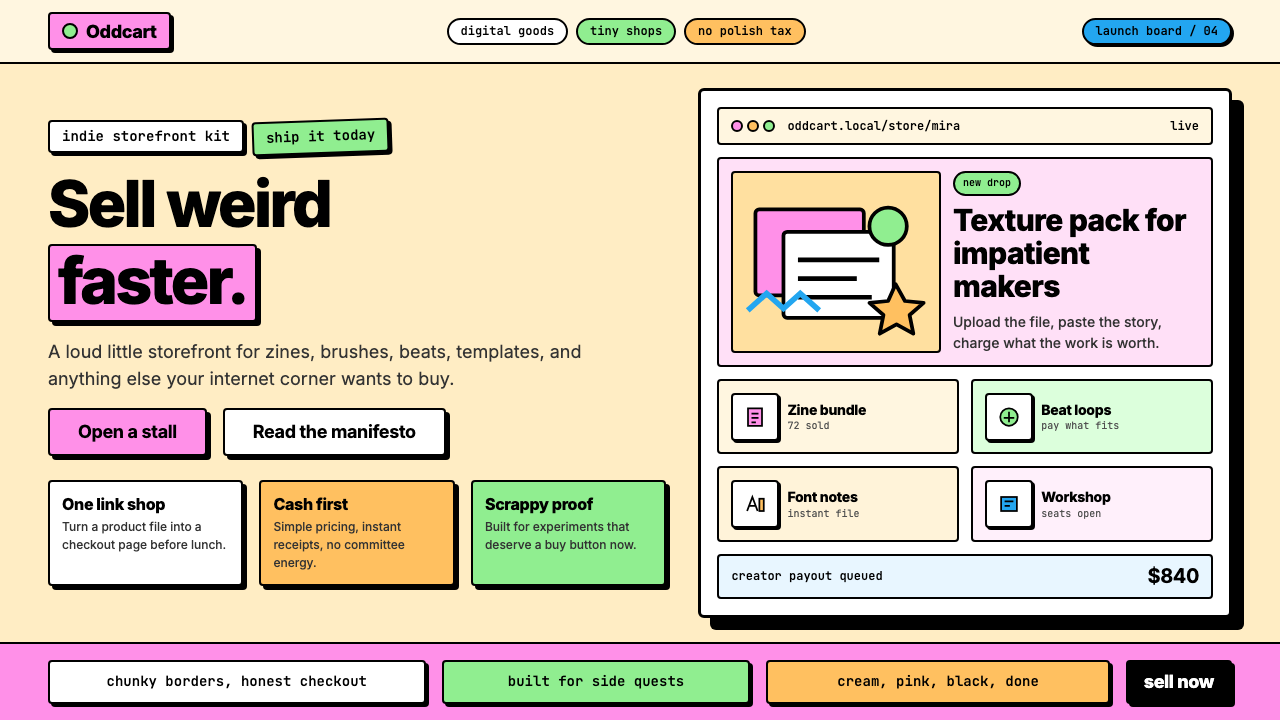 Gumroad CreatorGeoCities by way of Memphis. Hot pink, chunky black borders, hard offset shad…
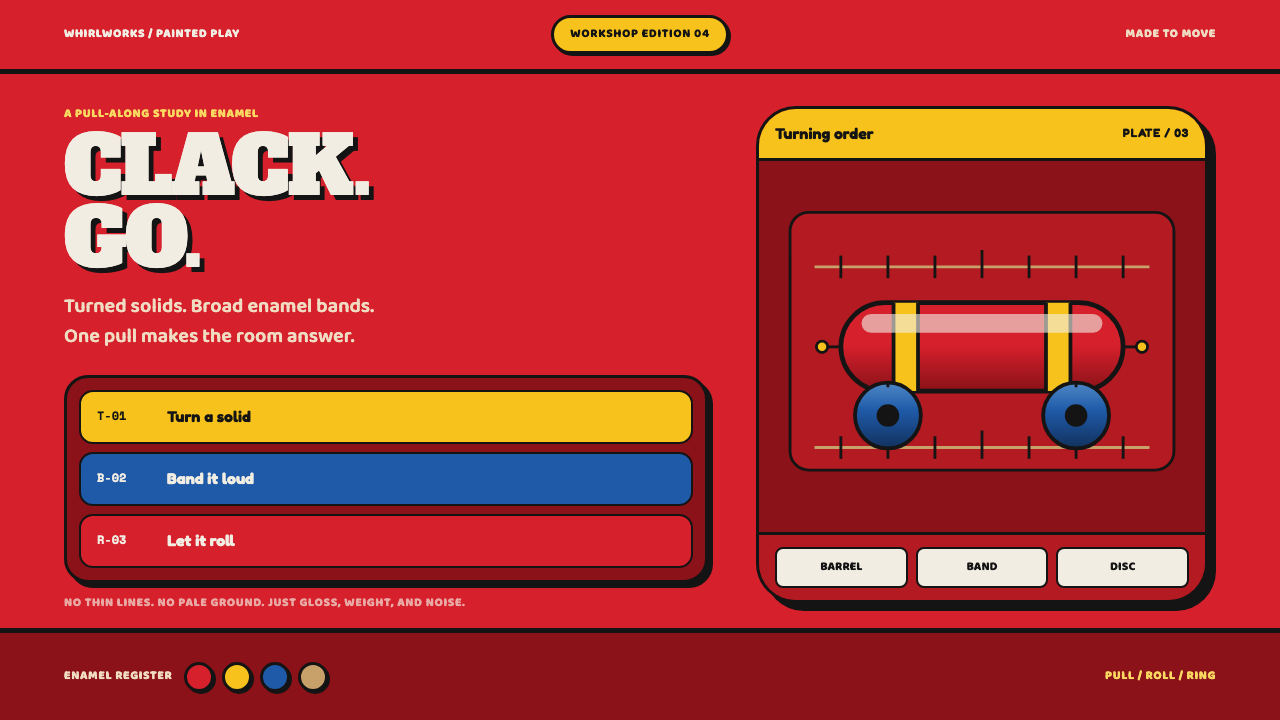 Buzzy Bee ToyPlay is mechanical. Gloss-red barrels, blue discs, and yellow bands clack in…
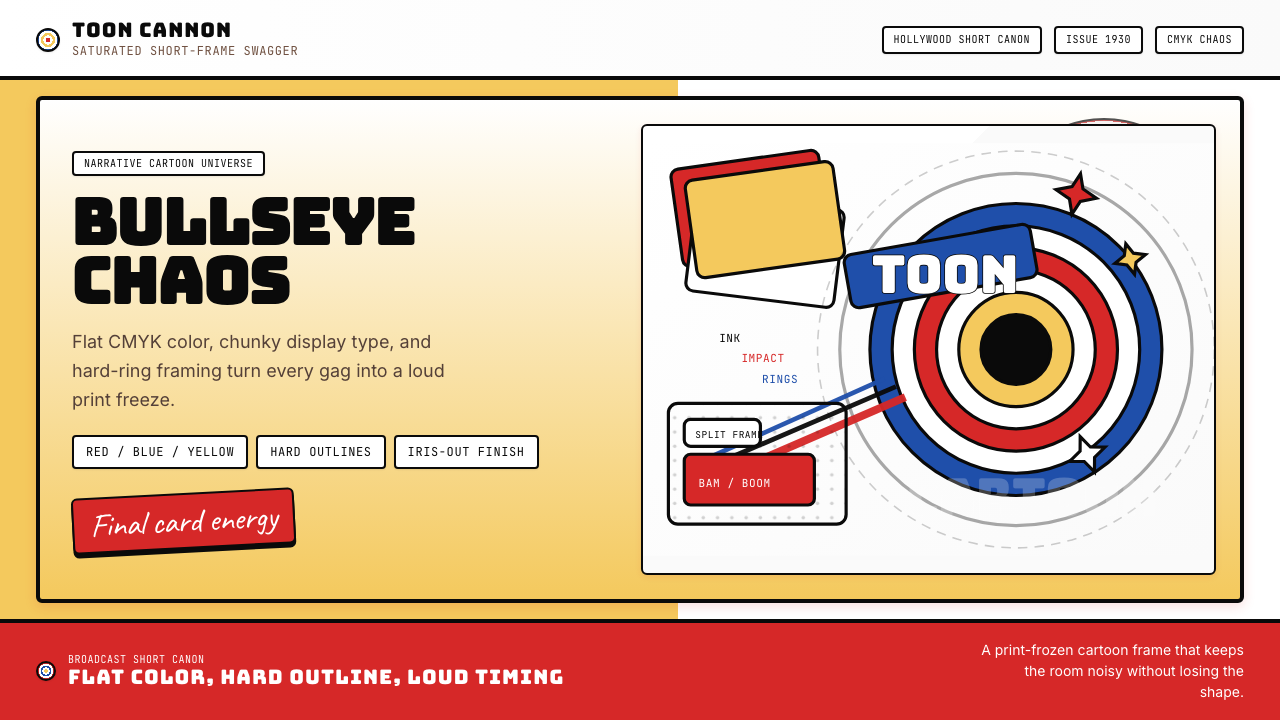 Looney Tunes (Warner Bros.)Pure cartoon chaos. Bull's-eye rings, Bungee type, and red-blue-yellow blocks.
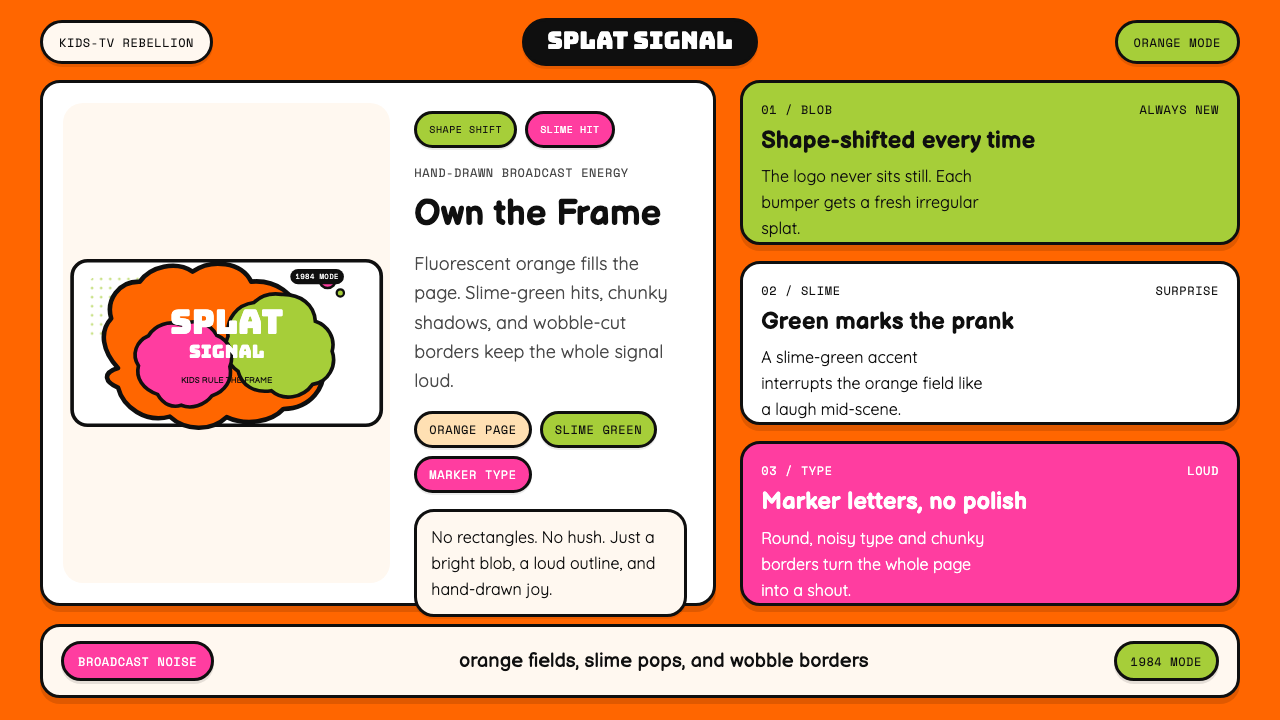 Nickelodeon Orange Splat (1984)Kids own the screen. Orange fields, slime-green pops, and wobble borders do t…
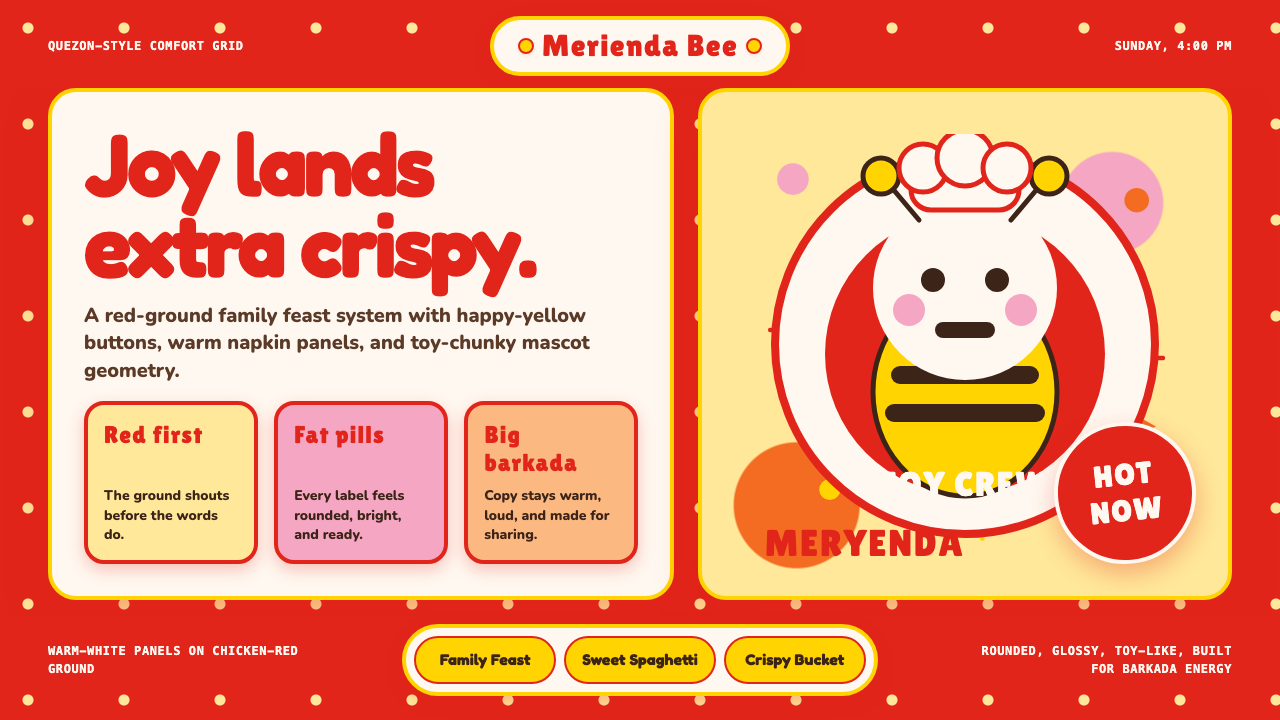 Philippines Jollibee Bee MascotJoy shouts first. Red ground, Fredoka curves, yellow pills, chunky grid.
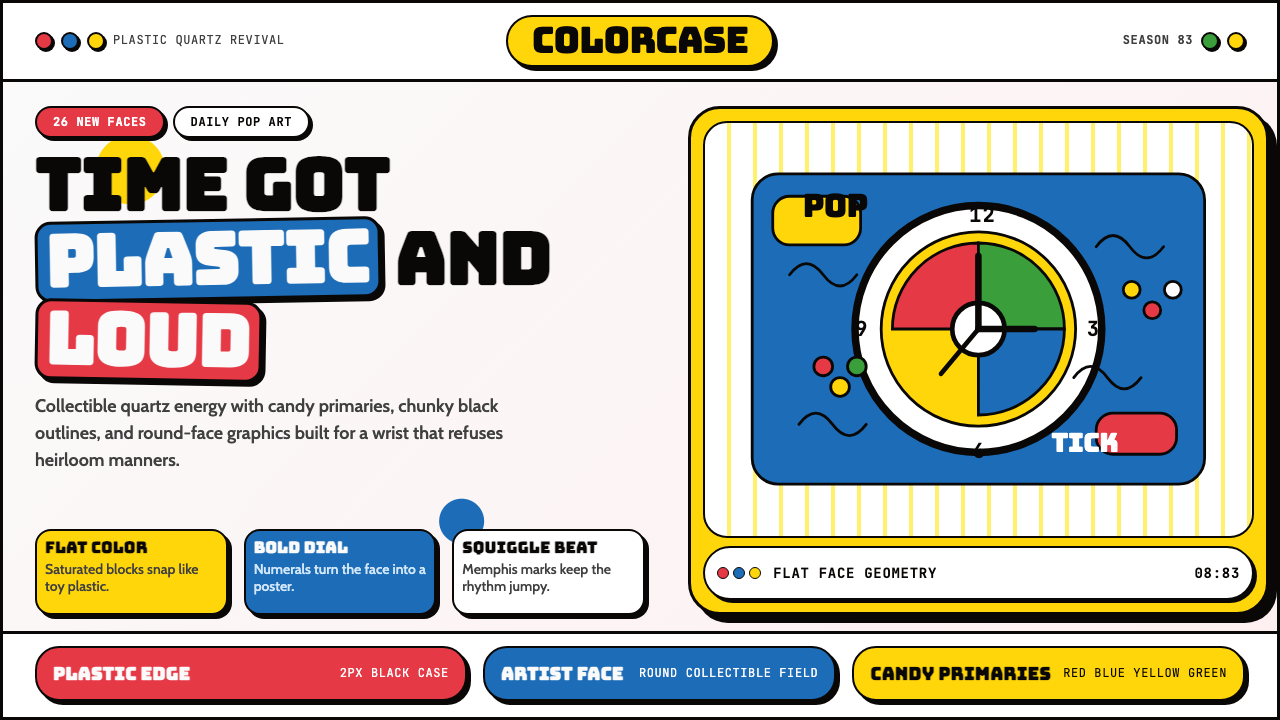 Swatch Watch (1983)Pop plastic optimism. Bungee type, candy primaries, round dials and squiggles…