What is Tanjore Painting (Gold-leaf Tamil)?
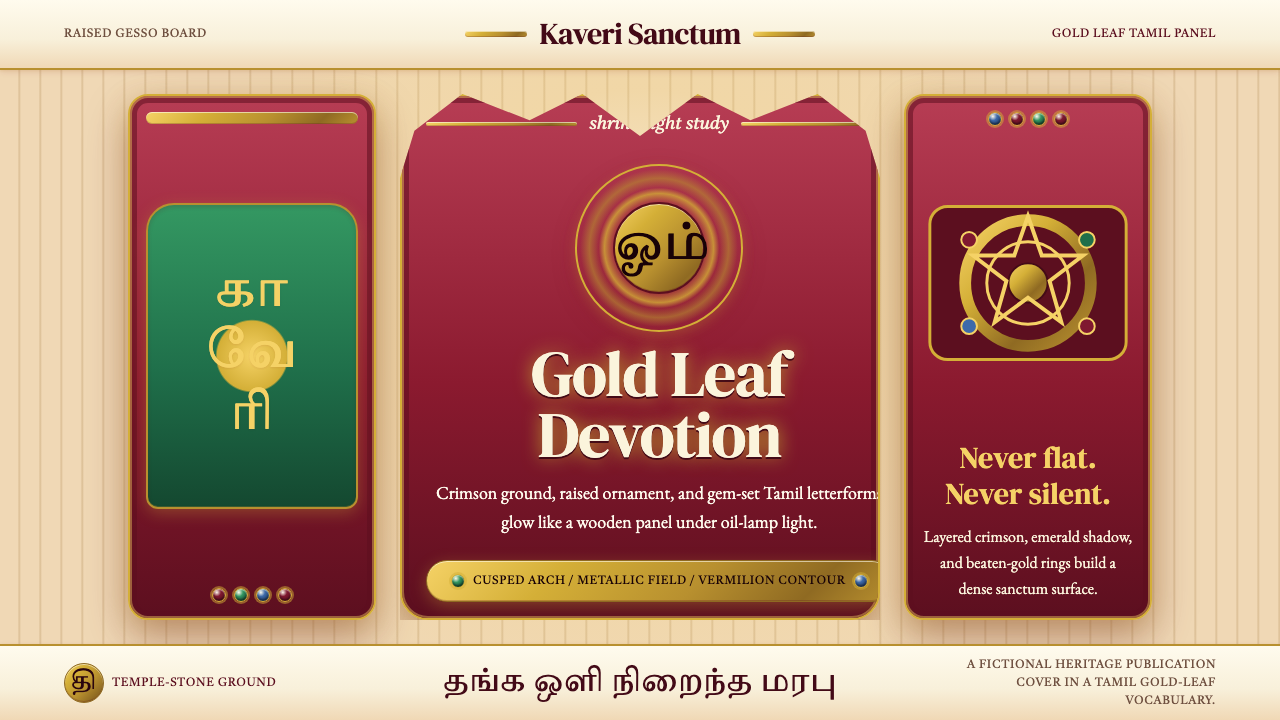
Tanjore painting is South India's most opulent devotional art — every panel a blazing assembly of gold leaf, embedded gems, and raised gesso relief that turns temple lamplight into sacred theater.
Tanjore Painting (Gold-leaf Tamil) in brief
Tanjore painting — known in Tamil as Thanjavur Chitra — is a tradition of devotional panel art from the Kaveri delta region of Tamil Nadu, South India. Each work is executed on a wooden board prepared with a ground of chalk and adhesive, upon which the artist builds raised gesso relief to give crowns, jewelry, and thrones a literal three-dimensional presence. Over this relief, semi-precious stones — rubies, emeralds, sapphires, and garnets — are embedded directly into the surface. Gold leaf is then applied across large portions of the background and the deity's adornments, creating a panel that catches and scatters light in the manner of a reliquary rather than a picture.
The aesthetic vocabulary of the tradition is dense, saturated, and intentionally overwhelming. Deep crimson grounds, often described as the color of temple velvet, establish the base register. Krishna-blue and emerald green occupy the mid-field as flesh tones and vegetal ornament respectively. Vermilion contour lines delineate every form with confident, brush-thick precision. At the center of each composition sits the deity — Krishna, Rama, Lakshmi, or Ganesh — framed inside a cusped multi-foil arch whose profile echoes the carved stone doorways of Dravidian temple architecture. The composition is bilateral and hierarchical: every element orbits the central sacred figure, and no area of the panel is permitted to rest empty.
Translated to the digital and print world, the Tanjore idiom demands total commitment to its logic of abundance. It is not a palette to borrow selectively — it is a complete visual philosophy in which richness, symmetry, and sacred centrality are inseparable. Applying it well means understanding what each visual decision is doing: crimson signals devotion and gravity; gold signals the presence of the divine; the cusped arch signals sanctuary; gemstone accents signal that something is being offered, not merely displayed.

Where does Tanjore Painting (Gold-leaf Tamil) come from?
The roots of Tanjore painting reach back to the devotional mural traditions of the Pallava and Chola dynasties, whose temple painters — working in fresco on the interior walls of shrines at Mahabalipuram and Thanjavur — established the visual grammar that Tanjore panel painting would later inherit: the centered deity framed by a canopy arch, the hierarchical scaling of figures by sacred importance, the use of jewel-bright mineral pigments, and the thick brush-drawn contour line as the primary vehicle of form. These murals, some dating to the eighth and ninth centuries, are the direct ancestors of the panel tradition.
The Tanjore panel painting tradition as a distinct form crystallized under the Nayak rulers of the sixteenth and seventeenth centuries, who governed the Thanjavur region as vassals of the Vijayanagara Empire. The Nayaks were prolific temple patrons — they expanded and elaborated the great Brihadeeswara temple complex, commissioning painted galleries, bronze processional sculptures, and the silk-and-gold textile offerings that became an integrated part of temple ritual. It was in this environment of competitive royal patronage that the panel painting form — portable, giftable, and suitable for domestic shrines — began to flourish alongside monumental temple art.
The tradition reached its peak of refinement and production under the Maratha rulers of Thanjavur, particularly during the reign of Serfoji II (1798–1832). The Marathas had arrived in the region in the late seventeenth century and, rather than displacing the existing Tamil artistic culture, absorbed and intensified it. Serfoji II was an extraordinary patron: he maintained a court that included European scientific instruments alongside Sanskrit manuscripts and Tamil devotional objects, and he actively supported the painter families — primarily Brahmin communities from the Raju caste — who were developing the raised-gesso and gold-leaf technique into its fully elaborated form. The Saraswati Mahal Library he founded in Thanjavur holds thousands of illustrated manuscripts that document the breadth of artistic production at his court.
The tradition was granted a Geographical Indication tag by the Indian government in 2007, formally recognizing Thanjavur as the protected place of origin for works produced in this style. This protected status has helped sustain the community of working artists — most of them descendants of the historic painter families — who continue to produce panels using the same wooden-board construction, raised gesso, stone-embedding, and gold-leaf application techniques that characterized the tradition at its height. Contemporary practitioners like S. Saravanan, who received the Padma Shri in recognition of his work, have helped bring the tradition to international audiences while maintaining fidelity to its technical demands.
What defines the Tanjore Painting (Gold-leaf Tamil) look?
Gold-Dominant Ground
Gold leaf covers a substantial portion — often well over a third — of any authentic Tanjore composition. It is not used as an accent but as a field: the background behind the deity, the throne, the arch interior, and much of the jewelry are all covered in beaten gold, applied in overlapping sheets and burnished to a high sheen. This gold ground is what distinguishes the tradition from other South Indian painting styles and gives it its quality of emanating light rather than merely reflecting it. In digital applications, this translates to rich metallic gradients that shift between warm amber and deep ochre, never flat fills.
Jewel-Tone Color Field
The palette of Tanjore painting is the palette of the gem cabinet: deep crimson, the blue of sapphire, the green of emerald, and the orange of carnelian. These hues are deployed at maximum saturation against one another, with no soft transitions or washed-out intermediaries. The crimson ground — derived historically from vermilion and lac — anchors the composition with a sense of velvety weight. The deity's complexion reads in one of the canonical Tamil iconographic tones: Krishna-blue for the cosmic god, warm ochre for Lakshmi, forest-dark for Rama. Against these deep saturated grounds, the gold and gemstone accents become incandescent.
Raised Gesso Relief
What separates Tanjore painting from flat panel painting traditions is its literal three-dimensionality. Before any pigment is applied, the artist builds up the jewelry, crown, throne, and architectural frame in chalk-and-adhesive gesso, modeling the relief by hand into forms that protrude from the board's surface. This relief is then gilded or painted. In person, a Tanjore panel casts micro-shadows as the viewer moves — the crown shifts, the lotus petals separate, the arch profile becomes a series of shadow-edged curves. In print and screen applications, this depth is evoked through ornamental border treatments that layer and overlap, through type that sits within framed registers rather than on open fields, and through the layering of decorative motifs that create visual depth without literal dimension.
Cusped Arch and Symmetrical Frame
The visual signature of the Tanjore tradition is the cusped multi-foil arch — a frame whose inner edge describes a series of petal-like curves, derived from the carved stone doorways of Dravidian temple gopurams. This arch always encloses the central deity, transforming the painting from an image into a shrine. It is typically gilded and studded with gem inlays along its edge. The arch in turn sits within a rectilinear outer frame, creating a nested hierarchy of frames that draws the eye inward through successive thresholds. This multi-layered framing logic — arch within rectangle, rectangle within border pattern, border within outer rule — is the structural principle most directly applicable to contemporary design work.
Dense Ornamental Fill
Tanjore compositions do not tolerate emptiness. Every zone of the painting — the background flanking the arch, the throne platform below the deity, the corners of the panel, the space between figures — is filled with ornamental motifs: scrolling vines, lotus rosettes, peacocks, celestial musicians, and geometric diaper patterns derived from textile traditions. This density is not carelessness but philosophical commitment: in the devotional aesthetic of South Indian Vaishnavism and Shaivism, abundance and completeness are attributes of the divine, and an empty surface would suggest incompleteness, a gap in the sacred order. In design applications, this principle manifests as a preference for richly patterned backgrounds, filled borders, and layered ornamental details over any approach that leaves ground empty.
Hieratic Scale and Sacred Centrality
Tanjore figure composition follows the hieratic scaling principle: the size of a figure is determined not by its spatial position but by its divine rank. The primary deity dominates the panel at a scale impossible in naturalistic perspective; attendant figures, musicians, and devotees surround the central form at progressively smaller scales. This creates a composition that reads as a diagram of sacred hierarchy rather than a representation of physical space. The implied message is that the center is the most important thing in the image, and everything else exists in relation to it. In layout terms, this translates to a strong central axis, a dominant hero element, and supporting elements that orbit and reinforce rather than compete with the center.
Vermilion Contour and Flat Flesh
All figures in the Tanjore tradition are delineated by a thick, confident vermilion or dark red contour line. This line does not model form through variation — it is consistent in weight and carries no shading information. Inside the contour, flesh tones are applied as flat, unmodulated fields: no gradient, no highlight, no shadow suggesting three-dimensional volume. The three-dimensionality of the image comes entirely from the raised gesso relief beneath, not from painted illusionism. This separation of outline and fill — contour as a structural decision, color as a declarative field — produces a visual language that is graphic and immediately legible at distance, similar in its logic to stained glass or cloisonné enamel.

Who shaped Tanjore Painting (Gold-leaf Tamil)?
Serfoji II (1798–1832) was the Maratha king of Thanjavur whose reign marked the highest point of royal patronage for Tanjore panel painting. He maintained a cosmopolitan court that combined European scientific curiosity with deep engagement with Tamil and Sanskrit learning, and he actively sponsored the Brahmin painter families whose workshops produced the tradition's most refined works. The Saraswati Mahal Library he founded holds an extraordinary collection of illustrated manuscripts that document the full range of artistic production at his court. Many of the iconographic types and compositional conventions that define Tanjore painting today were codified and standardized during his reign.
S. Saravanan is among the most celebrated living practitioners of Tanjore painting, honored with the Padma Shri — one of India's highest civilian awards — in recognition of his contributions to preserving and propagating the tradition. He has been instrumental in documenting the technical processes of gesso preparation, stone embedding, and gold-leaf application, and in training younger artists from both the traditional Brahmin painter communities and outside them. His work has been exhibited internationally and has played a significant role in establishing Tanjore painting as a serious object of scholarly and collector attention beyond South Asia.
The transmission of Tanjore painting technique has historically been the work of specific Brahmin communities — primarily the Raju caste families of the Thanjavur region — who passed the craft from father to son across generations. These families maintained not only the technical knowledge of material preparation and pigment mixing but the iconographic programs: the prescribed proportions for each deity, the specific gemstone placements for each divine archetype, the correct sequence of stages in producing a panel. The knowledge was largely oral and embodied, transmitted through workshop apprenticeship rather than written manuals. The Geographical Indication registration of 2007 formally recognized these communities as the custodians of an irreplaceable cultural practice.
Ramesh Babu is a contemporary Tanjore artist and educator who has worked extensively to adapt the tradition's visual language for new formats and audiences, including large-scale prints, archival-quality reproductions, and educational materials designed to introduce the tradition to viewers with no prior exposure to South Indian devotional art. His approach has been to work from the iconographic and technical foundations of the classical tradition while being transparent about which adaptations have been made for contemporary contexts — a methodology that has made his work useful both as art and as documentation.
The workshop system that produced Tanjore painting at its height was not the work of individual auteur artists but of organized court ateliers in which tasks — ground preparation, gesso modeling, pigment application, stone setting, gold leafing — were divided among specialists working in sequence. The Nayak courts of the sixteenth and seventeenth centuries established this atelier model, and the Maratha courts of the eighteenth and nineteenth centuries expanded and intensified it. Understanding this workshop origin is important for understanding the style's visual character: the confident division between outline and fill, the systematic repetition of iconographic types, and the consistency of technical standards across a large body of work all reflect the logic of organized craft production rather than individual artistic expression.
How do you use Tanjore Painting (Gold-leaf Tamil) today?
Applying the Tanjore visual language in contemporary design requires accepting its fundamental premise: this is an aesthetic of completeness, not restraint. Designers accustomed to working with generous white space and sparse layouts must set those instincts aside entirely. Tanjore-derived work should feel full, layered, and richly framed — every major element nested within an ornamental border, every background occupied by pattern or gold, every focal point anchored at the center of a symmetrical composition. The difficulty is not in adding richness but in doing so with the internal coherence that distinguishes the original tradition from pastiche.
For presentation slides, the Tanjore approach works best on covers and section dividers, where the full visual intensity can be deployed without competing with informational content. A cover slide built on this system uses a deep crimson or midnight-blue ground, a centered title framed by a cusped or multi-arch border element derived from the tradition's architectural frames, gold-metallic type treatment, and jewel-tone accents — deep green or sapphire blue — at the corners and along the border. Content slides require more discipline: the background can shift to a muted warm ground that echoes the crimson without overwhelming text; the ornamental border continues but reduces in weight; the hierarchy is established through a combination of gold-colored headings and cream-toned body text. Data slides within this system work best with charts whose fills draw from the jewel palette — deep red bars, gold reference lines — and whose axes and labels appear in a contrasting light tone.
For web and digital product interfaces, the Tanjore system is best suited to contexts with high cultural specificity and low cognitive load demands: landing pages for luxury or heritage products, event pages for festivals or cultural institutions, editorial pages for arts and culture publications. It is not suited to utility-dense applications where users need to parse information rapidly. When applied to a web interface, the key structural decisions are: a warm deep-toned hero section with centered content, a gold or warm-metallic accent color for primary calls to action and interactive highlights, and an ornamental border or pattern treatment as a recurring motif between page sections. Navigation and utility elements should be visually quieter — using lighter tones from within the same warm palette — to create breathing room without abandoning the system.
For editorial and marketing work, the tradition's poster-like quality — bold symmetry, high contrast, centered focal point, richly framed — adapts directly to printed invitations, event posters, book covers, and cultural heritage marketing materials. The approach for a printed piece: establish a deep crimson or midnight ground, center the primary image or typographic element within an arch or multi-frame border, apply gold-metallic foil or gold-ink simulation to the border and primary typographic elements, and use emerald or sapphire accents at corners and secondary elements. For marketing copy within this system, restraint in language complements richness in imagery: brief, declarative, elevated language works better than verbose body text against these highly decorated grounds.
A common mistake when working with the Tanjore vocabulary is treating gold as a simple color rather than a material quality. In the original tradition, gold leaf has tactile and luminous properties that no flat yellow or ochre fill can replicate. In digital applications, this means gold should always be rendered as a gradient — shifting from warm amber through bright yellow-gold to deep ochre — and should incorporate subtle variation across large areas rather than reading as a uniform fill. A second common mistake is applying the style's density without its underlying hierarchical logic: adding pattern, ornament, and color everywhere without establishing a clear center creates visual chaos rather than sacred abundance. The style's richness depends on everything being organized in relation to a dominant central element — remove that center, and the composition loses its coherence entirely.

Tanjore Painting (Gold-leaf Tamil) — FAQ
Can Tanjore style work in a dark-mode digital interface?
Yes — the tradition's own palette is already dark-ground. The canonical Tanjore composition uses deep crimson, midnight blue, or dark emerald as its primary ground, with gold and jewel tones providing the luminous contrast. This makes it naturally compatible with dark interface contexts where other historical styles require significant adaptation. The key is to preserve the luminous quality of the gold elements: in a dark interface, gold accents should be rendered with sufficient contrast to read as genuinely incandescent against the ground, rather than as a muted decorative element. Body text and utility elements should use light, warm-toned type rather than pure white, maintaining the sense of warmth that the style's deep palette creates.
How do I incorporate this style without it reading as culturally appropriative?
The most important step is understanding the tradition's origin, context, and ongoing living practice before applying its visual language. Tanjore painting is not a historical artifact — it is a protected living tradition with active practitioners, a recognized geographical indication, and communities whose livelihood depends on its continued value. Applying the style responsibly means, at minimum, acknowledging the source explicitly in any public-facing work, avoiding the reproduction of specific sacred iconography outside its devotional context, and considering whether commissioning or licensing work from actual Tanjore artists is appropriate for the project. Treating the style as an aesthetic toolkit stripped of its cultural meaning is the practice to avoid; engaging with it as a living tradition to be respected and credited is the alternative.
What distinguishes an authentic Tanjore-inspired design from one that merely uses bright colors and gold?
Authenticity in Tanjore-derived design comes from structural fidelity, not surface color. Three elements are diagnostic. First, the hierarchical center: a genuine Tanjore-derived composition has a dominant central element — a figure, a product, a typographic statement — that everything else serves and frames. Second, the multi-layered frame: the composition is bounded by nested borders that work inward from the outer edge, creating a sense of threshold and enclosure rather than elements floating on a ground. Third, the discipline of the gold: gold is applied to specific zones — arches, borders, jewelry, typography — rather than scattered as an ambient texture. A design that uses crimson and gold but distributes its elements in an asymmetric, non-centered layout with a flat gold fill has borrowed the palette without understanding the structure.
Is this style suitable for minimal or data-heavy interfaces?
It is not well-suited to either. Tanjore's visual philosophy is one of maximum density and ornamental completeness — the opposite of minimal interface logic. Attempting to apply it to a data-heavy dashboard or analytical tool typically results in the decorative framing overwhelming the informational content, reducing readability and increasing cognitive load precisely where those qualities need to be minimized. The style performs best in contexts where the user is meant to pause, absorb, and be moved by an experience — a landing page, an invitation, a cultural heritage presentation — rather than scan, extract, and act. For data-heavy contexts that require warmth and cultural richness, a selective approach — using the jewel palette and gold accents in structural framing while keeping data zones visually quiet — can work, but it requires significant restraint in how much of the full vocabulary is deployed.
How does the Tanjore tradition relate to other Indian painting styles like Madhubani or Mughal miniature?
The three traditions share a common inheritance from India's deep history of court and temple patronage, but they represent quite distinct regional visual systems. Madhubani (from Bihar in North India) is a folk tradition executed on paper or cloth with mineral and vegetable pigments; it is characterized by intricate linear patterning, the absence of three-dimensional illusion, and a flat, high-contrast graphic quality — it shares Tanjore's density but not its material opulence or its raised-gesso dimensionality. Mughal miniature painting (from the northern court tradition, peaking in the sixteenth through eighteenth centuries) is distinguished by its extraordinary painterly refinement, use of lapis lazuli blue, and naturalistic figuration drawn from Persian and European influence — it is more spatially illusionistic and less iconographically formulaic than Tanjore, and it does not use the gold-leaf ground as a primary material. Tanjore is specifically a South Indian Dravidian tradition, embedded in Tamil Vaishnavite and Shaivite devotional practice, and its raised-gesso-and-gold-leaf technique has no direct parallel in other Indian regional schools.
Related design styles
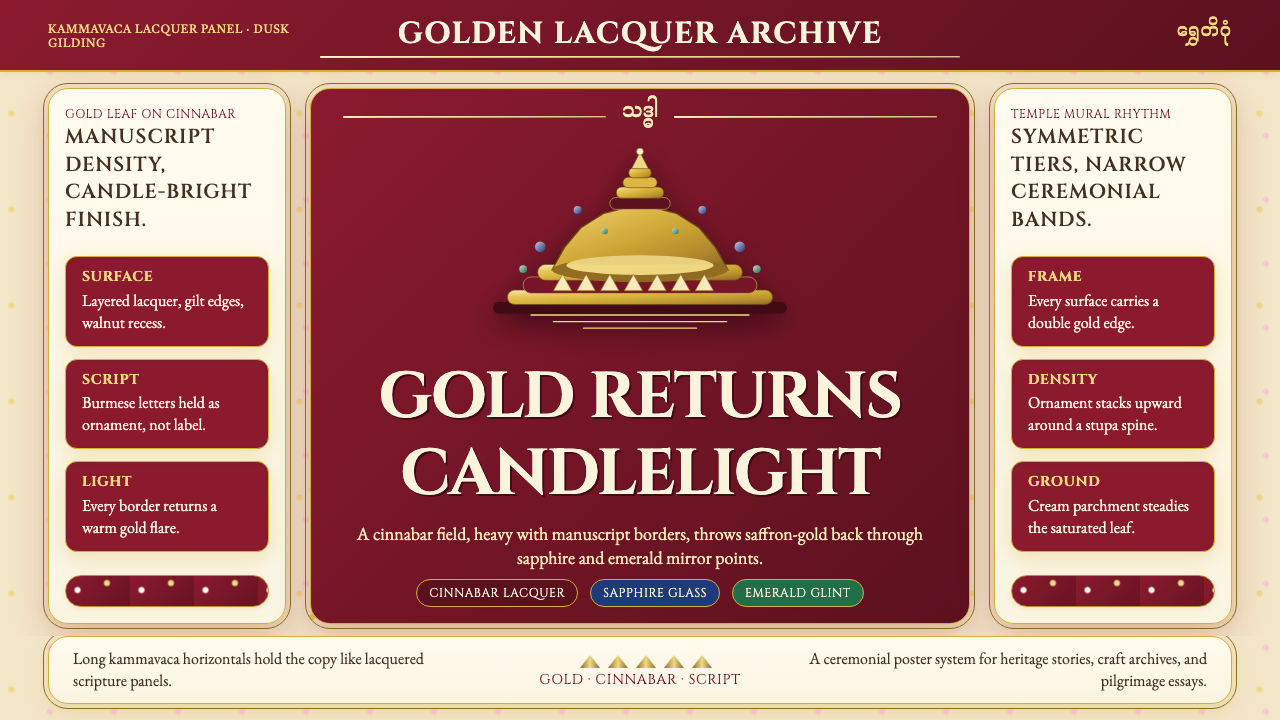 Burmese Shwedagon Gold-LacquerOpulence catches fire. Gold-leaf gradients on cinnabar panels frame a stupa s…
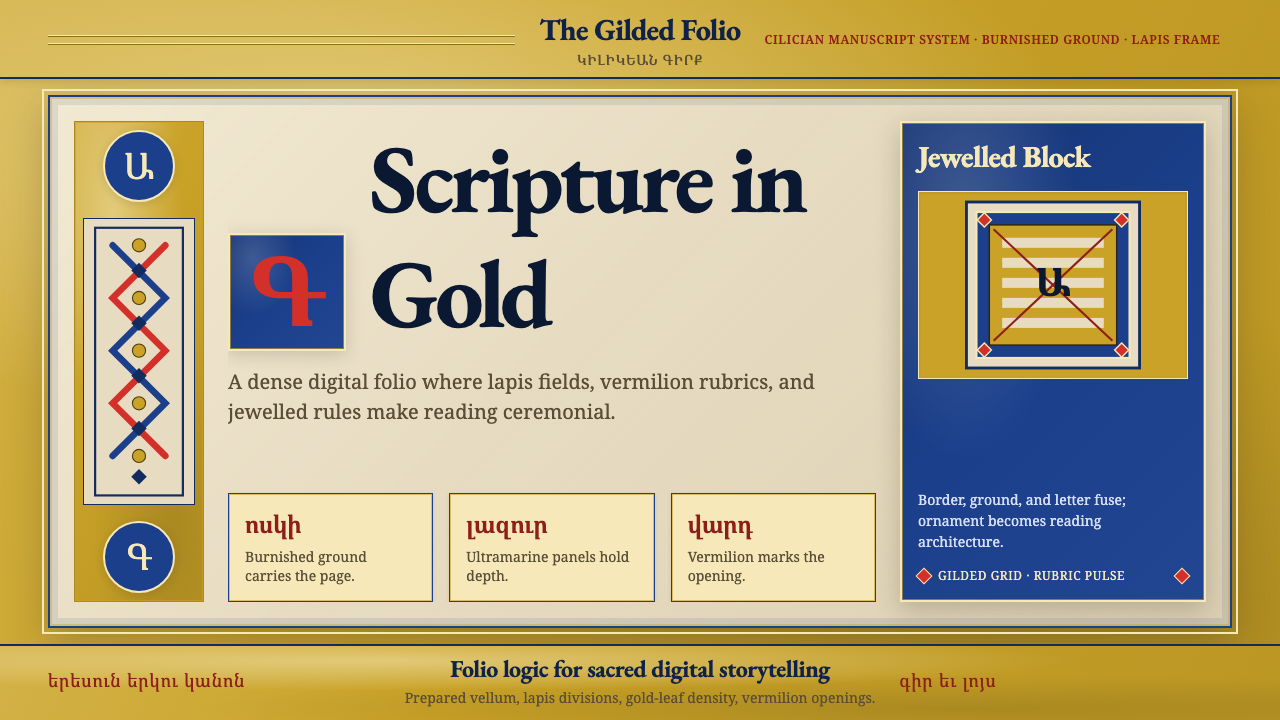 Armenian Illuminated ManuscriptGilded maximalism. Burnished gold, lapis frames, and vermilion initials build…
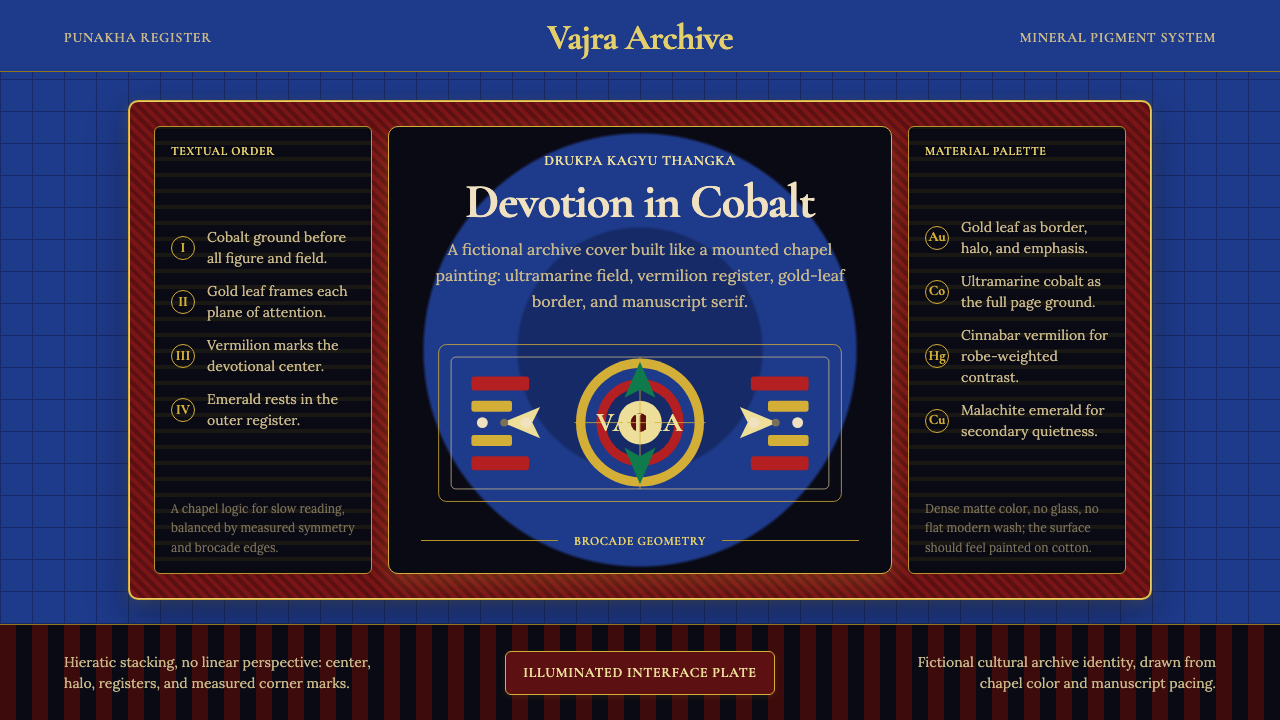 Bhutanese Drukpa Kagyu ThangkaDevotion made cobalt. Gold frames, Cormorant serif, and vermilion marks hold…
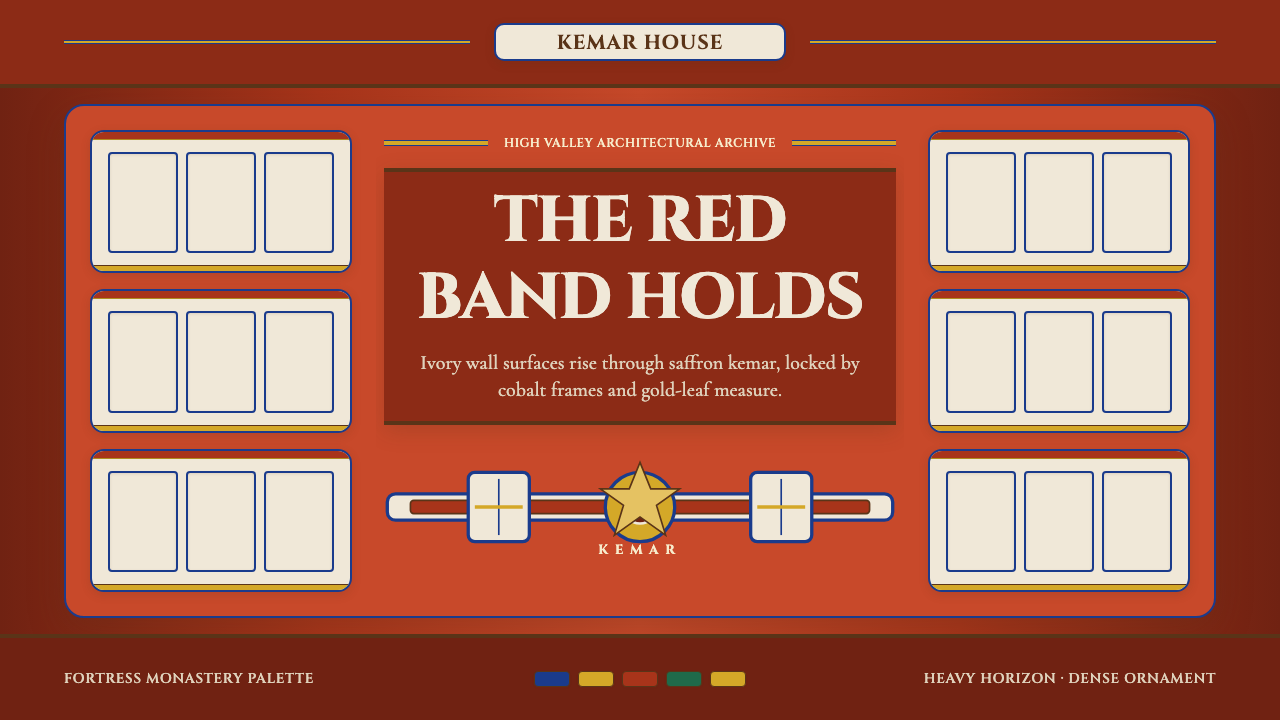 Bhutanese Dzong (Fortress Red)Monumental red holds the page. Cobalt frames and gold bands lock the fortress…
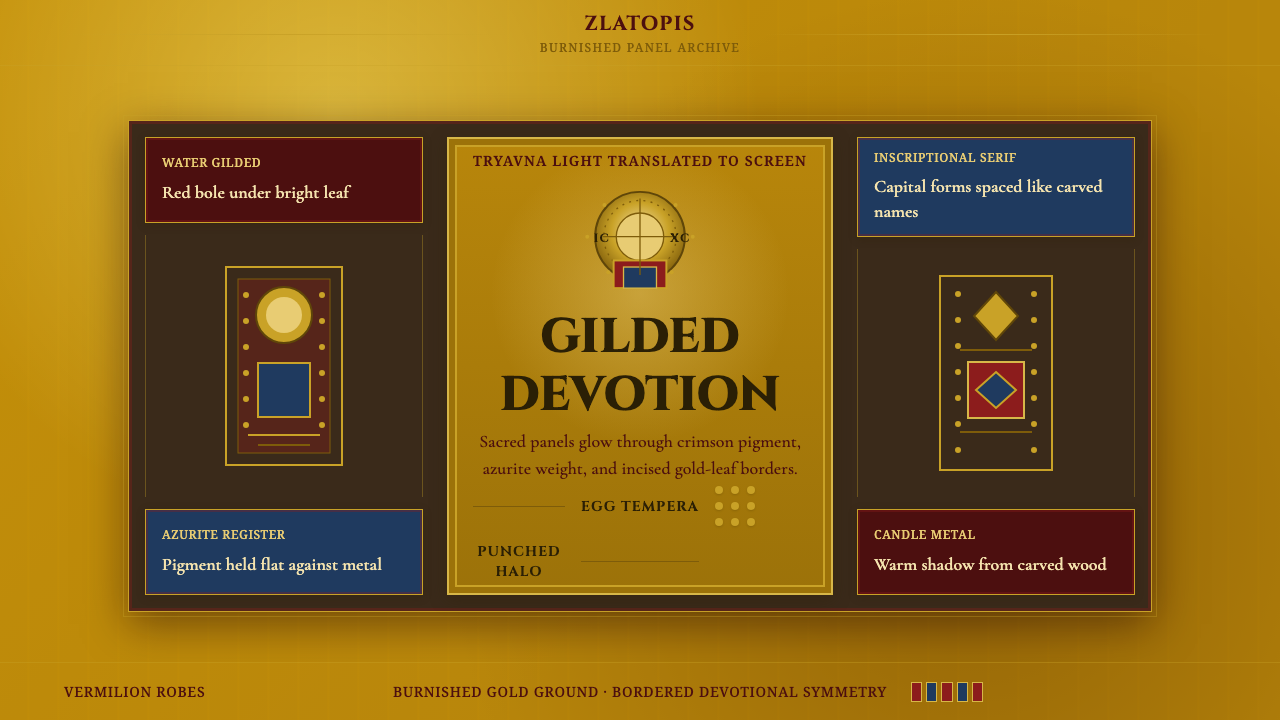 Bulgarian Orthodox IconSacred metal holds still. Burnished gold, crimson panels, and punched halos f…
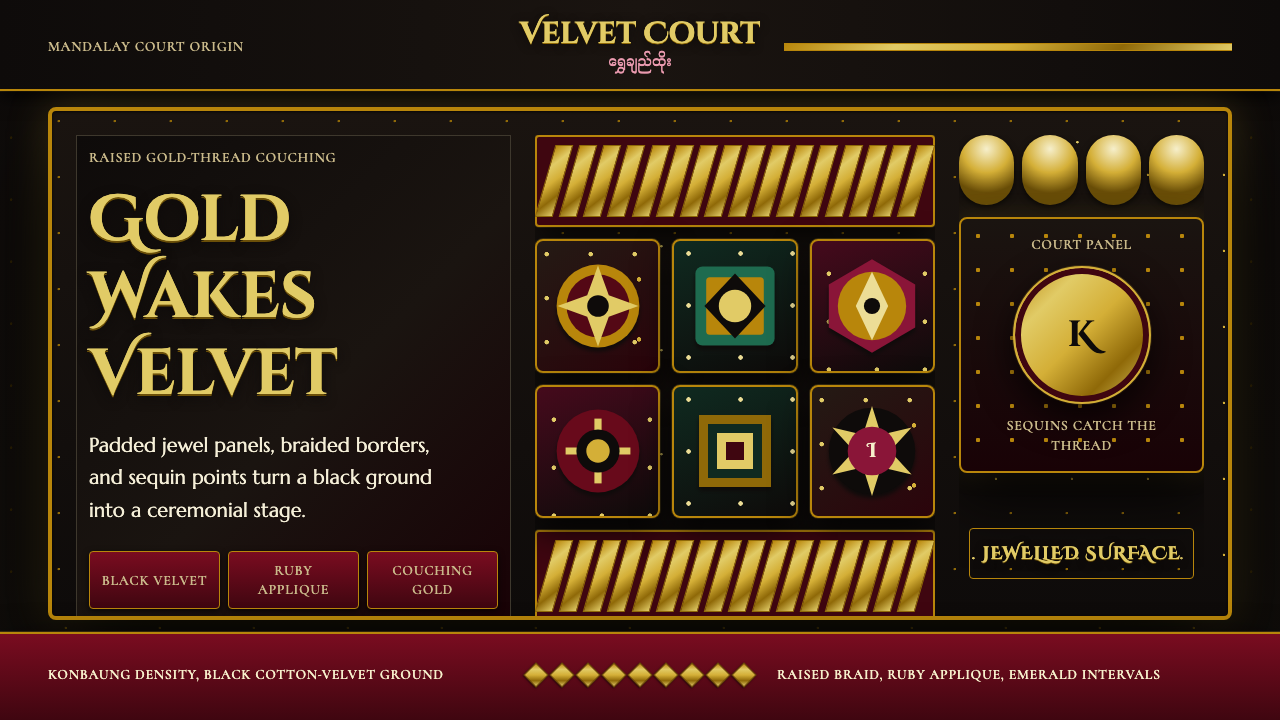 Burmese Kalaga TapestryVelvet becomes theater. Black ground, gold-thread borders, ruby and emerald p…