What is Syracuse Orange (College Athletics, 1870)?
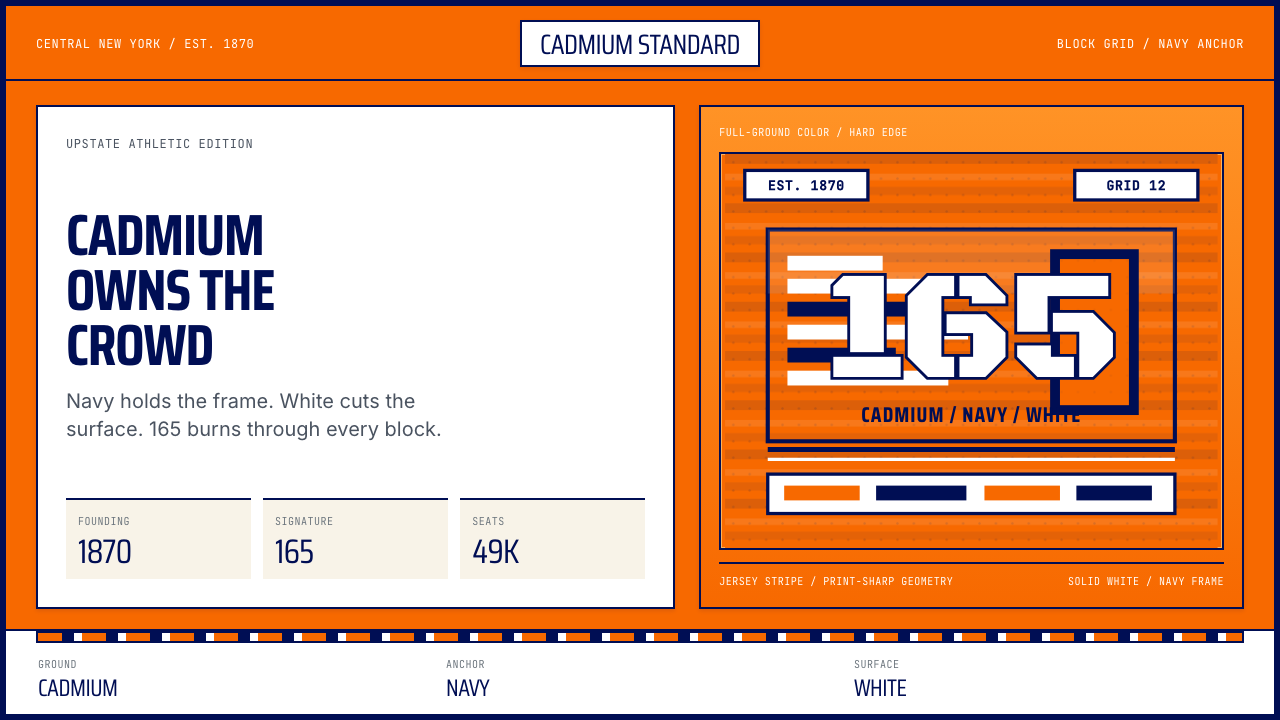
One saturated cadmium orange, chosen by student vote in 1890, became the total identity of a university — no gradient, no compromise, just the color.
Syracuse Orange (College Athletics, 1870) in brief
Syracuse Orange is the single-hue athletic identity of Syracuse University, a private research institution founded in 1870 in upstate New York. Unlike most collegiate visual systems that rely on balanced two- or three-color palettes, Syracuse committed entirely to one dominant warm orange as its primary identifying mark. That orange — a saturated, almost aggressive cadmium tone — appears on every jersey, every stadium seat, every alumni banner, and every official communication. The color is not an accent; it is the system.
The visual language built around that orange is deliberately bold and economical. Deep navy blue serves as the chromatic anchor, providing the contrast and weight that allows the orange to dominate without becoming chaotic. Pure white opens up surface space for content and legibility. Condensed athletic display type — the kind of letterform that evokes jersey numerals and scoreboard signage — reinforces the competitive, arena-ready energy of the identity. Rectilinear geometry and hard-edged blocks replace any decorative curvature, channeling the no-nonsense confidence of collegiate sports branding.
The result is a visual system with unusually high recognition density. Because the palette is so compressed — one hero color, one anchor, one neutral — every application reads immediately as Syracuse. This monochromatic discipline is rare in American collegiate athletics, where most programs hedge across several hues, and it gives Syracuse Orange a poster-like clarity that scales from a stadium of fifty thousand down to a mobile notification badge without losing its identity.

See the Syracuse Orange (College Athletics, 1870) design system
Where does Syracuse Orange (College Athletics, 1870) come from?
Syracuse University was chartered in 1870 by the Methodist Episcopal Church and opened its doors in 1871. Like most American universities of the period, it initially operated without a formalized athletic color. The early athletic program used what was described as 'Pink and Pea Green' — a combination that, by student accounts of the era, was both visually unremarkable and difficult to reproduce consistently on dyed fabric. The colors were tolerated rather than celebrated.
In 1890, a student-led effort to replace the existing palette culminated in a formal vote. The students selected orange — specifically the vivid, warm-toned orange that would later be standardized against Pantone 165 — as the single color of the university. The reasoning cited in historical records emphasizes distinctiveness and visibility: orange was uncommon among the athletic programs of peer institutions in the northeast, and it read clearly at distance in outdoor venues. The decision to commit to a single hue rather than a two-tone combination was itself significant — a design choice, even if no one in 1890 would have called it that.
The adoption of navy blue as a secondary anchor color developed over subsequent decades as the athletic program expanded and the visual system needed a contrast partner. Navy provided depth and legibility without challenging the primacy of the orange. White entered the system as a content surface — the field on which numbers, names, and typographic information could be clearly read. By the mid-twentieth century, the three-element palette of orange, navy, and white had stabilized into the system still in use today, though the exact proportions and applications have evolved through multiple NCAA conference affiliations, including the Big East era and subsequent move to the Atlantic Coast Conference.
The mascot history runs parallel to the color history. The university's athletic teams were long informally called 'the Orange Men' before the name was simplified to 'the Orange' in 2004 — a change that acknowledged the color itself as the identity, not a person or animal. Otto the Orange, the anthropomorphized mascot introduced in the 1980s, literalizes this: the mascot is the color made into a character. Key athletic figures who carried the identity into national prominence include basketball coach Jim Boeheim, who built one of the most decorated programs in NCAA history; football quarterback Donovan McNabb, whose tenure in the late 1990s brought widespread television visibility; and Carmelo Anthony, whose single season in 2002–2003 ended in an NCAA Championship and placed Syracuse Orange at the center of the national sports conversation.
What defines the Syracuse Orange (College Athletics, 1870) look?
Dominant Cadmium Orange
The defining characteristic of the entire system is the commitment to one chromatic anchor. The orange in question is warm, fully saturated, and positioned toward the red end of the orange spectrum — closer to a molten amber than to a softer apricot or peach. It is not a pastel, not a muted earth tone, and not a pale accent; it is designed to dominate every surface it occupies. In any composition, the orange claims the largest visual mass and sets the emotional register: energy, competition, visibility, and institutional pride.
Navy Blue as Structural Anchor
Deep navy blue functions as the chromatic counterweight to orange's warmth and saturation. It provides the contrast necessary for text legibility, outlines jersey stripes and logo borders, and anchors compositional edges that would otherwise dissolve into the orange field. Navy never competes with orange for dominance — it serves and frames. This relationship between a saturated warm hue and a deep cool anchor is a compositional strategy that creates maximum visual stability without introducing a third competing color.
Condensed Athletic Typography
The typefaces used in Syracuse Orange contexts are characteristically condensed — tall, narrow letterforms that fit maximum information into the limited horizontal real estate of jersey backs, scoreboard panels, and stadium fascia. This condensed quality reads as energetic and purposeful rather than decorative. Headlines carry the weight of arena signage: they are large, bold, and designed to be read at speed and distance. Body text and secondary information step back cleanly, allowing the display typographic hierarchy to carry the system's athletic identity.
Blocky Rectilinear Geometry
The compositional geometry of Syracuse Orange design is hard-edged and rectangular. Stripes are straight and of consistent width; logo lockups use rigid bounding boxes; layouts divide into clean rectangular zones rather than organic or curved regions. There is no rounding of corners, no softening of edges, no introduction of organic shapes that might suggest warmth or approachability. The geometry signals toughness, discipline, and competitive readiness — values consistent with the athletic context in which the system was developed.
Jersey-Stripe Rhythm
One of the most recognizable micro-patterns within the system is the horizontal stripe sequence derived from athletic jersey conventions. These stripes — typically orange bordered by narrow navy bands, or white bordered by narrow navy bands — appear not only on uniforms but migrate into graphic applications: presentation headers, web section dividers, editorial byline rules. The stripe is a modular rhythm device that carries the athletic heritage of the identity into designed contexts without requiring any literal depiction of sports equipment or imagery.
High Contrast and Immediacy
The entire palette is calibrated for maximum optical impact at distance. Orange against white creates one of the highest-contrast warm-ground combinations available to a designer; orange against navy creates a complementary-adjacent pairing with strong chromatic tension. Neither combination is subtle, and that is entirely intentional. The system was built to be seen from the upper tiers of a stadium, read from a moving television broadcast, and recognized on a crowd of fans moving through a parking lot. Subtlety was never an objective.
Monochromatic Brand Discipline
Most collegiate athletic programs spread their identity across multiple colors, creating flexibility at the cost of distinctiveness. Syracuse Orange inverts this trade-off by committing almost entirely to a single defining hue. The practical result is that any fragment of the system — a single orange stripe, an orange numeral, an orange seat in a sea of concrete — is immediately attributable. This monochromatic discipline requires accepting a narrower expressive range, but it produces a brand recognition density that is genuinely unusual in the landscape of American collegiate athletics.

See the Syracuse Orange (College Athletics, 1870) design system
Who shaped Syracuse Orange (College Athletics, 1870)?
An early advocate cited in Syracuse University historical records as associated with the 1890 effort to formalize the university's athletic color. The student movement he was part of replaced the informal 'Pink and Pea Green' with the single bold orange that has defined the institution ever since. His role represents the broader pattern in late-nineteenth-century American collegiate life in which student bodies — not administrations — shaped the visual identities of their institutions through advocacy and organized decision-making.
Head coach of the Syracuse University men's basketball team from 1976 to 2023, Boeheim is the figure most associated with projecting the Syracuse Orange identity into sustained national prominence. His tenure of nearly five decades produced an NCAA Championship in 2003, five Final Four appearances, and over nine hundred wins. The Syracuse orange uniform became a fixture of major college basketball broadcasts throughout his coaching career, ensuring that the color reached a national audience season after season and built an association between the orange identity and sustained competitive excellence.
Quarterback for Syracuse University from 1995 to 1998, McNabb was a central figure in a period of heightened national attention to Syracuse football. His dual-threat play style generated extensive television coverage during the cable sports era, bringing the orange jersey into regular prime-time visibility. After his college career, his NFL success with the Philadelphia Eagles extended the cultural reach of the Syracuse Orange brand well beyond the university itself, as sports media regularly referenced his collegiate origins alongside his professional achievements.
Anthony played a single season at Syracuse in 2002–2003 before entering the NBA Draft, but that season was definitive for the program's national profile. He led Syracuse to the NCAA Championship title, providing the sports media event that placed the orange uniform at the literal center of the college basketball world. His subsequent NBA career — spanning two decades at the highest level — meant that the Syracuse orange association remained visible in professional basketball coverage for years after his college departure. Few single-season college careers have done as much to nationalize a collegiate visual identity.
Introduced in the 1980s as Syracuse University's official mascot, Otto is an anthropomorphized orange — literally a smiling orange-colored spherical character. The choice to make the mascot the color itself, rather than an animal or historical figure, is one of the most direct expressions of how central the orange is to the institution's identity. Otto literalizes what the color system implies: the orange is not a property of the team, it is the team. The mascot's design, in its pure spherical simplicity, also echoes the bold, uncompromising visual character of the broader identity system.
How do you use Syracuse Orange (College Athletics, 1870) today?
Syracuse Orange is a high-impact, immediately recognizable style that translates well to designed contexts beyond athletics — provided the designer respects the discipline that makes it work. The system's power comes entirely from restraint: one dominant warm hue, one cool anchor, one neutral surface. Violating that economy by introducing additional colors or softening the palette's intensity immediately dissolves what makes the style distinctive. Every application decision should begin from the question: does this serve the orange, or does it compete with it?
For presentation slides, the Syracuse Orange system works with particular force on cover pages and section dividers. A cover built in this style places a large field of orange — occupying the majority of the slide area — against which a white or navy logotype and title appear in condensed, heavy type. Section dividers can use the jersey-stripe motif: a bold horizontal orange band bracketed by narrow navy lines, with the section title reversed out in white. Content slides should retreat to a white or light neutral ground, using orange only for headers, key data callouts, or active-state indicators. The contrast between the high-intensity cover and the clean content slides creates a presentation rhythm that feels both energetic and professional.
For web interfaces and dashboards, the style is well-suited to contexts where hierarchy, urgency, and scannability are primary requirements — sports scores and statistics, performance dashboards, ticketing and event platforms, any interface where the user needs to find critical information quickly. The approach: a white or very light neutral background carries all body content; orange is reserved for primary calls to action, live indicators, and top-level navigation labels; navy provides text weight for headings and structural borders. Avoid using orange as a background for large text blocks — it creates fatigue at reading lengths. Instead, use orange in short, high-contrast bursts: buttons, badges, alert banners, active tab states.
For editorial and marketing work, the Syracuse Orange palette supports a poster-like assertiveness that suits promotional materials, event announcements, and institutional communications. A full-bleed orange background with white condensed type is the system's most powerful single-layout move, appropriate for covers, hero sections, and billboards. Marketing page structures that alternate between an orange-dominant hero, a white content zone, and navy accent sections create visual rhythm without requiring any additional colors. The jersey-stripe motif migrates naturally into editorial dividers and section headers, providing texture and brand continuity without decorative illustration.
A common mistake when applying this style outside its athletic context is diluting the orange's saturation in the belief that a softer version will feel more 'professional' or 'versatile.' This is the single most damaging change one can make. A muted, washed-out orange reads as a different color entirely — it no longer carries the confident, competitive energy that defines the system. Similarly, adding a second warm accent color (gold, red, or yellow) creates chromatic confusion and undermines the monochromatic discipline that gives the style its recognition power. If the full-saturation orange feels too bold for a specific context, the correct adjustment is to reduce its surface area — use it on smaller elements — not to reduce its intensity.

See the Syracuse Orange (College Athletics, 1870) design system
Syracuse Orange (College Athletics, 1870) — FAQ
Why did Syracuse choose a single color instead of the typical two-color collegiate palette?
The 1890 student vote that established orange as the university color was primarily motivated by distinctiveness and visibility — two criteria that a single bold hue satisfies more completely than a two-color combination. Most northeastern university programs of that era used blue-and-white or crimson-and-white combinations. Orange was simply unused in the competitive landscape, and its high natural visibility in outdoor stadium conditions made it practically effective. The decision to standardize on one hue rather than two may have also reflected the production realities of 1890s textile dyeing, where consistency was easier to achieve with a single dye process. Whatever the original reasoning, the effect has been a brand recognition advantage that has compounded over more than a century.
How does Syracuse Orange differ from other orange-using collegiate brands like Tennessee or Clemson?
The key difference lies in chromatic commitment and the character of the orange itself. Tennessee uses an orange that leans toward a brighter, more yellow-inflected tone — often described as Volunteer Orange — paired with white as an essentially co-equal partner. Clemson's orange is also distinctly positioned, tending toward a warmer, slightly deeper tone, and is consistently paired with a rich purple that shares compositional weight. Syracuse Orange is positioned toward the red end of the orange spectrum, giving it a denser, more saturated quality, and it deploys navy rather than white or purple as its contrast partner. The single most meaningful difference is that Syracuse treats orange as a solo identity, not as one color in a pair — the system is built around the orange's dominance in a way that Tennessee's and Clemson's systems are not.
Can the Syracuse Orange style work in non-sports contexts like technology or financial services?
It can, with deliberate adaptation. The style's core properties — high contrast, strong hierarchy, immediate readability, geometric structure — are genuinely useful in any context where urgency and authority are desired values. Financial services interfaces that communicate real-time data, market alerts, or trading information can benefit from orange's attention-commanding qualities. Technology products in the competitive gaming, sports analytics, or event-ticketing categories align naturally with the palette's energy. The adaptation required is to suppress the most overt athletic signals — the jersey stripe motif, the condensed all-caps display type — and foreground the structural and typographic principles that underpin them. A dashboard that uses the orange sparingly, for critical alerts and primary actions only, with navy providing structural weight and white as the reading surface, can feel contemporary and authoritative without reading as a sports brand.
Is the Syracuse Orange system appropriate for dark-mode or dark-background applications?
The system adapts well to dark backgrounds, more readily than many athletic palettes. Orange on a very dark navy or near-black ground creates a striking and legible combination — the orange reads with even greater intensity against a dark surround than against white. The practical approach is to treat the dark ground as a replacement for white rather than as an addition to the existing palette: dark navy or near-black becomes the neutral surface, orange remains the primary accent, and white is reserved for the most critical text and interface elements. Avoid putting large blocks of orange type on pure black backgrounds, as the high chroma contrast creates optical vibration at extended reading lengths. The jersey-stripe motif works particularly well in dark contexts — an orange stripe on a dark field has an almost luminous quality that reinforces the athletic energy of the system.
How much orange is too much orange in a layout?
The practical threshold varies by context, but a useful working principle is that orange should occupy the largest visual mass in any given composition without occupying the majority of the total surface area. On a cover slide or hero section, orange might fill sixty to seventy percent of the space — that is the system's maximum intensity moment, appropriate for high-attention entry points. On content pages, orange should be significantly more restrained: used for headlines, key callouts, and interactive states, but not as the background of any area where sustained reading occurs. The clearest sign that a composition has too much orange is when the eye cannot find a resting point — when there is no neutral surface to recover on. Navy and white serve as visual rest areas; without adequate proportions of both, the orange becomes overwhelming rather than commanding.
Related design styles
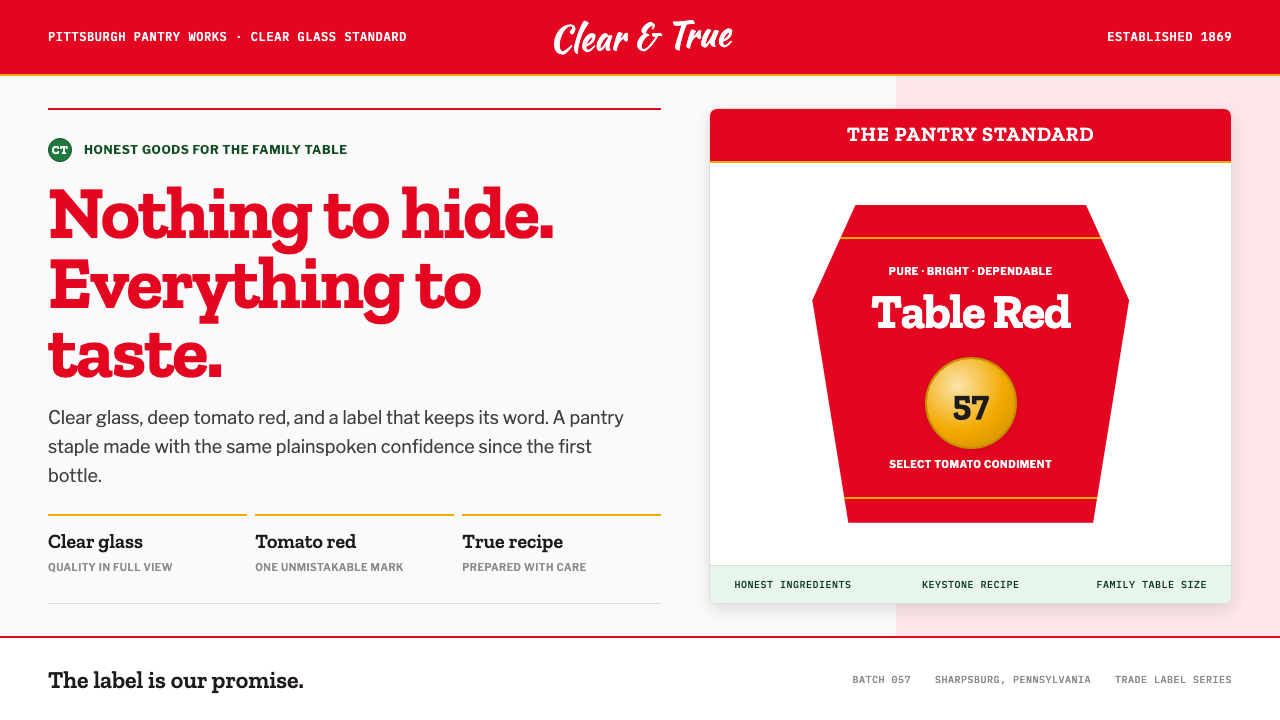 Heinz Ketchup (1869)Nothing to hide. Tomato red and slab serif lock clear-glass honesty into a ke…
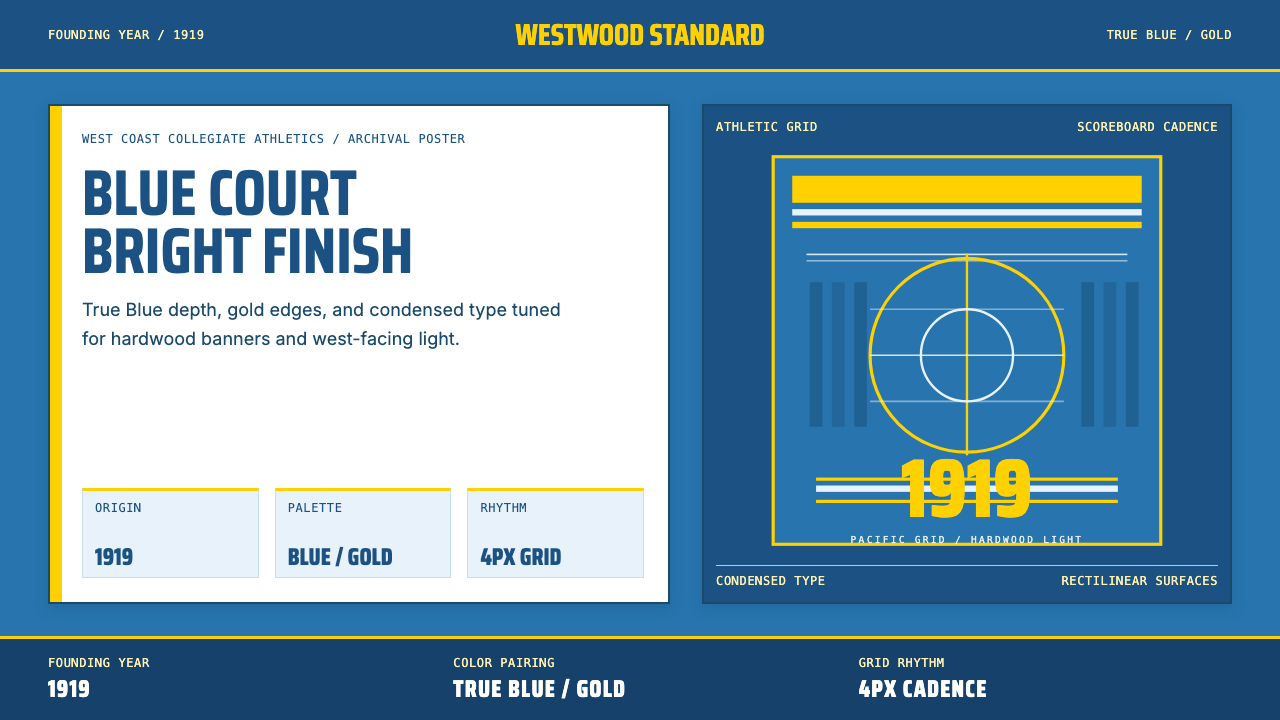 UCLA Bruin Purple & Gold (1919)Pacific authority in motion. True Blue panels, gold stripes, condensed athlet…
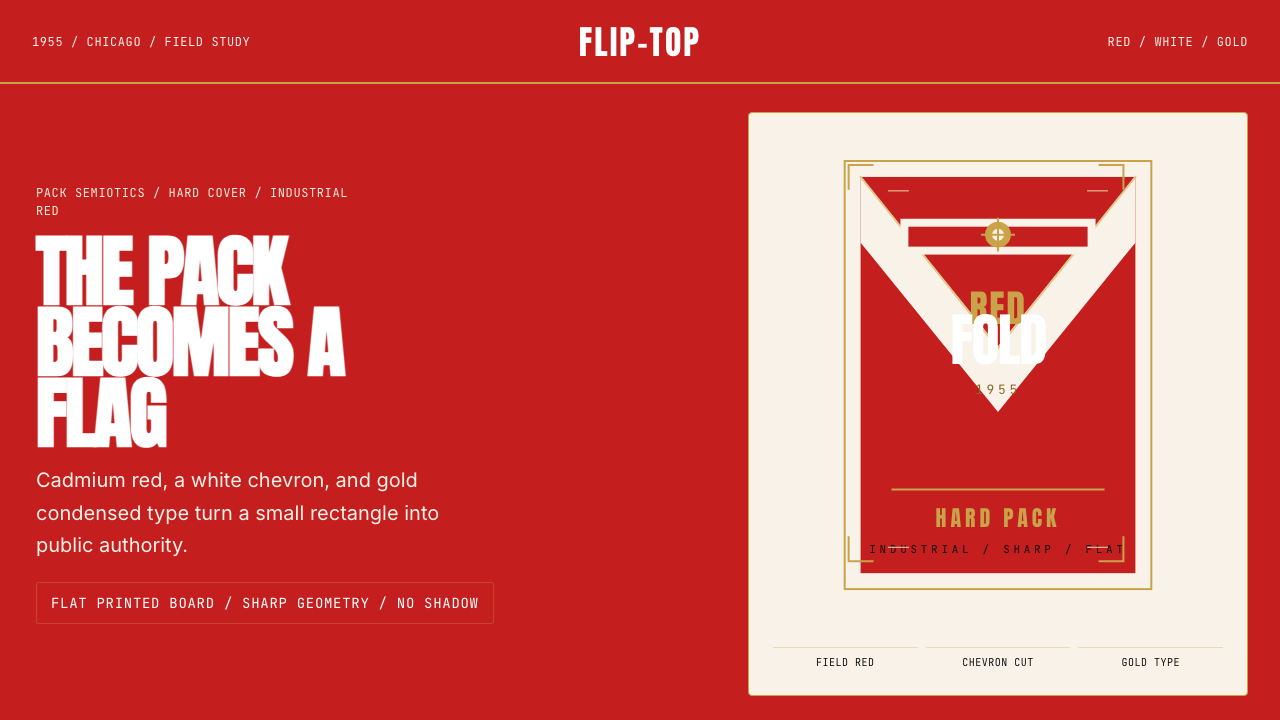 Marlboro Red Flip-Top (1955)Authority in one fold. Cadmium red, white chevron, and gold type read like a…
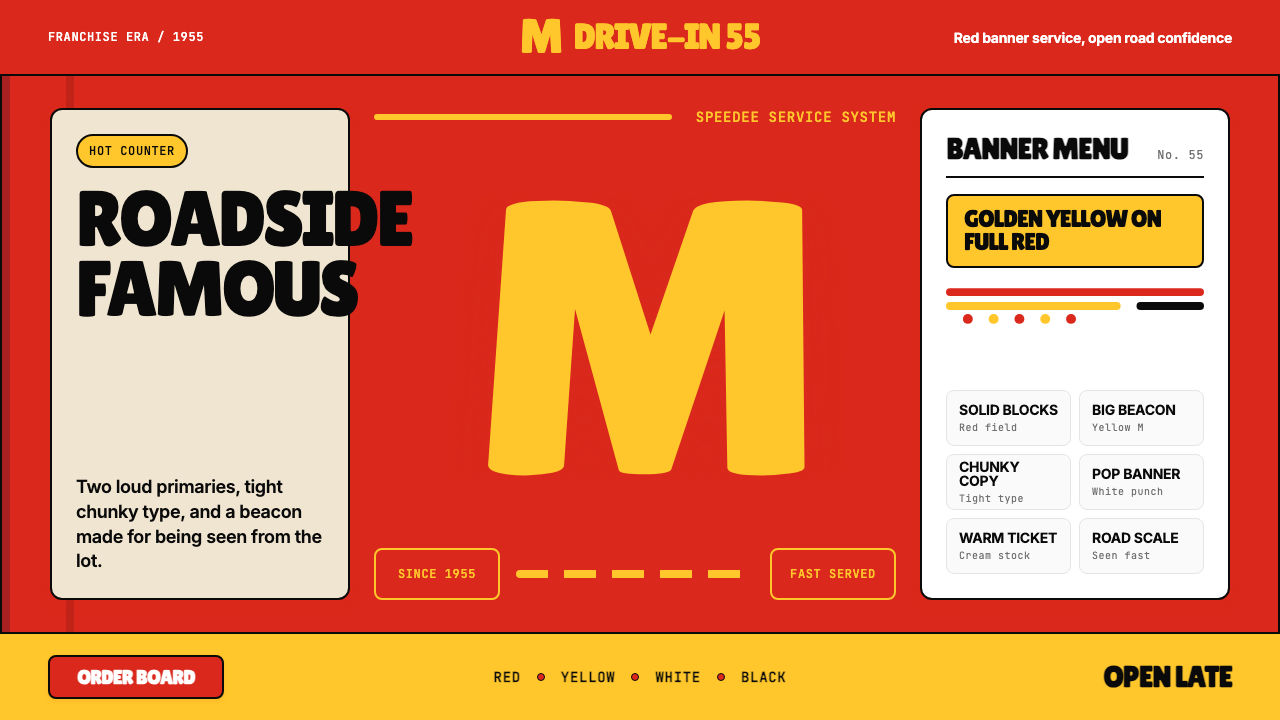 McDonald's Golden ArchesRoadside famous. Saturated red, hot yellow, and chunky type shout from 1955.
 Super Bowl (1967)Athletic spectacle becomes ceremony. Chalk grids, silver rules and Roman type…
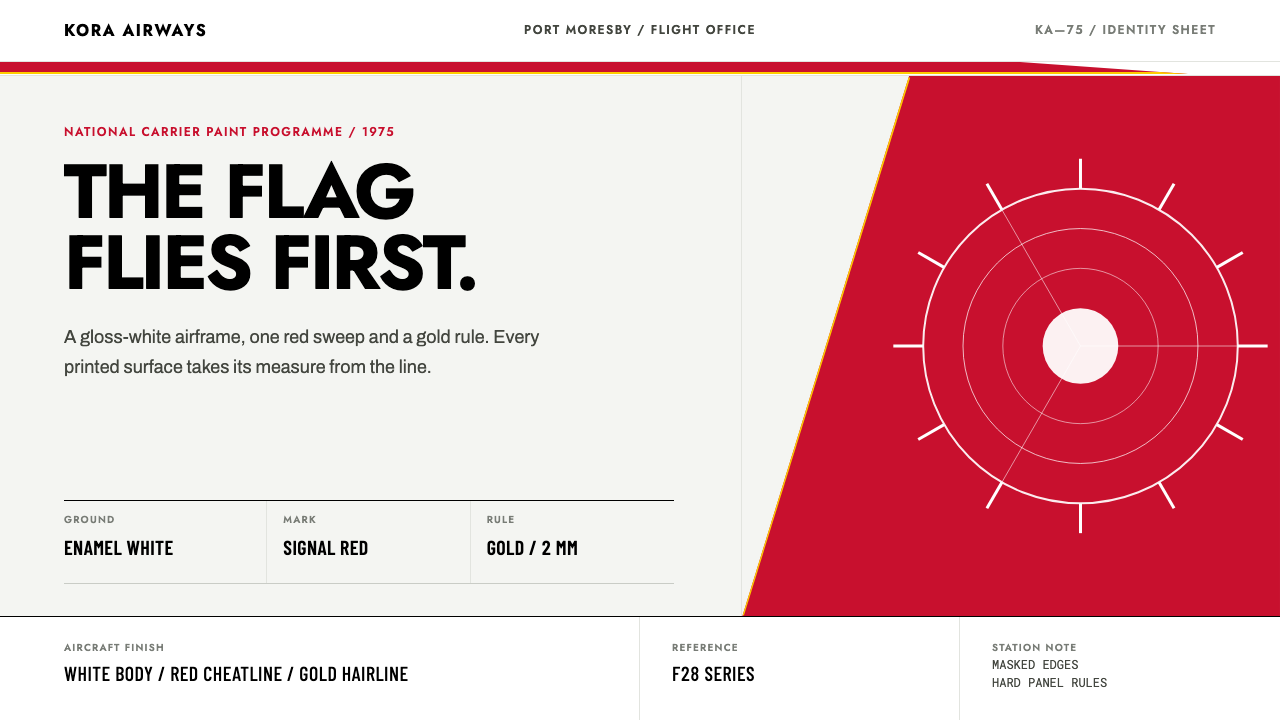 Air Niugini Livery 1975A flag engineered for flight. Signal red sweeps across enamel white, underlin…