What is UCLA Bruin Purple & Gold (1919)?
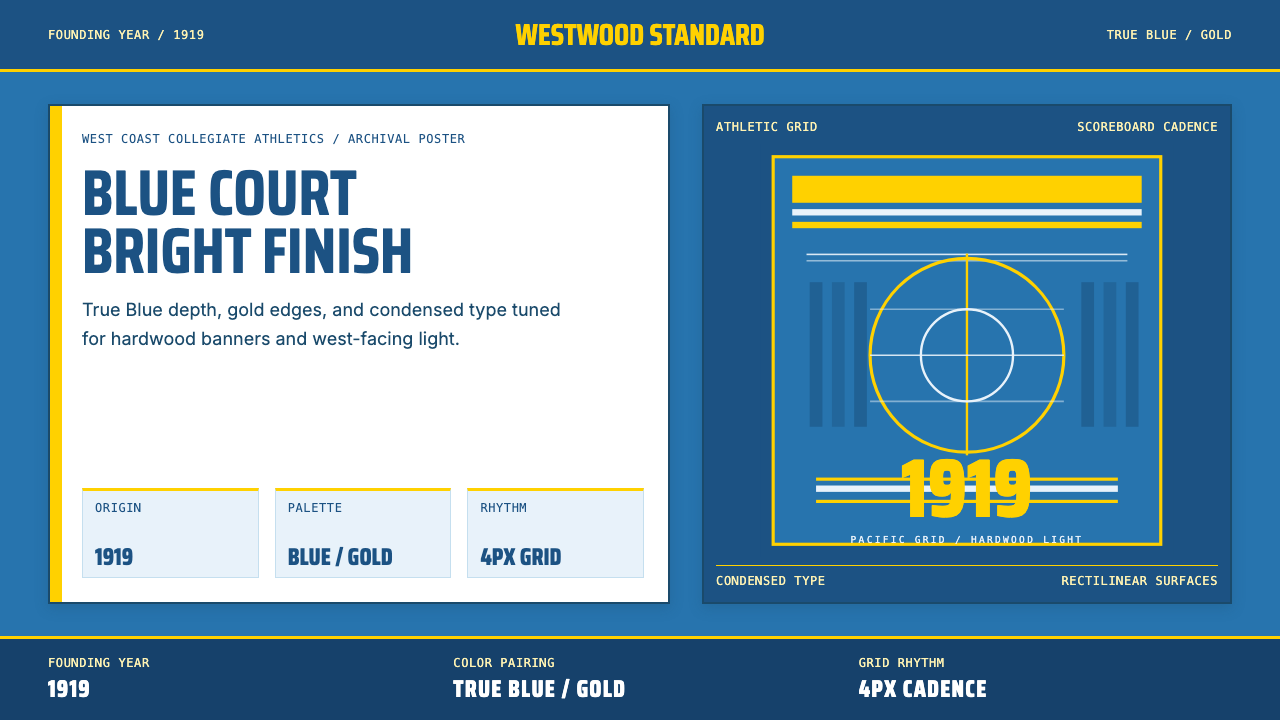
UCLA's True Blue and Gold — colors adopted by a fledgling Southern California teachers college in 1919 — became synonymous with competitive excellence and Pacific coastal authority through a century of collegiate athletics.
UCLA Bruin Purple & Gold (1919) in brief
The UCLA Bruin color system is one of American collegiate athletics' most recognizable pairings: a deep Pacific Blue carried at high saturation alongside a bright, warm athletic gold. Both colors operate at peak intensity — neither is muted or tinted toward neutrality — which produces an identity that reads as confident and unapologetic at any scale, from a stadium banner to a jersey number.
Visually, the system depends on high chromatic contrast and bold rectilinear structure. Condensed athletic typefaces — letterforms that compress horizontal width to emphasize vertical thrust — anchor the typographic identity, while broad flat panels of color replace any need for gradation or shadow. The geometry is deliberate and frontal: there is no ambiguity about where the eye should go.
What makes this system more than a sports palette is its historical weight. Every deployment of True Blue and Gold carries the residue of decades of West Coast athletic dominance — from the hardwood of Pauley Pavilion to the track at Drake Stadium — giving even a simple composition a sense of inherited authority that purely contemporary palettes cannot manufacture.

Where does UCLA Bruin Purple & Gold (1919) come from?
UCLA was founded in 1919 as the Southern Branch of the University of California — a modest extension campus in Los Angeles at a time when the state's flagship institution in Berkeley still dominated all prestige and resources. The school's colors were adopted in that founding year, borrowing the broader University of California's commitment to blue and gold while distinguishing itself through a particular shade of blue that gestured toward the Pacific Ocean rather than the Bay. That early act of color selection was also an act of geographic and institutional self-definition.
Edward Augustus Dickson, a regent of the University of California and one of the principal advocates for the Los Angeles campus, played a key role in establishing UCLA's identity as something distinct from its northern counterpart. The drive to build a credible, independent institution in Southern California shaped the visual culture of the young university — including the insistence on colors that would stand confidently on their own. The gold, deeply saturated and warm rather than yellow, specifically evoked California sunshine and the West Coast's different relationship to landscape and light compared with the older Eastern or Midwestern university traditions.
The athletic program that would make these colors famous on a national stage took shape gradually through the 1920s and 1930s as UCLA joined the Pacific Coast Conference and began competing at the highest levels of collegiate athletics. The university moved to its permanent Westwood campus in 1929, and the new facilities — including eventually Pauley Pavilion, opened in 1965 — gave the color system a physical home whose architecture reinforced its boldness. Blue and gold on hardwood, under arena lights, at championship stakes: the palette was forged in high-contrast conditions.
The John Wooden era (1948–1975) transformed UCLA's colors from a recognizable regional mark into a globally understood symbol of athletic excellence. Ten national basketball championships in twelve years — including seven consecutive titles from 1967 to 1973 — gave the True Blue and Gold an unmatched winning context. Players like Kareem Abdul-Jabbar, who arrived as Lew Alcindor in 1965, and Bill Walton carried those colors into professional careers that amplified the palette's visibility worldwide. The identity was no longer merely Californian; it had become a standard against which athletic aspiration measured itself. Jackie Robinson, who attended UCLA from 1939 to 1941 before his major league career, had earlier demonstrated that the university's colors could signify excellence across multiple disciplines simultaneously — athletics, character, and historical consequence.
What defines the UCLA Bruin Purple & Gold (1919) look?
Color Authority
The palette operates on two colors at maximum saturation: a deep, cool blue with the weight of deep Pacific water and a warm, brilliant gold that reads as direct California sunlight rather than pale yellow. Neither color hedges toward neutrality. Deployed together, they create an optical tension that reads as competitive confidence — two strong forces in deliberate balance rather than harmonious blend. White is used structurally to separate and clarify rather than to soften.
Condensed Athletic Typography
The typeface tradition of this system favors letterforms with compressed horizontal width and tall, assertive vertical strokes — the visual language of scoreboards, jersey numbers, and stadium signage designed to be read instantly at distance. This condensed proportion communicates urgency and forward motion. Headlines set in this manner carry physical energy; they lean into the message rather than presenting it at a neutral stance.
Rectilinear Surface Architecture
Compositions in this system are built from bold rectangular blocks of color rather than organic shapes, gradients, or textural fills. Panels divide the picture plane into zones of blue, gold, and white with hard, confident edges. This rectilinear approach gives every composition a structural certainty — a sense that each element occupies exactly the space it was given and that no space is uncertain or transitional. The geometry is frontal and declarative.
High-Contrast Hierarchy
Information hierarchy is established through maximum contrast rather than subtle gradation. A number or headline in gold against deep blue, or deep blue against white, announces itself without ambiguity. Supporting text in a neutral weight steps clearly back. There are no intermediate tones muddying the relationship between foreground and background. This binary logic — foreground at full strength, background at full strength in opposition — produces layouts that communicate instantly across distance and media.
Earned Historical Resonance
Unlike style systems assembled purely from formal principles, the UCLA palette carries specific historical memory. Each application of this color combination activates associations with championship seasons, individual athletic greatness, and a university tradition extending back more than a century. This resonance is available to designers who understand its source but cannot be manufactured without it. The palette works hardest when its context is consistent with those associations — achievement, precision, West Coast confidence.
Flat Finish, No Ornamentation
Surface treatments in authentic applications of this system are uniformly flat. Colors are applied as solid fills with no gradient transitions, no beveled edges suggesting three-dimensional depth, no drop shadows softening the boundary between elements. When a gold stripe crosses a blue field, the edge is absolute. This flatness is consistent with the athletic context from which the system derives — jerseys, flags, painted surfaces — where printing conditions demand clarity over subtlety.
Directional and Kinetic Composition
Compositions in this system favor diagonal stripes, angled type baselines, and geometric divisions that imply movement and momentum. Where the Bauhaus uses geometry to impose rational order, the UCLA athletic tradition uses it to suggest speed and forward energy. A panel may be divided by a bold diagonal that echoes the motion of a running figure or the trajectory of a thrown ball. The composition does not rest; it moves.

Who shaped UCLA Bruin Purple & Gold (1919)?
Dickson served as a regent of the University of California and was the most persistent advocate for establishing a southern branch of the university in Los Angeles. His lobbying of the state legislature was instrumental in creating what would become UCLA in 1919. As a founding figure, Dickson helped set the tone for an institution that would see itself as equal to, rather than subordinate to, the Berkeley flagship — an attitude of confident independence that the blue and gold palette has long embodied.
Wooden coached UCLA's men's basketball team from 1948 to 1975, accumulating ten national championships, including seven consecutive titles. His tenure transformed UCLA from a regional program into the most decorated collegiate basketball program in American history. The sustained excellence of the Wooden years gave the True Blue and Gold their primary cultural meaning: these are the colors of a dynasty, not merely a team. His methodical, principled approach to coaching also aligned the color system with values of preparation, precision, and character rather than just athletic spectacle.
Kareem Abdul-Jabbar — who played at UCLA from 1965 to 1969 under the name Lew Alcindor — won three consecutive national championships and was named the Most Outstanding Player in each of those tournaments. His physical and intellectual presence as a UCLA Bruin is inseparable from the peak of the color system's cultural authority. His subsequent professional career, which spanned two decades and six NBA championships, ensured that the association between the palette and sustained excellence would extend far beyond the campus.
Robinson attended UCLA from 1939 to 1941, where he became the first athlete in the university's history to letter in four sports in a single year: baseball, basketball, football, and track. Long before breaking Major League Baseball's color barrier in 1947, Robinson demonstrated at UCLA that a single individual — wearing Bruin blue and gold — could achieve excellence across fundamentally different disciplines simultaneously. His UCLA years established the color system's early association with barrier-breaking achievement rather than narrow athletic specialization.
Walton played at UCLA from 1971 to 1974, winning two national championships and anchoring two of the most dominant seasons in collegiate basketball history. In the 1973 championship game, he scored forty-four points on twenty-one of twenty-two field goal attempts — a performance that became one of the most cited examples of athletic perfection in American sports history. His UCLA career is inseparable from the apex of the Wooden dynasty and represents the color system at its moment of greatest competitive intensity.
How do you use UCLA Bruin Purple & Gold (1919) today?
The UCLA Bruin color system transfers effectively to contemporary design contexts because it is built on a principle rather than an era: maximum-saturation contrast in the service of clear hierarchy and immediate legibility. Applying it well requires understanding that the palette does not whisper — it declares. Every design decision should be made with that declarative quality in mind. When the palette hedges, it fails; when it commits fully, it commands.
For presentation slides, the system works with particular force on cover pages that need to assert authority from the first frame. A cover built in this palette places a bold typographic title in condensed letterforms against a field of deep blue, with the gold used as a single horizontal accent stripe or to highlight one critical word. Content slides should maintain the structural commitment: one primary color per slide as the dominant field, white for body text, and gold reserved strictly for the single most important data point or call-out. Data visualizations take on athletic clarity — bar charts in full-saturation blue and gold, with no intermediate tones diluting the contrast between compared categories.
For web interfaces, the system suits dashboards, analytics platforms, and pricing pages where users need to process information quickly under competitive pressure. The approach is disciplined: a near-white or light neutral background, deep blue used for primary navigation and structural elements, gold deployed exclusively for active states, primary calls to action, and the one tier or metric that must stand apart. Interactive components use hard edges and flat fills — no soft shadows, no blurred backgrounds, no frosted glass effects. The system reads as professional competence rather than friendly approachability, which suits B2B and performance-oriented consumer contexts.
For editorial and marketing work, the palette supports bold information hierarchy in the tradition of mid-century American sports publishing. A feature layout uses full-bleed blue or gold panels for section openers, with white body text set at a generous size in a condensed weight to maintain the athletic register. Marketing pages work with alternating full-width blocks — deep blue with gold typography, then white with blue typography — creating rhythm through chromatic alternation rather than decorative ornament. Campaign materials benefit from diagonal compositional energy: angled color panels that imply momentum, with condensed type sized to the edge of legibility for maximum impact.
A common mistake when working with this palette is treating the blue and gold as interchangeable dominants and alternating them at equal weight across a composition. In practice, the system requires a clear hierarchy of application: blue is the structural ground — the field, the frame, the primary surface — and gold is the accent that defines the single most important element at any moment. When gold dominates at the same weight as blue, the composition loses its directional energy and reads as decorative contrast rather than purposeful hierarchy. Similarly, introducing warm neutrals or muted tones as a mediating third element undermines the palette's core logic, which depends on the confrontational intensity of two fully saturated colors working in opposition.

UCLA Bruin Purple & Gold (1919) — FAQ
Can this palette work for non-athletic or non-sports-adjacent brands?
Yes, but with intentionality. The UCLA palette's core properties — high saturation, maximum contrast, condensed bold type — are not inherently athletic; they are inherently authoritative and high-energy. Financial platforms, competitive B2B software, legal or professional services seeking to project confidence, and educational technology brands can all employ this palette effectively. The important condition is that the brand's positioning aligns with authority, performance, and clarity rather than warmth, playfulness, or sensory richness. The palette actively works against contexts that require approachability or softness.
How does this system handle dark-mode or dark-background layouts?
The system inverts with reasonable success when using deep blue as the primary background surface. In a dark variant, gold becomes the primary typographic and accent color against the blue ground, with white reserved for body text and secondary information. The critical risk in dark mode is overusing gold — because it reads as a light source against the dark field, it must be applied even more selectively than in the standard light variant, or it will overwhelm the hierarchy. Introducing a true black background rather than the deep blue is possible but loses the color temperature contrast between the two primaries, flattening the compositional energy.
What distinguishes authentic application of this palette from a generic blue-and-yellow scheme?
Three elements: the specific character of the blue, the typographic register, and the compositional commitment. The blue in this system is deep and cool — Pacific in character, carrying oceanic weight rather than corporate lightness. Generic blue-yellow combinations often use a mid-tone blue that reads as friendly or trustworthy rather than authoritative. The typographic register matters equally: condensed, bold, athletic letterforms are as central to the identity as the colors themselves. And the compositional commitment — bold rectilinear panels, hard edges, maximum contrast, no hedging — separates genuine application from a surface-level color substitution on an otherwise unrelated design.
Is it appropriate to add a third color to extend the palette?
The system works precisely because it refuses a third chromatic presence. Adding a third color dissolves the binary tension that gives the palette its declarative force. In practice, the system already contains a functional third element — white — which handles separation, body text, and negative space. If additional differentiation is genuinely needed (for instance, to distinguish five service tiers in a pricing table), the preferred approach is to use tonal variations of the existing blue — a lighter, more airy shade for lower tiers — rather than introducing a new hue. Metallics or neutrals as accent metals are the only addition that does not disrupt the core logic, because they read as surface quality rather than chromatic competition.
How should imagery and photography be handled within this system?
Photography in this system should be treated as a structural element rather than an atmospheric one. The preferred approach is high-contrast treatment: images cropped aggressively to isolate a single figure or gesture, reproduced with enhanced tonal contrast so that the image reads as graphic rather than naturalistic, and either placed within a hard-edged rectangular field or silhouetted against the flat color backgrounds. Duotone treatments using the palette's blue and gold are particularly effective, converting photographic naturalism into a graphic object consistent with the flat, high-contrast surfaces of the broader system. Soft, atmospheric photography — wide landscape shots, environmental mood imagery — conflicts with the system's declarative character and should be avoided.
Related design styles
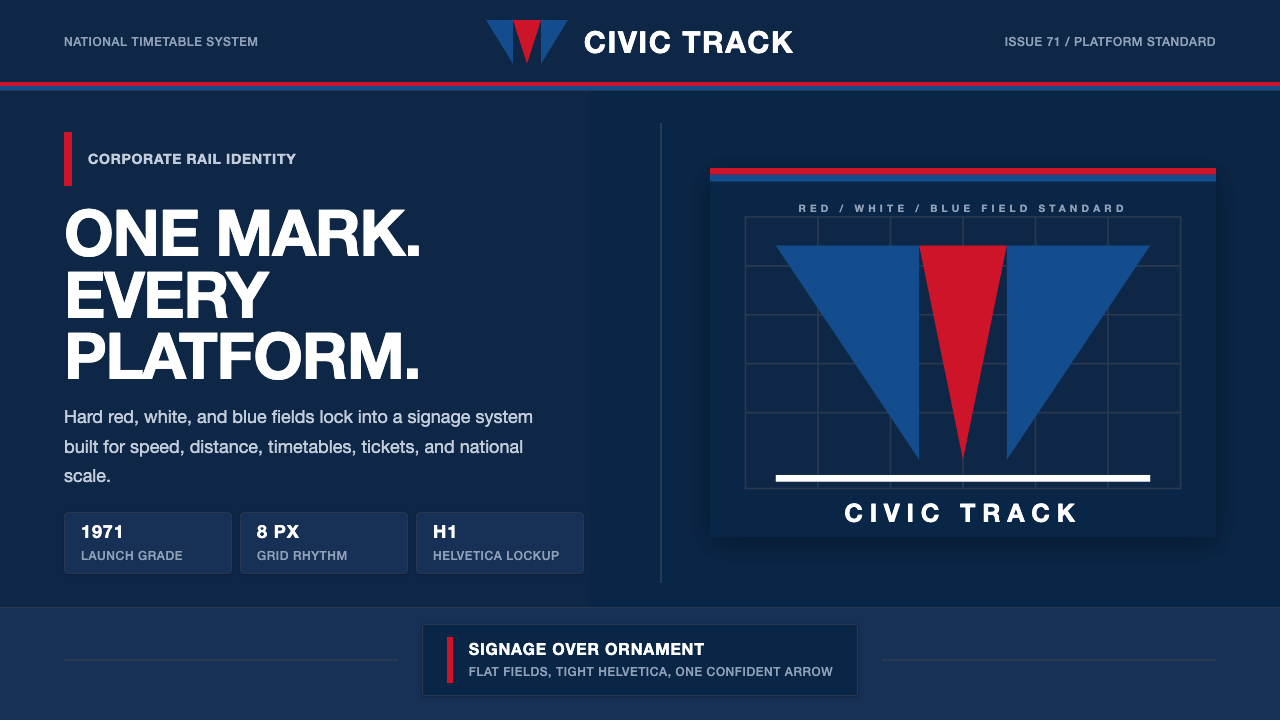 Amtrak Arrow (1971)Civic authority at speed. Deep navy, Helvetica lockups, and red-blue arrows.
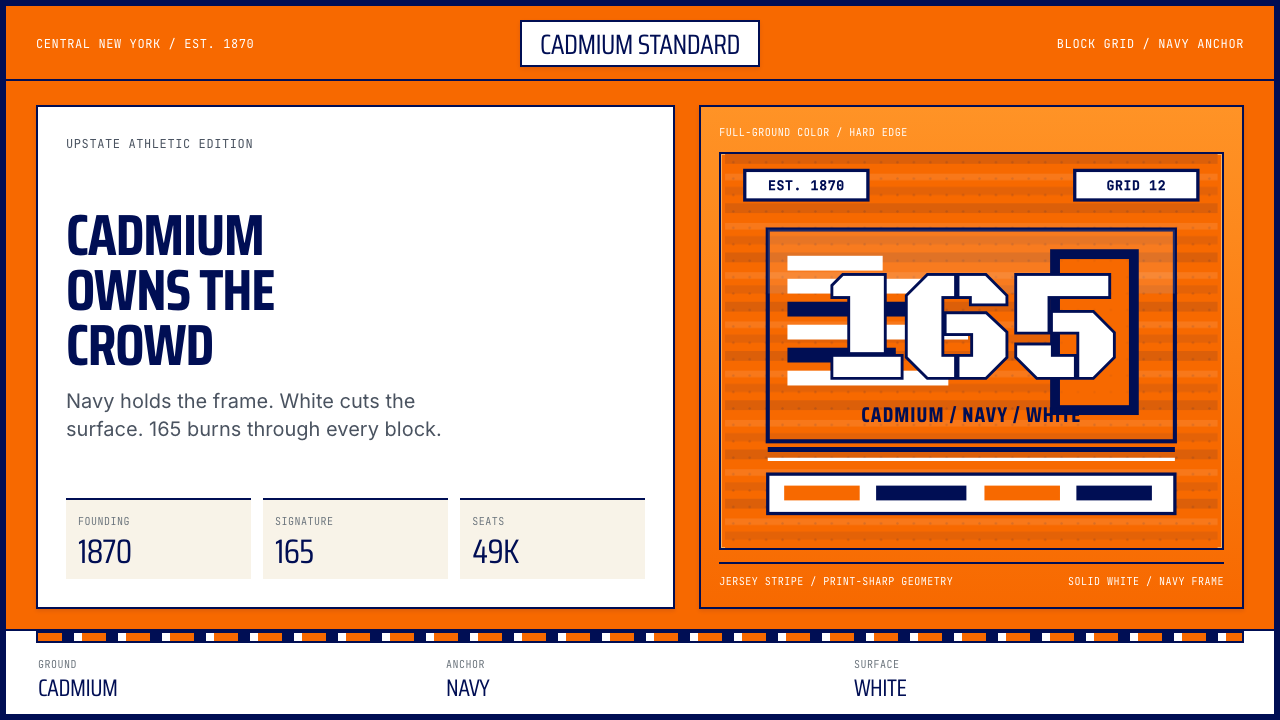 Syracuse Orange (College Athletics, 1870)One hue owns the crowd. Cadmium orange, navy frames, jersey-stripe geometry.
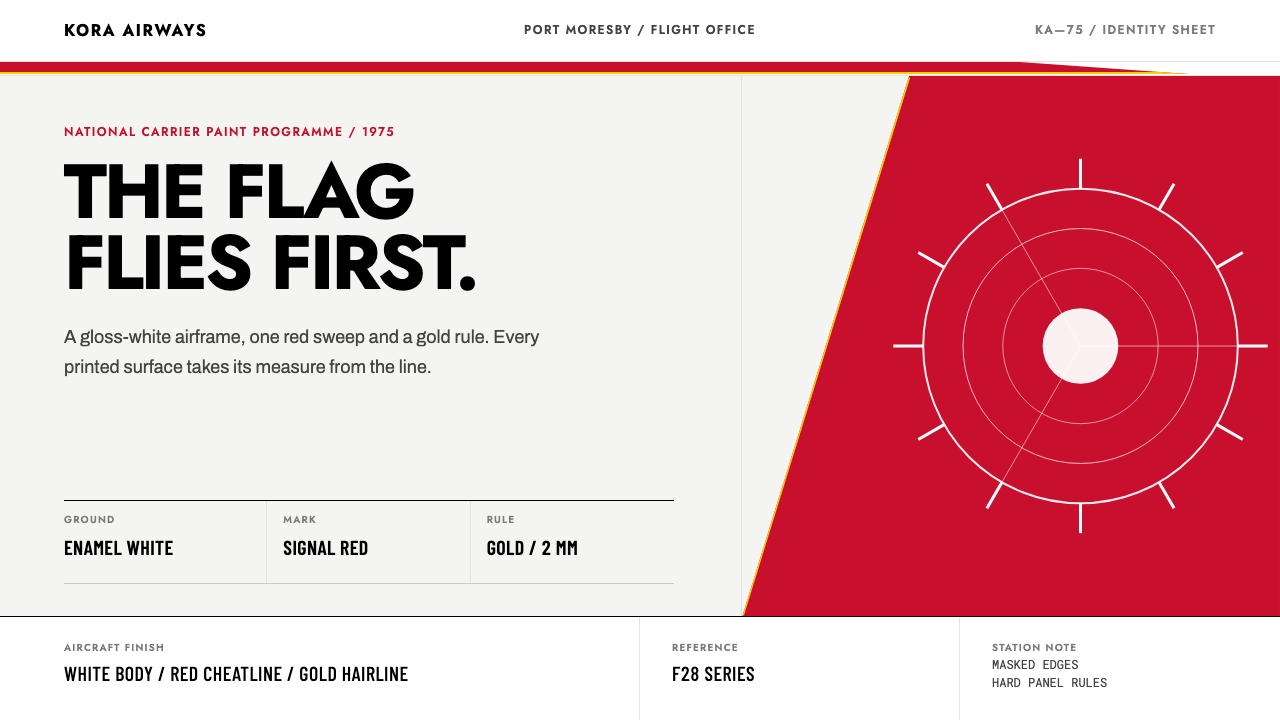 Air Niugini Livery 1975A flag engineered for flight. Signal red sweeps across enamel white, underlin…
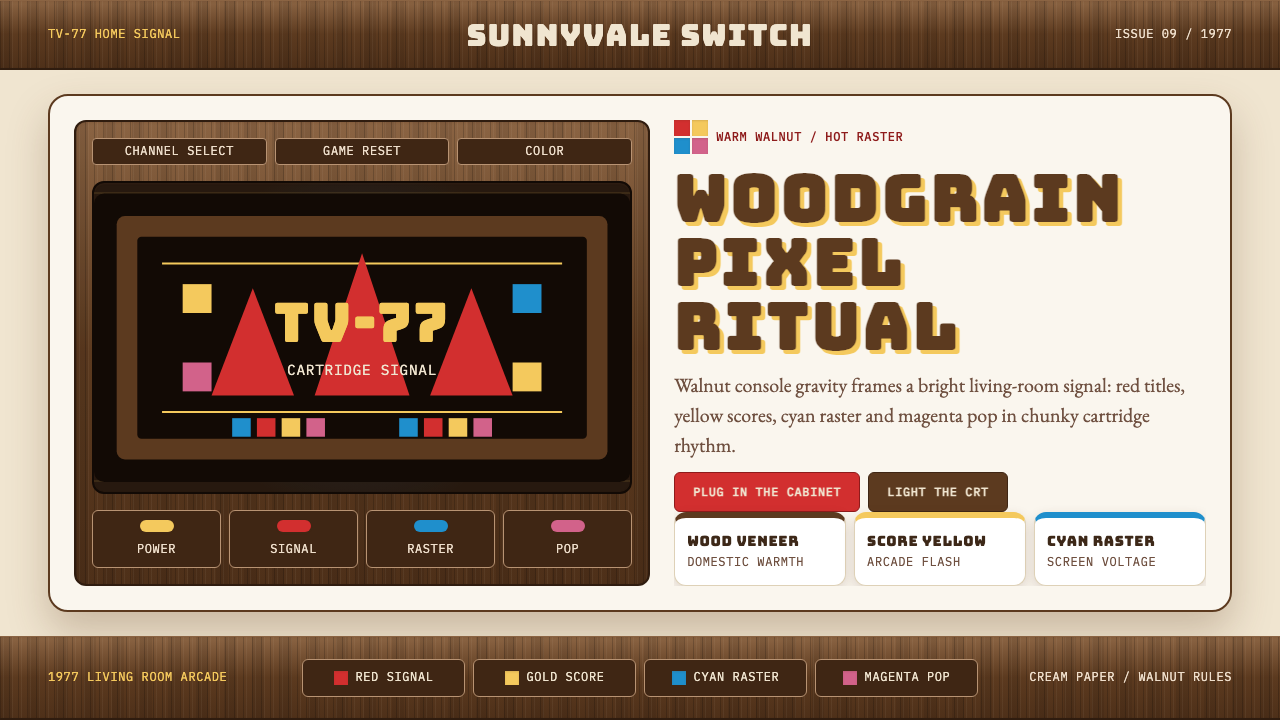 Atari 2600 (Woodgrain)Woodgrain meets raw pixels. Walnut panels frame Bungee type and CMYK raster b…
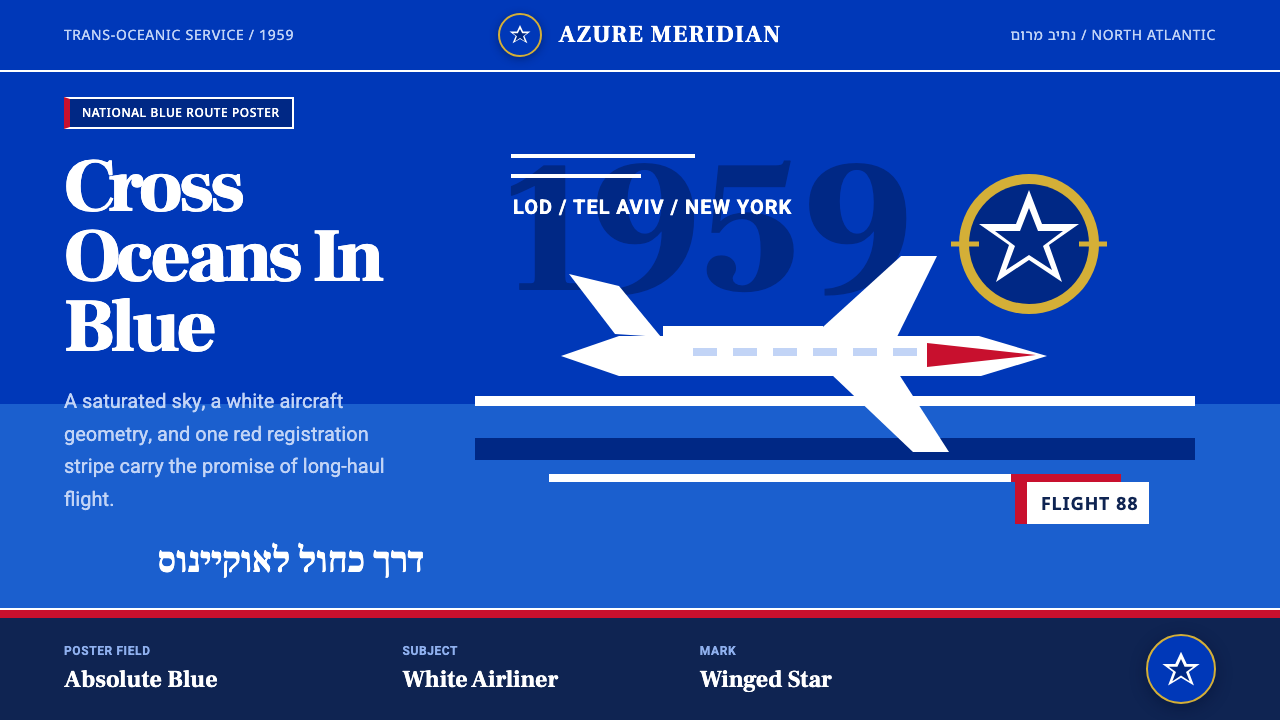 El Al Israel AirlinesNational blue takes command. White aircraft geometry cuts a flat jet-age post…
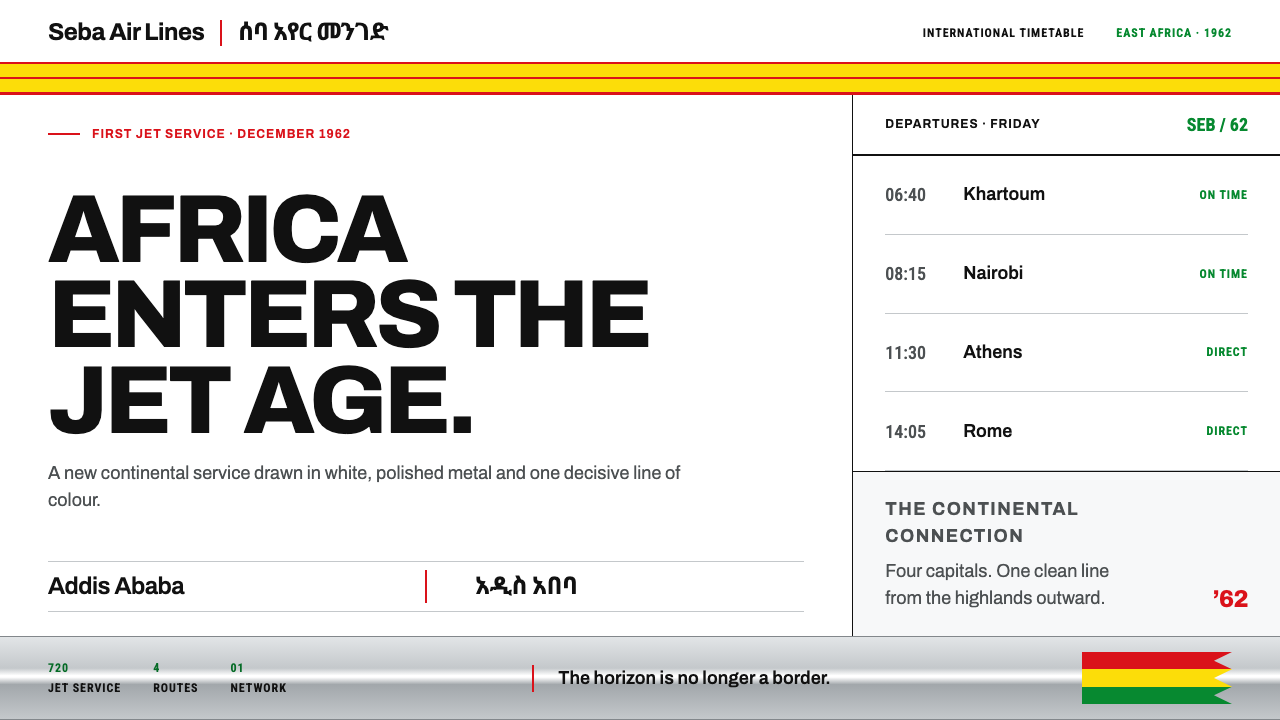 Ethiopian Airlines 1960sJet-age confidence, drawn flat. Yellow bands and red hairlines cut across whi…