What is Steampunk Victorian?
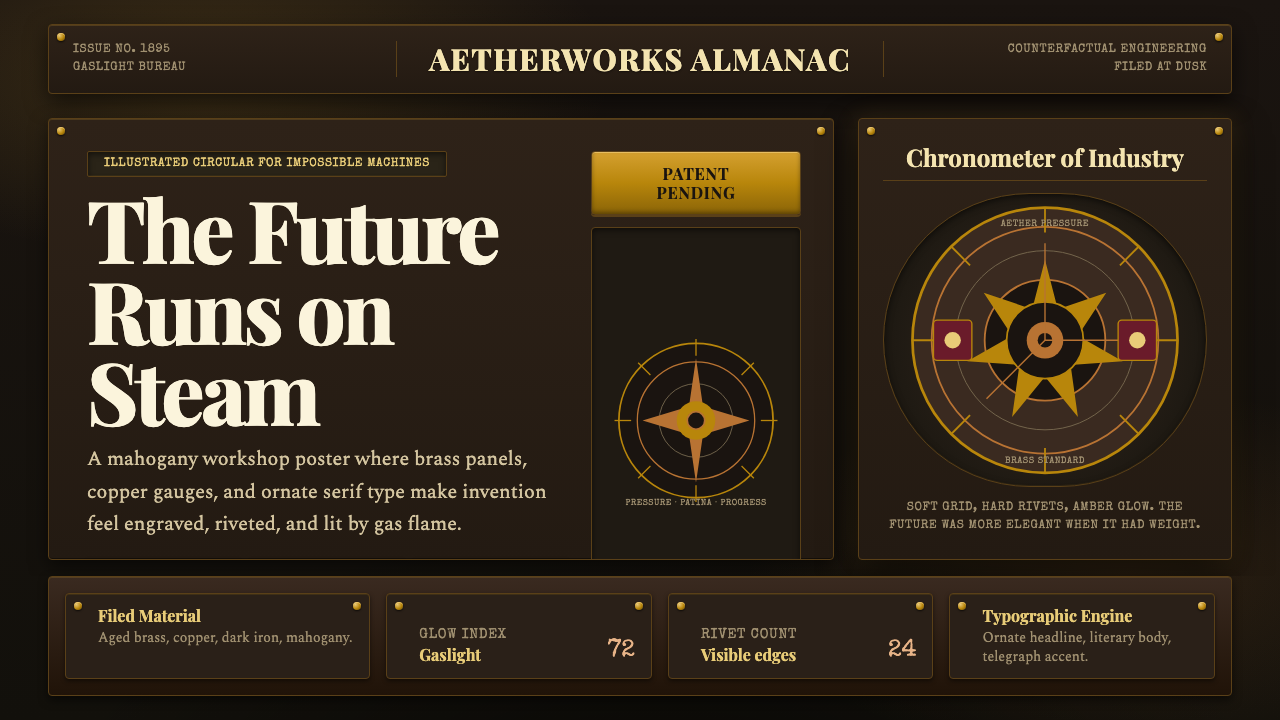
Steampunk Victorian imagines the Industrial Revolution never ended — only grew more beautiful, wrapping brass gears, copper pipes, and gaslight amber in the ornate silhouette of the Victorian age.
Steampunk Victorian in brief
Steampunk Victorian is a retrofuturist design aesthetic rooted in the visual culture of the British Victorian era (1837–1901) and filtered through the speculative fiction of Jules Verne and H.G. Wells. Its core proposition is an alternate history in which steam power, mechanical engineering, and ornamental craft evolved together into something richer than either industrialism or decorative revivalism alone could produce. The result is a visual language of warm metals — aged brass, copper, dark iron — layered against deep mahogany grounds and lit by the amber warmth of gas flame.
The style fuses two impulses that the actual Victorian age held in tension: a love of mechanical precision and a passion for surface ornament. Rivets and gears appear alongside flourishes and filigree. Clockwork mechanisms are rendered with the same care as carved wooden moldings. Typography in this aesthetic leans toward elaborate serif letterforms — the kind of ornate display faces that graced Victorian handbills, penny dreadfuls, and exposition catalogues — while the overall mood oscillates between the workshop and the drawing room, the engine house and the gentleman's club.
What distinguishes authentic Steampunk Victorian from mere Victorian pastiche is the insistence on mechanical depth. Every surface implies construction: panels are riveted, not merely painted; pipes connect and exhaust; gauges register pressure. The aesthetic does not simply decorate — it engineers, and the engineering is always visible. Darkness and warmth coexist: deep shadow plays against glowing amber highlights, and every composition suggests a world lit by fire and conducted through copper.

Where does Steampunk Victorian come from?
The Victorian era that Steampunk aestheticizes was itself a period of profound visual contradiction. Britain's Industrial Revolution, in full force from roughly 1760 onward, produced iron bridges, steam locomotives, and mass-manufactured goods. Yet the Victorian middle and upper classes responded to industrialization not by embracing its stark machine aesthetic but by doubling down on ornament: Gothic Revival architecture, elaborate cast-iron grilles, William Morris wallpapers, Arts and Crafts workshops. The real Victorian age was already a collision between the factory and the parlor, and Steampunk took that collision as its founding premise.
The literary roots run directly through Jules Verne's 'Extraordinary Voyages' series — particularly 'Twenty Thousand Leagues Under the Sea' (1870) and 'The Mysterious Island' (1874) — and H.G. Wells's scientific romances, including 'The Time Machine' (1895) and 'The War of the Worlds' (1898). Both authors depicted technologies beyond their era's capability but rendered them with the tactile, mechanical specificity of contemporary engineering. Verne's Nautilus submarine is described with the loving detail of a Victorian ship-builder's manual; Wells's time machine is assembled from nickel, ivory, crystal, and brass in a laboratory that smells of machine oil. These texts established the template: fantastical function wrapped in period-authentic material.
The term 'steampunk' was coined in 1987 by science fiction author K.W. Jeter in a letter to Locus Magazine, as a playful contrast to the then-fashionable 'cyberpunk.' Jeter, along with Tim Powers and James Blaylock, had been writing Victorian-set fantastical fiction; 'steampunk' named what they were doing retrospectively. The visual aesthetic crystallized through the 1990s and early 2000s, gathering momentum from role-playing games, film (notably Terry Gilliam's 'Brazil' in 1985, and the 'Wild Wild West' adaptation in 1999), and eventually the maker and cosplay communities of the mid-2000s, where handcrafted goggles, modified clockwork jewelry, and leather-strapped gadgetry became a recognizable subcultural uniform.
The fully formed Steampunk Victorian aesthetic as a self-conscious design movement emerged around 2006–2010, coinciding with the explosion of craft-sharing platforms and maker culture. William Gibson and Bruce Sterling's 1990 novel 'The Difference Engine' — which imagined a Victorian Britain powered by Charles Babbage's hypothetical analytical engine — provided a canonical text for the look's intellectual ambitions. By the 2010s, the aesthetic had spread far beyond literary subculture into fashion, interior design, event production, game UI design, and digital illustration, solidifying its vocabulary of riveted brass panels, exposed gear trains, pressure gauges, and gaslight-warm color throughout.
What defines the Steampunk Victorian look?
Color
The palette is built on warm metals and organic darks. Aged brass — a tarnished, slightly greenish gold — is the signature hue, appearing on mechanical elements, borders, and typographic ornaments. Copper provides a ruddier complement. Dark iron and charcoal form the shadowed grounds. Mahogany and deep walnut browns anchor the wooden surfaces. The only consistent light source is amber — the yellow-orange warmth of gaslight and open flame — which means highlights glow rather than illuminate evenly. Cool tones appear only as deep teal or bottle green in glass and indicator elements, never dominating. The overall impression is of a world perpetually seen by candlelight.
Typography
Display typography is emphatically serif, drawing on the ornate Victorian tradition of fat-face and slab-serif letterforms that dominated nineteenth-century printing and advertising. Headlines carry weight and presence, often featuring elaborate swash alternates, ink-trap details, or decorative terminals. Body text favors high-contrast classical serifs — the kind associated with quality Victorian periodicals and scientific journals — which lend authority and legibility. A third voice, the typewriter face, appears as a mechanical accent: monospaced, slightly imperfect, suggesting telegrams, ledger entries, or instruments printing data. Letterspacing is generous in display use; ornamental rules, borders, and flourishes frame and anchor the typographic hierarchy.
Texture and Material
Texture is essential, not optional. Every surface in a Steampunk Victorian composition implies a material: hammered or engraved metal, worn leather, polished wood grain, glass with slight distortion, paper that has been handled and aged. The patina of use — tarnish on brass, scratches on copper, foxing on paper — is not a flaw but a virtue. Digital applications of the style achieve this through layered overlays suggesting oxidation, subtle noise suggesting grain, and vignettes suggesting light fall-off at the edges of a gas lamp's reach. The contrast between highly machined precision (the gear teeth are exact) and organic wear (the casing is dented) defines the aesthetic's characteristic visual complexity.
Mechanical Ornament
Gears, cogs, springs, pipes, pressure gauges, rivets, and valves are the primary decorative vocabulary — but they function as ornament by being visible rather than hidden. In real Victorian machinery, working parts were often concealed behind polished casings; Steampunk Victorian does the opposite, celebrating the mechanism itself as the surface. Clock faces, compass roses, and technical-diagram linework appear as decorative motifs. This mechanical ornament is never purely abstracted — it retains its implied function, even when used decoratively. A gear in the corner of a layout implies something is being driven by it; a pressure gauge implies a system under tension.
Depth and Layering
Where Bauhaus is flat and Minimalism recedes, Steampunk Victorian insists on depth. Compositions layer foreground mechanisms over middle-ground paneling over background shadow, creating an impression of inhabitable space rather than a designed surface. Light falls directionally — from a source at upper left or from a lantern positioned within the frame — and produces hard cast shadows with soft penumbra edges consistent with warm artificial light. Vignetting, common in Victorian photography and lantern-slide projection, reinforces the sense that the viewer is peering through an aperture into a richly detailed world.
Darkness as Ground
Steampunk Victorian is almost always a dark-mode aesthetic. The dominant ground is dark — deep brown, near-black charcoal, or dark iron — against which warm metal highlights and amber light become intensely vivid. This darkness is not the cool, high-contrast darkness of noir or goth but the warm, close darkness of a fire-lit interior. It creates intimacy and suggests that the scene exists in a private, enclosed space: a workshop, a library, a captain's cabin. Lighter variants of the style exist but always risk losing this sense of depth and enclosed warmth that defines the aesthetic's emotional register.
Structured Ornament
Unlike the free-flowing organic ornament of Art Nouveau or the horror vacui of some Victorian surface decoration, Steampunk Victorian ornament is structured and mechanical. Borders are built from repeating geometric segments — keystone shapes, bolt-head motifs, sprocket-tooth patterns — rather than floral arabesques. Decorative fills are derived from technical diagrams, hatching, and engineering cross-sections. Even the filigree, where it appears, has the regular, constructed quality of a gear tooth rather than the irregular, growing quality of a vine. Ornament obeys the engineering logic of the composition: it fills a panel, reinforces a frame, or marks a functional boundary.

Who shaped Steampunk Victorian?
Verne's 'Extraordinary Voyages' series, published between 1863 and 1905, established the template for technologically detailed retrofuturism. His machines — the Nautilus submarine, the Albatross airship, the cannon-launched moon capsule — were not described abstractly but with the material specificity of a Victorian engineer: brass fittings, mahogany paneling, thick glass portholes, precise instrumentation. This tactile, material richness became the primary literary source for the Steampunk visual vocabulary, and Verne's affection for the intersection of luxury and mechanism remains the aesthetic's emotional core.
Wells brought to the proto-steampunk literary tradition a darker, more anxious quality. Where Verne celebrated the machine, Wells interrogated it. His time machine is assembled with almost obsessive material specificity — quartz rods, nickel bars, ivory plates — yet it transports its rider into futures of entropy and extinction. Wells's visual sensibility — the melancholy of a brilliant device in a decaying world — contributed the aesthetic's undertow of decay and ruin, the sense that all the beautiful machinery exists within a system that is winding down. This tension between celebration and elegy is what separates Steampunk Victorian from mere mechanical nostalgia.
Jeter coined the term 'steampunk' in a 1987 letter to Locus Magazine and wrote the novels 'Morlock Night' (1979) and 'Infernal Devices' (1987) that helped define the genre. His work engaged seriously with the moral and class dimensions of Victorian society — the exploitation beneath the ornament, the empire that funded the engineering — giving the aesthetic a critical edge that distinguishes serious Steampunk Victorian from superficial gear-and-goggle decoration. Jeter's framing remains important to designers who want the style to carry intellectual weight rather than functioning as mere cosplay.
Gibson, already the father of cyberpunk, co-wrote 'The Difference Engine' (1990) with Bruce Sterling, imagining a Victorian Britain transformed by Charles Babbage's analytical engine — a computer built from brass and ivory rods, powered by steam, staffed by human punch-card operators called 'clackers.' The novel elevated Steampunk from a visual subculture to a serious counterfactual literary form, establishing the idea that Victorian aesthetic richness and computational-era complexity could coexist. Gibson's participation also linked steampunk to the broader science fiction tradition and gave it intellectual credibility beyond craft and cosplay communities.
Though not a designer, Babbage — the nineteenth-century mathematician who designed but never completed the Difference Engine and Analytical Engine — is the movement's patron saint of unrealized potential. His machines, had they been built at full scale, would have been extraordinary objects: thousands of precision-machined brass columns, wheels, and rods in an arrangement of almost architectural grandeur. The Science Museum in London eventually built a working Difference Engine No. 2 in 1991, and photographs of it — gleaming brass rack and pinion, in a case of mahogany and glass — read as the ur-image of Steampunk Victorian design.
How do you use Steampunk Victorian today?
Steampunk Victorian is among the more demanding historical styles to apply well in contemporary design work, because its power comes from layered texture, controlled darkness, and the suggestion of mechanical depth — qualities that flatten badly when reduced to a color palette or a few gear icons. Applying it correctly requires committing to the full atmospheric logic: warm dark grounds, amber accent lighting, textured metal surfaces, and structured ornament that implies construction rather than mere decoration.
For presentation slides, Steampunk Victorian works best on atmospheric cover slides and section dividers rather than content-dense body slides. A cover built in this style uses a deep, near-black ground with a central mechanical illustration or emblem — a compass rose, a gear assembly, a pressure gauge — rendered in warm brass tones, with the title set in a heavy ornate serif and a subtitle set in a lighter but still high-contrast serif below. Section dividers can use full-width panel treatments with riveted border details. Content slides should be restrained by comparison: a dark but not fully opaque background, a clear typographic hierarchy in high-contrast serif and a monospaced accent for data labels, and minimal decorative intrusion to preserve readability. Data visualizations become instruments: bar charts rendered as pressure gauges, progress indicators as gear-advance meters, numerical readouts styled as telegraphic ledger entries.
For web interfaces, the style suits applications where atmosphere and specialness are more important than neutral utility — boutique e-commerce, game dashboards, portfolio sites, event registration pages, and niche community platforms. The approach is to define a warm dark background, establish a brass or copper accent color for interactive elements and calls to action, and use an ornate serif for display headings with a high-legibility serif for body text. Navigation can be treated as a brass-bordered instrument panel. Cards and modules should use subtle texture overlays suggesting worn leather or aged metal rather than flat or soft-shadow treatments. Pricing pages work with a tier-differentiation logic: standard tiers in muted iron gray, premium tiers in glowing amber-brass, with the structural contrast between dark restraint and warm highlight doing the persuasive work that flat-design color blocks would handle elsewhere.
For editorial and marketing work, Steampunk Victorian excels at covers, posters, feature headers, and event collateral where impact and memorability matter more than sustained readability. A poster in this style uses the full warm-dark palette, a focal mechanical illustration, and typographic hierarchy in contrasting display and body serifs, framed with structured border ornament. Editorial feature layouts can open with a wide, atmospherically dark header image — a mechanical illustration, a period-authentic photograph of actual Victorian machinery, or a hybrid — followed by body text set in a legible high-contrast serif on a lighter (but not pure white) ground that echoes the overall warmth. Marketing one-pagers and landing pages work well with the aesthetic when the product itself has connotations of craft, precision, heritage, or depth of engineering — watchmaking, leather goods, specialty coffee equipment, audiophile hardware, historical games.
The most common mistake when applying Steampunk Victorian is the gear-and-goggles reduction: assuming that scattering gear icons over a neutral background and setting text in an ornate font constitutes the style. It does not. The style's power is atmospheric, not iconographic — it requires the dark ground, the warm ambient light, the layered texture, and the sense of constructed depth. A second common error is letting the darkness become unreadable: the style must balance deep shadows with sufficient amber or brass highlights to maintain visual hierarchy and legibility. The third pitfall is anachronism in the wrong direction — using obviously digital interface conventions (flat toggle switches, sans-serif microcopy, iOS-style icons) inside an otherwise period-authentic frame, which collapses the aesthetic's internal logic.

Steampunk Victorian — FAQ
How is Steampunk Victorian different from general Victorian or Art Nouveau?
Victorian design encompasses a wide range of revival and applied styles — Gothic Revival, Rococo Revival, Arts and Crafts, japonisme — not all of which are dark, metallic, or mechanically focused. Art Nouveau (emerging in the 1890s) specifically reacted against Victorian historicism with a flowing, organic, plant-derived ornament in lighter, more pastel palettes. Steampunk Victorian is specifically the branch of Victorian aesthetic that foregrounds mechanical engineering, metalwork, and the industrial sublime — not the parlor, the china cabinet, or the flower garden, but the workshop, the engine room, and the inventor's laboratory. It is also necessarily a self-conscious anachronism: a contemporary design choice that adopts Victorian codes, rather than a design made in that period.
Can this style work in light mode, or is it always dark?
The style is most powerful in dark mode, where warm metal highlights gain maximum luminosity against deep grounds. Light-mode variants exist — think of aged parchment or ivory grounds with deep sepia and dark iron typography — and these can work well for editorial or print contexts where the aesthetic needs to coexist with extensive body text. However, the pale variant sacrifices the style's most distinctive quality: the sense of gaslit warmth, the impression of peering into a fire-lit interior. A parchment-and-sepia version tends to read as 'vintage' or 'antique' rather than specifically Steampunk Victorian, because it loses the metallic highlights and the dramatic chiaroscuro that make the full dark version so recognizable.
Does Steampunk Victorian work for data-heavy or analytical products?
Counterintuitively, yes — with care. The Victorian era produced some of the finest data visualization in history, including Florence Nightingale's polar area diagrams and Charles Minard's Napoleon campaign map. The style's instrument-panel logic (gauges, dials, ledger readouts) maps naturally onto dashboard interfaces. The key is treating data elements as instruments rather than as abstract charts: a thermometer-style progress bar, a gear-advance loading indicator, a ledger-column numerical readout. The risk is that the heavy ornamental framework competes visually with the data itself. The discipline is to make the data the mechanism — the thing the instruments are measuring — and to keep ornamental framing subordinate to informational clarity.
What product categories and brand personalities fit this style?
Steampunk Victorian aligns with brands whose core identity involves precision craft, historical depth, or the celebration of mechanism and engineering. Strong fits include: luxury watchmaking and horology, specialty spirits and aged whisky, leather goods and bespoke accessories, historical board games and tabletop RPGs, audiophile hardware, artisan coffee equipment, heritage cycling and automotive brands, and fiction-based entertainment with period settings. It struggles for brands that need to signal accessibility, modernity, clinical precision, or emotional warmth — healthcare applications, mainstream consumer tech, children's products, wellness and mindfulness platforms, and any brand whose identity depends on lightness, speed, or ease. The style's inherent darkness and complexity communicate that the product rewards attention and patience; this is a virtue in some markets and a barrier in others.
How do you apply this style without it looking like Halloween or cosplay decoration?
The distinction between serious Steampunk Victorian design and cosplay decoration lies in restraint and systemic consistency. Cosplay decoration uses gears, top hats, and goggles as isolated symbols pasted onto a generic background. Serious design application builds an atmospheric system: every design decision — color, typography, texture, light direction, ornamental grammar — contributes to the same coherent world. Restraint in iconographic elements is critical: the fewer gear icons used as decoration, the more powerful the aesthetic reads. What carries the style is not the iconography but the palette, the texture, the lighting logic, and the typographic voice. Applied with rigor, the result reads as authoritative and atmospheric; applied carelessly, it reads as costume. The test is whether removing the obvious period symbols (gears, goggles) would still leave a coherent, recognizable visual world — if yes, the application is working.
Related design styles
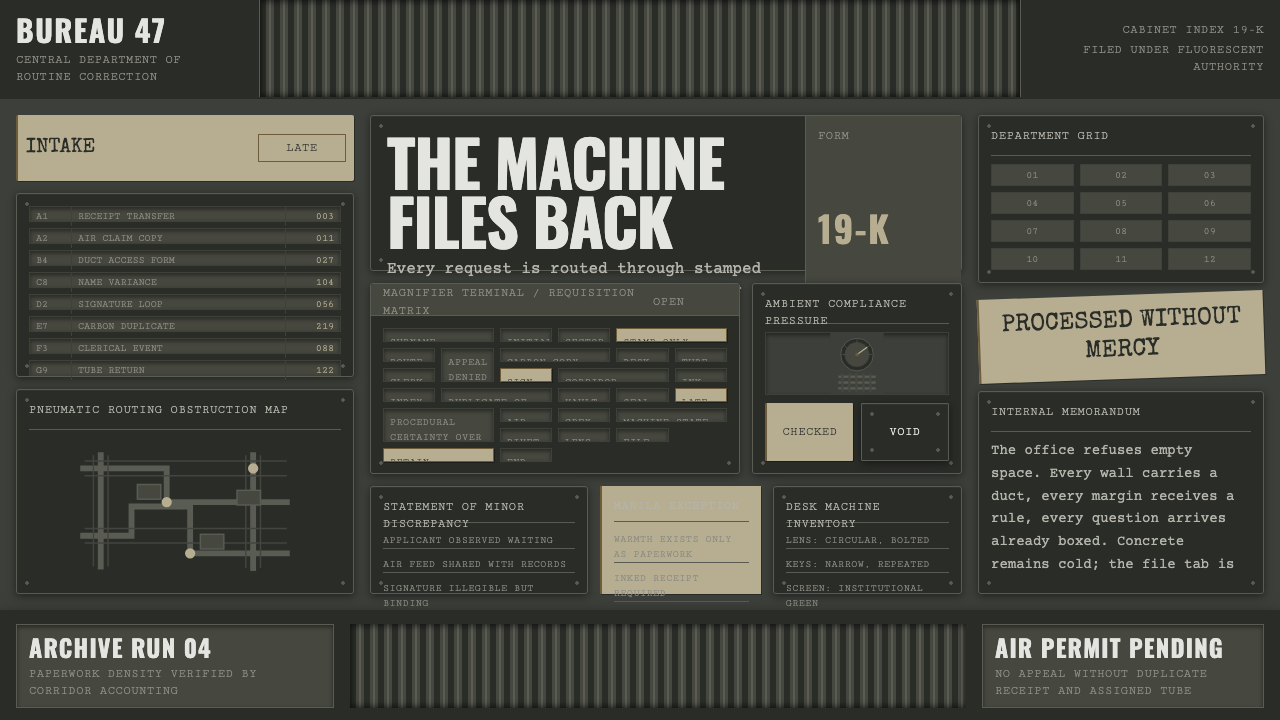 Brazil (1985)Bureaucracy turns hostile. Gray-green grids, duct bands, and manila stamps cr…
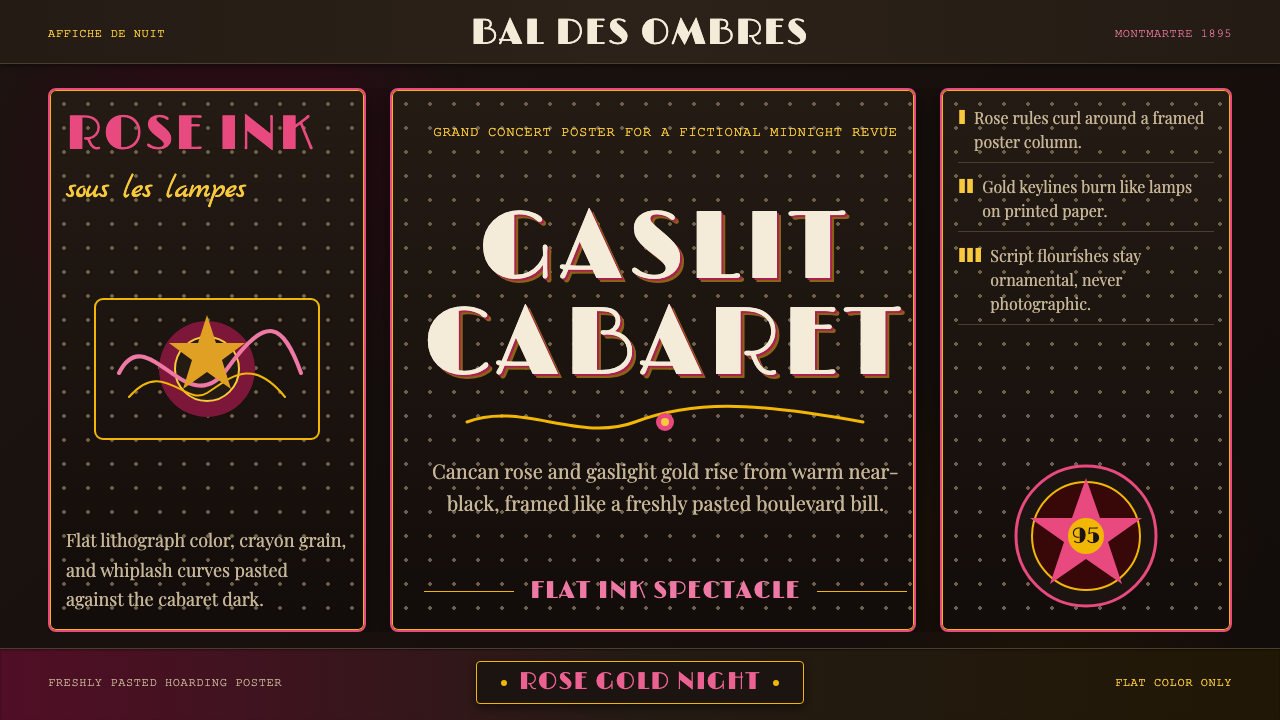 Belle Époque ParisCabaret night glows. Rose ink and gaslight gold curl across warm near-black p…
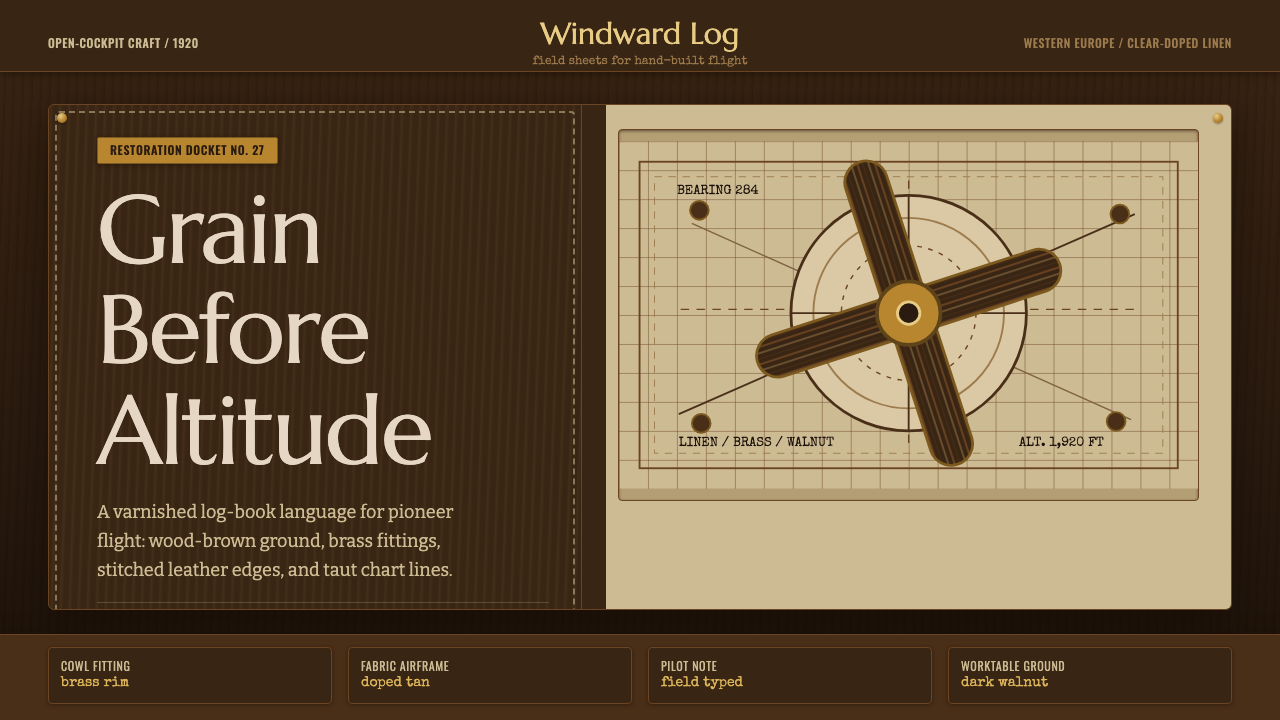 Biplane AviationPioneer flight feels hand-built. Dark walnut, brass, stitched edges, and char…
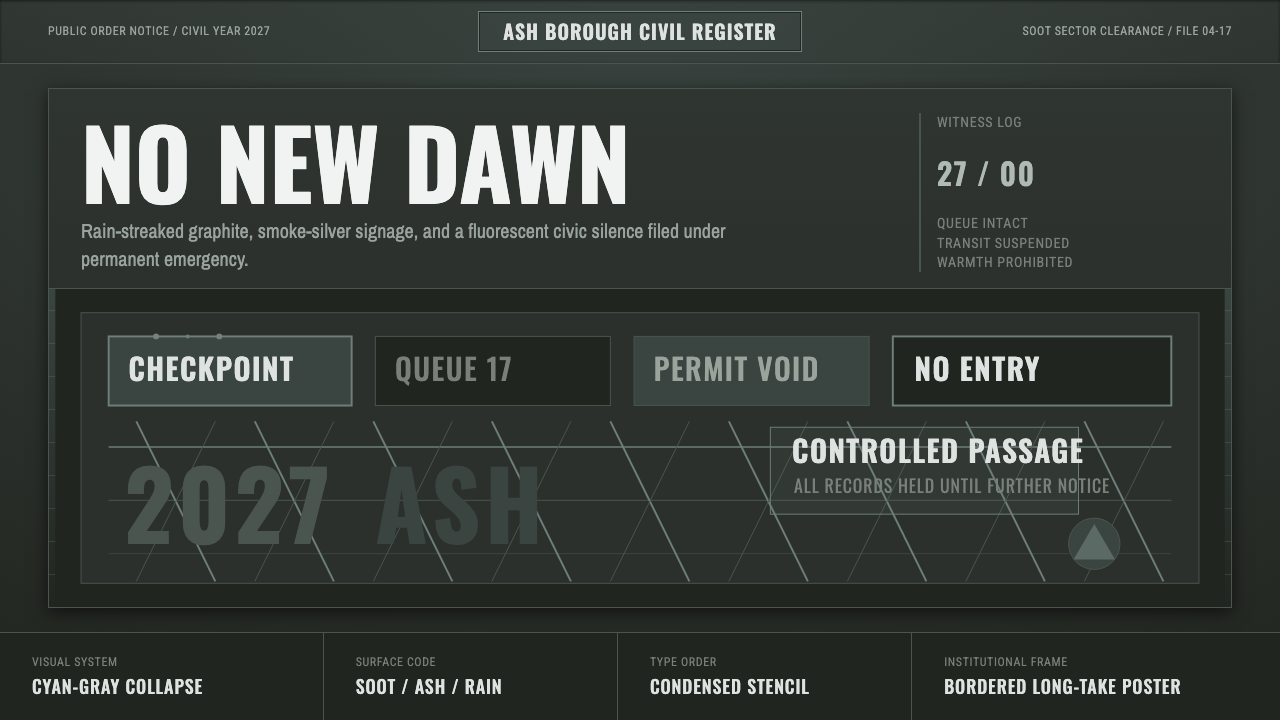 Children of MenHope drains out. Soot-green fields, smoke-silver type, and checkpoint rules h…
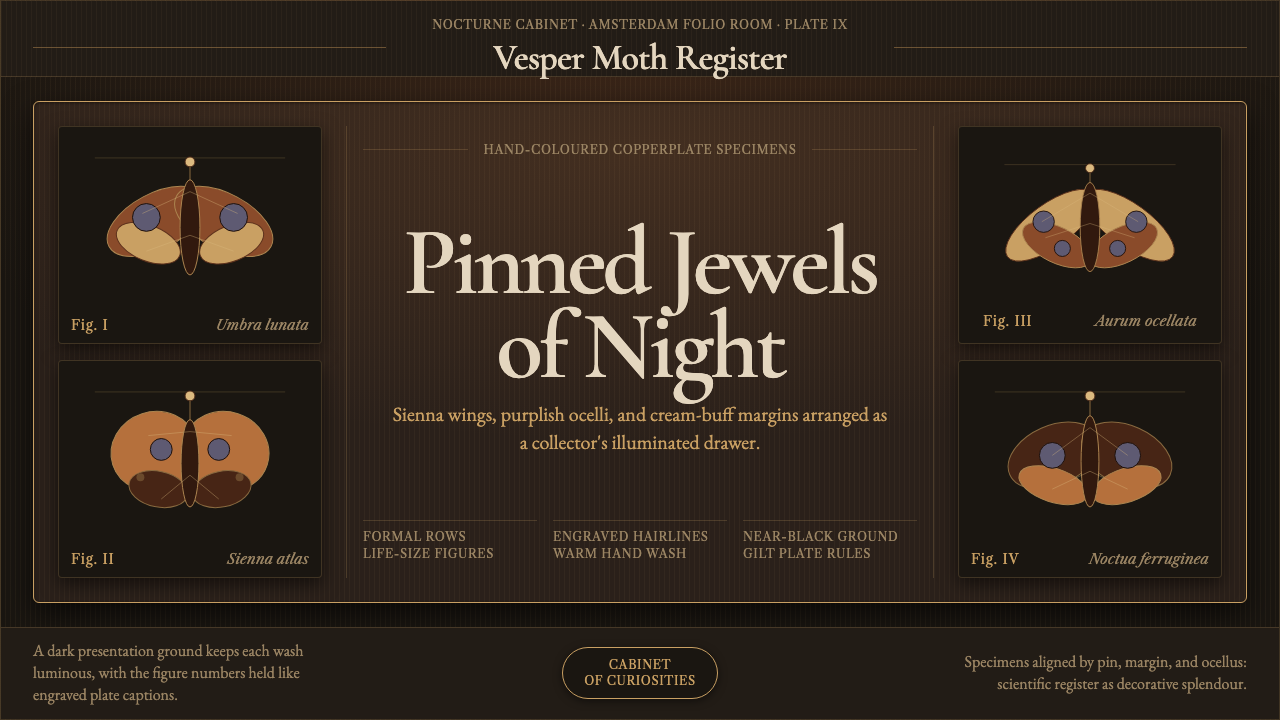 Cramer Exotic MothsJewel-like precision. Sienna specimens glow in formal rows on a near-black pl…
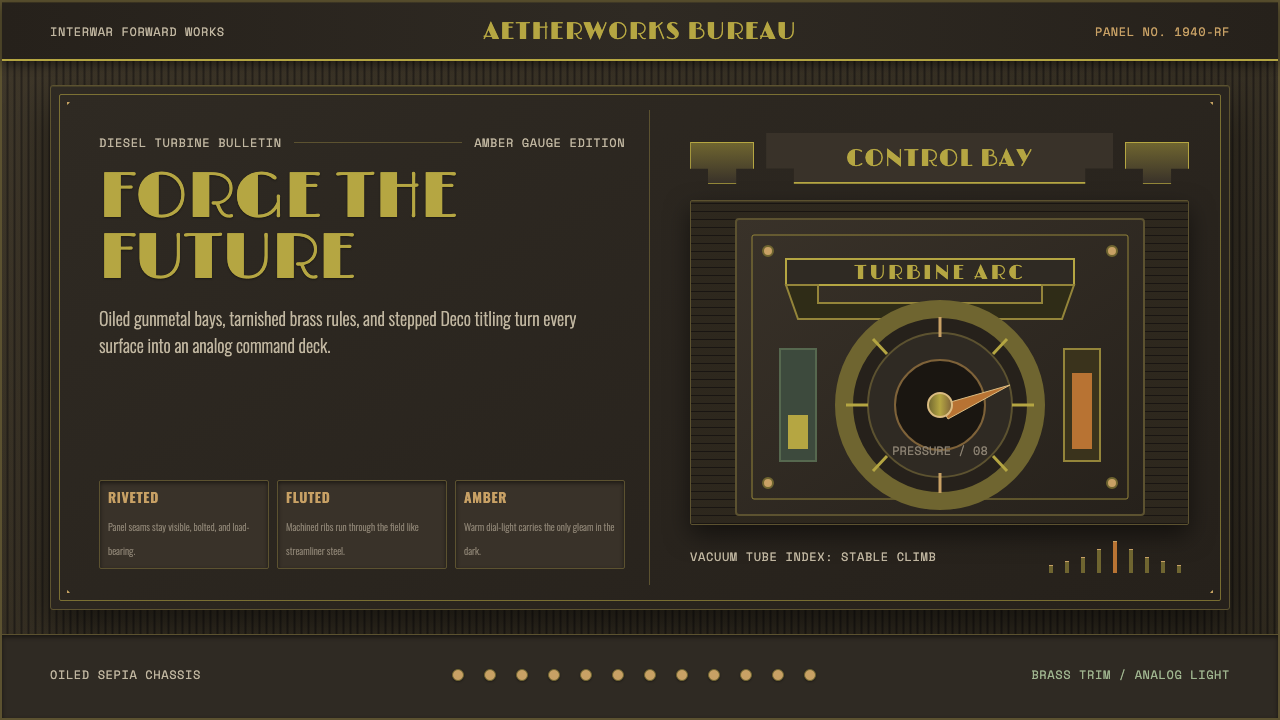 Dieselpunk RetrofutureMachine age, dark and bolted. Gunmetal grid, brass rivets, amber gauge geomet…