What is Spotify Dark?
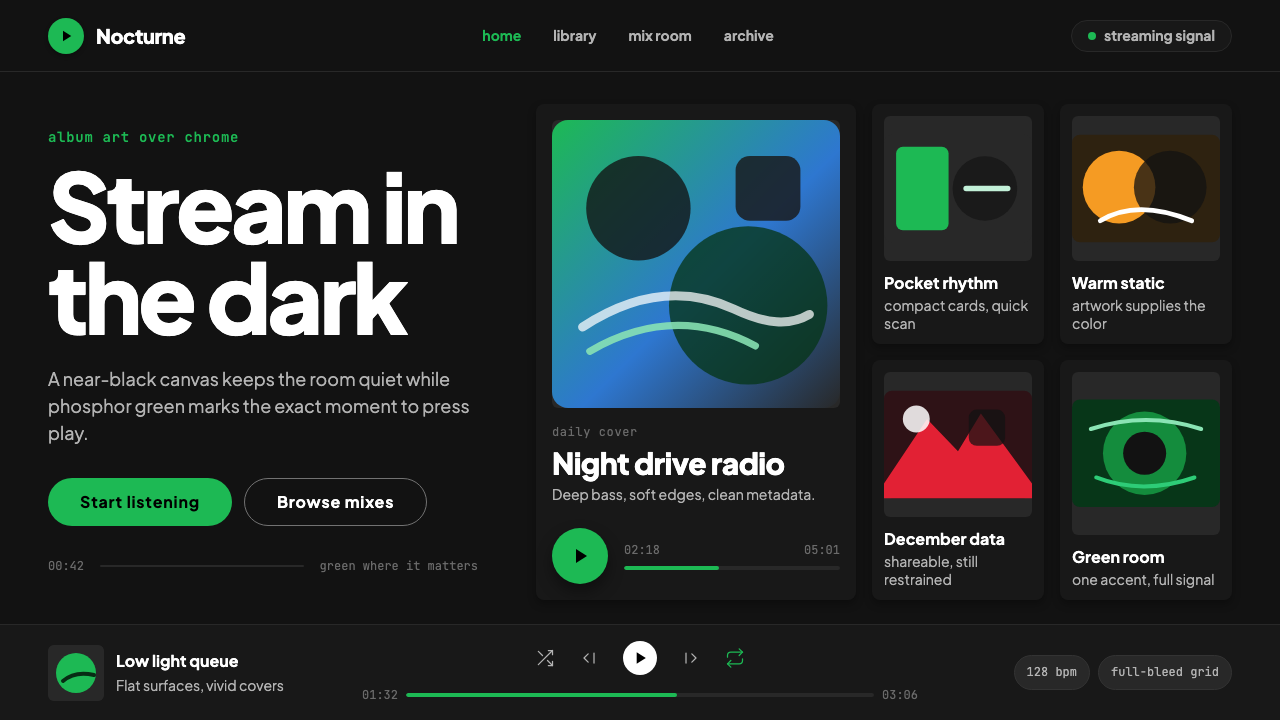
Spotify's near-black canvas and phosphor-green play button became the universal visual shorthand for music streaming — a design language so consistent it defined an entire product category.
Spotify Dark in brief
Spotify Dark is the visual design system developed by Spotify from its early years in Stockholm, built around a deep near-black surface, a single vivid green as its sole accent color, and album artwork as the primary visual content. The interface treats the music — its cover art, artist imagery, and playlist visuals — as the dominant graphic element, while all structural chrome recedes to near-invisibility.
The system's discipline is rigorous: surfaces remain flat and dark, typography is clean and unadorned, and the signature green appears only where interaction matters most — play controls, progress indicators, active states, and selected items. This scarcity of color gives the accent its power. Because it appears nowhere decoratively, every green element communicates a clear functional message.
Spotify Dark also proved that a brand's visual language can extend well beyond a single application. The annual Spotify Wrapped campaign — which turns personal listening data into shareable visual cards — demonstrates the system's flexibility, transforming analytical data into an emotionally resonant, culturally viral format while remaining immediately recognizable as Spotify.

Where does Spotify Dark come from?
Spotify launched in October 2008 out of Stockholm, Sweden, founded by Daniel Ek and Martin Lorentzon. The service entered a market still dominated by physical media and illegal downloads, and its visual identity needed to accomplish something ambitious: make digital music feel premium, organized, and immediately accessible. The early interface established the core visual logic — dark background, content-forward card grid, green as the single functional accent — that would persist through nearly two decades of product evolution.
The choice of a deep, near-black surface was partly aesthetic and partly functional. Dark backgrounds make album artwork — itself a rich, varied visual medium developed over decades of vinyl and CD design — pop with maximum contrast. Every album cover becomes a self-contained visual statement against the dark ground. This approach positioned Spotify as a frame for the music rather than a product competing with it, a subtle but important distinction that shaped the entire feel of the interface.
Tobias Ahlin, who served as Spotify's lead designer during a formative period, helped codify the visual system's principles around content-over-chrome: the interface should disappear as much as possible, leaving the user in direct relationship with the music. This philosophy aligned with a broader shift in digital product design away from the skeuomorphic textures of early mobile software toward flatter, more content-focused interfaces — but Spotify arrived at the approach through its own reasoning rather than simply following industry trends.
Spotify Wrapped, which debuted in its current shareable format in 2016, represented a significant expansion of the design system's reach. By applying the brand's visual language to personal data — listening time, top artists, genre percentages — the Wrapped campaign transformed a data visualization exercise into a cultural ritual. The visual system had to be expressive and flexible enough to carry personal narrative weight while remaining clearly Spotify. The bold typography, high-contrast color blocking, and restrained layout that Wrapped employs are direct extensions of the dark interface's underlying principles.
What defines the Spotify Dark look?
Near-Black Surface
The foundational surface is a very deep, slightly warm near-black — dark enough to create maximum contrast with album artwork, but not a pure flat black that would feel cold and harsh. This near-black is consistent across all surfaces: sidebars, main content areas, and modal overlays all share the same depth, creating visual continuity that lets content elements stand out without the interface itself competing for attention.
Single-Accent Green
The entire design system operates with a single, vivid green as its sole accent color. This restraint is the system's most distinctive discipline: green does not appear in backgrounds, decorative elements, or illustrations — only in interactive controls, active states, and progress indicators. The color's scarcity is its power; because it appears nowhere arbitrary, every instance of green carries clear functional meaning and draws the eye precisely where the system intends.
Album Art as Content
Album artwork functions as the primary visual element of every screen, not as decoration within a designed layout. The grid of cover images is the interface. This means the design system must remain neutral enough to accommodate artwork from every era, genre, and aesthetic tradition — from minimalist covers to maximalist pop imagery — without creating visual conflict. The near-black surface and restrained structural elements ensure the artwork always reads as the dominant visual presence.
Card-Based Grid
Content is organized into consistent card modules — square image thumbnails with minimal metadata below — arranged in horizontal rows or full grid layouts. The card structure creates visual rhythm through repetition, allowing users to scan large libraries efficiently. Cards have minimal borders or containers; the dark surface acts as the implicit grid, with cards floating against it rather than sitting inside explicit boxes. Scrolling is the primary navigation metaphor within any section.
Pill-Shaped Controls
Play buttons, action buttons, and interactive controls use fully rounded, pill-shaped outlines. The play button — arguably the most-seen interactive element in the entire product — is a solid green circle or rounded rectangle. This pill form appears consistently across the product: genre tags, filter chips, and call-to-action buttons all share the fully-rounded silhouette. The shape reads as friendly and approachable while remaining visually distinct from the rectangular card grid surrounding it.
Clean Typographic Hierarchy
Typography is set in a single clean sans-serif family, with hierarchy established through size, weight, and opacity rather than through multiple typefaces or decorative styling. Track titles appear in full-brightness white, metadata and secondary information in reduced-opacity white, and inactive or supplementary items in a further-dimmed tone. This stepped opacity system allows multiple levels of information hierarchy within the dark palette without introducing additional colors.
Minimal Interface Chrome
Borders, dividers, backgrounds, and structural markers are reduced to the absolute minimum needed for spatial orientation. Sections are separated by generous spacing rather than visible lines; navigation elements use simple text labels; icons are spare and outline-based. The persistent playback bar at the bottom of the screen — containing track info, playback controls, and progress — is the most structurally complex element in the interface, yet it maintains the same surface color and typographic restraint as every other area.

Who shaped Spotify Dark?
Daniel Ek co-founded Spotify in Stockholm in 2006 and served as CEO through its growth from a Swedish startup into the world's dominant music streaming platform. Ek's product philosophy — that the service should make the world's music universally accessible with near-zero friction — shaped every major design decision. His insistence on the content-first approach, where the interface serves the music rather than competing with it, established the aesthetic discipline that became Spotify Dark's most enduring characteristic.
Tobias Ahlin served as a lead designer at Spotify during a formative period of the product's visual development. He helped articulate and systematize the design principles that defined the Spotify interface: content-over-chrome, the dark surface as a neutral frame for album art, the disciplined use of the single green accent. Ahlin's work established the visual logic that persisted through years of redesigns and platform expansions, demonstrating that the system's clarity came from principle rather than from superficial style choices.
The Spotify Brand Team, working across product design, marketing, and brand identity, developed the visual system through iterative refinement over more than a decade. Their most culturally significant contribution was the design and evolution of Spotify Wrapped, which required extending the core dark-and-green vocabulary into a data-visualization and social-sharing format. The Wrapped work proved that a product design system can carry emotional and narrative weight far beyond its functional origins — a lesson that influenced how many other digital brands approached their own visual identity expansions.
Martin Lorentzon co-founded Spotify alongside Daniel Ek and brought significant experience from his earlier venture Tradedoubler. As chairman and co-founder, Lorentzon's entrepreneurial vision helped secure the business foundations that allowed Spotify's design team the stability to develop a coherent, long-term visual identity rather than pivoting reactively to competitor aesthetics. The sustained consistency of Spotify's dark visual language across more than fifteen years is partly a product of organizational continuity that Lorentzon helped establish.
How do you use Spotify Dark today?
Spotify Dark translates most naturally to contexts that share its core premise: a dark, content-rich environment where curated media — music, video, podcasts, images — is the reason the user is there, and the interface's job is to get out of the way. Applying the style correctly requires internalizing this logic rather than simply borrowing its visual surface. A near-black background with a single accent color is not enough; the discipline extends to what is absent — the decorative borders, the gradient fills, the ambient shadows, the competing accent colors that dark interfaces so often accumulate.
For presentation slides, Spotify Dark works powerfully as a cover and section-divider treatment. A deep near-black full-bleed background with the title in large, clean white type and a single accent-colored element — a progress-pill shape, a highlighted word — captures the system's precision. Content slides built in this style should use the dark surface consistently, reserving the accent color only for the single most important data point or call-out on each slide. Data visualization slides take on a striking quality when chart elements are rendered against the dark ground: bars and lines in the accent color against the near-black background achieve the same contrast-and-scarcity logic as the play button in the original interface.
For web dashboards and product interfaces, Spotify Dark is an excellent reference for media-adjacent products — music or podcast platforms, video libraries, digital art marketplaces, reading apps, game stores. The card-grid layout, dark surface, and single-accent discipline apply directly. For SaaS dashboards and analytics tools, the style works well when the data itself is the content: charts and tables rendered against a near-black ground with accent-colored highlights on key metrics provide excellent readability and visual hierarchy without decorative overhead. Pricing pages in this system should use the accent color for the recommended tier only, maintaining the accent's scarcity principle.
For editorial and marketing work, Spotify Dark lends a premium, culturally fluent feel that is especially effective for music, entertainment, gaming, and youth-oriented brands. A marketing page built in this idiom uses a deep near-black ground throughout, with section breaks defined by content transitions rather than visible dividers. Feature blocks alternate between full-bleed imagery or album-art-style cards and typographic sections in which large white headlines carry the emotional weight. The accent color appears on calls to action only — a single button or link in each section — maintaining the click-here precision that makes the original interface so navigable.
A common mistake when applying Spotify Dark is treating the dark background as license to use multiple accent colors for visual variety. The style's power comes specifically from color scarcity — one accent, appearing only functionally. A second accent color, even if used sparingly, breaks the logic entirely and transforms the interface from focused and disciplined into merely dark. Similarly, soft, diffuse shadows applied to cards and modals in the Spotify Dark style undercut the flat, surface-level quality that makes content elements feel like objects placed on a stage. If depth cues are needed, use sharp borders or brightness shifts rather than blurred shadow effects.

Spotify Dark — FAQ
Is Spotify Dark only suitable for music and entertainment products?
Not exclusively, but those are its strongest fit. The style's deep near-black surface originated as a frame for album artwork, which makes it naturally suited to any interface where rich visual media is the primary content. Beyond entertainment, it works well for gaming platforms, digital portfolios, developer tools and terminals, dark-mode SaaS dashboards, and any product positioning itself as premium and technically sophisticated. It struggles in contexts that call for warmth, accessibility for extended reading sessions, or an inclusive, family-friendly tone — dark interfaces require careful contrast work to maintain readability for all users, and the cool aesthetic can feel uninviting in consumer-facing emotional contexts like health, parenting, or financial wellness.
How does Spotify Dark differ from generic dark mode?
Generic dark mode is typically a tonal inversion of a light-mode interface — the same layouts, colors, and hierarchy, shifted to dark backgrounds and light text. Spotify Dark is a designed-from-the-ground-up dark aesthetic with its own specific logic: content-as-interface, single-accent discipline, card-grid organization, and the near-black tone calibrated for album art contrast rather than simple light reduction. Many dark-mode interfaces are dark in color but not in approach — they retain decorative dividers, multiple accent colors, and ambient shadows that the Spotify system eliminates. The difference is the difference between wearing dark clothes and having internalized a philosophy of restraint.
Can the Spotify Dark style work for a light-background layout?
The style can be partially transposed — the card-grid structure, pill-shaped controls, single-accent discipline, and content-forward hierarchy are all transferable to a light surface. However, the fundamental visual logic of the dark system depends on the near-black ground creating contrast with artwork and making the green accent luminous. On a light background, the same green accent reads very differently — less luminous, more casual — and loses some of its functional precision. A light adaptation is possible and is essentially what Spotify's own light mode approximates, but it is a different aesthetic experience: warmer and more approachable, with less of the cinematic, stage-lit quality that makes the dark version so distinctive.
How should imagery and photography be handled in a Spotify Dark layout?
Photography and imagery are treated as content objects, not as atmospheric backgrounds or decorative elements. Album covers, artist photos, and playlist artwork appear as square or rectangular cards in a grid, maintaining their original aspect ratios and color content against the dark ground. Photography is never used as a full-bleed background with text overlaid, which would compromise both the typographic clarity and the integrity of the image. When a single image must occupy a large space — an artist header or featured playlist — it is typically faded or darkened at the edges to maintain surface continuity with the near-black interface rather than breaking the spatial logic of the dark plane.
What are the most common pitfalls when adapting Spotify Dark for branded use?
The most common pitfall is substituting a different brand color for the signature green without understanding why the green works. The original green is highly saturated and luminous — it glows against the near-black ground, which is why it functions so precisely as a play button and active-state indicator. A muted brand color substituted in the same position will not achieve the same contrast or functional clarity. If adapting the system with a custom brand color, ensure it has enough saturation and luminosity to hold its own against the near-black surface. A second frequent error is introducing surface variety — using multiple shades of dark gray for different sections, or adding subtle gradient overlays — which erodes the flat surface coherence that makes content elements read as foreground objects rather than elements embedded in a layered background.
Related design styles
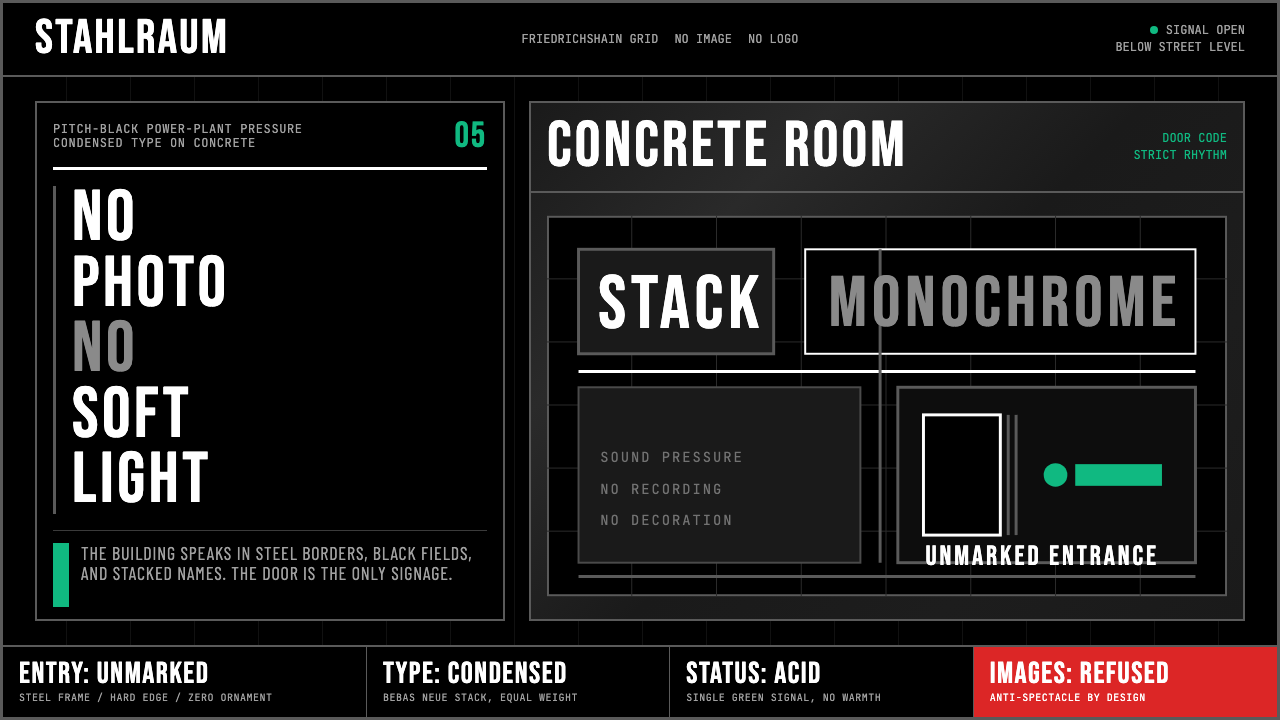 Berlin Techno (Berghain era)Refuses spectacle. Black grid, steel rules, condensed type, one acid-green si…
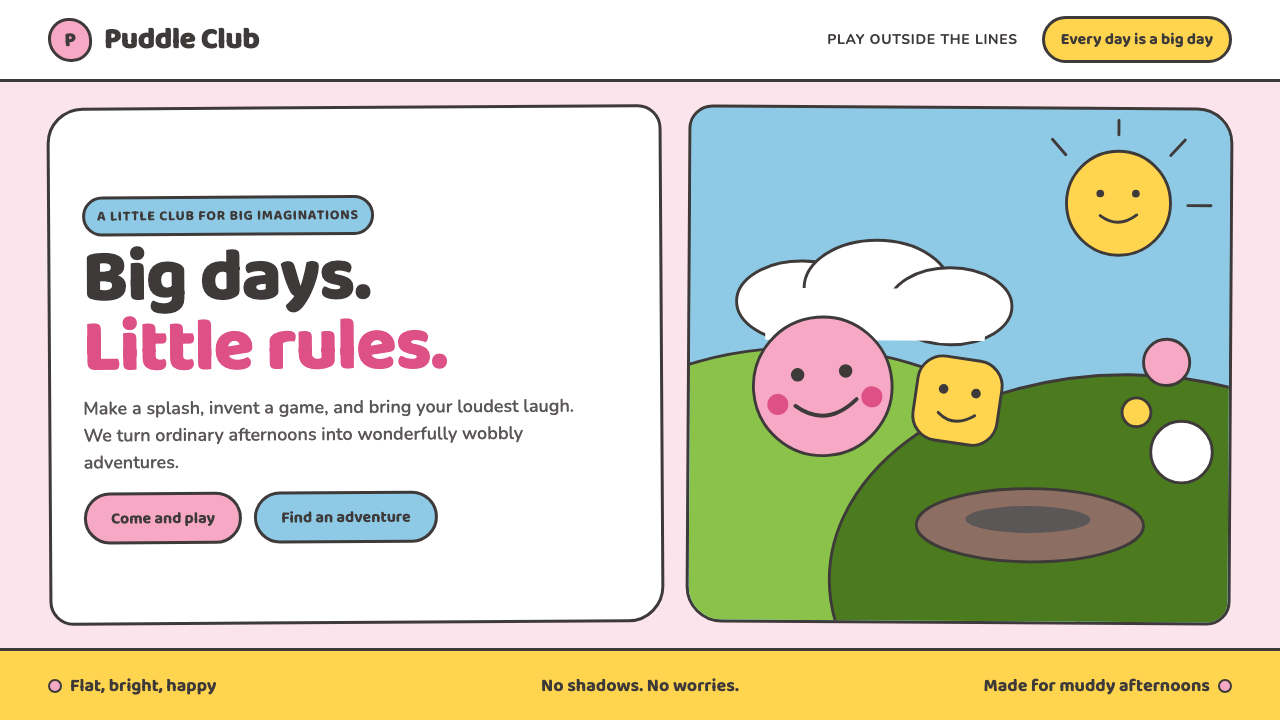 Peppa Pig (2004)Cheer without irony. Bubblegum pink, chubby type and thick outlines keep ever…
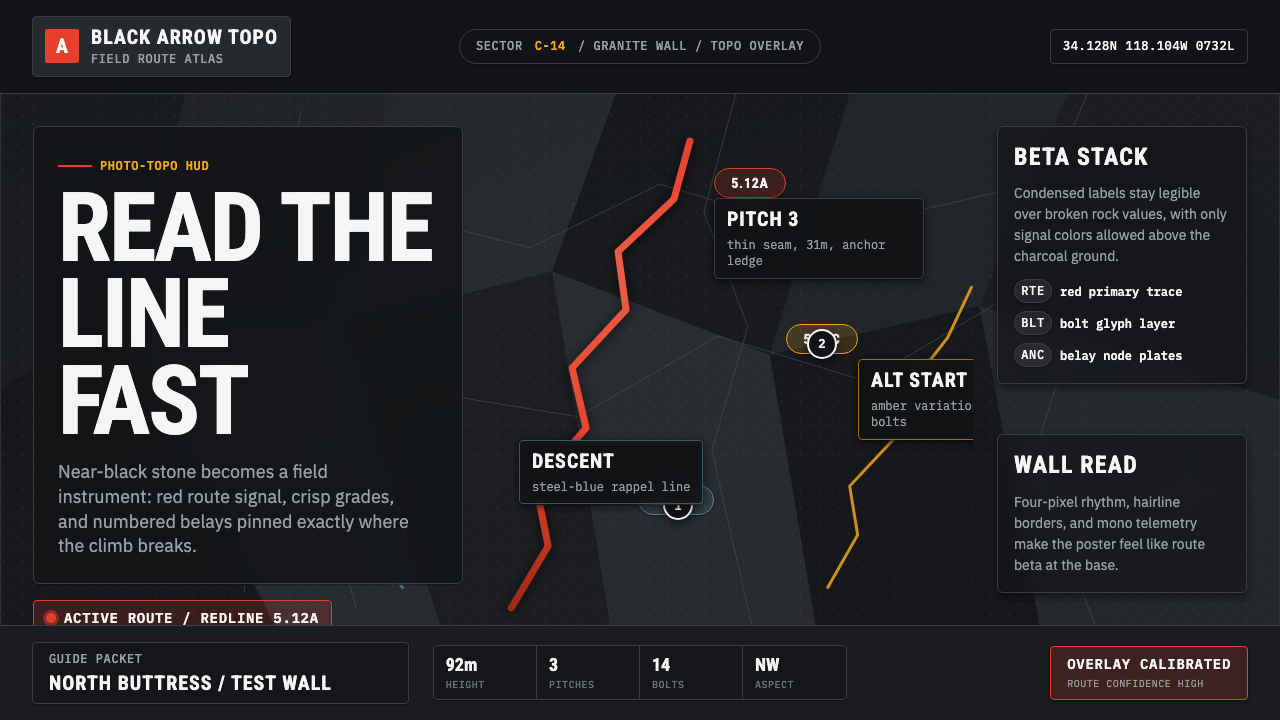 Climbing Topo GuideBeta at a glance. Red route telemetry cuts across near-black stone and conden…
 KlarnaFintech turns fashion-editorial. Dusty bubblegum pink, black Inter, and white…
 Mexican Fintech StartupNeobank, not legacy bank. White rounded cards float on near-black plum, lit b…
 Mirror's Edge Clean CityWhite becomes motion. Cool daylight planes leave one signal-red route to comm…