What is Klarna?
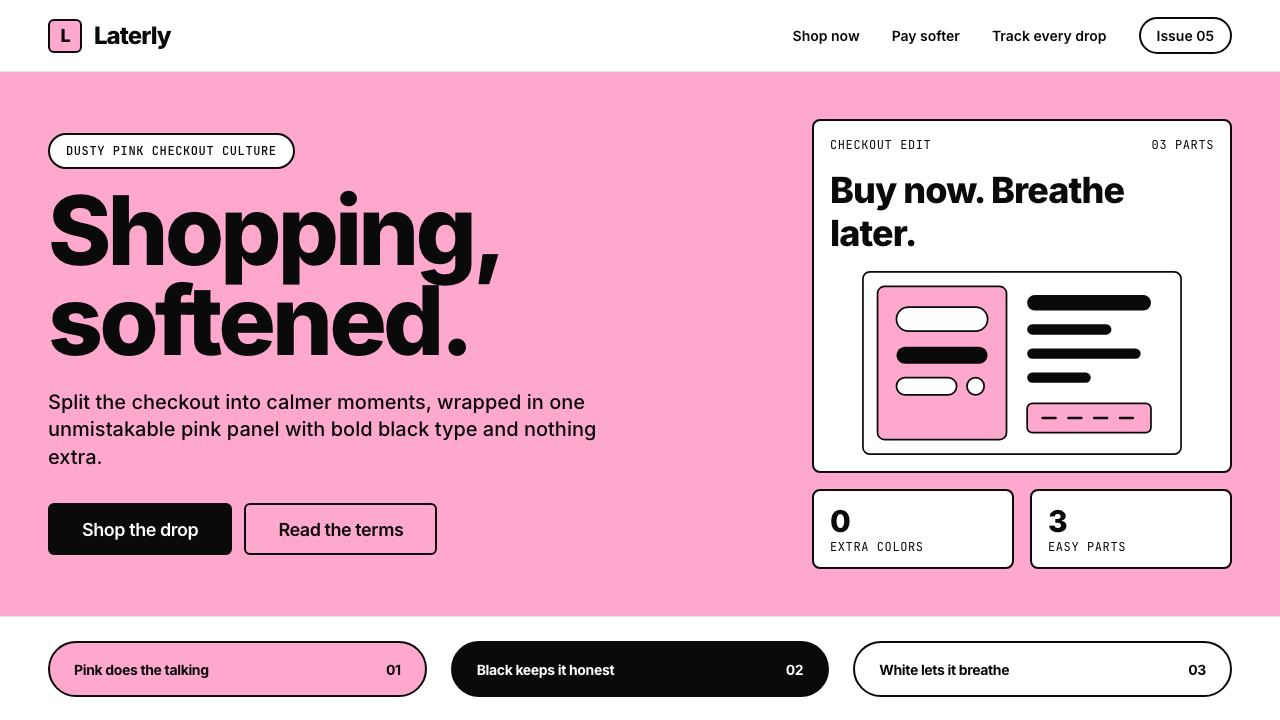
Klarna proved that a payment company could look like a fashion magazine — by stripping its palette to a single dusty pink, bold black type, and nothing else.
Klarna in brief
Klarna is a Swedish buy-now-pay-later company founded in Stockholm in 2005, and the visual identity it unveiled in its 2018 rebrand is one of the most recognizable systems in contemporary fintech. The design language centers on a single chromatic signature — a dusty, slightly greyed bubblegum pink — paired exclusively with stark black typography and generous white space. No secondary accent colors, no gradients, no decorative shadows interrupt the arrangement.
The system's authority comes from its refusal. Where most financial brands reassure through navy, grey, and gold — palettes inherited from banking's institutional past — Klarna made an almost provocative choice: a color associated with sweetness and lightness, deployed at scale across every touchpoint. The effect shifts the emotional register of consumer credit from obligation to pleasure, from friction to ease.
Two visual moves define the aesthetic in practice. First, large blocks of the signature pink are used as background fields rather than as accents, making color do structural work instead of decorative work. Second, typography is set with high contrast in weight and scale — headlines and body text occupy different leagues — so that hierarchy is established through letterforms alone, without relying on color shifts or ornamental dividers. The result is a system that communicates instantly and reads as fashionable without sacrificing clarity.

Where does Klarna come from?
Klarna was founded in Stockholm in 2005 by Sebastian Siemiatkowski, Niklas Adalberth, and Victor Jacobsson, as a solution to a practical problem: online checkout was complicated and consumers abandoned purchases at the payment step. The original product was simple — let customers buy first and pay later, spreading risk and removing friction. The business grew rapidly across Scandinavia, then into Germany, the United Kingdom, and eventually the United States, becoming one of Europe's most valuable fintech startups.
For most of its early years, Klarna's visual presentation was unremarkable — clean and professional, but indistinguishable from the broader fintech landscape. The company looked like what it was: a payment infrastructure company. That changed with a major rebrand undertaken around 2018 in partnership with DesignStudio London, a studio known for bold, character-driven identity work. The brief was to express Klarna not as a financial utility but as a brand with personality — one that stood alongside consumer lifestyle brands rather than behind them.
DesignStudio's central decision was color. The agency developed the now-signature dusty bubblegum pink as Klarna's sole chromatic identity. The choice was deliberate and research-backed: pink occupied a rare position in the competitive landscape of financial services, where no major player held it. At the same time, the softened, slightly greyed quality of the specific tone prevented it from reading as juvenile or superficial — it landed in a register closer to fashion editorial than to children's branding.
The typographic system that accompanied the color choice was equally considered. A single bold sans-serif voice carries all brand communication, set with decisive contrast in scale. The combination was reinforced by a commitment to restraint: the brand guidelines explicitly exclude secondary color families, gradient treatments, and the decorative shadows common in digital consumer products of the same era. From launch, the system proved unusually durable. Through subsequent product expansions — Klarna entered shopping, deals, and content aggregation — the core visual language remained stable, accumulating recognition without requiring revision. By the mid-2020s, the pink alone had become a trigger for brand recall across markets where the product had never been formally advertised.
What defines the Klarna look?
Chromatic Singularity
The Klarna system operates with one chromatic color — the dusty bubblegum pink — supplemented only by black and white. There are no secondary accent colors, no gradient transitions, no tonal variations within the pink family used simultaneously. This extreme reduction means that every chromatic appearance of the pink carries full brand weight, and the system accumulates recognition across applications without diluting its signal.
Pink as Architecture
Unlike brands that use color as spot accent, Klarna deploys its pink as a structural field — filling entire screen regions, card backgrounds, and hero sections. Color is not decoration applied over a layout; it is the layout. Large flat pink planes organize space and create the canvas on which black typography performs. This architectural use of color is what makes the system feel bold rather than pretty.
High-Contrast Typography
A single sans-serif voice carries all communication, but it operates at dramatically different scales and weights to establish hierarchy. Headlines are set at commanding sizes with heavy weight, while body text is proportionally lighter and smaller — the contrast between them is so great that information structure is immediately legible without needing color shifts or ornamental dividers. Uppercase lockup is common for brand marks and short statements, reinforcing the fashion-editorial register.
Absence of Decoration
The system excludes gradients, drop shadows, textural overlays, illustrative ornaments, and secondary border treatments. Surfaces are flat and opaque. Edges are clean. There is no visual noise competing with the primary color and typographic hierarchy. This austerity is not poverty of means — it is the enforced clarity that makes every element that does appear carry weight. When Klarna uses an icon or image, it inherits the same restraint: cropped cleanly, usually silhouetted or framed against flat color.
White Space as Signal
Where the pink is not, white dominates — and the switching between the two is deliberate and rhythmic. White sections provide visual breathing room and act as counterweight to the saturated pink fields. The ratio of pink to white within any composition is a design decision: it controls perceived energy, from the quiet confidence of a mostly-white page with a pink headline strip to the high-energy impact of a full pink screen. The brand rarely uses grey as a transitional tone, keeping the contrast between its two grounds crisp.
Fashion-Editorial Posture
Klarna's visual language borrows conventions from fashion media — generous page margins, typographic boldness treated as aesthetic expression, and imagery selected for mood over information. Product photography and lifestyle imagery, when used, is shot with clean backgrounds and strong lighting, treated as editorial content rather than technical documentation. This posture deliberately positions a financial utility as a lifestyle brand, communicating that shopping with Klarna is itself a desirable experience.
Consistency as the Brand Voice
Perhaps the deepest structural choice in the Klarna system is its commitment to consistency across every scale and medium. The same pink, the same typographic logic, the same anti-decoration stance appears on mobile app screens, outdoor advertising, web checkout flows, social media assets, and physical packaging. This uniformity means the system does not need complexity — recognition is built through repetition of a few very precise decisions rather than through visual variety.

Who shaped Klarna?
Co-founder and long-serving CEO of Klarna, Siemiatkowski has driven the company's strategic positioning from payment infrastructure toward consumer lifestyle brand. His articulated vision — that Klarna should feel like a trusted shopping companion rather than a lender — directly shaped the brief that led to the 2018 visual rebrand. Under his leadership, the company expanded across more than forty countries while maintaining a single, coherent visual identity, which itself became a case study in how consistent branding compounds into competitive advantage.
Co-founder of Klarna, Adalberth helped establish the company's foundational product philosophy — that reducing friction in the payment experience was itself a meaningful consumer benefit. This philosophy, which prioritized user experience over conventional financial-sector presentation norms, created the cultural conditions for the eventual visual repositioning. Adalberth later departed to found the philanthropic organization Norrsken Foundation, but his influence on Klarna's original ethos of making financial services feel effortless persists in the brand's visual simplicity.
The London-based brand agency that executed the 2018 Klarna rebrand, DesignStudio is known for identity systems built around strong, singular choices rather than comprehensive visual libraries. Their approach with Klarna — selecting a single chromatic color and refusing to dilute it with secondary palettes or decorative systems — reflects their broader design philosophy. The studio had previously worked on high-profile identity projects for companies including Airbnb and Premier League, and their Klarna work has since become one of the most cited examples of successful fintech brand differentiation.
The buy-now-pay-later sector that Klarna helped pioneer created a distinct set of visual communication challenges: the products needed to feel trustworthy enough to handle financial transactions yet approachable enough to attract consumers who distrust traditional banking. Klarna's visual resolution of this tension — premium simplicity and fashion-aligned color rather than institutional gravity — influenced a wave of subsequent fintech brands that sought to differentiate themselves from legacy banking aesthetics. The movement demonstrated that the visual language of a financial product could be decoupled from the inherited conventions of financial services design.
How do you use Klarna today?
Applying the Klarna style correctly requires internalizing its core logic: the system communicates through what it removes, not what it adds. Before placing any element, ask whether the pink, the black typography, and the white space can carry the communicative burden without supplementary color, texture, or decoration. If the answer is no, the instinct is usually to refine the content rather than to add visual complexity.
For presentation slides, the Klarna system works with exceptional force on cover and section-break pages. A cover should commit to a full pink background with a single, large, heavy-weight typographic statement in black — the contrast between the bold letterforms and the pink field is the design. Content slides work on white or near-white grounds, with typographic hierarchy carrying all organizational weight. Pink appears sparingly on content pages — as a highlight strip, a colored data bar, or a strong pull quote background — never as the general field. Data slides benefit from the system's structural clarity: bar charts, progress indicators, and comparison tables become crisp when color is restricted to the primary pink for one data series and black for the rest.
For web user interfaces, the Klarna approach is particularly well-suited to e-commerce checkout flows, product pricing pages, and account dashboard states where clarity and confidence are the primary goals. The structural pattern is consistent: white or near-white background for the functional layer, black for all informational text, and pink reserved for primary action elements — the key button, the selected state, the confirmation confirmation indicator. Shadow treatments, if used at all, should be flat and hard-edged rather than soft and diffuse. Card components look best when they use clean borders or elevation through flat-color offset rather than blurred box shadows.
For editorial and marketing applications, the Klarna style supports a poster-like directness. Full-width feature sections alternating between pink grounds with black type and white grounds with black type create rhythm without introducing new colors. Photography, when integrated, should be treated editorially: clean, high-contrast, often cropped to emphasize the subject rather than the setting. Marketing campaign assets — social cards, display advertising, out-of-home formats — benefit from the boldness of a full-bleed pink field with a single strong typographic statement, because the format rewards immediate recognizability over informational complexity.
The most common mistake when working in this style is treating the pink as one color among many, reaching for a blue or green to signal information categories, error states, or secondary actions. The Klarna system has no room for this expansion — it resolves all communication needs through the interplay of pink, black, and white alone, using scale, weight, and spatial distribution as the variables. A second common error is softening the typography, selecting a lighter weight or a more humanist letterform to avoid the style feeling cold. The hardness and weight of the typographic voice is precisely what makes the pink feel deliberate rather than accidental. Remove the contrast, and the system loses its tension.

Klarna — FAQ
Can the Klarna style work in a dark-background variant?
A dark inversion is technically possible but requires significant care. On a black ground, the dusty pink can feel unexpectedly heavy rather than light, losing the breezy quality that makes it distinctive. The system's power on a light ground comes from the brightness ratio between the pink field and the white ground — that relationship collapses on dark. If a dark variant is needed, the most coherent approach is to treat black as the structural field and use the pink exclusively for typographic elements or narrow accent lines, rather than reversing the full composition. The result will read differently from the canonical system, which should be considered a feature rather than a failure.
How does the Klarna style handle data visualization and charts?
The system's extreme chromatic restriction is both a constraint and a clarifying force in data visualization. Rather than using different colors to distinguish data categories — the default convention in most charting libraries — the Klarna approach relies on contrast between the signature pink and black, with white used as the ground. For a single data series, pink fills naturally. For comparisons requiring distinction, the convention is pink versus black, or solid versus outlined, rather than introducing a second hue. This approach forces compositional clarity: if a chart cannot be read in two tones, the underlying data presentation needs rethinking. Charts designed this way tend to be simpler and more immediately readable than their colorfully coded equivalents.
What kinds of products or brands should avoid the Klarna style?
The Klarna style communicates lightness, modernity, and a kind of deliberate sweetness — emotional registers that are a poor fit for contexts requiring authority, gravity, or institutional trust. Healthcare providers, legal services, financial planning tools aimed at older demographics, and government-adjacent services would likely suffer from the style's playful connotations. Similarly, the style's simplicity can feel thin in contexts where richness, tradition, or cultural depth are valued — luxury goods with artisanal heritage, cultural institutions, or editorial contexts covering serious topics. The style is at its best where the product genuinely wants to feel easy, contemporary, and slightly surprising.
Is the Klarna visual system minimalism?
It shares surface characteristics with minimalism — reduced palette, absence of decoration, generous white space — but the underlying logic is different. Minimalism, in its contemporary use, tends toward quietness and neutrality: the palette often includes warm greys, soft textures, and muted tones that recede rather than assert. The Klarna system is assertive. The pink is not chosen because it disappears; it is chosen because it demands attention. The typographic treatment is bold, not delicate. The system uses restraint, but not in service of neutrality — it uses restraint in service of impact. A better description might be high-reduction boldness: everything removed except the elements that maximize presence.
How should imagery and photography be selected and treated when using this style?
Imagery in the Klarna system works best when it is treated as editorial rather than documentary. Select photographs with clean, uncluttered backgrounds — ideally white, cream, or a neutral — so that the subject reads as a graphic element against the ground rather than as a window into a complex scene. High contrast and strong, directional lighting reinforce the system's structural boldness. Avoid photographs with ambient softness, golden-hour warmth, or lifestyle complexity — they import a tonal range and an emotional warmth that competes with the system's chromatic restriction. When images appear alongside the signature pink, the most coherent treatment is either a contained rectangular crop on a white ground, or a full-bleed photograph where a pink typographic overlay carries the brand voice.
Related design styles
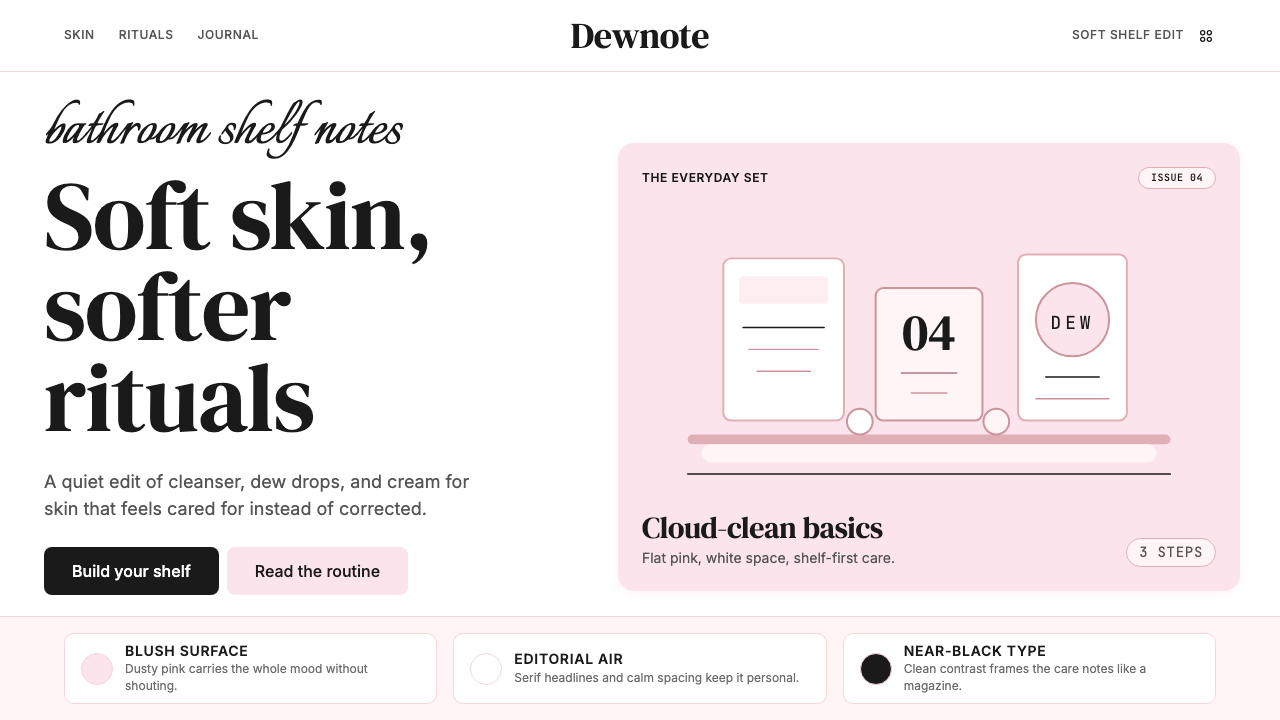 GlossierBeauty as a friend's conversation. Dusty pink (never bubblegum), editorial se…
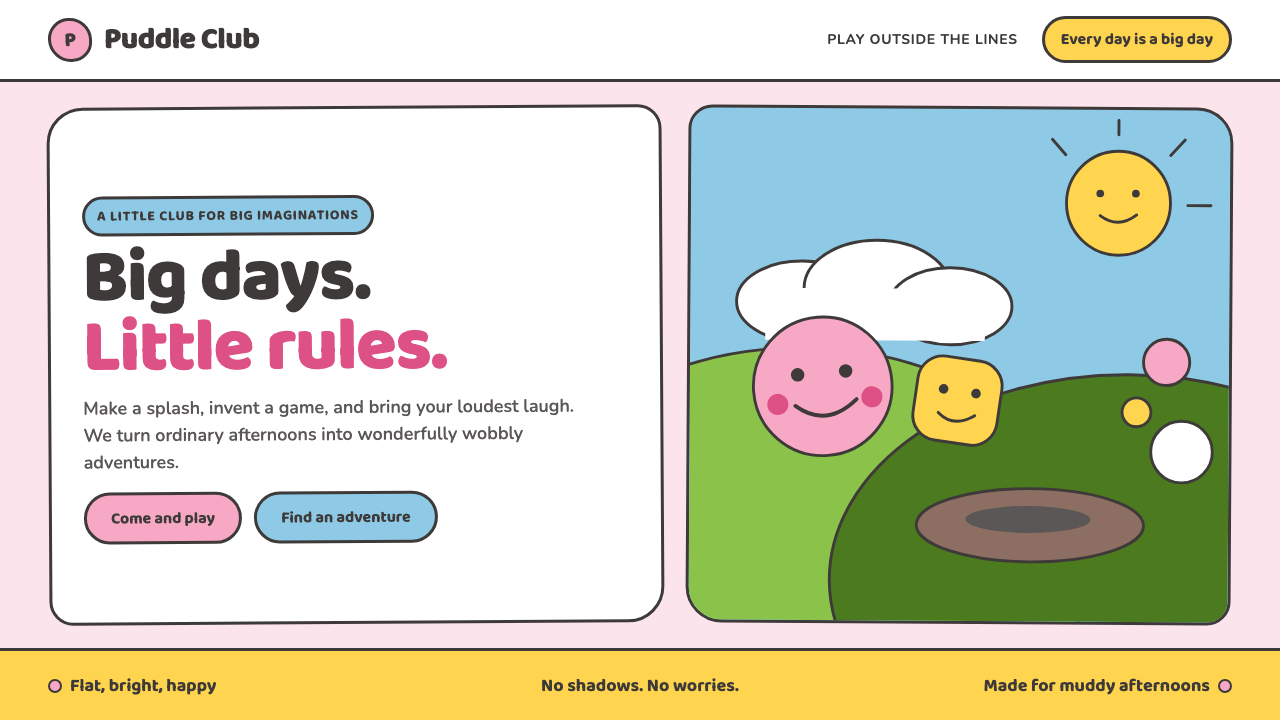 Peppa Pig (2004)Cheer without irony. Bubblegum pink, chubby type and thick outlines keep ever…
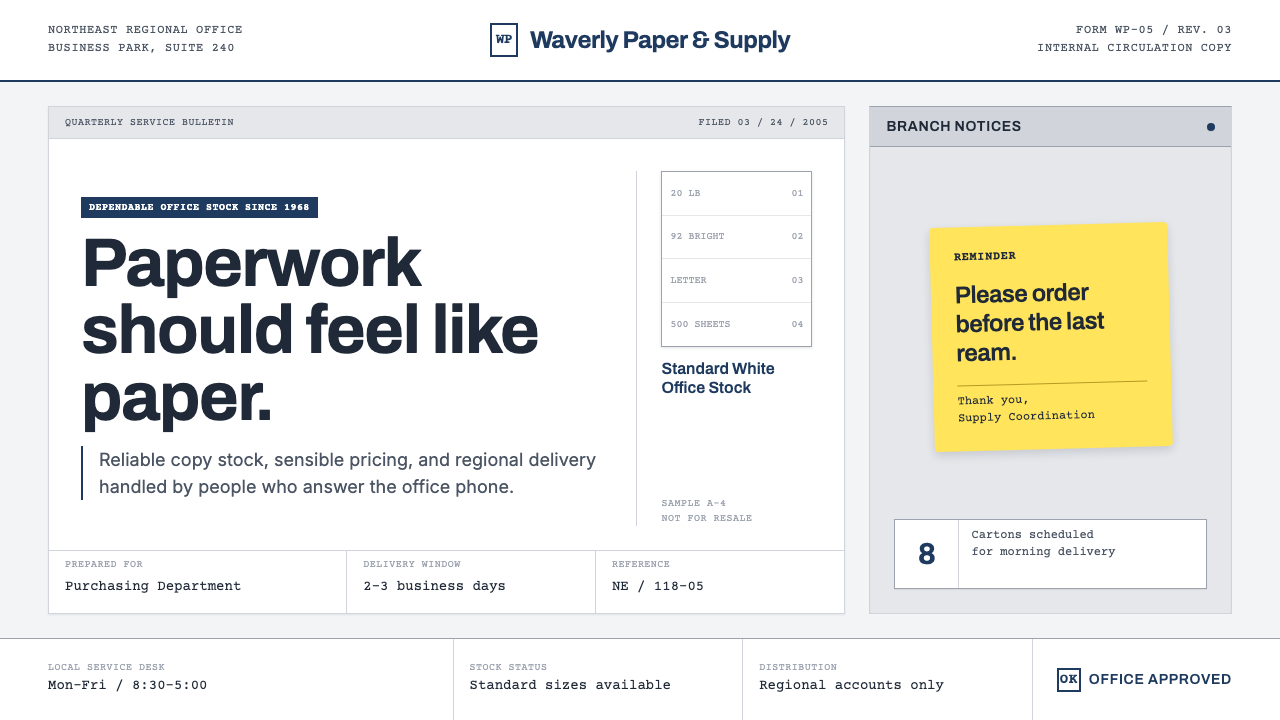 The Office (Dunder Mifflin, 2005)Mundanity is the punchline. Copier white, cubicle gray, memo grids, and one y…
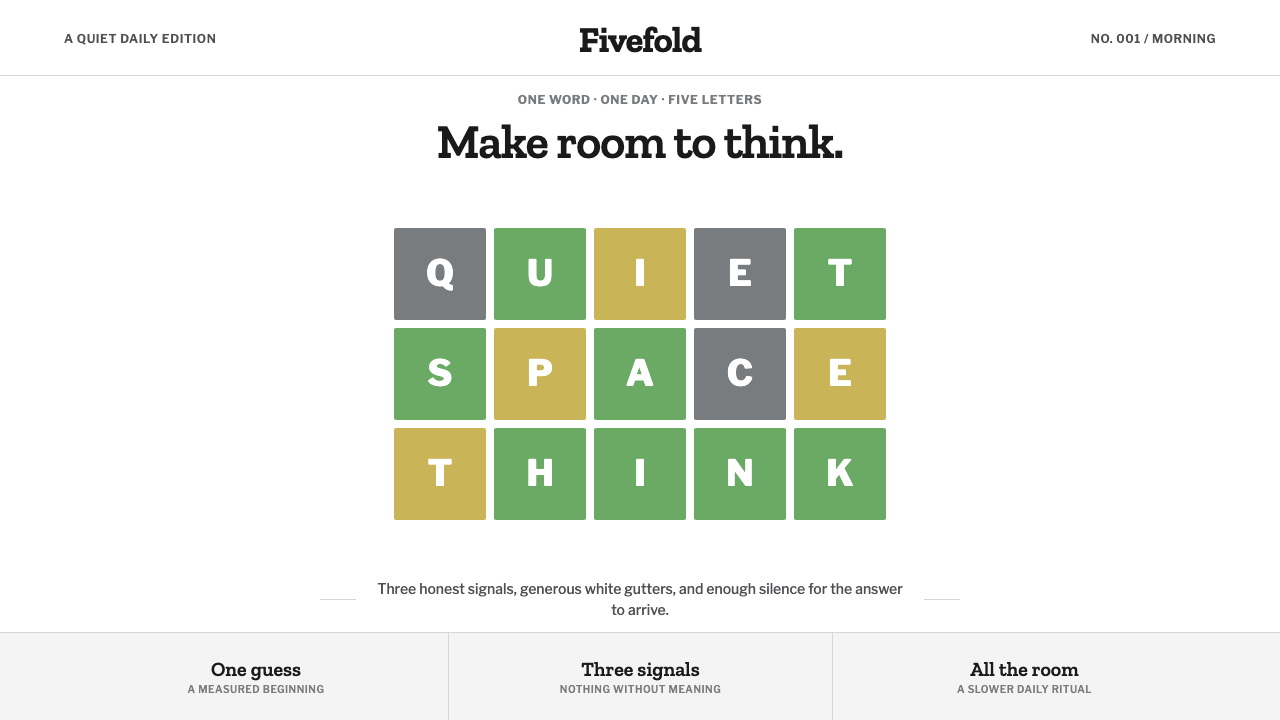 Wordle (2021)Quiet becomes addictive. Olive green, dusty gold, and gray score a strict gri…
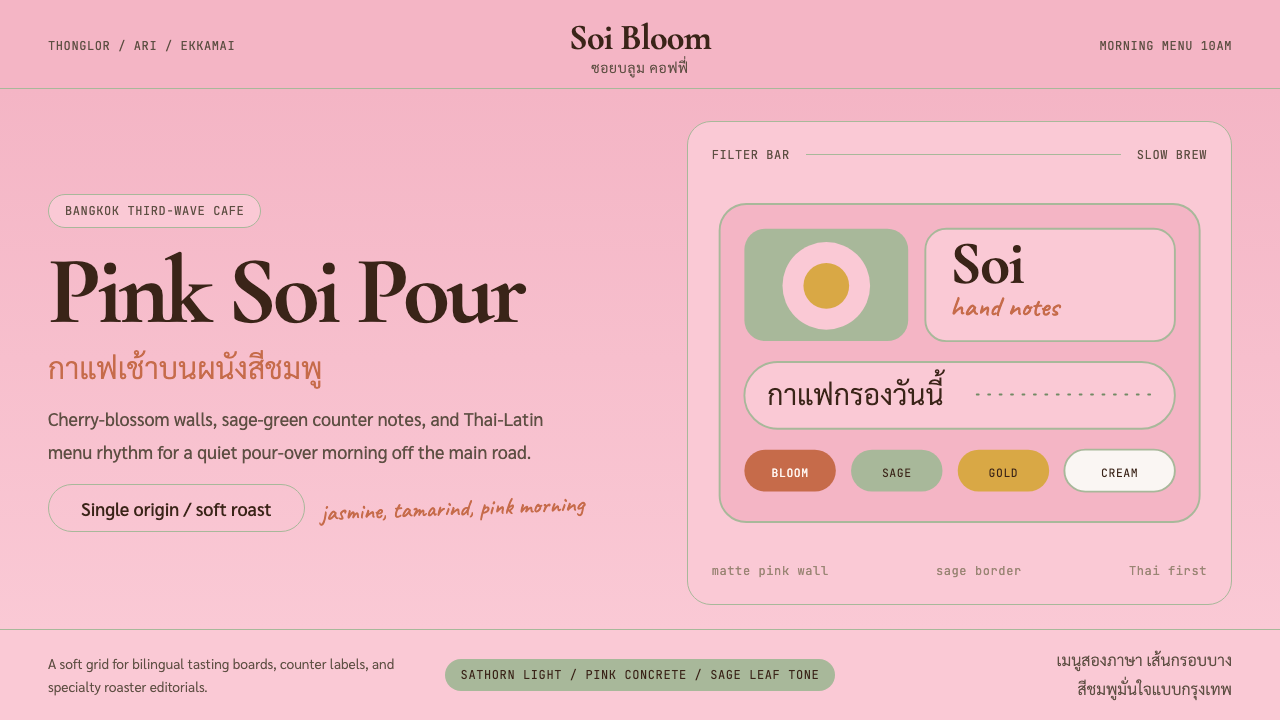 Bangkok Third-Wave CafeBangkok feels soft but sure. Cherry pink, sage borders, and Thai-Latin menu r…
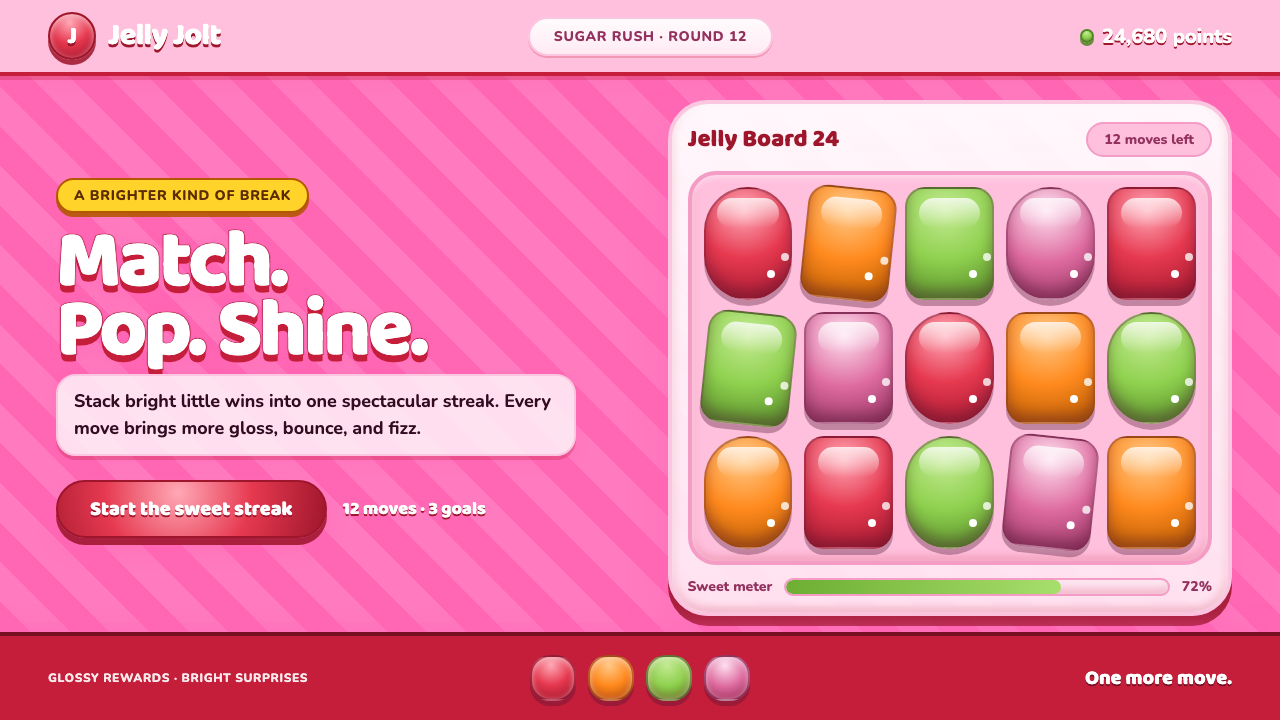 Candy Crush (2012)Sugar rush without restraint. Glossy candy tiles pulse across a striped bubbl…