What is K-Beauty Clean?
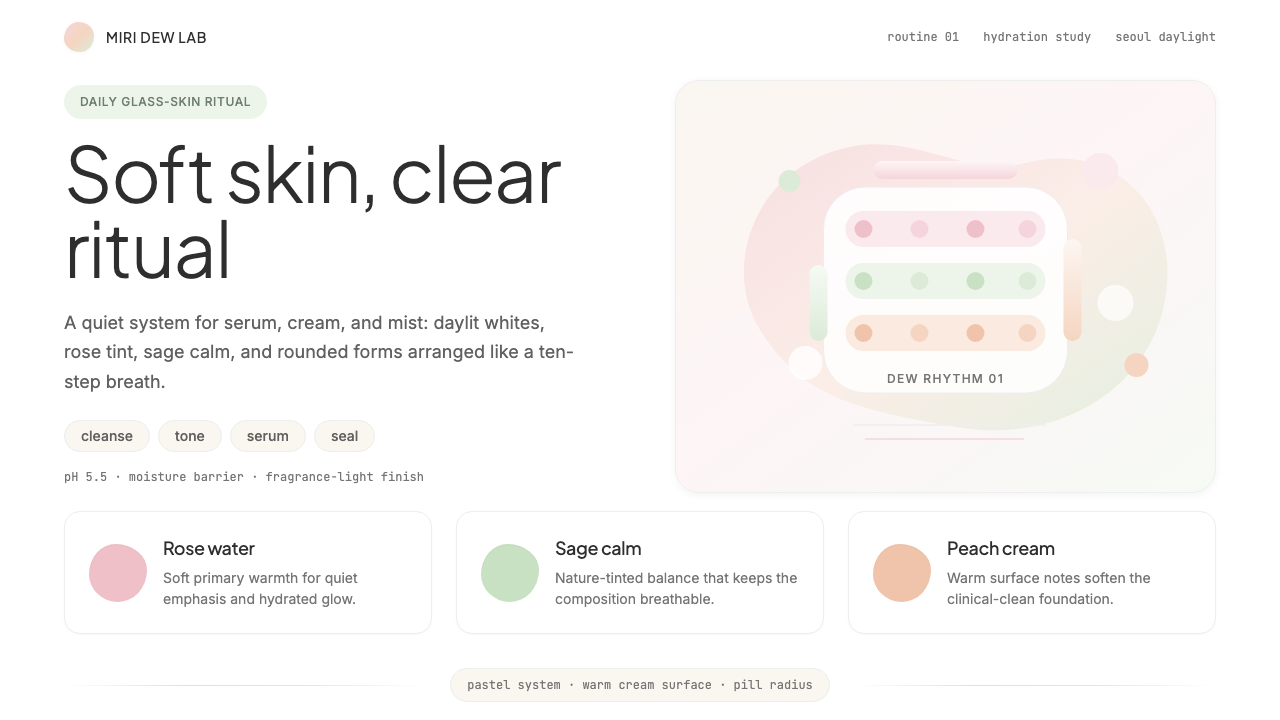
K-Beauty Clean translates the dewy, glass-skin glow of Seoul's skincare revolution into a design language built on soft pastels, generous white space, and typography as calm as a freshly cleansed face.
K-Beauty Clean in brief
K-Beauty Clean is a visual design system derived from the global wave of South Korean skincare culture. It draws on the packaging, retail identity, and digital presence of brands that made 'glass skin' — luminous, hydrated, poreless-looking skin — a worldwide aspiration. The palette runs through soft rose, sage, peachy beige, and milky white, anchored by crisp off-white grounds that evoke freshly washed skin rather than clinical sterility. Every surface feels moisturized: smooth, light-reflective, never harsh.
The aesthetic philosophy at the core of K-Beauty Clean is skincare-as-self-care. Korean beauty culture reframed the daily skincare routine from an obligation into a ritual of gentle attentiveness — and the visual language follows. Forms are rounded and organic rather than angular. Layouts breathe with intentional white space. Interactive elements like pill-shaped buttons and softly rounded cards feel approachable and friendly. Nothing shouts; everything invites.
Unlike minimalism that achieves restraint through severity, K-Beauty Clean achieves restraint through softness. It is refined without being cold, clean without being blank. The result is a system that works equally well for a ten-step skincare brand, a wellness subscription app, or a beauty editorial — anywhere the experience needs to feel nurturing, trustworthy, and effortlessly elegant.

Where does K-Beauty Clean come from?
The visual language of K-Beauty Clean cannot be separated from the rise of the Hallyu wave — the Korean Wave of cultural exports, including K-pop, K-drama, and K-beauty — that accelerated through the 2010s and reached peak global mainstream influence between roughly 2014 and 2020. South Korean skincare brands, which had long developed sophisticated multi-step routines and innovative formulations at home, found themselves suddenly in global demand. Brands like Innisfree, Laneige, Cosrx, and Sulwhasoo were forced to develop design identities that could communicate across cultural contexts while retaining the distinctly Korean sensibility of their origin.
The aesthetic roots of K-Beauty Clean reach into Hanji paper culture, celadon ceramics, and the restrained color philosophy of traditional Korean court dress — where soft, undyed or lightly tinted fabric was prized over vivid color. These cultural textures informed the palette choices of early K-beauty packaging designers: muted tones, gentle gradations, and forms that feel hand-touched rather than factory-stamped. The influential Innisfree design team, working from the brand's Jeju island nature positioning, pioneered the use of botanical photography on minimal, breathing white grounds that became a template across the industry.
The American beauty editor Emily Weiss and the global clean beauty movement of the mid-2010s played an important amplifying role. Weiss's Glossier, though American, absorbed and rebroadcast many K-beauty visual codes — the skin-first philosophy, the dewy glow, the soft millennial pink — to an English-speaking audience already primed by K-drama aesthetics on streaming platforms. This cross-pollination meant that K-Beauty Clean as a design language became genuinely international: a synthesis of Seoul's product innovation and a global appetite for gentle, sensorial self-care.
The digital maturation of the style happened alongside the rise of Instagram and YouTube beauty content from approximately 2015 onward. Skincare influencers filming their ten-step routines needed backgrounds and branding that felt consistent with the products: softly lit, pastel-toned, uncluttered. Brand digital channels — Instagram grids, product landing pages, app interfaces — developed a coherent visual grammar in response: rounded thumbnails, tonal palettes, generous padding, and type that felt as light as a serum. By the early 2020s, K-Beauty Clean had become a recognized and widely imitated global aesthetic, applied far beyond beauty into wellness tech, food and beverage, and lifestyle subscription products.
What defines the K-Beauty Clean look?
Palette
The color vocabulary runs through soft, desaturated pastels — powder rose, celadon sage, peachy beige, and lavender mist — layered over milky white or warm off-white grounds. Accents are kept within the same low-saturation family rather than introduced as sharp contrast. The overall effect is tonal and harmonious, evoking a skincare flatlay rather than a graphic poster. Black is used sparingly and only for body text or fine structural lines; it never dominates.
Form and Shape
Rounded corners and pill-shaped elements are the signature of K-Beauty Clean. Buttons, cards, tags, and containers all carry generous border-radius, softening the visual field into something that feels touchable and gentle. Organic blob-like shapes — irregular, asymmetrical, echoing water droplets or facial serums — appear as background motifs and decorative accents. Angular or perfectly geometric forms are avoided; everything curves slightly, breathing warmth into the layout.
Typography
Type selection leans toward clean, geometric sans-serif faces with friendly proportions — slightly wide letterforms with open apertures that feel approachable rather than authoritative. Weight contrast is gentle: headlines step up in size without turning heavy or imposing. Letter-spacing in headings is slightly open, adding to the airy, unhurried quality of the layout. Korean Hangul script, where present, is chosen for its rounded, balanced stroke structure that harmonizes naturally with the overall softness of the system.
White Space and Layout
Generous white space is not a secondary concern but a primary design material in K-Beauty Clean. Elements are given room to breathe; nothing crowds. Column widths are comfortable for reading, with wide margins that let the eye rest. Vertical rhythm is slow and unhurried, with ample space between sections. This spacing philosophy mirrors the pacing of a skincare routine — deliberate, attentive, never rushed — and signals that the brand cares about the user's experience of calm.
Surface and Texture
K-Beauty Clean favors surfaces that suggest luminosity without introducing literal texture. A very subtle gradient on a card background — shifting from milky white to the palest pink — evokes the light-reflective quality of well-moisturized skin. Frosted glass effects and soft, diffused glows replace hard shadows. Where shadows appear, they are barely-there, pale, and cool-toned — more like the shadow under a floating petal than a structural anchor. This treatment makes the interface feel fresh and skin-like, never flat or matte.
Imagery and Photography
Photography in K-Beauty Clean is styled with consistent intentionality: soft, diffused natural light — never harsh studio strobes — on pale backgrounds. Products are arranged in flatlay compositions with botanical props — dried florals, fresh herbs, translucent serum drops — that reinforce the natural and gentle positioning. Skin photography is dewy and close-toned, avoiding high-contrast dramatic lighting. Illustrations, when used, tend toward delicate line work or watercolor-adjacent washes in the pastel palette, never bold graphic shapes.
Tone and Micro-copy
The written voice that accompanies K-Beauty Clean design is warm, personal, and gently encouraging — a friend who knows skincare rather than a clinical expert issuing instructions. Button labels use soft imperatives ('Discover your routine', 'Start glowing') rather than transactional commands ('Buy now', 'Submit'). Error messages are apologetic and helpful, not curt. Onboarding copy acknowledges the user's individuality. This voice consistency is as much a part of the aesthetic system as the color palette.

Who shaped K-Beauty Clean?
The design team behind Innisfree — AmorePacific's nature-focused brand anchored in Jeju Island — created some of the most widely imitated packaging and digital templates in K-beauty history. Their approach of placing minimal, botanically-detailed product photography on spacious white grounds, pairing it with clean rounded type and a restrained green-and-cream palette, defined what international audiences recognized as the K-beauty aesthetic from the mid-2010s onward. Their work influenced how the entire industry presented skincare as a gentle, nature-connected ritual.
Laneige, another AmorePacific flagship, became globally synonymous with the 'water bank' and dewy glow concept that underpins much of K-Beauty Clean's visual identity. The brand's design team developed a visual system built around deep water blues, luminous whites, and translucent product photography that literally showed the glistening texture of hydration. Their campaign imagery — often featuring water, light reflections, and a cool, clean atmosphere — established a template for how Korean beauty brands communicate the sensation of moisture through design rather than just copy.
Cosrx represents a different strand of K-Beauty Clean — the clinical-minimal variation that strips back even the soft pastels in favor of stark white, pharmaceutical packaging aesthetics, and ingredient-first transparency. Their design philosophy, which deliberately avoided luxury signaling and emphasized the functional honesty of what was inside the bottle, influenced a generation of direct-to-consumer skincare brands worldwide. Cosrx demonstrated that K-Beauty Clean could communicate trust and efficacy through restraint just as effectively as it could communicate indulgence through softness.
Though American, Emily Weiss — founder of Into The Gloss and Glossier — acted as a crucial cultural translator between the Korean beauty world and the English-speaking West. Her editorial and brand work absorbed and rebroadcast K-beauty visual codes — the skin-first philosophy, the dewy flatlay aesthetic, the millennial pink tones, the conversational copy voice — to an audience primed by K-drama and K-pop through streaming platforms. Glossier's visual identity helped establish K-Beauty Clean as a globally legible aesthetic language, not just a Korean export.
Sulwhasoo, AmorePacific's luxury Korean herbal skincare brand, developed the premium end of the K-Beauty Clean spectrum. Their design team blended traditional Korean craft references — celadon glazes, hanji paper texture, the asymmetric elegance of Korean lacquerware — with modern minimal packaging to create a visual language that was unmistakably Korean yet globally luxurious. Sulwhasoo demonstrated how K-Beauty Clean could carry deep cultural specificity without sacrificing international accessibility, and influenced how global luxury beauty brands began integrating East Asian craft aesthetics.
How do you use K-Beauty Clean today?
K-Beauty Clean is among the most versatile contemporary styles for digital products that need to feel trustworthy, approachable, and premium simultaneously. The key to applying it correctly lies in understanding that its restraint comes from softness rather than severity — the goal is warmth through refinement, not minimalism through subtraction. Every design decision should ask: does this feel gentle? Does this breathe? Does this invite rather than demand?
For presentation slides, K-Beauty Clean excels on cover slides that establish an immediate mood: a full-bleed pastel ground, a single organic shape as a background element, and a title set in clean rounded type with generous letter-spacing. The dewy, airy quality should feel immediate. Content slides work best when treated as breathing galleries — one key idea per slide, generous padding around all elements, and a tonal illustration or product-quality photograph as the visual anchor. Data slides should adopt a soft-primary palette for charts, with rounded bar corners and gentle grid lines that feel like guide marks rather than cage bars. Avoid dense tables; translate data into simple, visually calm forms.
For web interfaces — particularly dashboards, wellness app home screens, and subscription product landing pages — K-Beauty Clean delivers its clearest value. The recommended approach is a warm off-white or milky base, a restrained two or three-tone pastel accent system, rounded card components with barely-there shadows, and typography that favors generous line-height and unhurried spacing. Pricing pages benefit from the style's inherent trustworthiness: soft pastel tier cards, a rounded highlight state for the recommended plan, and copy that speaks to the user's wellbeing rather than the transaction.
For editorial and marketing use, K-Beauty Clean supports high-quality lifestyle photography with minimal graphic intervention. The design's role is to frame and breathe — to give images room and to provide quiet typographic scaffolding rather than competing for attention. A K-Beauty editorial layout typically leads with a full-width hero image in natural light, followed by narrow body columns with wide margins, section breaks marked by soft tonal dividers rather than bold lines, and callouts set in a slightly larger, spaced version of the body face. Marketing email templates work well with a single accent-color call-to-action button — pill-shaped, never rectangular — against a pale background.
A common mistake when applying K-Beauty Clean is over-saturating the palette. The style's pastels are inherently low in saturation; introducing even one color at full vibrancy immediately breaks the tonal harmony and makes the design feel cheap rather than refined. A related mistake is using too many pastel tones at once — the system works best with a primary neutral ground, one dominant pastel accent, and one secondary accent used sparingly. Designers also frequently underestimate the importance of spacing: the dewy, airy quality of the style depends entirely on generous white space. Shrinking margins or tightening padding to fit more content destroys the atmosphere that makes the style work.

K-Beauty Clean — FAQ
Is K-Beauty Clean only appropriate for beauty and wellness brands?
Not at all — the style has migrated well beyond its origin category. Its core values (softness, trust, clarity, approachability) translate cleanly to any product where the user's emotional state matters: food and beverage subscription services, fertility and women's health apps, journaling and mindfulness tools, and premium lifestyle e-commerce. It works less well for products that need to signal power, precision, or technical authority — engineering tools, financial trading platforms, or cybersecurity products — where the gentle aesthetic can feel misaligned with what users need to feel confident in the product.
How do I prevent K-Beauty Clean from looking generic or bland?
The style's widespread adoption has produced many imitations that capture the surface markers — pink, rounded, lots of white space — without the underlying discipline. Differentiation comes from three areas. First, specificity of palette: choose a narrow two or three-tone combination and apply it consistently rather than pulling from a generic blush-and-sage library. Second, typographic voice: invest in the micro-copy and heading language; warmth of voice is a major differentiator when the visuals are quiet. Third, photography quality: the style amplifies great photography and exposes mediocre photography mercilessly; a truly distinctive K-Beauty Clean design usually has a signature photographic style developed specifically for the brand.
Can K-Beauty Clean work in a dark-mode interface?
A dark adaptation is possible but requires a significant shift in approach. True dark K-Beauty Clean does not simply invert the palette — a cream-on-black reversal tends to feel clinical or futuristic rather than warm. The more successful approach is a deep, warm charcoal or muted navy as the base, with the pastel accents shifted slightly more luminous (as if lit from within) and all shadows removed in favor of subtle, warm glows. Product photography needs to be reshot or re-graded for dark grounds. Expect that roughly half the visual warmth of the light version will be lost, and compensate through particularly careful typographic spacing and warmer accent tones.
How does K-Beauty Clean differ from generic 'millennial pink' design?
Millennial pink as a trend (roughly 2016–2019) was primarily a color phenomenon — a specific dusty rose tone applied across industries with little underlying system. K-Beauty Clean is a full design system: the color choices are part of a coherent philosophy that also governs form (rounded, organic), spacing (generous), typography (friendly, unhurried), imagery (naturally lit, dewy), and voice (warm, personal). A millennial pink design might use the right color while getting everything else wrong. K-Beauty Clean without the pink still reads as K-Beauty Clean, because the system's character is carried primarily by form, spacing, and imagery rather than by any single color.
What are the most important things to get right when using this style for a data-heavy product?
Data-heavy interfaces are among the harder contexts for K-Beauty Clean because the style's strength — generous spacing, gentle contrast, minimal visual hierarchy — can work against information density. The keys are: first, use the pastel palette as a semantic system for data (one tone for each category or state) rather than decoratively; second, maintain the generous spacing within individual components even while fitting more components on screen — internal padding matters more than external margins when density is needed; third, replace hard data grid lines with very soft tonal bands that organize information without feeling like cages; and fourth, use the typographic hierarchy aggressively for data labels and metrics — size contrast is the primary organizing tool when color contrast must stay low.
Related design styles
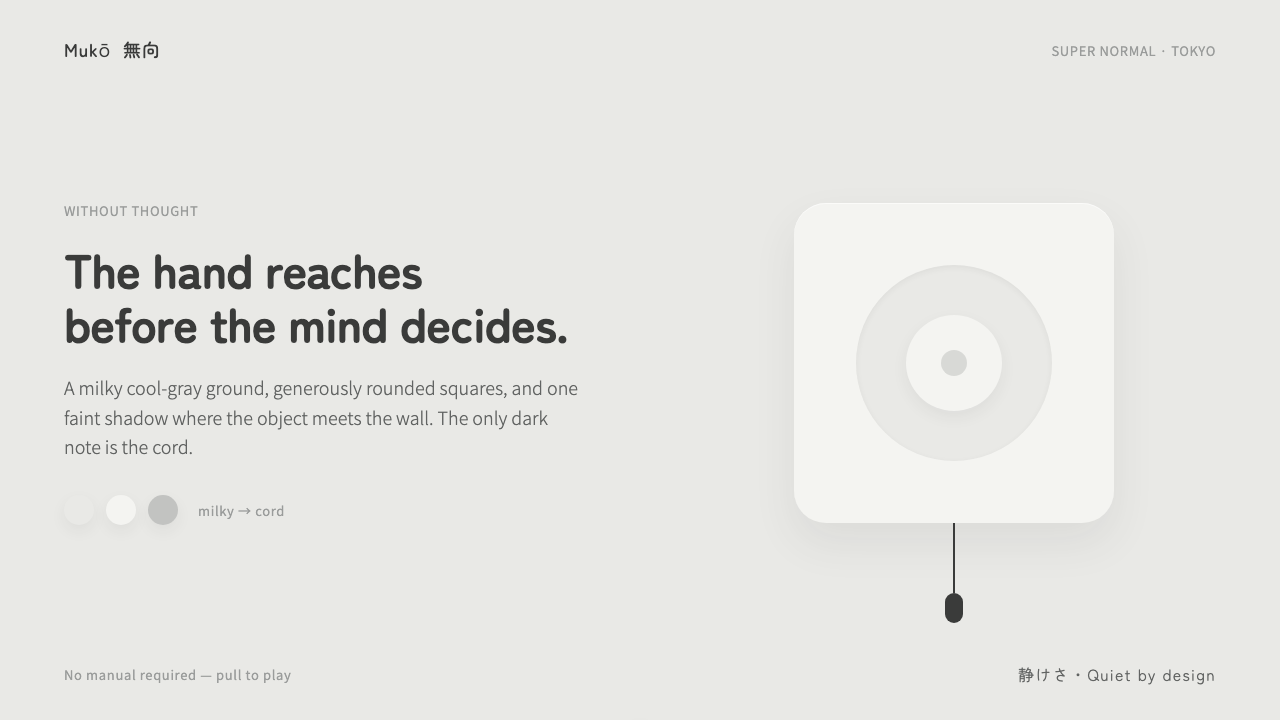 Fukasawa Without ThoughtHand reaches before mind decides. Milky cool-gray plastic, rounded squares, o…
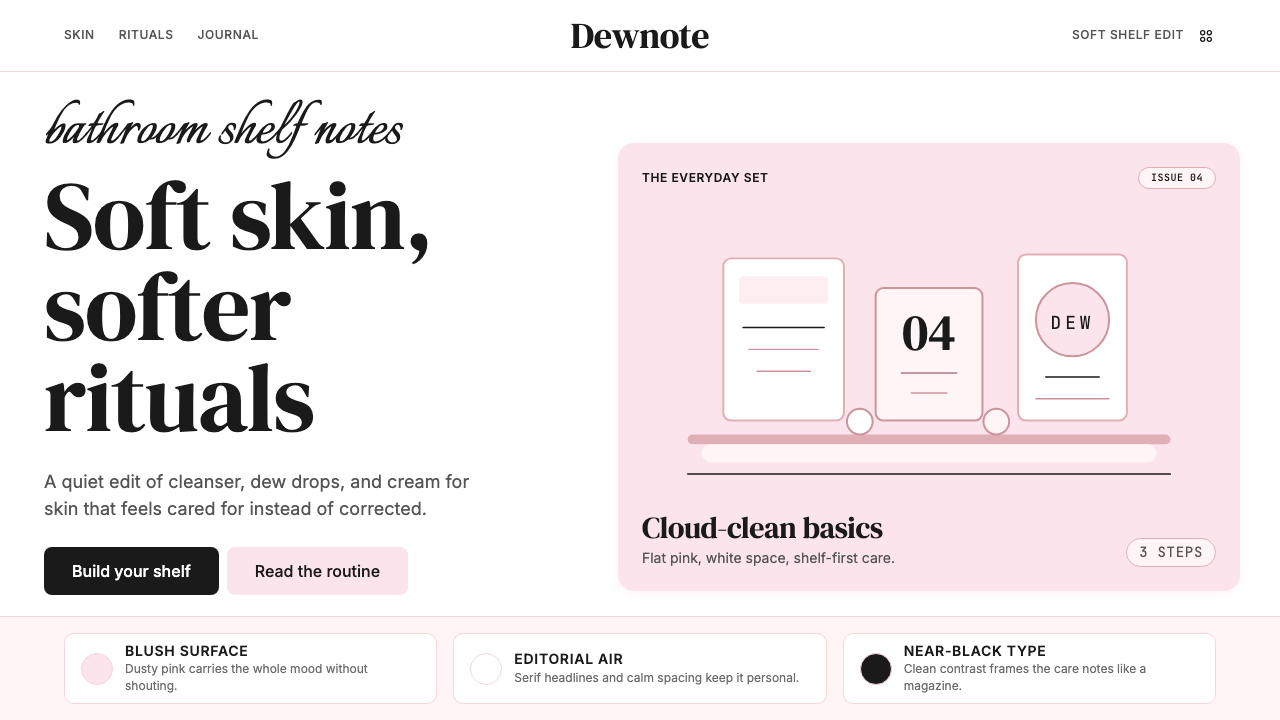 GlossierBeauty as a friend's conversation. Dusty pink (never bubblegum), editorial se…
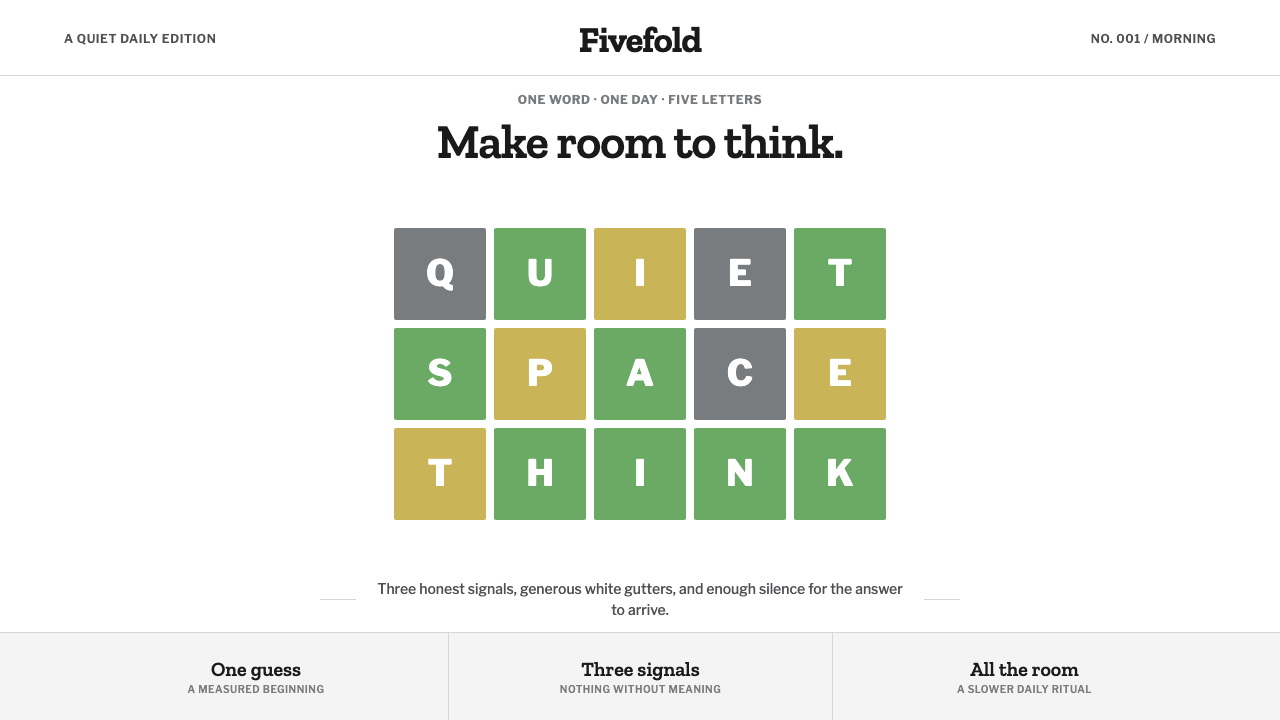 Wordle (2021)Quiet becomes addictive. Olive green, dusty gold, and gray score a strict gri…
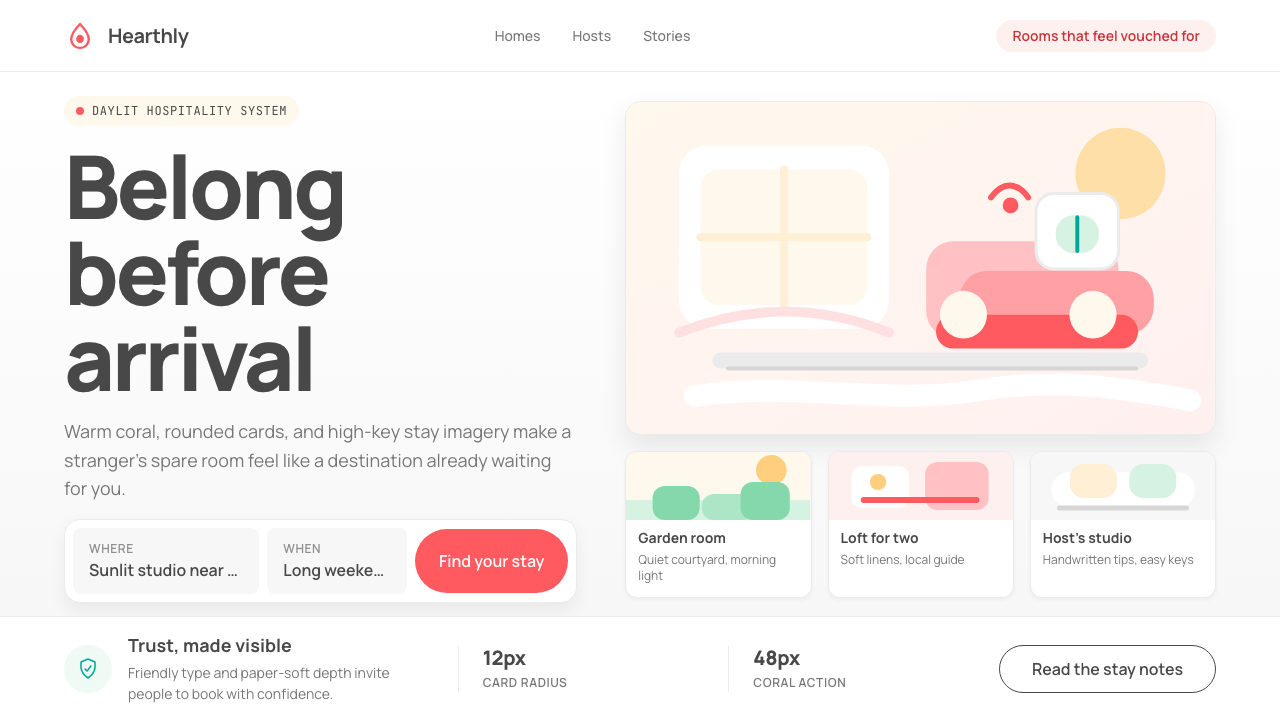 Airbnb 2014Coral red, soft pill cards, Cereal type. The Bélo wraps strangers in warm, da…
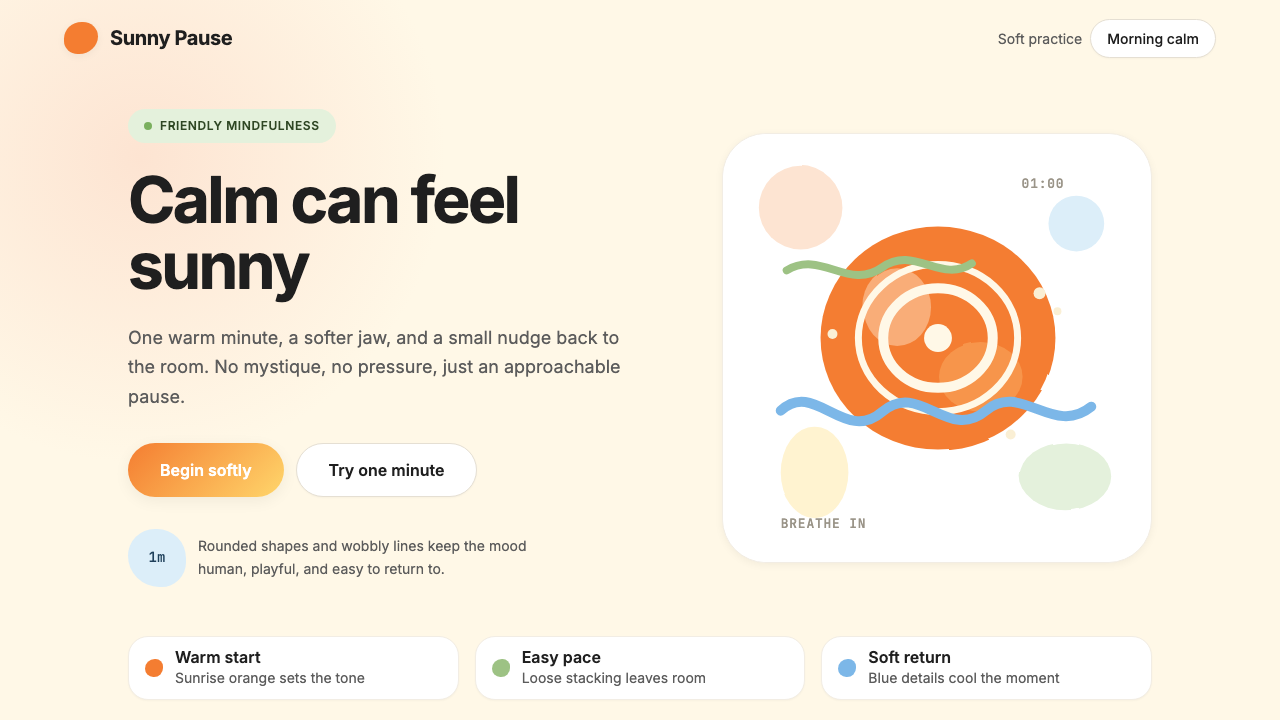 HeadspaceOptimism makes calm approachable. Sunrise orange and wobbly rounded forms bre…
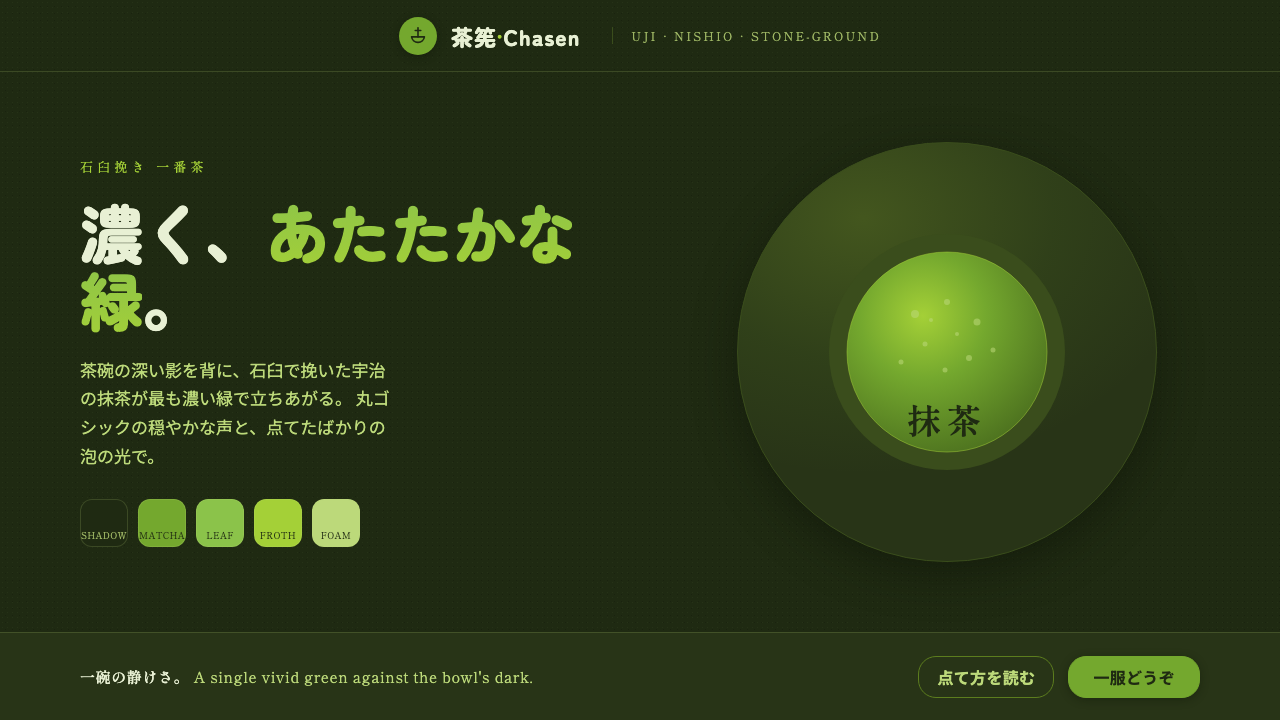 Matcha Latte Powder GreenA single vivid green at full strength. Stone-ground matcha on a dark tea-bowl…