What is Scandi Hygge (IKEA)?
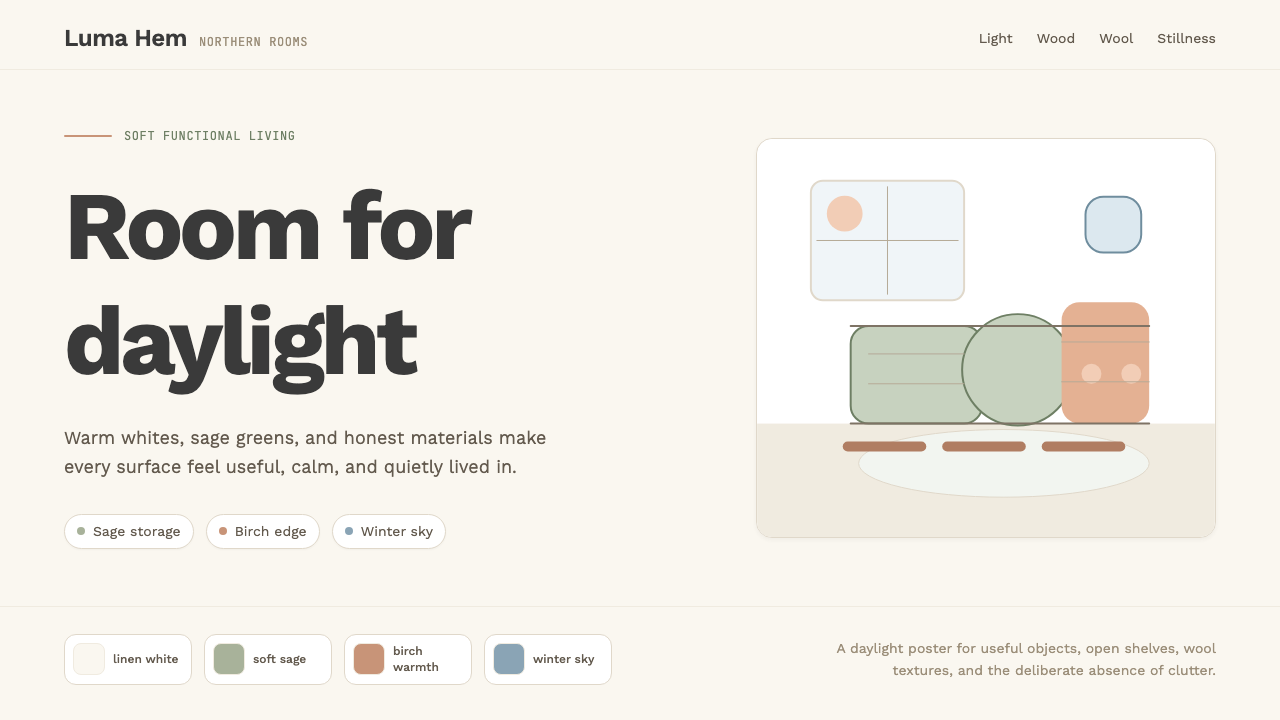
Scandinavian design extracts warmth from restraint — blonde wood, open light, and unhurried whitespace turned into a globally recognized language of liveable calm.
Scandi Hygge (IKEA) in brief
Scandi Hygge is the visual and philosophical system that emerged from a century of Scandinavian design thinking and reached global mass recognition through IKEA's retail showrooms and the mid-2010s international enthusiasm for the Danish concept of hygge — a word pointing to cosiness, conviviality, and the deliberate cultivation of comfort. As a design language, it is defined by warmth within austerity: natural materials rendered in pale, desaturated tones; generous whitespace that feels welcoming rather than sterile; soft rounded forms that invite touch; and an insistence on functional purpose balanced with sensory ease.
Where Bauhaus strips design to its geometric skeleton, Scandi Hygge softens the same minimalist impulse with human warmth. The palette is drawn from Nordic interiors — linen whites, birch creams, sage greens, dusty clays, slate blues — all muted to a degree that recalls indirect northern light filtering through frosted glass. Typography is humanist rather than geometric, carrying a friendliness that pure sans-serifs lack. Corners are rounded, not sharp. Breathing room is not emptiness but hospitality.
On screen, the Scandi system translates seamlessly. Warm white grounds, humanist type set with careful rhythm, generous line-height that slows the eye into reading, soft card elevation that suggests paper rather than glass, and nature-derived accent tones used sparingly to signal warmth or action. The result is a visual environment that feels considered, approachable, and calm — qualities that have made this aesthetic dominant in consumer software, wellness applications, home goods e-commerce, and content platforms worldwide.

Where does Scandi Hygge (IKEA) come from?
The foundations of Scandinavian design were laid in the 1930s through the 1960s by a generation of architects and craftspeople who shared a conviction that well-designed objects should be available to everyone, not merely to the wealthy. The Finnish architect Alvar Aalto bent birch plywood into organic curves for chairs and stools, discovering that natural materials need not be rigid. The Danish architect Arne Jacobsen produced the Egg Chair and the Swan Chair — molded shell forms in fabric and foam that defied the era's dominant orthogonal logic. The Danish cabinetmaker Hans Wegner refined the joinery of the Wishbone Chair over hundreds of sketches, seeking a form that was simultaneously beautiful, structurally honest, and comfortable for daily use. Each of these designers worked from a shared premise: simplicity is not the absence of care but the presence of rigorous attention.
IKEA was founded in 1943 by Ingvar Kamprad in the Swedish province of Småland. Initially a mail-order business selling small household goods, it pivoted to furniture in 1948 and adopted flat-pack design in the 1950s — not as an aesthetic choice but as a logistical solution to the problem of transporting bulky wooden furniture affordably. The flat-pack format forced designers to rethink how furniture was assembled, which in turn simplified forms, reduced hardware, and concentrated attention on surface and material quality. The first IKEA showroom opened in Älmhult in 1958, and the format of the warehouse-showroom — vast, bright, arranged like a walk-through home — became the sensory template through which millions of people first encountered Scandinavian design principles.
The concept of hygge entered Danish cultural life as a loan word from the Norwegian, derived ultimately from an Old Norse root meaning comfort or consolation. It was in common everyday use in Denmark and Norway for generations, but its international export happened abruptly around 2016, driven by a wave of popular books — most notably Meik Wiking's 'The Little Book of Hygge', published that year — and a broader cultural moment in which digital overload and social fragmentation made the idea of deliberate, slow, candle-lit conviviality feel urgent and desirable. Hygge was not, strictly speaking, a design movement; it was a lifestyle concept. But its visual associations — warm interiors, natural textures, muted wool and ceramics, low amber lighting, the particular warmth of a wooden surface in winter light — mapped directly onto the Scandi design language that IKEA had been distributing for decades.
The convergence of mid-century Scandinavian craft, IKEA's global distribution, and the hygge cultural moment produced a design language that is simultaneously rooted in serious functionalist tradition and approachable enough to furnish an apartment in any city on earth. This is unusual: most historically grounded design systems feel either archaic or exclusive. Scandi Hygge feels contemporary and democratic precisely because it was built from the start around the twin commitments of functional honesty and accessible warmth — values that translate across cultural contexts without requiring fluency in a specific national tradition.
What defines the Scandi Hygge (IKEA) look?
Palette
The Scandi Hygge palette is built on warmth and restraint simultaneously. Backgrounds run from linen white to birch cream — never a cold blue-white. Secondary surfaces step down to pale sage, dusty clay, or soft slate. All tones are desaturated, as if seen in the soft, diffuse northern light that filters through clouds rather than striking directly. A single warm accent — terracotta, moss green, or dusty blue — is used sparingly to draw attention or signal warmth. The overall effect recalls a well-curated Nordic interior in winter: light fills the room without dazzling it.
Typography
Humanist sans-serifs are the typographic core. Unlike geometric sans-serifs, humanist variants carry subtle calligraphic memory in their letterform proportions — slightly variable stroke widths, friendlier terminals, more open apertures — which gives text a warmth that pure geometry cannot provide. Type is set with generous line-height, giving body text room to breathe without urgency. Hierarchy is established through weight contrast and scale, rarely through color. The overall typographic texture feels unhurried and readable — designed for lingering attention rather than rapid scanning.
Form and Softness
Where Bauhaus favors hard-edged geometry, Scandi Hygge rounds every corner that can plausibly be rounded. Cards, buttons, input fields, and containers carry a consistent radius that softens their presence without making them feel childlike. This roundness is not merely decorative — it mirrors the rounded edges of wooden furniture, ceramic vessels, and woven textiles that define the physical Scandi interior, and it carries the same connotation of something handmade and considered. Forms feel approachable and stable rather than sharp or confrontational.
Whitespace and Breathing Room
Whitespace in the Scandi system is not the cold, clinical emptiness of minimal modernism — it is the visual equivalent of a well-proportioned room with furniture arranged to encourage conversation and rest. Margins are wide, elements do not crowd one another, and the space between components is consistent and generous. This produces layouts that feel calm and uncluttered without feeling barren. The discipline is similar to that of an IKEA showroom: everything has a place, nothing is superfluous, but the result invites you to stay.
Material and Texture References
While the digital Scandi system avoids skeuomorphic surface simulation, it draws on material memory in more subtle ways. Card backgrounds sit at a very slightly warmer tone than the page ground, evoking paper or unbleached linen rather than glass. Subtle grain or noise — applied very lightly — can suggest the texture of a plastered wall or raw cotton, provided it reads as atmosphere rather than decoration. Photography, when used, features natural light, organic materials, and unhurried domestic scenes. The overall effect is of a digital environment that has not forgotten what physical materials feel like.
Elevation and Shadow
Shadows in the Scandi system are soft, diffuse, and low-contrast — the opposite of Bauhaus hard shadows. A card lifts from the page with a barely perceptible shadow that suggests the weight of paper placed on a table rather than an object floating in bright light. Elevation is used sparingly: two or three levels at most, and only where interaction or hierarchy genuinely requires it. The goal is to suggest physical depth without drama, in the same way that a wooden surface sits quietly on a shelf rather than announcing its presence.
Functional Warmth
The defining tension of Scandi Hygge is that it must be functional without feeling cold. Every layout decision — the slightly warm white, the humanist typeface, the rounded corner, the soft shadow — serves both a structural purpose and an atmospheric one. This dual obligation is more demanding than pure functionalism, because it requires every element to justify itself twice: once for clarity, once for warmth. When the balance is achieved, the result is a visual environment that communicates capability and trust while also making the user feel comfortable and unhurried.

Who shaped Scandi Hygge (IKEA)?
Finnish architect and designer (1898–1976) whose experiments with bent birch plywood in the 1930s established the organic, material-honest approach that became foundational to Scandinavian design. His Stool 60 and Paimio Chair demonstrated that industrial production could yield forms that felt warm and human rather than mechanical. Aalto's insistence on natural materials, indirect natural light, and the body's relationship to furniture continues to inform how Scandi design is understood — as functional but never cold.
Danish architect (1902–1971) best known for the Egg Chair and the Swan Chair, both designed in 1958 for the SAS Royal Hotel in Copenhagen. These shell-form upholstered works showed that the Nordic commitment to human comfort and organic form could produce objects that were simultaneously architecturally ambitious and intimate. Jacobsen's ability to work across scales — from building facades to door handles and textiles — embodied the Scandinavian principle that every designed object merits the same level of consideration.
Founder of IKEA (1926–2018), who transformed a mail-order business in rural Sweden into the world's largest furniture retailer and, in doing so, democratized access to Scandinavian design principles. Kamprad's insistence on affordable prices and flat-pack logistics forced constant simplification of form and construction — accidentally reinforcing the Nordic aesthetic of restraint. The IKEA catalogue, distributed in hundreds of millions of copies annually for decades, became the primary medium through which Scandi design sensibility entered homes worldwide.
Danish furniture designer (1914–2007) who created over five hundred chair designs in his career, including the Wishbone Chair and the simply named The Chair — used by Kennedy and Nixon in their 1960 televised presidential debate. Wegner exemplified the Scandinavian craft ethic: relentless iteration toward the simplest, most honest form that a particular material and function allow. His work is important to the Scandi Hygge tradition because it demonstrates that warmth comes not from decoration but from the integrity of material and the precision of proportion.
Danish author and CEO of the Happiness Research Institute in Copenhagen, whose 2016 book 'The Little Book of Hygge' catalyzed the international adoption of hygge as both a cultural concept and a design aesthetic reference point. Wiking's contribution was not design invention but cultural translation: he articulated the visual and atmospheric qualities of the Nordic interior — warm light, natural materials, unhurried gathering — in language accessible to a global audience, connecting lifestyle aspiration to a design vocabulary that IKEA had already distributed worldwide.
How do you use Scandi Hygge (IKEA) today?
Scandi Hygge is among the most versatile historical design systems for contemporary digital work because its warmth and restraint travel well across categories. Applying it correctly requires internalizing the underlying logic rather than copying surface features: the warmth comes from tonal relationships and typographic friendliness, not from adding decorative wood-grain textures or illustration. Every element should be justifiable both functionally and atmospherically — it must work and feel welcoming.
For presentation slides, the style excels on both cover and content pages. A cover works well with a single warm-toned image or a clean typographic composition against a linen or birch-cream ground, with the headline set in a humanist sans-serif at a weight and scale that feels confident rather than aggressive. Content slides should breathe: one organizing thought per slide, body text given enough line-height to read without effort, data visualizations using the muted accent palette to distinguish categories rather than to dazzle. The overall deck should feel like a well-organized magazine spread — informative, calm, and easy to stay with.
For web interfaces, Scandi Hygge is especially strong on dashboards, pricing pages, and onboarding flows where trust and approachability matter. The approach: warm white background, consistent generous spacing between all components, humanist type for all labels and body text, rounded card components with soft diffuse shadows, and accent color reserved for primary actions and the single most important data point. Navigation should be clean and wordmark-led. Avoid icon decoration beyond simple, clean line icons at consistent weight. The goal is an interface that a first-time user feels invited into rather than confronted by.
For editorial and marketing work, the style supports rich information hierarchy while remaining visually restful. A Scandi-derived article layout places body text in a comfortable reading measure with generous margins, uses the whitespace to create rhythm, and marks section transitions with subtle typographic shifts rather than ornamental dividers. Marketing pages benefit from the style's poster-like restraint: large, quiet feature blocks with minimal text, alternating between warm-white and the palette's softest neutral tones, with a single consistent accent carrying all calls to action. The result reads as considered and trustworthy — never flashy.
A common mistake when applying Scandi Hygge is over-reaching toward decoration in the name of warmth. Illustrated characters, hand-lettered accents, and organic blob shapes are tempting because they feel warm — but they introduce noise that the system's restraint cannot absorb. True Scandi warmth comes from tonal precision and spatial generosity, not from illustrative embellishment. Similarly, using a fully saturated green or terracotta as a primary background — rather than as a contained accent — immediately collapses the quiet dignity the system depends on. Restraint is not a constraint to work around; it is the mechanism through which warmth operates.

Scandi Hygge (IKEA) — FAQ
How is Scandi Hygge different from general minimalism?
General minimalism removes until nothing can be further removed; it is defined by absence. Scandi Hygge removes in service of a specific atmospheric goal — warmth, calm, welcome — and stops when that goal is achieved. This means it tolerates elements that pure minimalism would eliminate: a very slightly textured background, a rounded corner, a humanist typeface with calligraphic memory, a soft shadow. The useful test is whether removing an element makes the design feel cleaner or colder. Minimalism always prefers cleaner. Scandi Hygge stops at the point before colder.
Can Scandi Hygge work for a dark or night-mode interface?
It can, but the translation is more demanding than for most styles. The canonical Scandi palette is light-ground, so a dark version must be designed rather than simply inverted. The background should shift toward a very dark, slightly warm charcoal — not pure black — to maintain the warmth that defines the system. Mid-tones step up from there in warm desaturated greys. Accent colors should be the softest, warmest members of the palette — sage rather than vivid green, terracotta rather than orange — and used even more sparingly than in the light version. The goal is a dark interface that still feels like a Nordic interior at night: a candle on a dark table, not a monitor in a dark room.
How should photography be selected and treated in this style?
Photography in the Scandi Hygge system should look like it was taken in natural, diffuse light — ideally the soft overcast daylight of a Nordic morning. Scenes are domestic, unhurried, and material-rich: wooden surfaces, ceramic objects, textiles, plants, hands around warm vessels. Avoid photography with artificial studio lighting, heavily saturated color grading, or dramatic shadows, as these conflict with the muted warmth the palette establishes. In layout, photography is typically given generous breathing room and does not bleed aggressively to the edge. When crops are used, they should be simple and dignified rather than dynamic and urgent.
Does IKEA's visual identity accurately represent Scandi Hygge as a design style?
IKEA's retail visual identity — the yellow and blue logo, the bold promotional typography, the warehouse-scale signage — is a commercial communication system built for legibility at high volume, and it departs significantly from the quieter, more refined Scandi Hygge aesthetic. IKEA's contribution to the style is primarily experiential and curatorial: the products sold, the showroom arrangements, and the catalog photography — which, since the 1970s, has consistently depicted light-filled rooms, natural materials, and unhurried domestic scenes — are far more representative of Scandi Hygge than the brand identity itself. Treat IKEA as a distributor and popularizer of the aesthetic, not its visual embodiment.
Where does Scandi Hygge struggle or feel out of place?
The style struggles in contexts that call for urgency, excitement, or cultural specificity. Financial trading platforms, gaming interfaces, sports brands, and entertainment products need energy and drama that Scandi Hygge's deliberate calm actively suppresses. The palette's desaturated warmth can also read as ethnically neutral in ways that feel tone-deaf for products aimed at specific non-Nordic cultural communities, where color and pattern carry their own deep significance. The style also has limits in information-dense enterprise software, where the generous spacing that produces calm in a consumer app can waste real estate at the scale of a complex analytical dashboard. Knowing these boundaries is as important as knowing the system's strengths.
Related design styles
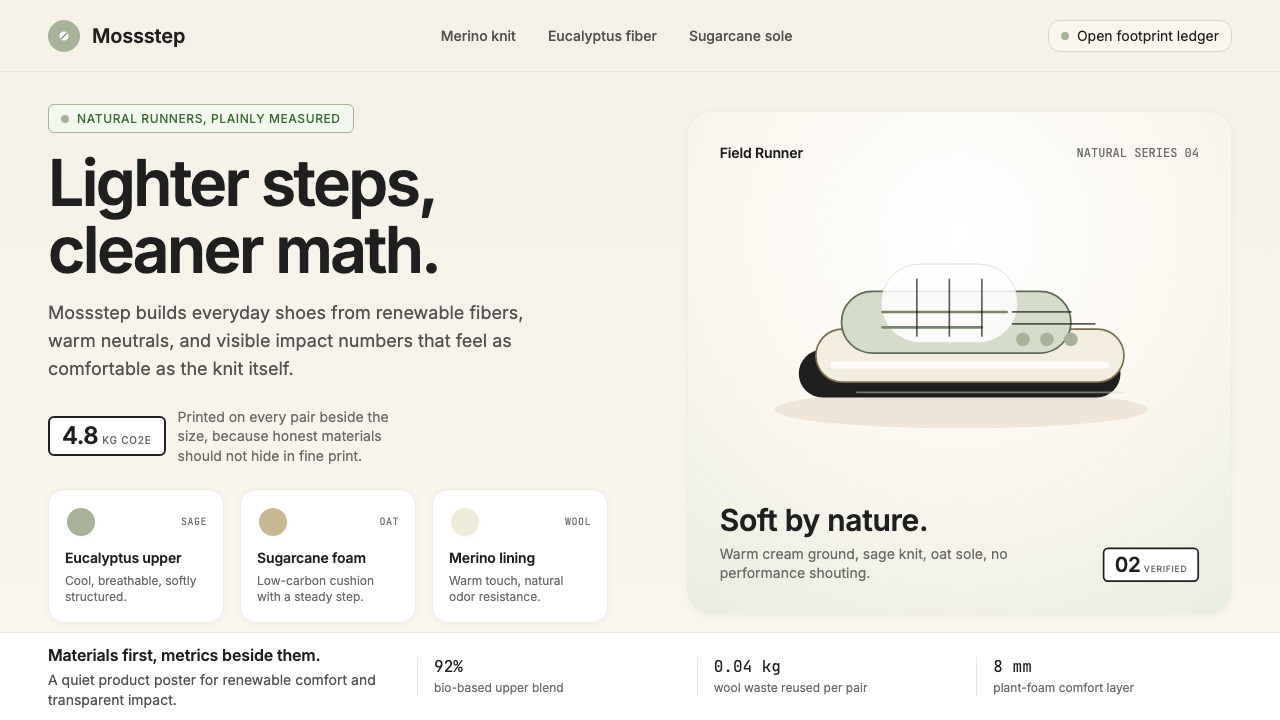 AllbirdsSustainability that breathes. Cream-and-sage tones, carbon labels next to pri…
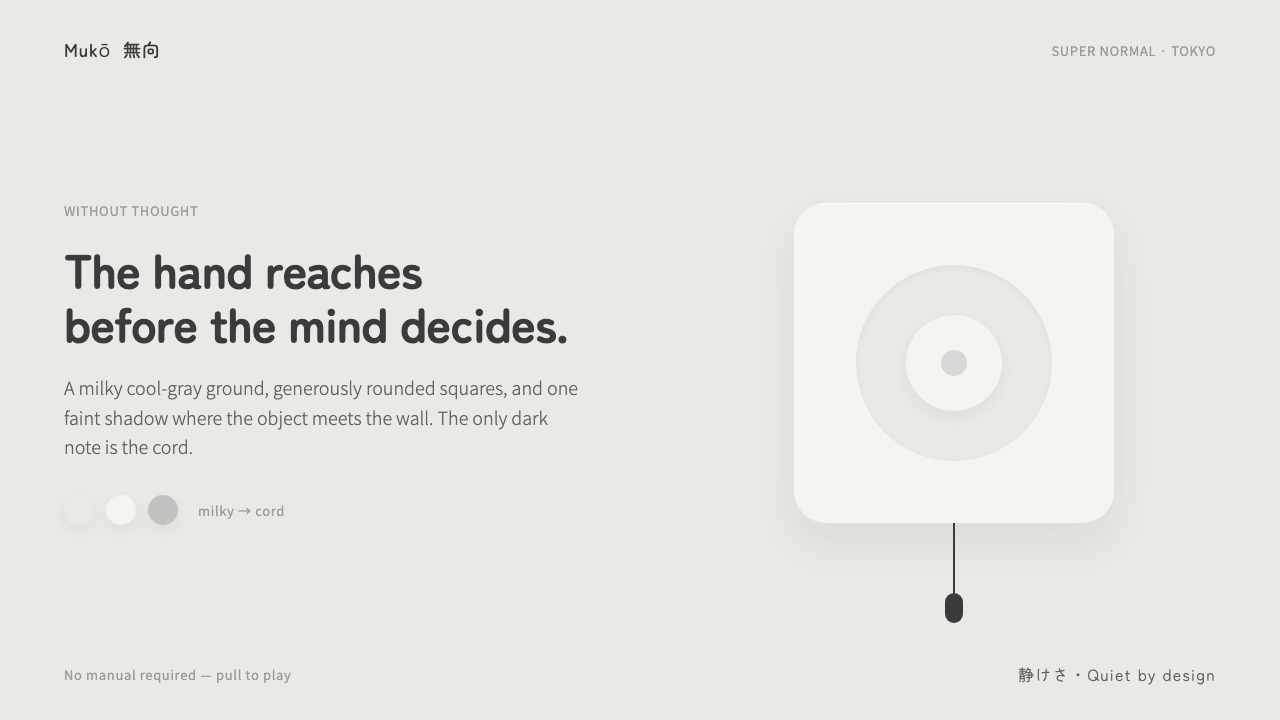 Fukasawa Without ThoughtHand reaches before mind decides. Milky cool-gray plastic, rounded squares, o…
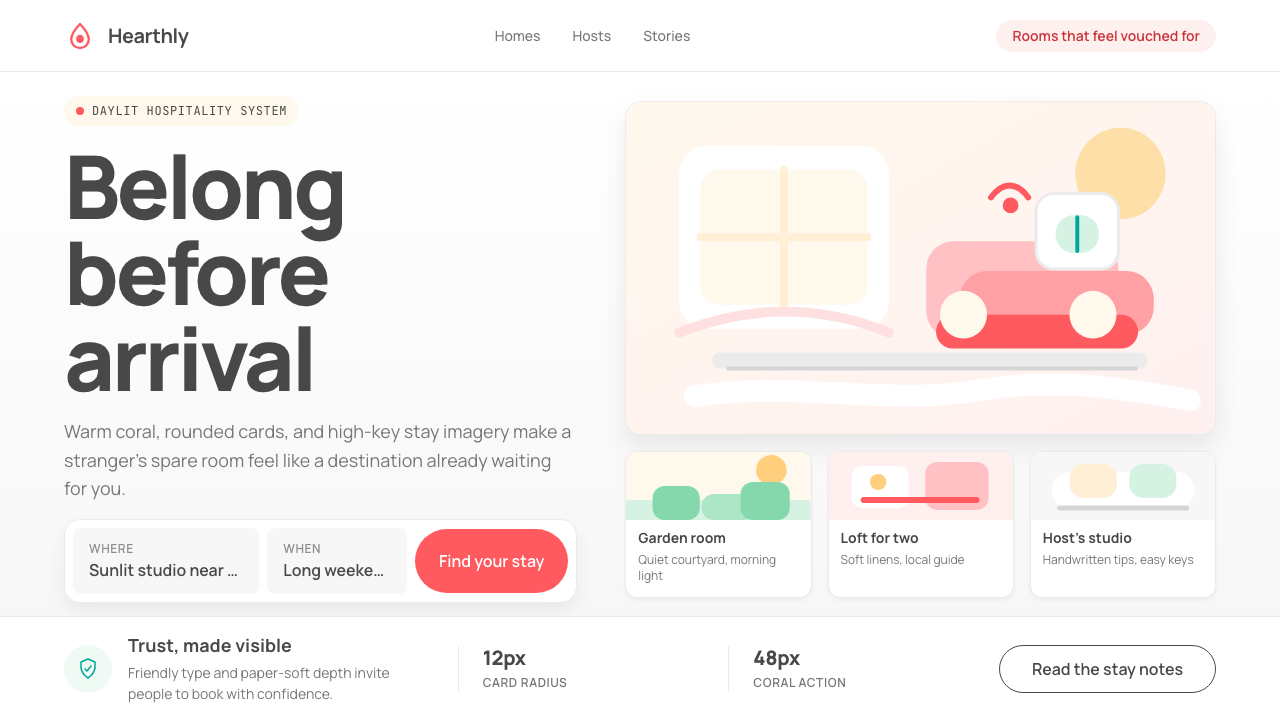 Airbnb 2014Coral red, soft pill cards, Cereal type. The Bélo wraps strangers in warm, da…
 Alvaro Siza WhiteLight makes the form. White planes on cool plaster throw sea-grey shadow and…
 Otl Aicher Munich OlympicsFriendly rigor. Sky-blue grids and straight-line pictograms make public infor…
 Portuguese CorkGrounded by texture. Cork tan speckles on bark brown, with one olive rule.