What is Headspace?
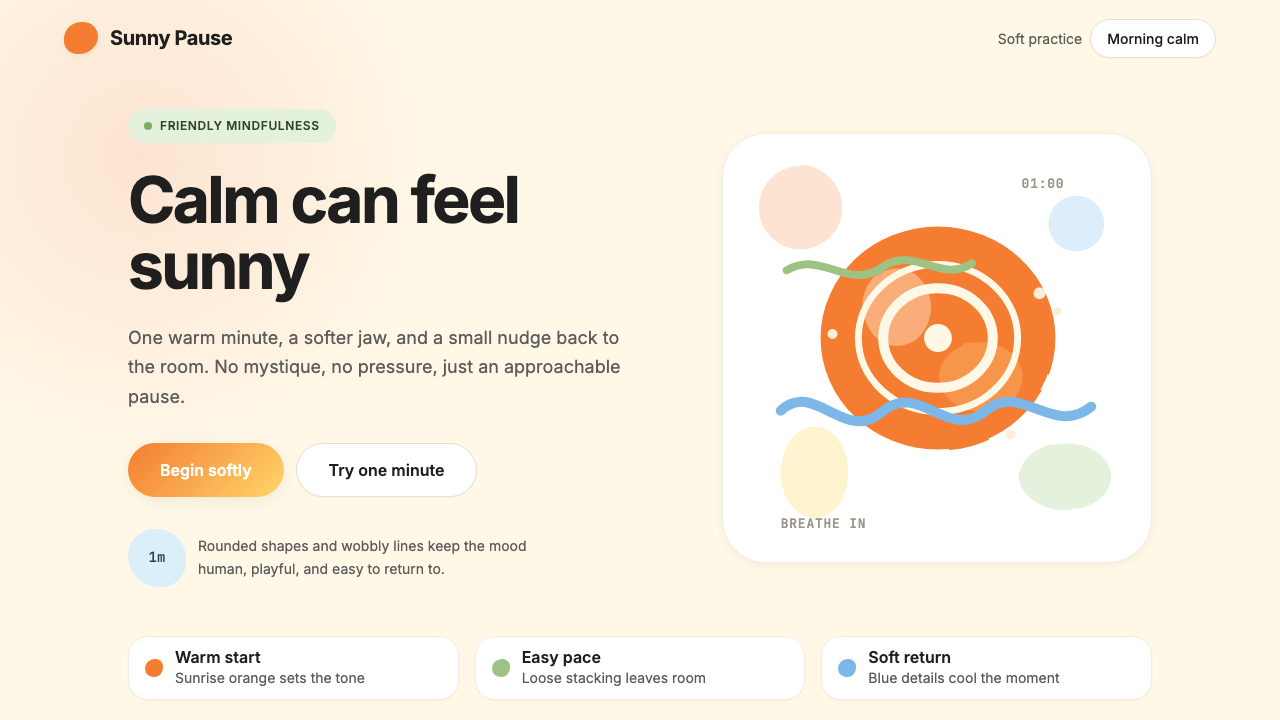
Headspace proved that calm could be sold through optimism — sunrise orange, wobbly hand-drawn characters, and a cream canvas that made mindfulness feel like a friendly morning rather than a meditation retreat.
Headspace in brief
Headspace is a visual design system born inside a meditation and mental-wellness app, developed collaboratively between the Headspace product team and the London-based animation studio Animade from roughly 2015 onward. Its vocabulary — warm cream backgrounds, a signature sunrise orange, soft coral and sky-blue accents, fat rounded shapes, and deliberately imperfect hand-drawn character illustrations — amounts to one of the most recognizable wellness aesthetics of the 2010s and 2020s.
What makes the Headspace system distinctive is its deliberate rejection of the dominant visual language of meditation: no lotus flowers, no incense smoke, no muted earth tones signaling retreat from the world. In their place, the style offers cheerful round characters — limbless, expressive blobs of color — that embody emotional states through posture and weight rather than facial detail. The palette reads warm and inviting, like a ripe fruit or a morning sky, deliberately choosing optimism over austerity to make mindfulness feel accessible rather than austere.
The typographic side of the system pairs a geometric humanist sans-serif with generous line spacing and unhurried hierarchies. Body text is set at comfortable, readable sizes; headlines carry weight without aggression. The overall impression is of a system designed to reduce rather than stimulate anxiety — every element rounded, every transition gentle, every surface breathing.

Where does Headspace come from?
Headspace was founded in 2010 in Santa Monica, California, by former Buddhist monk Andy Puddicombe and entrepreneur Rich Pierson. Puddicombe had spent a decade studying meditation in monasteries across Asia and Europe; Pierson had a background in advertising. Their collaboration produced a product concept premised on a single insight: the largest barrier to meditation was not skepticism but intimidation. People wanted to try mindfulness but felt they were doing it wrong, that it was too spiritual, too quiet, too foreign. The solution was not to simplify the practice but to change its emotional framing entirely.
The visual identity that eventually defined Headspace globally came into focus through a sustained partnership with Animade, a UK illustration and animation studio known for its characterful, warmly textured work. The studio developed the cast of rounded, blob-like characters — nicknamed 'Headspace people' — that became the app's emotional ambassadors. These figures appeared in guided meditation animations, onboarding flows, app store previews, and marketing campaigns, giving the brand a consistent animated personality across every touchpoint. The collaboration produced a visual language that was deliberately optimistic and approachable: soft, rounded, imperfect in the way a friendly illustration always is.
The palette choices were not arbitrary. Sunrise orange, the brand's dominant hue, was selected to evoke energy and warmth without aggression — closer to the feeling of morning light on skin than to the urgency of a warning signal. Cream backgrounds replaced clinical white, softening the environment and reducing the sense of digital sterility. The accent colors — sky blue, coral, soft yellow, gentle greens — were chosen to expand the emotional range without fragmenting the system's coherence, each one warm and slightly desaturated compared to its pure-hue equivalent.
The style emerged at a specific cultural moment: the post-2010 wellness-tech wave that also produced Calm, Peloton, and a generation of consumer health products designed to look nothing like traditional healthcare. Designers in this space were solving a shared problem: how do you make self-improvement feel like self-compassion? The Headspace answer — optimistic illustration, warm color, rounded form, gentle type — became one of the defining visual answers to that question, widely imitated across the wellness, mental health, and consumer-health design landscape throughout the following decade.
What defines the Headspace look?
Palette
The color system anchors on a warm sunrise orange that reads energetic but never harsh — closer to ripe citrus than to a traffic signal. This primary color sits against cream backgrounds rather than pure white, softening the environment and reducing visual tension. Accent colors expand the range: a calm sky blue provides contrast and coolness, coral offers emotional warmth, and muted yellows and greens extend variety without fragmenting coherence. All hues are pulled slightly toward warmth and away from full saturation, giving the palette its distinctly approachable, analog-feeling character.
Illustration and Character
The defining visual element is a cast of rounded, limbless character blobs developed with Animade. These figures communicate emotion through posture, weight distribution, and subtle deformation rather than through facial features — a drooping form signals fatigue, a buoyant bounce conveys joy, a still and centered mass represents calm. The line work is deliberately imperfect: slightly wobbly, as if drawn by a careful but human hand, rejecting the mechanical precision of vector illustration in favor of felt warmth.
Shape and Form
Every geometric element in the system is softened. Squares become rectangles with generously rounded corners, circles and ovals dominate, and even structural layout shapes avoid sharp 90-degree edges wherever possible. This rounding is not merely decorative — it is a systematic commitment to reducing visual sharpness and implied aggression across the entire interface. Fat, full shapes carry a sense of comfort and solidity; the aesthetic is plush rather than lean.
Typography
The typographic approach pairs a geometric humanist sans-serif with generous spacing — wide line height, comfortable letter spacing, and unhurried hierarchies. The weight range used across the system tends toward medium and regular cuts rather than heavy extremes; even headlines are set with care for legibility over impact. The overall typographic mood is calm and even, reinforcing the brand's core proposition: nothing here is trying to rush you.
Motion and Breathing
The Headspace visual language was designed for motion from the start. Animations are slow, elastic, and organic — characters inflate and deflate with simulated breath, transitions ease in and out with gentle curves rather than linear speed changes, and idle states involve subtle continuous movement like soft floating or rhythmic pulsing. Even in static applications, this sensibility manifests as compositions that feel airy and spacious: no surface is crowded, every element has room to exist.
Surface and Texture
Unlike the clinical flatness of mainstream UI design in the 2010s, Headspace illustrations carry a subtle handmade quality — slight texture in flat color fills, deliberate irregularities in line weight, and compositional looseness that references analog media like gouache or screen printing. This gentle texture differentiates the system from both mechanical minimalism and overly polished digital realism, occupying a warm middle ground that feels crafted.
Whitespace and Calm
Negative space is used with structural intention throughout the system. Layouts are open, with generous margins and padding that prevent any sense of crowding or urgency. Information is introduced incrementally rather than all at once; screens tend to carry one primary idea at a time. This use of restraint in composition mirrors the app's core practice — the act of clearing space — and ensures that the visual experience itself models the mental state it is trying to encourage.

Who shaped Headspace?
A former Buddhist monk ordained in the Tibetan tradition, Puddicombe spent a decade training in monasteries across Asia and Europe before co-founding Headspace in 2010. As the brand's most visible voice — appearing in guided sessions, marketing campaigns, and a Netflix documentary — he established the tonal and philosophical foundation that the visual system had to express: approachable, secular, optimistic, and grounded in genuine contemplative practice rather than lifestyle aspiration.
Pierson brought an advertising and brand-strategy background to the partnership, translating the practice of meditation into a mass-market consumer product. His contribution was fundamentally one of framing: recognizing that the visual and verbal identity of mindfulness tools needed to change before mainstream adoption was possible. The decision to lead with optimism and color — rather than the austere visual language typical of wellness — was as much a business strategy as a design philosophy.
The London-based animation and illustration studio was the primary creative partner responsible for the character system and animated identity that define Headspace visually. Animade's house style — warm, characterful, technically precise but emotionally loose — aligned closely with what Headspace needed: a visual register that communicated complex inner states without words or facial expression. The studio's influence on the broader wellness design aesthetic of the 2010s extended well beyond Headspace, as their approach was widely cited and emulated.
As a key design leader within Headspace's in-house team, Lohiya helped systematize and extend the visual language developed with Animade into a scalable product design system. The challenge was significant: translating a character-and-illustration-led brand identity into functional UI components, interaction patterns, and a coherent system that could scale across platforms and product lines while retaining the warmth and approachability of the original illustrated work.
How do you use Headspace today?
The Headspace design language is among the more technically forgiving historical wellness aesthetics to apply, because its warmth comes from palette and character rather than from rigid structural rules. That said, applying it correctly requires internalizing its emotional premise first: every visual decision should reduce friction and anxiety, not merely look friendly. Rounded corners, warm backgrounds, and character illustrations are symptoms of this principle, not the principle itself.
For presentation slides, the Headspace aesthetic works exceptionally well on cover slides that need to communicate approachability and emotional intelligence. A cover built in this style might use the warm cream background as its ground, place a single rounded character illustration at the center, and set the title in a medium-weight geometric sans-serif below it — unhurried, generous in spacing, with the orange accent reserved for a single keyword or highlight. Content slides should carry one idea per page, with wide margins and generous line heights that resist the temptation to pack information densely. Data slides work best when charts are given soft, rounded bar shapes and drawn in the warm accent palette rather than the default application colors.
For web and product UI, the Headspace style is most naturally suited to onboarding flows, wellness dashboards, subscription or pricing pages, and any context where the user is managing emotional state or personal progress. The approach: use the cream or off-white ground throughout, reserve white for card surfaces, deploy the orange for primary interactive elements like buttons and progress indicators, and use sky blue or coral as secondary accent for states and tags. Corners should be consistently rounded across all card and button components. Iconography, where needed, should feel illustrated rather than utilitarian — slightly irregular, slightly warm in line weight.
For editorial, marketing, and social content, the style lends itself to short-form communication where a single illustration and a single sentence carry the message. Campaign assets in this aesthetic work well at a large scale — a full-bleed cream background with an oversized character centered and a minimal headline in orange — and equally well as small-format cards. The style is less suited to long-form editorial layouts where text density is required, as the generous spacing and minimal hierarchy can make sustained reading feel under-structured.
A common mistake when applying the Headspace aesthetic is conflating rounded forms and warm color with the aesthetic itself, then adding digital polish that contradicts the system's handmade warmth: sharp gradients, high-gloss button states, overly precise illustration geometry, or mechanical animation easing. The result looks corporate-wellness rather than genuinely warm. To avoid this, treat every element with slight imperfection — let illustrations breathe, let spacing be generous to the point of spaciousness, let typography be unhurried. The system communicates trust through restraint and warmth, not through finish.

Headspace — FAQ
Is the Headspace style appropriate for products outside wellness and mental health?
It can work well in any context where approachability and emotional warmth are genuine product values — children's education, family finance tools, community platforms, entry-level learning apps. The aesthetic struggles in contexts where authority, expertise, or precision is the dominant value signal: enterprise dashboards, legal or financial tools aimed at professionals, medical diagnostics, or any product where users need to feel they are engaging with something rigorous and technically serious. The style communicates friendliness and calm so effectively that it can undermine trust signals in high-stakes professional contexts.
How does Headspace differ from other warm, rounded wellness aesthetics that followed it?
The primary distinguishing quality is the character system. Most wellness aesthetics that followed Headspace's success adopted the warm palette and rounded forms but replaced character-driven illustration with abstract shapes, gradients, or photography. The Headspace system's emotional communication depends fundamentally on those limbless, posture-expressive blobs — remove them, and you have a pleasant color palette, not a distinctive visual identity. A second distinguishing quality is the system's deliberate imperfection: the slightly wobbly line work that references handmade media, which is harder to fake than surface color or corner radius.
Can the Headspace aesthetic work on a dark background?
With significant care. The light-ground palette — cream and warm white — is central to the system's warmth and legibility. A dark inversion is possible, and some Headspace nighttime or sleep-focused product screens have explored deeper, more muted grounds, but the shift changes the aesthetic character substantially: the orange becomes more intense and alert, the imperfect line work loses some of its softness against dark backgrounds, and the cream-white character fills can read as stark rather than gentle. Dark variants work best when they shift the palette toward deeper warm neutrals rather than cool or pure blacks, and when character illustrations are redrawn or recolored for the dark ground rather than simply inverted.
How do you apply the Headspace aesthetic to data visualization without losing its warmth?
Data visualization is one of the more challenging applications of this aesthetic, because conventional charting tends toward precision and density that conflicts with the style's spaciousness. The key adjustments: use the warm accent palette for chart elements rather than standard visualization colors, round bar chart corners and use circular rather than square dot markers in scatter plots, give charts generous padding that treats them more like illustrations than instruments, and reduce the number of data points or series visible at one time so that each chart reads as a single clear idea. Avoid gridlines where possible — or draw them in a very light warm neutral — so the chart ground reads as breathing rather than ruled.
What is the most common error designers make when trying to evoke the Headspace style?
The most consistent error is prioritizing the palette over the character work. Designers see sunrise orange on cream and replicate the colors, add some rounded shapes, and call the result Headspace-inspired — but the system's emotional power comes from the animated personality of its character illustrations, not from the color combination alone. A second error is applying digital polish: clean vector curves, precisely sized components, symmetrical layouts. The Headspace system's warmth is inseparable from its deliberate imperfection. Without the wobbly line, the slightly uneven fill, the compositional looseness, the style reads as another rounded minimal aesthetic rather than as something genuinely crafted and human.
Related design styles
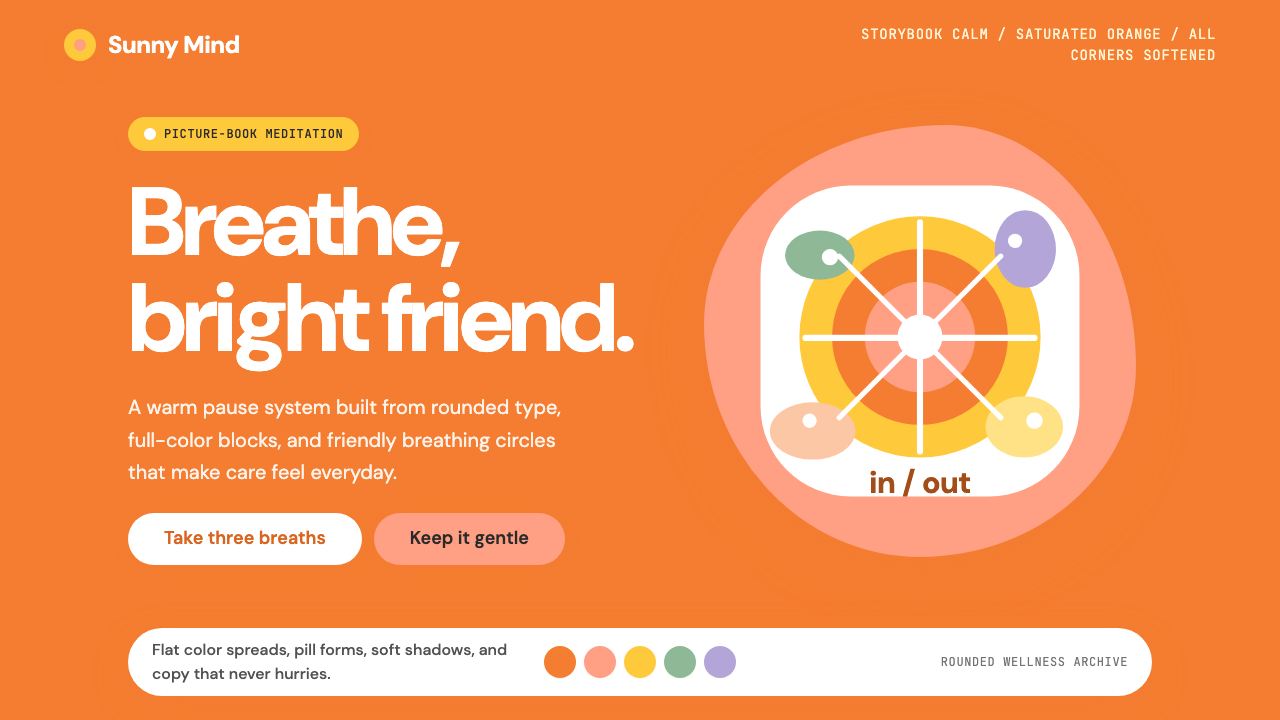 Headspace Orange MeditationMeditation becomes friendly. Orange blocks, DM Sans, and pill shapes soften e…
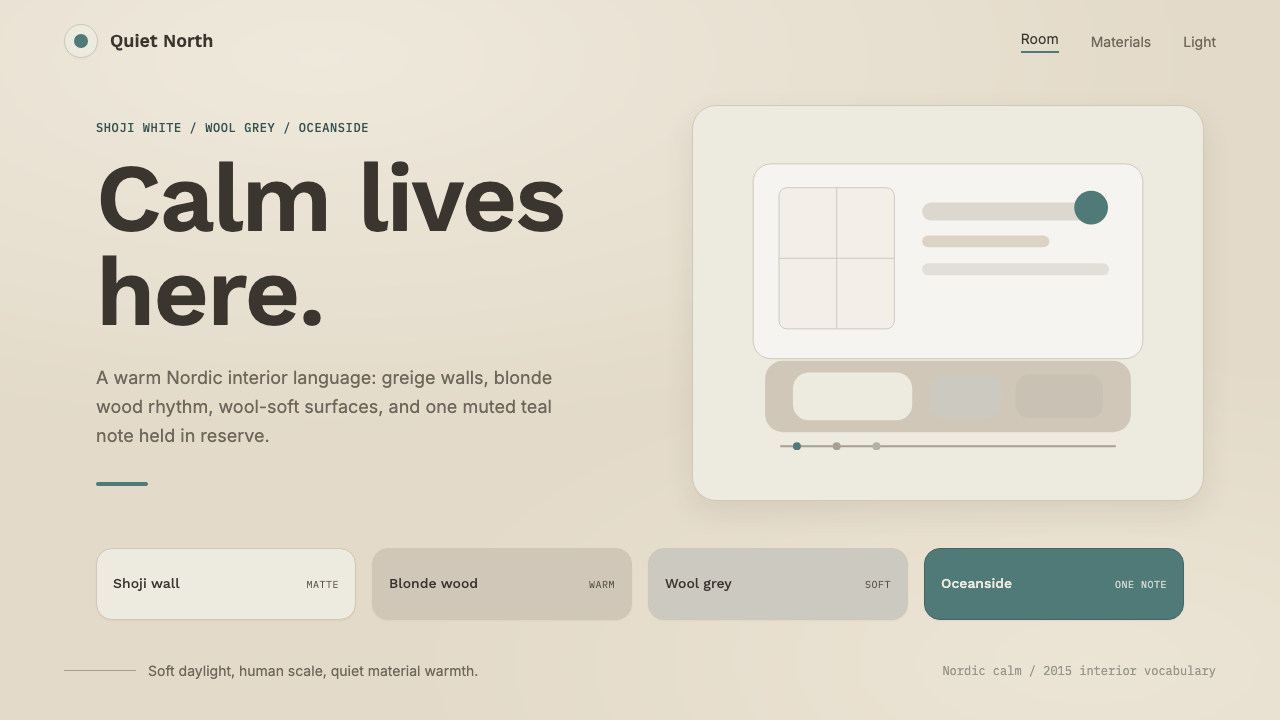 Scandinavian HyggeCalm is the brief. Greige walls, wool-grey cards, and one muted teal line.
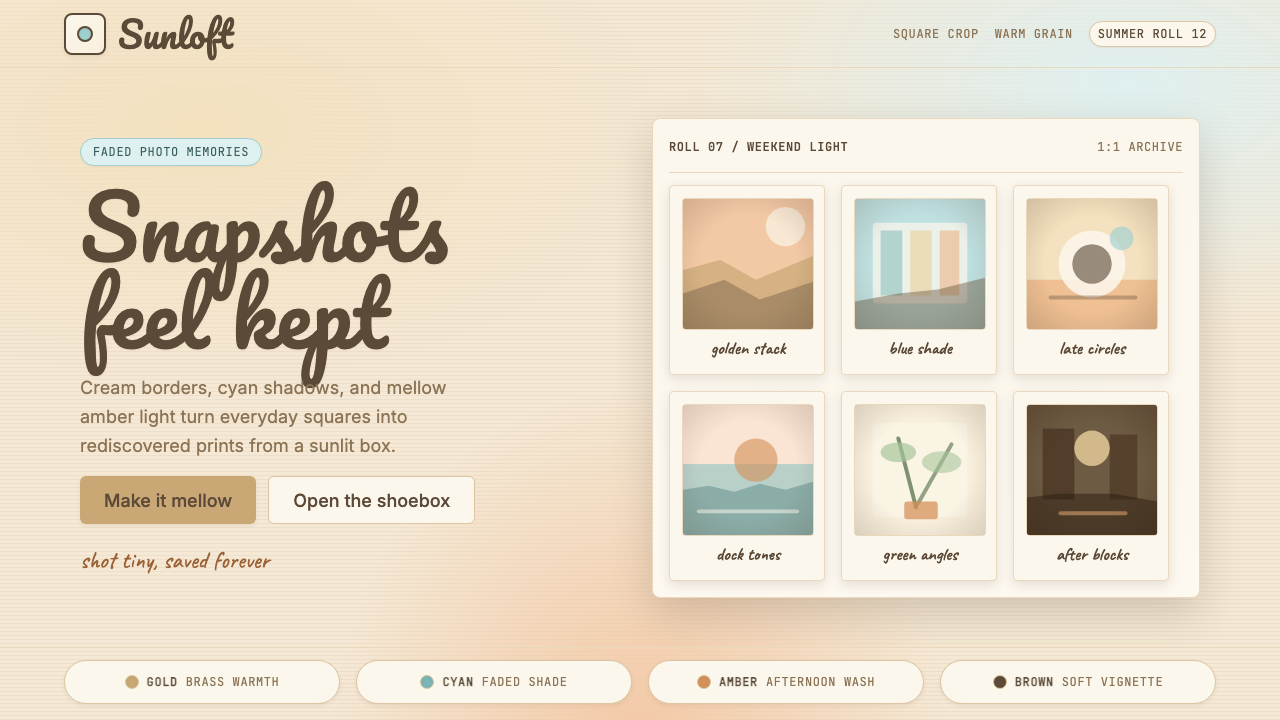 Instagram 2010s FilterWhen photos felt like memories. Faded warmth, dark vignettes, cream-tinted Po…
 Cornershop AppProduce-fresh and calm. Forest green field, white shelf cards, vivid green ac…
 GlossierBeauty as a friend's conversation. Dusty pink (never bubblegum), editorial se…
 K-Beauty CleanCalm arrives dewy. Rose, sage, and peach pastels float through airy rounded f…