What is Instagram Filters 2012?
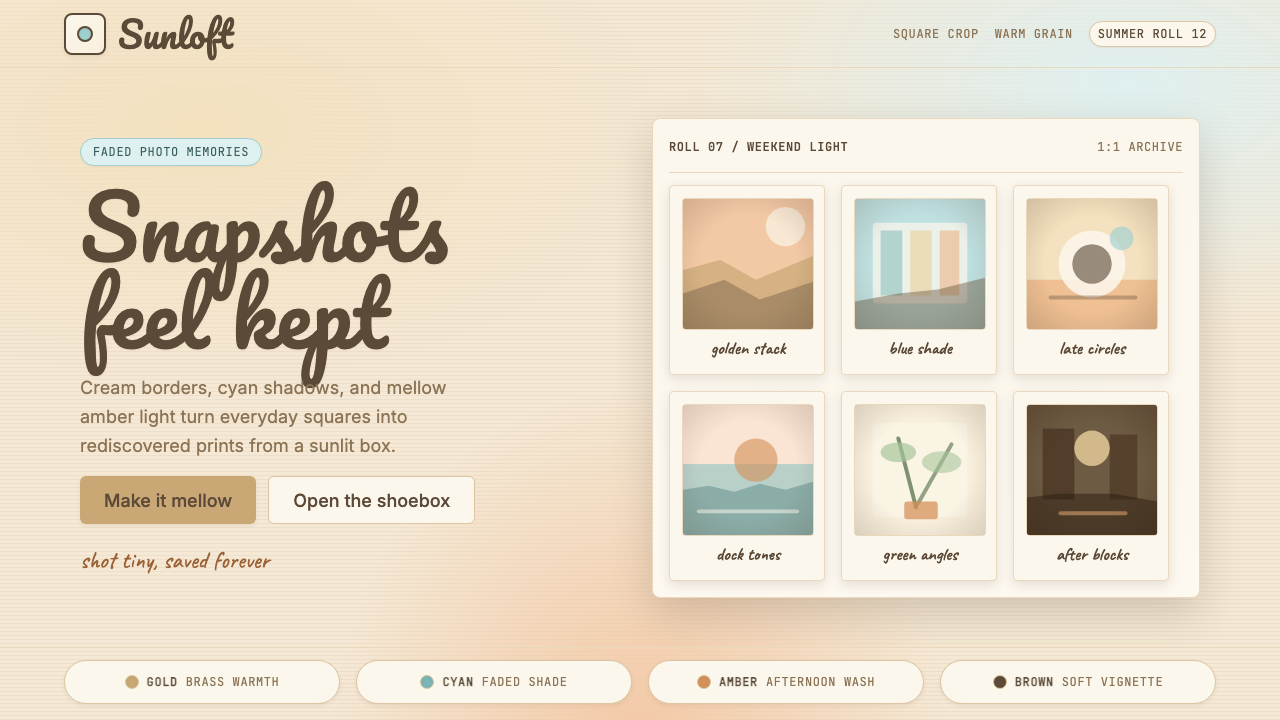
Before flat design erased everything, Instagram's early filters turned every phone snapshot into a warm, grain-dusted memory — and in doing so, accidentally invented a design language the internet still hasn't forgotten.
Instagram Filters 2012 in brief
Instagram Filters 2012 is a design style rooted in the visual vocabulary of the Instagram app's filter era, roughly 2010 to 2014. During those years, a set of named photo filters — Hudson, Earlybird, X-Pro II, Valencia, Lo-Fi, Amaro, and others — became the shared aesthetic of a generation of smartphone photographers. Each filter applied a distinct combination of faded warmth, boosted contrast, shifted color temperature, film grain, and dark vignettes to ordinary photographs, making them feel like rediscovered prints from an earlier decade.
As a design system, the style distills those photographic qualities into interface elements: cream and warm-ivory backgrounds in place of sterile white, visible grain textures, Polaroid-frame card layouts, handwritten-script headline typography, and a color palette that leans into amber, dusty rose, and muted teal rather than saturated primaries. The overall effect is skeuomorphic warmth — it is a style that references physical photography and analog memory rather than the clean grid of the digital screen.
What distinguishes Instagram filter aesthetics from generic vintage styling is its specificity to early mobile photography culture. It is not a broad nostalgia for the twentieth century; it is nostalgia for a particular moment — 2010 to 2014 — when social sharing was new, filters were a revelation, and the act of photographing everyday life felt genuinely expressive rather than performative. The design style carries that emotional register into interface work: it signals intimacy, warmth, and the feeling that content is personal rather than produced.

Where does Instagram Filters 2012 come from?
Instagram launched on October 6, 2010, created by Kevin Systrom and Mike Krieger in San Francisco. The app was built around a simple proposition: square photos, instant sharing, and a set of one-tap filters that could make any mediocre snapshot look intentional. In the first twenty-four hours, the app gained twenty-five thousand users. Within a year, that number had reached ten million. The filters were not an afterthought — they were the product. Systrom had studied at Stanford and worked at Odeo and Twitter before co-founding Instagram; Krieger brought the engineering depth. Together they identified that amateur photographers did not need better cameras; they needed a way to make their photos look as good as they felt when they took them.
The visual character of the early filters was shaped significantly by Cole Rise, a photographer and designer who created or inspired several of the most iconic filter looks — including Rise, which bore his name. Rise drew on the aesthetics of Hipstamatic, a camera app released in 2009 that simulated the look of toy cameras, plastic lenses, and expired film. Hipstamatic had demonstrated that a large community of mobile photographers actively wanted images that looked lo-fi, imperfect, and analog rather than sharp and digital. Instagram systematized and socialized that impulse: instead of a camera app, it was a sharing platform, and the filters were a social common language that anyone could apply.
The broader cultural moment mattered as much as the product decisions. The early 2010s were a period of what cultural critics called the Polaroid revival — a widespread enthusiasm for instant cameras, film photography, and analog media among a generation that had grown up entirely digital. Fujifilm Instax sales were climbing; Urban Outfitters was stocking darkroom supplies; Lomography had built a global community around deliberately imperfect plastic-lens cameras. Instagram filters arrived at the intersection of this analog nostalgia and the explosive growth of the iPhone, giving millions of people a frictionless way to produce images that looked handmade and time-worn.
The aesthetic dominance of the filter era did not last. As Instagram's user base grew into the hundreds of millions, the filters paradoxically undermined themselves: everyone using the same visual language made the language invisible. By 2014 and 2015, a counter-movement toward unfiltered, naturalistic photography was gathering — VSCO Cam had launched in 2012 offering subtler editing, and the term 'no filter' became a meaningful badge of authenticity. Apple's 2013 iOS 7 introduced flat design as a system-wide language, accelerating the departure from skeuomorphism across the entire mobile ecosystem. By 2016 the heavy-filter look was largely read as dated. But its influence had been substantial: it had established that warmth, imperfection, and analog reference were legible and emotionally resonant signals in digital interfaces, a lesson that would echo through subsequent movements in design and photography.
What defines the Instagram Filters 2012 look?
Color Temperature and Warmth
The palette is built around warm amber, honey, and muted golden tones rather than neutral or cool whites. Backgrounds shift away from pure white toward cream, warm ivory, and aged-paper tones. Shadows are not blue-grey but lean amber-brown. Color temperature throughout is pulled toward the warm end of the spectrum — the visual equivalent of afternoon light filtered through a window with aged glass. Teal and dusty rose appear as accent hues, echoing the split-tone effects that filters like X-Pro II and Earlybird applied to shadows and highlights respectively.
Film Grain and Texture
Visible grain overlaid on backgrounds, cards, and image containers is central to the aesthetic. The grain is not harsh or distracting — it is present at a level that gives surfaces a tactile, analog quality rather than the frictionless smoothness of a digital screen. Applied to solid-color areas, grain prevents flatness; applied to photographs, it harmonizes digital images with the surrounding interface, softening the boundary between UI and content. The texture evokes expired Kodachrome or Fujifilm stocks, not contemporary inkjet print.
Vignette and Edge Darkening
Dark vignettes — the gradual darkening of image edges toward the corners — are a signature element borrowed directly from the filter era. In interface contexts, vignetting appears not just on photographs but on card components and container backgrounds, drawing the eye inward and lending panels a sense of depth and age. The vignette is a non-linear shadow: it does not simulate a light source as much as it simulates the optical falloff of a lens, making content feel like it was captured rather than generated.
Faded Contrast and Lifted Shadows
Deep blacks are avoided. Shadows and dark values are lifted — pulled up from true black toward a warm dark-grey or dark-brown — creating the characteristic faded quality that made filter-era photos look like they had spent years in a shoebox. This lifted-black treatment prevents any element from anchoring to the page with full weight, giving the whole layout a slightly dreamy, impermanent quality. Even body text, when dark, rests against warm backgrounds rather than white, so there is no hard chromatic edge.
Polaroid and Frame References
Card and image components frequently reference the Polaroid print format: a square or near-square image area with a thick cream or white border, sometimes with uneven width at the bottom edge — the classic Polaroid undercard. This framing device treats digital content as if it were a physical photograph, reinforcing the analog memory register of the overall style. Stacked or slightly rotated card arrangements echo the experience of handling a pile of prints, adding a tactile spatial quality to what are otherwise flat interface components.
Handwritten and Script Typography
Headline typography leans toward flowing script and handwritten letterforms rather than the precision of geometric sans-serifs. The script energy references the hand-lettering of vintage diners, travel postcards, and craft packaging — an association with the handmade and the personal. Body text is typically set in a simple, warm-feeling serif or humanist sans-serif rather than a technical or geometric one, maintaining legibility while reinforcing the human-made quality of the overall aesthetic. Type sizing is restrained; the style does not rely on typographic scale for drama.
Warmth Through Restraint
Unlike many nostalgic or retro styles, the Instagram filter aesthetic achieves its emotional register not through overloaded decoration but through tonal unity. Every element — background, border, image treatment, type color — is pulled into the same warm, slightly faded register. There are no sharp chromatic surprises, no high-saturation accent colors that break the mood. The restraint is the warmth: because nothing fights for attention at full intensity, the overall effect reads as intimate and unhurried rather than designed and deliberate.

Who shaped Instagram Filters 2012?
Systrom co-founded Instagram in 2010 and served as its CEO until 2018. A trained engineer with a background in product management at Google, Systrom was the driving force behind the filter feature from the earliest stages of the product. He understood that filters were not a technical gimmick but a leveling mechanism: they gave non-photographers a way to produce images that felt intentional and emotionally resonant. His conviction that software should amplify human creativity rather than showcase technical capability shaped Instagram's early design philosophy and, by extension, the visual language of the entire filter era.
Krieger co-founded Instagram alongside Systrom and served as its CTO, responsible for the engineering infrastructure that allowed the filter experience to work smoothly on the constrained hardware of early iPhones. Where Systrom brought product intuition, Krieger brought systems thinking: he ensured that a filter could be applied, previewed, and shared in seconds, which was essential to the social dynamic that made the platform addictive. His focus on speed and reliability meant the aesthetic experience was never compromised by latency — a critical factor in making filters feel like a natural extension of the photographic act.
Rise was a photographer and designer whose work directly shaped some of Instagram's most iconic early filters — including the filter that bears his name. Drawing on a background in fine art photography and deep familiarity with analog film stocks, Rise brought an understanding of how light, grain, and color interact in physical photographic processes and translated that understanding into digital filter design. His filters leaned toward the warm, golden tones of well-exposed Kodachrome rather than the cool cross-processed look of other filters, establishing the warm-amber register that became most closely associated with the platform's early identity.
Hipstamatic preceded Instagram by a year and established the cultural permission structure that made Instagram's filter proposition legible. Founded by Joel T. Johnson and Lucas Allen Buick in 2009, Hipstamatic simulated the output of toy cameras, expired film stocks, and plastic lenses through a detailed skeuomorphic interface that required users to 'load' virtual film and 'attach' virtual lenses before shooting. The app demonstrated that a significant community of smartphone users wanted images that looked imperfect and analog rather than sharp and digital. Without Hipstamatic establishing that market, the Instagram filter as a casual one-tap tool might not have found its audience so quickly.
VSCO — the Visual Supply Company, founded by Joel Flory and Greg Lutze in 2011 — represented both an evolution and a critique of the Instagram filter model. Where Instagram filters were dramatic and immediate, VSCO's editing tools were subtle and precise, oriented toward photographers who wanted more control and a less processed look. VSCO presets became the successor aesthetic to Instagram filters as the platform's visual culture matured: warmer but less saturated, lighter on vignetting, more naturalistic. By documenting the transition from heavy filter culture to more restrained editing, VSCO marks the inflection point at which the Instagram 2012 style became recognizable as a distinct period style rather than simply 'how photos look now'.
How do you use Instagram Filters 2012 today?
Applying Instagram filter aesthetics to designed work requires understanding the emotional logic of the style before reaching for its visual elements. The style works because every element points in the same direction — warmth, imperfection, intimacy, memory — and the moment one element breaks that register (a saturated red call-to-action button, a sharp-white modal background, a geometric sans-serif headline), the coherence collapses. Before specifying anything, identify whether the product's emotional positioning genuinely aligns with analog warmth and personal memory. Consumer lifestyle products, travel experiences, food and beverage brands, personal creative platforms, and photography-adjacent tools are natural fits. Enterprise software, financial dashboards, and clinical health applications are not.
For presentation slides, the style works best on covers designed to establish mood and on section dividers that mark transitions between themes. A cover using this aesthetic might feature a warm cream or aged-ivory background with a Polaroid-frame image container offset to one side, a handwritten-script headline in a warm dark tone, and subtle grain across the full bleed. Content slides should be simpler: warm background, one clear typographic hierarchy using a humanist serif for headings and a readable body weight for text, no decorative borders beyond a thin warm rule. Data slides are the most challenging — the faded, warm palette conflicts with the precision that charts require. The solution is to use a lightly tinted card behind each chart, pull chart colors into the warm register (amber for primary data, dusty rose for secondary), and lift the darks so no value appears as a hard black.
For web interfaces, the style is well-suited to portfolio sites, personal blogs, food and recipe platforms, lifestyle brand marketing pages, and any product where the user relationship is meant to feel personal rather than transactional. The approach for dashboards or utility pages in this style is more constrained: use warm backgrounds and cream surface tones to set the register, apply grain texture only to hero or background areas rather than to interactive components, and rely on warm-toned bordered cards rather than soft-shadow floating panels. Navigation and interactive elements (buttons, inputs, tabs) should stay legible and clean — the warmth lives in the surfaces, not in the controls. Pricing pages can use this style effectively if the brand positioning supports it: warm card containers, script or humanist type for plan names, amber or honey-toned highlights for recommended tiers.
For editorial and marketing work, the filter aesthetic excels at hero imagery treatments, campaign landing pages, and print-adjacent digital collateral. A marketing page in this style typically features full-bleed imagery with a warm overlay and vignette, cream-background text sections with generous leading and a moderate measure, and section breaks marked by thin warm rules or Polaroid-frame photo inserts rather than geometric dividers. Headlines in a flowing script or warm serif create an editorial tone that feels crafted rather than templated. For social media graphics, the style translates directly: warm-toned background, centered or left-aligned script headline, subtle grain, and a Polaroid-border treatment on any image used.
A common and damaging mistake is using the visual elements of the filter era without the tonal discipline. Designers reach for grain texture and cream backgrounds but then introduce a fully saturated brand color, a hard-white popup, or a geometric icon set — all of which signal a completely different design vocabulary and break the warmth register instantly. Another frequent error is overdoing the grain: at high intensity, grain reads as a technical problem rather than an intentional aesthetic, particularly on screens that render at high pixel density. The grain should be present but subliminal. Finally, mixing handwritten-script headlines with body text in a heavy geometric sans-serif creates a tonal mismatch that reads as confused rather than layered. Choose one humanist family and vary it by weight and size rather than combining expressive script with cold geometric forms.

Instagram Filters 2012 — FAQ
Is this style the same as general vintage or retro design?
No, and the distinction matters for application. General vintage and retro design is a broad category that can reference any era — Art Deco geometry, fifties diners, seventies psychedelia, eighties neon. Instagram filter aesthetics is specifically anchored to early smartphone culture and the photographic conventions of film stocks from the 1970s and early 1980s as mediated through digital filters. It is warm and faded rather than colorful and ornate. It has no decorative borders, no typography that references a specific historical period's poster conventions, and no color relationships derived from a specific decade's fashion or print palette. If you are designing something that should evoke the early 2010s social internet rather than a general sense of 'the past,' the Instagram filter register is the right reference. For a broader or differently anchored nostalgia, a different vintage style is more appropriate.
Can this style work for professional or business-facing products?
It can, but only for specific categories of professional products where warmth and personal connection are brand values. A professional photography platform, a creative freelancer portfolio tool, a specialty food or beverage business, or a boutique travel service could use this style effectively. It is inappropriate for products where authority, precision, and neutrality are expected — financial services, legal software, medical platforms, enterprise analytics. The risk in applying this style to a professional context is that the warmth reads as informality, and the faded quality reads as lack of precision. If a user needs to trust the accuracy of what they are seeing, the Instagram filter register — which makes everything look slightly dreamy and impermanent — works against that trust.
How do you prevent the style from looking dated or ironic?
The key is to apply the aesthetic qualities — warmth, grain, faded tones, analog references — without literal nostalgia signaling. A design that uses cream backgrounds, lifted shadows, and warm grain can read as a contemporary considered choice rather than a period imitation, provided it avoids the specific UI conventions of the 2010s: chunky skeuomorphic buttons, linen texture backgrounds, drop shadows on everything, and literal filter-name typography. The grain should be fine and integrated, not coarse and theatrical. The warmth should be in the tonal register, not signaled by obvious Instagram-era icons or interface metaphors. Used with restraint and paired with contemporary layout sensibility, the warmth and grain of the filter era can feel fresh because the underlying emotional register — intimacy, impermanence, analog warmth — is genuinely resonant rather than historically specific.
What is the difference between this style and VSCO aesthetic?
Instagram filter aesthetics (2010–2014) is heavier, more dramatic, and more obviously processed than VSCO aesthetic. Instagram filter-era images have strong vignettes, visible grain, dramatic color shifts, and the distinctive faded quality of lifted blacks. VSCO presets — which dominated from around 2013 onward — are subtler: lighter on vignetting, more controlled in grain, warmer or cooler in temperature shifts rather than multi-dimensional, and oriented toward a look that appears edited but not overtly filtered. If Instagram filters say 'this photo has been transformed,' VSCO says 'this photo has been refined.' In design application, Instagram filter aesthetics is more texturally rich and emotionally warm; VSCO-influenced work is cleaner and more photographic, closer to the contemporary editorial aesthetic that followed the filter era.
Can dark mode work with Instagram filter aesthetics?
A dark variant is possible but requires a careful rethinking of every element. The light version of the style derives its warmth from cream and ivory grounds on which faded tones float; on a dark background, the same faded tones can read as murky or unresolved rather than warm. A successful dark adaptation would anchor to a very dark warm-brown or amber-tinged near-black rather than a neutral dark grey or true black, keeping cream and warm ivory as foreground text and card surface colors, and reducing grain intensity since grain reads differently at higher contrast. The vignette logic inverts: instead of edges darkening into corners, the center of a component might be slightly lighter, simulating a gentle spotlight rather than optical falloff. Polaroid frame treatments become amber-bordered rather than cream-bordered. The style is achievable in a dark context, but it is more constrained and requires more deliberate calibration than the light version.
Related design styles
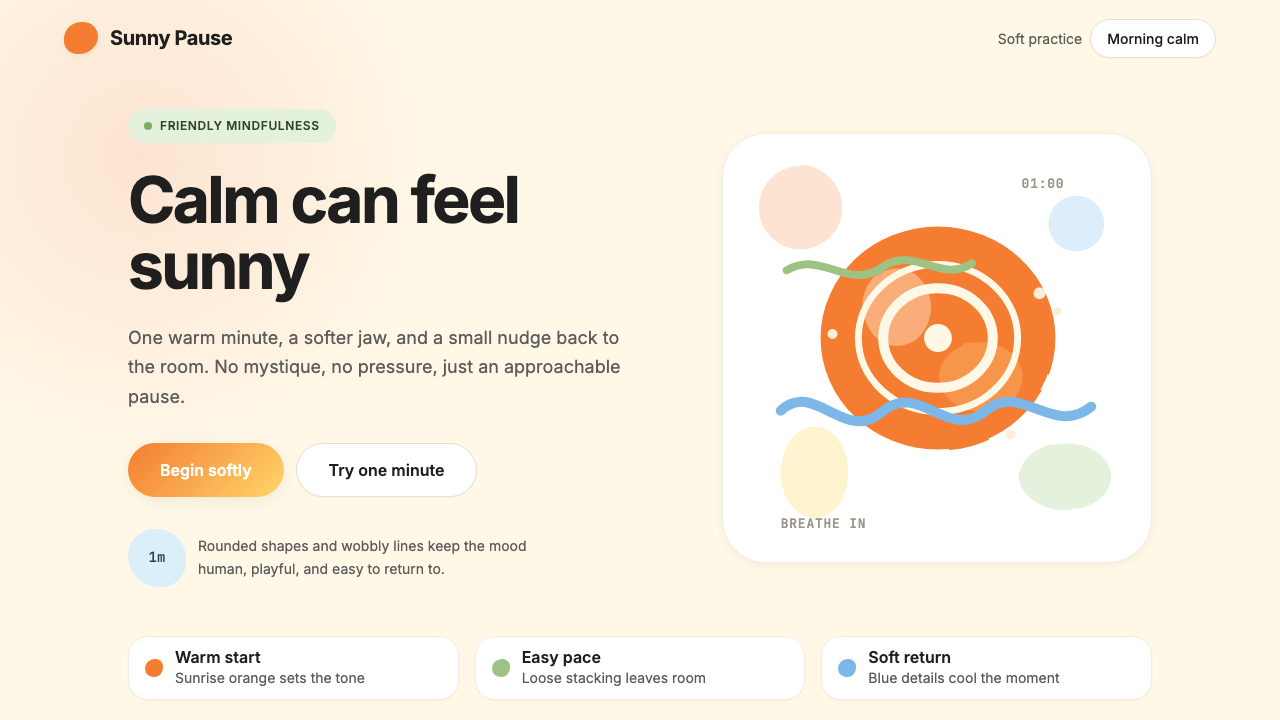 HeadspaceOptimism makes calm approachable. Sunrise orange and wobbly rounded forms bre…
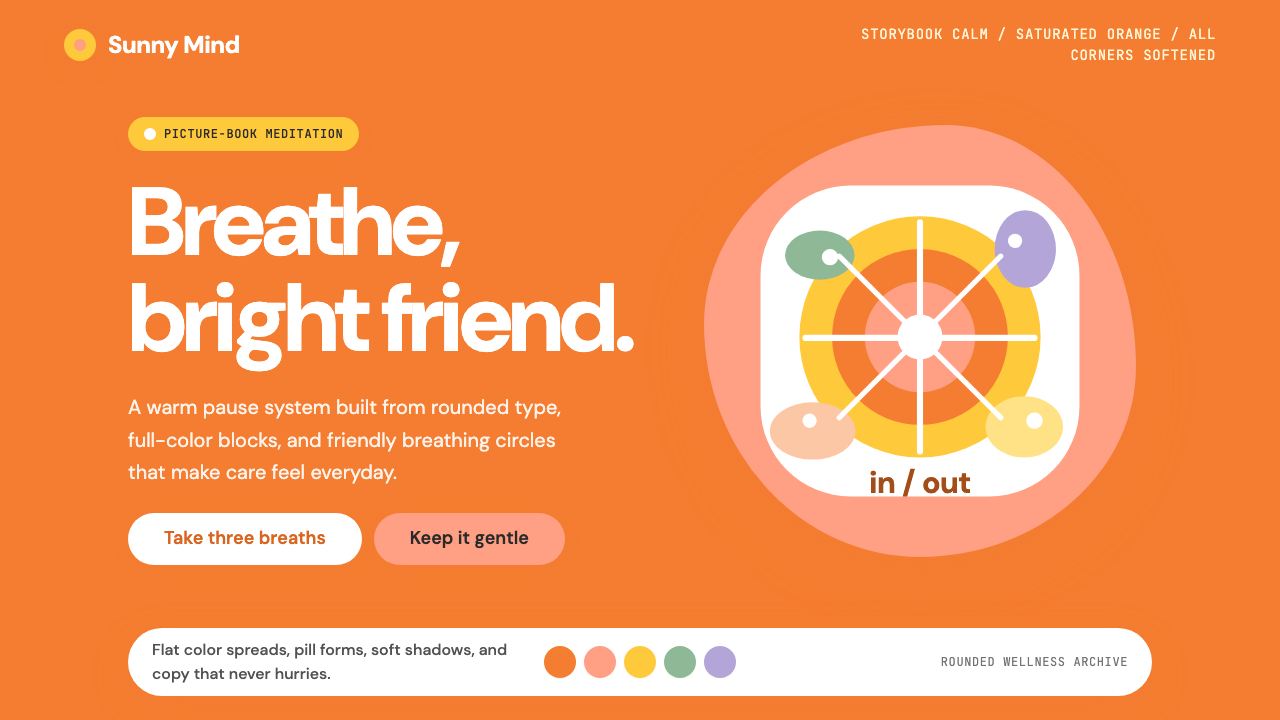 Headspace Orange MeditationMeditation becomes friendly. Orange blocks, DM Sans, and pill shapes soften e…
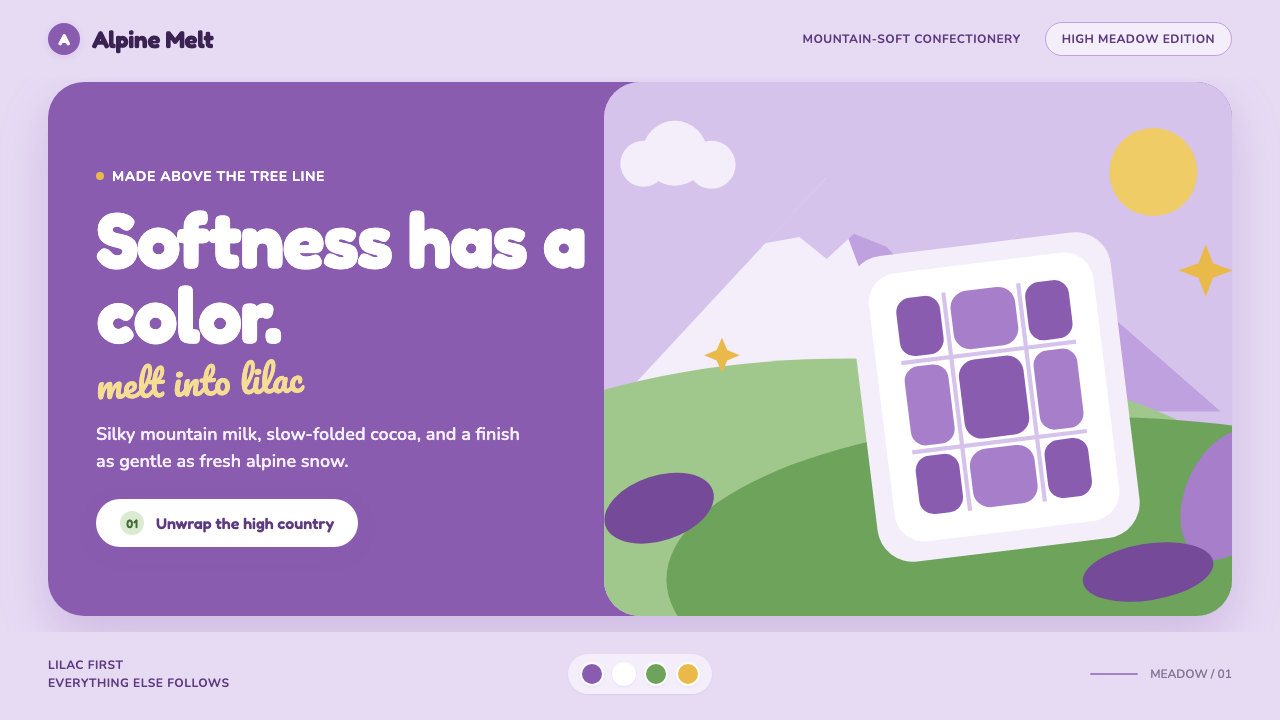 Milka Lilac (1901)Lilac tastes like chocolate. Plump type, snow-white foil and meadow green mak…
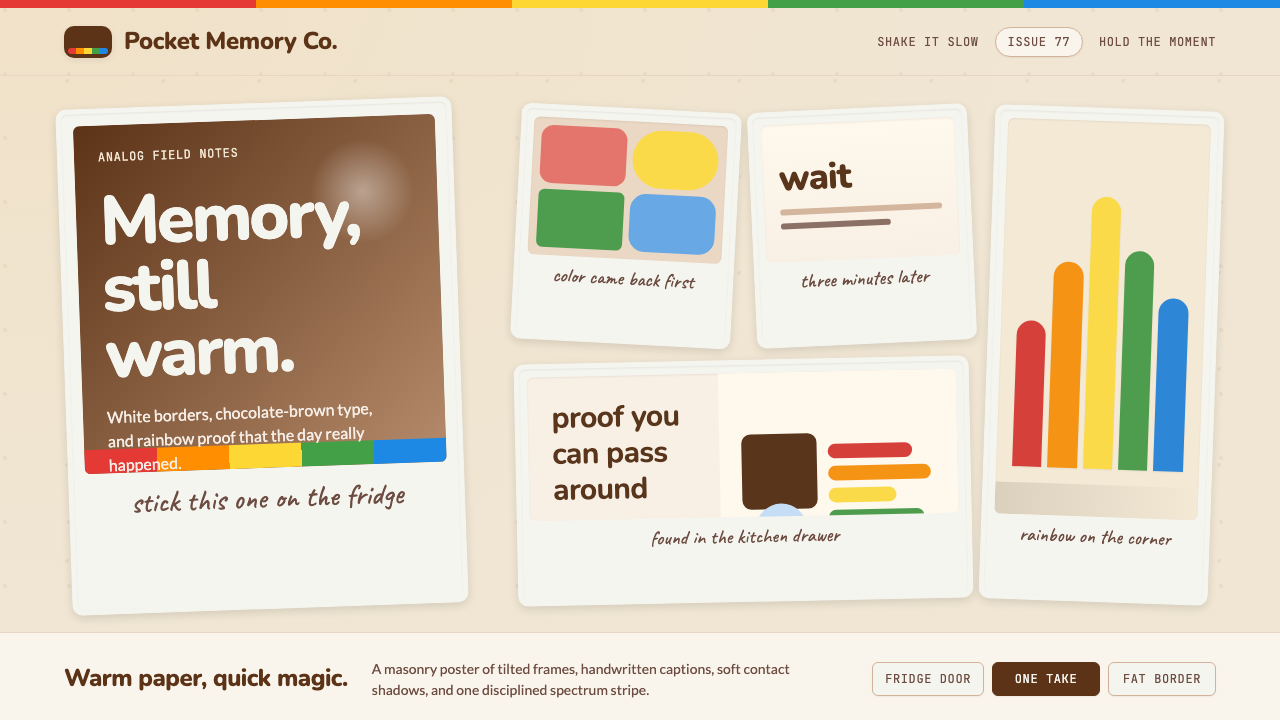 Polaroid InstantMemory made tangible. Photo-white frames tilt on aged paper with a warm rainb…
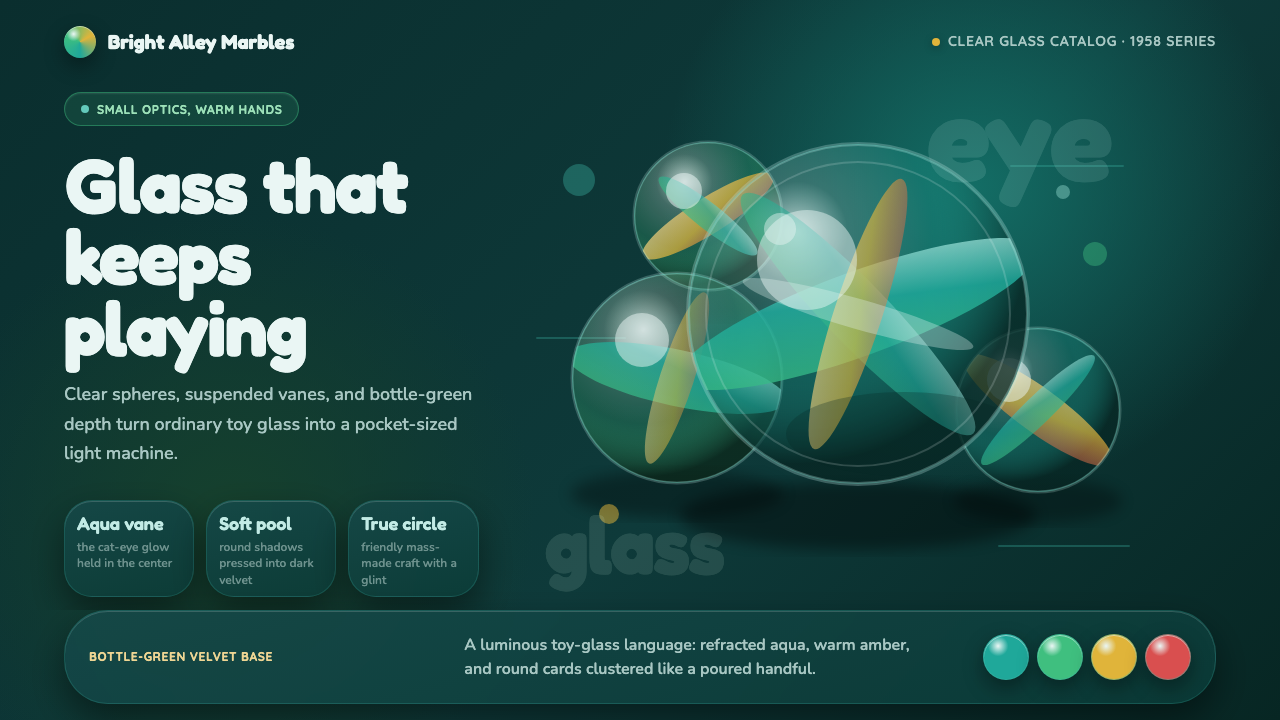 Cat's Eye MarblesMass-made glass feels magical. Aqua vanes glow inside round forms on bottle-g…
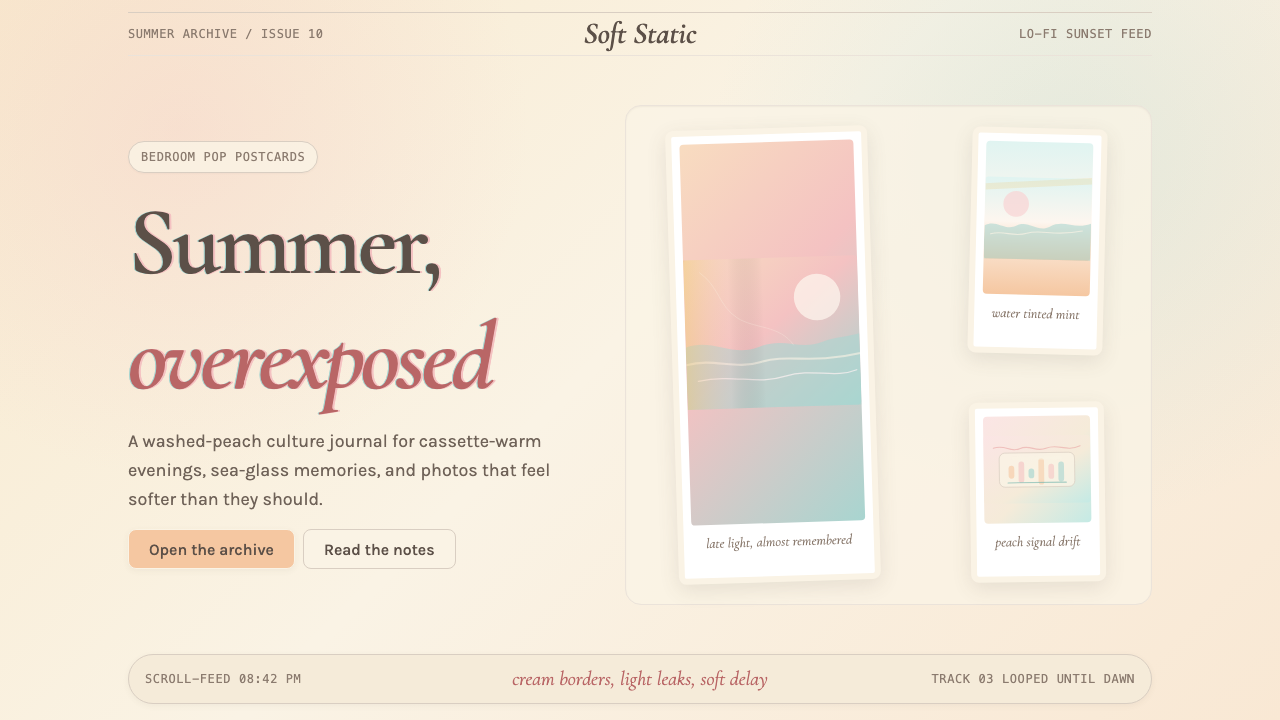 Chillwave TumblrA summer that never happened. Cream Polaroids, washed peach, and turquoise li…