What is Cat's Eye Marbles?
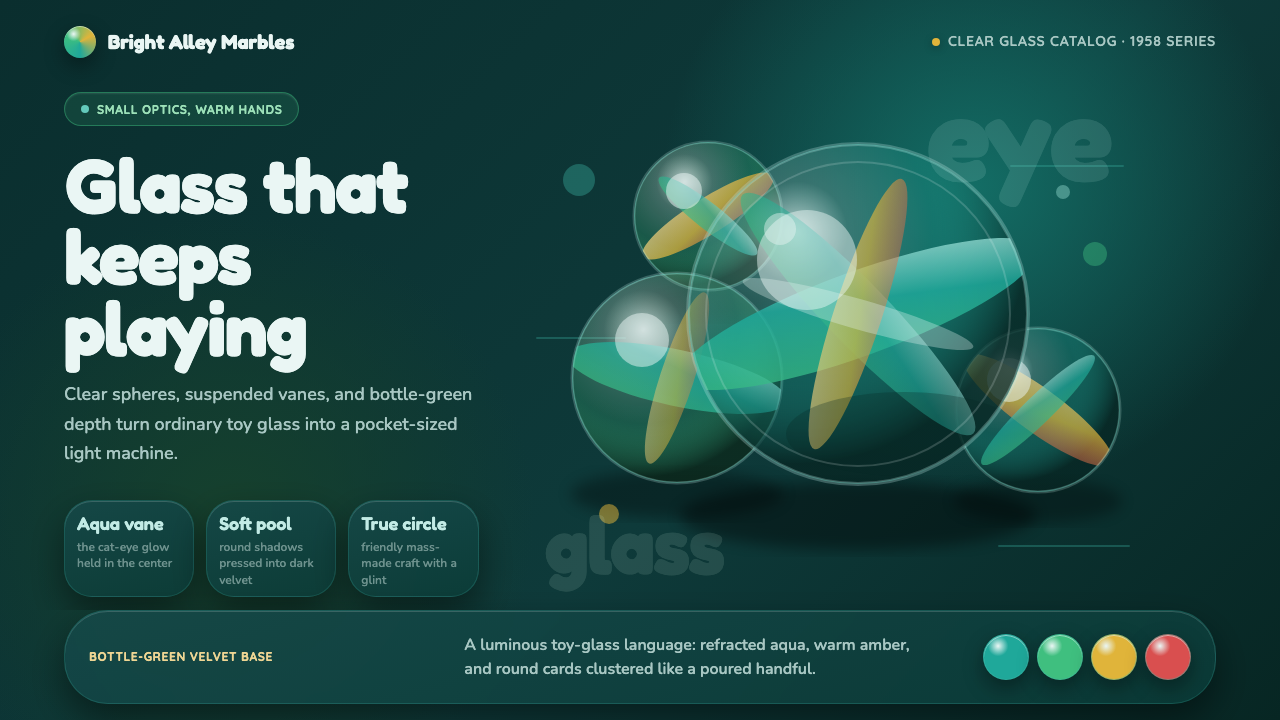
The cat's-eye marble packs a tiny, glowing miracle of mass production into a sphere of glass — and this system turns that same clear, refractive glow into an interface.
Cat's Eye Marbles in brief
Cat's Eye Marbles is a design system built from a specific, beloved piece of twentieth-century childhood: the machine-made glass marble with a colored, blade-like vane suspended at its center, visible through a clear glass shell. Held to the light, the vane seems to glow from within, and the whole sphere throws a soft, round shadow onto whatever surface it rests on — a small, self-contained optical object rather than a flat printed design.
The system treats glass as a literal material logic rather than a decorative filter. Surfaces behave the way the marble itself behaves: cool, refractive, and luminous, as though light is genuinely passing through and bending inside them rather than sitting on a flat colored fill. Everything is staged on a ground dark enough — a deep teal — to let the internal glow of the vane and the pale halo of its shadow actually read, the way a marble photographed on dark velvet looks far more vivid than one photographed on white paper.
Because the marble itself is small, round, cheerful, and made for a child's hand, the system avoids anything cold or clinical. Display type is rounded rather than sharp, and content is grouped into circular clusters rather than square tiles — an arrangement that echoes how marbles pool together in a pouch or roll into a cluster on a playing ring, tactile and playful rather than rigidly geometric.

Where does Cat's Eye Marbles come from?
The cat's-eye marble takes its name from its resemblance to a feline eye: a colored vane suspended inside a clear glass sphere looks strikingly like an iris and pupil floating behind a curved cornea. The design is a genuine feat of small-scale glass engineering — the vane is formed by injecting molten colored glass into a stream of clear molten glass as it is shaped into a sphere, so that the color sits fixed in three dimensions at the center rather than printed or painted on the surface.
The technique originated in Japanese glassworks, where manufacturers developed the injection method needed to suspend a distinct colored vane inside a clear glass body at industrial speed and consistency. From the 1950s onward, American marble manufacturers — most notably the Vitro Agate Company and later Marble King — adopted and scaled the technique, and cat's-eye marbles quickly became the dominant, most widely produced marble type in the United States, largely displacing older styles made from fired clay or hand-worked swirled glass.
Marbles themselves are far older than the cat's-eye style — children have played games with small round objects for millennia, using clay, stone, or nuts before glass became affordable and mass-producible. But the cat's-eye marble specifically belongs to the mid-twentieth-century industrial toy boom, when American factories could produce colored glass marbles by the millions at a cost low enough to make them a near-universal playground and schoolyard object rather than a handmade curiosity.
Marbles supported an entire informal game culture built around a scratched circle drawn in dirt or chalk, in which players tried to knock opponents' marbles out of the ring while keeping their own inside it — a game broadly known as ringer, formalized enough in the United States to support an annual National Marbles Tournament held in Wildwood, New Jersey since 1922. Cat's-eye marbles, prized for their bright, distinctive coloring and the number of vanes fused inside a single sphere, remain one of the most actively collected categories among vintage marble enthusiasts today.
What defines the Cat's Eye Marbles look?
Color and Inner Glow
The signature color is a bright, saturated aqua-green, the shade most associated with classic cat's-eye vanes, though other vane colors appear as accents. The vane color is always treated as an inner glow rather than a surface tint — brighter and more concentrated toward the center, softening outward — to mimic how a colored vane genuinely appears to radiate light from within a glass sphere.
Transparency and Refraction
Surfaces are treated as glass-like: cool, clear, and refractive, with the suggestion of light bending as it passes through a curved dome rather than sitting flat on an opaque fill. This distinguishes the system from a simple flat-color palette — every panel or card behaves as if it has real depth and thickness, like a sphere rather than a sheet.
Circular Form
The sphere is the system's fundamental shape. Cards, badges, and content groupings are arranged as circular clusters — echoing how loose marbles gather in a pouch or roll together on a playing surface — rather than laid out as rectangular tiles. This circular logic extends to buttons and icons, which favor round or pill forms over sharp rectangles.
Vane Pattern
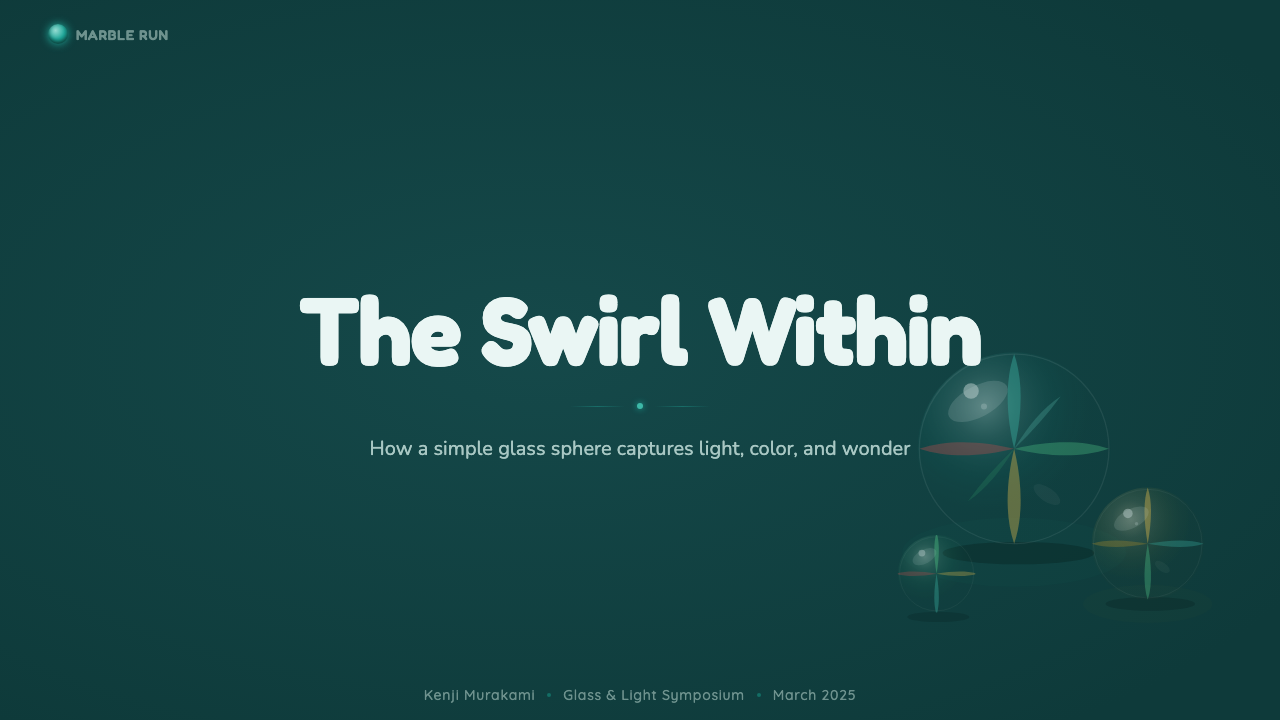
Inside a circular form, a radiating, blade-like pattern of four to six segments recalls the vane structure fused inside a genuine cat's-eye marble. This motif is reserved for focal points — a featured badge, a loading indicator, a highlighted card — rather than repeated as an all-over background texture, the way a real marble's vane is a singular, central feature rather than a repeating print.
Soft Round Shadow
Elements cast a soft, diffuse, perfectly round shadow beneath them, echoing how a spherical marble resting on a surface throws a rounded pool of shadow rather than a sharp geometric one. This keeps shapes feeling like real, dimensional objects sitting on a surface rather than flat graphics layered on top of a page.
Typography
Display type is rounded and friendly rather than sharp or technical, matching the tactile, toy-like character of the marble itself. This keeps the system feeling warm and playful rather than cold or precision-engineered, even though the underlying material logic — glass, refraction, light — is quite technical.

Who shaped Cat's Eye Marbles?
Japanese glass manufacturers developed the technique of injecting molten colored glass into a stream of clear glass to form a suspended vane, the core engineering innovation that makes a cat's-eye marble possible. This origin is the technical foundation the entire American cat's-eye marble industry later built upon.
One of the most significant American marble manufacturers of the mid-twentieth century, Vitro Agate adopted and scaled cat's-eye production, helping make the style the dominant marble type sold across the United States from the 1950s onward. Its production runs are heavily documented and collected by vintage marble enthusiasts today.
A long-running American marble manufacturer known for cat's-eye and other machine-made marble styles, Marble King is one of the few marble factories from the mid-twentieth century that continued production into the modern era, providing continuity between the golden age of American marble manufacturing and today's collector market.
Held annually in Wildwood, New Jersey since 1922, this tournament formalized the schoolyard game of ringer into a structured national competition, cementing marbles — and by extension cat's-eye marbles as prized playing pieces — as a genuine part of twentieth-century American childhood culture rather than a purely casual pastime.
The community of collectors who catalogue vintage marbles by manufacturer, color combination, and vane count has preserved detailed knowledge of cat's-eye production history, and their documentation is a primary reason so much is known today about how specific colorways and factories relate to one another.
How do you use Cat's Eye Marbles today?
Cat's Eye Marbles works best where a product benefits from a sense of playful, tactile delight rather than corporate seriousness, because the entire system is built around the physical charm of a small glass toy rather than an abstract color scheme. Applying it well means preserving the glass-like transparency and the circular, spherical logic, rather than simply using teal and green as flat brand colors.
On presentation slides, the system shines on cover slides and any moment meant to feel like a reveal — a circular badge with a glowing vane pattern can anchor a title the way a marble held up to the light draws the eye. Content slides work well when data points are shown as circular clusters of varying size rather than bars or rectangles, echoing how marbles of different sizes group together naturally.
For web interfaces, the system fits playful consumer products, games, kids' products, and creative tools where a dashboard or pricing page can afford warmth and tactility over strict corporate seriousness. Circular cards and pill-shaped buttons carry the spherical logic through the interface, and the soft round shadow beneath each card reinforces a sense of real, touchable objects rather than flat rectangles.
In editorial and marketing contexts, the system supports nostalgic, collectible, or hobbyist storytelling — long-form articles about vintage toys, craft, or childhood memory benefit from the deep teal ground and glowing accent color, and pull quotes or callouts can be framed inside circular badges rather than rectangular boxes. Marketing pages for playful or collectible products read naturally within the system's tactile, rounded visual logic.
A common mistake is treating teal and green as arbitrary flat brand colors rather than as an inner glow that should concentrate toward the center of a shape and soften outward; without that glow logic, the palette reads as generic rather than glass-like. A second mistake is laying content out in strict rectangular grids, which fights against the system's circular, clustered arrangement and undercuts the tactile, marble-like feeling the whole system depends on.
Cat's Eye Marbles — FAQ
Why is it called a 'cat's-eye' marble?
The name comes from its visual resemblance to a feline eye — the colored vane suspended inside the clear glass sphere looks strikingly like an iris and pupil floating behind a curved cornea, especially when the marble is held up to the light and the vane appears to glow from within.
How is the colored vane actually made inside the glass?
The vane is formed during manufacturing by injecting a stream of molten colored glass into a stream of clear molten glass just as it is being shaped into a sphere, so the color becomes fused and suspended in three dimensions at the center rather than painted or printed on the surface afterward. This injection technique originated in Japanese glassworks before being adopted and scaled by American manufacturers.
Are cat's-eye marbles still made today?
Yes — manufacturers such as Marble King have continued producing marbles, including cat's-eye styles, from the mid-twentieth century into the present day, though the style's peak cultural moment as a nearly universal playground object was the mid-1900s. Vintage examples from that peak era, especially rare colorways, are actively sought by collectors.
What game were cat's-eye marbles originally used for?
The most common traditional game is known as ringer, played inside a circle scratched into dirt or chalked onto pavement, where players try to knock opponents' marbles out of the ring while keeping their own inside it. The game was formal enough in the United States to support an annual National Marbles Tournament held in Wildwood, New Jersey since 1922.
What is a common mistake when applying this style to a design?
The most common mistake is using teal and green as flat, uniform brand colors instead of treating them as an inner glow that concentrates toward the center of a shape and softens outward, which is what makes the palette feel like glass rather than paint. A close second is arranging content in strict rectangular grids, which works against the circular, clustered logic that gives the system its tactile, marble-like character.
Related design styles
 Play-Doh (1956)Joy you can squish. Candy primaries, chunky type, and pinched clay forms make…
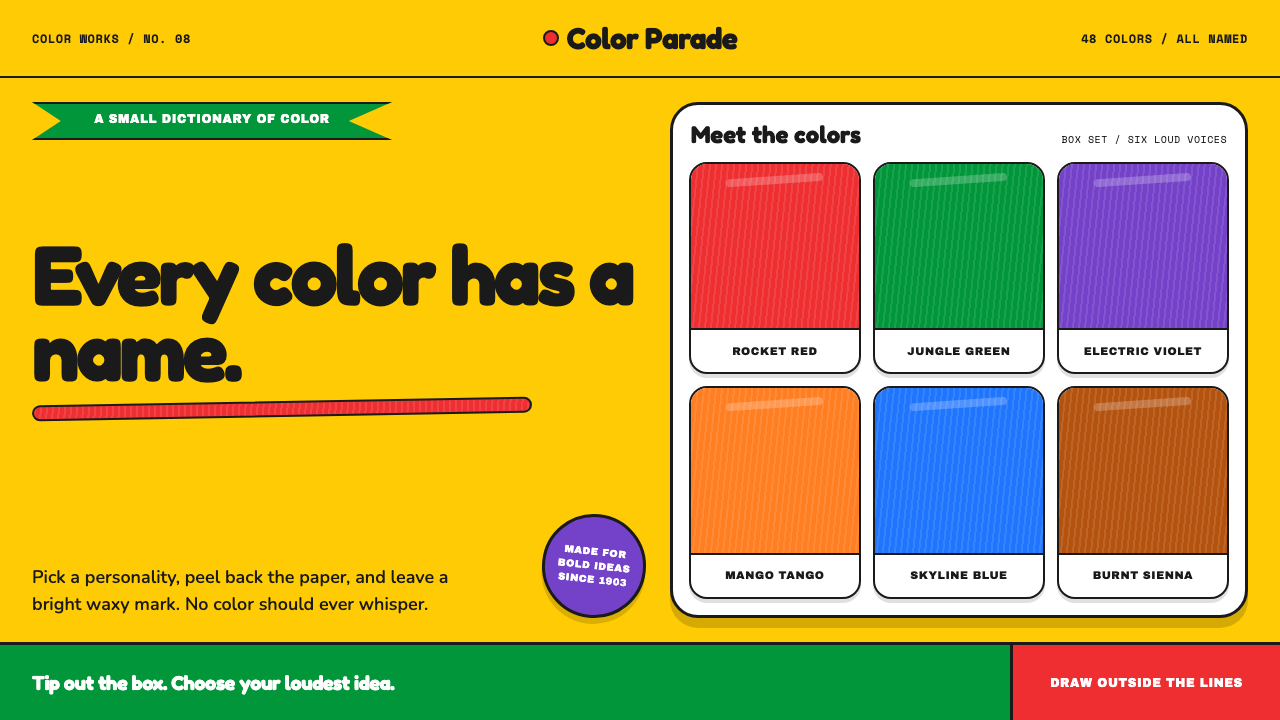 Crayola (1903)Color never whispers. Golden yellow, a green slash, and waxy swatches make ev…
 Indonesian Rattan WeaveBent by hand, varnished warm. Honey-caramel cane and dark binding edges over…
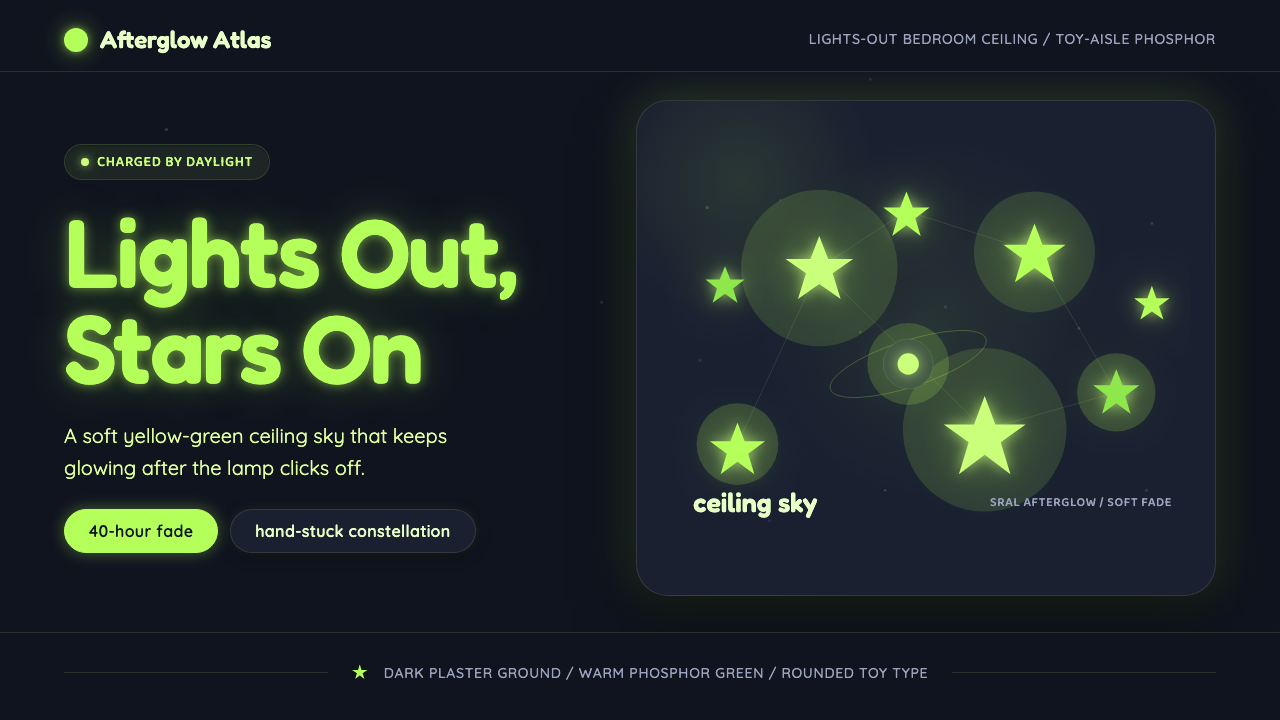 Glow-in-Dark Ceiling StarsTurns lights-out into wonder. Yellow-green stars glow across a dark blue-gray…
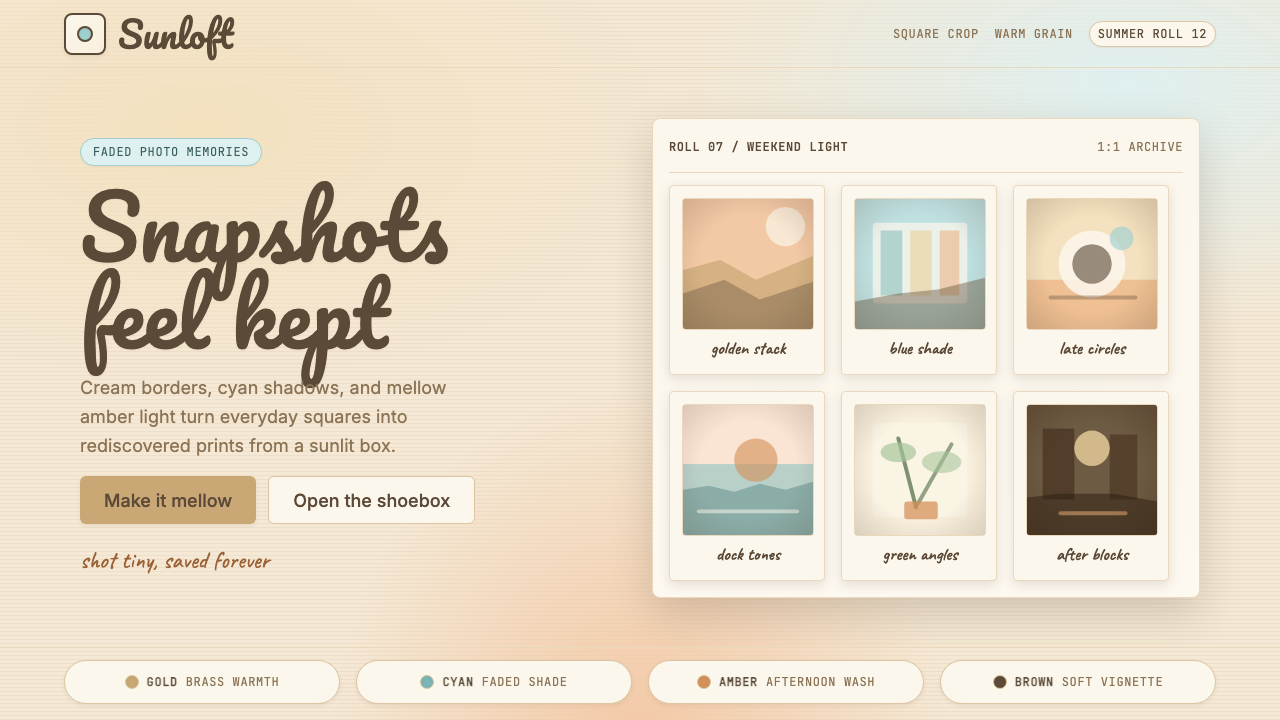 Instagram 2010s FilterWhen photos felt like memories. Faded warmth, dark vignettes, cream-tinted Po…
 Macramé Fiber ArtSlow craft, hand to fiber. Undyed ecru cotton on raw-jute walnut, square knot…