What is Sombrero Vueltiao?
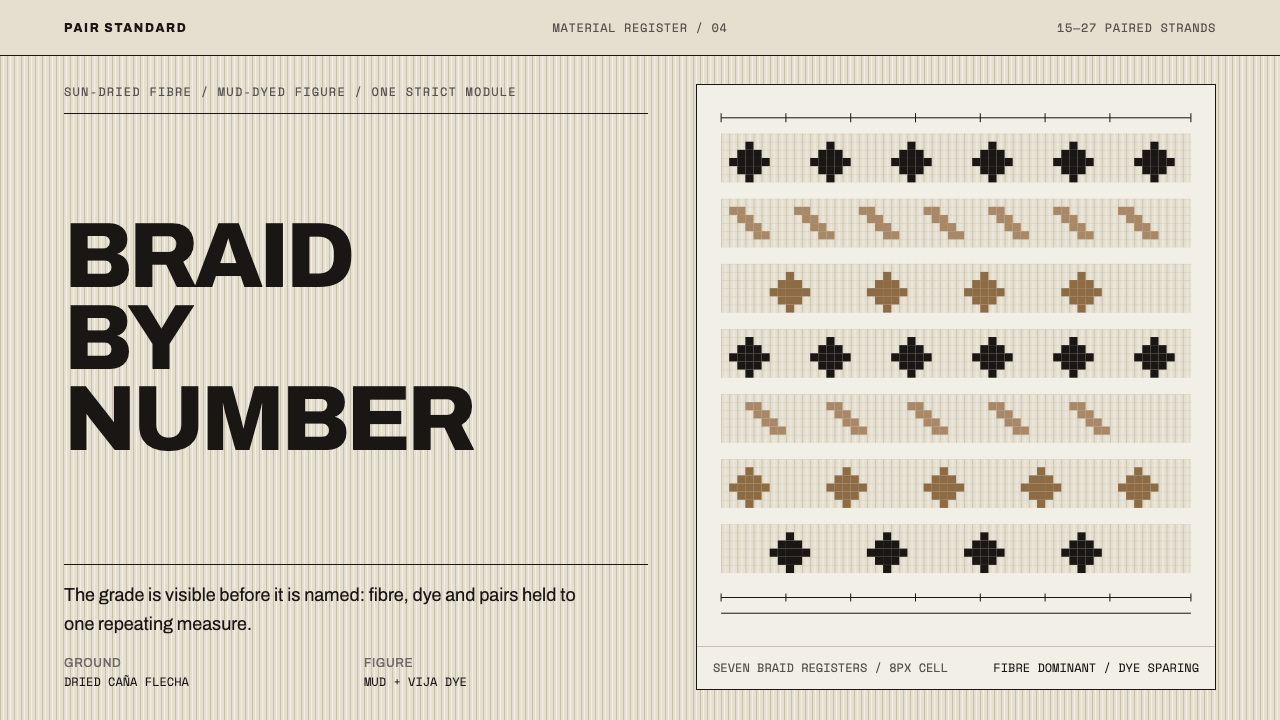
The sombrero vueltiao is a counting system before it is a hat — two tones of cane braided into repeating bands, every figure built from countable cells.
Sombrero Vueltiao in brief
The sombrero vueltiao is the woven hat of the Zenú people of Caribbean Colombia, plaited from caña flecha, a cane that is split into very fine strips. As a design system it is a language of bands, cells and two tones. Mud-brown figures run across pale, sun-dried straw in horizontal stripes, and each stripe is built from a strict module of small square cells. The surface is entirely matte, because dried grass has no shine, and the dark tone is a brown-black that never quite becomes black.
What sets the style apart is that it begins with counting. The hat's quality is not a matter of opinion or a brand name but of how many paired strands are plaited together: fifteen pairs at the coarse end, twenty-seven at the finest. Pattern, density and value are all read from the same grid. A design that takes this measure treats everything as a band on a cell module, and treats fineness as a quantity that can be seen and counted rather than merely claimed.
The result is a visual language that feels both ancient and rigorously modern. Its repeating figures can be tiled without seams, its diagonals are staircases because a woven grid can only step, and its colour is the colour of what the material actually does: pale where the cane dries in the sun, dark where it has sat in mud. Nothing is printed on the surface. Every mark is structure.

Where does Sombrero Vueltiao come from?
The hat comes from the Zenú homeland in Caribbean Colombia, centred on the town of Tuchín and the Zenú resguardo, in the departments of Córdoba and Sucre. The source describes the craft as pre-Columbian Zenú weaving that has stayed in continuous production, which makes the hat the visible end of a much older tradition of textile and basketry. The word vueltiao is usually explained by the turns of the braid wound around the crown, and that image of a plait that goes round and round is the key to its pattern language.
The material and the colour are inseparable. Caña flecha is split into strips, and the strips are divided into two lots. One half dries in the sun until it turns a beige-white. The other half sits for three or four days in black mud and is then boiled with vija until it holds a brown-black. The colour is taken into the fibre, not laid on its surface like an ink, and the two lots are then plaited together into a braid. That is why the dark tone in this system has a warmth to it: it comes from mud and a long soak and boil, not a printing process.
The repeating figures in the braid are called pintas, and they carry Zenú clans, animals and landmarks around the circuit of the hat. A pinta is a geometric figure, but it is also a statement: who the weaver belongs to, what lives in the country, where things are. Because the braid is a closed ring, the figures repeat in a loop rather than ending, and they are built from the crossings of strips, so each is a stepped, cell-based shape. The structure of weaving imposes the geometry; the culture supplies the meaning.
In the twenty-first century the hat took on a second life as a national emblem. The source records that Colombia declared it a national cultural symbol by Law 908 of 8 September 2004, placing Zenú craft among the images by which the country represents itself. That makes the hat a case of Colombian artesanía as national identity, and also a case with a tension in it, because a regional craft belonging to specific families became shorthand for a whole country. The weaving families of Tuchín, rather than any individual maker, are the source's key figures.
What defines the Sombrero Vueltiao look?
Two-Fibre Palette
The palette is two tones and nothing more: a beige-white from cane dried in the sun, and a brown-black from cane soaked in mud. The dark is never a true black; it carries the warmth of mud and a long soak. There is no third colour, because the material has only two states. This limitation is what makes the style so cohesive: every figure is simply light against dark or dark against light.
The Cell Module
Every figure is built from cells where one strip crosses another. A cell is the smallest unit the weaver has, so no mark can be smaller, and no line can be anything but a row of cells. Diagonals become staircases, and curves become approximations made of steps. A layout that adopts the module snaps everything to one square rhythm and gains an almost architectural order.
Horizontal Bands
Pattern arrives in bands that run around the circuit of the hat. Each band repeats a figure, bands are stacked, and the pale and dark rows alternate. Because the braid is a closed ring, the repeats never end; they loop. In design terms this is a system for dividers, headers, borders and section markers that tile horizontally without a seam, and it favours wide, stacked layouts over tall, isolated ones.
Pintas as Language
The figures are not arbitrary ornament. Each pinta carries a meaning: a clan, an animal, a landmark of the Zenú country. The geometry is abstract, yet the content is specific. The lesson for a designer is that a repeating pattern can be a carrier of information rather than wallpaper, and that the structure of the pattern should be chosen with the same care as the meaning it carries.
Counted Fineness
Quality is expressed as a count of paired strands, from a coarse weave at one end to a very fine one at the other. More pairs mean smaller cells, a softer hand and a higher value. The same dimension is visible in a layout: density can be a tier, a level of detail that readers can see at a glance. It is a rare system in which price, craft and visual resolution are the same variable.
Matte Dye, Not Ink
The surface has no shine, no gradient and no cast shadow. Dried grass does not gleam, and a dye soaked into a fibre does not sit on top of it like a print. Depth comes only from the physical overlap of strips, never from simulated light. Translated to interface work, this means flat, matte surfaces, solid fills and edges that are decisions rather than glows.

Who shaped Sombrero Vueltiao?
The source gives no individual maker, only the weaving families of Tuchín, and that is accurate to the craft. Knowledge passes through households, with the cane prepared, the mud and vija dye managed and the braid counted pair by pair. Treating the families as the author means treating the style as a living practice with owners, not a free-floating pattern book, and it sets the tone for how a designer should credit and describe it.
The pintas carry clans, animals and landmarks around the hat, which makes the clans both the subject and the audience of the pattern. The clans are not designers in the modern sense, but they are the reason the figures exist and the reason each has to be treated as meaningful. For designers it is a reminder that the structure of a pattern can be borrowed freely, while specific motifs belong to the people whose identity they record.
The cane is a collaborator in the design. Split into strips, it dries pale in the sun or darkens in mud, and the whole visual system follows from what the strips can do: they cross, they step, they take two tones and no shine. A style that is this closely tied to a material is a useful corrective to design that starts from an image and looks for a way to make it. Here the material comes first, and the image follows.
The law of 8 September 2004 is not a person, but it is the event that turned a regional craft into a national symbol. It recognised the hat as part of what Colombia is, and it brought Zenú weaving into public view well beyond the Caribbean coast. It also shows how a design language can move from the margins to a nation's emblem, with all the opportunities and misreadings that attention brings.
How do you use Sombrero Vueltiao today?
The sombrero vueltiao style is highly transferable because it is a system rather than a picture: a two-tone palette, a cell module, stacked bands and a matte surface. Applying it well means respecting the structure and being careful with the specifics.
For presentation slides, the cover can be built around a single wide band: a pale field with one stepped, repeating stripe near the top or bottom, and a title set in plain type on the open area. Content slides should snap to the cell module, with text blocks, images and dividers all aligned to one square rhythm and a thin band separating sections. Data slides suit the style well: bar charts and heat maps made from visible square cells read as if woven, and a count of cells becomes a count of value.
For web interfaces, the cell module is a ready-made spacing system, and the bands become headers, dividers and footers that tile seamlessly across any width. Pricing pages can borrow the idea of counted fineness, letting each tier show its level as a visible number of units. Dashboards can use cell-based heat maps and calendar grids. Keep surfaces matte, with solid fills and firm edges, and let the two tones carry the interface without a third colour.
For editorial and marketing work, the style is a natural fit for craft and heritage brands, travel and cultural content, artisan commerce, packaging and anything that wants to say 'made by hand, with a method'. A single patterned band as a recurring header gives a publication an identity without a logo. Pair it with plain, warm text and generous space, and credit the Zenú craft where the style is the subject.
The most common mistake is to add shine: gloss, bevels, soft shadows or a photographic straw texture, all of which contradict a surface defined by being matte. A second mistake is to treat the pintas as generic ethnic wallpaper. The structure of bands and cells can be borrowed freely, but specific figures carry clan identity, so avoid reproducing them as pure decoration, and never scramble them into pseudo-patterns. A third is to add a bright accent colour; a third tone breaks the logic of two states.

Sombrero Vueltiao — FAQ
What is a pinta?
A pinta is one of the repeating figures plaited into the braid of the hat. Each is a geometric, cell-built shape that carries a Zenú clan, an animal or a landmark around the circuit of the hat. Because the braid is a closed ring, pintas repeat in a loop. For design, they offer a model of how a pattern can be both strictly geometric and genuinely meaningful.
Why is the dark tone brown-black instead of true black?
Because it is a dye in a fibre, not an ink on a surface. The cane sits for three or four days in black mud and is then boiled with vija, which sets a brown-black that never quite becomes black. That warmth is part of the identity. Replacing it with a pure, cold black makes the palette feel printed and synthetic, and loses the earthy, matte quality the style depends on.
What do the fifteen and twenty-seven pairs mean?
They are the two ends of the quality scale. A hat is graded by how many pairs of strands are plaited together: fifteen at the coarse end, twenty-seven at the finest. More pairs mean smaller cells, a softer weave and a higher value. It is a rare example of a craft in which visual resolution, tactile quality and price are all read from a single, countable variable.
Why is everything matte?
Because the material is dried grass, and dried grass does not shine. Depth in a woven surface comes from strips passing over and under one another, not from reflected light. In a digital layout, this translates into flat fills, firm edges and no glossy highlights or soft glows. Adding shine would make the surface look like a different material and would weaken the sense that every mark is structure.
Can I use real pintas in a design?
Be careful. The structure of the style, meaning bands, a cell module and two tones, is free to learn from. Specific pintas record Zenú clans, animals and landmarks, so reproducing them as generic decoration risks flattening their meaning. If a project is about Zenú craft or Colombian heritage, credit the source and take care with the figures. If it is not, use the structure and invent your own cell-built shapes.
Related design styles
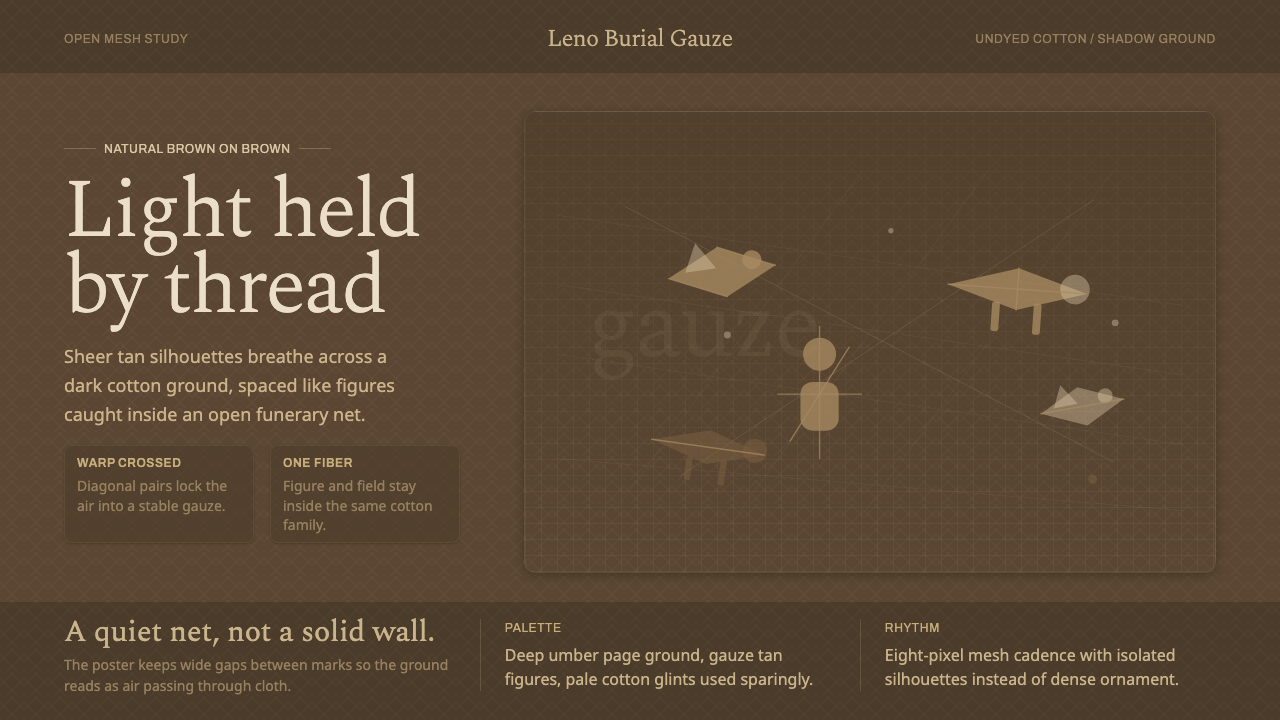 Chancay Gauze TextileQuiet woven dignity. Tan silhouettes float through a dark open cotton mesh.
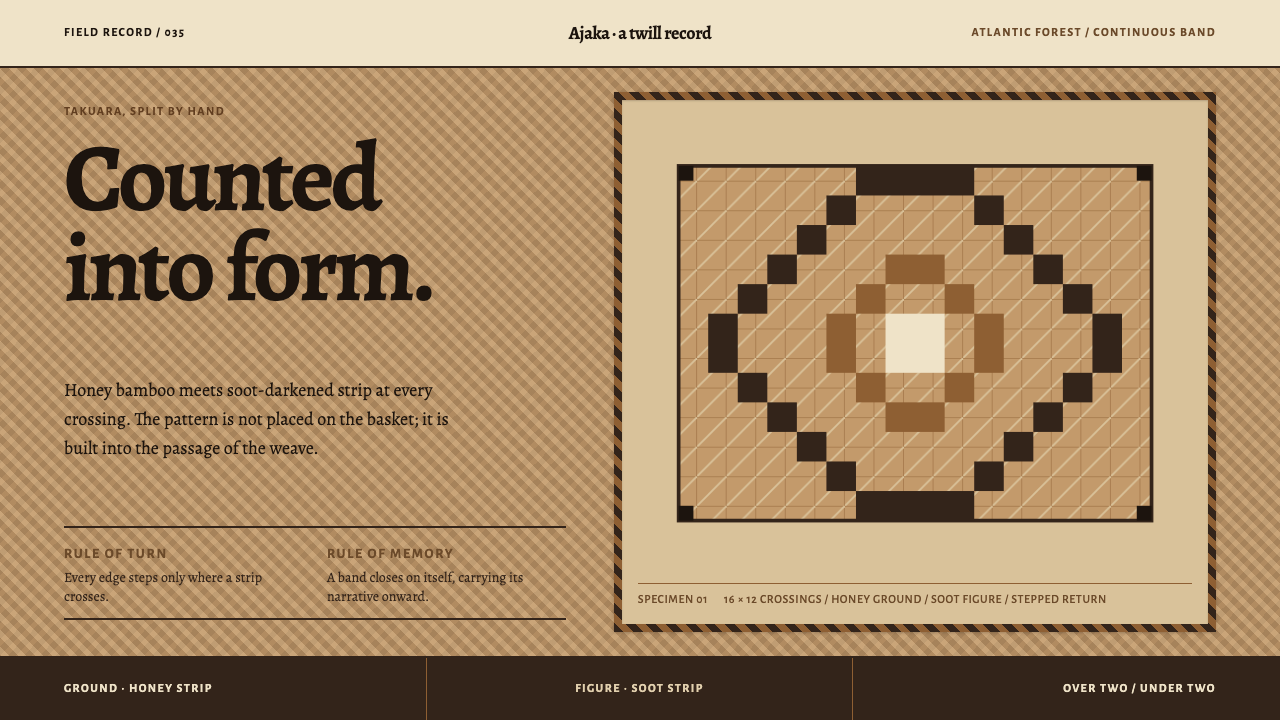 Guaraní Takuara BasketPattern is a record, not garnish. Honey bamboo and soot strips lock into a co…
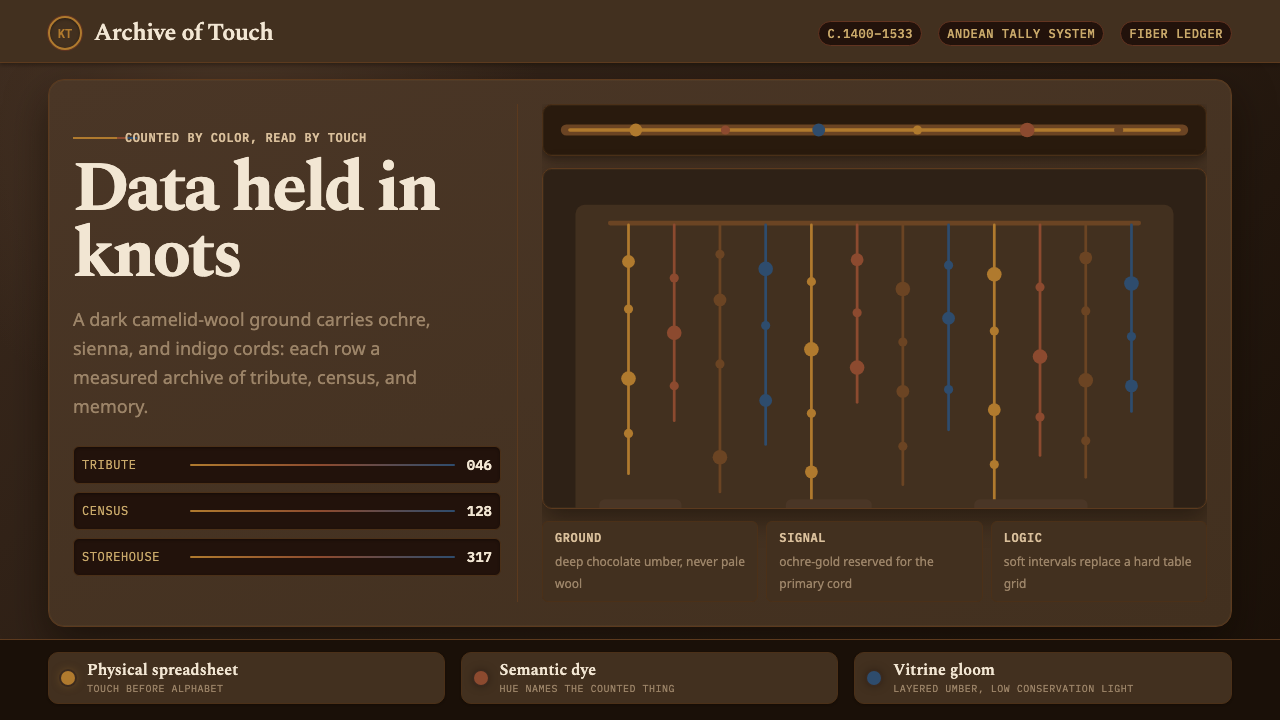 Inca Quipu Knot-CordData you can touch. Ochre cords and knots hang in chocolate-umber vitrine glo…
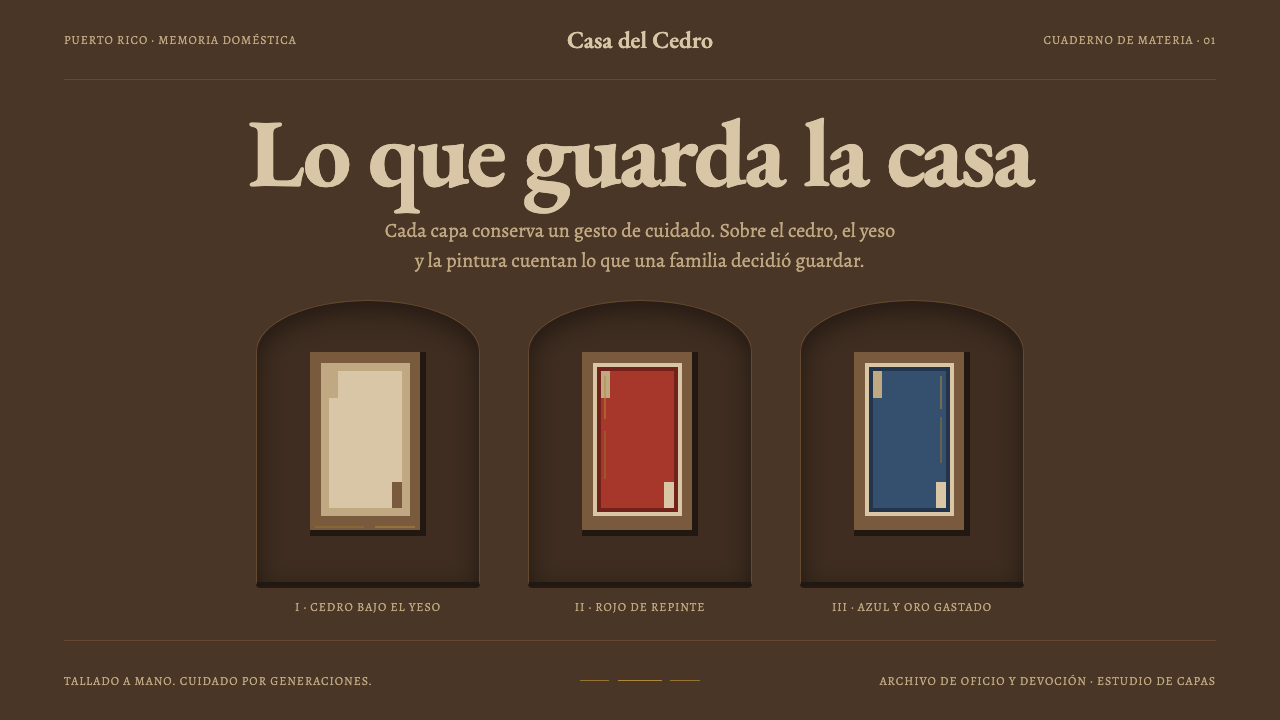 Santos de PaloDevotion leaves layers. Cedar-dark recesses hold gesso, repainted red and a w…
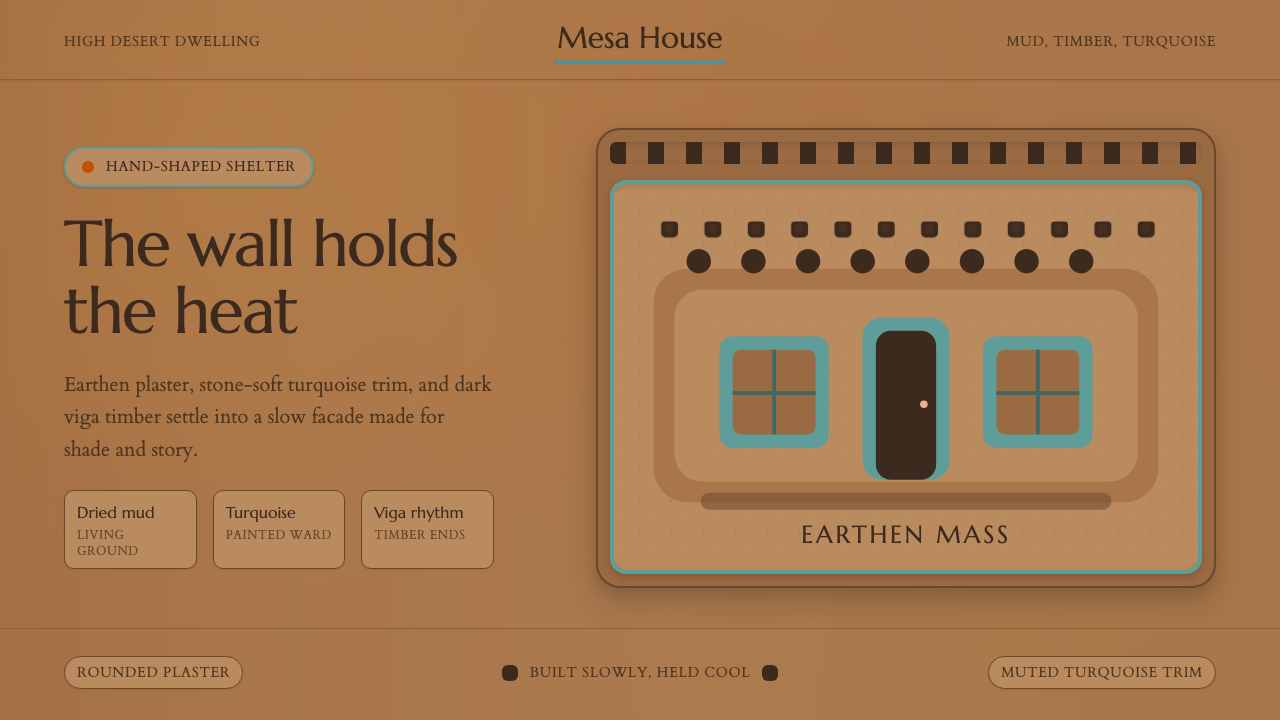 Adobe Pueblo SouthwestFeels made by hand. Earthen tan, turquoise trim, and viga rhythm shape the fr…
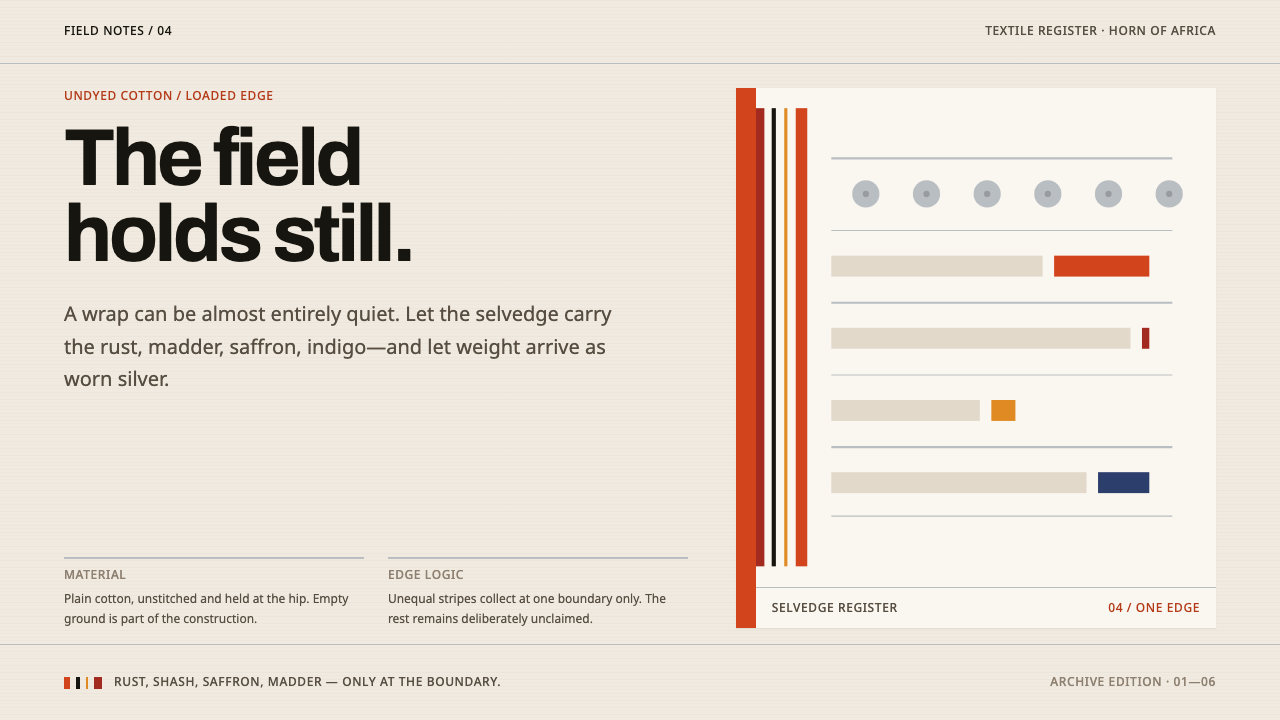 Afar Nomad TextileWeight lives at the edge. Rust and madder selvedges cut across a quiet cotton…