What is Afar Nomad Textile?
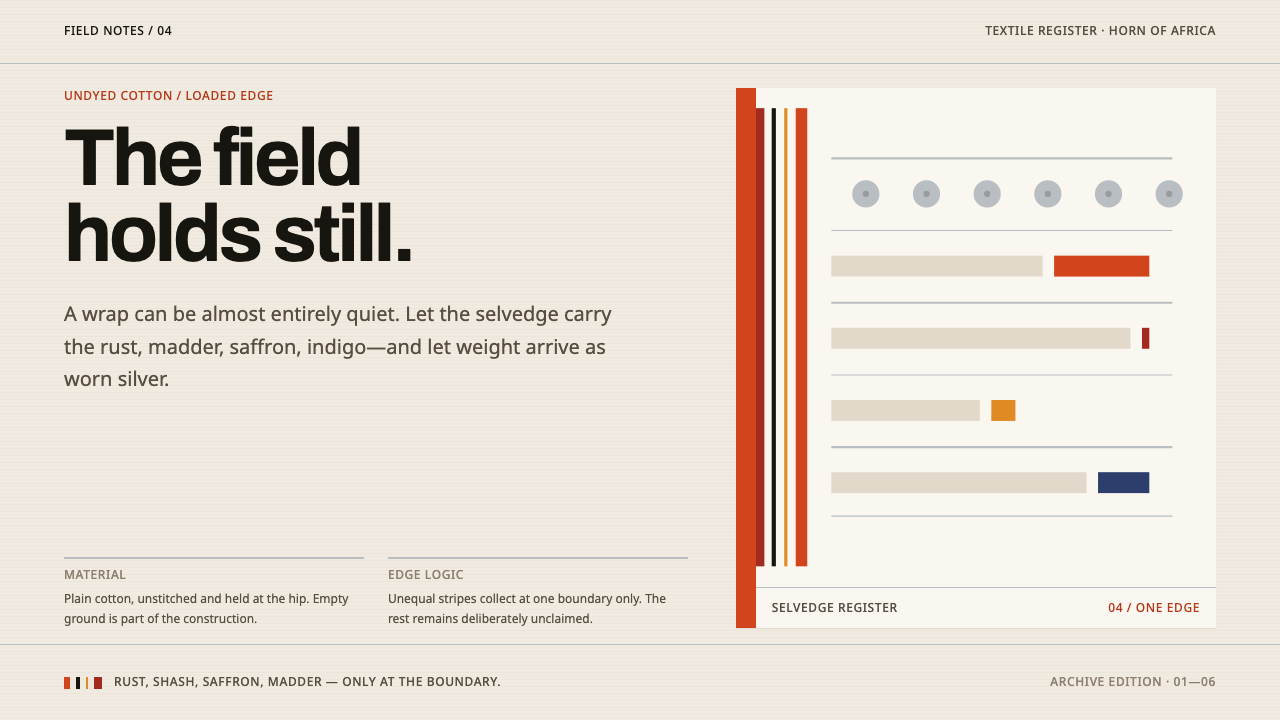
The Afar did not weave their cloth, they chose it, and the whole identity of the garment sits in a narrow striped selvedge and a few pieces of heavy silver set against a deliberately quiet field.
Afar Nomad Textile in brief
Afar Nomad Textile is a design style taken from the everyday dress of the Afar people of Djibouti and the Danakil depression, whose homeland also runs across Eritrea and Ethiopia. Its central garment is the sanafil, an unstitched wrap of plain cotton knotted at the right hip. The cloth is not woven by the people who wear it. It is bought from merchants, cottons and muslins that came inland along Red Sea trade routes, and it is worn undyed by preference, a preference that has not changed.
What makes the garment readable is not the field but the edge. A narrow band of woven stripes runs along the selvedge, unequal in width and clustered at one side only, while the rest of the cloth stays blank. Add silver, hammered thick and hung from leather in the hair, worn as weight rather than as sparkle, and the whole visual argument is complete: one quiet ground, a few loaded edges.
As a design system the style turns that into layout logic. Large calm fields of warm, unbleached off-white; colour confined to thin bands in rust and madder; one dense accent of cool metal; and a deliberate lopsidedness, because the weight sits on one side. Emptiness here is not a restraint applied on top of the design. It is simply how the cloth looks.
Where does Afar Nomad Textile come from?
The Afar homeland is the Danakil depression and the country around it, in Djibouti and across the borders into Eritrea and Ethiopia. The style's lineage places Afar clans at the heart of the salt-caravan economy, holding the routes that ran inland from the Red Sea. That position made them customers in a trade that moved cloth as well as salt, and it is the key to everything visual about the garment. The tradition is dated simply as older than 1900 and continuous into the present; there is no revival and no break, only dress that has kept being worn.
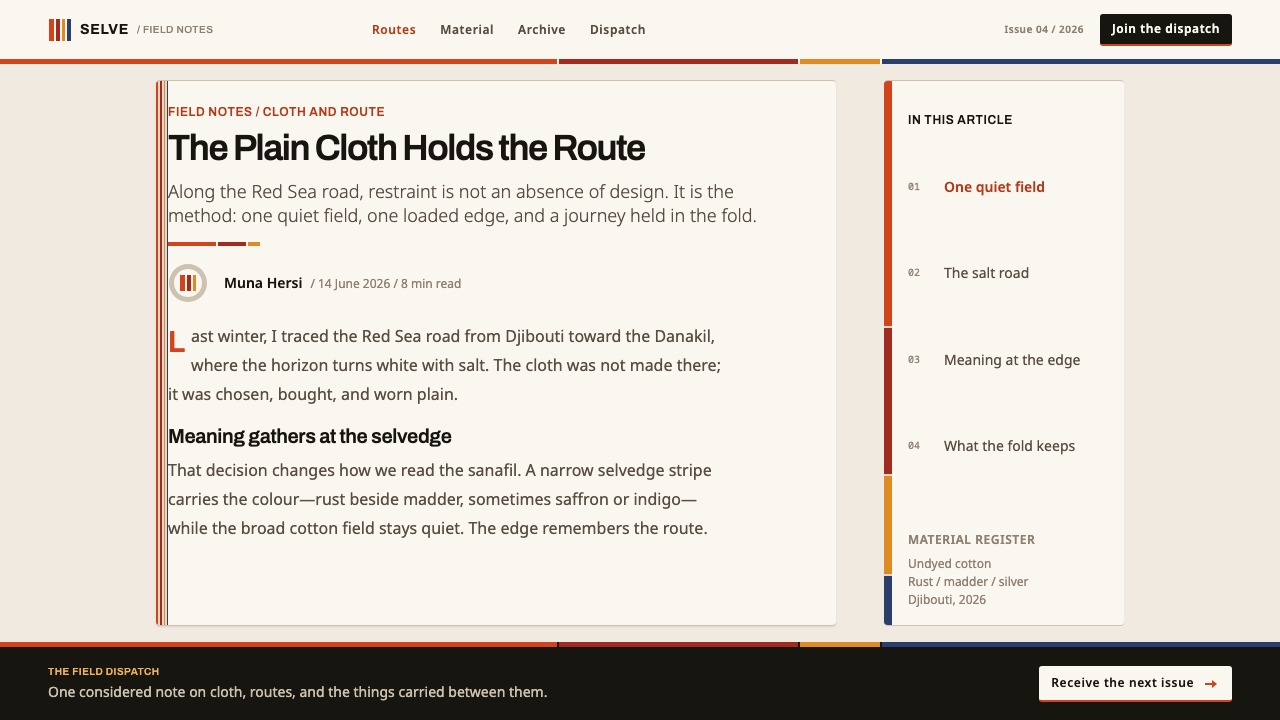
Because the Afar bought their cloth rather than weaving it, design effort went somewhere other than the surface. Merchants brought cottons and muslins; the Afar selected among them and wore them plain. The sanafil is wrapped, not tailored, knotted at the right hip, and undyed. The only colour the cloth carries is the narrow woven stripe band at its selvedge, and the only ornament worn with it is metal. A garment organised this way has no need for allover pattern. Its character is carried by choice, proportion and a very small number of places where colour and craft are allowed to gather.
Two further strands complete the lineage. The first is institutional: the Aussa Sultanate, which the lineage names among its key shapers, belongs to the same world of Afar clans, caravan routes and exchange that put the cloth into Afar hands. The second is craft. Afar silversmiths work within the wider Horn of Africa tradition of silver ornament, producing the thick hammered pieces that hang from leather cord in the hair. Silver is worn for its mass. It is not polished into sparkle, and it is not there to flatter the cloth; it balances it.
Read as nomadic pastoral dress, the whole thing looks like design for people who move. A wrapped cloth can be put on, adjusted and carried without a tailor; metal ornament travels without wearing out; and one small band of colour at an edge tells you everything you need to know. The style inherits that economy of means. Nothing decorative is added that could not be carried, and nothing structural is added that a knot could not do.
What defines the Afar Nomad Textile look?
The undyed field
The ground is natural, undyed cotton: a soft, warm off-white with a trace of cream, never optical white. Because the Afar choose their cloth and leave it undyed, the field is the main material of the garment rather than a backdrop to something else. Large stretches of it stay unbroken, and the eye is expected to rest on it.
The selvedge stripe band
The only substantial colour is a band of woven stripes at the selvedge, in rust and madder: a burnt orange-red and a deeper, slightly bluish red. The stripes are unequal in width and irregular in rhythm, like a ruled margin drawn by hand rather than a pattern generated by a rule. They are thin enough to stay a border, and strong enough to anchor the whole field.
Weight on one side
The stripes cluster at one edge only, and the opposite side stays bare. This is the style's central compositional move. Balance comes from a heavy edge set against a vast empty field, not from mirroring, and the result is a layout that feels settled even though it is lopsided. Centring everything undoes the effect.
Wrapped, not stitched
The sanafil is unstitched; it holds together with a knot at the right hip. Translated into interface terms, structure is a gesture and not a wall. Sections are separated by space and, at most, one thin band. Heavy boxes, thick frames and nested containers all contradict a garment whose whole architecture is a wrap and a knot.
Silver as weight
Silver is hammered thick and hung from leather in the hair; the point is mass, not sparkle. Visually that means a dull, dense, cool grey accent with no gloss and no simulated shine. In a layout it is one compact element, a mark, a badge or a single heavy rule, that carries emphasis because it looks heavy, not because it glows.
Emptiness as material
In most minimal design, emptiness is a choice. Here it is the cloth's actual state: undyed, unfilled, left as it came. The style is therefore quiet in a particular way, calm because nothing was added rather than because something was removed. Typography should behave the same way: plain, unhurried, with no ornament competing with the one edge that matters.
Who shaped Afar Nomad Textile?
The clans who held the salt-caravan routes inland from the Red Sea sit at the origin of the whole look. Their position in the trade explains why they were buyers and wearers of imported cloth rather than weavers of their own, and why their dress concentrates identity in selection and in a few edges instead of in surface pattern.
A historic Afar political institution that the style's lineage lists among its key shapers. It belongs to the same world of clans, caravan routes and exchange. The style takes no particular motif from it, only a context: an organised world of trade and authority standing behind the plain cloth.
The merchants who carried cottons and muslins inland supplied the cloth itself. Their goods are the reason the field is plain: the textile arrived made, and the Afar made it their own by choosing it and wearing it undyed. In design terms they stand behind the principle of cloth that is chosen, not made.
Silversmiths working in the wider Horn of Africa tradition of silver ornament produce the hammered pieces hung from leather in the hair. They supply the style's second pole: if the cloth is quiet and light, the silver is dense and heavy. Their craft shows that weight, not shine, is the measure of ornament here.
How do you use Afar Nomad Textile today?
Afar Nomad Textile suits work where calm should be the dominant feeling and a single edge should do the talking. Its logic is portable: leave the field alone, load one edge, add one heavy accent. Used that way it travels across media, and it is easiest to get wrong when it is treated as a pattern to scatter.
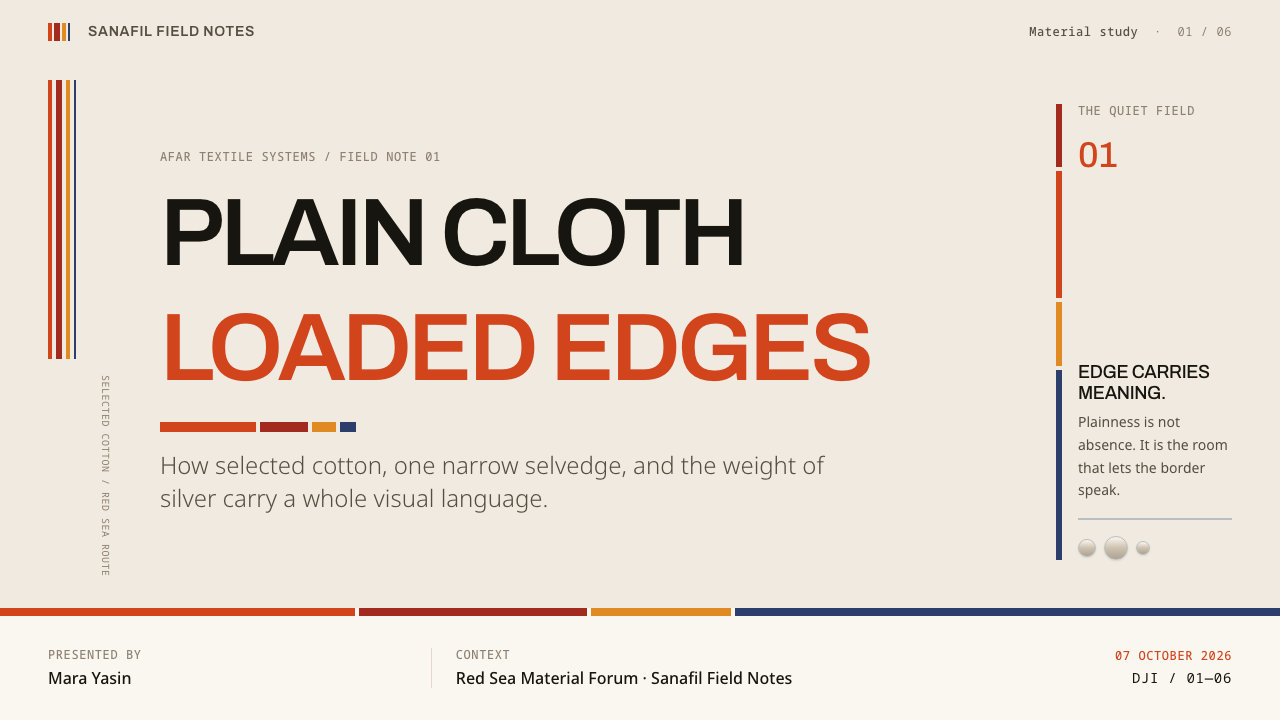
For slides, a cover works best as a vast warm off-white field with the title set plainly and a thin rust-and-madder striped band running along one edge only: the left, the bottom or the top, never both sides. Content slides repeat the band as a small marker at the same edge, so that it reads as the selvedge of the same cloth, and keep text on the open field with generous margins. Data slides should draw charts in one dark, quiet ink and let a single series or a single bar take the rust, while a small cool-grey mark plays the role of the silver and carries the one callout that matters.
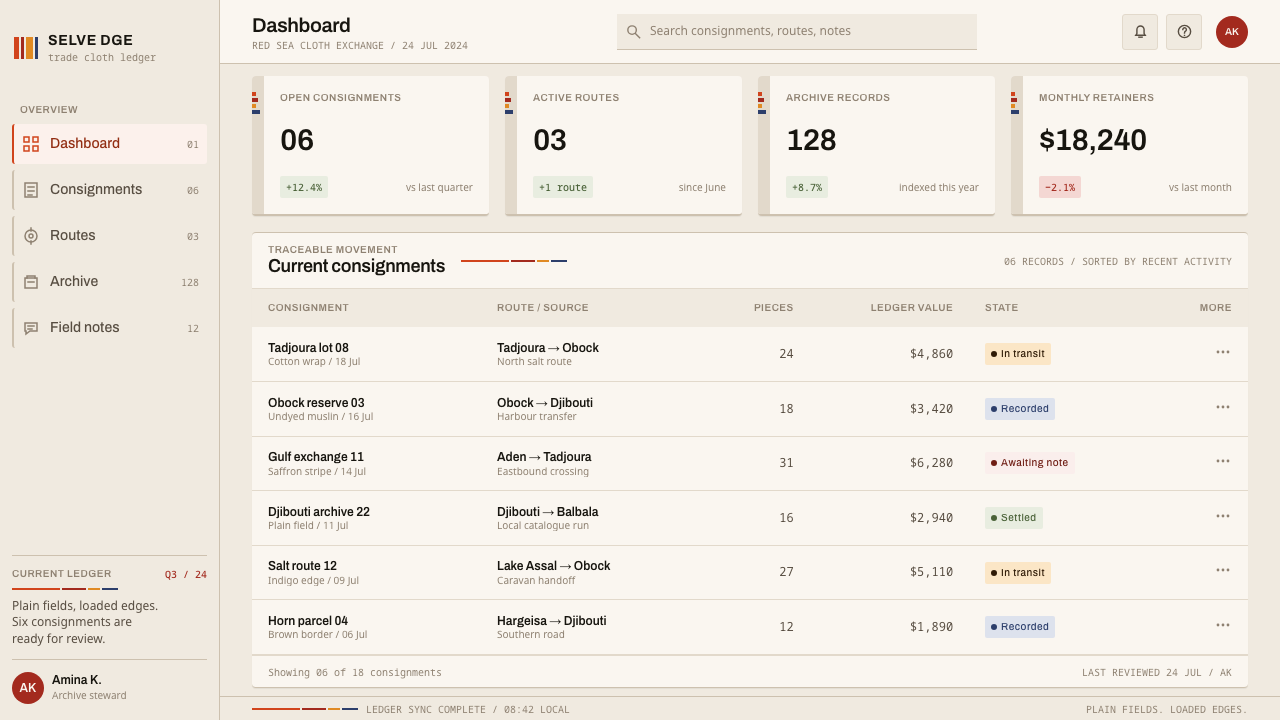
For web interfaces, the style suits calm, reading-first products: documentation, journaling and planning tools, travel and craft shops, anything where the user should feel unhurried. Pages stay mostly empty. Colour appears as an edge: the stripe band can mark the side of the active card, the selected row or the top of a pricing tier, while the rest of the surface stays unbroken. Dashboards should resist filling every card with colour; one highlighted metric per view, placed at an edge, follows the logic better than a row of coloured chips. Controls stay plain and dark, and the silver role goes to a single heavy element such as a logotype or a primary action.
In editorial and marketing work, the band becomes a margin device: a striped edge down one side of a feature spread, a landing-page section or a campaign poster, with the rest left to type and photography. Product shots and portraits should sit in the open field with room around them. A single dense grey element, one badge or one rule, provides the weight; a second one dilutes it.
The most common mistake is to take the stripe band as a pattern and repeat it across the whole surface, which turns a garment about restraint into a patchwork. Related errors are centring the layout, bleaching the field to pure white, drawing the silver as a glossy gradient, and letting the band grow into many colours. Treat the cloth as a source of structure rather than as costume: borrow the logic of one quiet field and a few loaded edges, and do not use its stripes as generic 'tribal' decoration.
Afar Nomad Textile — FAQ
Is Afar Nomad Textile a pattern style?
No, it is close to the opposite. The garment is mostly blank cloth, and its identity comes from a narrow stripe band at one selvedge and a small amount of heavy silver. A page designed in this style is therefore mostly empty, with colour held to a thin edge. Anyone who fills the surface with stripes has borrowed the colours and lost the idea.
Why undyed cotton rather than pure white?
Because the cloth is bought, chosen and worn undyed, and undyed cotton is warm and slightly creamy, not bleached. Pure white would read as a clinical screen colour and would make the rust and madder band look cheaper by contrast. A soft unbleached ground lets the field feel like a material, and lets the stripes sit on it the way they sit on the real selvedge.
Can it be used on a dark background?
It is built as a light-ground style, because its premise is undyed cotton left as it came. A dark version can keep the structural logic, one loaded edge and one heavy accent on an otherwise quiet field, but the central image of an open natural field is lost, and the rust and madder will behave very differently against dark. If a dark theme is required, keep the band thin and the accent single, and expect to retune the colours by eye.
How do I show silver without gradients or shine?
By mass, not by light. Silver in this tradition is hammered thick and worn for weight, so the digital equivalent is a dense, matte, cool-grey element that looks heavy: a solid badge, a thick rule, a compact logotype. Keep it flat, keep it single, and place it where the eye needs an anchor. Gloss, metallic gradients and glints would turn it into jewellery, which is the opposite of the point.
What kinds of product suit it, and where does it struggle?
It suits calm, reading-led or craft-minded products where space is a feature: documentation, notebooks, planners, travel, slow retail. It struggles where the interface genuinely needs many colours at once, such as dense analytics screens with many categories, or playful consumer apps built on loud colour. There the single-edge logic keeps colliding with the content, and a different style will serve better.
Related design styles
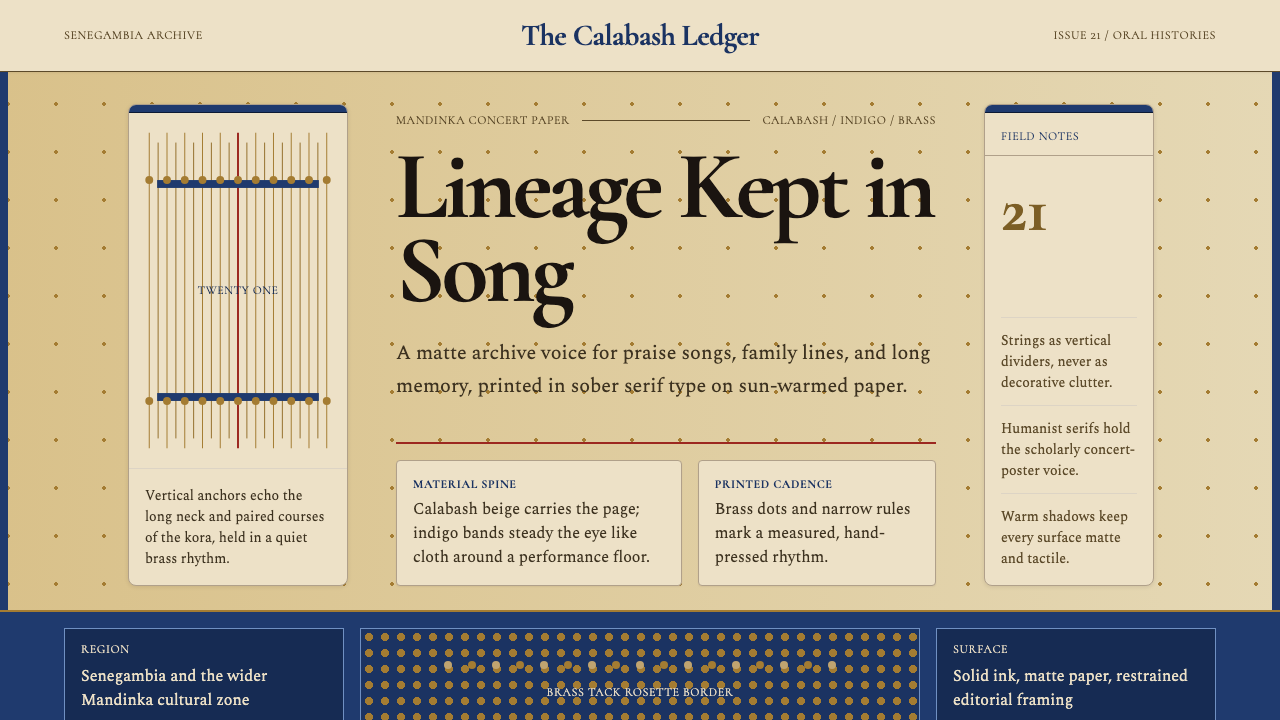 Gambian Griot Kora (21-string)Oral history feels tactile. Calabash beige, indigo bands, and 21 brass string…
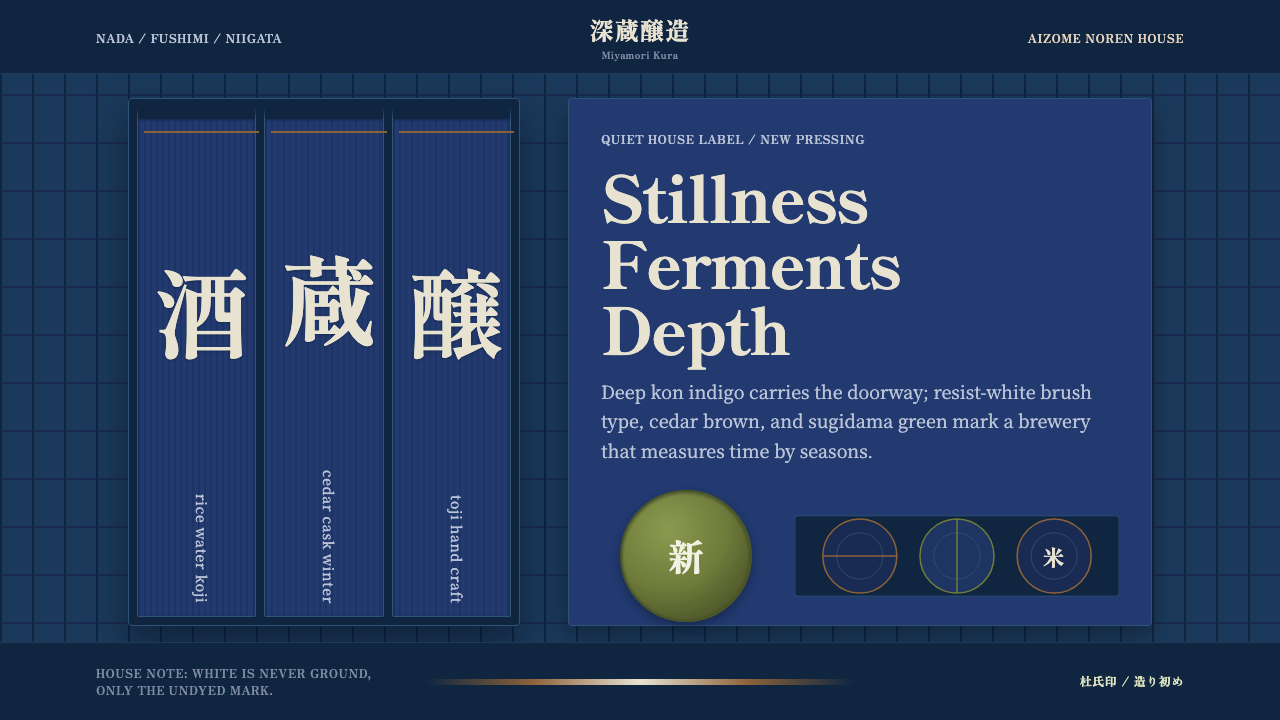 Sake Brewery KuraQuiet indigo authority. Resist-white kanji and cedar accents frame a vertical…
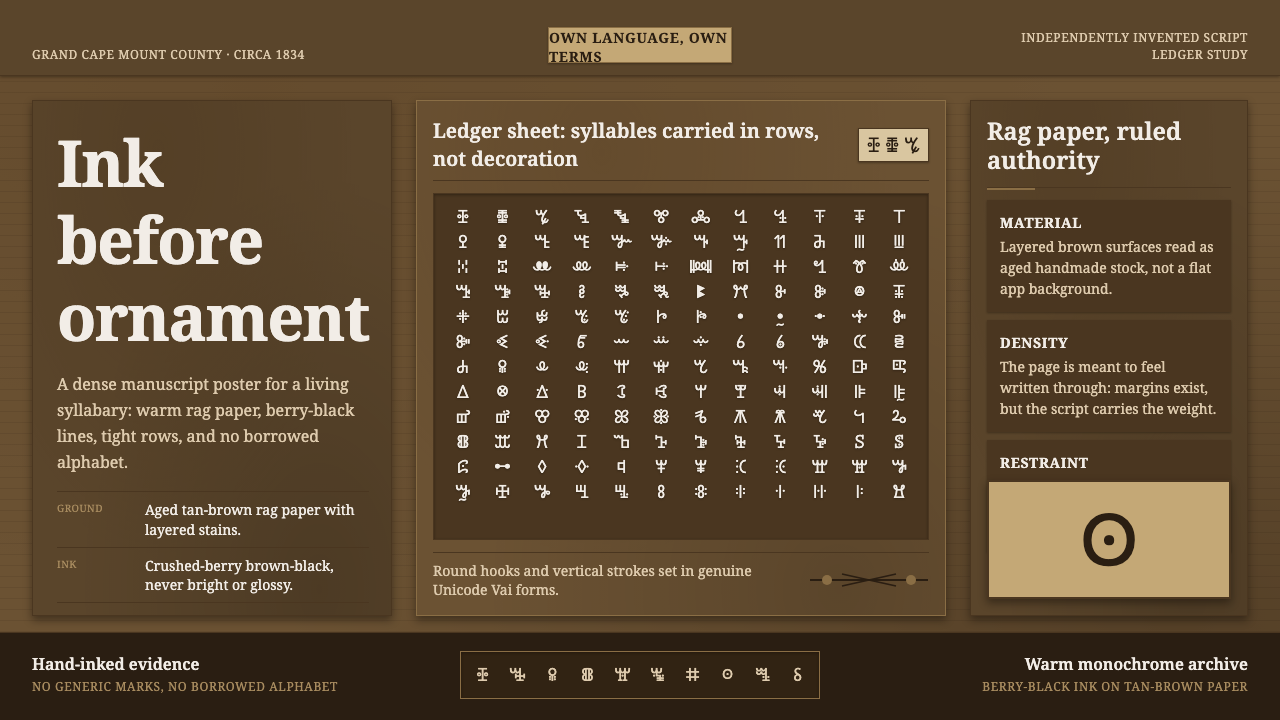 Vai Syllabary LiberiaInk has authority. Dense Vai glyphs pack berry-black rows across warm tan rag…
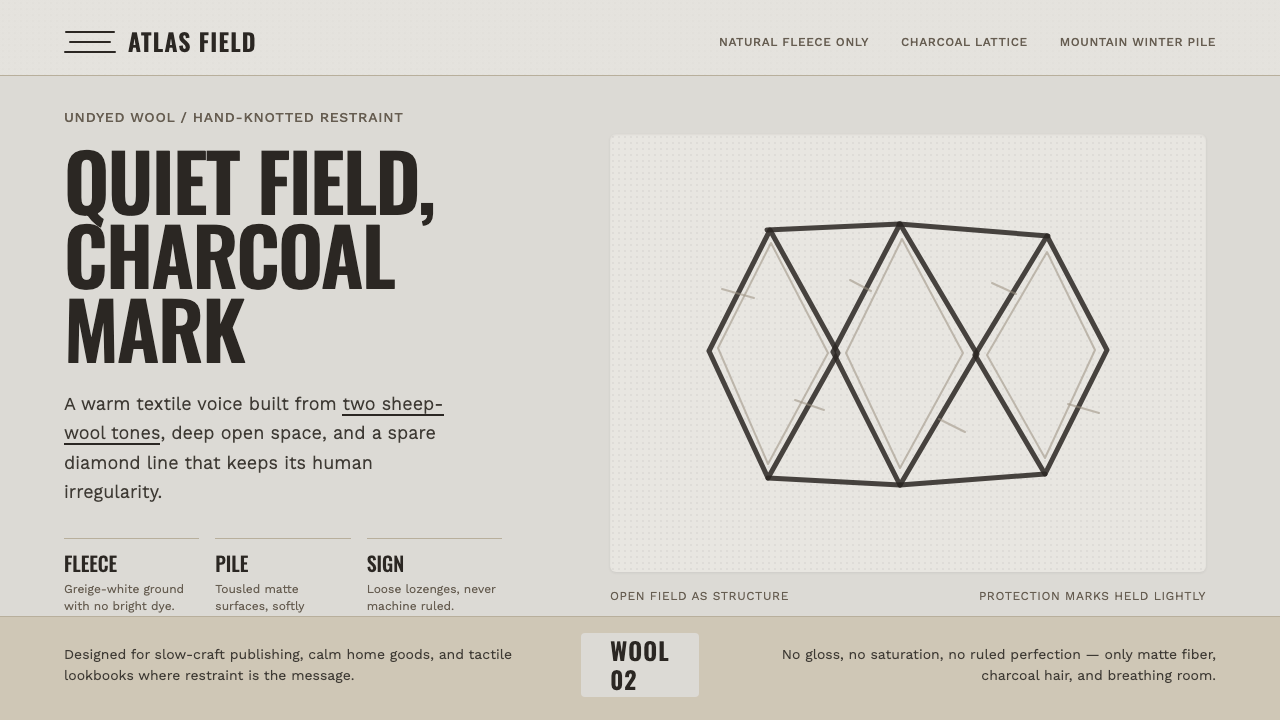 Beni Ourain Berber CarpetRestraint feels tactile. Greige wool field, Oswald type, and a loose charcoal…
 Cree SyllabicsPlain ink has authority. Carbon columns and red rubrication sit on rag-grey p…
 Emirati Bait Al Naboodah Coral HouseFeels built, not styled. Coral ochre, teak brown, and a sky-square courtyard…