What is Ak-Kalpak Felt Hat?
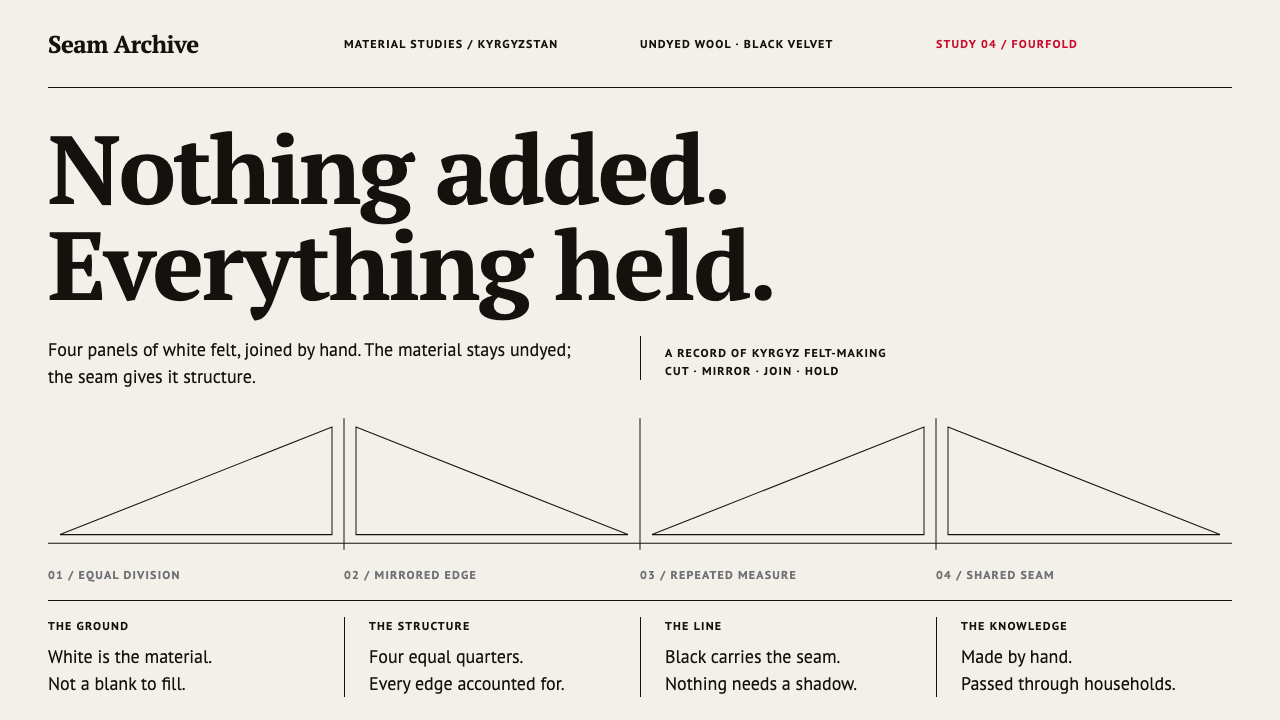
The ak-kalpak is a hat of four felted wedges that stands like a Tian Shan snow peak, and its design language is built on the same few moves: undyed white, black line, four-fold symmetry and one cord of ornament drawn once.
Ak-Kalpak Felt Hat in brief
Ak-Kalpak Felt Hat is a design style drawn from the white felt hat of the Kyrgyz people. 'Ak-kalpak' means 'white hat' in Kyrgyz and nothing more. Four wedges of hand-felted, undyed sheep's wool are cut, wetted, rolled and seamed into a crown that stands up like a snow peak of the Tian Shan. Black velvet trims the turned-up brim, and a single embroidered cord curls across it in a ram's-horn pattern.
The visual system follows the construction of the hat. Four-fold symmetry is the grid: four equal wedges, mirrored, with long straight seams that meet at the apex. Undyed white is the ground and most of the page. Black carries every line, every letter and every edge. Ornament is limited to one cord, drawn once. A single felt-embroidery red appears only when something must be identified, and then only once.
The effect is restraint of an unusual kind. This is not minimalism as an aesthetic choice but minimalism as a consequence of a material and a form that have been refined over centuries. In 2019 UNESCO inscribed the craftsmanship of making the ak-kalpak, and the customs of wearing it, on its list of the intangible cultural heritage of humanity.
Where does Ak-Kalpak Felt Hat come from?
The ak-kalpak belongs to centuries of documented Kyrgyz nomadic dress. Its home is Kyrgyzstan, the Tian Shan mountains and the Central Asian steppe, a landscape of high ranges and open grassland whose people moved with livestock and made most of what they needed from what the animals gave. Sheep's wool was the obvious raw material, and felt, a fabric made not by weaving but by wetting, rolling and compressing fibres until they lock together, was the obvious technique.
The hat sits within the wider family of Kyrgyz felt craft, the tradition that also produced shyrdak, the inlaid felt carpets, and ala-kiyiz, the felt rugs worked with patterned wool. Felt-making was largely household work and is still done in homes and villages, which is why the style lists Kyrgyz household felt-makers among its key figures. Among them are the village kalpakchy, master craftswomen who specialise in making the hat and know how to shape four wedges so that they stand up and keep their form.
The construction is simple and exact. Wool is felted into sheets and cut into four wedges. The wedges are wetted and rolled, then seamed together so that the long straight seams meet at the top, and the crown stands up in a point or a gentle peak, much like the snow-covered mountains the people live beneath. The brim is turned up and trimmed in black velvet, and a single cord is coiled and embroidered across it in the shape of a ram's horn, the only ornament the hat carries. Every rule of the design system can be traced to one of these steps.
The craft has since been recognised well beyond the steppe. In 2019 UNESCO inscribed the making and wearing of the ak-kalpak on its list of the intangible cultural heritage of humanity, which places it alongside other living traditions that are carried by communities, not by institutions. The design system reads that inscription as a reminder of the point: this is a living object defined by hands and customs, so the page should feel quiet, handmade and complete without needing anything added.
What defines the Ak-Kalpak Felt Hat look?
Undyed White Ground
The ground is the white of undyed felt, a warm, slightly soft white that is the page itself, not a canvas awaiting decoration. It occupies most of the area. Because wool is never perfectly uniform, the white carries faint tonal differences, a family of off-whites that suggests felt without ever imitating its texture with a filter.
Black Carries the Structure
Every line, every letter and every edge is black, the black of the velvet trim. This gives the system a very small vocabulary: white for ground, black for structure. Black is used for text, rules, borders and controls, and it is applied crisply, so that structure always reads as drawn, never as a tint.
Four-Fold Symmetry
The grid is the hat's four mirrored wedges. Compositions divide into quarters or into four equal columns, with elements mirrored around a central axis, and long straight lines converge toward a point at the center or top. Symmetry here is functional, not decorative: it mirrors how the hat is built and keeps layouts calm.
Hairline Seams
Where the wedges meet there is a seam, and the style draws it as a hairline in black. These thin, straight lines divide the page into its quarters and run edge to edge. They are the structural drawing of the hat, and they replace the heavy borders, boxes and backgrounds that other interfaces use to separate content.
Hard Cut Edges
Felt is cut with scissors, and the style keeps that decisiveness. Edges are hard and exact, the boundary between white and black is sharp, and shadows are not used to soften anything. Elevation is expressed by position and by line, never by blur, so that every object looks cut from a sheet and placed.
One Cord, Drawn Once
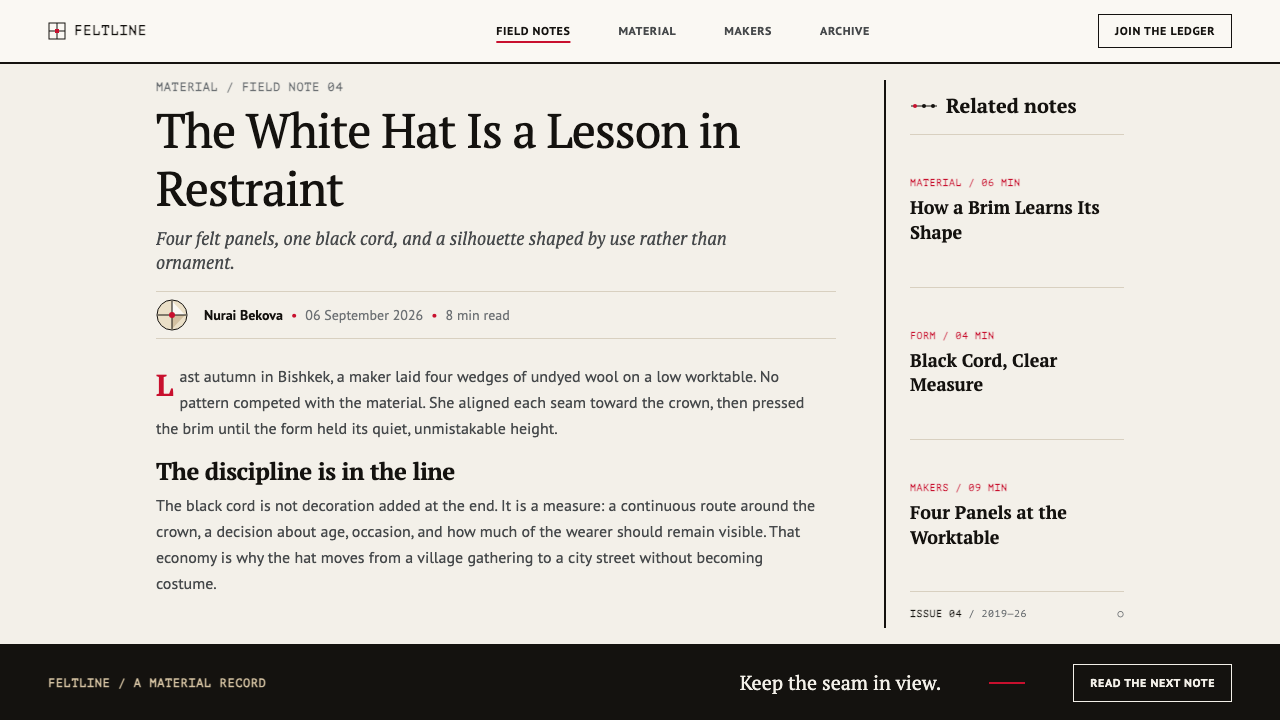
The hat's only ornament is a single embroidered cord curling across the brim in a ram's-horn pattern. In the system, this becomes the rule that decoration is limited to a single curved line or flourish, used once per page, such as one curl in the header or one mark beside a heading. Repetition would turn it into a pattern, which is exactly what the hat avoids.
A Single Felt-Embroidery Red
Color enters at one point only. A red drawn from Kyrgyz felt embroidery appears when something needs to be identified or marked, and then just once on the page: a single call to action, a single alert, a single selected state. Because it is unique, it is unmissable; used twice, it would stop working.
Who shaped Ak-Kalpak Felt Hat?
The kalpakchy are the village master craftswomen who make the ak-kalpak. They cut the wedges, wet and roll the felt, seam the crown and embroider the cord. The precision of their work, with four equal parts meeting in a clean peak, is the source of the style's symmetry and its refusal of extra ornament.
Felt-making in Kyrgyz life is largely household work, passed along in families and villages and connected to the wider tradition of shyrdak and ala-kiyiz. These felt-makers are the broader community behind the hat. They keep alive the knowledge of how undyed wool becomes a structure, which gives the style its sense of material honesty.
UNESCO inscribed the craftsmanship of making the ak-kalpak and the customs of wearing it on its list of the intangible cultural heritage of humanity in 2019. The inscription is not part of the visual style, but it explains why the design system treats the hat with such care, as a living tradition held in hands and habits rather than a motif to be decorated with.
How do you use Ak-Kalpak Felt Hat today?
Ak-Kalpak Felt Hat suits work that benefits from calm, clarity and a sense of origin: heritage and craft brands, cultural institutions, travel and mountain-related content, wool and natural-fibre products, and minimalist editorial or portfolio sites. It is among the lightest and most spare of the historically grounded styles, and it handles large amounts of text with ease.
For presentation slides, a cover works as a nearly empty white field with a thin black hairline dividing it into four, the title set in black at the center or top, and the single red marker as a small accent. Content slides can use the quartered grid: four columns or a two-by-two arrangement divided by hairlines. Data slides suit the system well, since a single black line chart or black bars on white are already in its vocabulary, and one red point can mark the figure that matters.
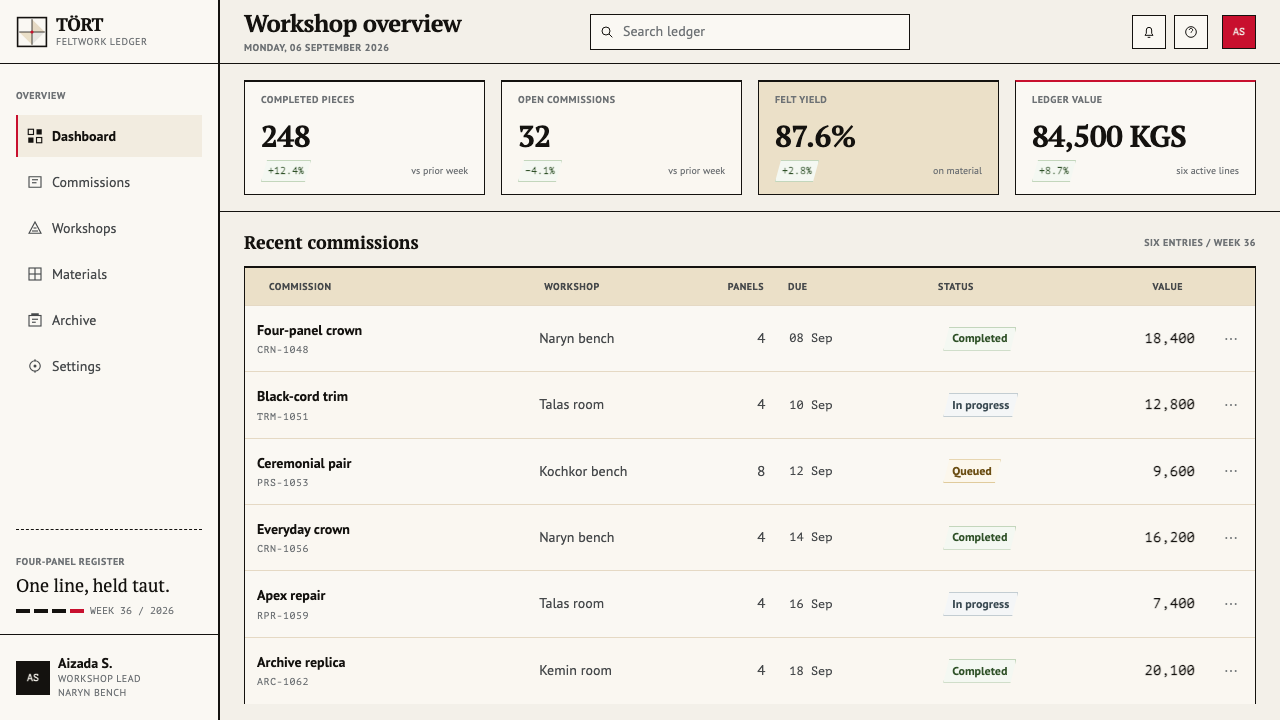
For web interfaces, make white the page and use black hairlines instead of cards or boxes. Navigation is a row of black text with a thin rule beneath it; forms use black outlines on white; buttons are black rectangles with white text. Reserve the red for a single primary action per view. Avoid shadows, gradients and tinted panels entirely. Layouts that break into four columns or mirror around a central axis feel natural, and generous white space is part of the identity.
For editorial and marketing work, the style gives text and image an unusually clean frame. Long articles can sit in a centered column with black hairline dividers between sections and a single ornamental curl at the head. Photography of mountains, textiles and portraits works well when it is cropped into rectangles and bounded by thin black lines. Campaign pages benefit from placing one large word or number in black on the white field, relying on scale rather than decoration.
The most common mistake is to treat white as emptiness waiting to be filled. Adding tinted panels, drop shadows, pastel accents or a second ornament destroys the premise that white is the main subject. A second error is to use the red repeatedly: once it appears in several places it is no longer a marker. A third is to use rounded, soft-edged shapes, which contradict the cut edges of the felt. Keep to white, black, four-fold structure and one cord of decoration.
Ak-Kalpak Felt Hat — FAQ
What does ak-kalpak mean?
Ak-kalpak means 'white hat' in Kyrgyz. It is a plain name for a plain object: a hat of undyed white felt. The design system takes the literalness seriously, letting white be the dominant color of the page rather than an accent, and refusing to add more than the hat itself carries.
Why four-fold symmetry?
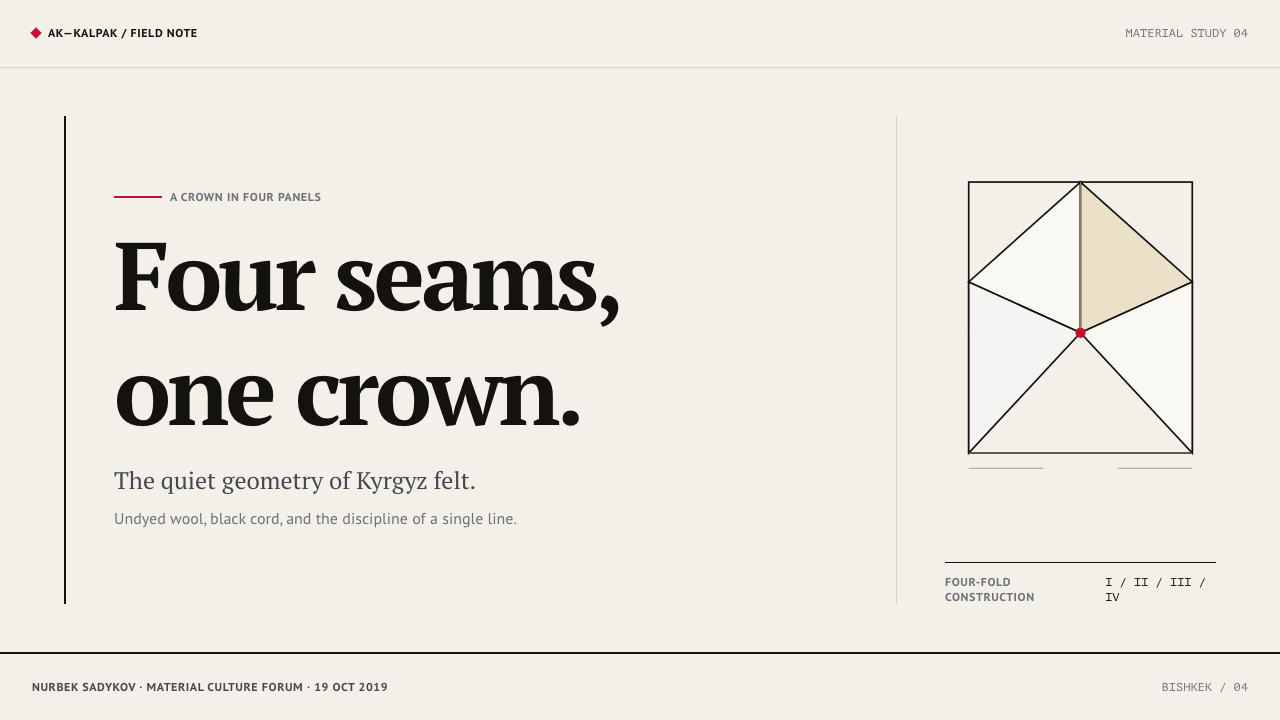
Because the hat is made of four equal, mirrored wedges of felt that meet at a point. The design system turns that construction into its grid: four equal parts, long straight seams, mirrored composition around a central axis. The symmetry is structural, and it keeps layouts calm, balanced and easy to scan.
How should the single red accent be used?
Use it once per page or view, to identify the one thing that matters most: a primary call to action, a critical alert or a selected state. It works precisely because it is rare against a field of white and black. If it appears in several places, it stops signalling and starts decorating, which goes against the style.
Does it work for data-heavy interfaces?
Yes, within limits. Black text on a white field is highly legible, and hairlines handle tables and charts cleanly. The limitation is color: with only one red accent, it cannot encode many categories. Use position, line weight and labels instead of color to distinguish series, and keep the red for the single highlight.
When does Ak-Kalpak Felt Hat struggle?
It struggles where a product needs warmth through color, playfulness, rich imagery or a feeling of abundance, such as children's brands, entertainment or festive campaigns. It is a style of subtraction, so it is poorly suited to anything that needs visual noise to feel alive. For quiet, honest, origin-minded subjects, it is exceptionally clear.
Related design styles
 Mandaean Ginza RbaTransmission, held in a leaf. Buff paper, red rubrics, ruled ink, and river b…
 Samaritan TorahContinuity made visible. Iron-gall columns, prick marks, and gilt colophon cr…
 Afar Nomad TextileWeight lives at the edge. Rust and madder selvedges cut across a quiet cotton…
 Glagolitic ScriptCarved faith in limestone. Cinzel capitals and red rubrics sit in shadowed gr…
 Kalmyk Todo Bichig Clear ScriptRestraint becomes script. Soot columns on grey rag paper, touched by cinnabar…
 Shaker Furniture 1850Utility becomes beauty. Bone plaster, iron black, smoke pine, and one smoke-t…