What is Guaraní Takuara Basket?
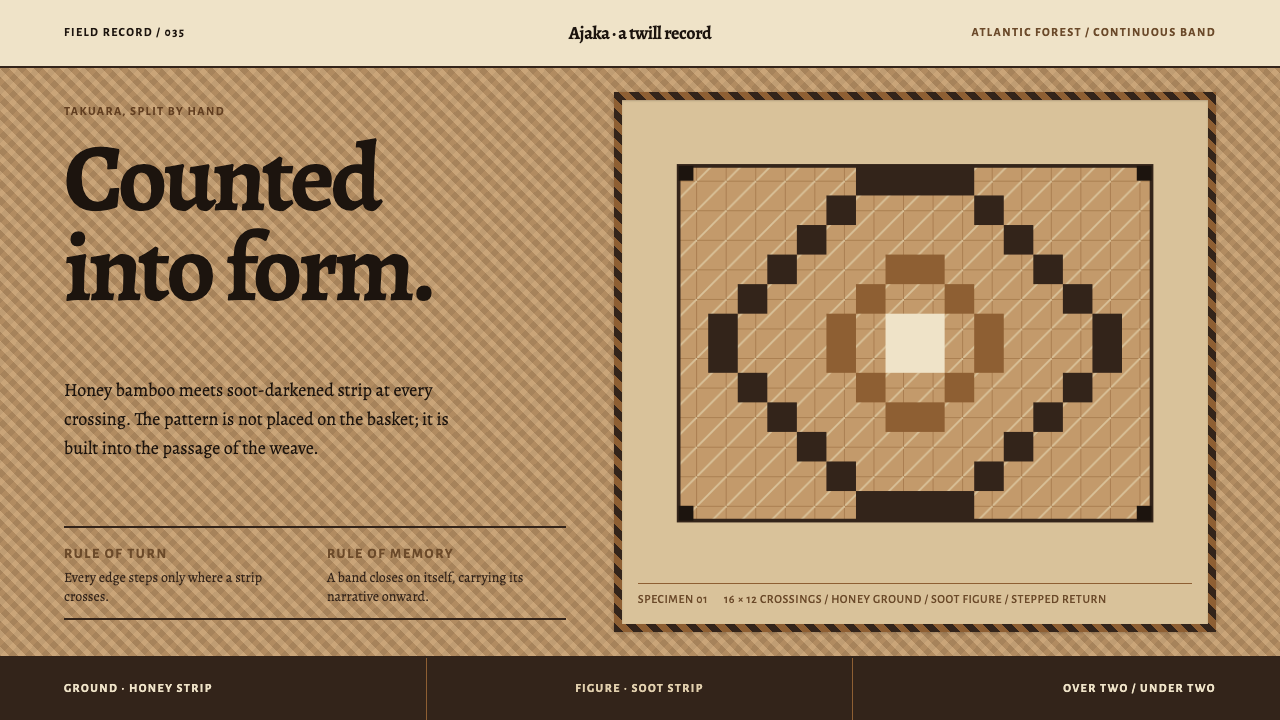
A Guaraní takuara basket carries its pattern in the plait itself — honey-coloured and soot-dark bamboo strips crossing on the diagonal until animals and geometry rise out of the structure, counted rather than drawn.
Guaraní Takuara Basket in brief
The Guaraní Takuara Basket style is drawn from the ajaka, the carrying basket of the Mbyá Guaraní. It is a modest object, about thirty-five centimetres across, twill-plaited from takuara, a bamboo that is split into narrow strips and worked into a rounded, load-bearing body. The Mbyá Guaraní live across eastern Paraguay, the Argentine province of Misiones and the Atlantic-forest states of southern Brazil, and the same basket is still woven and sold there today, in a line of practice the record traces to before 1900 without a break.
What lifts it from craft object to design language is the way the pattern is made. About half of the strips keep the warm, honey colour of the bamboo. The other half are darkened in mud and soot, or replaced by guembepi, the aerial root of the imbé vine. When light and dark strips are run against each other on the diagonal, figures appear — animals and geometric motifs — and they appear because of the structure, not on top of it. Nothing is painted, printed or stitched on afterwards. The weave is the image, and the image is the weave.
As a visual system this has a clear consequence: pattern behaves as information, not as decoration. A motif has to be counted into the plait strip by strip, and a contour can only change direction at the point where one strip crosses another. Every edge therefore climbs in small steps, every animal is a blocky, squared-off silhouette, and the bands of pattern run all the way around the body of the basket and close on themselves. Each figure is also tied to an oral narrative, so the basket is read as much as it is used. The style keeps that premise: pattern is content, never garnish.
Where does Guaraní Takuara Basket come from?
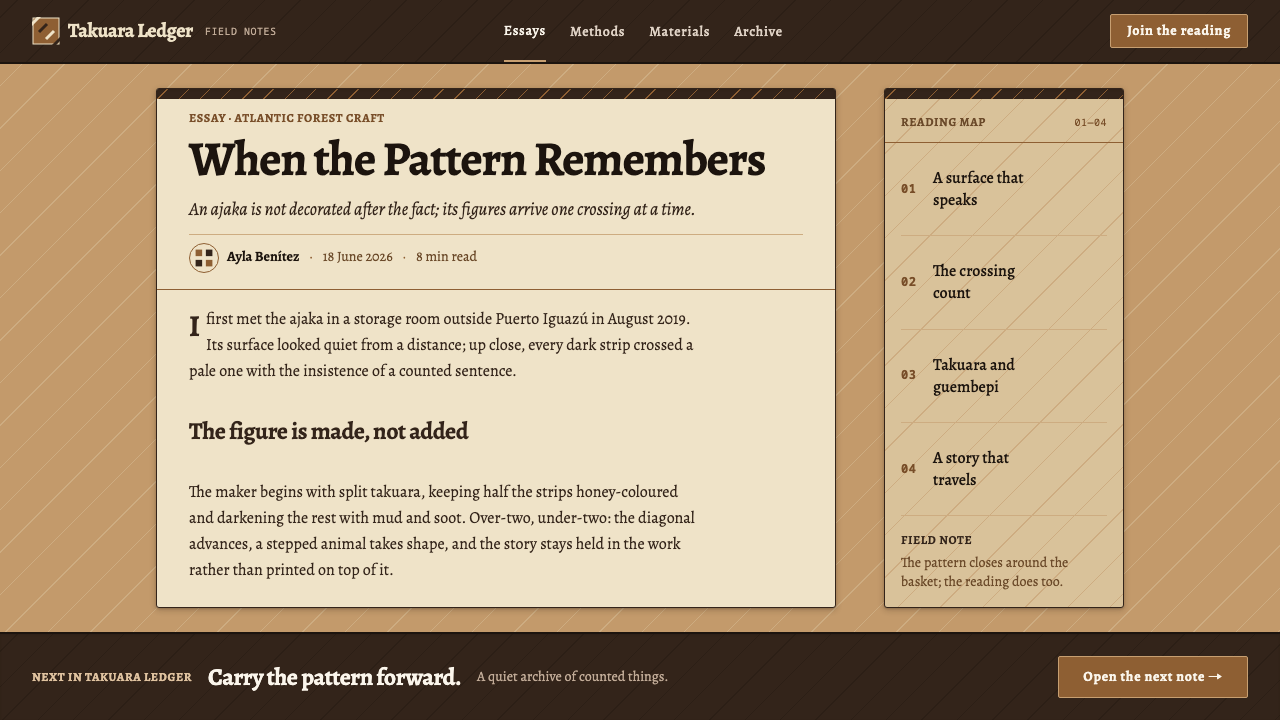
The Mbyá are one of the Guaraní peoples, and their territory ignores modern borders. It spreads over eastern Paraguay, the province of Misiones in northeastern Argentina and the Atlantic-forest states of southern Brazil, which is forest country. The materials of the ajaka belong to that setting and to the hearth: takuara bamboo, the imbé vine, mud and soot. The colour range of the basket is therefore the range of its surroundings — pale cane, dark root, dark earth — and none of it depends on manufactured colour.
The record gives the age of the tradition as pre-1900 and unbroken, and both words matter. This is not a revival assembled from museum evidence; the ajaka woven today belongs to the same line as the ones woven before 1900, and baskets of this kind are still made for use and for sale. That continuity explains why the style feels so settled. Nobody had to codify its rules, because the rules are carried by the technique itself: a weaver learns what the twill allows, and the structure refuses whatever it cannot hold.
The record places the basket in a category it calls twill basketry as narrative record. Each figure carries an oral narrative, which means the woven pattern works as a memory aid: the story is told aloud, and the figure on the basket is where it is kept. Nothing is illustrated in the Western sense of picturing a scene. The story is encoded in the count, and a person who knows it can read the figure, while a person who does not still meets an orderly, legible geometry. This double reading — meaningful to insiders, clear to anyone — is a useful model for any design that has to carry content without shouting.
Beyond the community, the work is filed under several overlapping headings: Guaraní plaited-fibre craft, as a regional technique; Paraguayan indigenous art, as a national-cultural category; and twill basketry as narrative record, as a way of understanding what the object is for. Institutions such as the Museu Paranaense and the Museu do Índio appear in the record of this style as reference points where Guaraní work has been kept and studied. For a designer these frames matter less than the plain fact they point to: a living craft, still in the hands of Mbyá weavers, in which structure, colour and meaning were never separate decisions.
What defines the Guaraní Takuara Basket look?
Two-Tone Color
Two tones do all the work. One is the honey colour of split takuara bamboo, a warm, slightly amber light that serves as the ground. The other is the dark of strips blackened in mud and soot, or of guembepi root, which serves as the figure. There is no third hue to arbitrate between them. Because the dark is always the figure and the light is always the ground, contrast is not decided case by case; it is simply the rule of the material.
Twill Structure
The basket is twill-plaited: strips cross on the diagonal in a regular rhythm of crossings, so the surface is a field of small, equal units set on a slant. This is the invisible grid of the style. Every mark has to land on it, because there is nowhere else for a mark to land, and the grid gives even complex figures a quiet, mathematical order.
Stepped Contours
A strip can only turn where it crosses another, so a true curve is impossible and every outline becomes a staircase of small diagonal steps. Edges are never smooth and never apologise for it. Animal silhouettes are consequently squared-off and blocky, with heads, legs and tails built from the same repeated unit. The stepped edge is the signature of the style, as recognisable as the serif is in a typeface.
Animal and Geometric Figures
Two families of motif share the surface: animal figures reduced to compact silhouettes, and purely geometric motifs built from the same stepped units. They are treated as equals. Neither is background to the other, and both are drawn from one vocabulary, the crossing. The animals read as silhouettes rather than portraits; the effort goes into rhythm and recognisability, not into descriptive detail.
Banded, Self-Closing Repeats
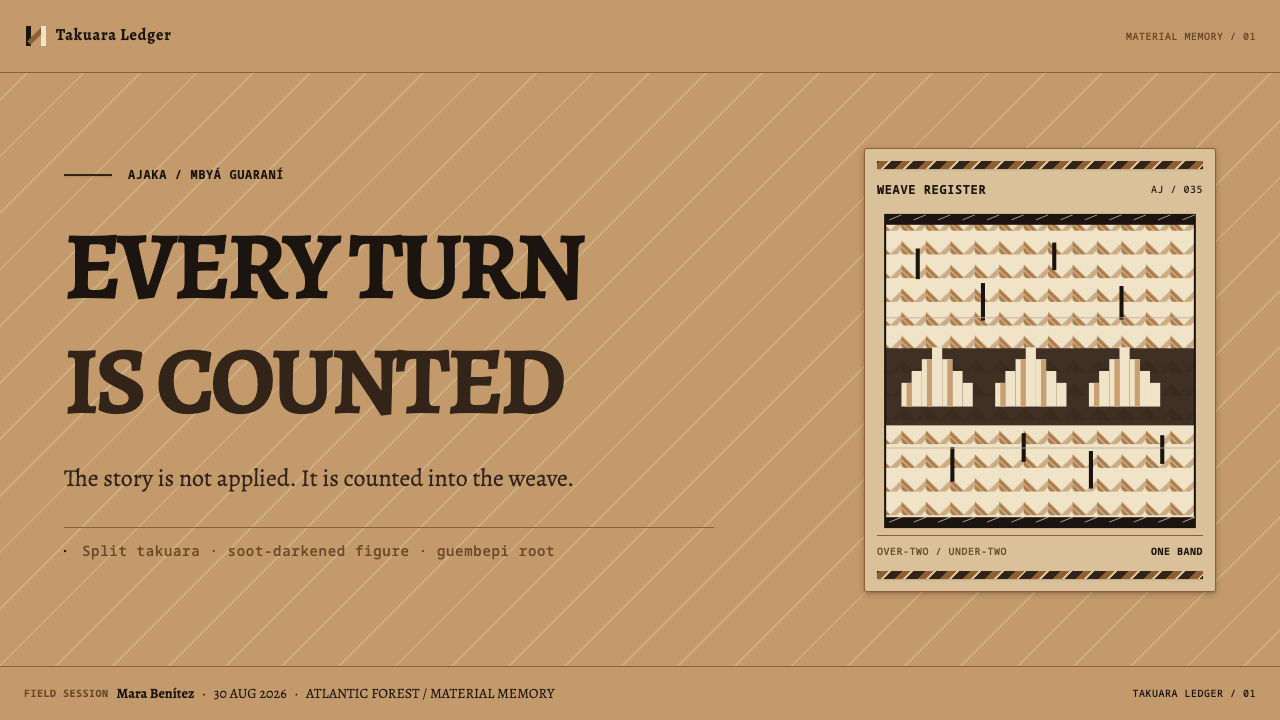
Pattern wraps around the body of the basket in bands that join back to their own beginning. There is no edge of a motif sheet, no cropped fragment, no start or end. A band is a complete cycle, and its repetition gives the basket its rhythm. For a flat design the lesson is that a repeating band should close, returning to itself cleanly rather than trailing off at the margin.
Pattern as Narrative
Every figure carries an oral narrative. That makes pattern a kind of text: it is meant to be read, and it has a meaning that is independent of how handsome it looks. A design in this style should be able to answer the question of what a given figure says. If a motif has no job to do, it has no place in the plait.
Nothing Applied
No paint, print, embroidery or gloss is added to the finished basket. Every visible element is structural, and the finish is simply the finish of the material. This discipline gives the style its honesty and its restraint: shadows, gradients and ornamental flourishes have no analogue in the weave, so they have no analogue in the system.
Who shaped Guaraní Takuara Basket?
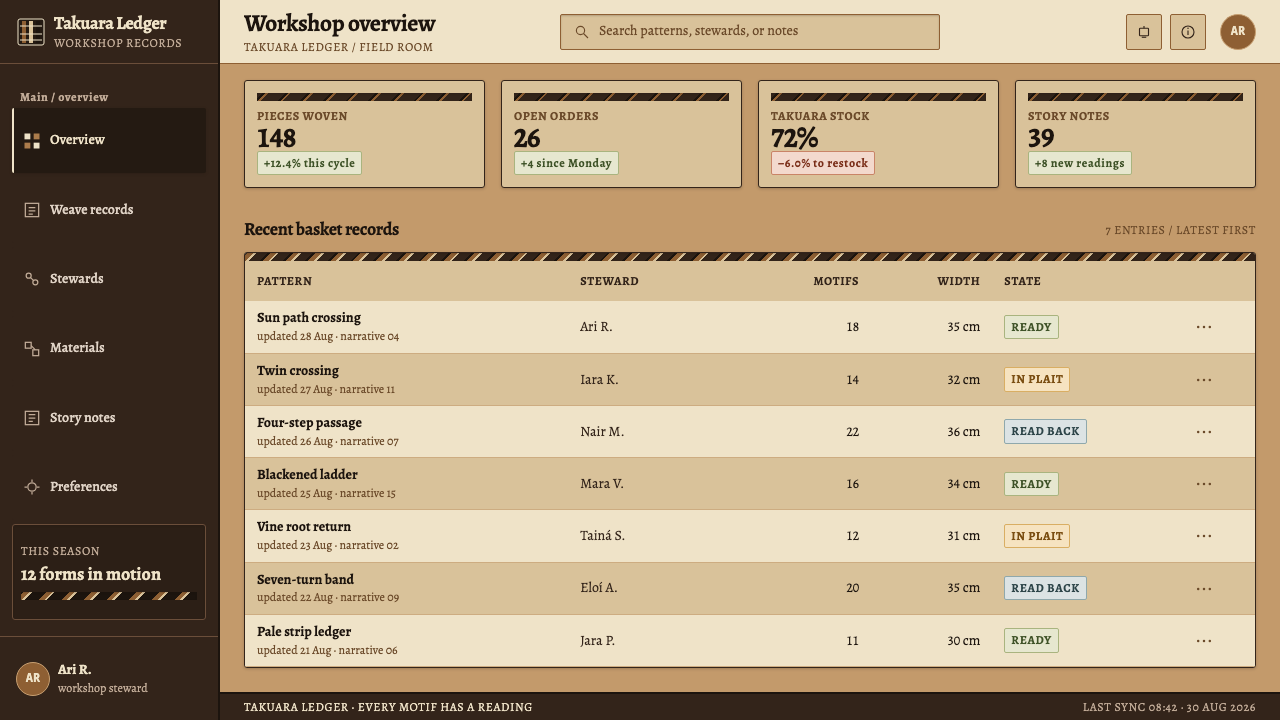
The weavers are the authors of the style in the fullest sense, and the record credits them as a community rather than naming individuals. They plait the ajaka, choose which strips to darken, count each figure into the twill and carry the narrative that gives the figure its meaning. The knowledge that matters here — where a strip may turn, how a band closes, what a figure says — is held in practice, which is why the tradition has stayed unbroken from before 1900 to the present.
One of two museums that the record of this style cites. Its role in the story is as a reference institution for Guaraní work, which is how objects made for carrying become visible to people outside the communities that make them. Museum documentation fixes the details of a craft — materials, structure, motif — in a way that lets the style be described accurately, though it cannot replace the weavers' living knowledge of how and why a figure is made.
Named alongside the Museu Paranaense as a second reference point. As its name signals, it is a museum concerned with indigenous peoples, and the record lists it among the places connected with the study of Guaraní work. For designers it is a reminder that the style belongs to a living culture with its own institutions of memory, and that borrowing its visual logic carries a duty to describe it accurately and to credit its makers.
How do you use Guaraní Takuara Basket today?
The Guaraní Takuara Basket suits work that wants warmth without softness. Its palette is just two tones, its edges are always stepped and its pattern always means something. Applied well, it gives a layout a handmade authority — the sense that every mark was counted — and it rewards designers who treat the structure of a page as seriously as the weavers treat the structure of the plait.
On presentation slides, a cover works best as a warm, honey-toned ground with one band of dark stepped figures running across it and the title set plainly against the rhythm of the band. Content slides can use the band as a divider or section marker, repeating the same motif so that the audience learns to read it. Data slides are a natural fit: a bar or step chart built from blocky, stepped units looks native to the style, and because the palette has only two tones, emphasis should come from position, size and the dark-on-light figure rather than from adding hues.
For web interfaces, the style fits product pages, documentation and dashboards that value legibility and calm. Keep the ground light and warm, use the dark tone for text and for the single figure that matters on each screen, and give components crisp, squared-off silhouettes without soft blurred shadows. On a pricing page, tiers can be told apart by the density or number of motifs rather than by colour, provided each motif actually refers to something. A repeating band can serve as a progress indicator or footer rule, closing on itself at the edge of its container.
In editorial and marketing work, the style supports stories about makers, materials, craft, regions and provenance. A woven band can mark chapter openings, and a single animal silhouette can act as a section emblem. Captions that explain what a motif says honour the principle that every figure carries a narrative. Photography of the baskets themselves should be treated as documentary: close crops that keep the weave visible, and no heavy filters that would hide the two-tone structure.
The most common mistake is treating the weave as wallpaper: a diagonal texture dropped behind text, a faux-bamboo pattern tiled across a hero image, or a set of animal icons used because they look charming. That reverses the style's central rule, which is that pattern is content. The second mistake is smoothing the stepped edges into curves or adding gradients and shadows, which turns a counted structure into an illustration of one. Keep the two tones, keep the steps, and let every figure justify itself.
Guaraní Takuara Basket — FAQ
What are the ajaka and takuara that this style is named after?
The ajaka is the carrying basket of the Mbyá Guaraní, about thirty-five centimetres across. Takuara is the bamboo it is made from, split into narrow strips and twill-plaited into a rounded body. The style is named for the object and its material because both are inseparable from the pattern: the strips are the pixels, and the plait is the layout.
How do the dark strips get their colour?
According to the record, half of the strips stay honey-coloured, while the other half are darkened in mud and soot, or swapped for guembepi, the aerial root of the imbé vine. The dark therefore comes from the materials themselves, which is why the style never needs a separate layer of added colour and why its two tones always feel like part of the structure.
Why are all the outlines stepped instead of curved?
Because a strip can only change direction where it crosses another strip. A motif is counted into the plait, so a smooth curve is physically impossible; every contour is built from small diagonal steps. In design terms, the stepped edge is the visible proof that the pattern is structural. Smoothing it into a curve would fake a freedom the weave does not have.
Is this a historical style or a living one?
A living one. The record describes the tradition as pre-1900 and unbroken: the same ajaka is woven and sold today. That is unusual among historical design references, since most are recovered from museums or archives. Here the weavers are still working, and anyone borrowing the look should treat it as the visual language of a present-day craft, not a closed period.
Can the style work with more than two colours?
It can, but it loses its logic quickly. The strength of the style is that light is always ground and dark is always figure, with no third hue competing. If a project needs an extra colour for state or emphasis, give it one narrow job and keep it small, so the two-tone structure still carries the page. Adding several accent colours would turn the basket into a decorated surface, which is exactly what it is not.
Related design styles
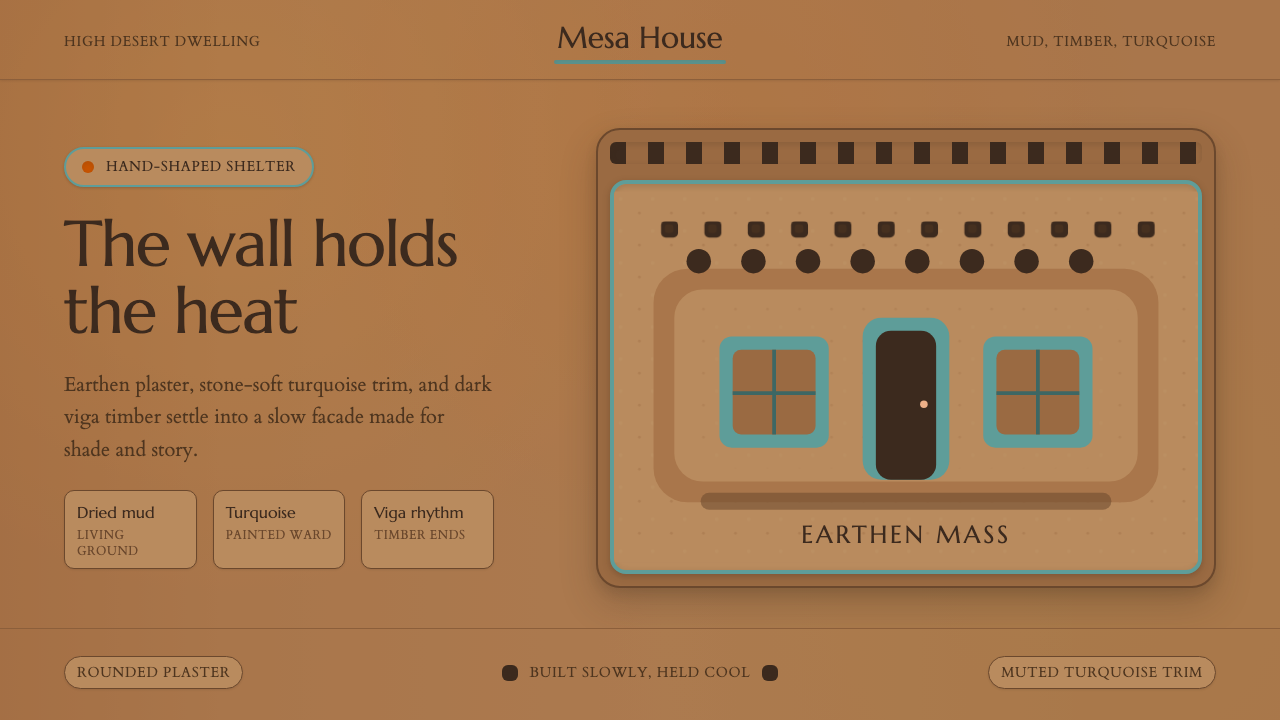 Adobe Pueblo SouthwestFeels made by hand. Earthen tan, turquoise trim, and viga rhythm shape the fr…
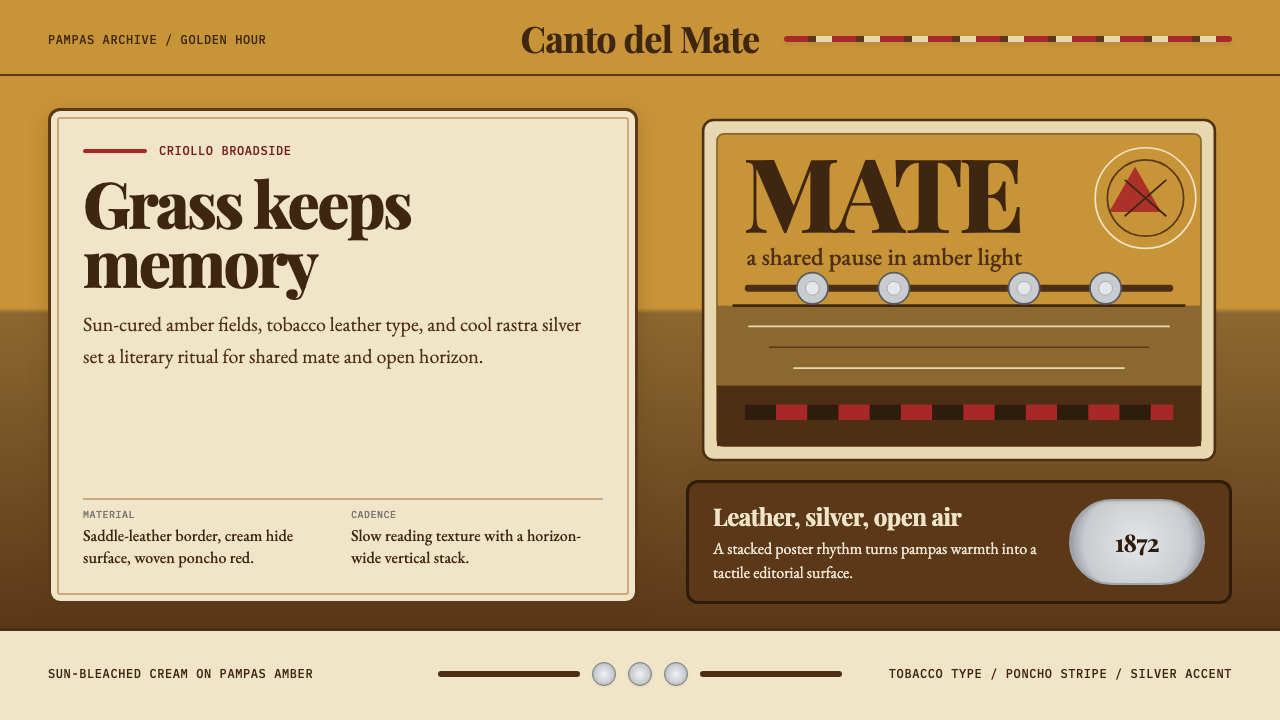 Argentine Gaucho (Pampas Mate Culture)Open grassland, printed warm. Amber fields, Playfair serif, and silver rastra…
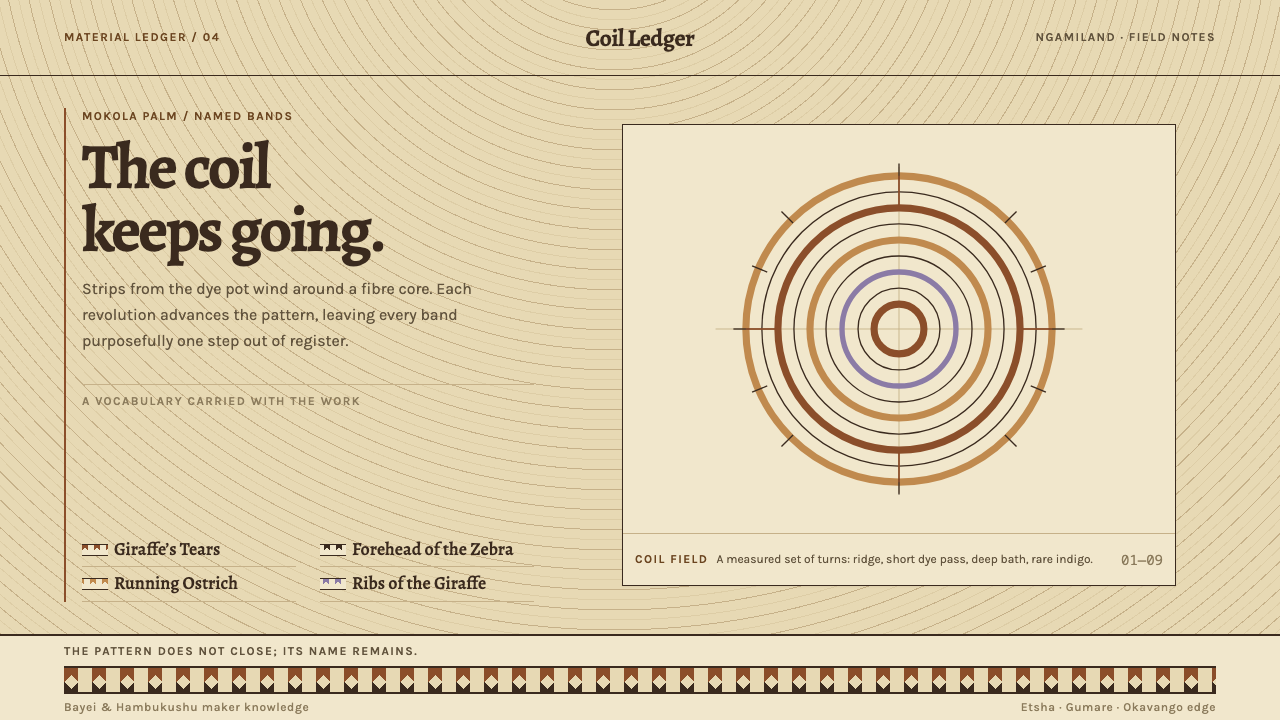 Botswana Coiled BasketThe pattern keeps travelling. Bark-brown stepped bands wind across a straw co…
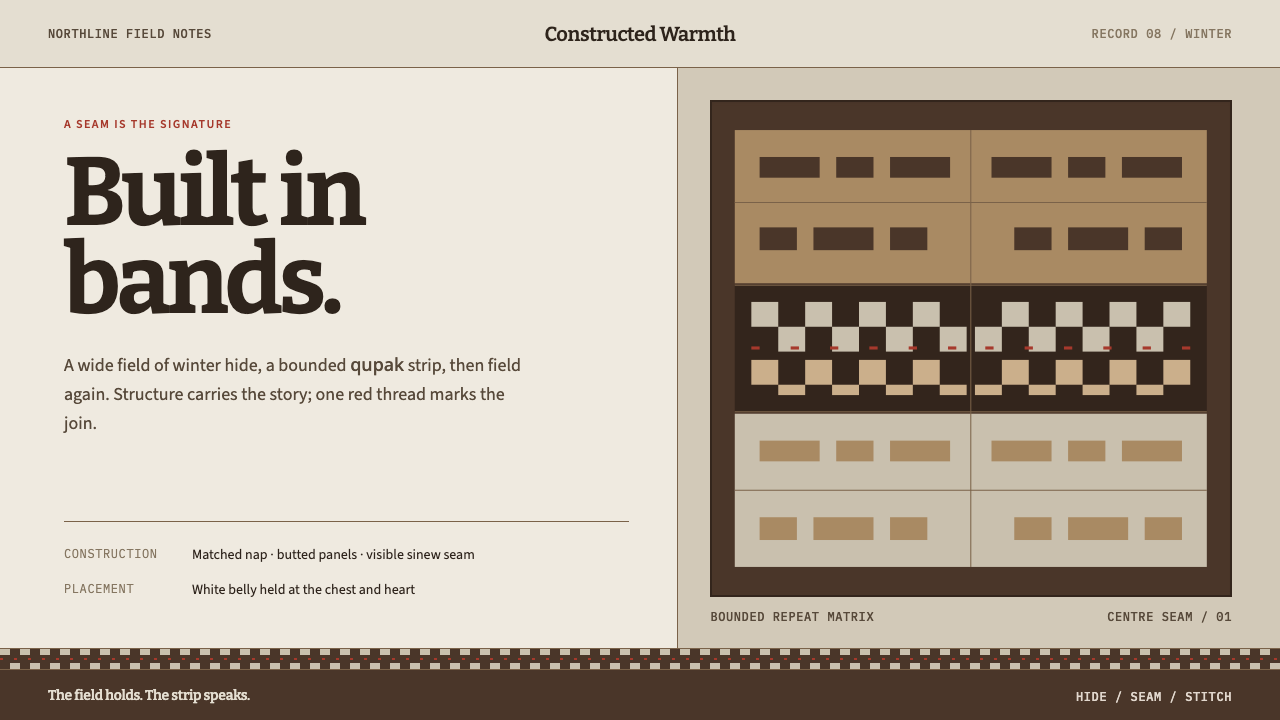 Iñupiat ParkaStructure carries the signature. Caribou-hide bands frame a bounded qupak rep…
 Kanak Grande CaseDarkness gives memory form. Bitter type rises on a thatch-brown central axis.
 Knossos Minoan FrescoColour becomes wall. Six mineral fields meet swift contours and honest fragme…