What is Iñupiat Parka?
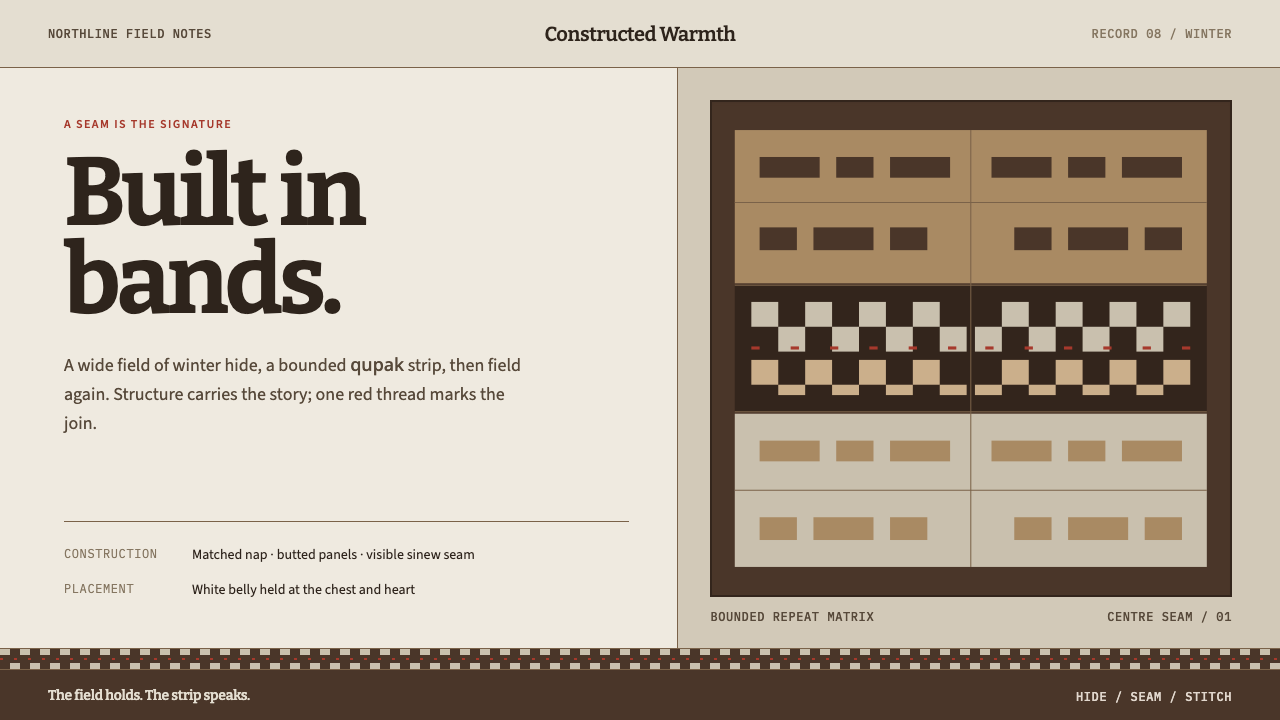
The Iñupiat atigi is assembled, not decorated: wide hide fields, a narrow pieced qupak strip as the signature, and a single thread of trade-wool red.
Iñupiat Parka in brief
The Iñupiat Parka is a design language drawn from the atigi, the skin parka of Northwest Alaska, made by Iñupiaq seamstresses from panels of caribou and reindeer hide. An atigi is not decorated so much as assembled. Panels are seamed into a garment that reads like a layout: a wide field, a narrow pieced strip, a field again. Its visual vocabulary is built from hide tones, visible seams, one bounded band of small hard-edged repeats, and a single accent of red.
Structure carries meaning throughout. White belly fur is placed deliberately over the chest and the heart. The hood ruff is engineered in three layers, with wolverine inward, then wolf belly, then wolf back, each doing a different job against the wind. Nothing is arbitrary, and the garment can be read as a series of decisions about warmth, protection and identity.
The qupak band at the hem, the cuff and the yoke is the signature. It is made of small repeats with hard edges, such as steps, blocks and alternating tabs mirrored about a centre seam, and it names the seamstress and her region to anyone who can read it. The strip is bounded, not an all-over pattern. The design system inherits this logic: banded structure, visible seams, generous plain space like bleached hide, and one thread of red pierced through the trim.
Where does Iñupiat Parka come from?
The atigi belongs to Northwest Alaska and the Seward Peninsula, to the inland caribou country of the Nunamiut and to the trade routes across the Bering Strait. The record dates the tradition to before 1900. It sits within the broader craft of Arctic skin sewing and fur inlay, in which garments are made by cutting hides, aligning the hair, and joining panels with sinew so that the seams become part of the character of the piece.
The garment's logic is visible in its construction. Panels of caribou and reindeer hide are cut and aligned by the direction of the hair and sewn into a parka that reads in horizontal bands. White belly fur is set over the chest and the heart, and the hood ruff is built in three layers, wolverine against the face, wolf belly in the middle and wolf back outside. This is design as engineering for survival, in which every material is placed where its properties help most.
The qupak is where the tradition becomes decorative as well as functional. The record locates the sun-bleached-strip qupak in the 1870s and 1880s, and notes that it elaborated rapidly after reindeer reached the Seward Peninsula in 1892. Before that, the Iñupiat had been trading across the Bering Strait with Chukchi herders for white and spotted hides. The Bering Strait trade in white reindeer hide and the Chukchi–Iñupiat exchange are both listed in the record as part of this history, and they explain why pale, patterned strips became so central to the garment.
Our knowledge of the tradition comes from several kinds of source. The record names the Iñupiaq seamstresses themselves, whose trim patterns identify them, as well as the Smithsonian Arctic Studies Center and the National Park Service's record of Nunamiut skin clothing. This design system draws from that body of evidence three structural ideas: a banded layout of wide fields and narrow strips, seams that remain visible, and a single thread of trade-wool red pierced through the trim as the only accent.
What defines the Iñupiat Parka look?
Banded Structure
The garment reads as a layout: a wide field, a narrow pieced strip, a field again. Bands run horizontally across the body, and each has a clear job, with the large fields giving rest and the narrow strips giving information. The proportion between wide and narrow is the system's basic rhythm, and it translates directly into pages built from large calm areas punctuated by thin, precise bands.
The Qupak Band
The qupak at hem, cuff and yoke is the signature. It is a bounded strip of small, hard-edged repeats, such as steps, blocks and alternating tabs, mirrored about a centre seam. It does not spread across the whole garment, and it is read as a name: it tells a knowledgeable viewer who made the garment and where she is from. In design terms it is a contained ornament with an identity.
Visible Seams
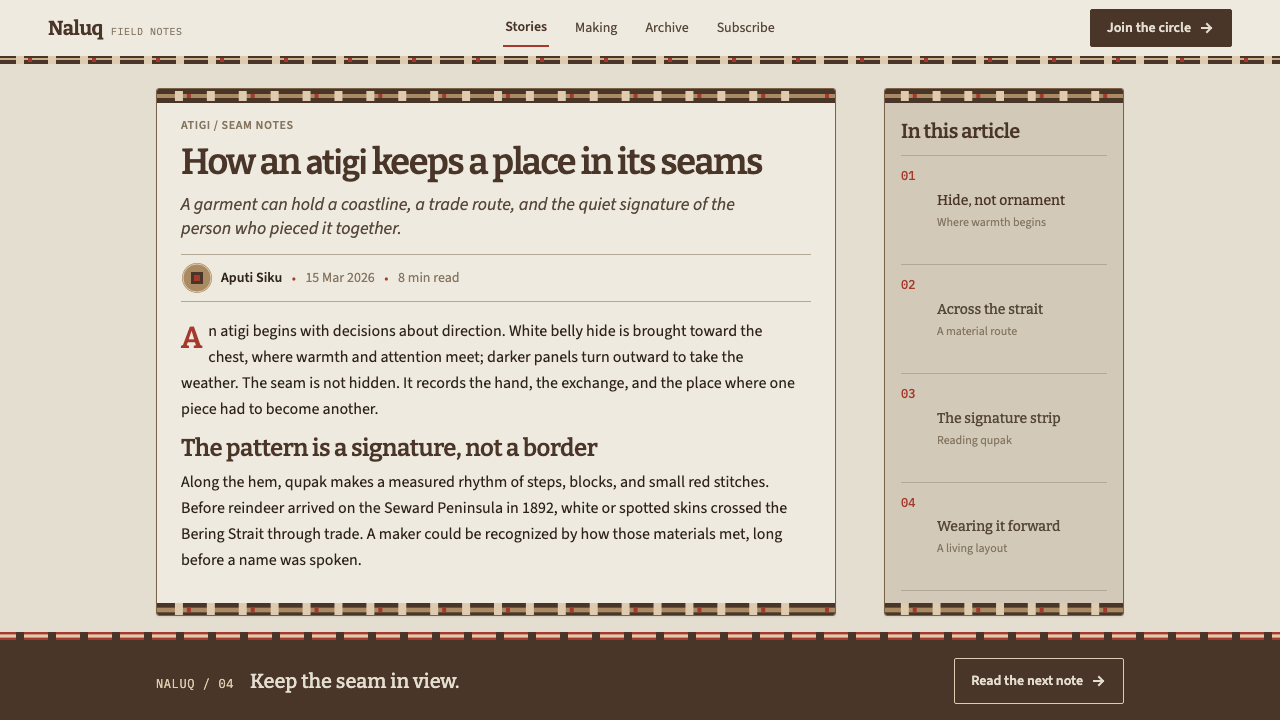
The panels are cut, aligned by the direction of the hair and joined with sinew, and the seams are left visible. They are structure, not blemish. In a layout this means dividers, borders and joins are shown honestly, and sections are separated by clear edges rather than by blurring one area into the next. The page looks put together by hand, and its construction is part of the message.
Plain Space Like Bleached Hide
Between the bands lie broad, quiet fields in natural hide tones, with pale, bleached areas acting as white space. The surface is matte and tactile, and restraint is part of its dignity. In design the large plain areas are not unfinished but deliberate, and they make the narrow decorated strips more powerful by contrast.
Meaningful Placement
White belly fur is set deliberately over the chest and heart, and the hood ruff is built in three layers: wolverine inward, then wolf belly, then wolf back. Each element is placed for a reason, tied to warmth, protection or meaning. This is the style's strongest lesson for layout: nothing is positioned just to fill space, and each part of the composition has a purpose you can explain.
One Red Thread
The only accent is a single thread of trade-wool red pierced through the trim. It is a small and exact gesture, and it works because everything around it is restrained. The red marks one point of attention in the whole composition, and using it more than once or twice would turn a thread into decoration and lose the effect.
Who shaped Iñupiat Parka?
The seamstresses who made atigi are the true authors of the tradition, and the record notes that their trim patterns identify them. A qupak band functions as a signature: the choice and arrangement of steps, blocks and tabs tell a reader who made the garment and from which region. This is why the style treats the band as a name and not as a texture.
The Smithsonian Arctic Studies Center appears in the record as an institution through which Arctic garments are studied and documented. For a designer it stands for the importance of working from documented sources: the structural ideas in this style, from banded layout to bounded ornament, rest on how the actual garments were made and are recorded.
The National Park Service's record of Nunamiut skin clothing is another source the record names. It concerns the inland caribou country, where hides were the basic material of daily life. It reminds us that the visual language of the atigi comes from a working relationship with materials, in which each choice responded to climate, animal and use.
How do you use Iñupiat Parka today?
This style suits work that wants structure, craft and a quiet identity. It asks the designer to think in bands: large calm fields, narrow decorated strips, visible joins, and one accent used once. The decorative vocabulary belongs to Iñupiaq seamstresses, whose patterns identify them, so borrow the logic of the garment rather than copying any particular pattern, and credit the tradition.
For presentation slides, a cover can be a wide plain field in a natural hide tone with one narrow banded strip of small hard-edged repeats near the bottom, and a title set in confident, plain type. Content slides should read in horizontal bands, with a header strip, a body field and a footer strip. Data slides take well to banded tables and bar charts with blunt, square ends, and the one red thread can mark the single figure the audience needs to remember.
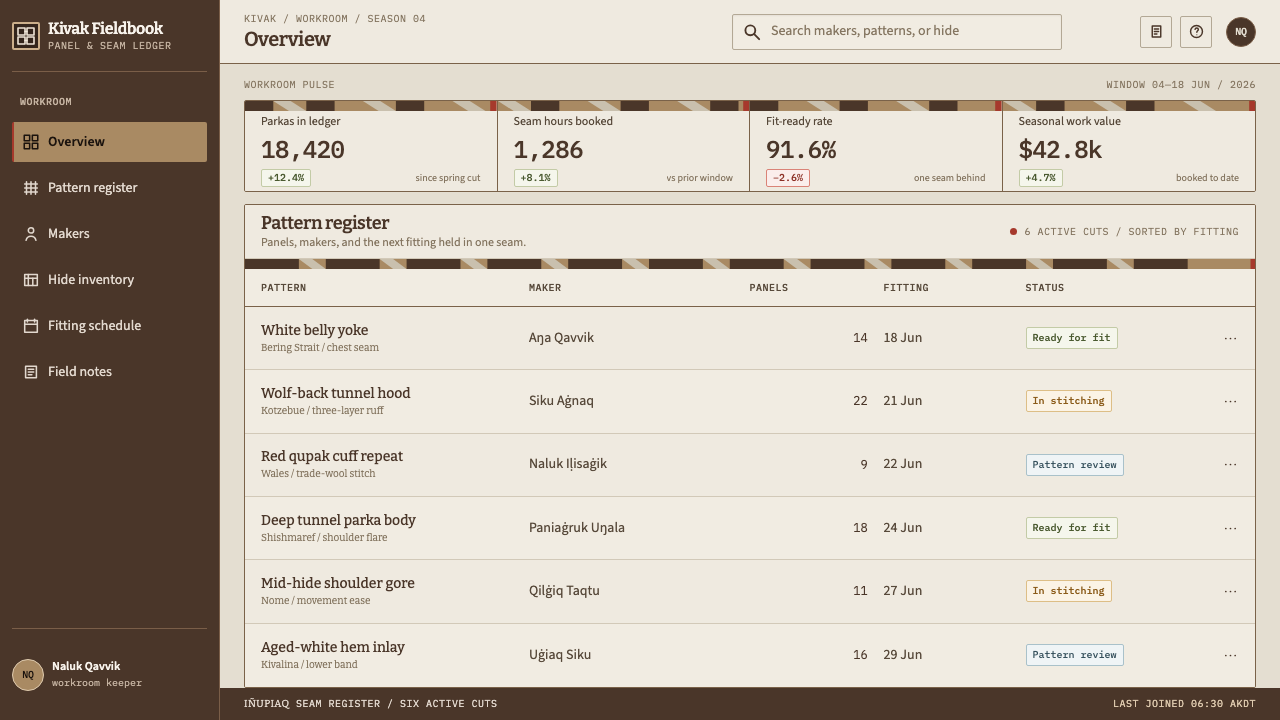
For web interfaces, the style fits dashboards, product pages and documentation that want a grounded, well-built feel. Divide the screen into clear horizontal sections with visible borders, so that structure is shown honestly, and keep large areas calm. Pricing pages can read as stacked bands, one for each tier, with a narrow decorated strip marking the recommended option. Reserve the red accent for a single action or alert on each screen, so that it keeps the force of a single stitch.
For editorial and marketing work, the qupak logic gives section dividers a purpose. A long article might alternate wide fields of text with narrow patterned strips between chapters, while a marketing page can use one bounded band to mark each new theme. Photography and imagery should be allowed to occupy the large fields, with the narrow strips acting as the page's signature, and all of it should feel assembled with care.
The most common mistake is to spread the qupak pattern across the entire surface. In the atigi it is a contained strip, and its force comes from being surrounded by plain field. Other mistakes include using several accent colours instead of one red thread, hiding seams with soft shadows and gradients, copying a specific trim pattern as though it were generic decoration, and filling every field with content so that no area remains quiet. Keep the strips narrow and the fields wide.
Iñupiat Parka — FAQ
What are an atigi and a qupak?
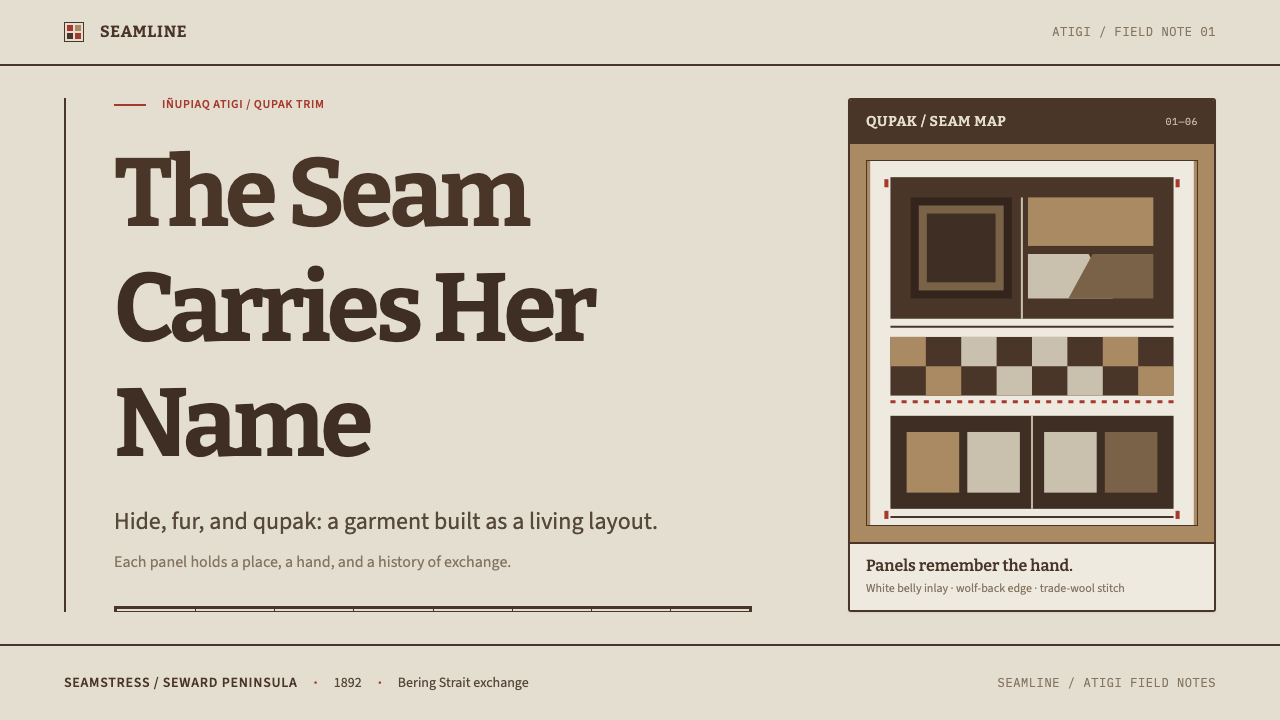
An atigi is the skin parka of the Iñupiat of Northwest Alaska, made from panels of caribou and reindeer hide. The qupak is the narrow pieced band at its hem, cuff and yoke, built from small hard-edged repeats such as steps, blocks and alternating tabs mirrored about a centre seam. It is the garment's signature, and to anyone who can read it, it names the seamstress and her region.
Why does the system use only one red thread?
Because the red is a single thread of trade-wool pierced through the trim, and its power depends on that scarcity. Everything around it is restrained, so one small point of red commands attention. If red appears across many elements, it stops being a thread and becomes decoration. The rule is to spend the accent once on each composition, on the thing that most needs to be seen.
Why does the garment read like a page layout?
Because its panels are seamed into horizontal bands: a wide field, a narrow pieced strip, a field again. The proportions between wide and narrow create a rhythm, and each band has a clear function. That structure translates directly to slides and web pages built from large calm areas, narrow information strips and visible dividers, which is why the style is so useful as a layout system.
Why did the qupak become more elaborate after 1892?
The record notes that qupak elaborated rapidly after reindeer reached the Seward Peninsula in 1892, and it dates the earlier sun-bleached-strip qupak to the 1870s and 1880s. Before reindeer arrived, the Iñupiat had traded across the Bering Strait with Chukchi herders for white and spotted hides. The record treats these exchanges and the arrival of reindeer as the setting in which the pale pieced band grew into a richer decorative language.
Can I copy qupak patterns as decoration in my own design?
It is better to borrow the logic than the pattern. Trim patterns identify individual Iñupiaq seamstresses and their regions, so copying one as generic decoration treats a signature as a texture. What a designer can use respectfully are the structural ideas: bounded bands, hard-edged repeats, visible seams, wide plain fields and a single accent. If a specific pattern is used, credit the tradition and, where possible, involve its community.
Related design styles
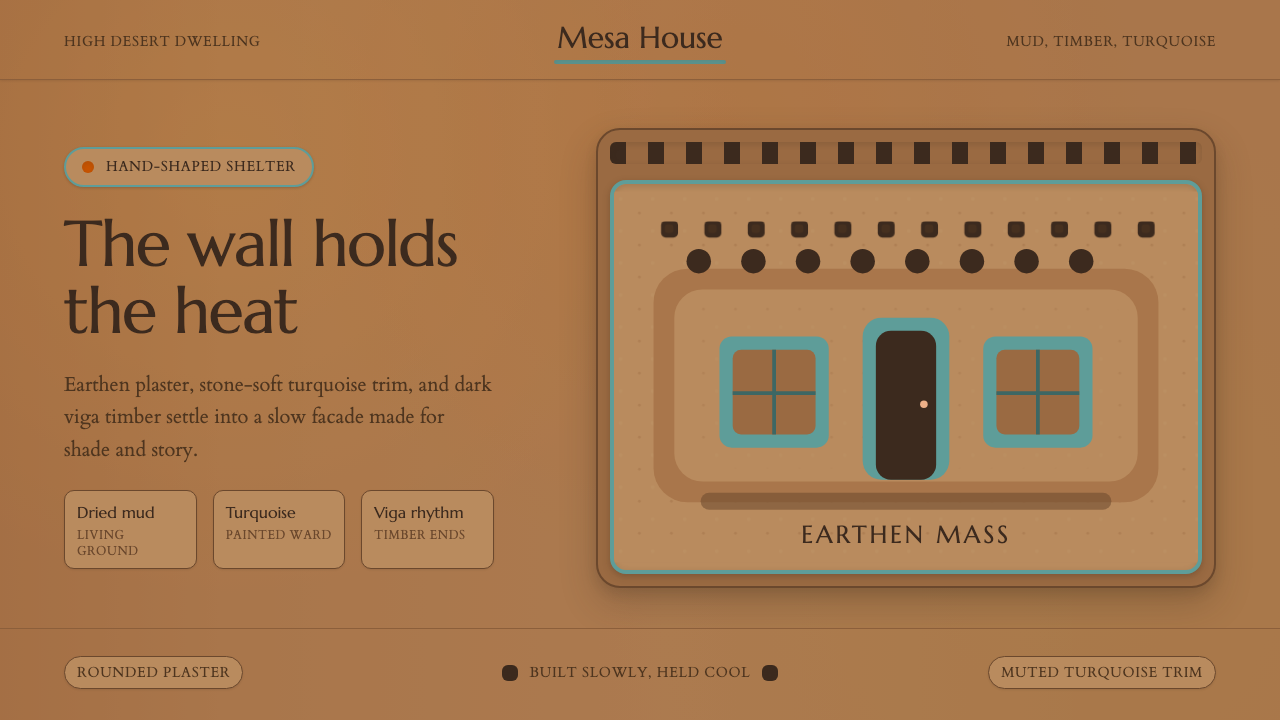 Adobe Pueblo SouthwestFeels made by hand. Earthen tan, turquoise trim, and viga rhythm shape the fr…
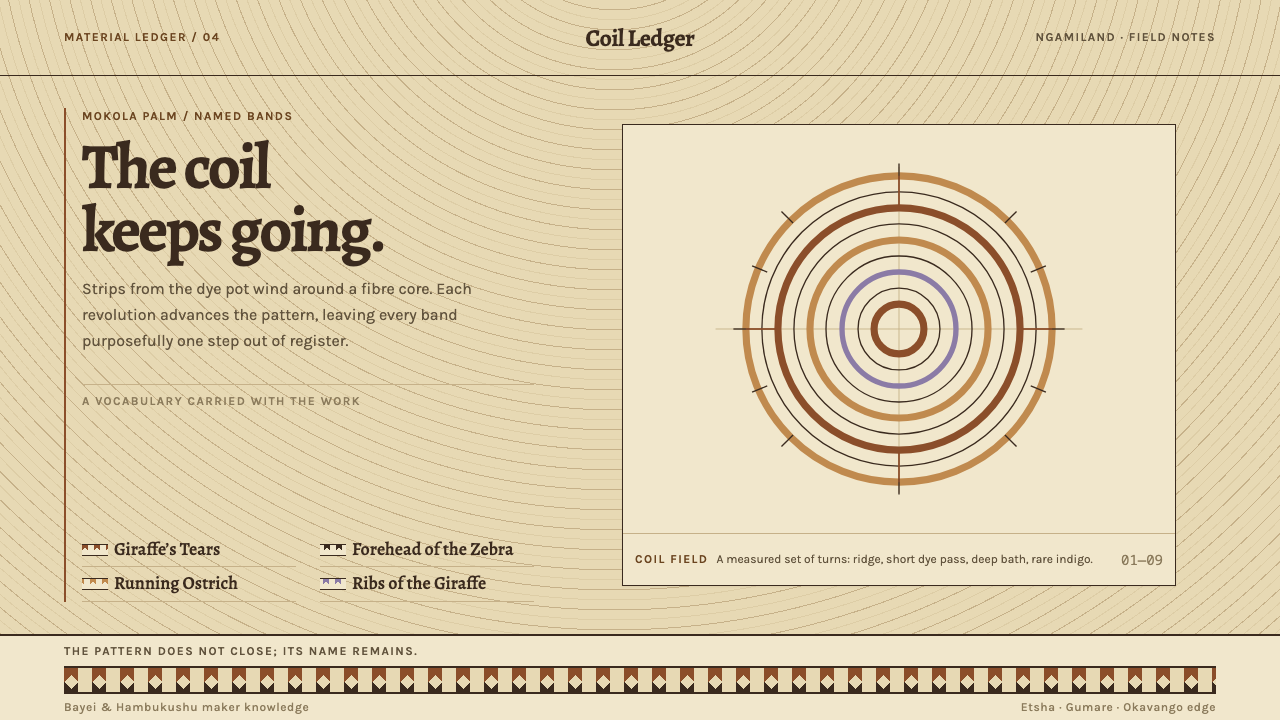 Botswana Coiled BasketThe pattern keeps travelling. Bark-brown stepped bands wind across a straw co…
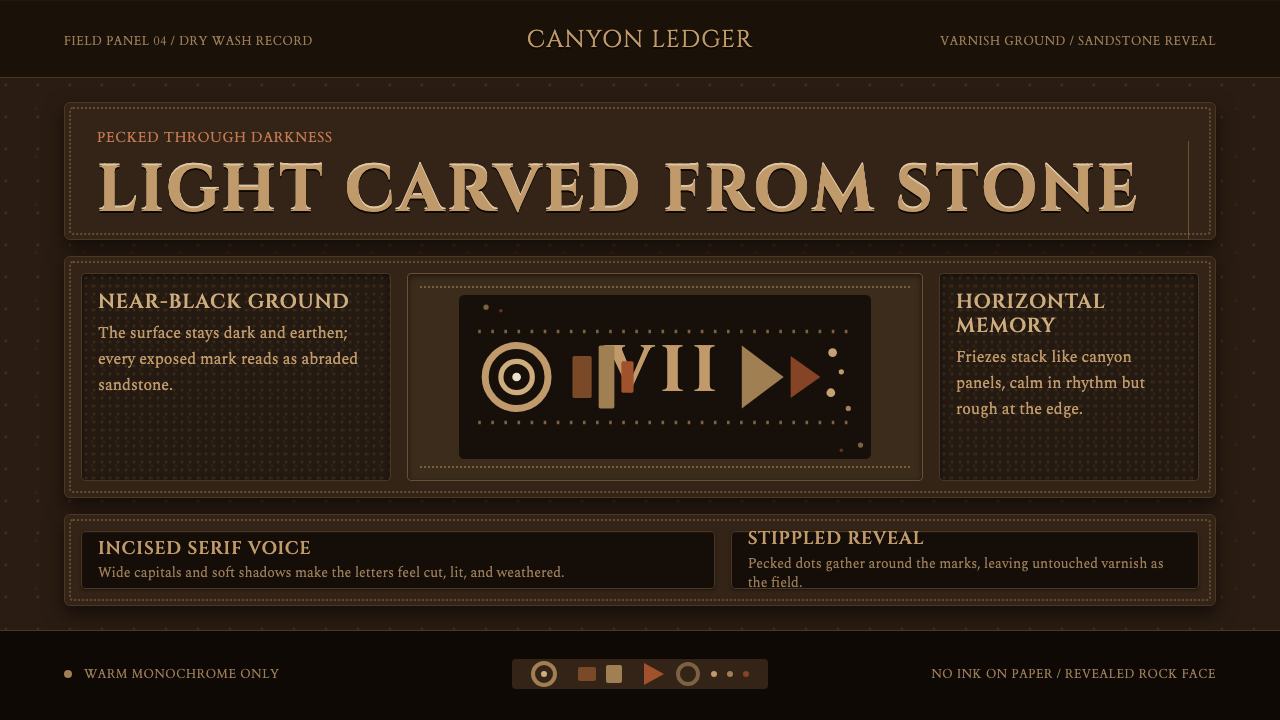 Desert VarnishStone remembers. Sandstone glyphs cut through near-black varnish in stacked f…
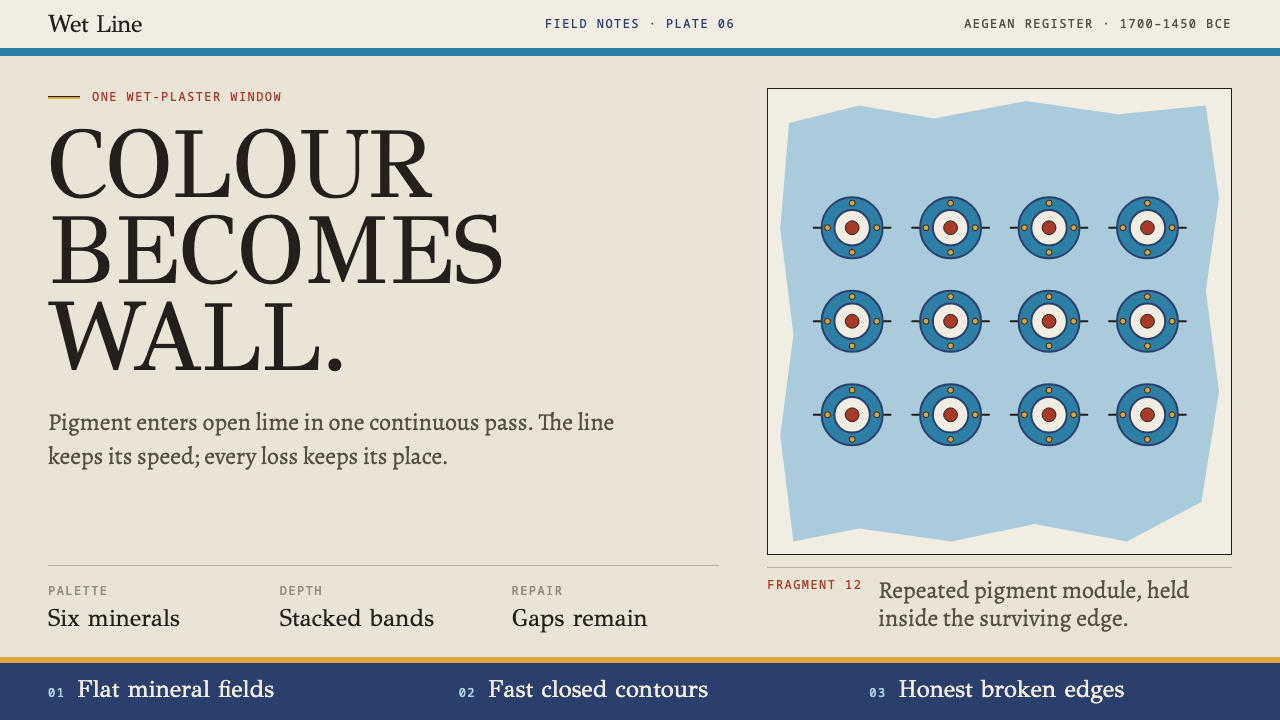 Knossos Minoan FrescoColour becomes wall. Six mineral fields meet swift contours and honest fragme…
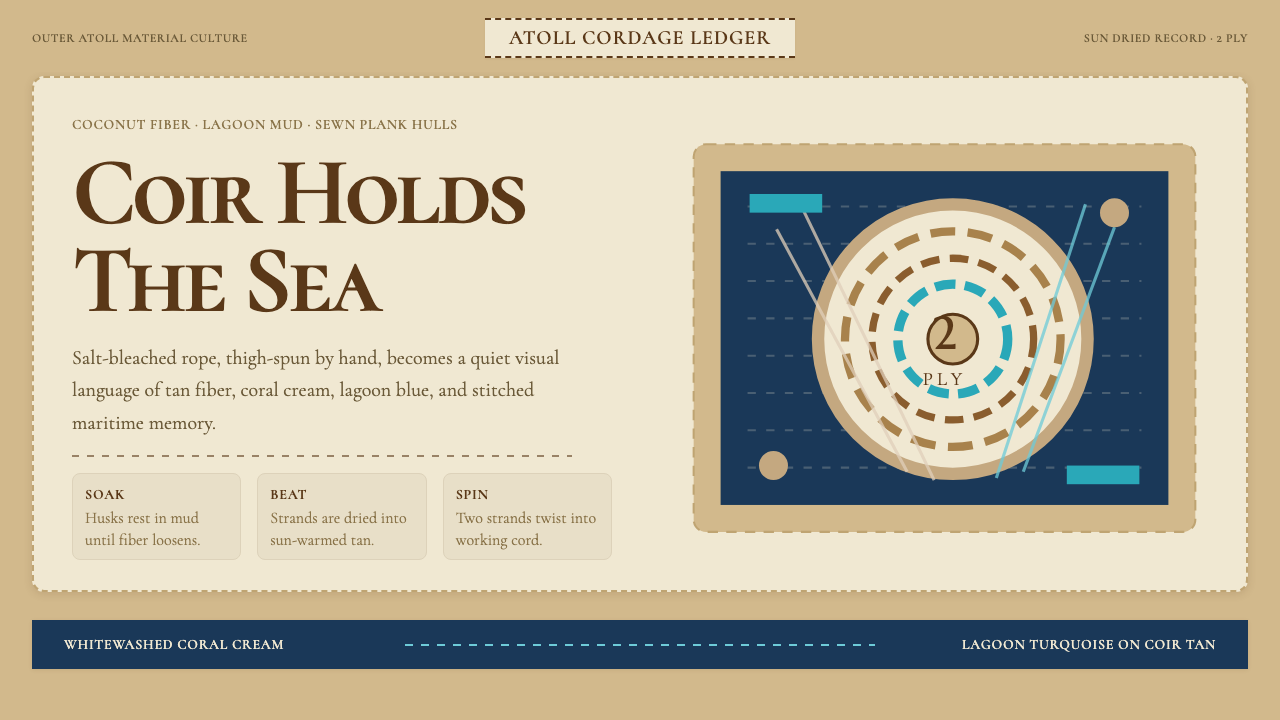 Maldivian Coir (Coconut Rope)Ocean-tested craft. Coir tan, coral cream, Cormorant type, and dashed seam ge…
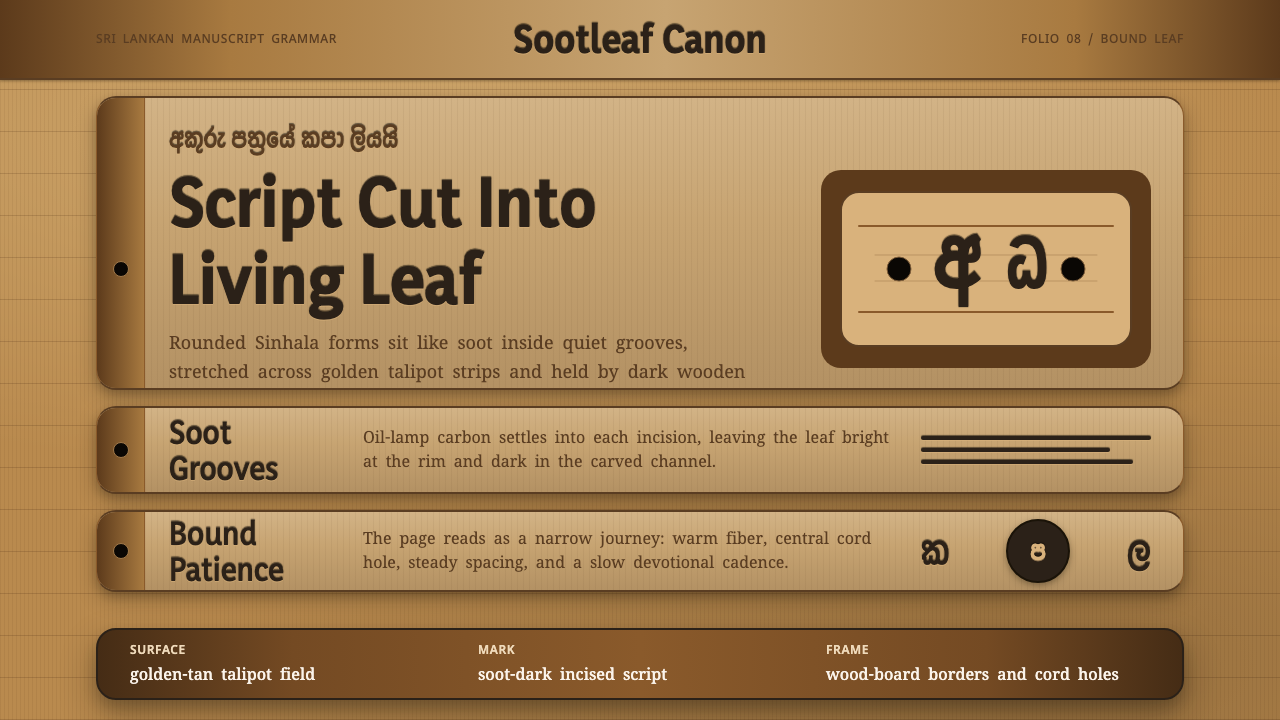 Sinhala Ola-LeafDevotion turns tactile. Soot text, Yaldevi curves, and palm-brown strips bind…