What is Slack 2019?
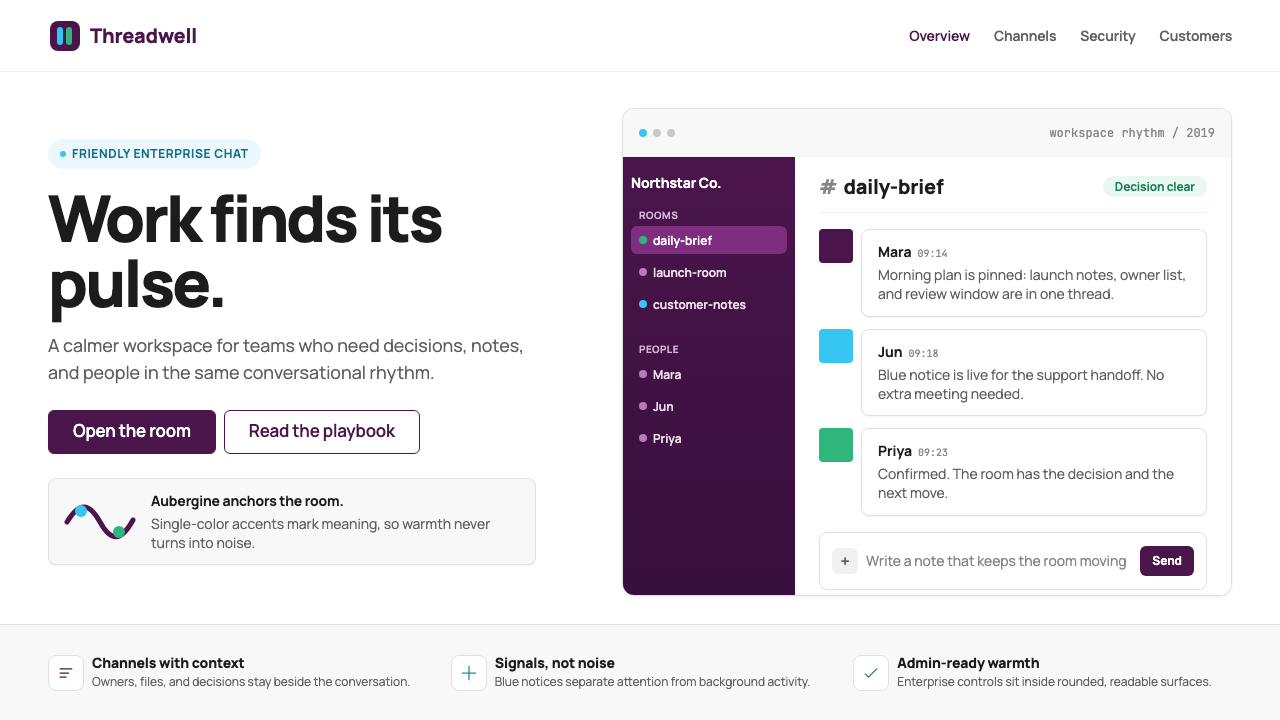
Slack's 2019 redesign distilled a chaotic rainbow into a disciplined aubergine-anchored identity that made enterprise software feel genuinely human.
Slack 2019 in brief
Slack 2019 refers to the visual identity system created for Slack following a comprehensive brand refresh led by the design firm Pentagram under partner Michael Bierut. Released in 2019, the system replaced an earlier logo and inconsistent color application with a tightly governed design language built around a four-color lozenge mark — aubergine purple as the dominant ground, with yellow, green, blue, and pink appearing as disciplined quadrant accents rather than as equal partners in a chaotic rainbow.
The resulting aesthetic sits at a considered midpoint between enterprise credibility and approachable warmth. Rounded geometries, generous whitespace, and restrained accent use give interfaces and collateral a conversational quality — nothing feels cold, bureaucratic, or intimidating, but nothing is frivolous either. The system was designed to scale: from a tiny app icon to a billboard, from a notification badge to a full-screen marketing page, the visual logic holds.
What distinguishes Slack 2019 from earlier productivity software aesthetics is its insistence on warmth without sacrificing legibility. The aubergine sidebar and navigation surfaces carry visual weight and authority while the content areas breathe. Typography — anchored by a rounded humanist sans-serif — reinforces the conversational register. This combination made Slack 2019 a reference point for a generation of SaaS and productivity tools seeking to escape the sterile blue-and-white conventions of earlier enterprise software.

Where does Slack 2019 come from?
Slack was founded in 2013 in Vancouver by Stewart Butterfield and a small team as a pivot from a failed video game called Glitch. The original product was a workplace messaging tool built to solve the team's own internal communication problems, and its initial visual identity reflected that scrappy origin: a colorful, informal, slightly chaotic hashtag-shaped logo in eleven colors, which quickly became both beloved and visually unmanageable as the company scaled.
By the late 2010s, Slack had grown into one of the world's most widely used enterprise software platforms, with millions of daily users and a prominent position in corporate IT stacks. The eleven-color original logo — while iconic to early adopters — presented significant reproduction challenges: it looked muddy on dark backgrounds, it required careful color matching in print, and it was difficult to maintain visual consistency across the dozens of surfaces where a modern software brand must appear. The brand had, in a sense, outgrown its startup origins.
In 2019, Slack engaged Pentagram, the independent design partnership, to undertake a comprehensive brand refresh. The project was led by Michael Bierut, one of the firm's New York partners and one of the most celebrated graphic designers of his generation. Bierut's solution was disciplined reduction: the eleven-color palette was distilled to four — yellow, green, blue, and pink — arranged in a simplified lozenge mark that preserved the spirit of the original hashtag symbol while making it reproducible across any medium and at any scale. Aubergine purple, which had been a secondary surface color in earlier iterations, was elevated to the dominant brand color, providing the warmth and distinctiveness the identity needed.
The redesign was publicly announced in January 2019 and was immediately controversial among portions of Slack's user base, who had formed strong attachments to the original logo. Pentagram and Slack published detailed explanations of the design rationale, which helped contextualize the decisions. Over time, the new identity proved its utility: it held up under conditions the original could not handle, and the aubergine-anchored system became strongly associated with Slack's brand worldwide — to the point that many subsequent enterprise software companies adopted similar warm-purple sidebar strategies as a direct or indirect reference.
What defines the Slack 2019 look?
Aubergine as Anchor
The deepest, richest color in the system — a warm, dark purple closer to an eggplant than a cool violet — functions as the primary structural surface throughout the interface. It appears in navigation sidebars, top bars, and brand backgrounds, grounding the entire visual system in something warmer than typical enterprise navy or corporate grey. Its warmth distinguishes Slack from colder enterprise tools and signals approachability without sacrificing authority.
Four-Color Accent System
Yellow, green, blue, and pink operate as a disciplined set of accents rather than a palette to be used simultaneously at full intensity. In the lozenge mark, each color occupies one quadrant; in interface contexts, they appear on notification badges, status indicators, channel icons, and interactive highlights. The rule is restraint: at most one or two accent colors appear on a given screen, preventing the chaotic rainbow quality of the pre-2019 brand from re-emerging.
Rounded Geometry
Every structural element in the Slack 2019 system tends toward soft corners and rounded forms: the lozenge mark, the channel icons, the notification bubbles, the input fields, and the card containers all share a consistent degree of roundness. This is a deliberate warmth signal — sharp right angles read as rigid and clinical; rounded corners read as approachable. The geometry communicates that this is a tool for humans, not a database interface.
Humanist Typography
The typeface central to the Slack 2019 identity is a rounded humanist sans-serif — one whose letterforms retain traces of hand-drawn pen strokes rather than being purely constructed from geometric arcs. This choice reinforces the warmth and conversational quality of the brand: humanist letterforms read as more personal than geometric or grotesque alternatives. The type system creates hierarchy through weight and size alone, without needing italics or decorative treatments.
White and Cream Content Surfaces
Beneath the aubergine navigation chrome, content surfaces are kept near-white or very lightly warm — a tone closer to cream than a stark technical white. This contrast between dark structural surfaces and light content areas creates natural visual hierarchy: the sidebar recedes, the content advances. The slight warmth in the content backgrounds prevents the UI from feeling clinical, connecting the content zone to the overall brand warmth.
Generous Whitespace and Breathing Room
The Slack 2019 layout system is consistently open. Message threads, channel lists, and card containers all carry more internal padding than minimal efficiency would require. This generosity of space is a deliberate signal: it communicates that the product is not trying to squeeze maximum information into every pixel, that there is room to think, and that the interface respects the user's attention. Density is controlled and purposeful — never the result of cramming.
Lozenge Mark Logic
The four-color lozenge replaces the earlier eleven-color hashtag as the primary brand symbol. Its logic is systematic: the four colors are always present, always in their designated quadrant positions, always at the same proportional balance. This consistency means the mark can be reproduced at any scale — even at the size of a mobile app icon — without losing its identity. The lozenge also gives the brand a singular, memorable outline form that the original hashtag lacked.

Who shaped Slack 2019?
A partner at Pentagram's New York office and the creative lead on the Slack 2019 brand refresh, Bierut is one of the most influential graphic designers of his generation. His practice is known for identity systems that are conceptually grounded and institutionally durable — work for organizations including the Yale School of Architecture, Hillary Clinton's 2016 presidential campaign, and MIT Media Lab demonstrates his ability to distill complex organizations into singular, flexible visual systems. The Slack project was a high-profile consumer-facing identity challenge: to modernize a beloved but unmanageable logo while retaining its spirit.
Co-founder and CEO of Slack from its founding in 2013 through the Salesforce acquisition in 2021, Butterfield shaped the product's cultural identity as much as its visual one. His background included co-founding Flickr, the photo-sharing platform, and the cancelled game Glitch, which seeded the Slack team. Butterfield consistently positioned Slack as a humane alternative to email and traditional enterprise software, and that positioning — warmth, approachability, human communication over bureaucratic process — was directly reflected in the 2019 design brief.
An independent design partnership founded in London in 1972, Pentagram operates as a unique structure in which each partner owns their own studio and client relationships while sharing a collective identity. It has produced identity systems for some of the world's most recognizable institutions — including Citibank, the United States Holocaust Memorial Museum, Harley-Davidson, and the New York City transit system — across decades and disciplines. For the Slack project, Pentagram brought its institutional expertise in identity systems that must function across wildly different scale and media contexts.
Co-founder and Chief Technology Officer of Slack, Henderson was the lead engineer behind the original product and a key voice in shaping the technical and cultural infrastructure of the company. While not a designer, his engineering philosophy emphasized reliability and legibility — qualities that translated directly into the functional clarity of the product interface. The Slack engineering culture he helped build valued understandable, well-documented systems, a disposition that aligned with the 2019 design system's emphasis on disciplined, rule-based visual logic.
How do you use Slack 2019 today?
The Slack 2019 system is highly transferable to contemporary digital design contexts, particularly for SaaS products, productivity tools, and any platform that needs to communicate both professional credibility and human warmth. Applying it well requires understanding the structural role the aubergine plays — it is not simply a brand color applied decoratively, but the primary surface that frames all content and creates the contrast that makes the rest of the system work.
For presentation slides, the system supports both cover and content designs. A cover slide benefits from a full-bleed aubergine ground with the title in clean, lightly weighted type — reversed out in white or a very light neutral — with one accent color (yellow or green) used for a single highlight or decorative element. Content slides work best on near-white grounds with the aubergine used sparingly as a section header background or a sidebar stripe. Data visualizations should use the four-color accent system: assign each data series one of the four accents, keep the charting area clean, and let the color do the categorical work without additional decoration. Avoid using all four accent colors simultaneously on a single chart — two is usually the practical maximum.
For web interfaces — dashboards, pricing pages, onboarding flows, account settings — the system translates directly. A standard application layout uses a left aubergine sidebar for primary navigation, a near-white content area for main content, and accent colors reserved for interactive states, badges, and category indicators. Pricing pages work well with the system's tiered accent logic: assign each pricing tier one of the four accent colors, keep all other visual elements neutral, and let the color difference carry the tier differentiation without requiring heavy decorative treatment.
For editorial and marketing contexts, the system's warmth and roundedness translate to a brand voice that reads as inviting and modern. Marketing pages should lead with the aubergine as a hero background color for high-impact feature sections, alternating with white content sections for readability. The four accent colors work well as category signals in editorial grids — blog tag pills, category headers, feature callouts — providing enough variation to create visual rhythm without becoming chaotic. The rounded typography reinforces a conversational tone that suits blog content, onboarding copy, and help documentation.
A common mistake when applying Slack 2019 is reaching for all four accent colors simultaneously in an attempt to match the brand's energetic quality. In practice, the four-color system works because each color is used sparingly and purposefully — seeing all four at once at full intensity recreates exactly the chaotic quality the 2019 redesign was built to eliminate. Similarly, applying the aubergine too broadly — turning entire content pages purple rather than reserving it for structural navigation surfaces — collapses the contrast that makes the system readable. The system requires restraint: aubergine as structure, near-white as content, and accent colors as precise signals.

Slack 2019 — FAQ
Why was the original eleven-color Slack logo replaced?
The original logo was designed for a startup context — it was distinctive, energetic, and memorable at a time when Slack needed to stand out in a crowded landscape of enterprise tools. But eleven colors create significant practical problems at scale: the logo was difficult to reproduce cleanly on dark backgrounds, required careful color matching in print, and was nearly impossible to render in single-color contexts. As Slack grew into a global enterprise platform, these reproduction limitations became increasingly costly. The 2019 redesign solved the problem by distilling the essential spirit — color variety, energy, approachability — into a four-color system that could be controlled, reproduced reliably, and governed by clear rules.
Is Slack 2019 suitable for products outside of workplace messaging?
The system is broadly applicable to any digital product that wants to communicate professional utility with human warmth — project management tools, file-sharing platforms, scheduling applications, and internal tooling all sit within the natural range. It is less well-suited to consumer contexts requiring high sensory richness (food, lifestyle, entertainment) or to contexts demanding clinical precision (medical interfaces, financial data terminals). The warm purple anchor and rounded geometry carry strong associations with the collaborative SaaS category, which is an asset for products in that space and a potential mismatch for products outside it.
How does Slack 2019 differ from other enterprise software design systems?
Most enterprise software design systems prior to Slack 2019 relied on cool blues and neutral greys to signal professionalism, creating a visual landscape that was legible but emotionally flat. Slack 2019's most distinctive departure was the choice to make warmth a structural value rather than an accent — the aubergine is not a highlight or a brand moment, it is the primary navigation surface. This inversion gave Slack a visual personality that immediately distinguished it from competitors like Microsoft Teams (which adopted a cooler purple) and Google Chat (which leaned on Material Design conventions). The focus on rounded geometry, humanist type, and generous whitespace further differentiated the system as one designed around human communication rather than data processing.
Can the Slack 2019 system work in a dark mode variant?
The system does have a natural dark mode expression, and Slack itself has implemented dark themes. The key is understanding what reverses and what stays fixed. The aubergine sidebar can deepen toward near-black, with navigation text reversing to light; the content area shifts to a dark grey rather than pure black, preserving the slight warmth differential between structural and content surfaces. The four accent colors hold relatively well on dark grounds — yellow and green tend to remain readable, while pink can weaken and may need a slight adjustment toward a more saturated or lighter variant. The humanist type and rounded geometry are media-neutral and translate without modification.
What makes the Slack 2019 system feel different from a generic purple-and-white interface?
The difference lies in system thinking rather than surface color choice. A generic purple-and-white interface typically uses purple as one of several equal visual elements — a button color, a header accent, a brand moment. In Slack 2019, aubergine is a structural surface: it holds navigation, it frames content, it creates the primary contrast relationship that governs the entire visual hierarchy. The four accent colors are disciplined and rule-governed; the typography is specifically chosen for warmth; the whitespace is generous and intentional. The system coheres because every decision — color, form, type, spacing — reinforces the same values. Surface imitation without that underlying coherence produces something that looks vaguely Slack-like but reads as hollow.
Related design styles
 Corporate Memphis (Alegria)Friendly by design. Violet flats and rubber-hose geometry soften the SaaS gri…
 Airtable Spreadsheet-RainbowWork becomes celebratory. Inter grids stay white while rainbow pills and yell…
 Loom Async-Video PurpleAsync, not meetings. Pure white ground, electric purple, record-button geomet…
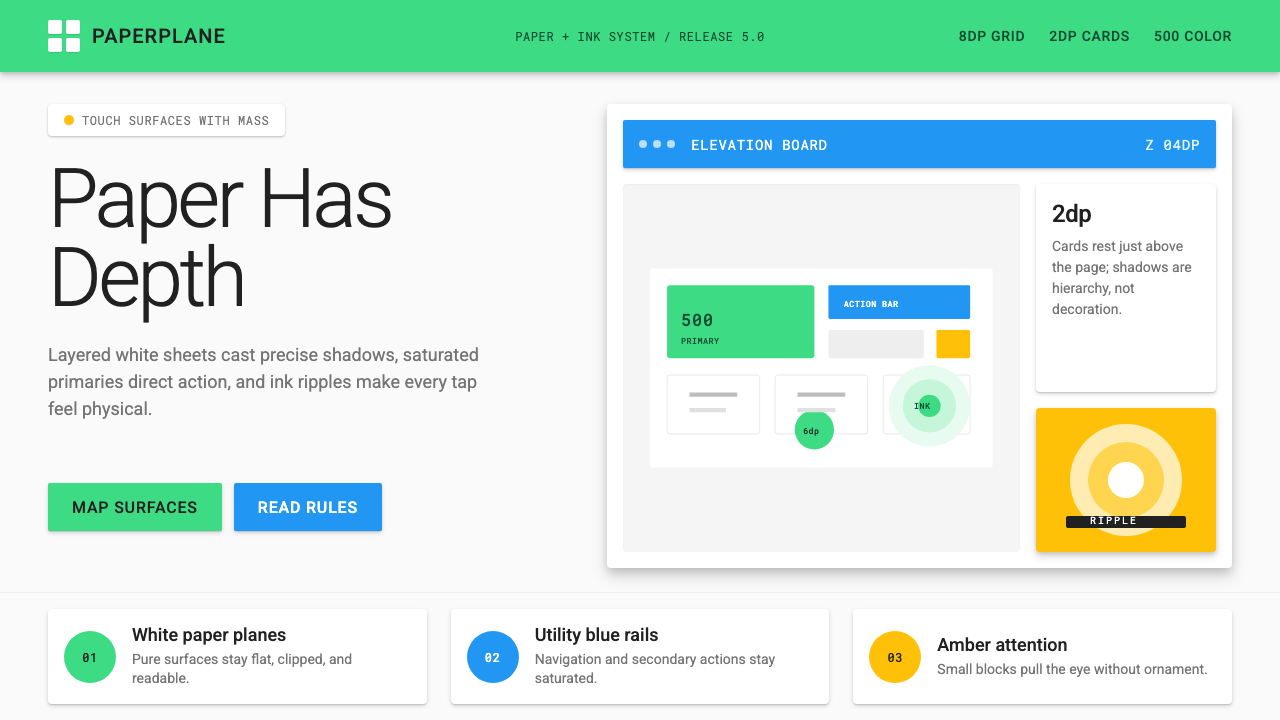 Android Lollipop (Material 1.0)Paper becomes physical. Roboto, green FABs and sharp shadows give white cards…
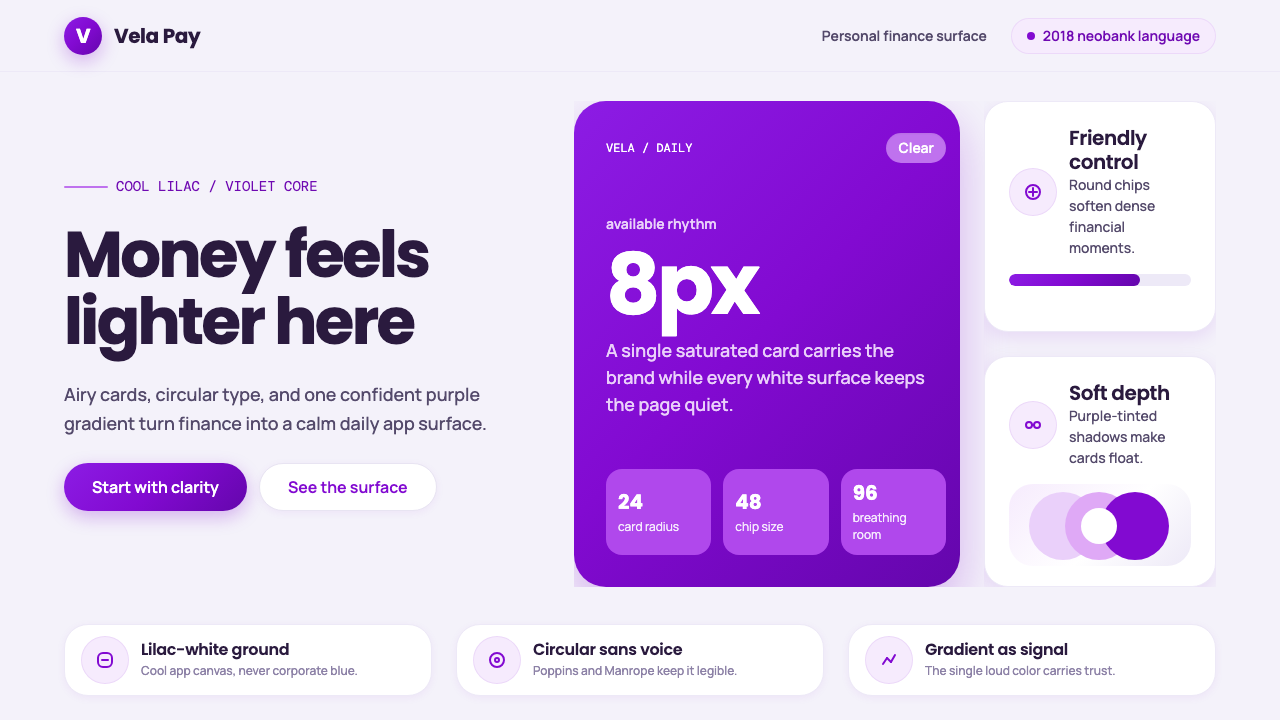 Circular FintechFinance feels light. Lilac-white space, rounded cards, and one vivid purple g…
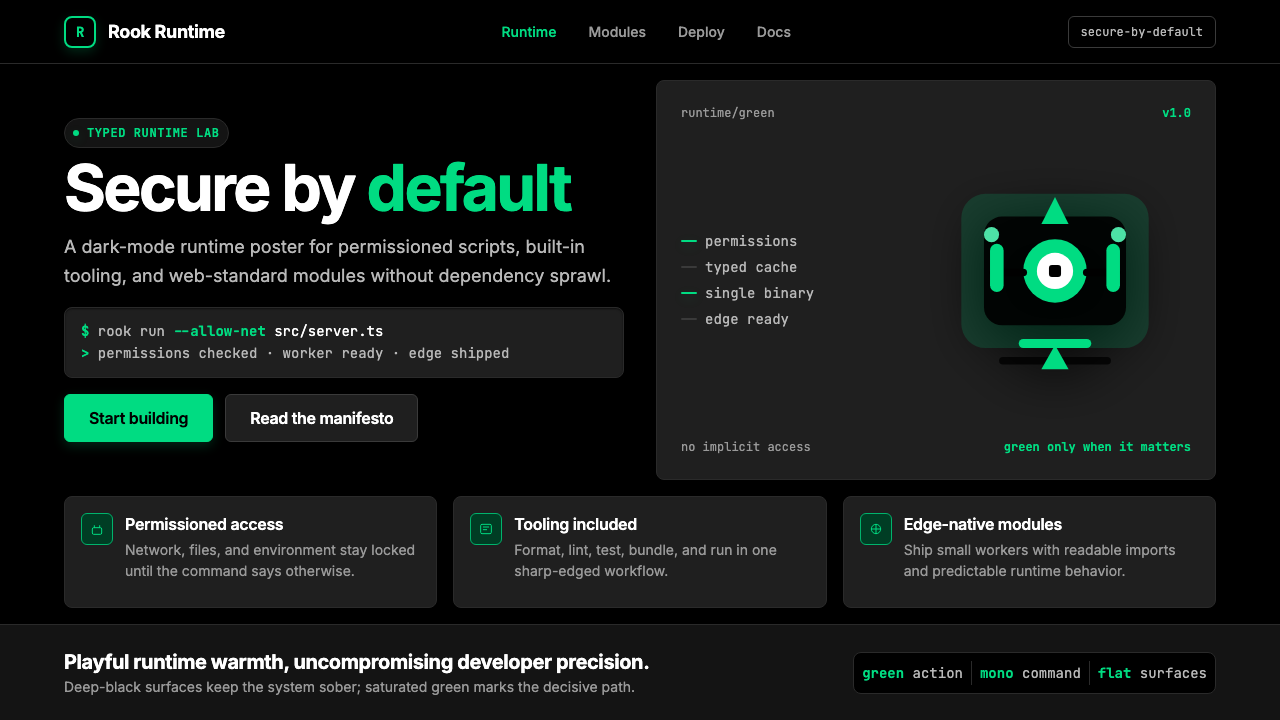 Deno Runtime-GreenWarm precision on black. Saturated green, Inter, and mono code turn security…