What is Nyonya Kebaya Embroidery?
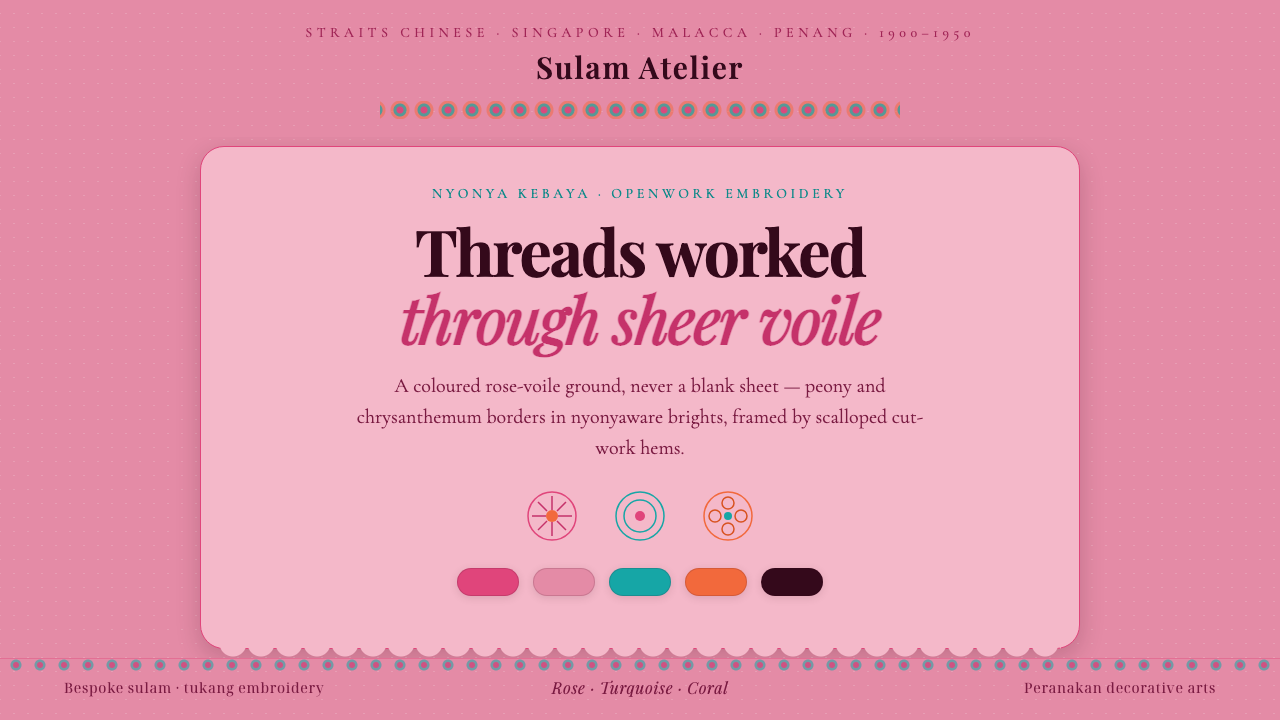
Nyonya kebaya embroidery turns transparency into ornament — rose voile, turquoise sulam, coral accents, and mirrored flowers held together by the poise of a high-contrast serif.
Nyonya Kebaya Embroidery in brief
Nyonya kebaya embroidery is the visual language of the sheer silk-voile blouse worn by Straits Chinese women across Singapore, Malacca, and Penang from roughly 1900 to 1950. Its defining craft is sulam: fine openwork machine embroidery that creates floral borders through stitched structure and deliberate apertures. The result is decorative without becoming opaque, ornate without losing air.
The pattern vocabulary is floral and mirrored. Peonies, roses, and chrysanthemums appear as recurring border motifs, arranged with the measured balance of a garment meant to be read across its whole surface. The palette recalls Peranakan porcelain: rose pink and rose-voile grounds support bright turquoise and coral, while the openwork itself introduces a shifting relationship between color, cloth, and surrounding space.
As a digital design system, Nyonya kebaya embroidery begins with a coloured ground rather than a blank sheet. Scalloped cut-work hems, openwork lattice, mirrored ornament, and high-contrast serifs translate the physical qualities of the garment into interface and editorial form. The governing impression is crafted abundance held in disciplined balance: every opening is intentional, every flower belongs to a border, and every contrast preserves delicacy.
Where does Nyonya Kebaya Embroidery come from?
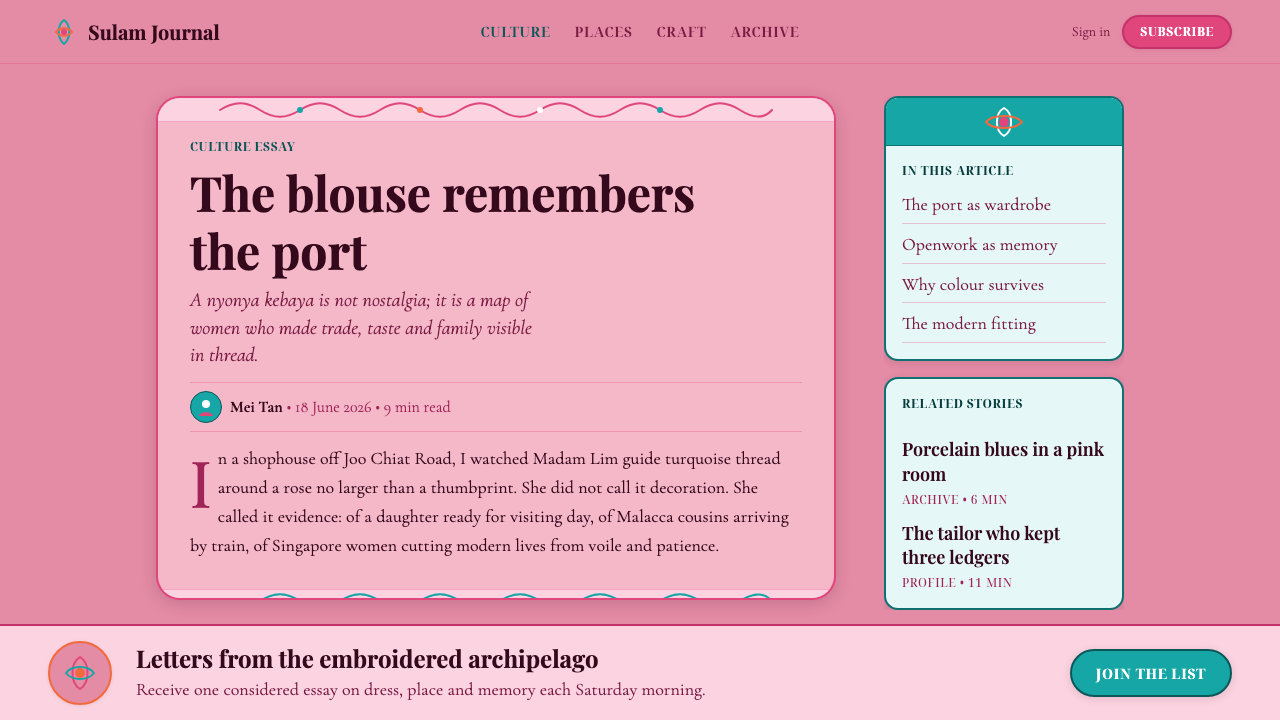
The kebaya described here belongs to late Straits Chinese material culture, with its strongest period placed roughly between 1900 and 1950. Its geographic frame is Southeast Asia, specifically the Peranakan communities of Singapore, Malacca, and Penang. The garment is not treated as an isolated surface pattern; it is a blouse whose sheerness, embroidery, and floral borders operate together as one visual system.
Sulam is the central technical reference. The embroidery is fine, openwork, and machine-made, so the defining effect comes from the relationship between stitched lines and the spaces they leave open. This matters to the style’s identity: the ornament is not simply applied color, and the ground is not merely a background. The cloth remains visibly present through the pattern, giving the design its characteristic lightness.
The floral language is built from mirrored peony, rose, and chrysanthemum borders. Mirroring supplies composure, while the flowers keep the composition organic and richly detailed. The result is a controlled dialogue between repetition and variation: the border has a clear rhythm, but its subject is botanical rather than mechanical.
The palette connects the kebaya to Peranakan decorative arts and the porcelain tradition of Nyonyaware. Rose pink, turquoise, and coral establish a bright but softened chromatic world, one that is decorative without relying on darkness or metallic severity. The digital interpretation carries this lineage forward through a rose-voile ground, scalloped cut-work edges, open lattice, and typography chosen for its contrast and delicacy.
What defines the Nyonya Kebaya Embroidery look?
Rose Voile Ground
The ground is coloured, sheer, and visibly material. Rose pink creates warmth beneath the ornament, so content never appears to float over an indifferent white field. The effect should feel like looking through fabric: soft in atmosphere, but clearly constructed.
Sulam Openwork
Sulam is expressed through fine lines, deliberate apertures, and open lattice rather than solid illustration. Empty space is part of the embroidery’s visible structure. Digital patterns should therefore let the ground breathe through borders and dividers instead of filling every area with opaque ornament.
Mirrored Florals
Peonies, roses, and chrysanthemums are arranged as mirrored border motifs. Symmetry supplies ceremonial calm, while the flowers prevent the system from becoming rigid. Use floral repetition to frame, anchor, or close a composition, not as scattered decoration without a boundary.
Porcelain Palette
Rose pink, turquoise, and coral create the palette associated with Peranakan porcelain. The colors are bright and decorative, but the rose ground keeps them from becoming harsh. Turquoise can carry openwork and secondary information; coral is most effective as a lively accent against the softer field.
Scalloped Edges
Scalloped cut-work hems give containers and sections a crafted finish. The edge should read as a repeated fabric gesture, not as a generic decorative wave. It works best where a panel, card, or page needs a clear lower boundary with softness rather than a hard rule.
High-Contrast Serifs
High-contrast serif typography echoes the fine delicacy of stitched lines. Thick and thin strokes create a refined counterpoint to the floral border, giving headings a dress-like presence without requiring additional ornament. Supporting text should remain calm so the contrast feels intentional rather than crowded.
Who shaped Nyonya Kebaya Embroidery?
Nyonya needlewomen represent the lived craft tradition behind the kebaya. Their work is understood through the garment’s fine openwork, mirrored floral borders, and careful balance between ornament and transparency. In the digital system, this figure stands for patient hand-guided judgment: pattern must feel made, placed, and maintained rather than mechanically repeated.
Bespoke sulam tukang embroiderers embody the specialized construction of the openwork surface. Their reference point is not generic floral decoration but the precise conversion of stitched line into airy, readable ornament. They guide the use of lattice, cut-work edges, and floral framing as structural devices.
The Peranakan and Baba-Nyonya communities provide the cultural setting in which the kebaya, its decorative arts, and its porcelain-associated palette belong together. This collective figure keeps the system from becoming a detached textile moodboard. It points toward a connected world of garment, ornament, colour, and regional material culture.
How do you use Nyonya Kebaya Embroidery today?
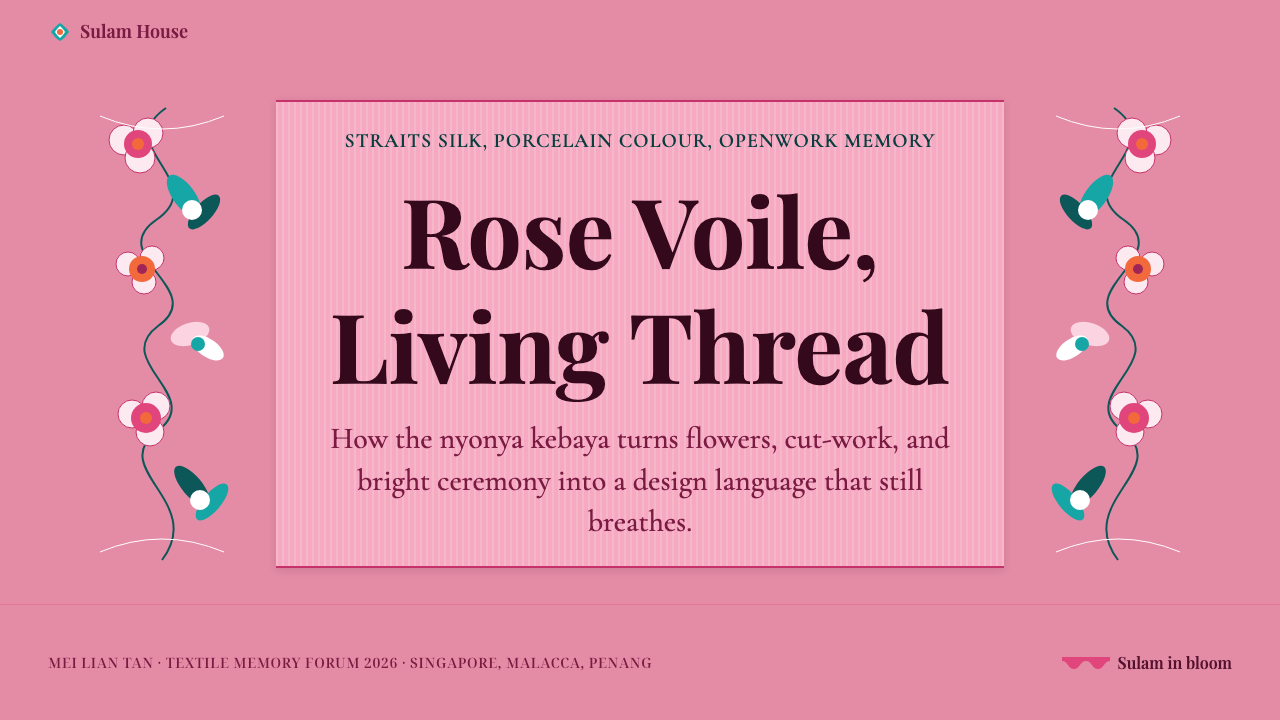
For presentation covers, begin with the rose-voile ground and let a mirrored floral border establish the frame. A high-contrast serif title can sit inside that frame with generous breathing room, while turquoise or coral introduces a single clear point of emphasis. Content slides should keep the same material logic: open lattice can separate sections, scalloped edges can close a page, and floral motifs should clarify structure rather than compete with the message.
Data slides benefit from treating the palette as a system of roles. Rose pink can provide the field, turquoise can carry primary chart structure, and coral can call attention to a selected result or key comparison. The important quality is not maximal colour but porcelain-like coordination. Charts should remain legible and spacious, with openwork-inspired dividers used sparingly so the visual craft supports the information.
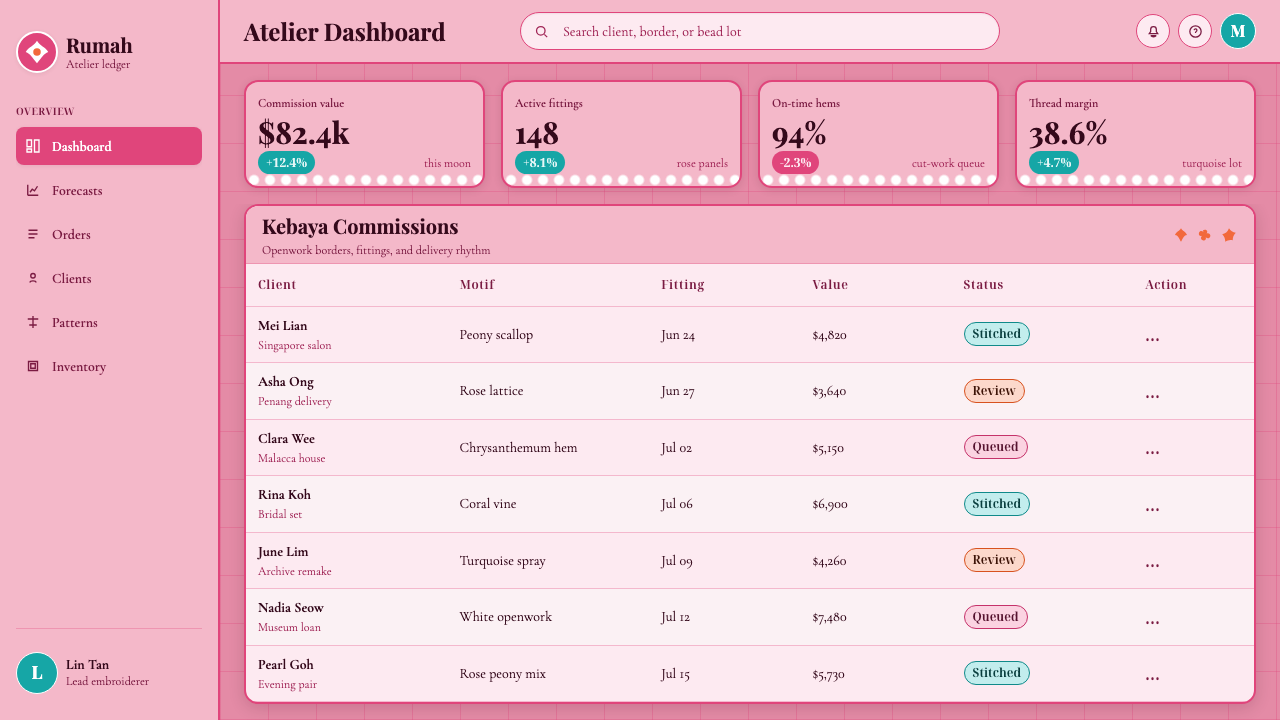
For web interfaces, the style suits dashboards and pricing pages that need warmth without abandoning hierarchy. Use the coloured ground to distinguish the interface from a blank utility surface, reserve high-contrast serifs for titles or prominent labels, and let turquoise and coral mark states, tiers, or actions. Cards can use scalloped lower edges or lattice panels as identifying features, but controls should remain clear enough that the embroidery language never obscures function.
Editorial and marketing work can use the kebaya system as a frame for stories about craft, culture, fashion, or regional material traditions. A narrow reading measure paired with generous rose space gives long text a textile-like calm. Campaign pages can alternate floral borders, open lattice, and porcelain colours across sections, while a single repeated motif provides continuity. The design is strongest when the ornament feels sewn into the composition rather than placed on top of it.
The common mistake is to treat Nyonya kebaya embroidery as permission to scatter flowers, bright colours, and decorative edges everywhere. That produces generic ornament instead of sulam. Keep the ground visible, preserve the distinction between stitched line and open space, use mirrored motifs as framing devices, and let the serif contrast carry much of the refinement. If every surface is equally elaborate, the system loses the delicacy that makes it recognizable.
Nyonya Kebaya Embroidery — FAQ
Is Nyonya kebaya embroidery the same as a general floral or tropical style?
No. Its identity depends on the combination of sheer rose voile, sulam openwork, mirrored peony, rose, and chrysanthemum borders, and the bright palette associated with Peranakan porcelain. A generic tropical style may use flowers and vivid colour, but it does not necessarily preserve the relationship between stitched structure, transparency, symmetry, and crafted edging.
Why is the background coloured instead of white?
The coloured ground is essential to the material analogy. Rose voile makes the digital surface feel like fabric before any ornament is added, and it gives turquoise and coral a warm field to sit against. A white ground can still appear in supporting areas, but if the whole system begins on blank white, it loses the sense that the decoration belongs to a textile.
How should openwork be translated into a digital interface?
Treat openwork as the relationship between visible line and deliberate space. Lattice panels, patterned dividers, and cut-work edges can frame content while allowing the rose ground to remain present. Avoid using dense pattern as a background behind important text. The digital translation succeeds when the openings remain structural and the content stays easy to read.
Can the style use only one floral motif?
Yes, provided the motif still behaves like a border or framing element. The source language names peonies, roses, and chrysanthemums as a family of mirrored floral borders, not as a requirement that every composition display all of them. A single rose border, for example, can be effective when its symmetry, spacing, and relationship to the ground remain clear.
What makes the typography feel authentic to the system?
The defining choice is high-contrast serif typography, used to echo the fine delicacy of sulam stitching. It should provide refinement through the contrast between thick and thin strokes, not through additional flourishes. Keep supporting text quieter and let the floral borders, coloured ground, and serif headings form a coherent material conversation.
Related design styles
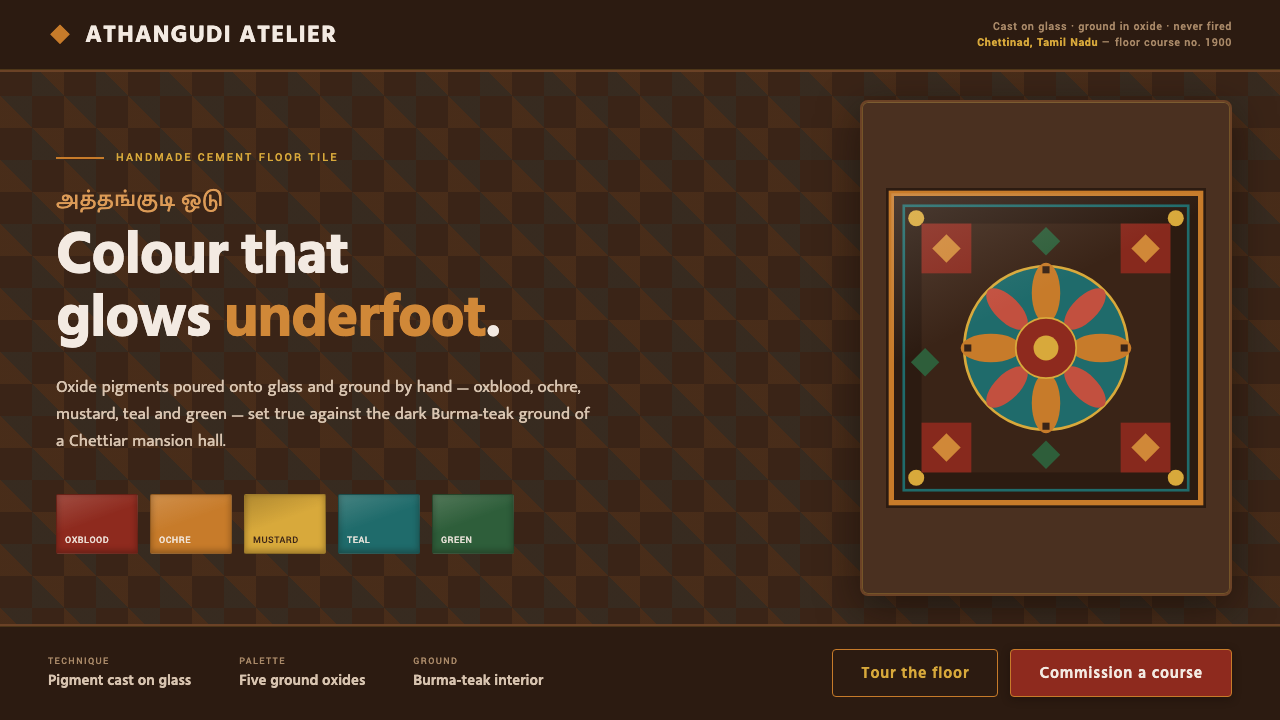 Chettinad Athangudi TilesColour that glows underfoot. Five ground-oxide tones on dark teak in bordered…
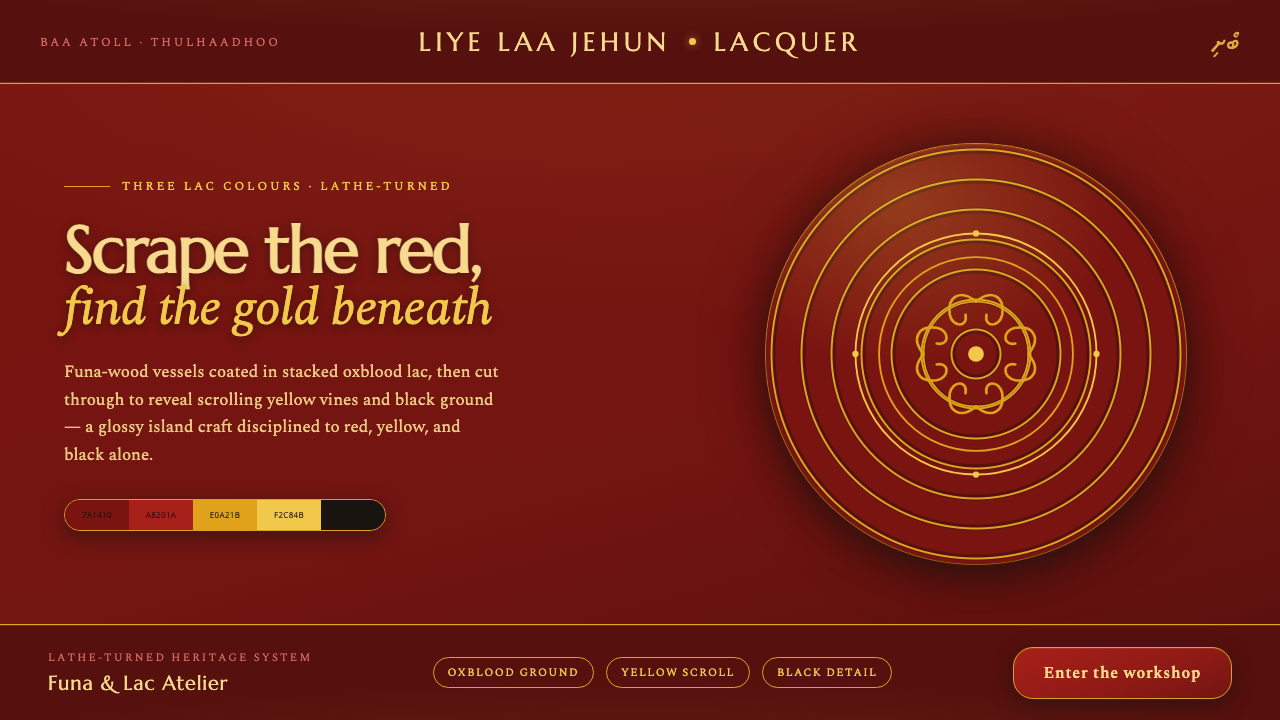 Maldivian Liye Laa Jehun LacquerThree lac colours, nothing else. Glossy oxblood scraped through to yellow scr…
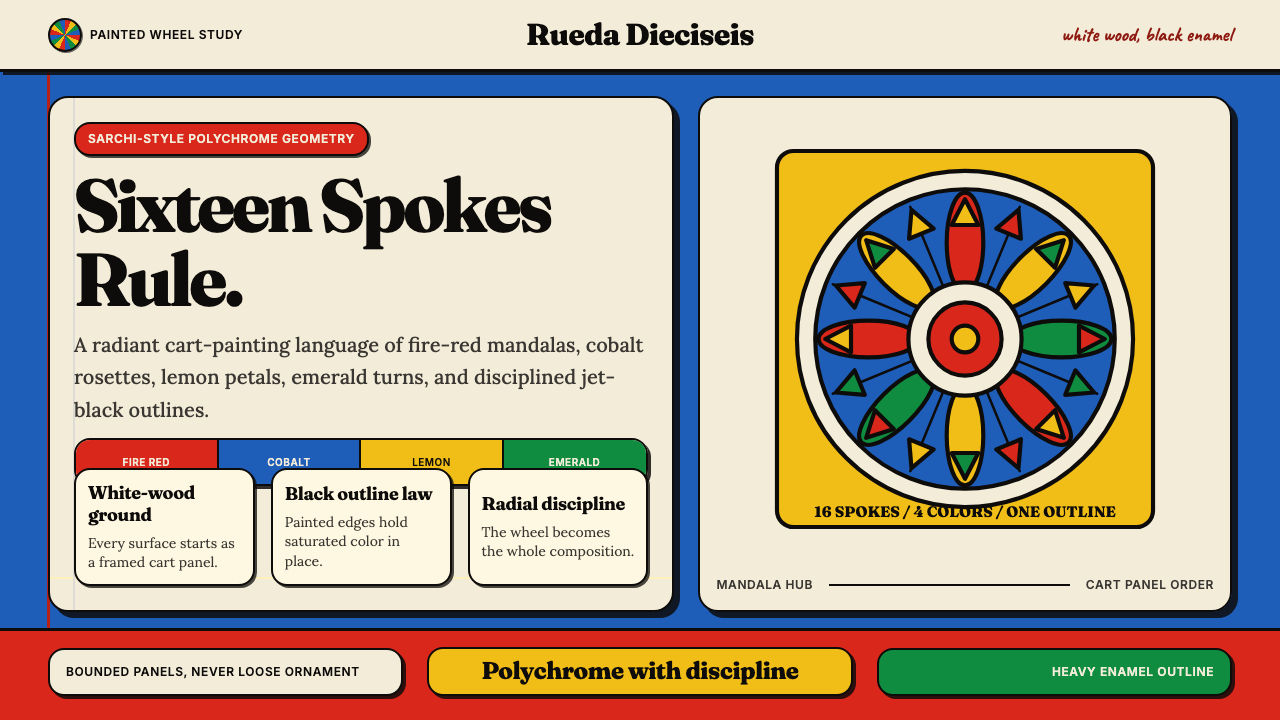 Costa Rican Oxcart Sarchí 1900Geometry sings. Fire red, cobalt, lemon and black outlines turn the wheel int…
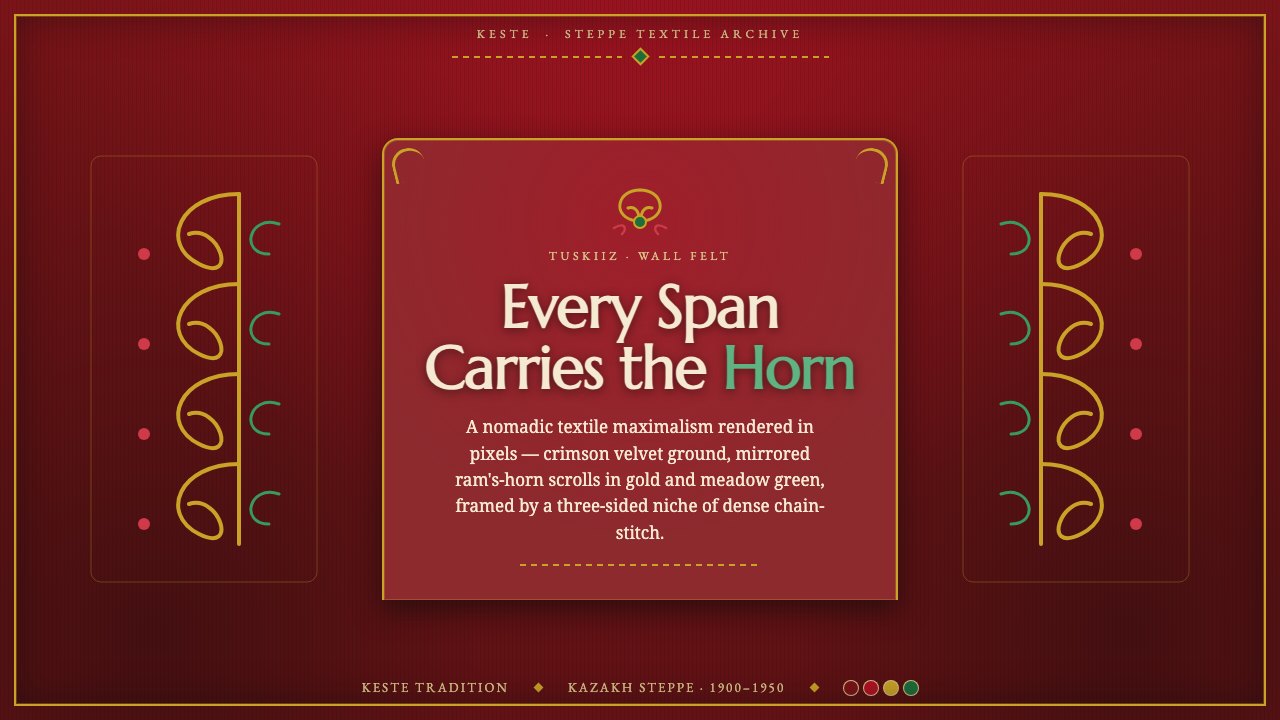 Kazakh Tuskiiz Wall HangingNothing flat, nothing empty. Crimson velvet, gold-green ram's-horn scrolls, a…
 Nabeul Ceramic TealGlaze over fired clay. Peacock teal and white reserve banded in black on terr…
 Bhutanese KushutharaPatience made visible. Lac pink and indigo bands shift across a warm silk gro…