What is Kazakh Tuskiiz Wall Hanging?
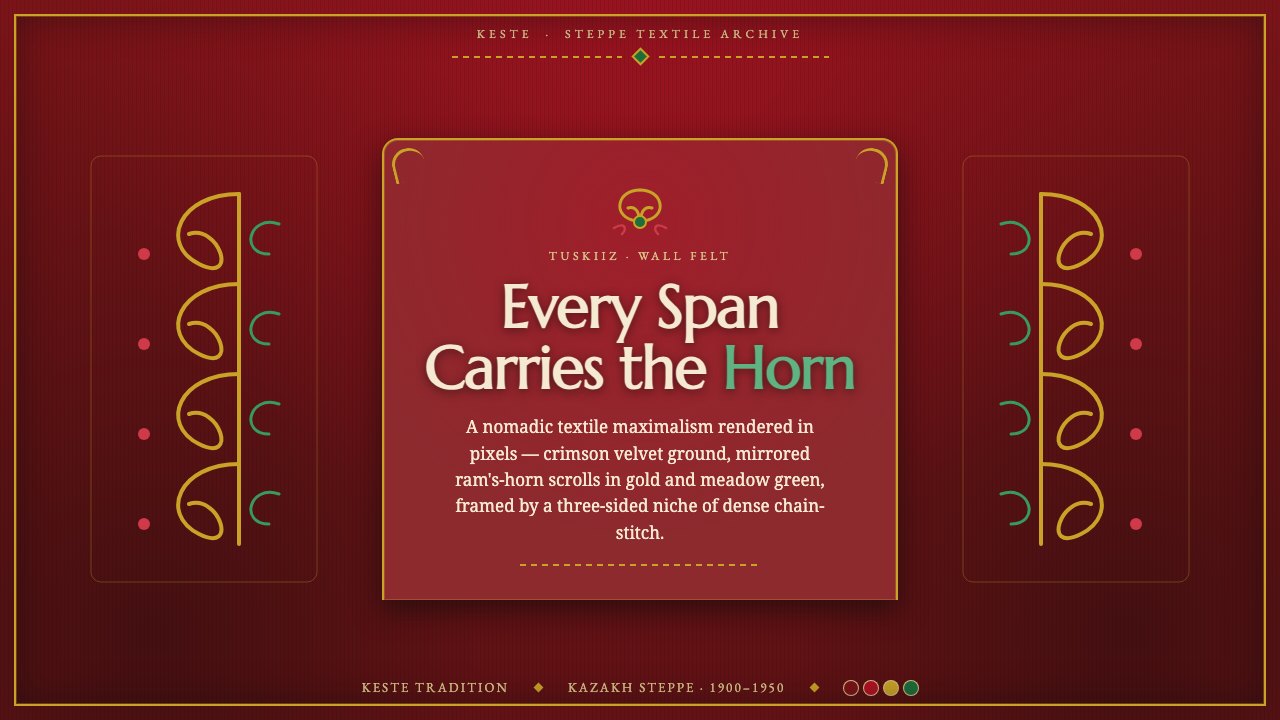
Kazakh tuskiiz turns a wall into a field of velvet, mirrored ram’s-horn scrolls, and chain-stitched abundance.
Kazakh Tuskiiz Wall Hanging in brief
A tuskiiz is a Kazakh embroidered wall hanging mounted inside the yurt, worked by chain stitch onto a deep crimson velvet field. Its defining motif is the muyiz, a curling ram’s-horn scroll embroidered in crimson, gold-yellow, and green silk around a central niche.
As a design system, Kazakh Tuskiiz Wall Hanging translates nomadic textile maximalism into a digital surface. The ground should feel saturated and tactile rather than flat; mirrored S-curves establish rhythm; a framed niche creates a visual center; and ornamental borders press closely against the field. The composition is full, layered, and deliberately unapologetic.
The style communicates abundance through density rather than through scattered decoration. Crimson carries the warmth of the velvet ground, gold-yellow brings threadlike radiance, and green gives the ornament a vegetal, jewel-like counterpoint. Nothing is treated as empty paper. Every area belongs to the textile field, whether it holds a scroll, a border, a frame, or the visual suggestion of pile.
Where does Kazakh Tuskiiz Wall Hanging come from?
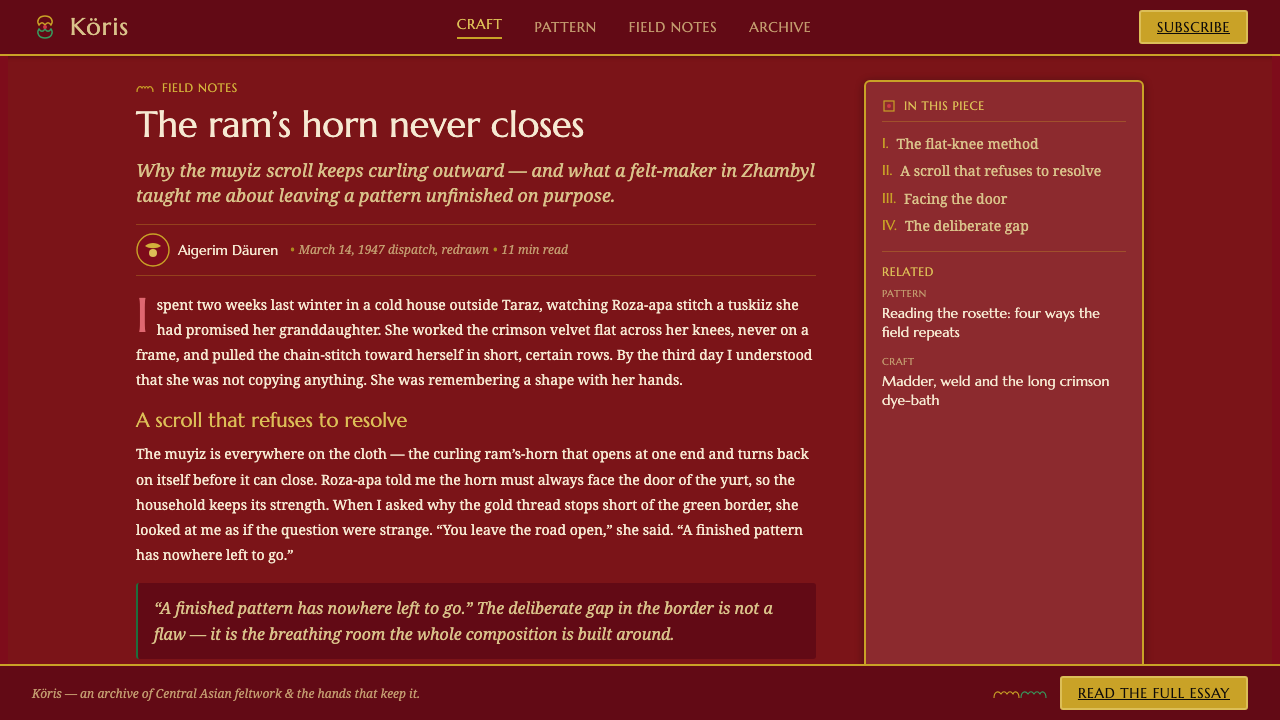
Tuskiiz belongs to the keste embroidery tradition of the Kazakh steppe, a Central Asian textile culture shaped by nomadic furnishing and the interior life of the yurt. The approved lineage places this form within the period from 1900 to 1950, while the muyiz ornament itself reaches back across centuries.
The object begins with a textile field rather than a paper-like support. Deep crimson velvet provides the ground, and chain stitch builds the visible ornament directly onto it. This relationship between ground and stitch is essential: the velvet is not merely a background color but the surface that gives the hanging its weight, depth, and tactile identity.
The composition centers on a niche framed by ornamental structure. Around it, the muyiz scroll repeats in mirrored form, turning the ram’s-horn curve into a system of balance and recurrence. Crimson, gold-yellow, and green silk make the ornament legible against the saturated field while preserving the sense of a single, densely worked textile.
The tradition is associated with anonymous Kazakh women embroiderers whose work belongs to keste practice rather than to a named individual author. Tuskiiz therefore carries a collective visual identity: its character comes from recurring craft knowledge, the muyiz lineage, and the practical role of felt-and-textile furnishings inside the yurt.
What defines the Kazakh Tuskiiz Wall Hanging look?
Velvet Ground
The ground is deep crimson velvet, rich enough to feel like a material before it is read as color. It should suggest pile, weight, and compressed softness. Flat fills, sterile white space, and paper-like neutrality weaken the style because the surface itself is part of the ornament.
Muyiz Scrolls
The muyiz is the signature vocabulary: a curling ram’s-horn scroll with an S-shaped energy. Its curves should feel continuous, muscular, and embroidered rather than casually ornamental. Repetition turns the motif into a border, frame, or enclosing rhythm around the central niche.
Chain-Stitch Line
Chain stitch gives the ornament a visible line quality. Edges should read as linked, tactile paths, with the rhythm of thread preserved even when the system becomes digital. Outlines are not neutral containers; they carry the handmade pulse of the textile.
Mirrored Balance
The scrollwork is organized through mirroring. This does not create quiet symmetry; it creates ceremonial balance, as if the central niche were being held in place by paired ornamental forces. Curves should answer each other across the composition without becoming mechanically identical.
Framed Niche
A central niche provides the composition with a place of focus. Its frame is ornamental and architectural at once: it separates the center from the surrounding field while allowing the muyiz pattern to gather around it. The niche should feel embedded in the textile, not pasted on top of it.
Dense Ornament
Tuskiiz rejects the modern instinct to leave large areas untouched. Borders, scrolls, frames, and color fields should interlock so the eye keeps discovering another layer. Density is not visual noise when the motif family remains coherent; it is the style’s principal expression of richness.
Who shaped Kazakh Tuskiiz Wall Hanging?
The central makers of the keste tradition are anonymous Kazakh women embroiderers. Their collective practice gives tuskiiz its authority: the form is carried through shared textile knowledge, chain-stitch skill, and recurring ornament rather than a single celebrated signature.
Keste is the embroidery tradition that supplies tuskiiz with its craft context. It frames the wall hanging as a worked textile intended for the yurt interior, where surface, stitch, and furnishing belong to the same material world.
The muyiz lineage supplies the visual grammar of curling ram’s-horn scrolls. Its importance lies in repetition and continuity: a single curved motif expands into mirrored borders, enclosing frames, and the dense ornamental field that defines tuskiiz.
How do you use Kazakh Tuskiiz Wall Hanging today?
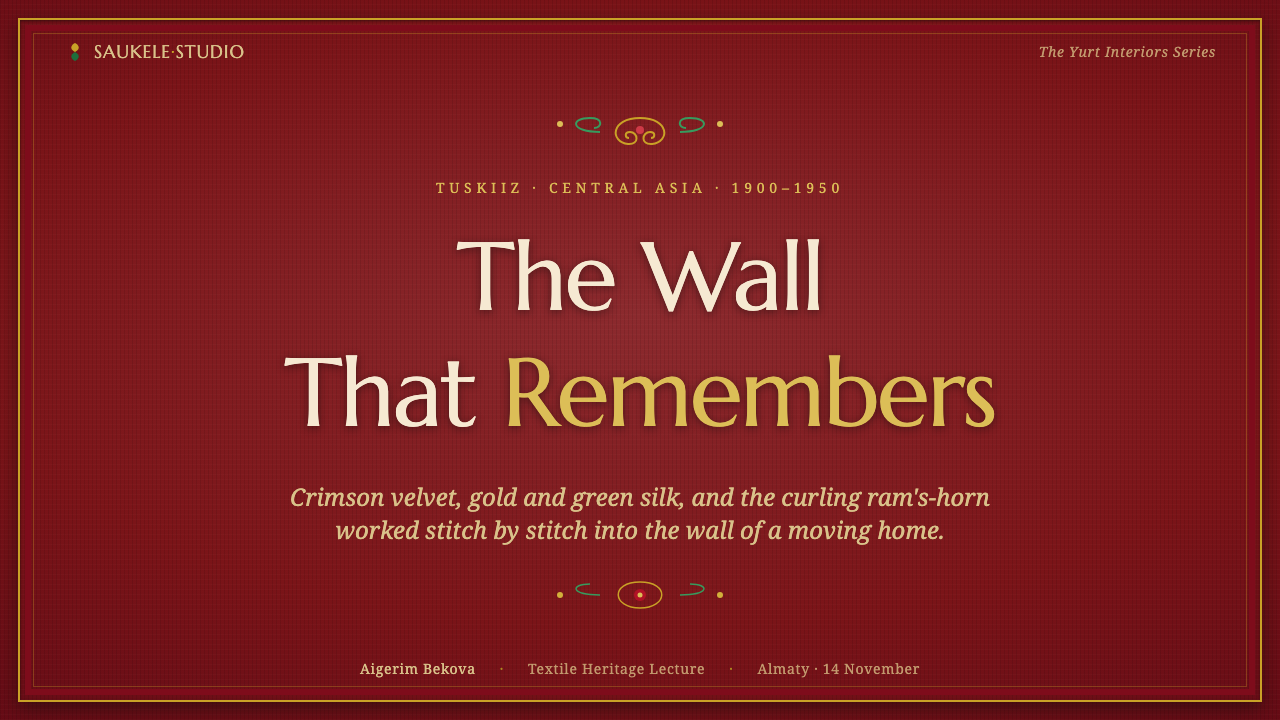
For presentation covers, let the crimson velvet ground establish immediate atmosphere. Place the title within or beside the central niche, using the mirrored muyiz scrolls as a framing device rather than as a decorative background. Content slides should retain the same visual logic: dense borders can mark the edge of the field, while gold-yellow and green organize emphasis within the crimson system.
Data slides benefit from treating information as something housed inside the textile. A chart, diagram, or key figure can occupy the central niche, with ornamental structure around it providing continuity between pages. Keep the data legible through clear contrast and restrained internal decoration; the frame should create ceremony without swallowing the information.
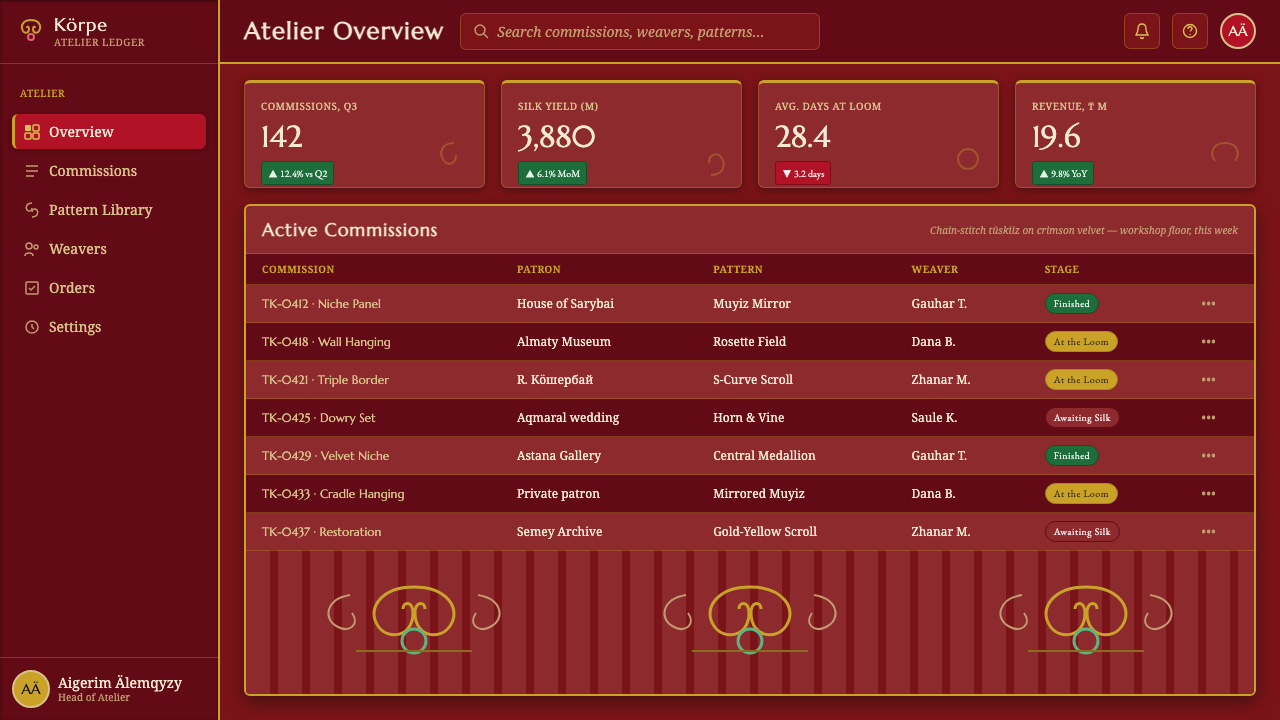
For web interfaces, the style suits dashboards and pricing pages that need a memorable, richly branded surface. Use the crimson ground as the dominant environment, reserve gold-yellow for active emphasis, and use green as a secondary signal. Panels should feel inset or framed, with borders and linked curves replacing generic floating cards. The interface must remain navigable beneath the ornament.
Editorial and marketing work can use tuskiiz to turn a page into a crafted object. Articles may place introductions, quotations, or metadata inside framed niches, while dense ornamental bands separate sections. Campaign pages can alternate close textile crops with quieter content moments, provided the velvet field and muyiz vocabulary remain the recognisable thread across the whole system.
The common mistake is to imitate only the crimson-and-gold palette while leaving the layout flat and empty. Tuskiiz depends on material suggestion, mirrored structure, chain-like linework, and sustained density. Another mistake is to scatter unrelated ornaments across the page. Choose a coherent muyiz family, let it gather around meaningful content, and preserve the sense that every mark belongs to one embroidered hanging.
Kazakh Tuskiiz Wall Hanging — FAQ
What is a tuskiiz?
A tuskiiz is a Kazakh embroidered wall hanging mounted inside the yurt. It is chain-stitched onto deep crimson velvet and organized around a central niche framed by muyiz ram’s-horn scrolls.
What does muyiz mean visually in this design system?
Muyiz is the curling ram’s-horn scroll that supplies the system’s principal shape language. Repeated and mirrored, it becomes border, frame, rhythm, and enclosure around the central niche.
Why does this style avoid large areas of empty space?
The tuskiiz field is understood as velvet pile and worked textile, not as neutral paper. Its richness comes from the sustained relationship between ground, stitch, border, and scroll, so emptiness should be treated as a deliberate material pause rather than the default layout condition.
Can the style work with a dark interface?
Yes. Its defining ground is already deep crimson, and the system is built around saturated darkness rather than pale neutrality. The important distinction is that the dark surface must feel like velvet, with ornament and framing providing depth, rather than like a plain black screen.
What should designers avoid when adapting tuskiiz digitally?
Avoid reducing it to a palette of crimson, gold-yellow, and green. A convincing adaptation also needs mirrored muyiz structure, chain-stitch line quality, a framed central focus, dense borders, and a ground that feels materially present. Without those relationships, the result becomes generic ornament rather than tuskiiz.
Related design styles
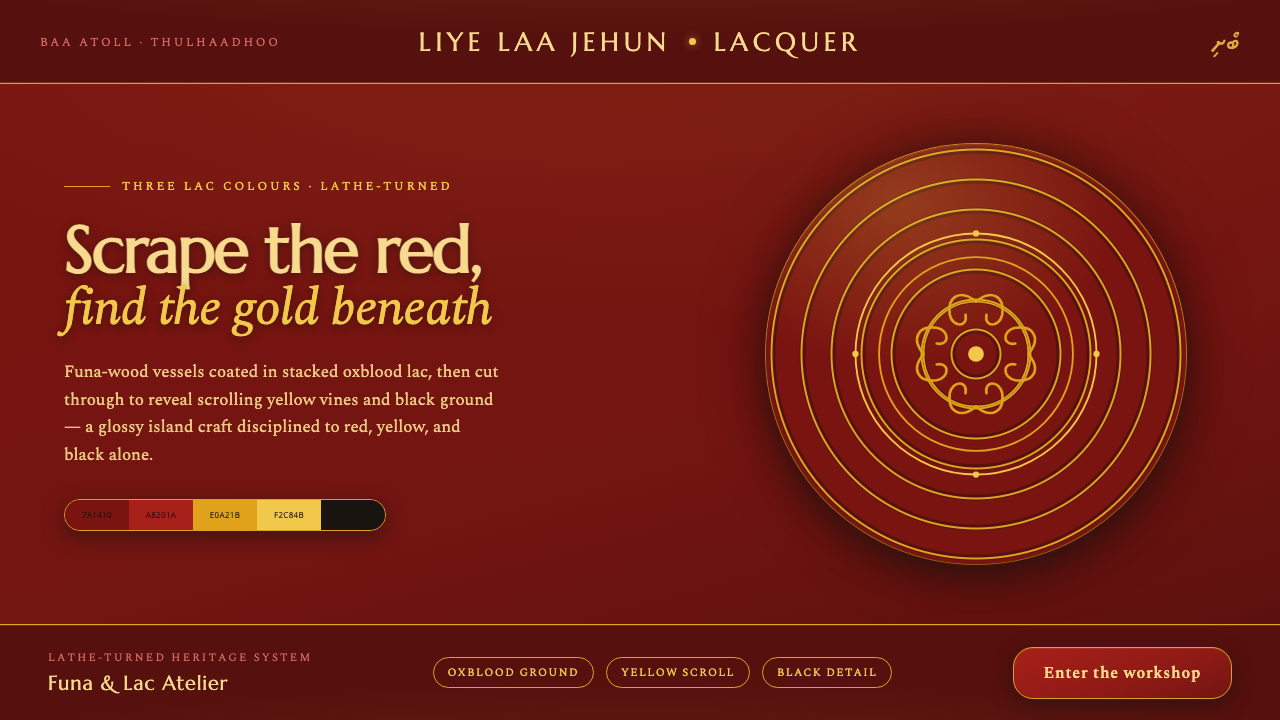 Maldivian Liye Laa Jehun LacquerThree lac colours, nothing else. Glossy oxblood scraped through to yellow scr…
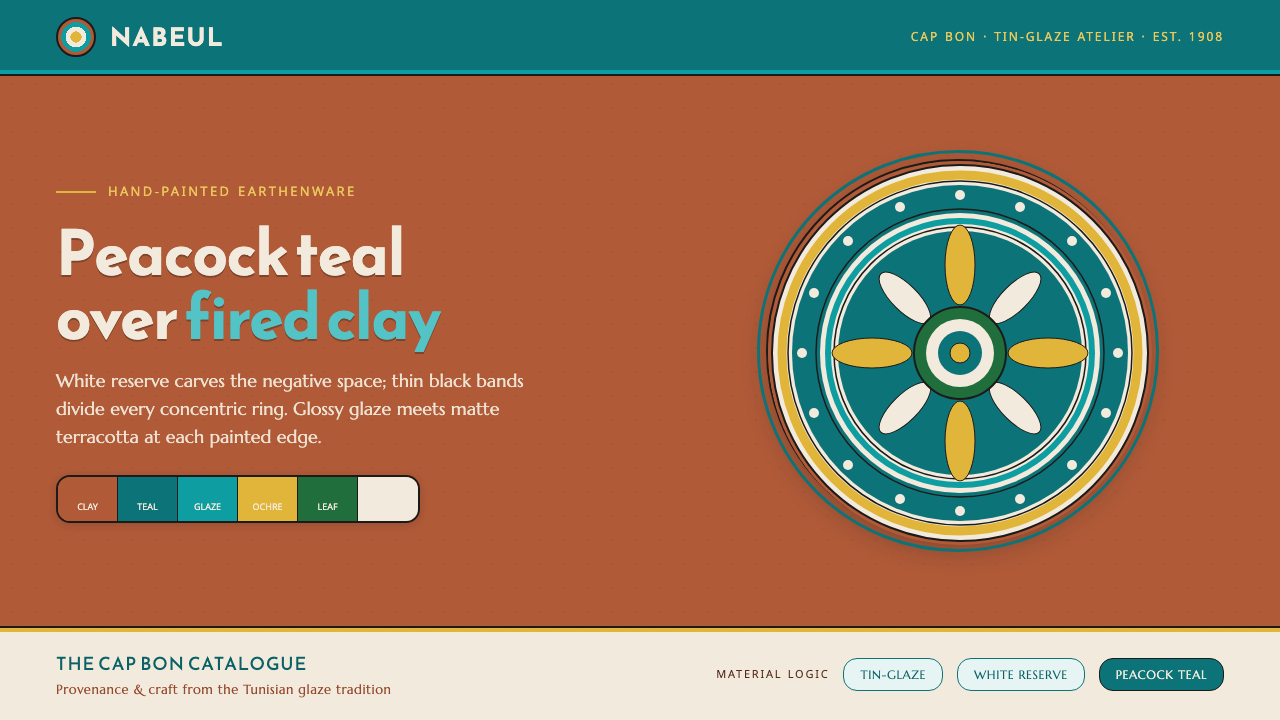 Nabeul Ceramic TealGlaze over fired clay. Peacock teal and white reserve banded in black on terr…
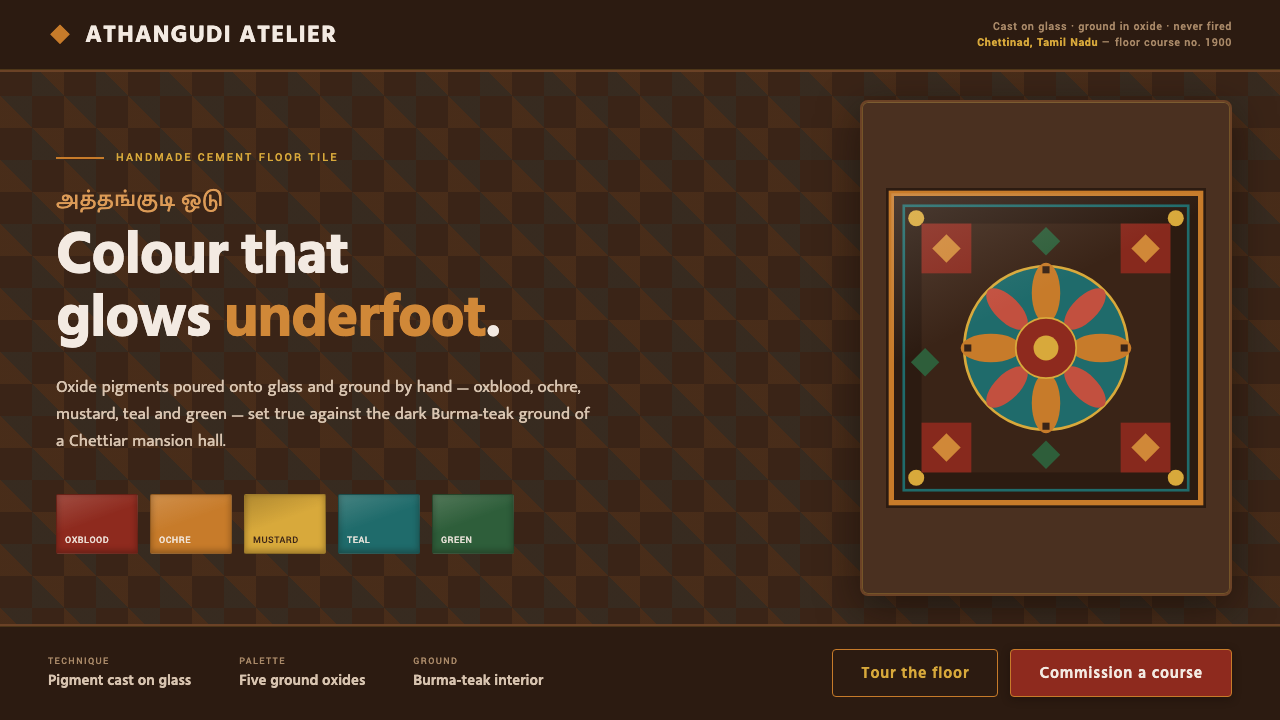 Chettinad Athangudi TilesColour that glows underfoot. Five ground-oxide tones on dark teak in bordered…
 Christmas ClassicTradition glows warmly. Evergreen panels, berry-red notes and burnished-gold…
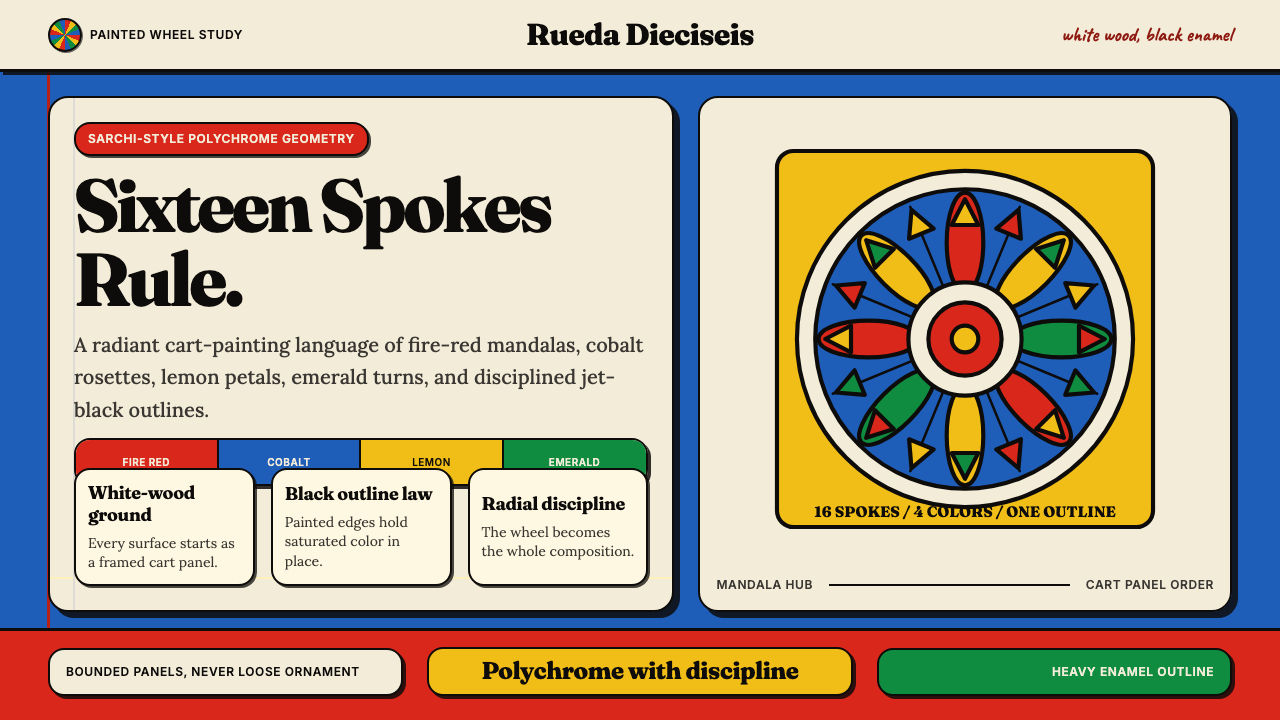 Costa Rican Oxcart Sarchí 1900Geometry sings. Fire red, cobalt, lemon and black outlines turn the wheel int…
 Mongolian Deel & Ger FeltTextile gravity. Smoke-black felt frames crimson silk, brass knot borders, an…