What is Sherlock Holmes — Baker Street (1887)?
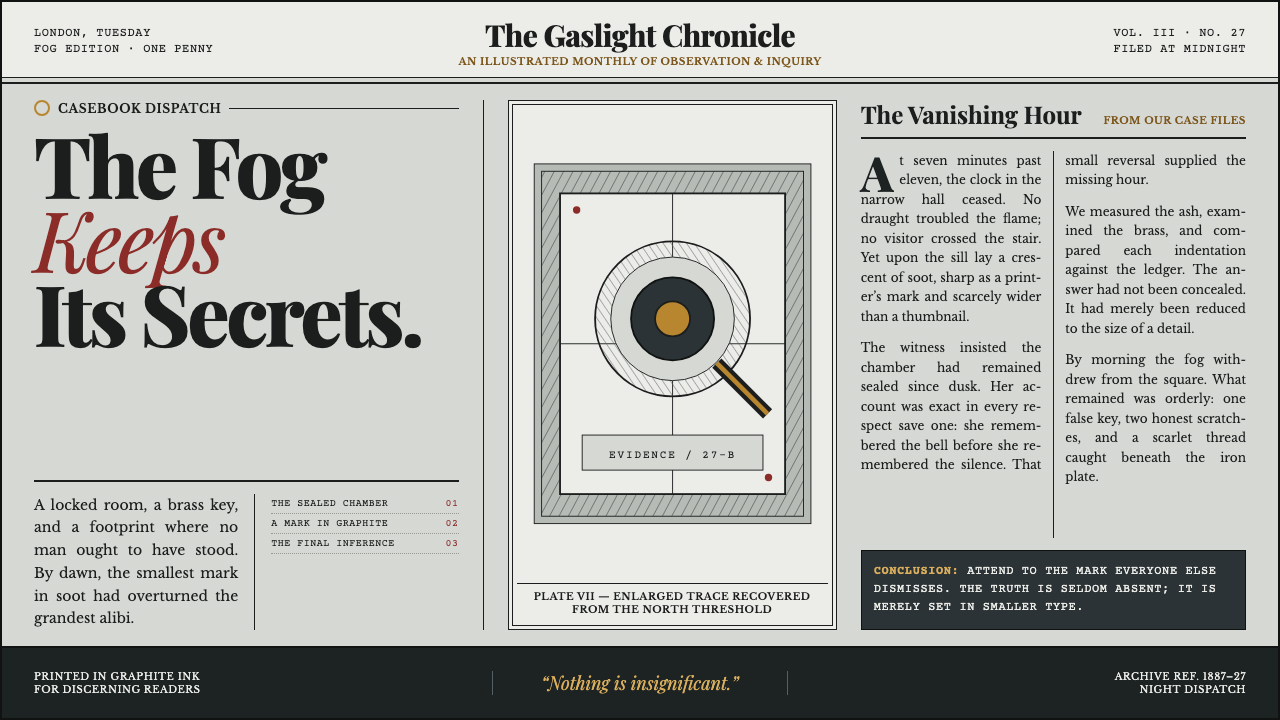
Sherlock Holmes — Baker Street turns the detective story into a Victorian serial page: fog, engraved ink, and a single brass glow cutting through the gray.
Sherlock Holmes — Baker Street (1887) in brief
Sherlock Holmes — Baker Street is a print-led editorial style drawn from the London of 1887: fog-gray streets, hissing gaslight, cheap grayish pulp stock, and the sharply engraved line associated with the detective’s early printed world. Its mood is literary and investigative rather than theatrical. A page should feel as though it has been pulled from a monthly case-file serial, carrying evidence, narration, and image in the same measured field of ink.
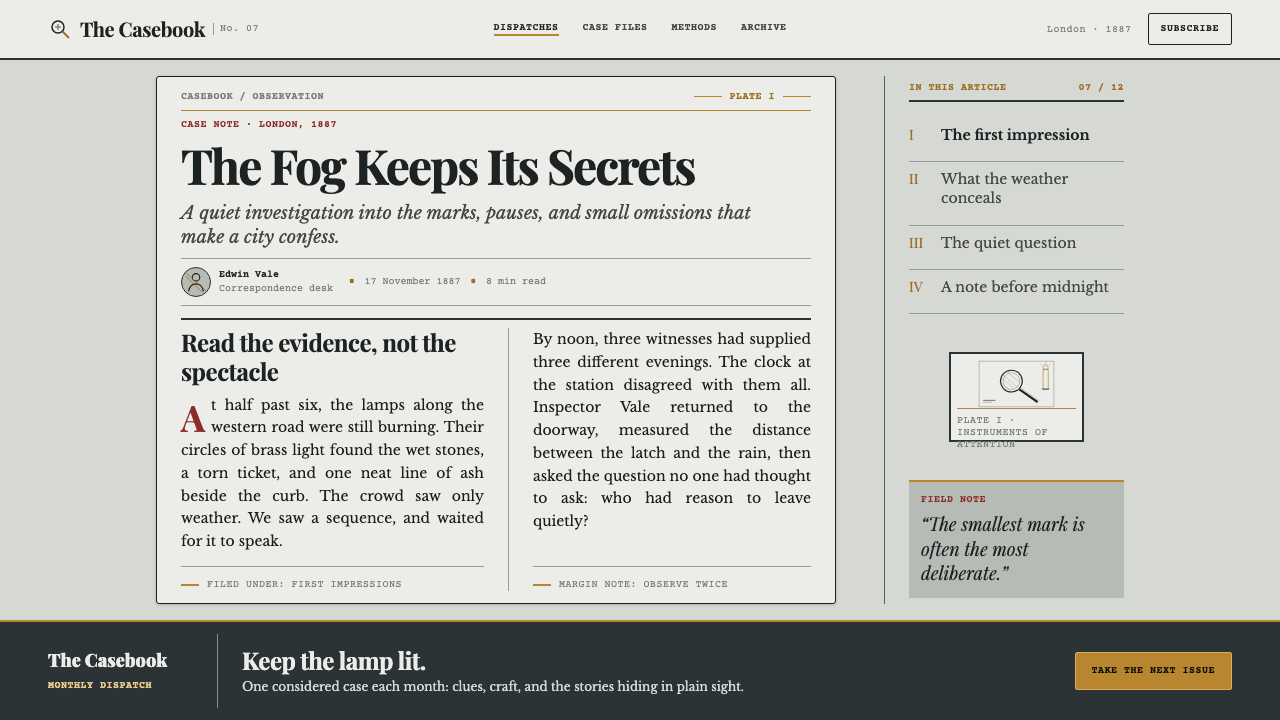
The system is built around narrow justified text columns divided by a hairline vertical rule. Dense text is not a defect here; it creates the pressure of a report being carefully read. Titles arrive with the formality of a dossier heading, while engraved plates and their captions interrupt the prose as visual evidence. A magnifying-glass dingbat beneath a title gives each opening the small, ritualized gesture of a mystery beginning.
The visual language stays nearly monochrome. Graphite, soot, fog, and gray paper establish the dominant atmosphere; a muted brass note suggests gaslight, while scarlet appears only as a rare clue or alarm. Cross-hatching is central to the style because it makes darkness feel printed rather than digitally shaded. The result is not simply old-fashioned: it is a controlled fiction of paper, pressure, observation, and withheld information.
Where does Sherlock Holmes — Baker Street (1887) come from?
The style begins with the Sherlock Holmes setting named by its source material: London, Baker Street, Fleet Street, and the Strand. Its period runs from A Study in Scarlet in 1887 through the launch of The Strand in 1891 and the short-story run that followed into 1893. These dates define a particular printed moment, when detective fiction could feel immediate because it arrived as reading matter, not as a retrospective artifact.
Its visual foundation is Victorian wood-engraving illustration. The engraved line is dense, directional, and materially persuasive: it can describe soot-dark rooms, damp streets, coat fabric, gaslit interiors, and faces held just beyond certainty. Cross-hatching does more than create darkness. It turns shadow into accumulated marks, making every dim area feel examined, carved, and reproduced through ink.
Penny-serial magazine design supplies the page rhythm. Cheap stock, narrow columns, rules, captions, and compact editorial hierarchy make information appear economical and continuous. The style should retain that serial quality: a page does not announce itself as a museum object but as the next installment, already carrying the residue of prior clues and the promise of another page to come.
Late-nineteenth-century periodical typography provides the final discipline. Text must look arranged for sustained reading, with headings functioning as case markers rather than oversized advertising. Arthur Conan Doyle, Sidney Paget, George Newnes, and Walter Paget are the named figures in the source framework. Within this theme, Doyle and Paget anchor the relationship between detective narrative and its printed, illustrated presence.
What defines the Sherlock Holmes — Baker Street (1887) look?
Ink and Paper
The page begins with the feeling of grayish pulp stock, not a pristine digital canvas. Graphite-black marks should appear absorbed into a fogged paper ground. Slight visual roughness is welcome when it supports the fiction of inexpensive serial printing, but it must remain legible and deliberate rather than distressed for its own sake.
Engraved Line
Cross-hatching replaces smooth tonal modeling. Dark areas are assembled from visible strokes that cross, gather, and thicken around the unknown. Illustration should feel cut into a block and transferred to paper, with crisp edges and a density that suggests investigation rather than atmospheric blur.
Fog and Gaslight
Fog-gray establishes the field, while brass-colored gaslight appears as a contained illumination rather than a broad wash of warmth. It should reveal a clue, a rule, or a title detail without dissolving the surrounding reserve. Scarlet is rarer still: a visual interruption with the force of evidence.
Serial Columns
Narrow justified columns create the cadence of a periodical. A fine dividing rule should organize the reading field quietly, giving the eye a firm path without becoming decoration. The density communicates that the page contains testimony and deduction; generous blankness should be reserved for titles, plates, and moments of discovery.
Case Typography
Headings should carry the formality of a case record, with small-capital character and restrained hierarchy. The title is an entry point to an investigation, not a cinematic slogan. Body copy should remain compact and editorial, while plate captions act as factual annotations that tighten the bond between image and text.
Evidence and Ornament
The magnifying-glass dingbat is a useful recurring sign because it belongs to the act of detection. Like engraved captions and hairline rules, it should earn its place by guiding attention or establishing the case-file world. Decorative additions that have no narrative or editorial function weaken the style’s printed conviction.
Who shaped Sherlock Holmes — Baker Street (1887)?
Doyle is named in the source material as a key figure for the Sherlock Holmes — Baker Street period. In this visual system, his name anchors the detective narrative that gives the printed page its purpose: observation, sequence, suspense, and the gradual presentation of evidence.
Paget is the source material’s central visual reference. His dense cross-hatched ink on grayish pulp stock defines the engraved atmosphere of the theme, demonstrating how illustrated darkness can be built from marks rather than simulated with smooth tonal effects.
Newnes appears among the source material’s key figures during the period marked by the launch of The Strand. His presence situates the style within a magazine context: a recurring printed format where narration, illustration, captions, and editorial pacing belong to one serial whole.
Walter Paget is included in the source material’s key-figure list. Within the theme, that inclusion reinforces the importance of the Paget name to its approved historical frame and keeps the visual discussion connected to the listed period rather than to a generalized Victorian past.
How do you use Sherlock Holmes — Baker Street (1887) today?
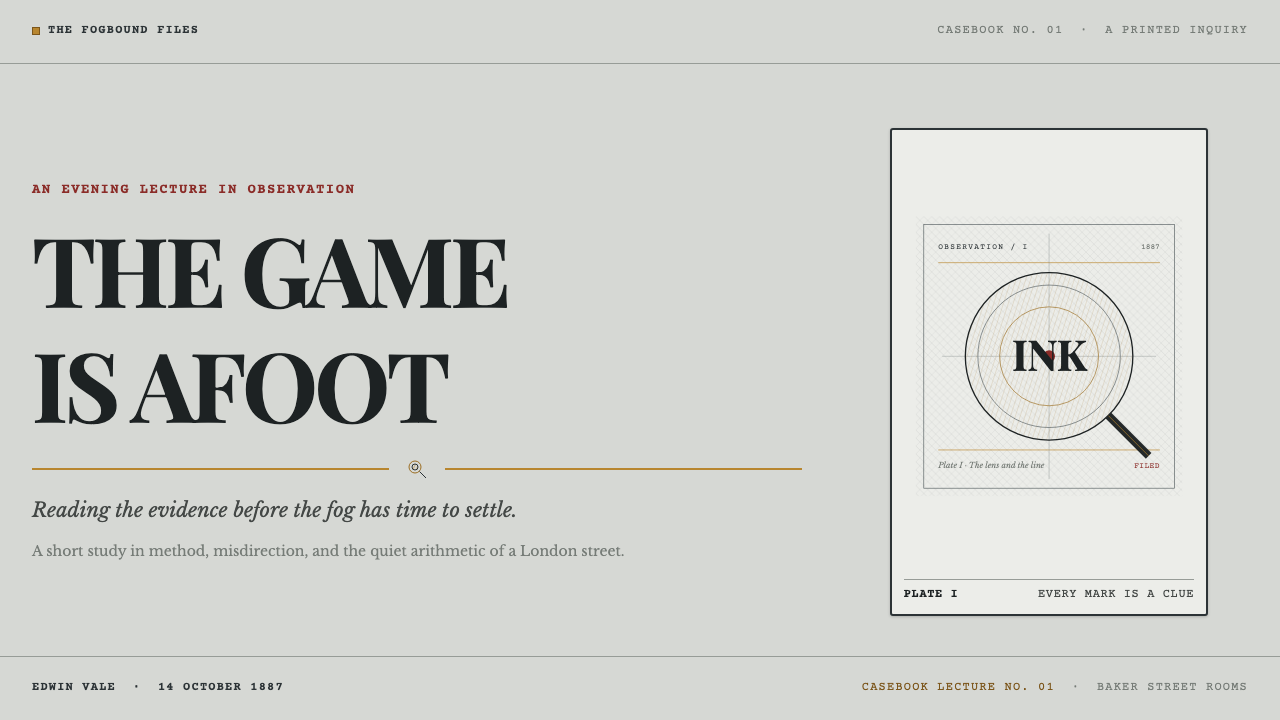
For presentation covers, treat the slide as the opening page of a case. Set the title with dossier-like authority against a quiet fog-gray field, then introduce one engraved clue, a restrained brass light, or a small scarlet interruption. Avoid filling the surface with props. The strongest cover implies a mystery before it explains it.
Content slides should inherit the periodical logic. Use narrow text territories, a fine rule, concise captions, and one carefully cropped engraved image where an illustration can clarify the argument. Keep headings stable from slide to slide so that the deck feels like a sequence of numbered findings rather than a set of unrelated posters.
Data slides work when charts are treated as printed evidence. Favor graphite marks and clear labeling over glossy visual effects; let a brass accent identify the relevant series and reserve scarlet for an exception, warning, or decisive change. Annotation is especially valuable here, since the style is naturally suited to the language of clues, observations, and conclusions.
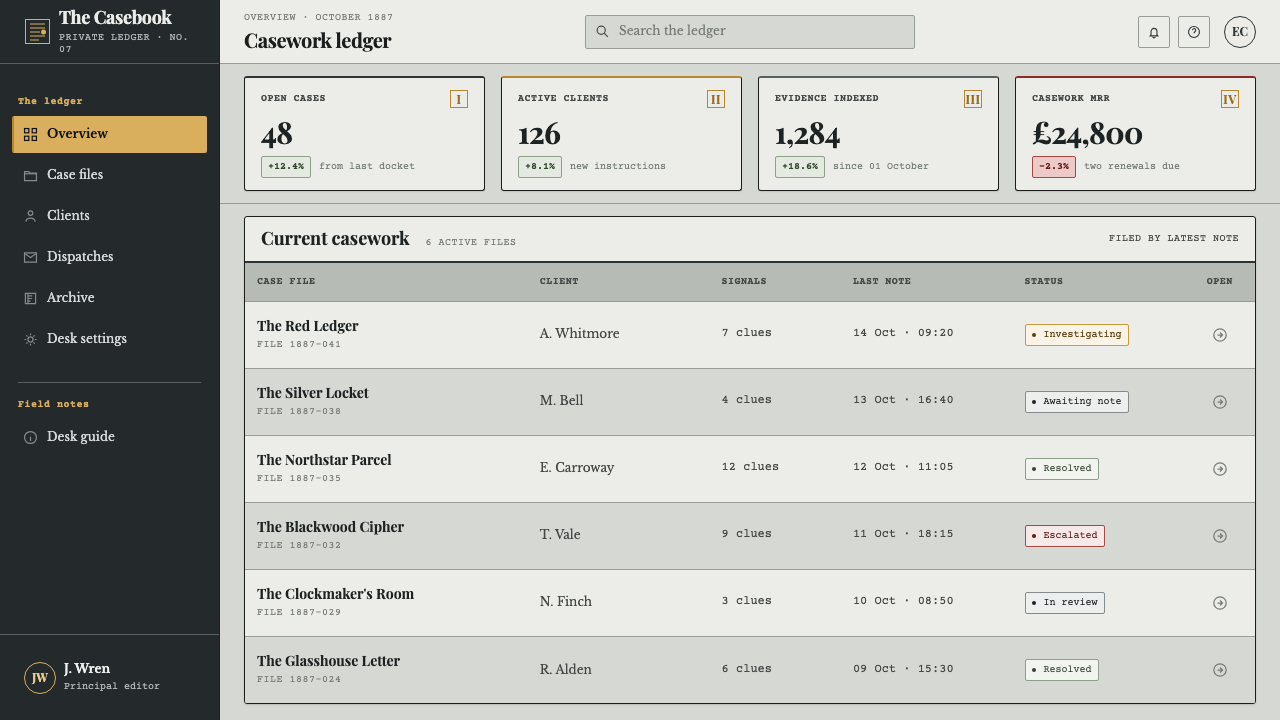
For web interfaces, the style fits reading-oriented dashboards, research tools, archives, and pricing pages that benefit from an investigative editorial mood. Navigation can resemble a quiet publication masthead, while panels read as bounded reports. Maintain strong text contrast, clear captions, and visible structural rules so that the historical atmosphere never interferes with scanning, interaction, or trust.
For editorial and marketing work, use the style to frame a product, essay, or campaign as a story worth examining. A hero image may function as an engraved plate; pull quotes can resemble case notes; brass emphasis can lead readers to a call to action. The common mistake is turning every surface into dark Victorian decoration. Too much fog, texture, scarlet, or ornamental imagery turns investigation into costume. Preserve the hierarchy of paper, ink, evidence, and one controlled light.
Sherlock Holmes — Baker Street (1887) — FAQ
Is this style simply Victorian design?
No. Its frame is much narrower: the Sherlock Holmes printed world associated with London from 1887 through the early Strand short-story period. Victorian references are useful only when they support that frame: fog-gray pulp, wood-engraved lines, serial columns, captions, gaslight brass, and the editorial pressure of a case narrative. General antique decoration is not enough.
Why is cross-hatching more appropriate than smooth shading?
The source material centers Sidney Paget’s dense cross-hatched ink. Cross-hatching makes shadow visibly constructed from printed marks, which connects the image to wood-engraving illustration and grayish pulp stock. Smooth shading can create a pleasant image, but it weakens the sense that darkness has been physically cut, inked, and reproduced on a serial page.
How should scarlet be used?
Use it as a rare narrative signal. In a field dominated by graphite and fog, scarlet has force precisely because it is withheld. It can identify a clue, a warning, a key status, or a moment requiring attention. If it becomes a broad decorative background or repeats everywhere, it loses the evidentiary sharpness that the palette gives it.
Can the style support a modern dashboard or pricing page?
Yes, provided the historical reference serves clarity. Use its editorial structure for grouping, its rules for navigation, its captions for explanation, and its restrained accents for hierarchy. Do not imitate age at the expense of readable data, clear actions, or usable controls. The successful modern version feels like an orderly investigation, not a decorative historical simulation.
Related design styles
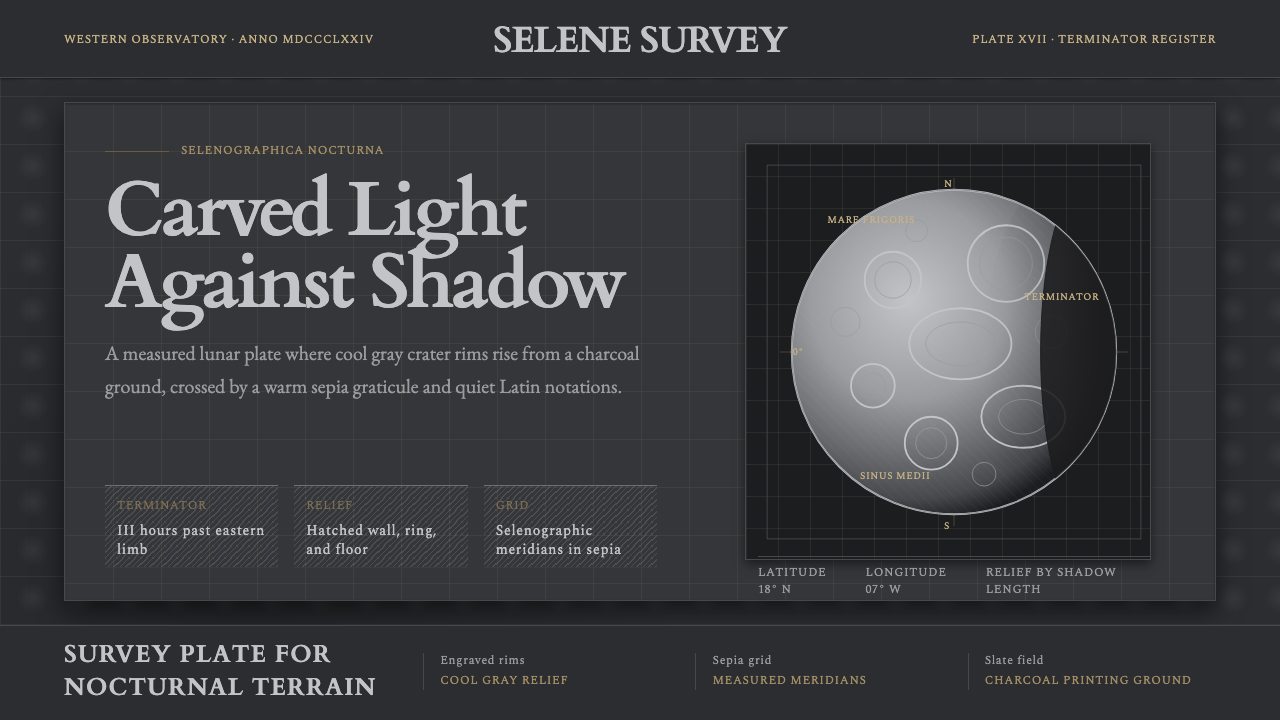 Lunar SelenographyMoonlight becomes measurement. Slate ground, sepia grid, and hatched gray cra…
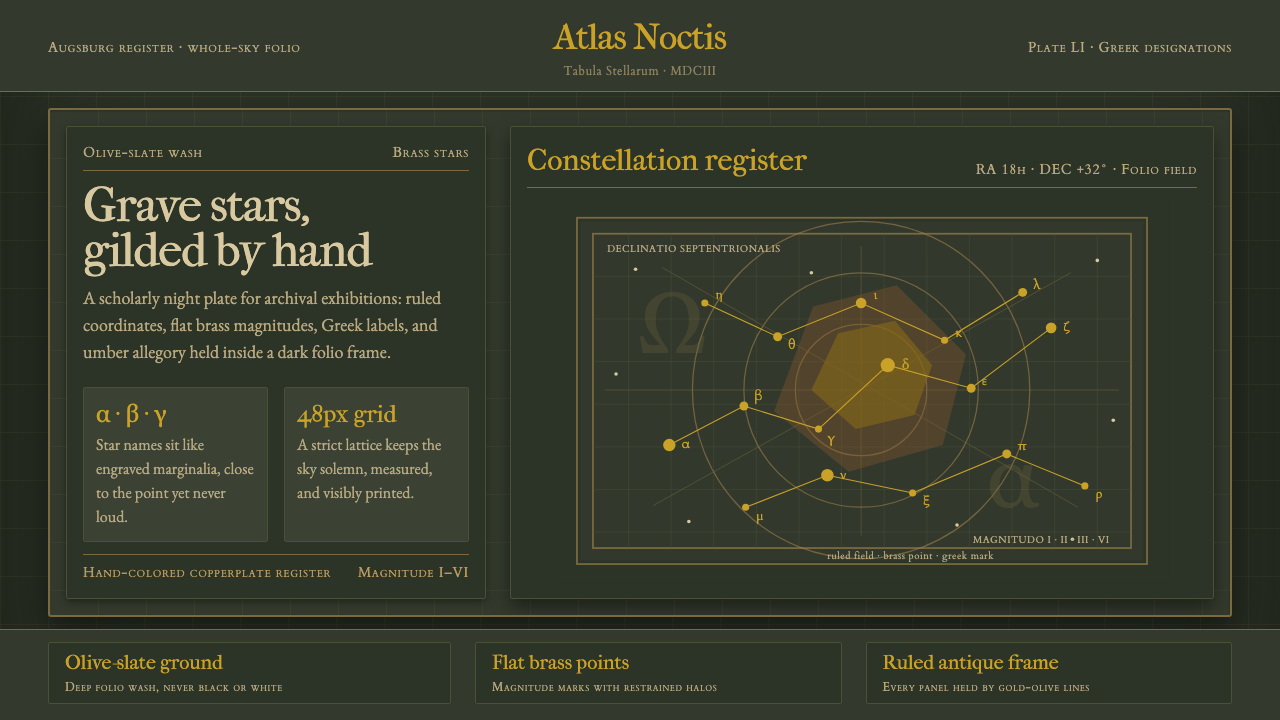 Bayer UranometriaGrave celestial folio. Olive-slate grid, brass stars, Greek labels, old-style…
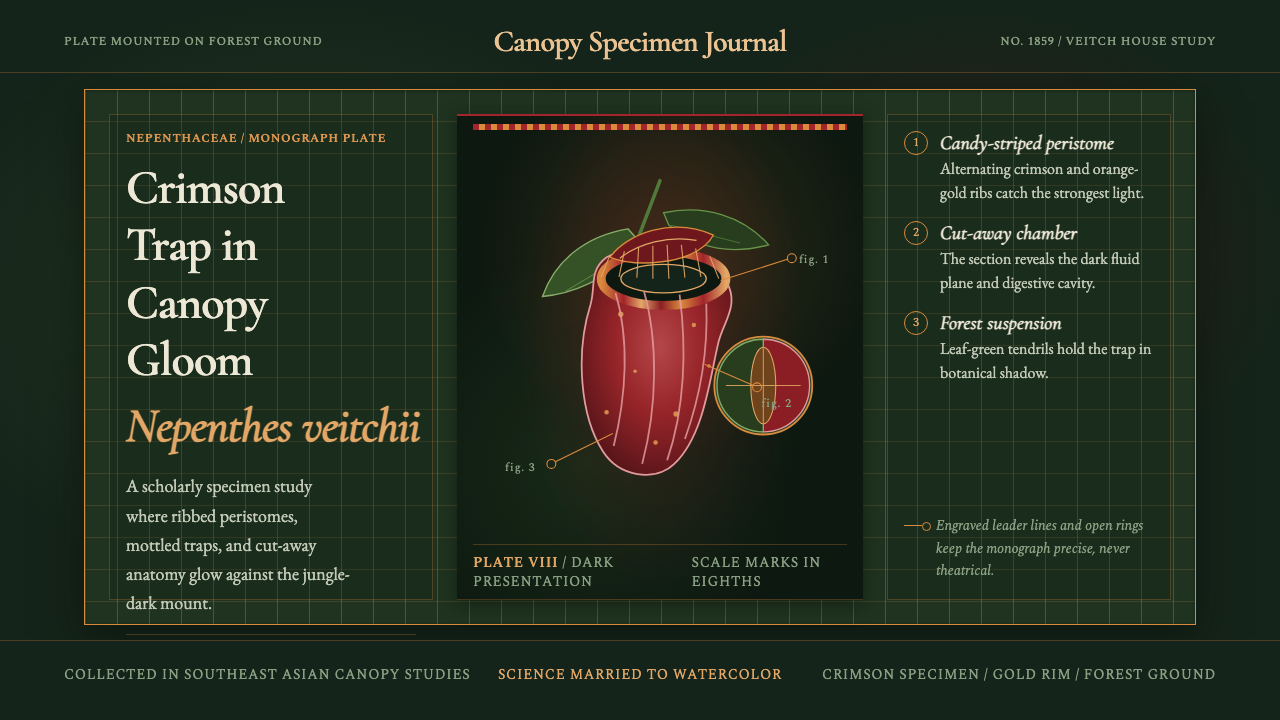 Carnivorous Pitcher PlantBotanical danger glows. Crimson traps and gold rims float on jungle-dark gree…
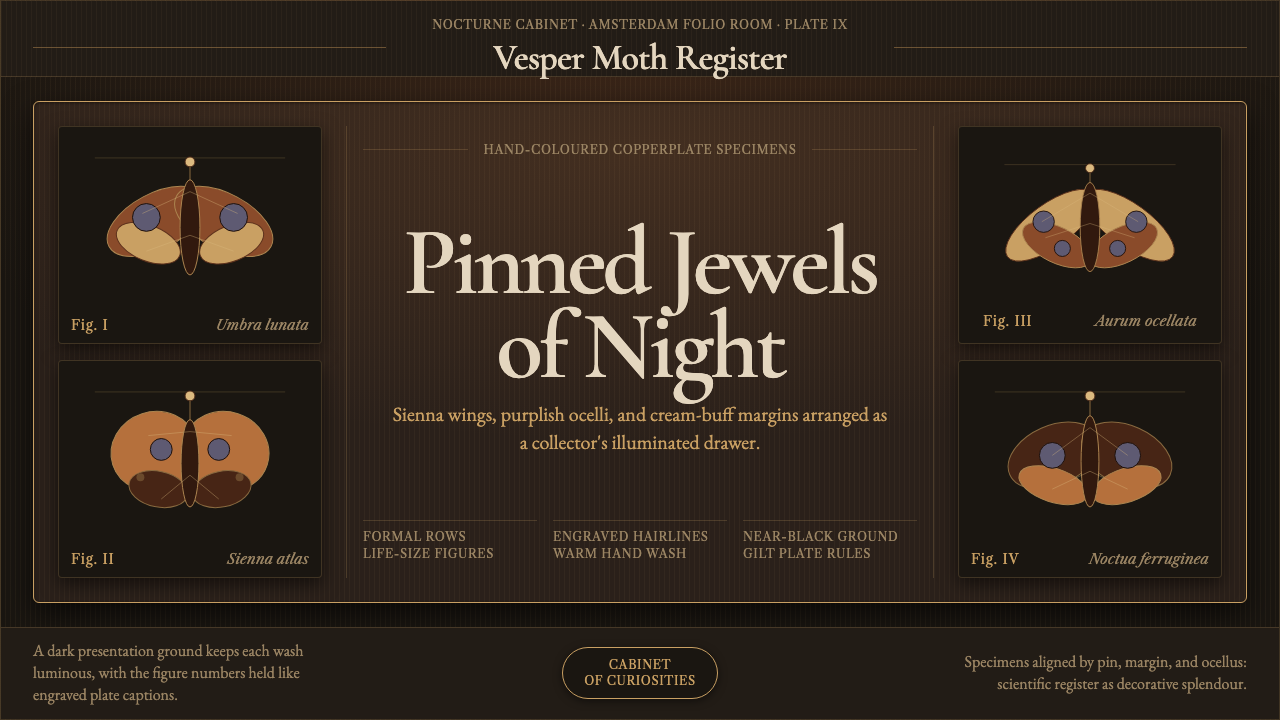 Cramer Exotic MothsJewel-like precision. Sienna specimens glow in formal rows on a near-black pl…
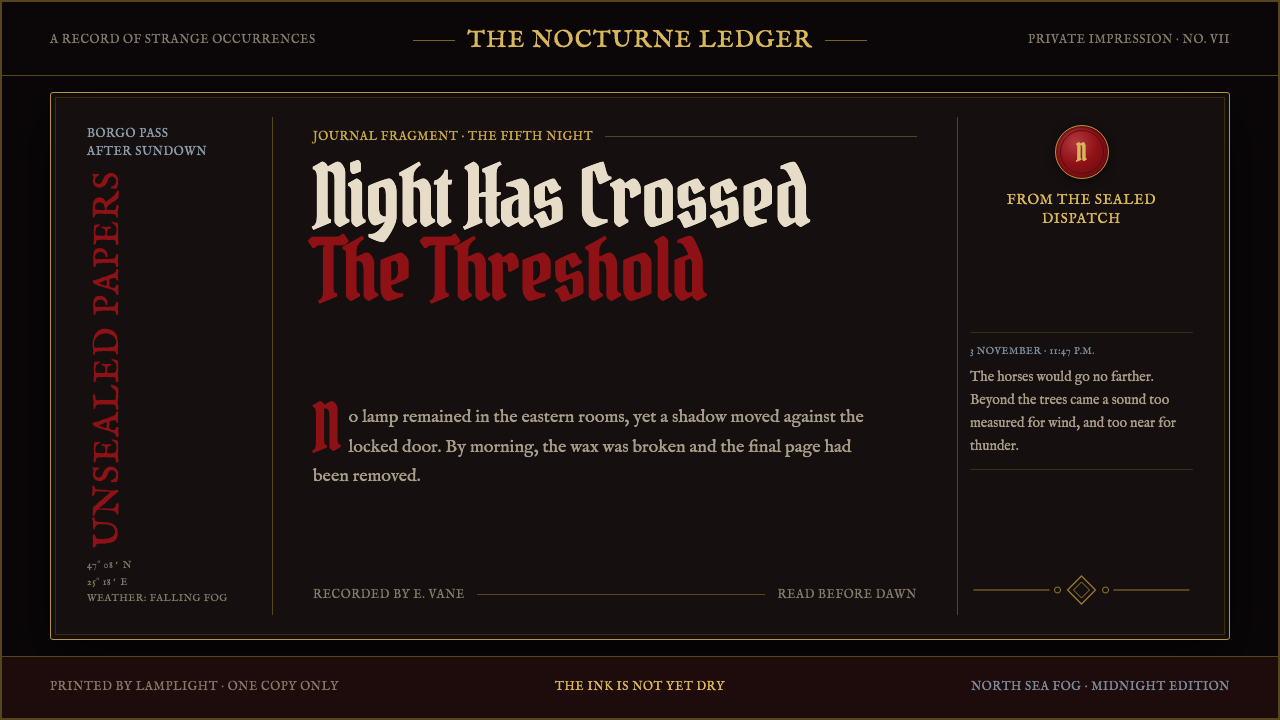 Dracula Gothic (1897)Victorian dread after dark. Blood-red initials and tarnished gilt haunt coffi…
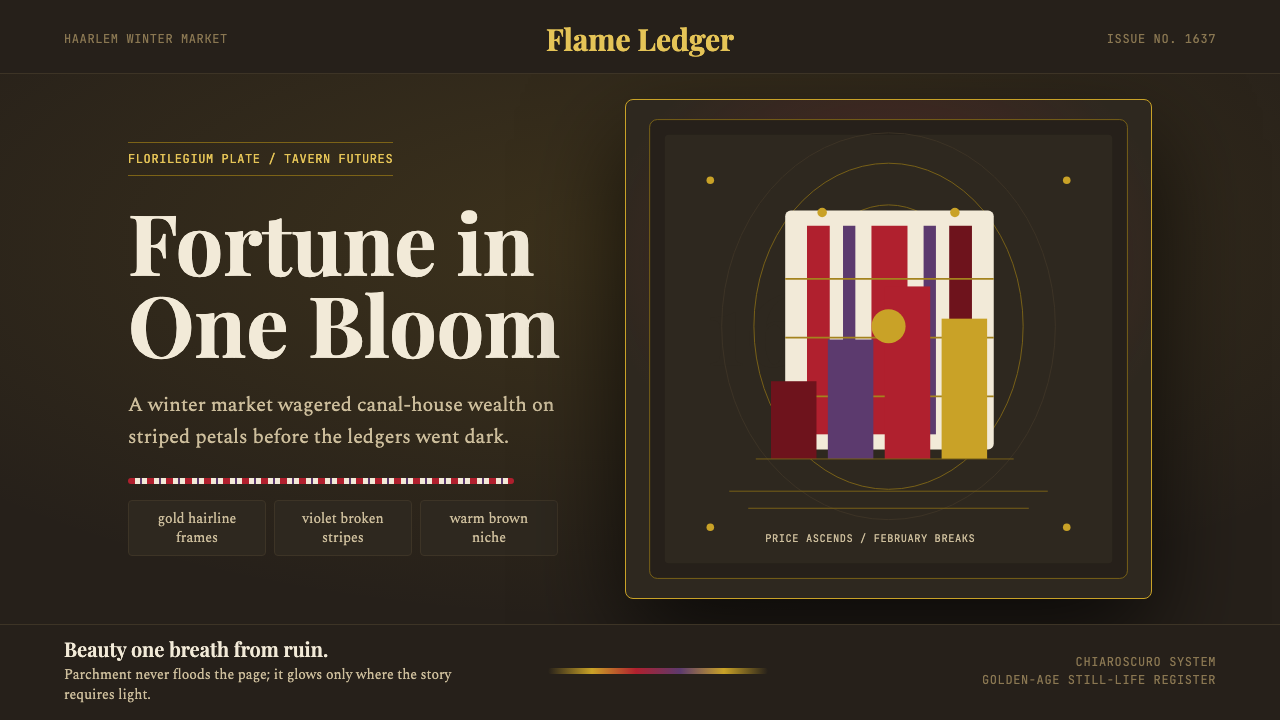 Dutch Tulip ManiaSpeculation burns in shadow. Flame red petals, violet stripes, gold frames on…