What is Carnivorous Pitcher Plant Plate?
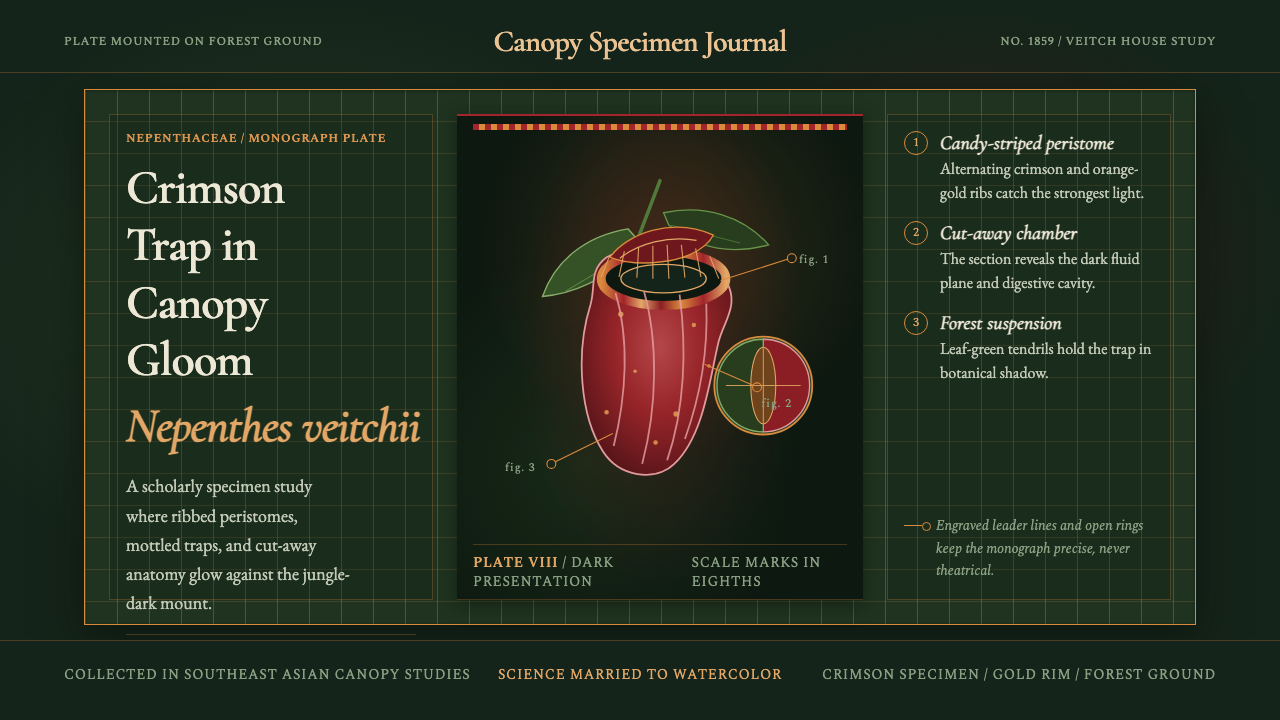
Carnivorous Pitcher Plant Plate takes the Victorian scientific illustration of a predatory tropical plant and lets its crimson trap and gold-flecked rim glow the way they would in the gloom of a real rainforest canopy, not on a clinical white page.
Carnivorous Pitcher Plant Plate in brief
Carnivorous Pitcher Plant Plate is built on the visual tradition of the Victorian botanical monograph — the kind of exquisitely detailed illustrated plate that scientific publishers produced to document newly discovered plants for a public fascinated by the exotic and the strange. Its specific subject is Nepenthes, the pitcher plant genus, rendered with the mottled crimson-and-green coloring of a real trap, a candy-striped rim, and a cutaway cross-section exposing the digestive fluid pooled inside — the plate's original purpose being to show, with total anatomical honesty, exactly how the plant catches and consumes insects.
What distinguishes this system from a straightforward reproduction of that Victorian plate is its ground. The original illustrations were printed on plain white or cream lithographic paper, in keeping with the scientific-publishing conventions of the day. This system instead stages the same specimen against a deep, jungle-dark green field — a documented alternative presentation of these plates — so the crimson pitcher and its gold-flecked rim read as luminous, almost predatory, objects glowing out of dense foliage rather than as a clinical diagram pinned to a blank page.
The overall effect sits at the intersection of two registers that rarely combine: the disciplined, almost forensic precision of scientific illustration, and the theatrical, faintly menacing beauty of something genuinely built to lure and consume. Nothing about the specimen is softened or prettified beyond what the plant itself already is — the drama comes from accurate observation staged in shadow, not from artistic embellishment.
Where does Carnivorous Pitcher Plant Plate come from?
Nepenthes pitcher plants are native to the tropical forests of Southeast Asia, and their arrival in the European imagination followed the pattern typical of Victorian natural history: a specimen collected in a distant colony, shipped home, described by a metropolitan scientist, and rendered by a professional illustrator for publication. Each stage of that chain has a named figure in the record of this particular plant, and each left its mark on the visual language this system draws from.
Thomas Lobb was a professional plant collector employed by the Veitch nursery, one of the great commercial plant-hunting operations of the era, and he traveled through Southeast Asia gathering specimens — including pitcher plants — that had never been seen alive in Britain. Collectors like Lobb were the essential first link: without a live or preserved specimen making the journey back, there was nothing for a scientist to describe or an illustrator to paint.
Joseph Dalton Hooker, one of the most eminent botanists of the Victorian era and a future director of the Royal Botanic Gardens, Kew, provided the scientific description that gave a newly arrived specimen its formal identity. Hooker described Nepenthes veitchii — a species named in honor of the Veitch nursery itself — in 1859, embedding the commercial plant-hunting operation directly into the plant's scientific name and illustrating how tightly science and commerce were intertwined in this period.
Walter Hood Fitch supplied the visual half of the equation as one of the era's most prolific and technically accomplished botanical illustrators, closely associated with the long-running publication Curtis's Botanical Magazine, the primary venue through which plates like this reached the public. Fitch's watercolors, translated into print through hand-colored lithography, combined the anatomical precision that scientific description demanded with a painter's sense of light and surface — the tradition this system's crimson-and-gold color handling is drawn from directly.
What defines the Carnivorous Pitcher Plant Plate look?
Color
The palette centers on a mottled crimson-red trap set against deep, jungle-dark green, with gold reserved strictly for the flecked rim of the pitcher's mouth — a small, precise highlight rather than a broad wash. Nothing in the palette is bright for brightness's sake; every hue is drawn directly from the specimen itself and from the shadowed forest ground it is staged against.
Botanical Watercolor Technique
Surfaces are rendered with the layered, semi-transparent glazing technique of traditional botanical watercolor, translated into print — thin washes built up in successive layers to suggest the waxy, faintly reflective surface of a real pitcher and the softer matte texture of surrounding leaves. Nothing is flat-filled; every surface carries subtle internal gradation earned through the painting technique itself.
Anatomical Cross-Section
A defining compositional device borrowed directly from scientific illustration: the specimen is not shown intact but partly cut away, revealing an interior — in the pitcher's case, the pooled fluid inside the trap. This device signals scientific authority and invites close inspection, functioning less like a decorative flourish and more like a diagram that happens to be beautiful.
Mottled and Striped Pattern
The trap's surface carries an irregular, dappled mottling of crimson and green, while the rim of the pitcher's mouth is marked with fine, evenly spaced stripes — a pattern language taken directly from the plant's actual markings rather than invented for visual interest. Pattern here is documentary, not decorative.
Scientific Precision
Every line respects real botanical structure: vein patterns, the specific curve of a pitcher's lid, the texture transition between trap and leaf are all rendered with taxonomic accuracy rather than artistic license. This precision is what separates the style from generic tropical or jungle illustration — it depicts a specific, identifiable organism, not an impression of exotic plant life in general.
Dark-Ground Drama
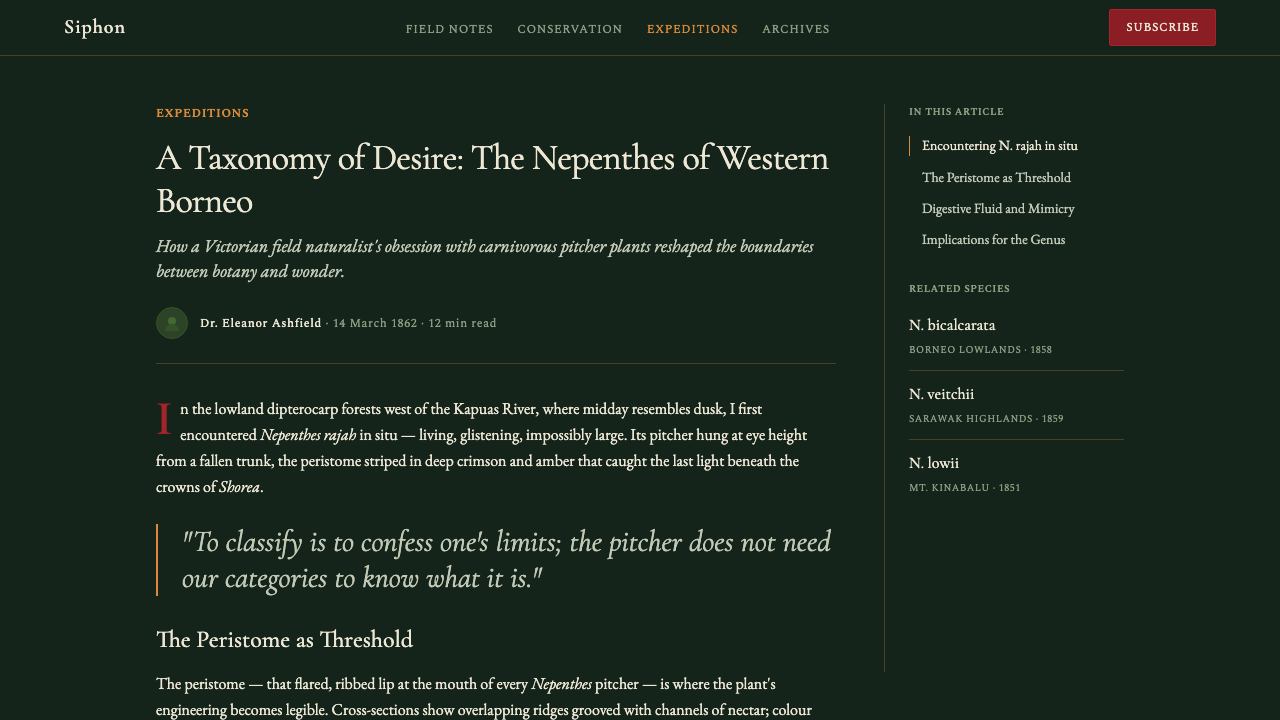
By staging the specimen against a near-black jungle-green ground rather than the original plate's plain white, the system builds its entire drama from contrast: the crimson trap and gold rim appear to glow, almost lit from within, the way something genuinely dangerous seems to catch light in deep shadow. This dark-ground treatment is a documented alternative to the traditional white-page presentation, not an invented distortion.

Who shaped Carnivorous Pitcher Plant Plate?
A professional plant collector employed by the Veitch nursery who traveled through Southeast Asia gathering specimens, including pitcher plants, that had never before been seen alive in Britain. As the collector who physically brought the plant back, he supplied the essential raw material without which no scientific description or illustration could exist.
One of the most eminent botanists of the Victorian era and a future director of the Royal Botanic Gardens, Kew, who provided the formal scientific description of Nepenthes veitchii in 1859, giving the newly arrived specimen its taxonomic identity and anchoring the plate's scientific authority.
One of the era's most prolific and technically accomplished botanical illustrators, closely associated with Curtis's Botanical Magazine. His watercolor plates, translated into print through hand-colored lithography, are the direct visual source for this system's layered, glazed color technique and its combination of anatomical precision with painterly light.
The commercial nursery dynasty that funded and organized plant-hunting expeditions such as Lobb's, turning newly discovered exotic species into a business as much as a scientific pursuit. The species name Nepenthes veitchii — honoring the nursery directly — captures how tightly commerce, science, and illustration were bound together in this era.
How do you use Carnivorous Pitcher Plant Plate today?
This style carries real specificity and real drama, so it works best applied to contexts that can support both a naturalist's attention to detail and a slightly theatrical, dangerous-beauty mood — it is not a generic 'botanical' or 'jungle' filler pattern.
For presentation slides, cover pages can stage a single specimen — rendered with full mottled, cross-sectioned detail — glowing against the dark jungle-green field, with a restrained gold accent used only for the title rule or a key figure. Content slides should keep the dark ground as a constant and let one illustrated or iconographic element per slide carry the visual weight, echoing the plate tradition of a single specimen per page rather than a crowded collage. Data slides can borrow the specimen-label convention directly — a number or statistic presented with the same precise, captioned authority as a plate's scientific annotation.
For web interfaces, the style is a stronger fit for content-rich, editorial-leaning products than for dense operational dashboards — think a nature or science publication, a curated plant or garden retailer, or a luxury goods site that wants a slightly gothic, collector's-cabinet mood. Pricing pages can borrow the specimen-plate structure by presenting each tier as its own 'plate,' with the gold accent reserved for the recommended or premium option, echoing the rarity implied by a single flecked gold rim.
For editorial and marketing work, the style suits natural history and science storytelling, high-end botanical or garden brands, and beauty or fragrance products that want to evoke something exotic and faintly dangerous rather than conventionally pretty. Feature sections can be built as a series of specimen 'plates,' each with its own cross-section detail and caption, maintaining the discipline of one focal specimen per composition.
A common mistake is treating the gold as a broad decorative metallic finish rather than the narrow, specimen-accurate highlight it should be — once gold spreads across borders, frames, and typography generally, it stops reading as the plant's own coloring and starts reading as generic luxury packaging. A second mistake is lightening the ground toward a conventional cream or white, which undoes the entire premise of the dark-ground reinterpretation and flattens the drama back into an ordinary botanical illustration.
Carnivorous Pitcher Plant Plate — FAQ
Is this the same as a generic botanical or jungle-print pattern?
No. A generic botanical or jungle pattern typically repeats stylized leaf or flower motifs purely for decorative texture, with no specific species and no scientific structure. This style depicts one identifiable organism, Nepenthes, with anatomical accuracy borrowed from an actual Victorian scientific plate, including a cutaway cross-section — it is documentary illustration first, pattern second.
Does it require real Nepenthes specimens, or can the plant be stylized?
The style's identity depends on the plant reading as a specific, real specimen — the mottled coloring, the striped rim, the cutaway showing digestive fluid are all drawn from actual botanical observation. Some simplification for different media is reasonable, but flattening the plant into a generic decorative silhouette removes exactly the scientific specificity that makes this style distinctive.
How is this different from a generic 'dark academia' or 'moody jungle' aesthetic?
Dark academia and moody jungle aesthetics are mood-first, typically assembled from a loose collection of atmospheric textures and props without a specific documented source. This style is source-first: it is a specific reinterpretation of an identifiable Victorian scientific plate, staged on a documented alternative dark ground, tied to named collectors, scientists, and illustrators rather than to a general vibe.
Does the gold accent need to be a metallic foil finish?
A physical metallic finish is one legitimate way to render it, but it is not required — what matters more is restraint and placement. The gold should read as the plant's own gold-flecked rim coloring, applied narrowly and precisely, rather than as a general luxury material applied broadly across borders, frames, or typography.
What products or brands does this style suit, and where does it fall flat?
It suits natural history and science media, high-end botanical and garden brands, collector-oriented products, and beauty or fragrance brands seeking an exotic, faintly dangerous mood. It falls flat for anything needing to feel cheerful, mass-market, or reassuringly ordinary — a children's product, a budget consumer app, or a brand built on approachability will find the style's precision and darkness work against the intended tone.
Related design styles
 Caspar David FriedrichSilence becomes vast. Prussian blue depth, pearl mist, and parchment framing…
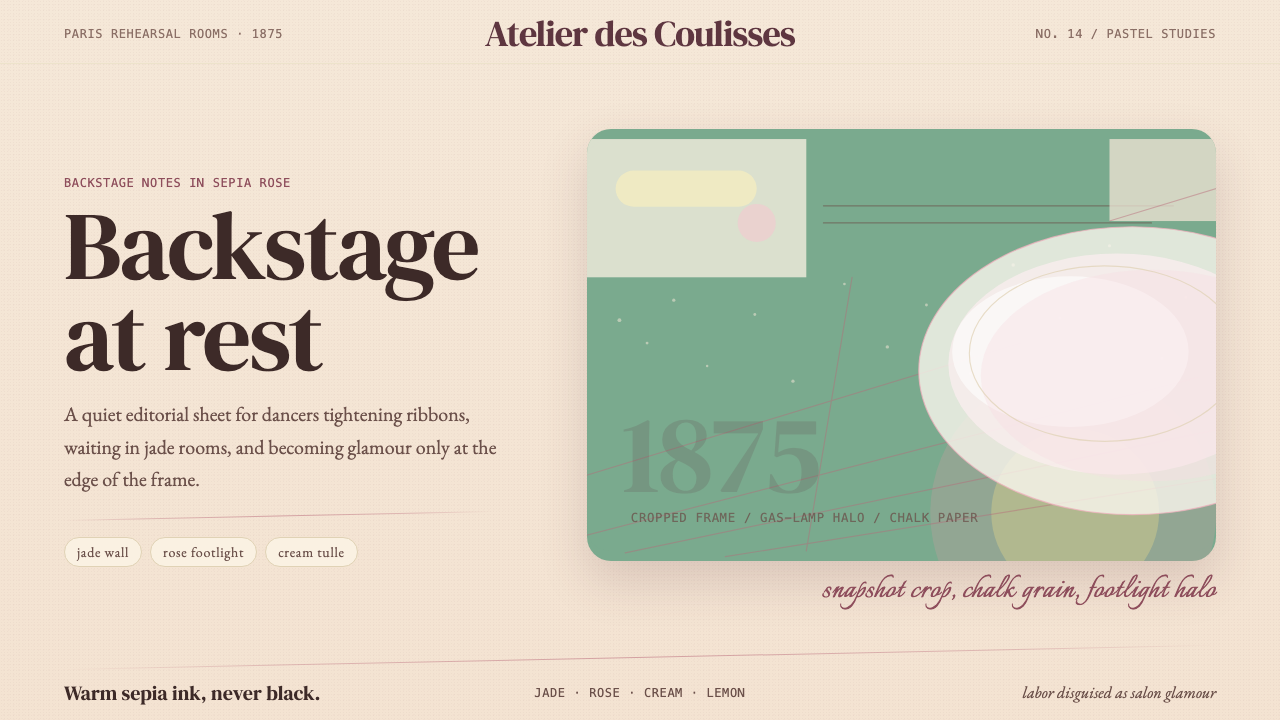 Degas Ballet PastelsBackstage glamour is labor. Jade walls, rose footlights, cropped serifs on cr…
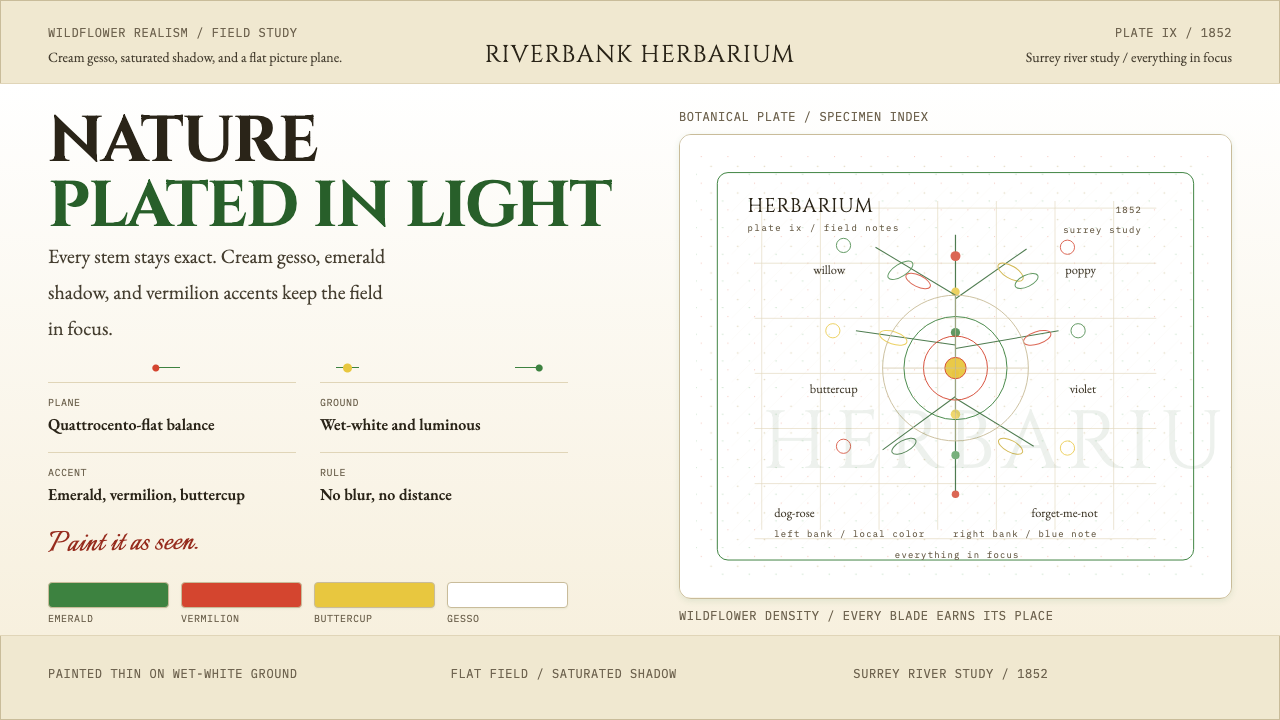 Millais — Ophelia / Wildflower Pre-RaphBotany, rendered with conviction. Cream gesso, emerald, and vermilion stay in…
 Tamil Grantha InscriptionSacred stone, quietly lit. Pale Grantha glyphs float on dark granite in a nar…
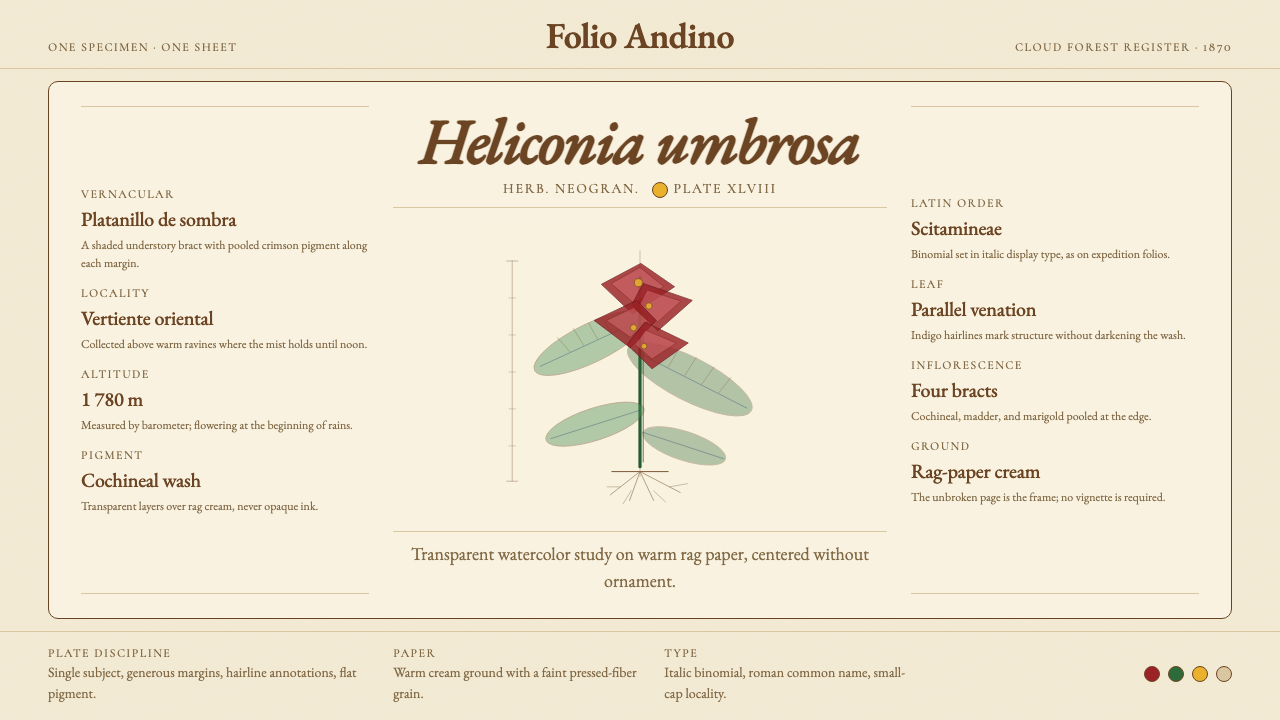 Colombian Botanical (Triana)Observation becomes ornament. Crimson watercolor specimen breathes on cream r…
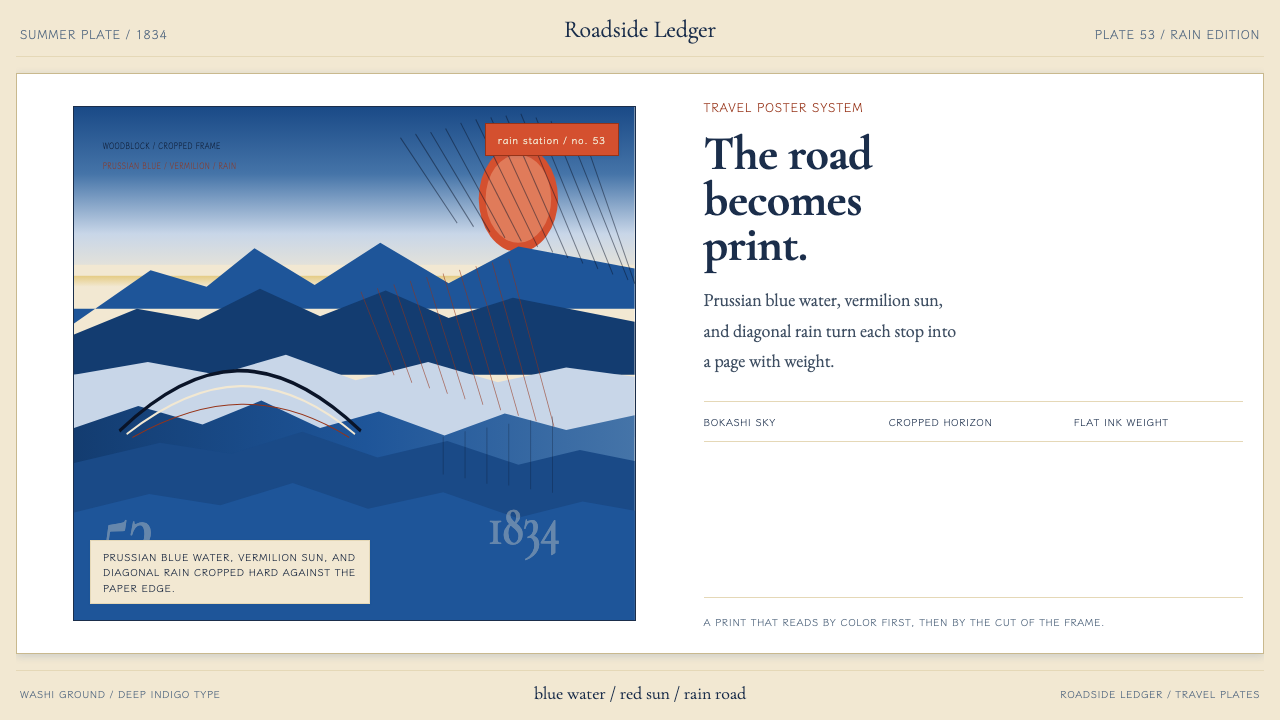 Hiroshige — Tokaido RoadA road print in motion. Prussian blue blocks, vermilion cartouches, diagonal…