What is Shake Shack (Green-Chartreuse)?
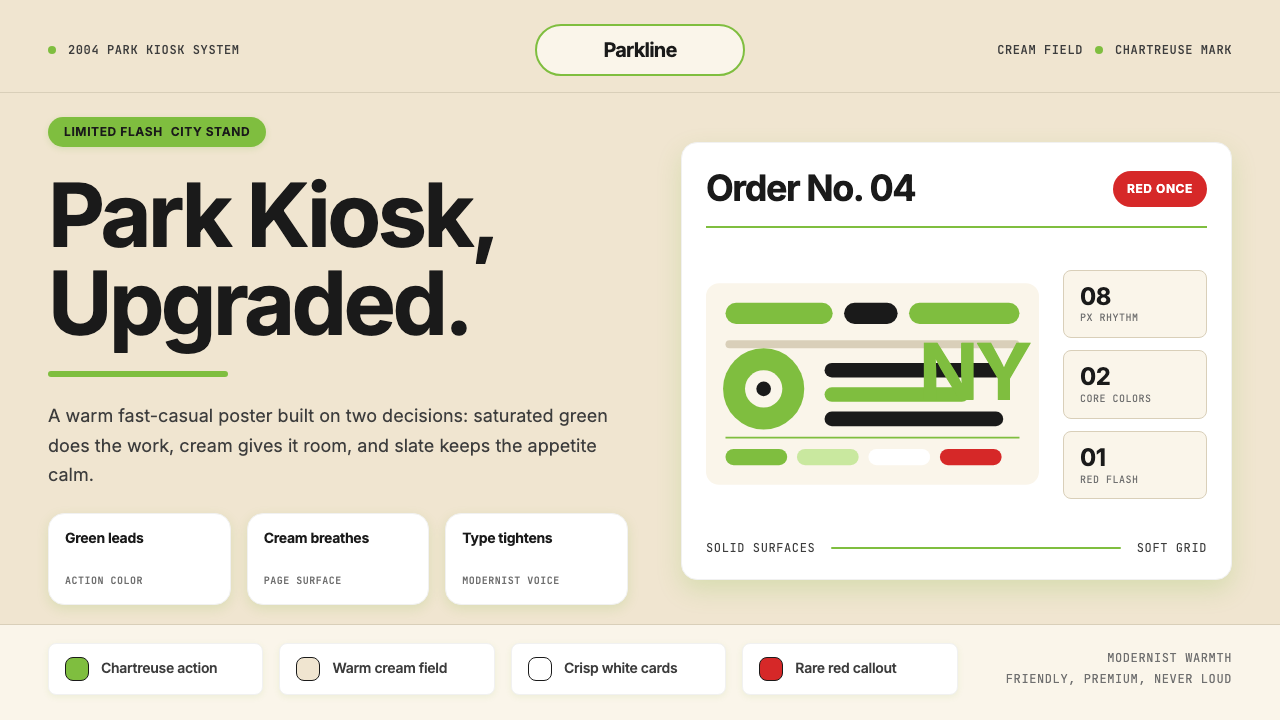
Shake Shack turned a hot-dog cart in Madison Square Park into one of the most recognizable fast-casual identities on earth — powered by a single, audacious bet on chartreuse green.
Shake Shack (Green-Chartreuse) in brief
Shake Shack (Green-Chartreuse) is the visual identity system created for Shake Shack, the American fast-casual burger brand that grew from a single hot-dog cart in New York City in 2004 into an international chain. The identity was designed by Paula Scher at Pentagram and centers on a chartreuse-green wordmark set against a warm cream ground — a pairing that reads simultaneously as premium, approachable, and unmistakably urban.
The color system is deliberately restrained. Saturated chartreuse-green carries all the brand's action energy: wordmarks, primary calls to action, packaging accents. Warm cream functions as the primary surface — neither stark white nor yellow, but a tone that softens the brightness of the green and gives the system a handcrafted, almost artisanal warmth. Deep slate handles all body type and structural elements, and a rare flash of saturated red appears as a tertiary punctuation mark. Four colors total, deployed with discipline.
The typographic sensibility is Pentagram-modernist: tight letter-spacing on display-weight settings, generous open space around text blocks, and a clear hierarchy enforced through scale rather than decorative devices. Product photography leans warm and tactile — steamed buns and melting cheese rather than stylized food CGI — grounding the modernist type system in human appetite.

Where does Shake Shack (Green-Chartreuse) come from?
The story begins in the summer of 2001, when restaurateur Danny Meyer — founder of Union Square Cafe and the Union Square Hospitality Group — agreed to operate a cart selling Chicago-style hot dogs in Madison Square Park as part of a public art initiative. The cart was a fundraiser, not a business. It was staffed seasonally and operated without a permanent home. But the lines it drew told Meyer something important about what New York was hungry for: unpretentious food made with the same care that fine-dining kitchens applied to their ingredients.
In 2004, a permanent kiosk opened in Madison Square Park under the name Shake Shack. The menu expanded — ShackBurgers, crinkle-cut fries, hand-spun shakes — and the lines grew longer. Paula Scher's team at Pentagram was brought in to create a visual identity that could carry the brand beyond its single location while staying true to its origins as a humble park stand. The solution was a mark in chartreuse green: a color associated with the park itself, with lush summer grass, and with a certain New York energy that sits between the organic and the electric.
The choice of chartreuse was not obvious. In the broader fast-food landscape of the early 2000s, brand colors skewed toward primary red, primary yellow, or corporate navy. Chartreuse — a yellow-leaning green named after the French liqueur — was unexpected, slightly eccentric, and entirely ownable. It photographed well against natural surfaces, it glowed against the warm cream that became the system's ground, and it carried none of the clinical associations of pure green. It was a color that felt alive without shouting.
Shake Shack went public in 2015, and the brand's current visual system, refined through approximately 2018 to 2024, has matured the original identity into a global standard while preserving its essential character. Across locations in New York, London, Tokyo, Dubai, and beyond, the chartreuse wordmark on cream remains the immediate signal — a system that scales from a paper bag to a skyscraper hoarding without losing its identity.
What defines the Shake Shack (Green-Chartreuse) look?
Chartreuse Green
The defining hue sits at the intersection of yellow and green — bright enough to read from a distance, complex enough to avoid looking cheap. It carries energy without aggression, and its slight warmth keeps it from the clinical feel of a cooler green. In use, it is reserved for marks, primary brand moments, and calls to action; it is never used as a background field for body text.
Warm Cream Ground
The background is neither white nor yellow but a warm, slightly off-toned cream that softens the chartreuse's brightness and gives the system a tactile, almost paper-like quality. It signals premium without sterility — more bistro menu than sterile hospital or tech company. This warmth is foundational: replace the cream with pure white and the whole system tips from approachable to clinical.
Deep Slate Typography
Body text and structural type are set in a deep, warm-leaning dark tone — close to black but not fully neutral — that pairs with the cream ground without the harsh contrast of pure black on white. Display type is set with notably tight letter-spacing, a Pentagram signature that reads as confident and contemporary. The typographic scale is generous: large display moments sit far from body text in size, creating clear hierarchy without decorative borders.
Restrained Accent Red
A saturated red functions as a tertiary element — appearing rarely and specifically, not as a secondary brand color but as a punctuation mark. It might signal a promotional moment, an allergen alert, or a specific menu category. Its scarcity is the source of its power: because it appears infrequently, it registers immediately when it does. Using it liberally would collapse the hierarchy entirely.
Modernist Spacing and Breathing Room
The system is generous with negative space in a way that separates it from ordinary fast-food identity. Menus, packaging, and signage all reserve substantial margins around text and brand marks. This space is not emptiness — it is what makes the chartreuse feel premium rather than garish. Crowded applications of the palette strip the system of its authority and reduce it to something that merely shares the green's wavelength.
Tactile, Warm Photography
Product photography in the Shake Shack system leans warm in color temperature and emphasizes texture: the gloss of a freshly sesame-seeded bun, the melt of cheese, the condensation on a shake cup. This warmth counterbalances the modernist rigidity of the type system and ensures the overall impression remains appetizing and human rather than architectural and cold. Photography is styled to read as honest rather than aspirational.
Urban Friendliness
The overall temperament of the system — premium materials, modernist structure, warm palette, human photography — is precisely calibrated to signal what Danny Meyer called 'enlightened hospitality' at fast-casual price points. It does not shout like traditional quick-service brands, but it does not whisper like luxury fine dining. It speaks at a conversational register: confident, clean, glad to see you.

Who shaped Shake Shack (Green-Chartreuse)?
Meyer founded Union Square Hospitality Group and pioneered the concept of 'enlightened hospitality' in the American restaurant industry — the idea that a restaurant's primary obligation is to make guests feel genuinely welcomed, not merely served. Shake Shack was his experiment in applying fine-dining values of ingredient sourcing, staff training, and environmental design to a street-food format. His insistence that the brand feel 'friendly, premium, and unmistakably New York' directly shaped the brief that Pentagram received.
Scher is a partner at Pentagram and one of the most influential graphic designers working in American identity and environmental design. Her portfolio includes the identity systems for Citibank, the Museum of Modern Art, and the Public Theater. For Shake Shack, she developed the chartreuse wordmark that became the brand's primary asset — a mark that had to function on a park kiosk in 2004 and on a global chain's packaging two decades later. Scher's approach treated the brand as a piece of New York typography: confident, compressed, occupying its space without apology.
Rosati joined Shake Shack in its early years and served as Culinary Director, shaping the menu that the visual identity was ultimately designed to serve. His commitment to quality sourcing — humanely raised beef, real custard shakes, locally baked buns where possible — provided the substance behind the brand's premium positioning. A visual identity claiming quality while serving mediocre food would not survive; Rosati's kitchen standards validated the promise the chartreuse green was making.
Pentagram is the international design consultancy — structured as a partnership of independent design principals — that has produced some of the most durable brand identity systems of the past half-century. Their involvement in Shake Shack brought a level of strategic and typographic rigor unusual for a food-service brand at the time. The firm's house sensibility — modernist structure, typographic clarity, restraint over decoration — found a natural match in Meyer's 'elevated without being elevated' brief, and the resulting system has proved resilient enough to scale globally without fundamental revision.
How do you use Shake Shack (Green-Chartreuse) today?
The Shake Shack green-chartreuse system works best when applied with the same discipline that produced it: color used sparingly and hierarchically, warm cream as the dominant surface, and generous space as a deliberate signal of quality. For presentation slide covers, the most effective approach is a near-full cream field with the chartreuse color reserved for the title or a single large graphic element — a shape, a brand mark, a bold numeral. Resist the temptation to flood the slide with green; the system's power comes from the green's scarcity against the cream.
Content slides in this system benefit from the same typographic logic the brand uses in its printed menus: tight letter-spacing on section headings, comfortable line-height in body paragraphs, and clear size differentiation between levels. Use the deep slate tone for all body copy and reserve chartreuse exclusively for active elements — a highlighted data point, a chapter label, a progress indicator. Data slides can use chartreuse as the primary data color for the most important series, with the slate and a muted warm tone handling secondary and tertiary data, so that the key insight always reads as the brand color.
For web UI, the system translates naturally into dashboards and pricing pages. The warm cream makes an excellent primary background at full-page scale — warmer than pure white, easier on the eye for extended reading sessions. Navigation and interactive elements in chartreuse read immediately as actionable. For pricing tiers, the recommended hierarchy is: a cream card with slate type for the standard tier, a chartreuse-border card with chartreuse headings for the featured tier, and the deep slate as a background for the premium tier with cream type and chartreuse accents. This preserves the three-tier hierarchy without introducing new colors.
In editorial and marketing contexts, the system supports both intimate and large-scale treatments. A feature article layout in this system places a wide margin to one side for pull quotes or captions rendered in chartreuse, while body text runs in slate on a cream ground. Section breaks are best marked by a bold chartreuse rule rather than a decorative ornament. For out-of-home advertising or hero banners, the most impactful treatment is a large area of cream with a single line of tightly letter-spaced chartreuse type and one close-up food or product photograph — the same combination that made Madison Square Park's kiosk signage stop pedestrians in their tracks.
The most common mistake when applying this palette is overusing the chartreuse — treating it as a background fill rather than an accent. A chartreuse background with cream or white type is visually striking for a moment but exhausting at scale; it inverts the system's fundamental logic and makes every element fight for attention equally. A second common error is substituting a cooler, purer green or a more yellow-leaning lime for the chartreuse itself. The specific warmth and yellow-bias of the original hue are what give the system its personality; a cooler green reads as environmental or pharmaceutical, a more yellow-leaning green reads as sour or acidic. Matching the exact character of the color — not just its general family — is essential.

Shake Shack (Green-Chartreuse) — FAQ
What makes chartreuse work where other greens might not?
Most greens read as either natural and environmental, or clinical and functional, depending on their temperature and saturation. Chartreuse sits at an unusual intersection: warm enough to feel alive and slightly luxurious, yellow enough to carry energy and brightness, but green enough to maintain freshness and distinction from standard food-brand yellows and golds. Against warm cream, it reads as premium without coldness. Against photography of real food, it amplifies rather than competes. It is one of the few greens with enough personality to anchor an entire identity system on its own.
Can this system work for non-food brands?
Yes, with careful positioning. The Shake Shack system's underlying values — premium quality signaled through restraint, urban sophistication without exclusivity, warmth through material and color temperature rather than decorative friendliness — are transferable across categories. It works well for consumer lifestyle brands, urban hospitality services, and any brand that wants to signal 'carefully made' rather than 'expensively made'. It is less suited to technology products, financial services, or contexts where neutrality and authority are paramount, where the warmth of the cream ground and the eccentricity of the chartreuse can read as casual or imprecise.
How does the system handle dark-mode or dark-background applications?
The system was conceived as a light-ground identity, and dark inversions require significant care. The most workable approach swaps the cream for a very dark warm tone — charcoal rather than pure black — and retains the chartreuse at approximately its original saturation for marks and calls to action. The slate type moves to cream or near-white. The critical danger is that chartreuse at high saturation against true black can feel neon or aggressive, losing the approachable premium quality the system depends on. A warm dark ground tames the green and preserves the system's overall temperament. A fully inverted, pure-black background should be used only for short-duration moments — a hero image, a promotional overlay — not as a sustained interface background.
Is this style appropriate for premium fine-dining branding?
Not directly. The Shake Shack system is calibrated for a specific positioning: elevated but democratic, premium but priced for accessibility. Fine dining typically demands a different set of visual values — more austere or more ornate depending on the concept, rarely this warm and approachable. The chartreuse reads as energetic and youthful in ways that can feel at odds with the gravitas most fine-dining brands cultivate. That said, the underlying discipline — restrained palette, generous space, typographic hierarchy — is sound and could be adapted with a different anchor color (perhaps a more muted or complex hue) for a finer-dining context while retaining the structural logic.
How many colors should actually be in use at once in a typical layout?
Two or three at most. The full four-color system — chartreuse, cream, slate, red — is the complete palette, but no single layout should deploy all four simultaneously unless each is performing a clearly differentiated function. A standard content layout uses cream as ground, slate for text, and chartreuse for one or two highlighted elements. The red accent appears only when genuinely needed for a distinct communicative purpose — an alert, a promotional label — and is absent from the vast majority of layouts. Treating all four colors as freely available at once produces visual noise that undermines the system's precision.
Related design styles
 Dropbox ModernFriendly SaaS gets loud. Electric blue and Sharp Sans drive a structured geom…
 Humanist NGO ReportNumbers made approachable. Deep field-green covers, warm orange chart accents…
 Ubuntu Linux BrandLinux that feels human. Aubergine ground, one focal orange circle-of-friends,…
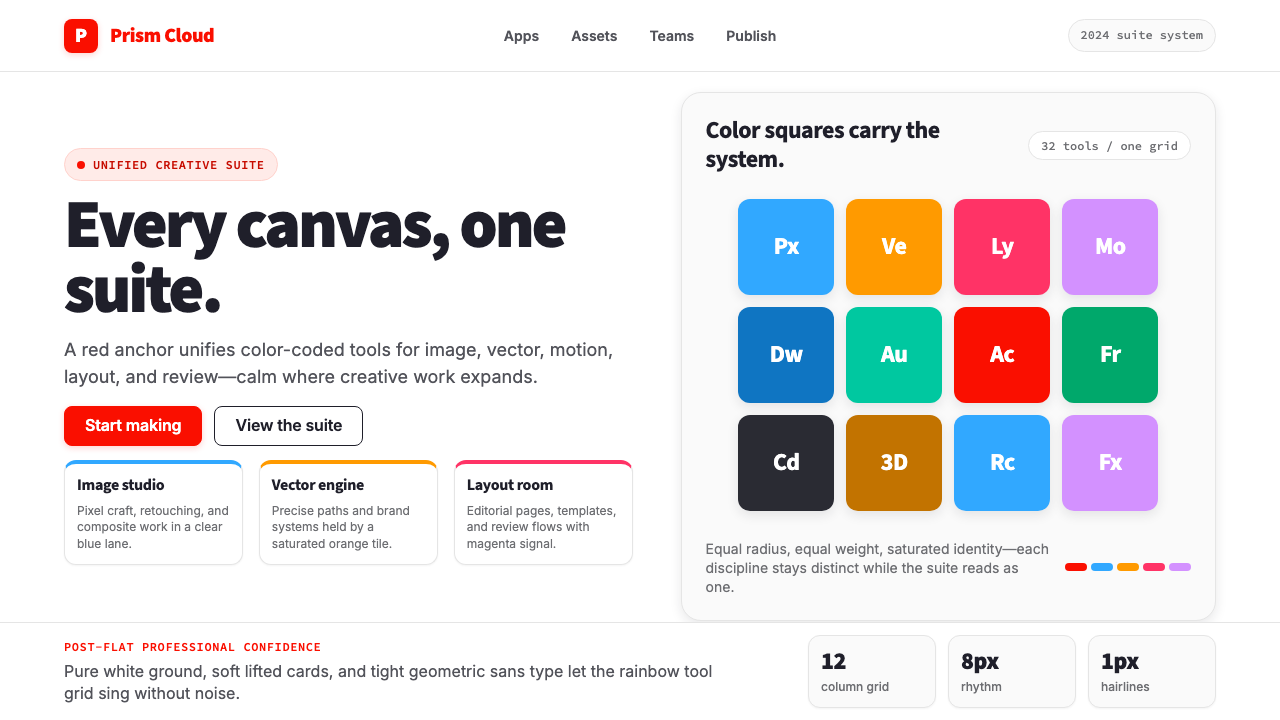 Adobe Creative CloudUnified, not uniform. Red anchor, white space, and saturated app tiles organi…
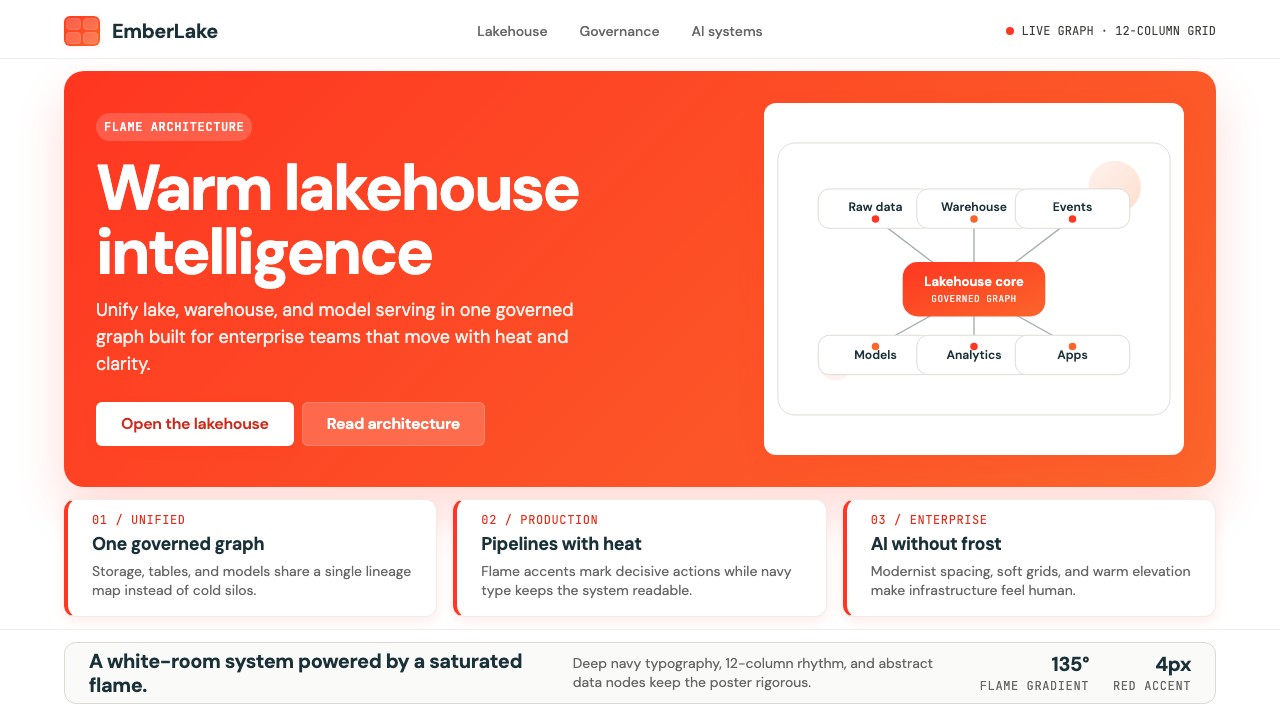 Databricks LakehouseWarm enterprise confidence. Flame red-orange gradients meet DM Sans and clean…
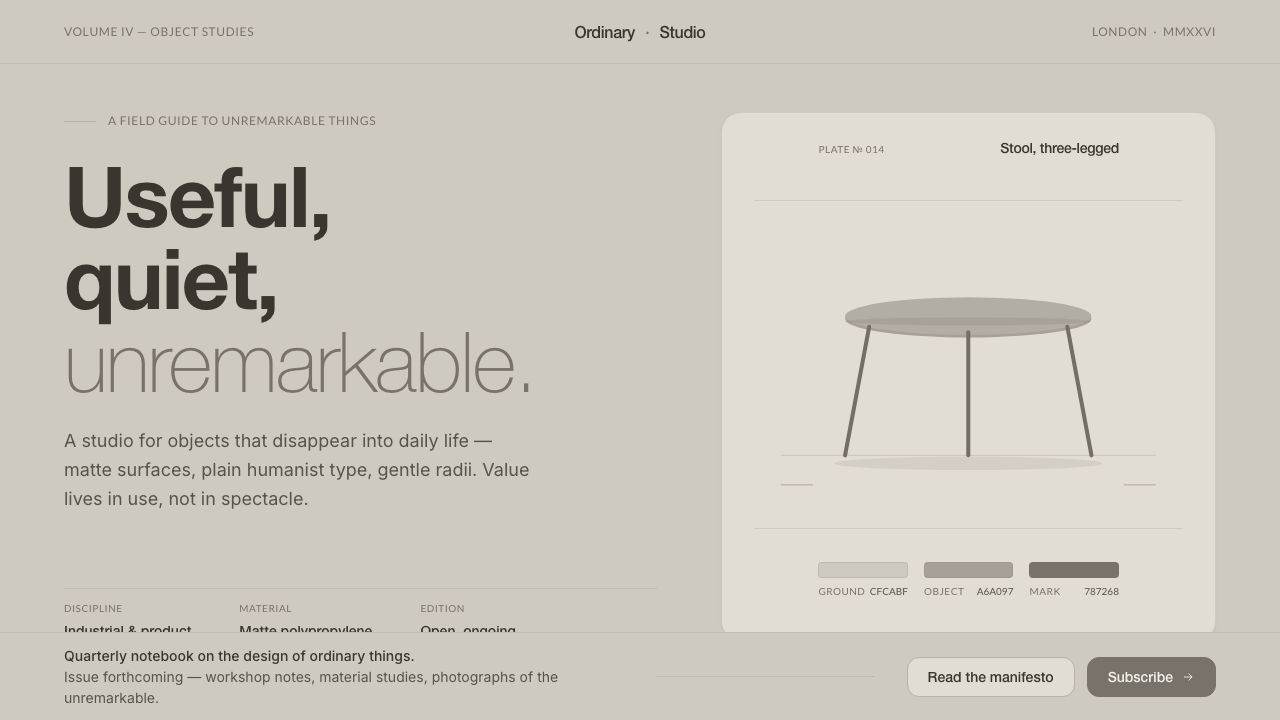 Jasper Morrison Super NormalRefuses spectacle. Matte greige ground, plain Helvetica, gentle 20px radii —…