What is Dropbox Modern?
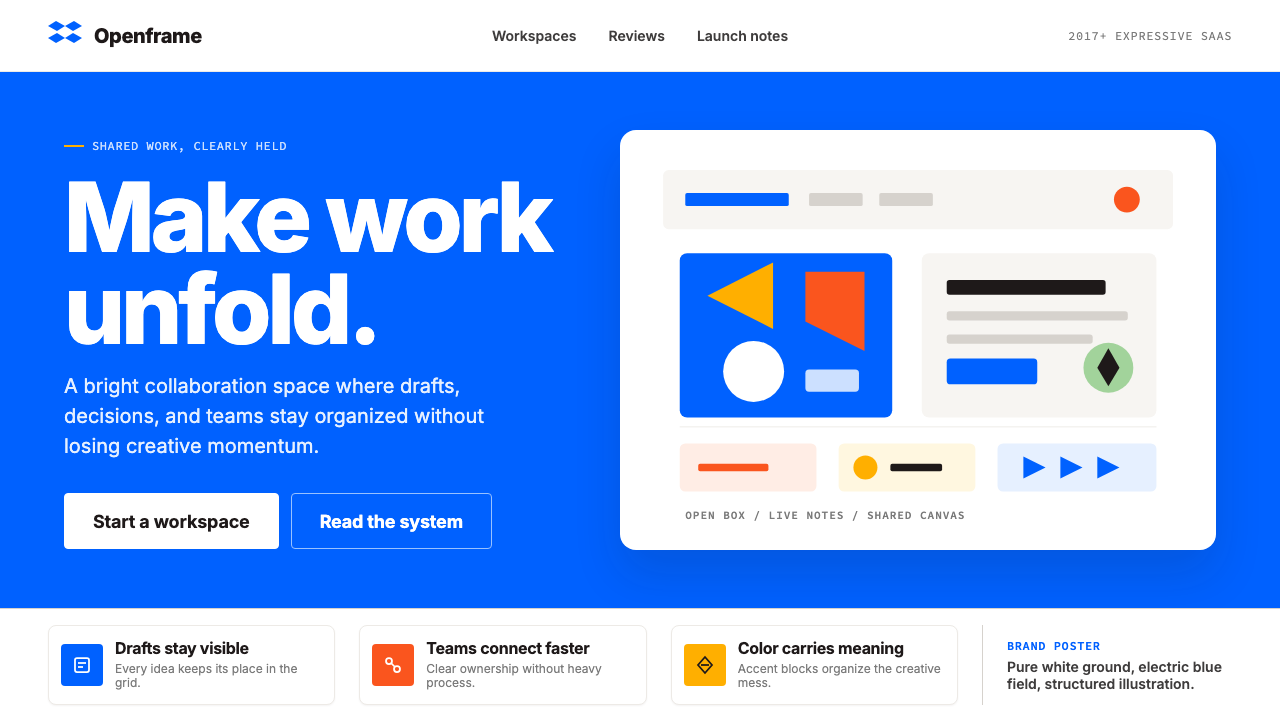
When Dropbox swapped muted cloud-storage beige for electric blue and bold geometric illustration in 2017, it rewrote what a friendly SaaS brand could look and sound like.
Dropbox Modern in brief
Dropbox Modern is the post-2017 visual identity of Dropbox, the cloud-storage and collaboration platform founded in San Francisco in 2007. It was born from a comprehensive brand refresh led by the New York design agency Collins — a deliberate and radical departure from the reserved, utility-first aesthetic that had characterized early cloud-storage software. In its place, the system introduced saturated electric blue, typographically commanding headlines set in a custom geometric sans-serif, and a rich library of abstract geometric illustration that replaced stock photography entirely.
The style pairs a confident corporate-technology backbone with genuine editorial warmth. Pure white grounds dominate, and generous white-space gives each element room to breathe. A structured multi-color secondary palette — warm orange, coral, deep teal, bright yellow, and lime green — provides flexibility without descending into chaos. The open-box logomark, a simple line drawing of a blue box with its lid lifted, acts as connective tissue across every surface: app icons, marketing pages, conference booths, and slide decks. The overall character is direct, luminous, professional but not stiff — a modernist sensibility wearing a friendly face.
Crucially, Dropbox Modern is not a minimalist style in the austere sense. It is a maximalist-in-control style: the palette is broad but governed by a clear hierarchy, the illustrations are complex but follow an internally consistent geometric grammar, and the typographic scale is bold but disciplined. Understanding this distinction — structured expressiveness rather than either bare minimalism or undisciplined complexity — is the key to applying it correctly.

Where does Dropbox Modern come from?
Dropbox was founded in 2007 by Drew Houston and Arash Ferdowsi as a solution to a problem Houston had experienced personally: forgetting his USB drive and being unable to access his files. The company's early visual identity reflected its startup pragmatism — a simple blue box logo, clean sans-serif type, and an interface aesthetic that prioritized clarity and function over expression. For most of its first decade, Dropbox looked like competent, well-funded utility software: trustworthy and unremarkable.
By 2017, Dropbox was preparing for a public offering and facing a crowded, maturing market. Google Drive, Microsoft OneDrive, and Apple iCloud had commoditized cloud storage as a feature; Dropbox needed to reposition itself as a platform for creative professionals and teams, not merely a folder in the cloud. The company engaged Collins — the agency co-founded by Brian Collins, known for bold, culture-shifting brand work — to conduct a full identity redesign. The brief was not refinement but transformation.
The Collins refresh, unveiled in October 2017, was immediately polarizing. The new identity introduced a much broader and more saturated color palette, replacing the former restrained blue-and-white with a full spectrum anchored by a newly intensified Dropbox blue. The custom typeface, Sharp Sans Display, designed by Lucas Sharp, provided the typographic engine: a geometric sans-serif with rounded details that felt simultaneously rigorous and approachable. Perhaps most controversially, the system abandoned photography entirely in favor of a large library of abstract geometric illustrations created by a roster of artists and illustrators — a decision that made Dropbox visually unlike any other cloud product on the market.
The transition was not without friction. Some longtime users found the new look jarring or overly loud. Design commentators debated whether the system was coherent or merely energetic. But in the years that followed, the Dropbox Modern identity proved highly effective as a platform for brand extensions, partnerships, and product lines: it could accommodate Dropbox Paper, HelloSign, DocSend, and Dropbox Spaces while maintaining a recognizable visual family. By the early 2020s, its influence on the broader SaaS design landscape was clear — the generation of product brands that followed borrowed its confidence with color, its commitment to illustration over photography, and its conviction that utility software could have genuine aesthetic character.
What defines the Dropbox Modern look?
Color Hierarchy
The system is anchored by a single dominant hue — an intense, fully saturated blue that reads as electric rather than corporate — deployed against pure white grounds. This primary blue commands all interactive elements, primary calls to action, and the logomark itself. A structured secondary palette of warm orange, coral, deep teal, bright yellow, and lime green provides variation for illustrations, section accents, and product differentiators, but each secondary color is used in isolation rather than in competition. The effect is a system that feels vibrant and multi-colored at the campaign level while remaining legible and organized at the component level.
Custom Geometric Typography
Headlines are set in a custom geometric sans-serif — designed specifically for the brand — that balances mathematical precision with rounded, approachable terminals. The letterforms are not purely mechanical; they retain subtle optical corrections that make them readable at large display sizes without feeling cold. Typographic scale is used aggressively: headlines dominate compositions at a size that commands attention, while body text retreats to a much quieter register. The result is a typographic voice that is simultaneously loud and legible — confident in a way that generic system fonts cannot replicate.
Abstract Geometric Illustration
The most distinctive and debated feature of the system is its complete replacement of photography with abstract geometric illustration. These illustrations are not diagrams or infographics; they are full-composition artworks in which overlapping circles, rectangles, triangles, and organic curves create dense, layered visual environments. The illustrations use the system's full color range and often juxtapose flat shapes with subtle textures or gradient-like color transitions that stay within the palette's logic. The style is identifiably coherent across different artists because it is governed by a shared grammar of forms rather than a single illustrator's hand.
Open-Box Logomark as System Thread
The open-box logomark — a simple line drawing of a box with its lid lifted and separated, rendered in the primary blue — functions as much more than a brand identifier. It appears at multiple scales, in multiple colors, and in multiple contexts: as the app icon, as a structural element in marketing compositions, as a repeated motif in illustration backgrounds. Its geometric simplicity allows it to coexist with complex illustrations without competing, and its single-color rendering makes it reproducible across any surface. The open form of the box — lid lifted, implying access and sharing — carries conceptual weight that reinforces the product's core purpose.
White Space as Structural Element
Despite the system's apparent boldness and color richness, it depends fundamentally on generous, even aggressive use of white space. Compositions are not crowded; each element — a headline, an illustration, a call-to-action — has a clear territory that is not compromised by proximity to neighbors. This white-space discipline is what prevents the broad palette and complex illustrations from tipping into visual noise. The white ground is not passive; it is an active structural element that gives color and form their impact. Marketing pages built in this style breathe in a way that makes the colored elements feel chosen rather than accumulated.
Flat Geometry over Photography
The commitment to illustration over photography is not merely stylistic preference; it is a structural decision about control and consistency. Photography introduces variables — lighting conditions, color temperatures, compositional conventions — that are difficult to reconcile across a diverse product suite. Geometric illustration, governed by a shared palette and formal grammar, can be produced by different hands and still read as family. It also scales: a geometric illustration looks as resolved at social-media card size as it does on a conference hall banner, without requiring reshooting or recomposition. The flatness of the illustration style — no simulated depth, no photographic realism — also reinforces the visual flatness of the UI environments the brand inhabits.
Structured Expressiveness
The Dropbox Modern system sits in a deliberately constructed middle ground between the minimal restraint of enterprise software and the expressive freedom of creative-tool branding. It is neither Swiss-grid austerity nor unstructured maximalism. The expressiveness — bold color, complex illustration, large type — is always contained by structural rules: one color dominates per composition, illustration does not crowd type, and white space is non-negotiable. This structured expressiveness is what makes the style feel simultaneously professional and energetic, suited to boardrooms and creative agencies alike. It is a difficult balance to maintain, and imitations that tip either toward over-restraint or over-exuberance quickly cease to read as Dropbox Modern.

Who shaped Dropbox Modern?
Drew Houston co-founded Dropbox in 2007 and served as its CEO through the 2017 brand transformation and the company's 2018 IPO. His vision for Dropbox as a collaboration platform rather than a storage utility was the business rationale behind the aggressive identity redesign. Houston championed the Collins refresh internally at a time when some executives were skeptical of the departure from a trusted, if understated, visual identity — the willingness to risk the brand's familiar face in service of a new strategic positioning was, in retrospect, essential to the redesign's long-term impact.
Brian Collins is the co-founder and chief creative officer of Collins, the New York brand design agency responsible for the 2017 Dropbox identity. Collins built a practice around the idea that brand identity should function as cultural signaling, not just organizational labeling — a belief that shaped the Dropbox refresh's ambition to reposition the company in the creative-professional market. The agency's approach of engaging multiple illustrators within a single defined visual system, rather than commissioning a monolithic style from a single hand, was a significant methodological contribution that other brand programs have since adopted.
Lucas Sharp is the type designer who created Sharp Sans, the geometric sans-serif typeface family that became the typographic cornerstone of Dropbox Modern. Sharp Sans Display — the variant used for marketing headlines — balances the rational construction of a geometric sans with optical refinements that make it legible at the large scales demanded by bold campaign work. Sharp's work represents a strand of contemporary type design that seeks to reconcile modularity with warmth, producing typefaces suited to tech brands that want to signal precision without feeling mechanical.
Arash Ferdowsi co-founded Dropbox alongside Drew Houston and served as the company's CTO through its formative years. His technical architecture decisions — particularly the choice to build Dropbox as a cross-platform client that worked seamlessly across operating systems — defined the product's core value proposition and, indirectly, the identity brief: a tool for professionals who move between Windows, macOS, iOS, and Android needed a visual identity that felt equally at home on all of them. The brand's platform-agnostic, platform-confident visual language reflects this underlying technical philosophy.
A notable feature of the Dropbox Modern system is that its illustration library was not created by a single artist but by a curated roster of illustrators working within a defined visual framework. This collaborative production model — unusual at the time for a corporate rebrand — allowed the system to generate a large volume of illustrations quickly while maintaining coherence through shared color rules and formal principles rather than stylistic uniformity. The illustrators' individual voices are detectable within the work, but the grammar that binds them creates the impression of a single, expansive visual world. This approach to commissioning has influenced how subsequent SaaS brands structure their illustration programs.
How do you use Dropbox Modern today?
Dropbox Modern is among the most applicable SaaS design styles for contemporary presentation and web work because it is a system built for digital-first surfaces at multiple scales. Applying it correctly requires understanding its structural logic — color hierarchy, illustration grammar, typographic scale, and white-space discipline — rather than simply sampling its most recognizable features. A layout that uses the electric blue, a large geometric headline, and a colorful illustration but ignores white-space discipline will read as a noisy imitation rather than a coherent application.
For presentation slides, the style excels on both cover and content pages. A cover slide works best with a bold, asymmetric composition: a large abstract geometric illustration occupies one half of the canvas while the title sits in oversized type against a white or electric-blue ground. The illustration and the type should not compete — give each its own zone, separated by generous white space. Content slides should be treated as structured layouts: a clear typographic hierarchy using scale alone to differentiate heading from body, with any data or supporting graphics rendered in the secondary palette. Data slides translate naturally into the geometric vocabulary: bar charts and area charts become colored blocks that feel continuous with the illustration language, and the absence of decorative chart borders reinforces the system's clean confidence.
For web interfaces — particularly dashboards, pricing pages, and feature marketing pages — the style provides a strong foundation for hierarchy and scannability. Use a structured column grid, keep the default background pure white, and reserve the primary blue for interactive states, primary buttons, and key navigation elements. Secondary colors should mark distinct product tiers or feature categories, not appear randomly. Navigation should be typographically led, with the logomark and wordmark doing the primary identification work. Illustration should appear in designated marketing zones — hero sections, empty states, feature callouts — rather than scattered across functional UI areas where it would interfere with task-focused interactions.
For editorial and marketing work — campaign landing pages, event graphics, social cards, print collateral — the style's poster-like boldness is its greatest asset. A marketing page built in this idiom uses full-width feature blocks that alternate between white-ground-with-illustration and electric-blue-ground-with-white-type, creating rhythm and preventing monotony. The open-box logomark can be used as a structural element — appearing large in background zones or as a repeated motif — without undermining its identity function, because its geometric simplicity prevents it from reading as decorative clutter. Social cards should commit to a single dominant color per card with one concise typographic statement; the temptation to include multiple secondary colors in a single small-format composition should be resisted.
The most common mistake when applying Dropbox Modern is overloading the secondary palette. The system's power comes from restraint within apparent richness: each campaign or product context should lead with one or two colors from the full palette, not attempt to deploy all of them simultaneously. Similarly, illustrations should be given space rather than compressed into tight containers alongside text — an illustration that is too small to read its geometric logic loses its communicative function and becomes decorative noise. A second common mistake is using photography alongside the illustration system; the two visual registers are fundamentally incompatible in this style, and mixing them collapses the visual coherence that makes Dropbox Modern immediately recognizable.

Dropbox Modern — FAQ
Is Dropbox Modern suitable for dark-mode or dark-background layouts?
The canonical Dropbox Modern system is light-ground: white backgrounds with electric-blue accents and multi-color illustrations are its native habitat. A dark inversion is possible but requires careful renegotiation of the color relationships. On a dark ground, the secondary palette colors — particularly the bright yellow and lime green — can become visually dominant in ways that destabilize the system's intended hierarchy. A workable dark variant typically selects one secondary color as the foreground accent, keeps the primary blue for interactive elements only, and adjusts the illustration palette to ensure sufficient contrast without the color relationships inverting in meaning. The open-box logomark renders well in white on dark grounds and maintains its identity integrity.
How does Dropbox Modern differ from other SaaS brand styles that also use bold color and illustration?
Several SaaS brands adopted bold color and illustration in the years following Dropbox's 2017 refresh, but the Dropbox system has a few distinguishing structural features. First, its primary color is a single, fully saturated blue that is used at full intensity without tinting or modifying — many imitators soften or pastelize their primaries. Second, its illustration style is abstract and geometric rather than character-based or scenario-based; it depicts form and color relationships rather than people using software. Third, the system maintains a strict white-ground default that grounds the expressiveness — brands that attempt Dropbox Modern's palette energy without its white-space discipline tend to feel overwhelming rather than confident. Finally, the open-box logomark provides a geometric anchor that most competing systems lack.
Can Dropbox Modern be applied to consumer products, or is it inherently a B2B style?
The style sits at an interesting intersection: it is more expressive and warm than typical enterprise B2B branding, but more structured and confident than most consumer-facing playful styles. It was designed for a product used by both individual consumers and professional teams, which gives it genuine flexibility. For consumer applications, the warmth of the secondary palette — particularly the coral, orange, and warm yellow — can be emphasized, while the electric blue takes a supporting rather than dominant role. For B2B or professional-tool contexts, the blue-and-white combination with restrained use of secondaries produces a more authoritative register. The style struggles in contexts that require sensory richness or organic warmth — food, wellness, fashion — where its geometric flatness reads as cold rather than confident.
How should illustrations be commissioned or adapted for a Dropbox Modern-inspired project without licensed access to the original library?
The Collins-era illustration library is proprietary to Dropbox, but the underlying visual grammar is documentable and replicable. When commissioning new illustrations in this style, the brief should specify: abstract geometric forms (circles, rectangles, triangles, arcs, and organic curves) rather than figurative or character-based imagery; a defined palette of three to five colors drawn from the system's range, with one color dominant per composition; flat shapes as the primary building block, with textures or color transitions used sparingly as secondary elements; and compositions that have a clear figure-ground relationship — a dominant central form or color zone, with supporting elements arranged around it. The illustrator's individual style will inevitably show through, which is acceptable as long as the formal grammar is respected — the Collins approach demonstrated that a consistent grammar can unify diverse hands into a recognizable family.
What are the most important things to get right when using Dropbox Modern for a slide deck?
Three things determine whether a slide deck reads as Dropbox Modern or merely as a colorful deck with some blue in it. First, white-space discipline: every slide should have at least as much white as content — the temptation to fill space with additional illustration, text, or color should be actively resisted. Second, typographic scale: the headline should be substantially larger than the body text, not just slightly larger, and the typeface used should be a geometric sans-serif with confident letterforms — the slide's typographic voice should be assertive. Third, illustration as a distinct zone: illustration should occupy a defined area of each slide rather than being layered behind text or cropped awkwardly into content areas. When these three principles are respected, even a simplified version of the palette and a modest illustration library will produce slides that feel coherent and confident rather than approximate.
Related design styles
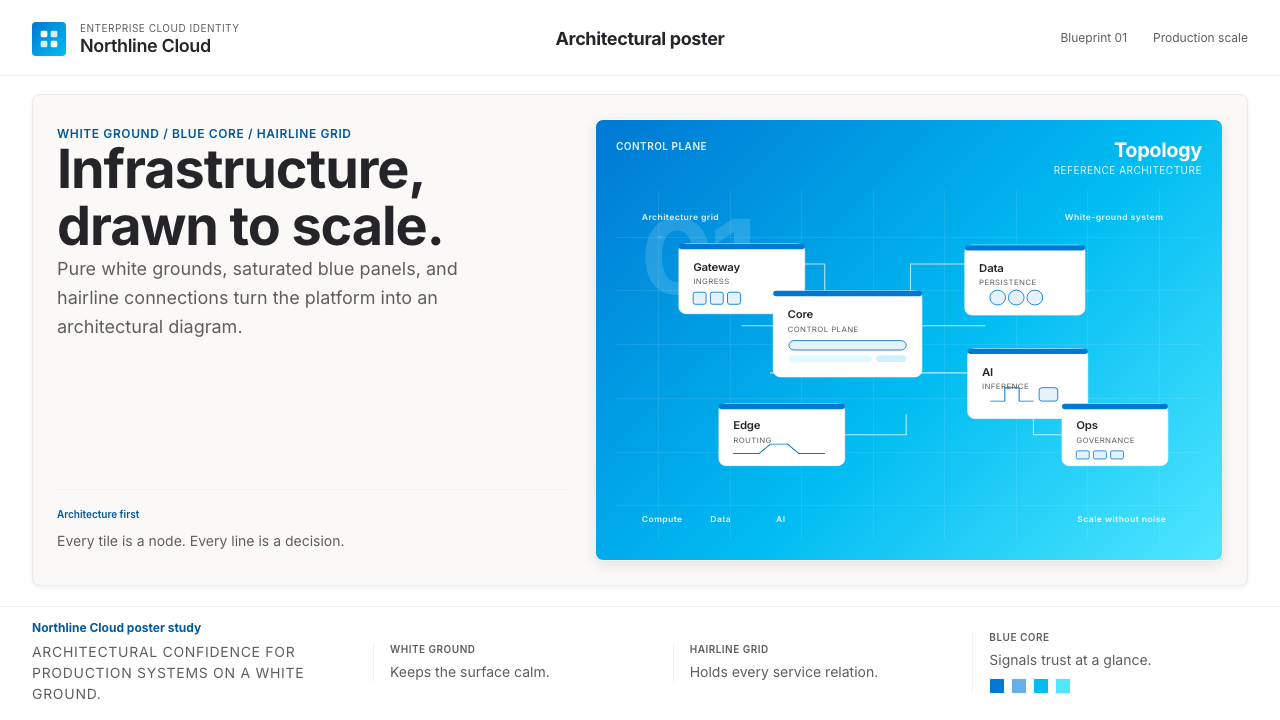 Microsoft AzureEnterprise calm, sharply diagrammed. White ground, saturated blue, hairline l…
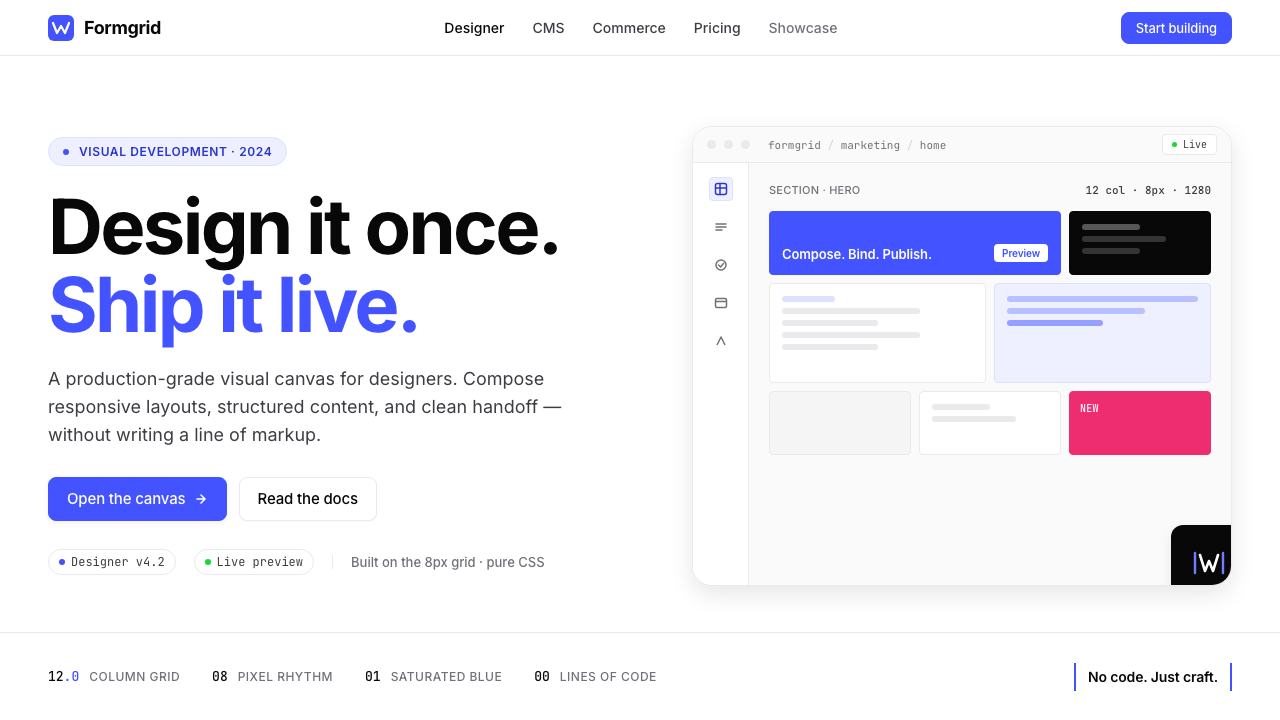 Webflow No-CodeA designer's tool, dressed like one. Saturated electric cobalt on pure white,…
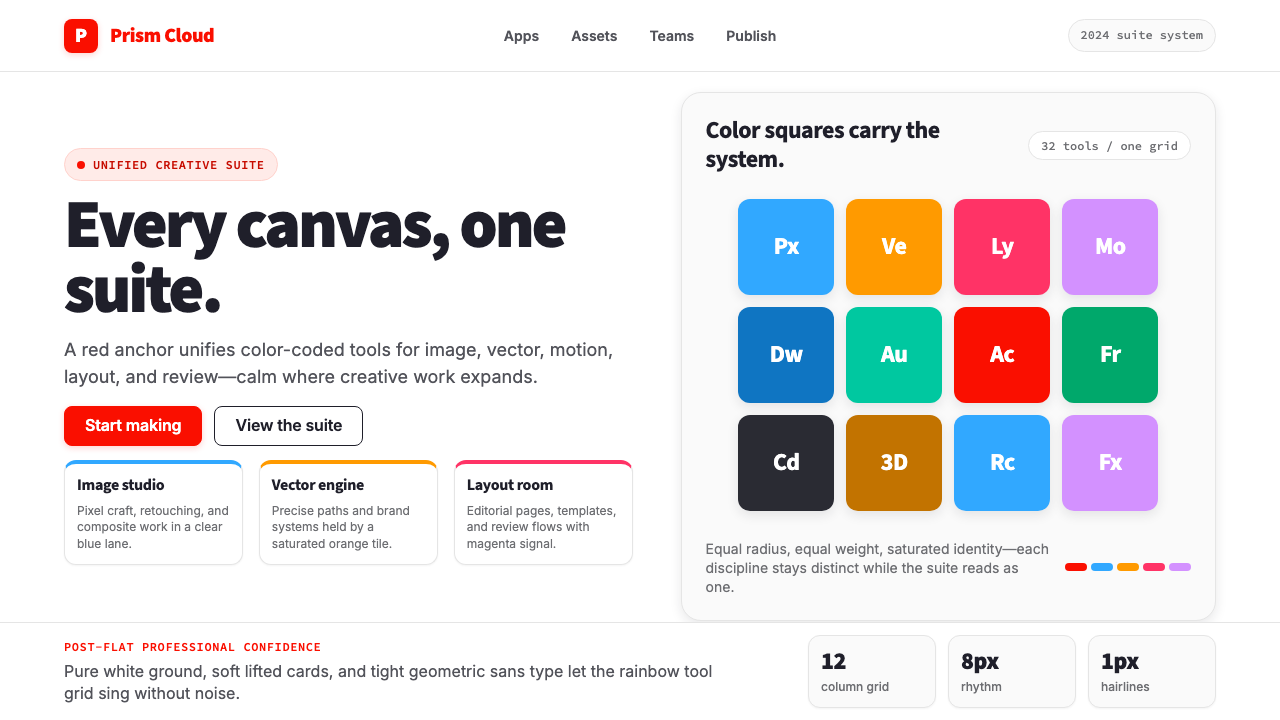 Adobe Creative CloudUnified, not uniform. Red anchor, white space, and saturated app tiles organi…
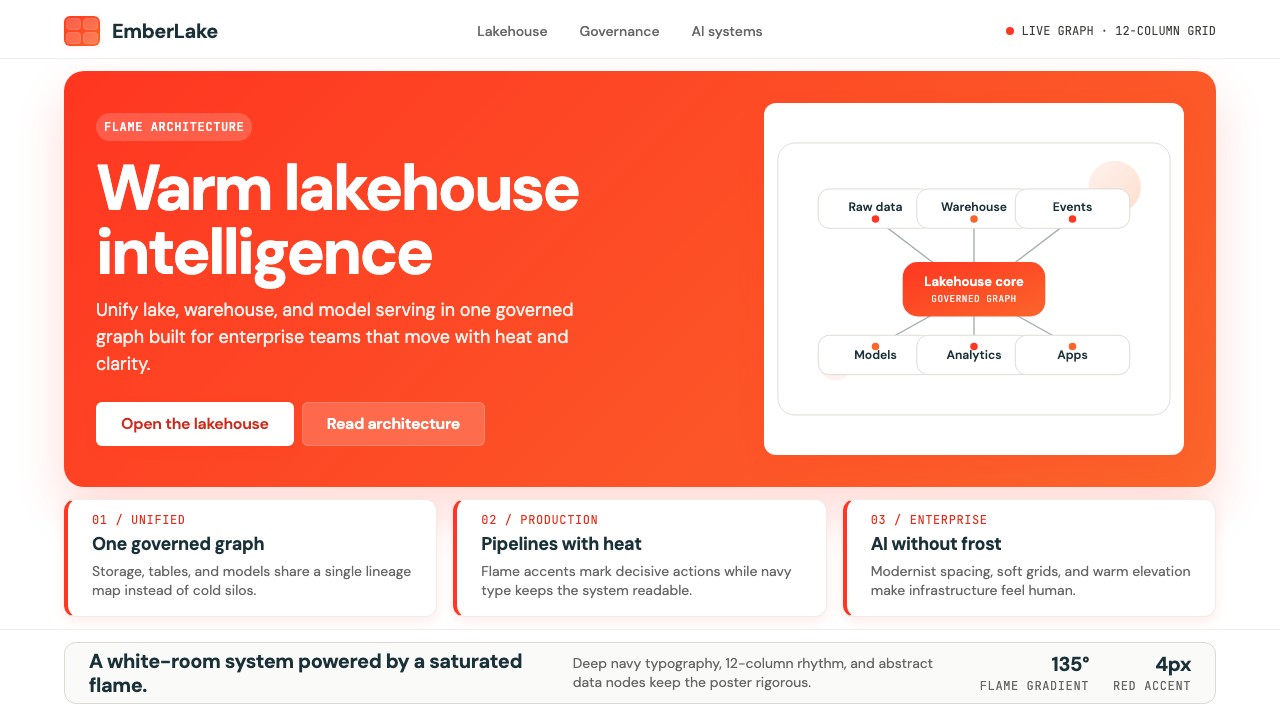 Databricks LakehouseWarm enterprise confidence. Flame red-orange gradients meet DM Sans and clean…
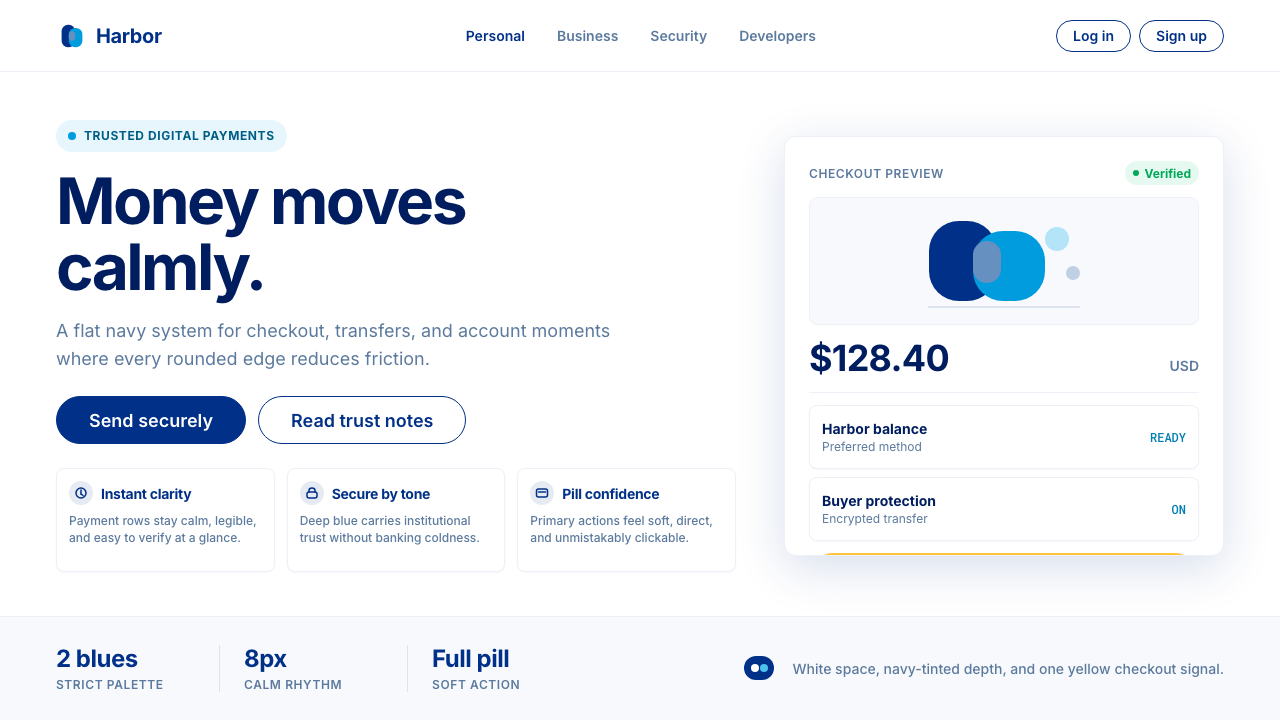 PayPalTrust without coldness. Deep navy, sky cyan, white cards, and pill checkout c…
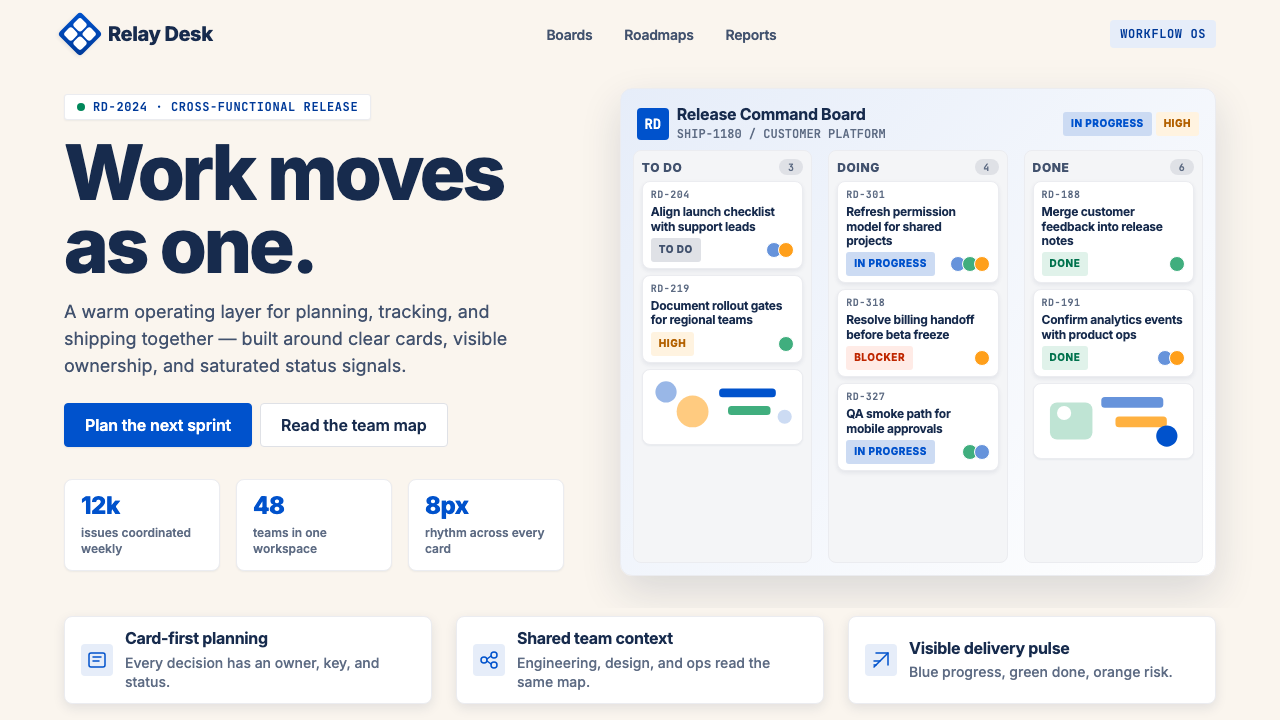 Atlassian Jira BlueWarm enterprise teamwork. Saturated blue cards on cream make status feel huma…