What is Sega Dreamcast (1999)?
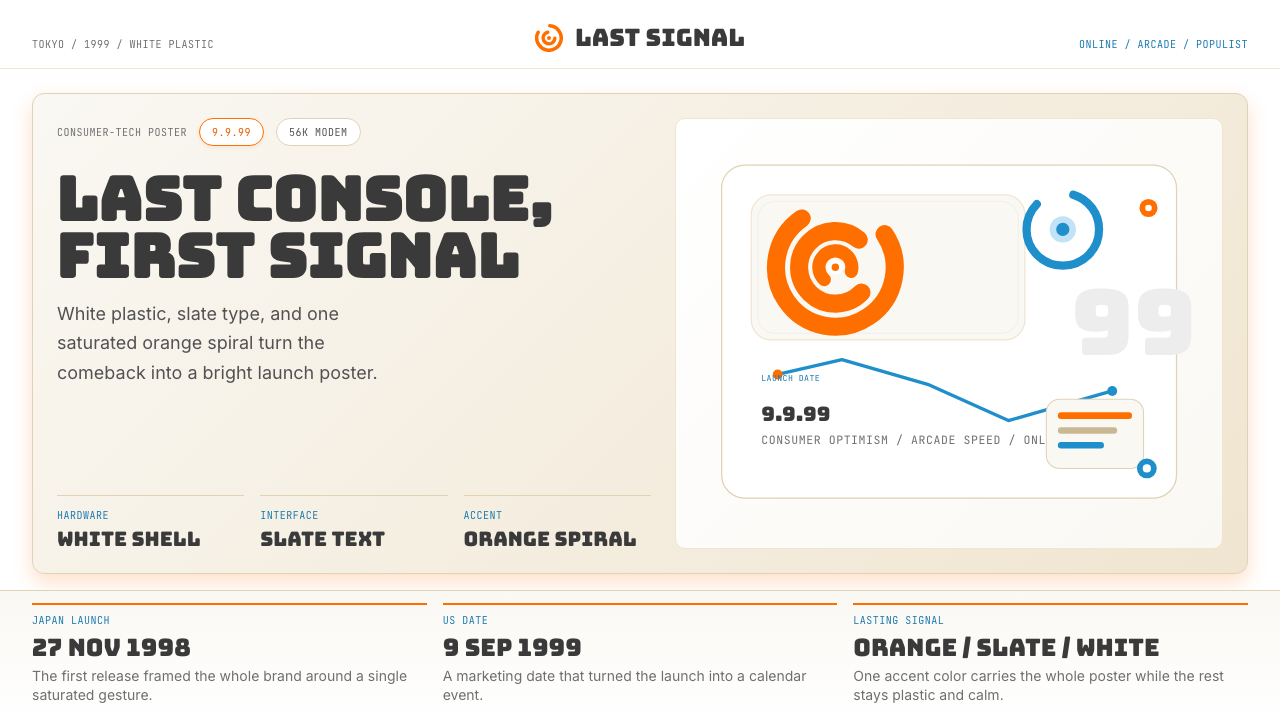
A saturated orange spiral on white plastic — the Dreamcast's visual identity captured the exact moment the world stood at the threshold of online gaming and Y2K optimism.
Sega Dreamcast (1999) in brief
Sega Dreamcast (1999) is a design language born from a games console — Sega's last — that launched in Japan in 1998 and reached North America in 1999. Its visual identity is disciplined populism: pure white plastic surfaces, deep slate-grey type, a single saturated orange accent that carries all symbolic weight, and occasional cyan-blue echoes drawn from the console's distinctive cable color and online-era marketing campaigns.
The aesthetic is consumer-cheerful and tech-confident without aspiring to luxury or industrial severity. Where the competing PlayStation adopted a cool grey minimalism and the Nintendo 64 leaned into toy-like primary colors, the Dreamcast chose white-field clarity with one loud accent — a visual grammar that reads as simultaneously optimistic and purposeful. The orange spiral logo is its most concentrated expression: a form that suggests motion, connectivity, and forward momentum.
As a design reference, the Dreamcast palette belongs to the late-1990s wave of Y2K tech aesthetics — the conviction that the digital future was arriving and that it would be clean, bright, and slightly thrilling. It shares DNA with that era's internet-era product packaging, ISP installation discs, and early web portals, all of which reached for a similar combination of white space, high-contrast type, and one energizing accent color.
Where does Sega Dreamcast (1999) come from?
The Dreamcast was born from Sega's urgent need to recover from the commercial failure of the Saturn console in North America and Europe in the mid-1990s. Under the leadership of Hayao Nakayama and, for the North American launch, Bernie Stolar — who famously cancelled the Saturn's North American lifespan to clear the decks — Sega developed the Dreamcast on an accelerated timeline. The hardware team in Tokyo produced a machine built around an NEC PowerVR graphics chip and a Yamaha sound processor, while the marketing and identity teams worked to define a visual language that would signal a clean break from the Saturn era.
The console launched in Japan on November 27, 1998, under the slogan 'The Dreamcast is here.' The North American launch on September 9, 1999 — numerically rendered as 9/9/99 — was one of the most theatrical product launches in gaming history, generating over 225 million dollars in first-day sales. The marketing identity established at launch was built around that orange spiral on white: a visual grammar that appeared across hardware, software packaging, controller peripherals, the VMU memory card, and the console's startup screen. The identity was coherent and immediately recognizable, even for consumers who had never heard of the hardware specifications.
The Dreamcast was also the first home console to ship with a built-in modem as standard, and Sega's SegaNet online service shaped the marketing aesthetic: a sense of connectivity, openness, and the slightly euphoric feeling of 1999 internet culture. Cyan-blue, borrowed from the distinctive blue swirl of the console's cable, appeared as an accent color in advertising and launch materials — a nod to the network premise that made the hardware distinctive. Hidekazu Yukawa, Sega of Japan's then-executive vice president, became an unlikely face of the campaign in Japan, appearing in self-deprecating television advertisements that acknowledged the Saturn's failures directly.
The console was discontinued in March 2001, just over two years after its North American launch, as Sony's PlayStation 2 and the announced Xbox eroded its market position. But the aesthetic it established — white-field clarity, slate type, saturated orange, occasional cyan — became a touchstone for the Y2K design moment and has experienced sustained revival in retro-gaming culture, indie game marketing, and digital nostalgia design since the early 2010s. The Dreamcast's visual language is now treated as a coherent period style as distinctly recognizable as any design movement of its decade.
What defines the Sega Dreamcast (1999) look?
Color
The palette centers on a single saturated orange — warm, energetic, and unmistakable — set against pure white or very light off-white grounds. Deep slate grey handles all typographic and structural work, never black for body content, which keeps the palette feeling airy rather than stark. Cyan blue appears as a secondary accent, lighter and cooler in temperature than the orange, referencing online connectivity and appearing primarily in interface elements and marketing borders. The white ground is treated as a positive design element, not empty space — broad white fields give the orange room to resonate at full energy.
The Spiral Mark
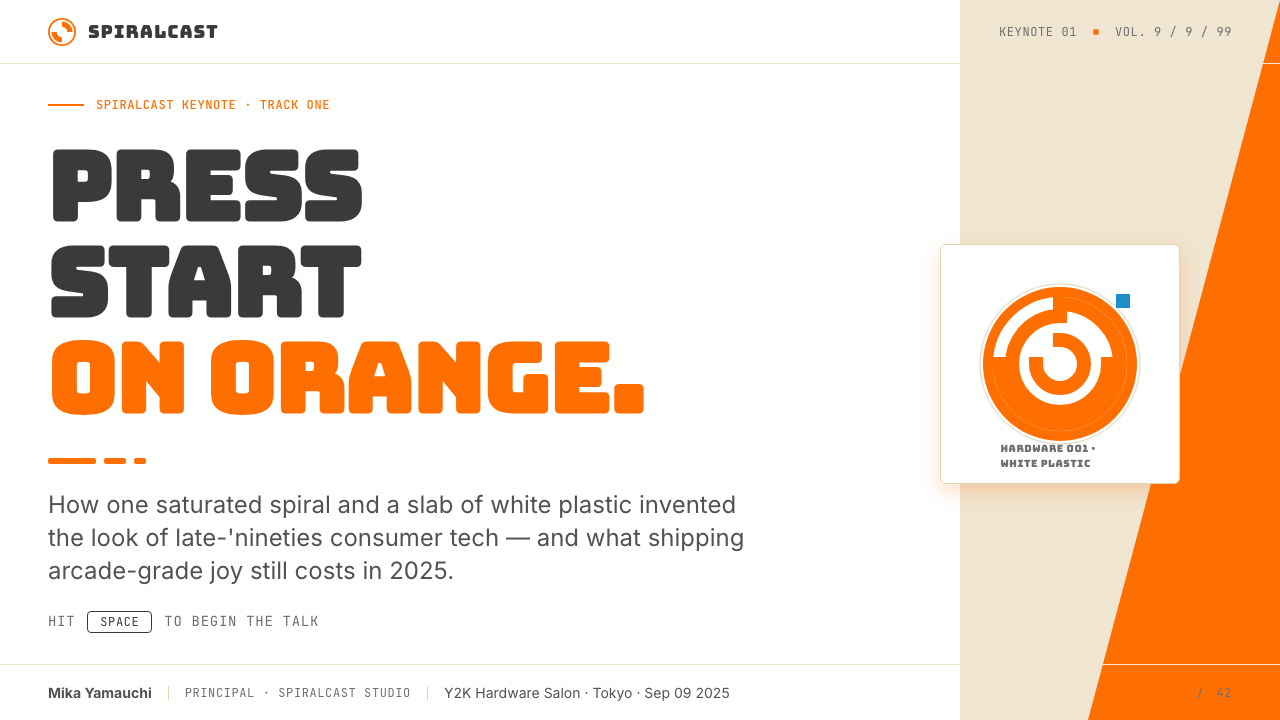
The orange swirl logo is the aesthetic system's most iconic element — a continuous spiral that reads simultaneously as a letter D, a vortex, a loading indicator, and a signal of forward momentum. It is the single most reproduced element of the Dreamcast visual identity, appearing at hardware scale on the console lid, at thumbnail scale on software spines, and at monumental scale in launch advertising. Its function is both brandmark and emotional tone-setter: the form communicates speed and connectivity before any text is read.
Typography
The Dreamcast typographic system uses rounded, slightly condensed sans-serif letterforms — approachable but precise, avoiding both the cold neutrality of Swiss rationalism and the playfulness of toy-market type. Headlines are set large and confidently, often left-aligned with generous white space above and below. The slate-grey body type against white ground creates a softer, more consumer-friendly contrast than black on white, which positions the system as tech-confident rather than corporate-severe. Numerical elements — game titles, version numbers, connectivity indicators — are treated with the same weight and placement care as any headline.
Surface and Form
The console hardware established a design grammar of smooth white plastic with minimal surface articulation — no aggressive ridges, no vents used as decorative elements, no visible screw heads. This clean-surface logic carries into the two-dimensional visual system: flat color fields replace gradients, hard edges replace feathered borders, and interface elements read as clean geometric solids. The overall effect is consumer-optimistic — surfaces that look easy to keep clean, uncluttered, and ready for the future.
Grid and White Space
Dreamcast-era materials use a loose but consistent grid that privileges open white space over information density. Content is set at comfortable scale with wide margins — a layout grammar that reads as generous rather than cramped. This was partly driven by console-era print production, where legibility at a glance from shelf distance mattered as much as close reading. In the UI of the console's menus and the SegaNet portal, the same principle applied: fewer elements per screen, each given sufficient breathing room to be identified quickly.
Y2K Optimism
The Dreamcast visual language carries a specific emotional temperature that distinguishes it from merely functional tech design. It is forward-pointing: the spiral suggests motion, the orange suggests energy, the white ground suggests possibility rather than emptiness. This emotional register — tech-confident, consumer-friendly, slightly euphoric about networked possibility — is the quality most sought by designers working in retro revival contexts. It reads as a period record of what the digital near-future felt like to ordinary consumers in 1999, before that optimism was complicated by the dot-com bust and the events of the early 2000s.
Software Packaging Coherence
Sega enforced a consistent packaging grammar across its first-party Dreamcast software library. GD-ROM cases followed a distinctive white-field layout with the Dreamcast logo and orange swirl occupying a fixed position, game title in slate-grey type at a consistent scale, and cover art contained within defined borders rather than bleeding to edge. This created a shelf-presence coherence unusual for the era — a row of Dreamcast titles had a visual rhythm that Sony and Nintendo packaging of the same period did not match. The packaging grammar is as much a part of the design legacy as the hardware identity.
Who shaped Sega Dreamcast (1999)?
Nakayama served as CEO of Sega Enterprises and was the driving force behind the company's console ambitions through the Mega Drive, Saturn, and Dreamcast eras. His decision to accelerate the Dreamcast's development timeline after the Saturn's commercial disappointment directly shaped the urgency and optimism embedded in the console's marketing identity. The 'Dreamcast is here' positioning — projecting confidence rather than apology after a failed generation — was a product of his organizational will. Nakayama stepped down from his CEO role shortly after the North American launch in 1999.
Stolar joined Sega of America as president and COO in 1996, having previously served at Sony Computer Entertainment America during the original PlayStation launch. His controversial decision to discontinue active support for the Saturn in North America — famously declaring at E3 1997 that 'the Saturn is not our future' — was a deliberate effort to position the Dreamcast as a total reset. His tenure oversaw the 9/9/99 North American launch, and the visual and marketing identity he approved established the Dreamcast aesthetic in its most widely seen form. He was replaced as president of Sega of America in early 2000 as the console's sales trajectory became uncertain.
Yukawa was executive vice president of Sega of Japan and became an unlikely pop-cultural figure through Sega's Japanese Dreamcast marketing campaign. In a series of television advertisements, he appeared as himself — a corporate executive who acknowledged the Saturn's failures and was subsequently humiliated or underestimated by rival platforms and the gaming public. The campaign's self-deprecating humor created significant brand warmth in Japan and demonstrated that the Dreamcast identity could accommodate emotional range, not just technical confidence. Yukawa's appearances became a minor cultural phenomenon and are remembered as a distinctive element of the console's Japanese launch marketing.
As the lead programmer and creative force behind Sonic Team, Naka's work on Sonic Adventure — the Dreamcast's flagship launch title in Japan — defined the public's first impression of the hardware's capabilities and the aesthetic of its software library. Sonic Adventure's character design, color philosophy, and kinetic visual energy were closely aligned with the console's own identity: saturated, forward-moving, and optimistic. Sonic Team's subsequent Dreamcast titles, including Jet Set Radio's cel-shaded visual revolution, extended the console's visual legacy beyond its hardware identity into the history of games as a design medium.
Suzuki was AM2's leader and creator of Shenmue, the Dreamcast's most ambitious and most expensive production. Shenmue's documentary-realist visual approach — detailed urban environments, facial expressions rendered at then-unprecedented fidelity, a commitment to mundane physical detail — represented a counterpoint to the console's orange-and-white marketing identity: here was Dreamcast software pushing toward photographic seriousness at the same moment the hardware was packaged in pop optimism. Suzuki's work established the Dreamcast as a platform with aesthetic range, not merely a cheerful consumer product.
How do you use Sega Dreamcast (1999) today?
The Dreamcast aesthetic is among the more immediately accessible retro-revival styles available to contemporary designers, precisely because its grammar is so concentrated: white ground, slate type, saturated orange, occasional cyan, and one iconic spiral motif. Applying it correctly means understanding its emotional register — consumer-optimistic, tech-confident, slightly euphoric — and deploying those signals purposefully rather than decoratively.
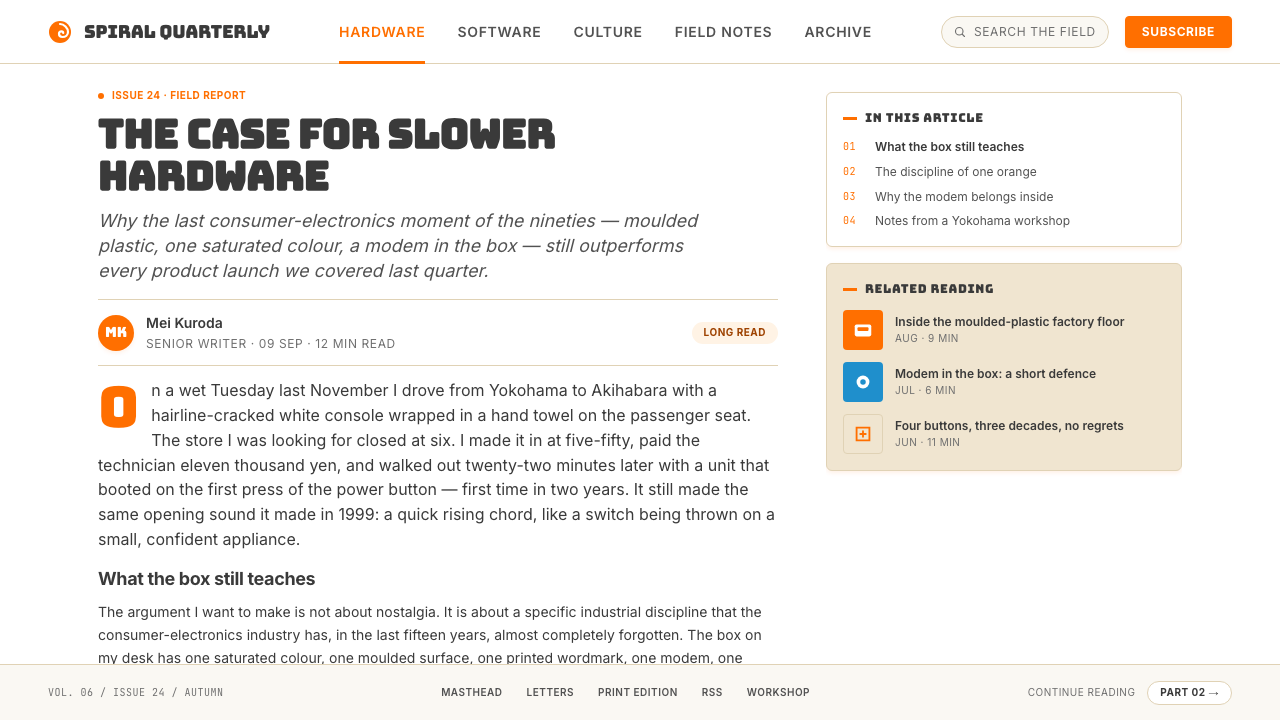
For presentation slides, the Dreamcast style works exceptionally well on cover pages and section dividers. A cover benefits from a large orange spiral or arc anchoring one corner of a white field, with the deck title in slate-grey type and a secondary label in a smaller weight. Content slides should commit to the white-ground discipline: generous margins, type set at comfortable reading size with no body text in pure black, and data visualizations treated as geometric solids colored with the orange and cyan palette. Avoid decorating every slide with the spiral — use it as a punctuation device at transitions and covers.
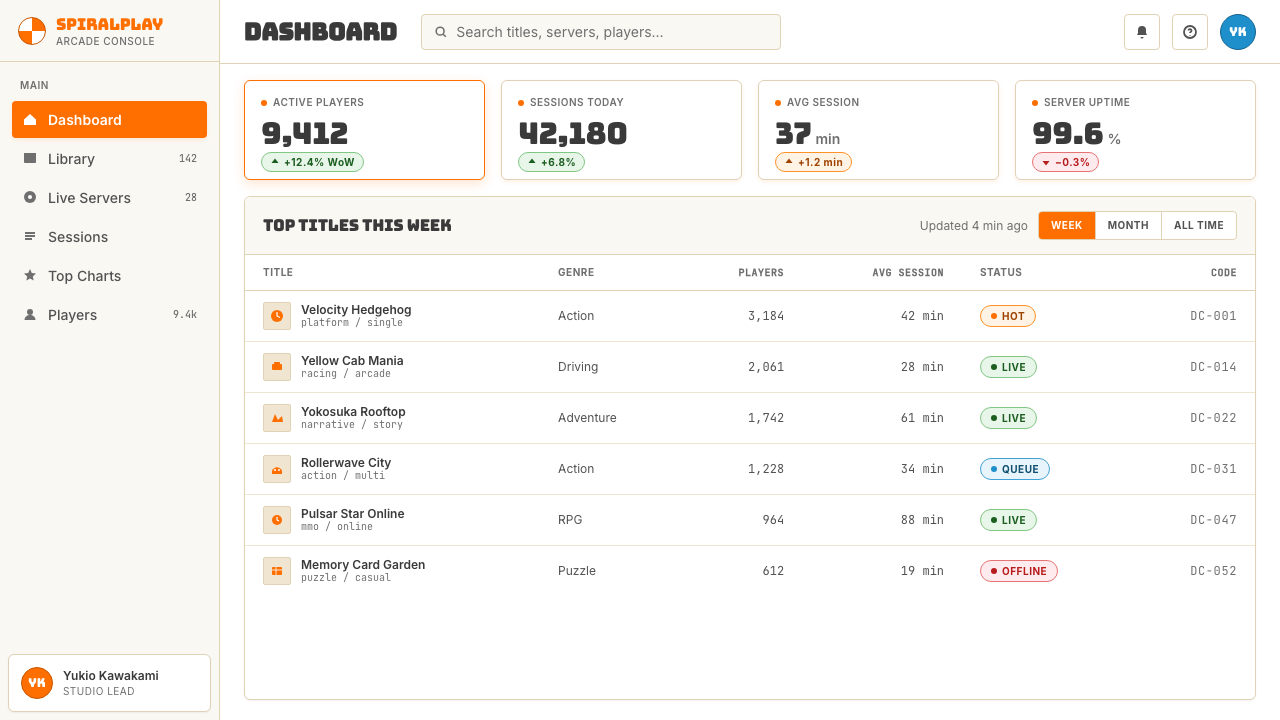
For web interfaces and dashboards, the Dreamcast grammar is well-suited to products with a retro-gaming or Y2K positioning, community platforms, and any context where a warm, energetic tech aesthetic is preferable to Swiss neutrality. Define a clean column grid, hold the background to white or near-white, and reserve the saturated orange strictly for primary interactive states — active tabs, call-to-action buttons, progress indicators. Cyan can handle secondary states and borders. Interface components should have clear, confident edges rather than soft drop shadows; the visual language is tactile and physical, not glassy.
For editorial and marketing contexts — particularly brand identities, campaign materials, and social cards for gaming, technology, or nostalgia-driven products — the style's poster quality is its primary asset. Full-width white fields with a large orange spiral or type mark create immediate impact at social media scale. Marketing hierarchies should follow the console-packaging grammar: one dominant orange element, one slate-grey headline, one secondary text level at noticeably smaller scale, and broad white breathing space around all of them. The cyan accent works well for callouts, tags, and bordered metadata.
The most common mistake when applying this aesthetic is treating the orange as a color to be used at low saturation or mixed with warm tones for harmony. The Dreamcast orange works precisely because it is unapologetically saturated against a pure white ground — reduce its intensity and the whole system loses its characteristic energy. A secondary mistake is adding gradient fills or soft glow effects in the spirit of late-1990s web design; the Dreamcast aesthetic is actually flatter and more geometric than that era's typical web production, closer to its packaging and hardware than to its browser interfaces. Keep surfaces flat, edges hard, and let the orange do its full work.
Sega Dreamcast (1999) — FAQ
Is the Dreamcast style the same as general Y2K design?
Y2K design is a broad umbrella covering the visual culture of roughly 1997 to 2003, encompassing everything from translucent iMac plastics and chrome-bubble interfaces to the aggressive lens-flare aesthetic of early CGI advertising. The Dreamcast style is a specific, disciplined subset of that broader moment. It is notably flatter and more restrained than typical Y2K maximalism — fewer gradients, no chrome, no translucency — and its emotional register is optimistic rather than aggressive. Think of it as the Y2K aesthetic filtered through console-hardware industrial design: clean, purposeful, and oriented toward consumer accessibility rather than technical spectacle.
Can the Dreamcast aesthetic work for products that have nothing to do with gaming?
Yes, with some calibration. The style's emotional register — forward-optimistic, tech-confident, consumer-friendly — translates well to technology products, community platforms, creative tools, and digital-native brands that want to signal accessible energy rather than corporate authority. It is particularly effective for brands targeting a demographic that grew up with the console, roughly those now in their thirties and forties. The gaming association is real but not inescapable; used at the level of palette and composition rather than explicit motif reference, the style reads as Y2K-optimistic technology design rather than as gaming nostalgia specifically.
How do you avoid the style looking like a joke or pastiche?
The key is structural commitment over surface decoration. Applying a spiral sticker and an orange color is pastiche; rebuilding a layout around the style's actual compositional logic — white-ground discipline, slate-grey type system, orange reserved for primary meaning-carrying elements only — is authentic application. Pastiche uses the motifs without the principles; authentic application uses the principles and earns the right to the motifs. Concretely: set your type in the Dreamcast register before adding any orange element, then ask whether the orange is doing structural or communicative work, not merely decorative work. If it is only decorative, remove it.
Does the Dreamcast style work in dark-background contexts?
The canonical Dreamcast identity is light-ground — white hardware, white packaging, white marketing fields. A dark inversion is possible but requires care. On a dark or near-black ground, the saturated orange reads differently: it gains an aggressive, high-contrast pop that can easily overwhelm the rest of the composition. The solution is to reduce the orange's field coverage significantly when inverting — treat it as a small, precise accent rather than a bold anchor. The slate-grey type system also needs to become near-white for legibility, which changes the palette's overall emotional temperature from optimistic-open to something closer to dramatic or nocturnal. A dark Dreamcast variant can work well for gaming-adjacent contexts and after-hours product positioning, but it is a reinterpretation rather than a faithful application.
What are the clearest signs that Dreamcast-style application has gone wrong?
Three diagnostic signals: first, orange appearing at low saturation or mixed with other warm tones — the palette depends on orange being unapologetically vivid against white, and any desaturation or mixing collapses the system's visual logic. Second, the spiral motif appearing multiple times on a single layout surface without a clear hierarchy — the spiral works as a singular accent, not as pattern wallpaper. Third, body text in pure black rather than slate grey — this hardness reads as editorial severity rather than consumer warmth, which shifts the emotional register away from the style's defining tone. Addressing these three signals will resolve the majority of Dreamcast-style application failures.
Related design styles
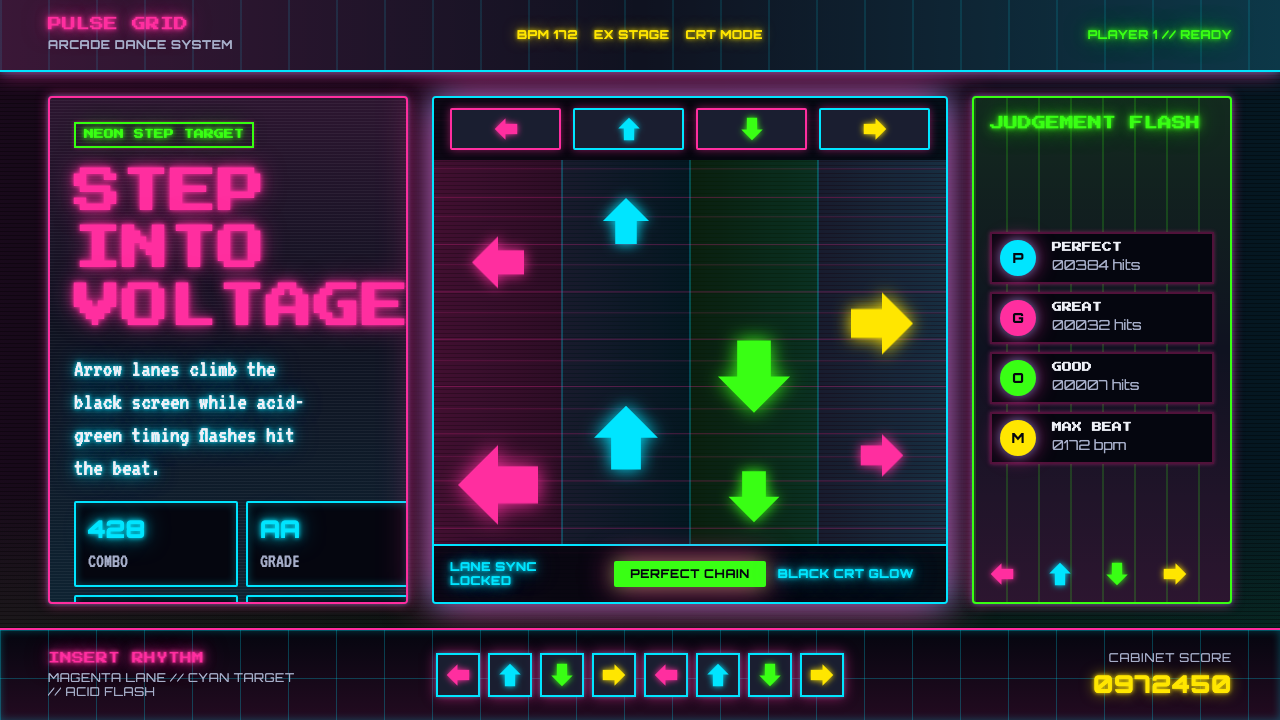 Dance Dance Revolution ArrowsPure arcade voltage. Magenta, cyan, and acid-green arrows climb a black CRT g…
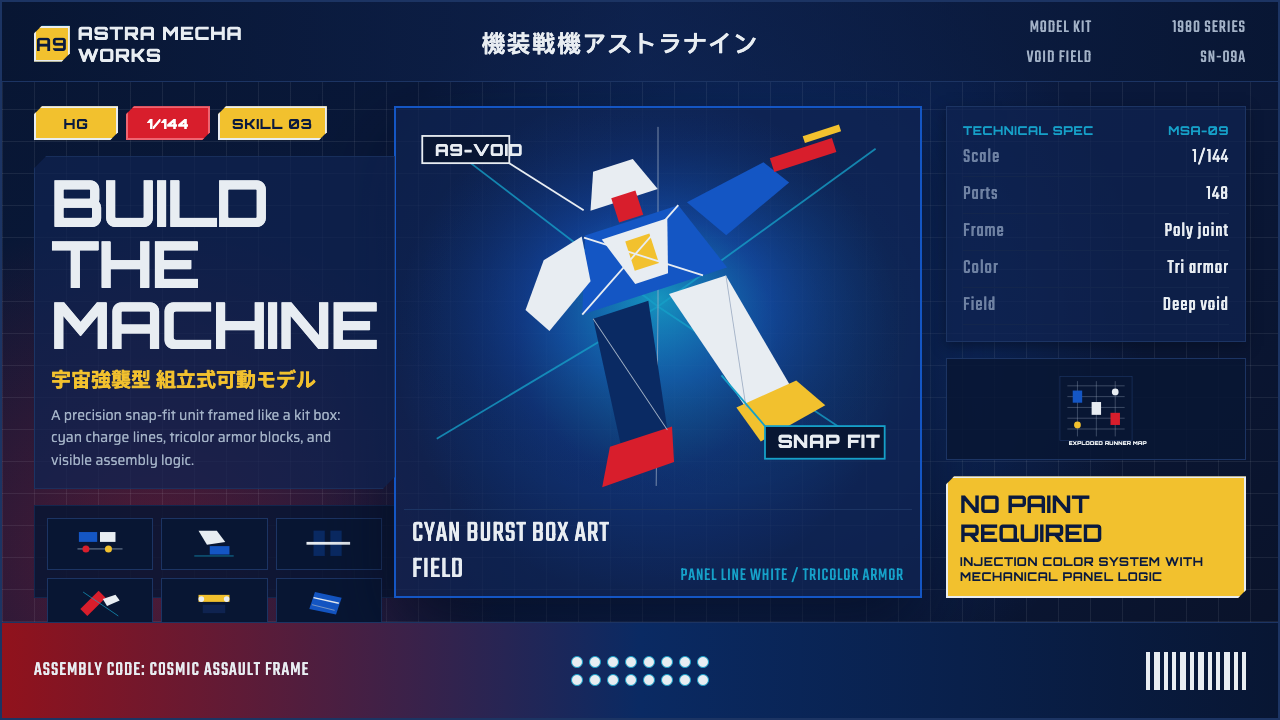 Gunpla Model BoxBuild-sheet drama. Cosmic navy, cyan burst, tricolor armor, and spec-panel gr…
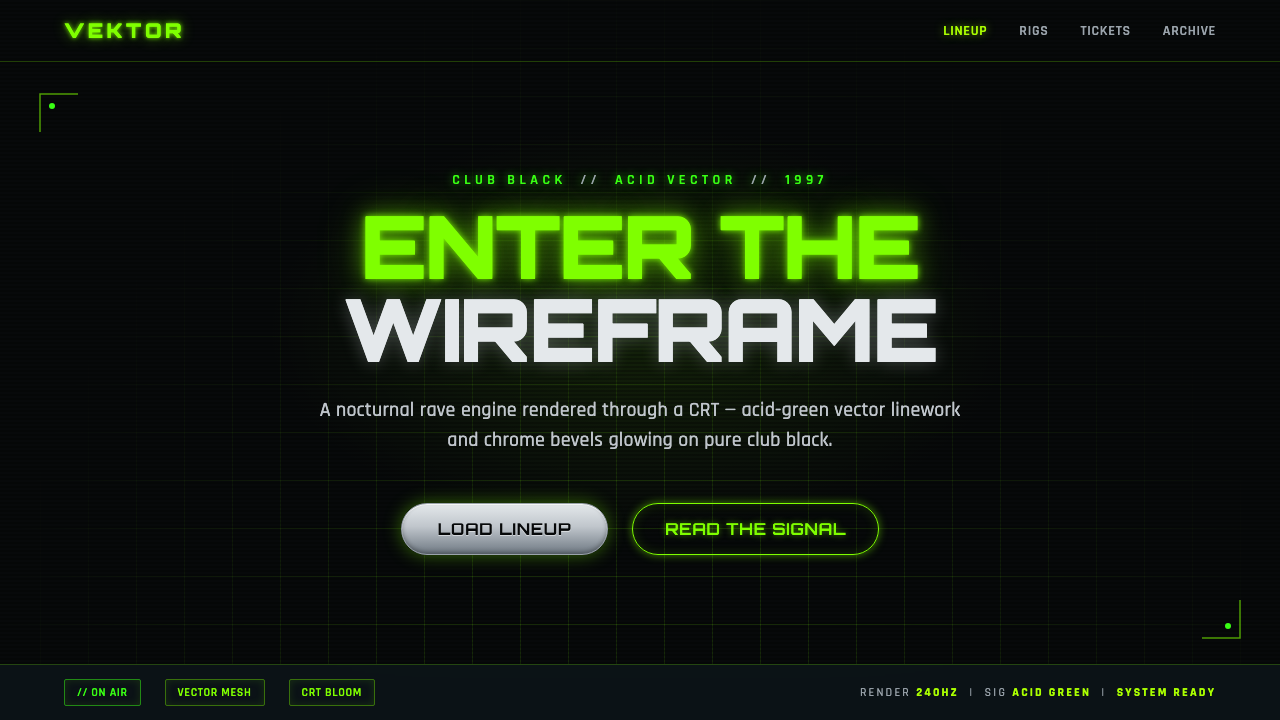 Playstation Rave Green 1997Enter the wireframe. Acid-green vector lines and chrome glow on club black, a…
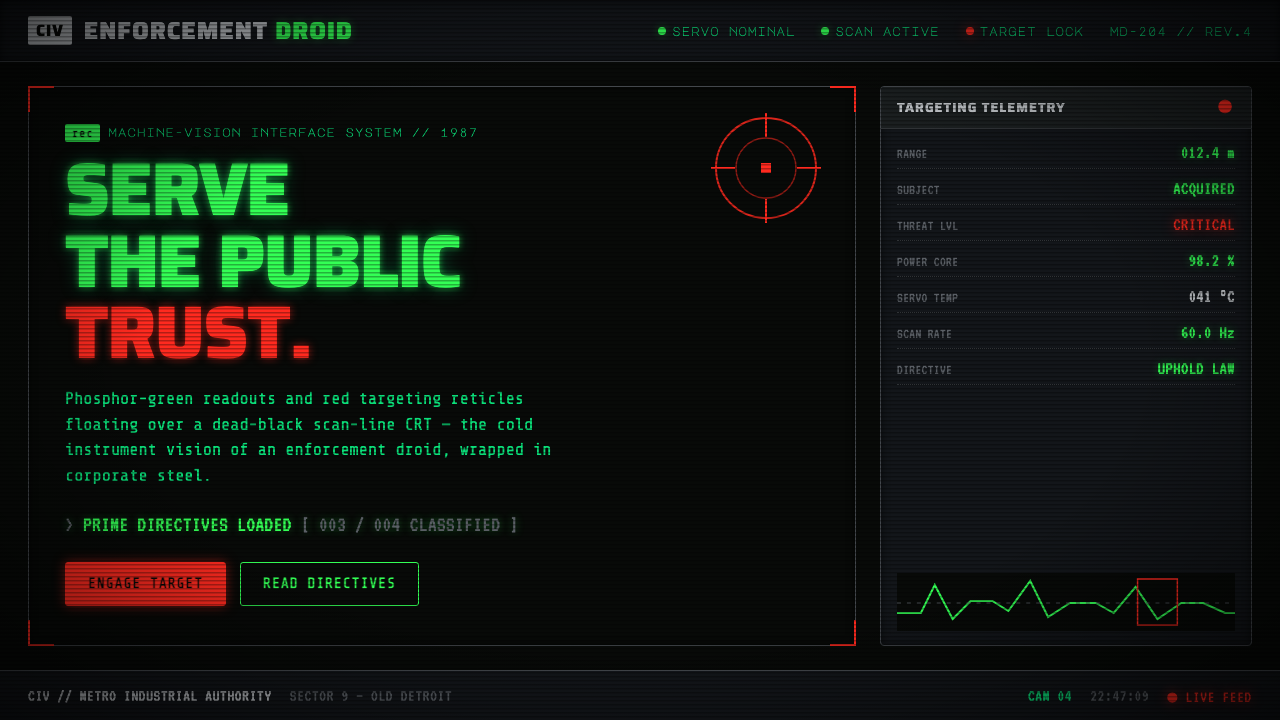 RoboCop (1987)Machine vision as interface. Phosphor-green readouts on dead-black CRT, red r…
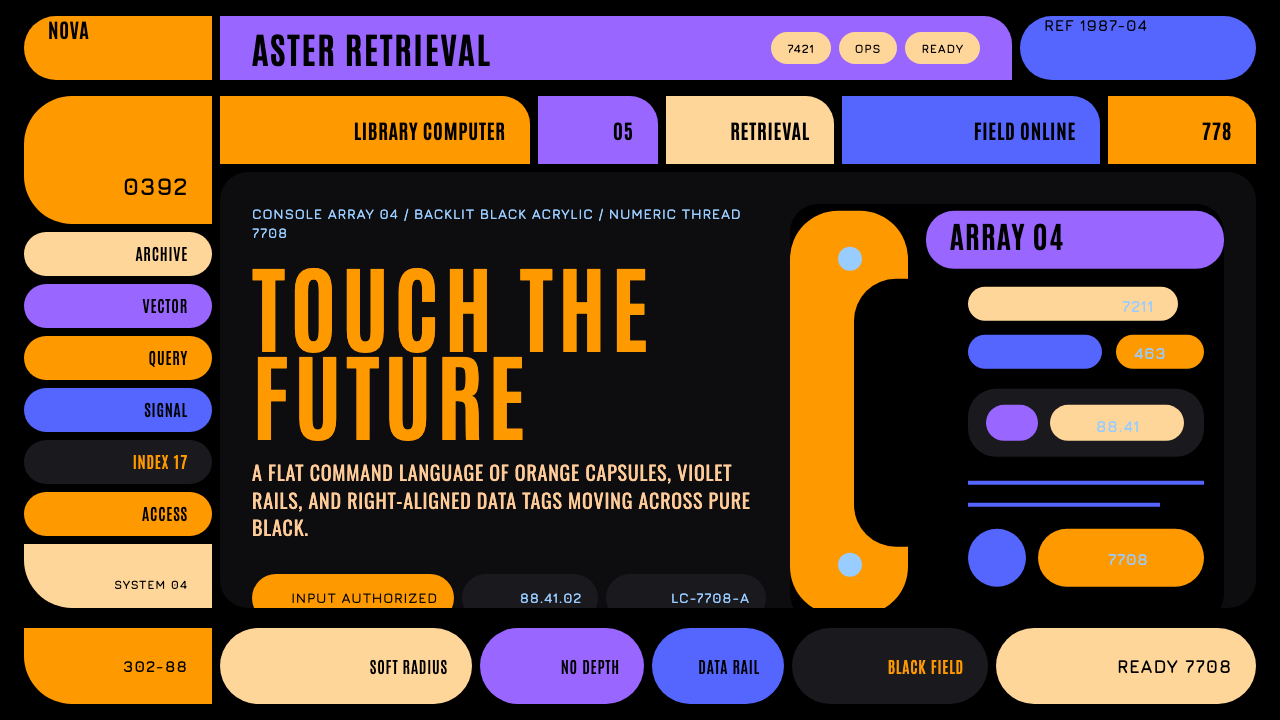 Star Trek LCARSFuture as flat command. Orange-violet elbows and Jura numbers glow on black.
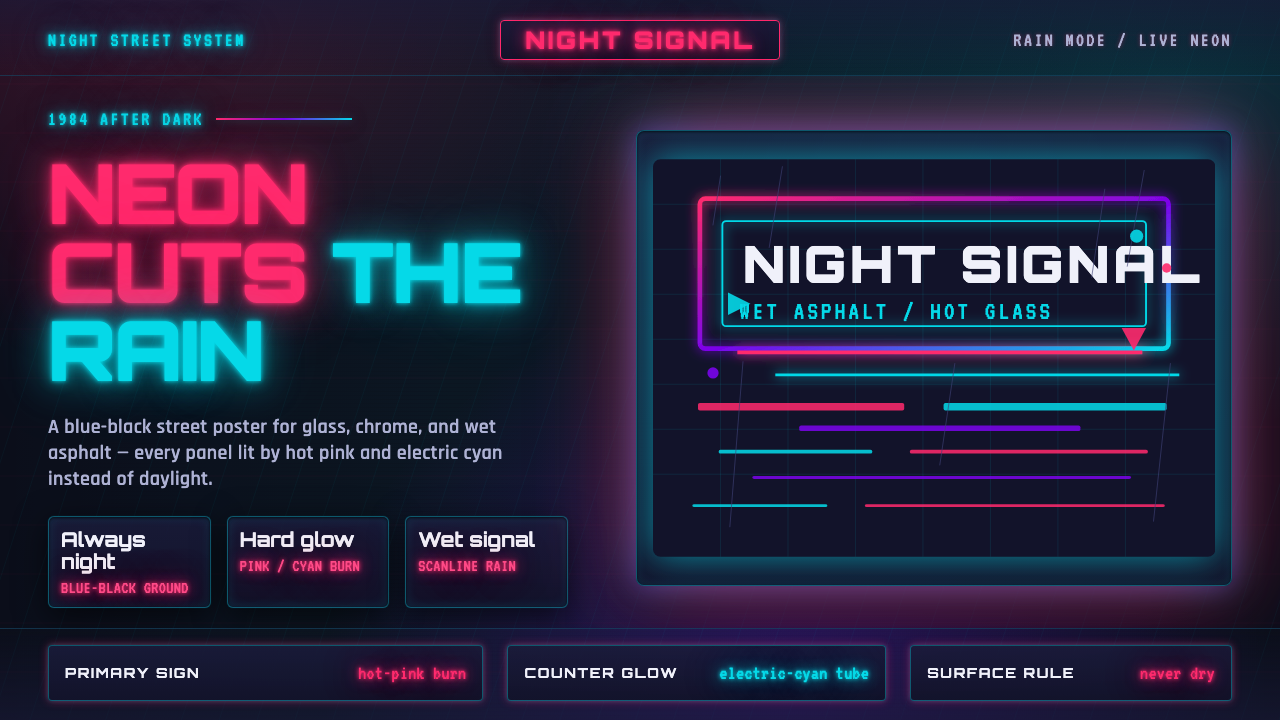 Tech-NoirAlways night. Blue-black asphalt reflects hot pink and electric cyan neon.