What is Scythian Gold?
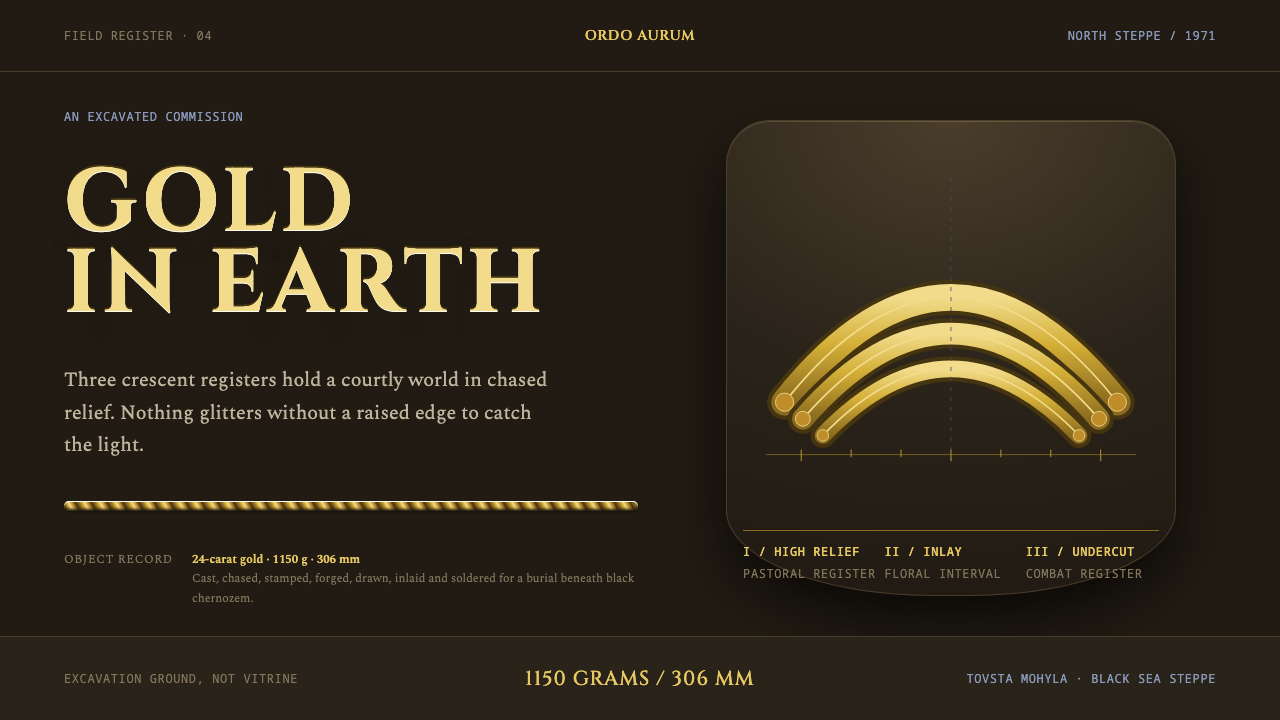
Scythian Gold keeps the black earth the pectoral was found in — a chernozem ground, three chased crescent registers, and gold that appears only where relief would truly catch the light.
Scythian Gold in brief
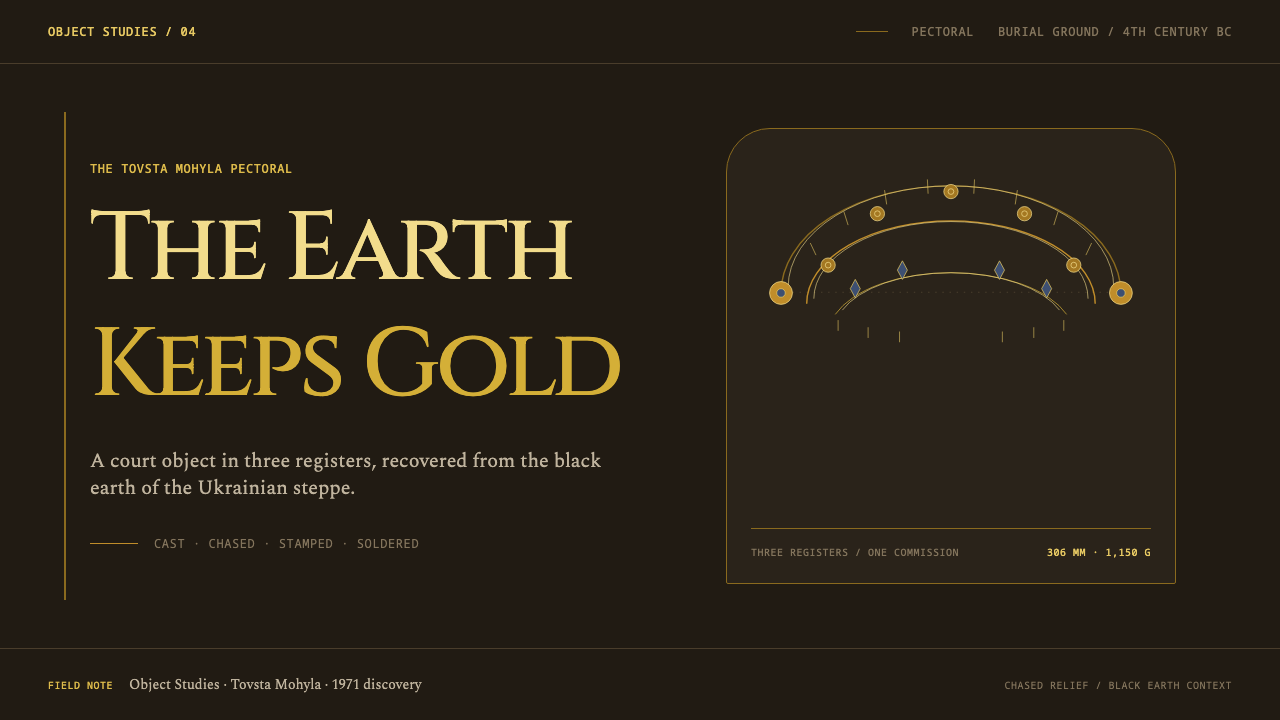
Scythian Gold is a dark design language built on a single archaeological object: a gold pectoral of the fourth century BC, made from 1150 grams of solid metal and 306 millimetres across. It was cast, chased, stamped, forged, drawn, inlaid and soldered by metalworkers who knew both the iconography of the steppe and the relief vocabulary of Greece. Its layout is three stacked crescent registers separated by twisted hollow tubes that end in lion-headed clasps.
Each register has its own subject. The upper one shows pastoral life, the middle a floral scroll with birds, and the lower animal combat: horses, lions and griffins. The sequence moves from herding to ornament to conflict, and the divisions between bands are drawn as twisted gold wire. That structure, a clear stacked hierarchy in which every band carries its own kind of content, is what the system borrows for layout.
Its colour logic is distinctive. The ground is not museum glass or velvet but the black chernozem earth in which the object was found. Gold appears only where relief would actually catch raking light, and it appears with the full range from highlight through base metal to recess shadow, because that range is what makes cast form legible. The result is a dark page with a few precisely placed passages of metal, not a gold-coloured page.
Where does Scythian Gold come from?
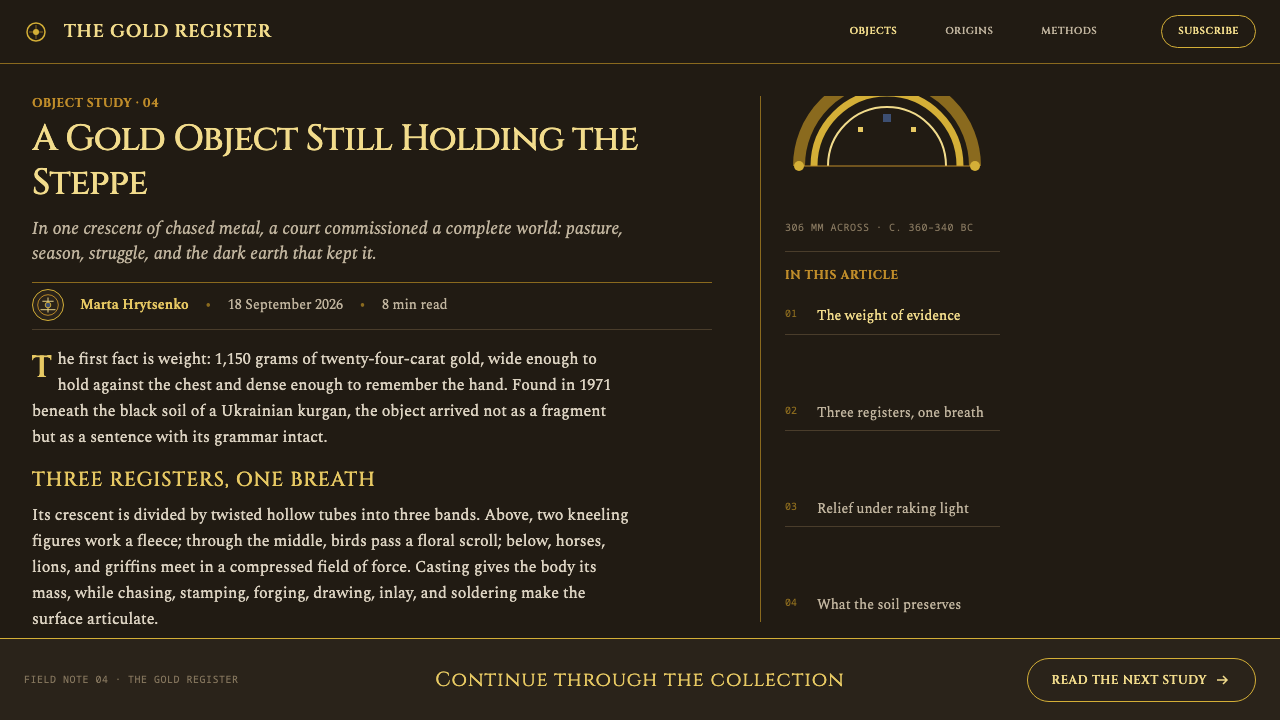
The object dates from the fourth century BC and was buried around 360–340 BC in a kurgan on the northern Black Sea steppe, in what is now Ukraine. Its weight and scale, 1150 grams and 306 millimetres across, place it among the major pieces of its world. It is best understood as a commissioned court object rather than a heap of treasure: one piece, made for a purpose, by people at the top of their craft.
Two traditions meet in the metalwork. The movements the lineage names are the Scythian animal style, Greco-Scythian court metalwork and the Black Sea kurgan burial culture. The craftspeople who made the pectoral knew steppe iconography and Greek relief alike, and the object is the product of that meeting: steppe subject matter worked in the language of modelled relief. The seven techniques involved, casting, chasing, stamping, forging, drawing, inlaying and soldering, are a reminder that this is composite work, with several processes layered into one piece.
The excavation is part of the story, and the system keeps it. In 1971 the archaeologist Borys Mozolevskyi recovered the pectoral at the entrance to the central chamber of the Tovsta Mohyla barrow, near Pokrov, surrounded by black chernozem so dark it shines. The system takes that earth as its ground: the excavation, not the vitrine. A vitrine suggests neutral light and a hushed room; the chernozem suggests weight, soil and the long wait before the object saw daylight again.
Translating the object into a page requires two decisions. Layout follows the pectoral: stacked crescent-shaped registers, each with its own content, divided by a twisted-wire rule that ends in a clasp-like terminal. Colour follows the dig: dark earth as ground, and gold only in the passages where there is relief to catch light. That rule, gold is earned by form, is what separates the system from a generic black-and-gold luxury scheme.
What defines the Scythian Gold look?
Black earth ground
The page is carried by black chernozem, the soil the pectoral lay in, rather than by a neutral black backdrop. It has depth and weight, and reads as material. Because the ground is earth, everything on it feels unearthed: found, brushed clean, and lit from the side, not displayed under even museum light.
Gold as lit relief
Gold is never a flat fill. It appears with a full range of tone, from the bright catch of a raised edge, through the body colour of the metal, to the dark of the recess beside it. That range is what makes cast form legible. Take away the highlight or the shadow and gold stops looking like a worked metal and starts looking like a yellow.
Three stacked registers
The composition is built from three crescent-shaped bands stacked on top of one another, each with its own subject. This gives the system a ready-made information architecture: three zones, three kinds of content, read in order from top to bottom. The curve of the crescent is the one organic gesture the layout permits.
Twisted-wire dividers and lion-headed clasps
Registers are divided not by plain lines but by twisted hollow tubes, drawn as gold wire, which end in lion-headed clasps. The divider is therefore part of the ornament and a terminal at the same time. Rules in this style should look braided and finish with something, never just stop.
Narrative hierarchy: herd, scroll, combat
The upper register shows pastoral life, the middle a floral scroll with birds, and the lower combat among horses, lions and griffins. The stacking is a hierarchy of tone as well as of subject: calm above, ornamental in the middle, intense below. Content should be distributed with the same logic, with the quietest material at the top.
Worked, composite surface
The pectoral was cast, chased, stamped, forged, drawn, inlaid and soldered, and the surface shows it. Texture in this style is the trace of process: tooled lines, stamped repeats, inlaid areas, soldered joins. It rewards close viewing, and it is never a smooth, generated gradient.
A commissioned court object, not a treasure pile
The system treats the pectoral as one deliberately made piece, not as heaped riches. Gold is scarce, placed with intent, and surrounded by dark. Abundance is the wrong register; authority comes from precision and restraint, with a few things made extremely well and the rest left to the earth.

Who shaped Scythian Gold?
The archaeologist who excavated the pectoral in 1971 at the entrance to the central chamber of the Tovsta Mohyla barrow. Because his dig is the reason we meet the object with soil still around it, he is the figure behind the system's central decision: keep the excavation ground rather than the vitrine. Every dark page in this style is, in effect, a record of the moment the object came out of the earth.
The makers are anonymous, but the lineage identifies who they were in craft terms: workers who knew both steppe iconography and Greek relief, in a tradition it calls Greco-Scythian court metalwork. They are the authors of the system's most important discipline. The seven techniques layered into one piece show a workshop at the highest level, and the system's own precision should be held to that standard.
The kurgan near Pokrov on the northern Black Sea steppe, in Ukraine, where the pectoral was buried around 360–340 BC and recovered in 1971. It stands for the Black Sea kurgan burial culture named in the lineage, and for the setting that gives the system its mood: weight, soil and a long wait in the dark. The barrow is the reason the page is dark before it is gold.
How do you use Scythian Gold today?
Scythian Gold is a dark, ceremonial system whose central rule is that gold has to be earned by form. Used with that discipline it feels authoritative and archaeological; used as a generic black-and-gold luxury theme it falls apart. The page is earth first and metal second, and every use of gold should be able to answer the question of what relief it is catching.
On slides, the cover is a dark ground with the title set in or beside a crescent-shaped band, a single gold element carrying a visible range of highlight and shadow. Content slides follow the three-register logic: stack the content in three bands of different weight, divided by a twisted-rule divider with a small terminal at the end. For data slides, highlight the one series that matters in gold and let the others sit in the dark and shadow tones, so that gold is scarce and means something.
On the web the style suits museums, exhibitions, archaeology and history publishers, jewellery and craft brands, premium heritage products and fantasy or historical games. A hero can be a dark field with a single gold crescent emblem; a pricing page can treat the three tiers as three registers, with the middle one carrying the most ornament. Keep calls to action in gold only where they would genuinely read as lit metal, and make body text a quiet, pale tone on the dark ground.
In editorial and marketing work, such as exhibition catalogues, history long reads, documentary titles and premium invitations, the style gives a solemn, tactile mood. Photographs of objects work best in low-key lighting from the side, matching the raking light of the system. Dividers can be drawn as twisted rules, and chapter openers can borrow the clasp motif as a terminal mark.
The most common mistake is the flat yellow fill or the single gold gradient pasted everywhere, which turns the metal into mustard and the page into a casino. Related errors include spreading gold across body text and backgrounds so it is no longer scarce, ignoring the black earth in favour of a neutral black, and smoothing every surface, which erases the traces of tooling that make the object feel made.
Scythian Gold — FAQ
What object is Scythian Gold based on?
It is based on a single gold pectoral of the fourth century BC, 1150 grams of solid gold and 306 millimetres across. It was buried around 360–340 BC in the Tovsta Mohyla barrow near Pokrov in Ukraine and excavated in 1971 by Borys Mozolevskyi. It is a commissioned court piece, made by metalworkers who knew both steppe iconography and Greek relief.
What do the three registers show?
The upper register shows pastoral life, the middle a floral scroll with birds, and the lower animal combat among horses, lions and griffins. They are divided by twisted hollow gold tubes that end in lion-headed clasps. In the design system the same stacking becomes a layout idea: three bands, each with its own kind of content, calm at the top and intense at the bottom.
Why is the background black earth and not a museum backdrop?
Because the system keeps the excavation ground rather than the vitrine. The pectoral was recovered surrounded by black chernozem, and that soil gives the page weight and material. A museum backdrop suggests even, neutral light and a finished display; the chernozem suggests an object found, which is where the sense of authority and age in this style comes from.
Is this just a black-and-gold luxury theme?
No, and the difference is the rule about gold. In generic black-and-gold schemes gold is a flat colour sprayed over everything. Here it appears only where relief would catch raking light, with highlight, base metal and shadow all present, and it is scarce. If your gold is flat, or if it covers body text and backgrounds, you have built the generic version.
Can Scythian Gold work on a light background?
The system is built on dark earth, and gold reads as lit metal precisely because the ground is dark. A light version loses that relationship and tends to make gold look like yellow ink. If a light page is unavoidable, use dark areas for the key panels and keep the gold inside them, so the metal is still seen against black earth.
Related design styles
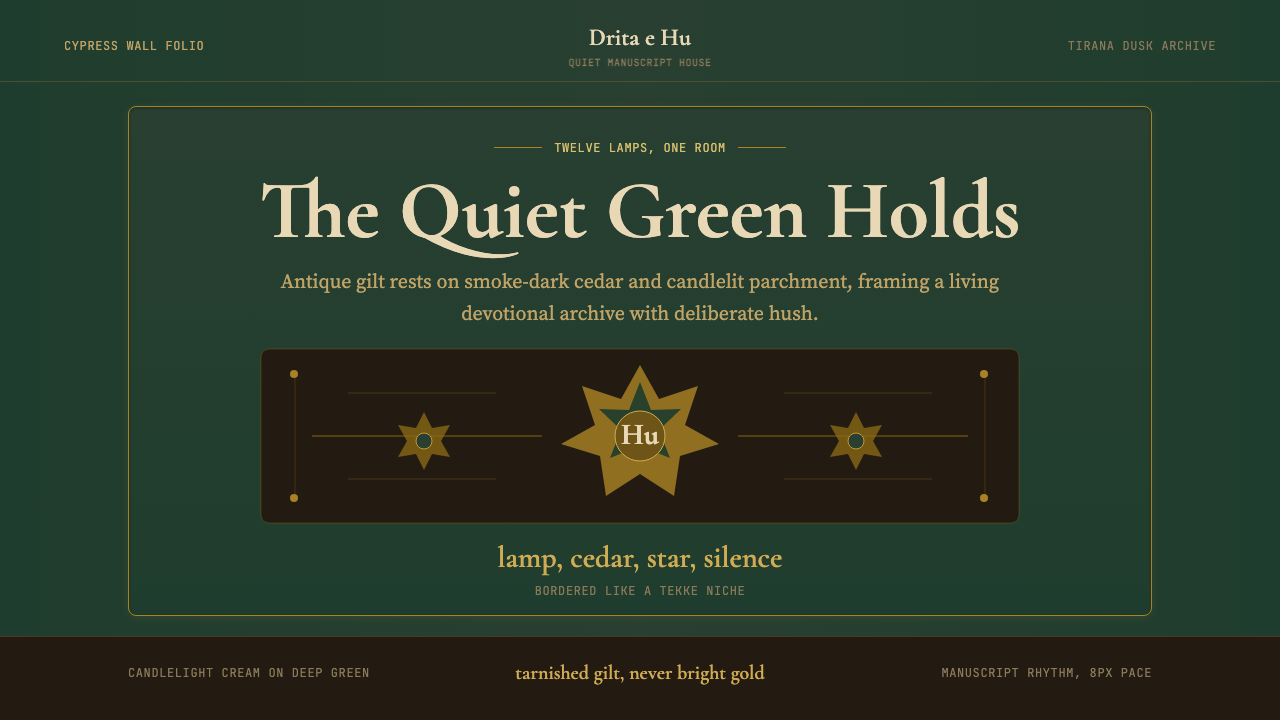 Albanian Bektashi Sufi (Tekke)Sacred quiet in cypress green. Gilt stars and Cormorant type frame a dusk tek…
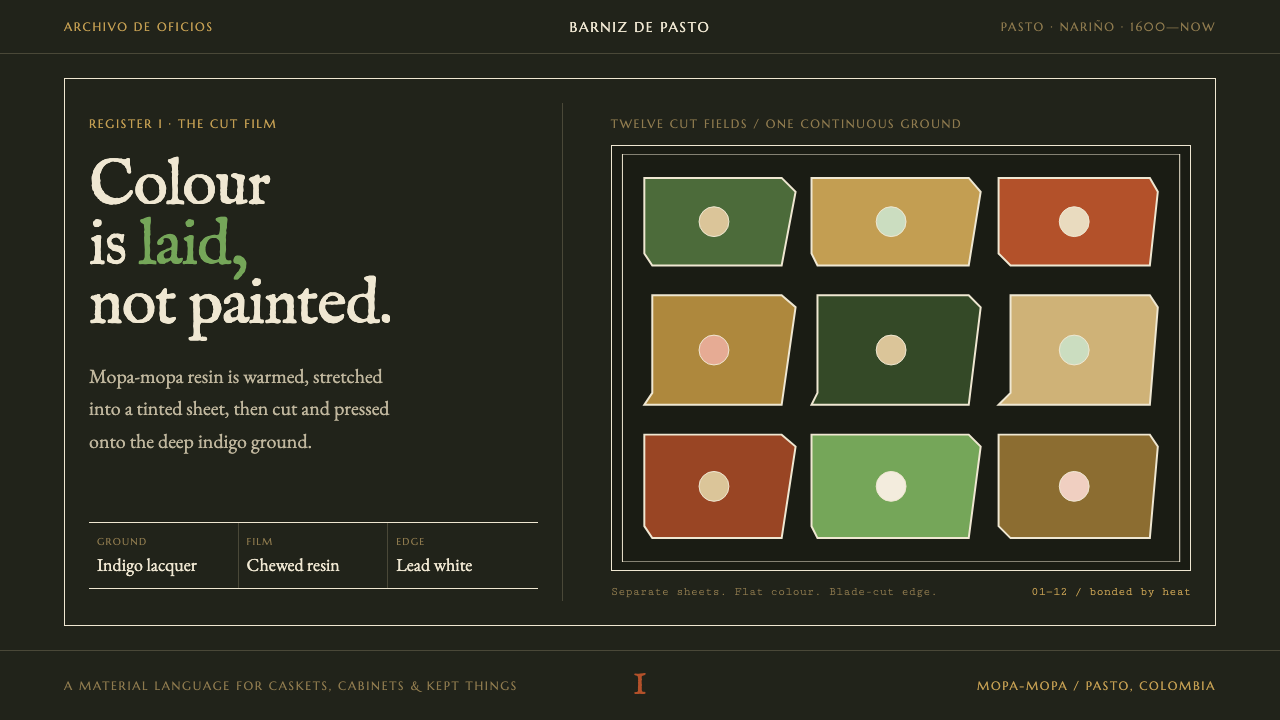 Barniz de PastoColour is laid, not painted. Cut green, gold, and red resin sheets glow on in…
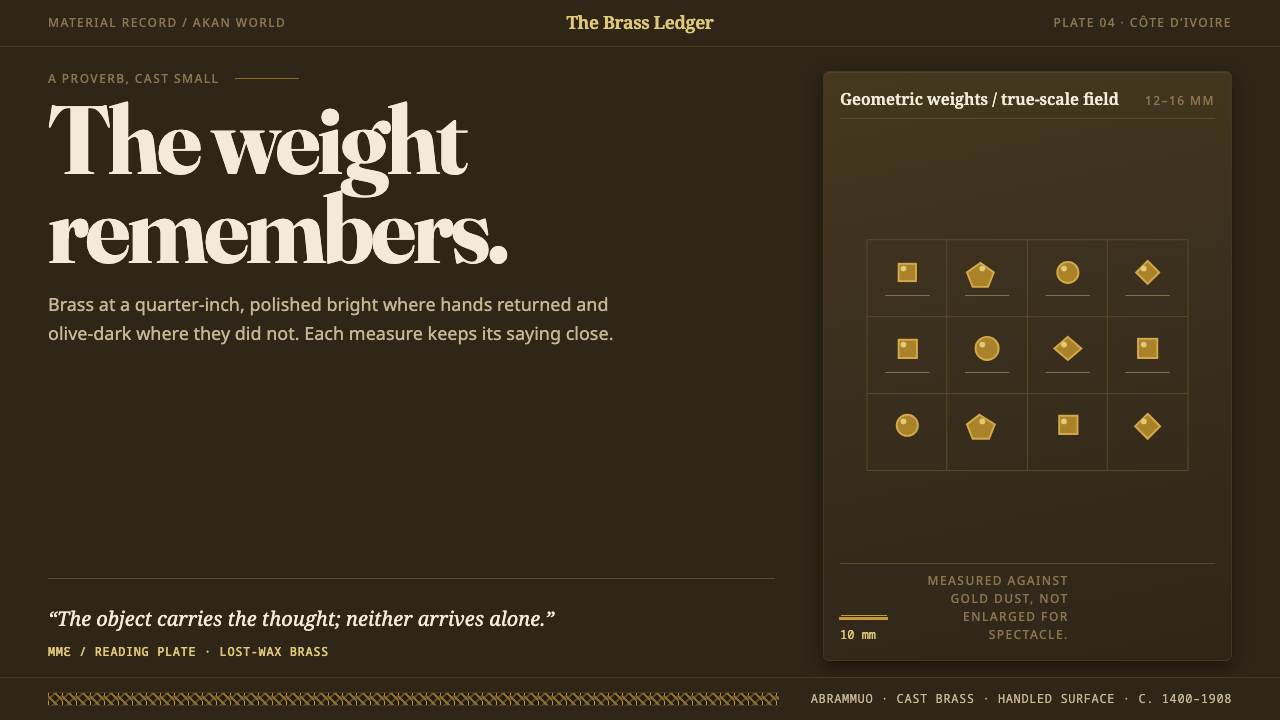 Baule GoldweightWear is the ornament. Burnished brass and olive recesses make every small wei…
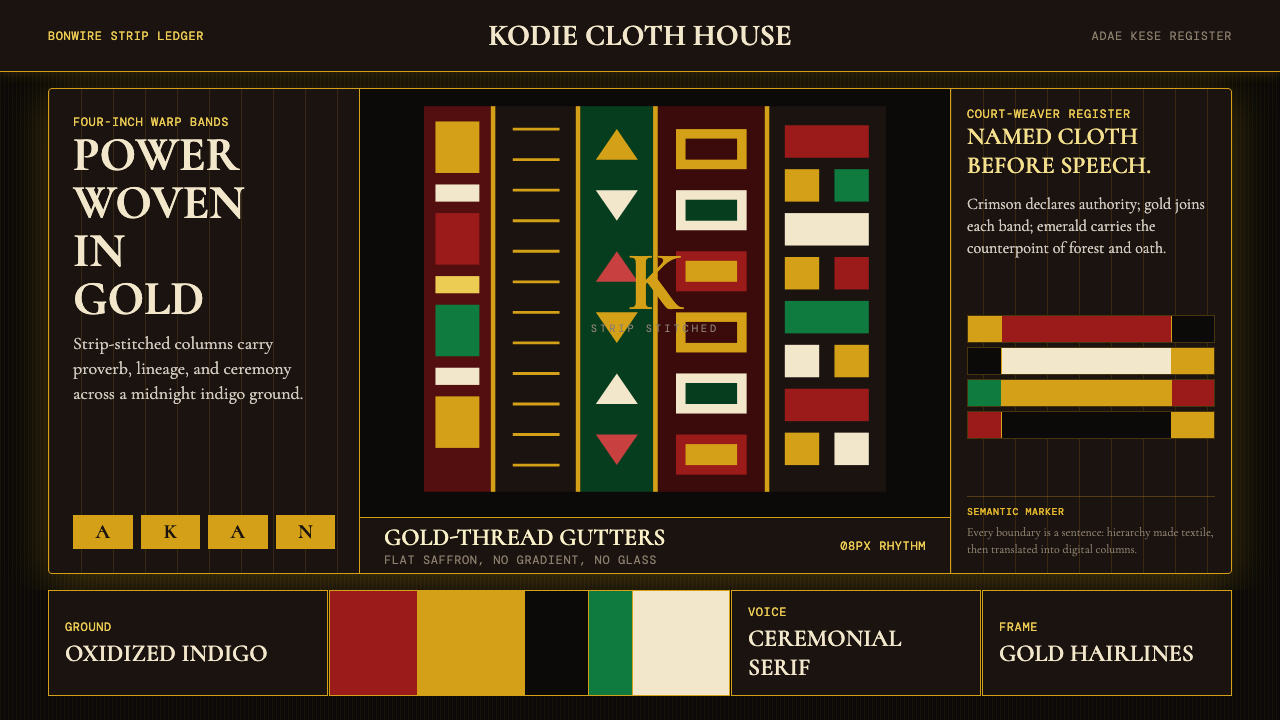 Ghanaian Kente (Asante Royal Gold)Royal authority, woven dark. Gold gutters stitch crimson and indigo strips in…
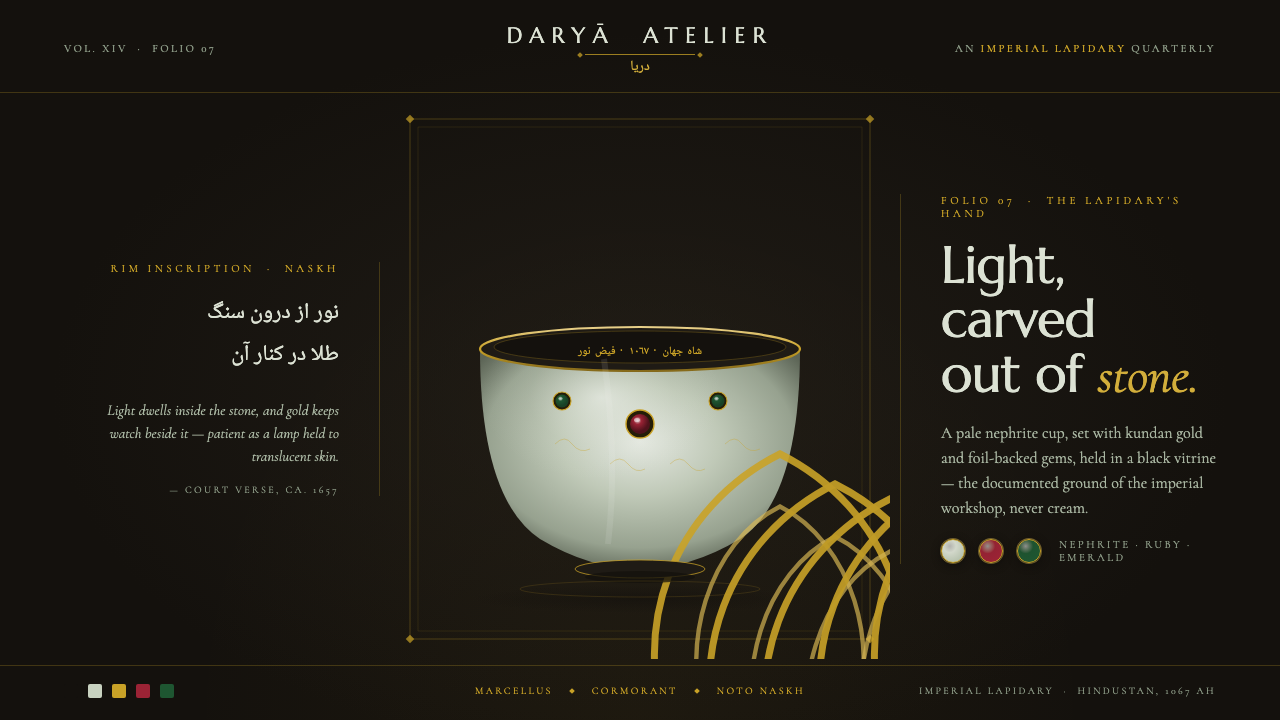 Mughal Jade CarvingImperial luxury, lit from inside. Pale nephrite glows on black, kundan gold f…
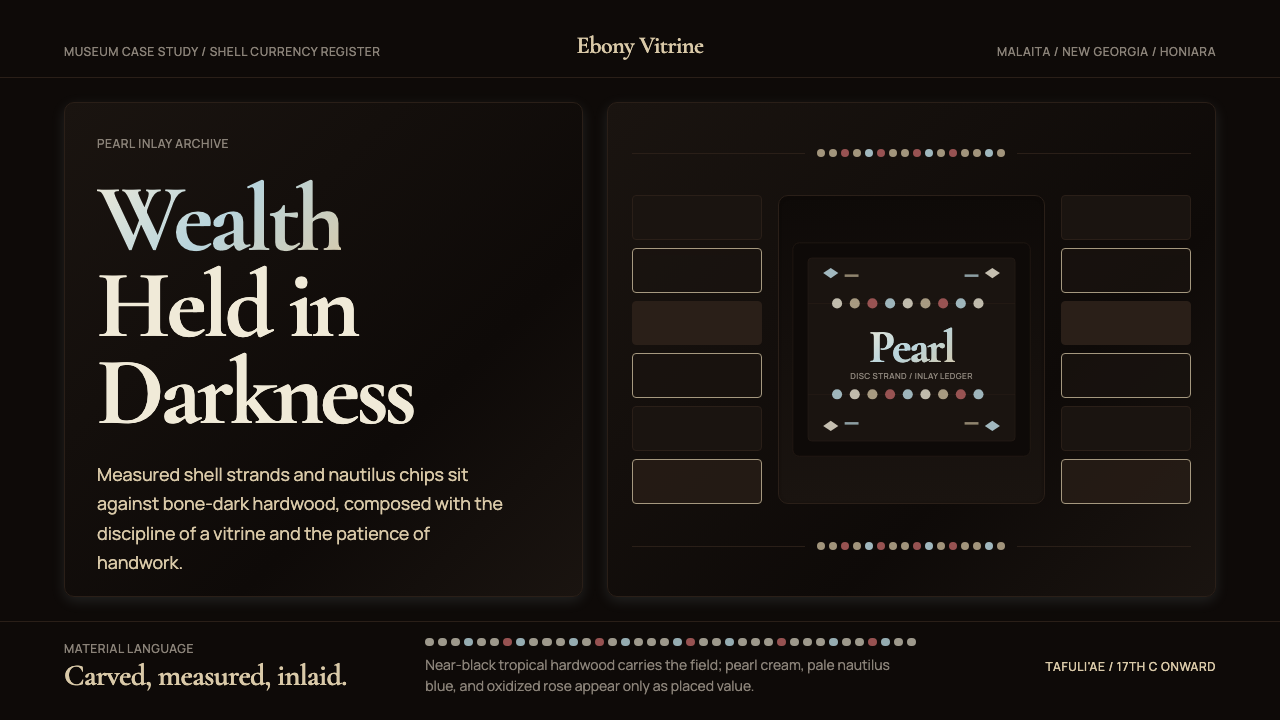 Solomon Shell Money & Pearl InlayDignity inlaid in darkness. Pearl cream and nautilus blue form strict shell-s…