What is Solomon Shell Money & Pearl Inlay?
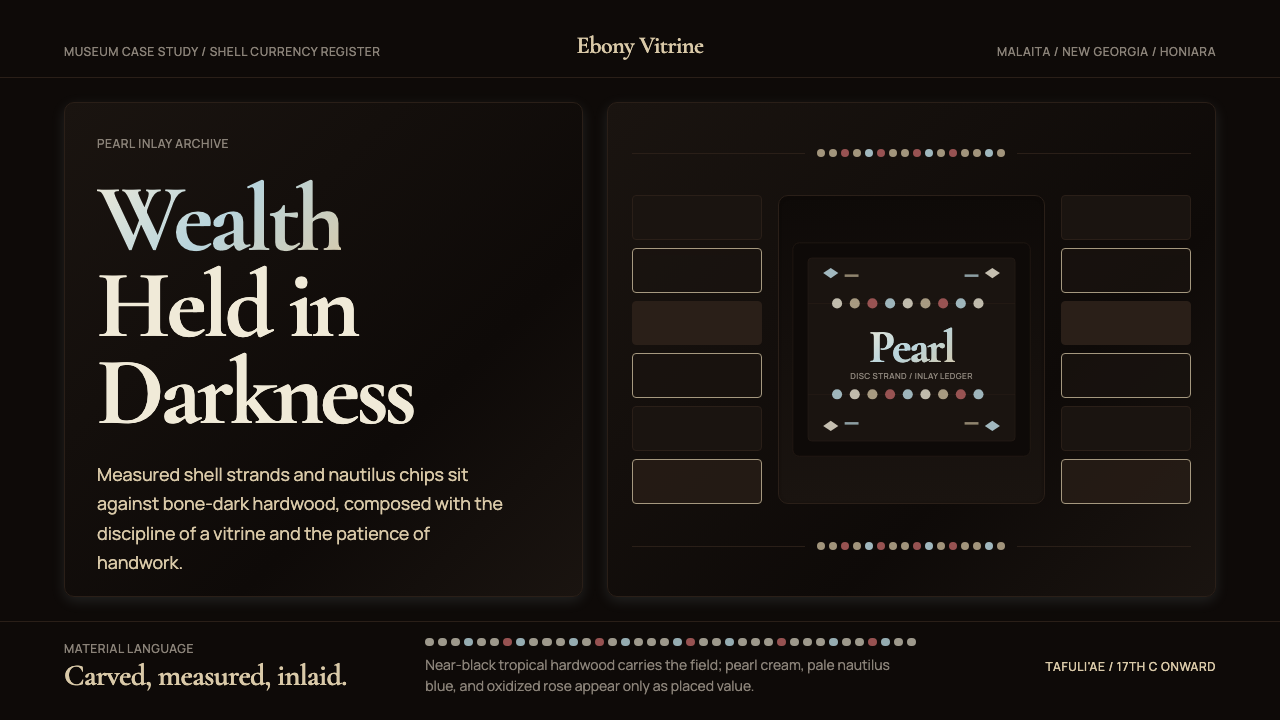
From the Langalanga lagoon to war-canoe prows, Solomon Islands shell money and pearl inlay translate wealth worn on the body into a complete visual grammar of darkness, lustre, and disciplined band.
Solomon Shell Money & Pearl Inlay in brief
Solomon Islands Shell Money & Pearl Inlay is a design aesthetic drawn from two interlocking craft traditions of the Solomon Islands: the strung-disc shell currency known as tafuli'ae, produced by the Langalanga people of Malaita Province, and the nautilus-chip inlay work carved into the ebony hulls of the New Georgia war canoes called tomoko. Together these traditions fuse exchange value with sacred ornament, producing a visual language that reads simultaneously as ledger and jewel.
The aesthetic is defined by its commitment to a near-absolute dark ground. Tropical hardwood, blackened bonito-wood, and volcanic obsidian serve as the canonical surface: so deep as to appear carved from shadow rather than grown from light. Against this ground, the shimmer of pearl — cream-white, blue-shifting, iridescent — is not scattered but organized into strict horizontal or curving bands, each row of shell discs or nautilus chips placed with the patience of a craftsperson who understands that every misaligned piece reads as poverty, not accident.
What distinguishes the style from other Pacific island aesthetics is its extreme economy of means. There are effectively two actors: the dark void and the luminous band. Secondary materials — red Chama shell, rare turquoise Tridacna chip — appear as accent punctuation within the primary pearl registers, never as independent compositional elements. The result is an aesthetic of controlled scarcity: not the absence of resources but the deliberate marshalling of them into lines of maximum radiance against maximum dark.
Where does Solomon Shell Money & Pearl Inlay come from?
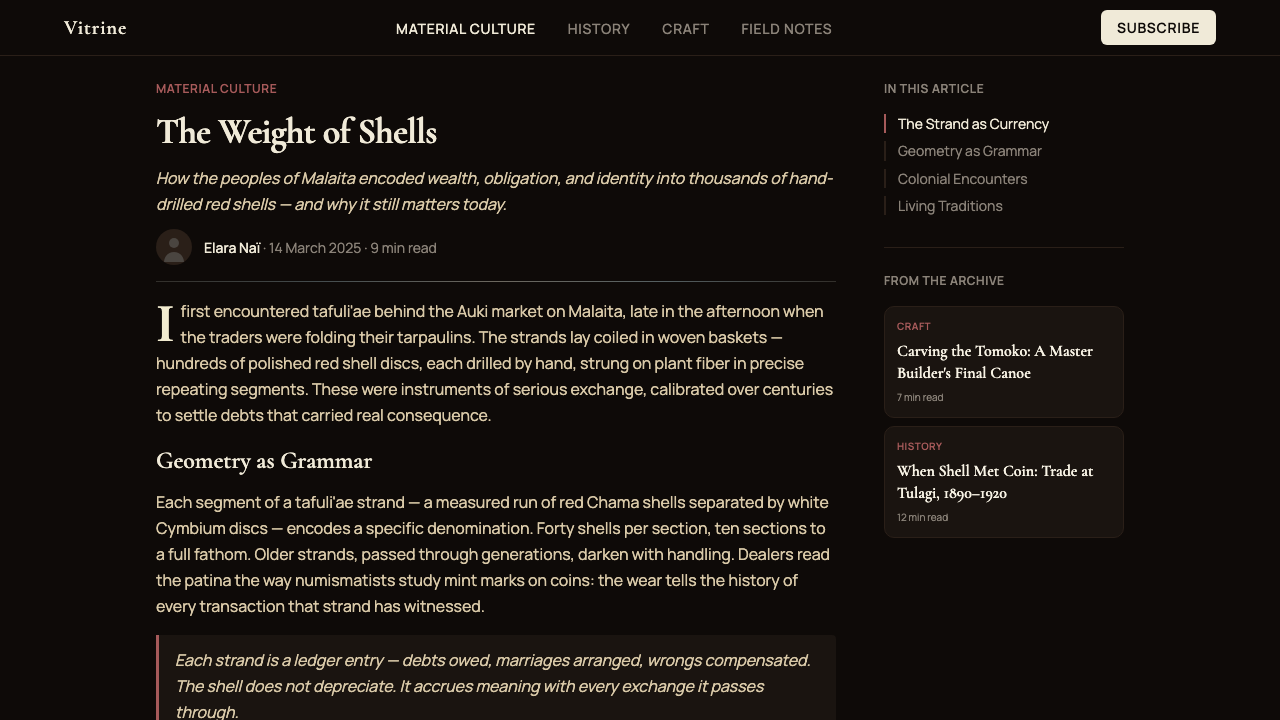
Shell money production in the Langalanga lagoon of Malaita is documented from at least the seventeenth century, though the tradition is certainly older. The Langalanga people occupy a series of artificial islands they constructed themselves in the lagoon, sustained almost entirely by the manufacture and trade of tafuli'ae — strings of ground and polished shell discs whose value is determined by colour, density of polish, and the quality of the string. Red Chama discs command the highest value; white Cymbium discs form the everyday currency. The labour of production is extraordinary: a single disc requires grinding a shell fragment against coral stone until it reaches the precise diameter and smoothness demanded by tradition, then drilling a central hole with a hand-operated bow drill. A full string of tafuli'ae may represent weeks of accumulated labour.
The inlay tradition of the Western Province centres on the tomoko, the war canoe of the Roviana and Marovo lagoon peoples. These vessels, some exceeding fifteen metres in length, were both instruments of headhunting raids and statements of chiefly prestige. Their prows, sterns, and hull washstrakes were inlaid with geometric patterns in nautilus shell — the chips fitted into carved channels in the bonito-wood planks with a precision that left no visible gap. The Hara'asi lineage of carvers in Roviana was the acknowledged centre of excellence for this work in the nineteenth century, and their patterns — interlocking triangles, step-meander borders, and radiating fan motifs — established the visual canon that later revival carvers would study.
Both traditions converged on the same visual logic through independent development: darkness as the prestige ground, luminosity as the prestige mark. In Malaita shell-money exchanges, the darkness of the string backing and the precision of each disc's alignment signal not just wealth but social authority — tafuli'ae are used to negotiate marriage, settle disputes, and compensate for death. In New Georgia canoe-building, the ebony darkness of the hull and the precision of the inlay signal the owner's ability to command the labour of skilled specialists, which is itself a measure of political power.
European contact in the late nineteenth century disrupted both traditions: headhunting raids were suppressed by the British colonial administration after 1900, and the tomoko-building tradition declined sharply with the loss of its social context. Shell money survived longer as a living exchange medium — it remains in active use in parts of Malaita today for brideprice and compensation payments — but the density and quality of production diminished as younger generations entered the cash economy. The revival of both traditions as artistic practices has been supported since the 1990s by the British Museum's Pacific Heritage programme, the Solomon Islands National Museum in Honiara, and by scholars including anthropologist Ben Burt, whose documentation of Malaita adornment established the ethnographic baseline for revival practitioners.
What defines the Solomon Shell Money & Pearl Inlay look?
Ground Darkness
The defining chromatic decision of this style is the depth of its dark ground. Backgrounds are not merely dark but approach a quality of absorbed light — the tropical hardwood or bonito-wood blacks that anchor this aesthetic have a warmth absent from pure mechanical black, a depth that reads as aged and dense rather than printed. Every other value in the palette is measured against this void. Nothing competes with it; everything contrasts it.
Pearl Lustre as the Sole Light Source
In this system, luminosity does not come from a background — it is generated by the foreground elements themselves. Pearl and nautilus inlay carry an inherent iridescence that shifts between cream-white and a cool blue-green depending on viewing angle. This colour-shifting quality means the palette appears to breathe: static in reproduction, alive in physical form. When working in digital contexts, the shimmer is evoked through layered translucency and cool highlight tones rather than through any single fixed hue.
Banding and Register Discipline
Elements in this aesthetic do not float freely. They are organized into horizontal or gently curving registers — bands whose width, spacing, and density are governed by formal rules rather than expressive improvisation. The tafuli'ae string enforces this: each shell disc must align with its neighbors in both height and tilt, and the bands must be uniform in thickness along their full length. This discipline carries into two-dimensional and digital applications as an insistence on strict horizontal alignment, consistent band weight, and the refusal of decorative irregularity.
Geometric Motif Vocabulary
Within each band, decorative vocabulary is drawn from a closed set of geometric motifs: interlocking triangles, step-meander sequences, radiating fan forms, and simple dot-in-circle punctuation. These are not naive ornament — they encode cosmological relationships and clan identities in their original context. In visual application, their value lies in their sharp angularity against rounded shell surfaces, the way hard-edge pattern reads against the soft shimmer of the ground material. No figurative representation enters the system; everything is abstracted to geometric resolution.
Accent Restraint
A secondary palette of warm red, derived from the red Chama shell used in high-value tafuli'ae, appears in this aesthetic only as punctuation — a single register of red accent within a composition otherwise dominated by dark and pearl. This restraint is part of the tradition's value logic: in shell money, the rarest material commands the highest price, and using it everywhere would dissolve the hierarchy it exists to create. The same logic governs any digital or print application of this style: warm accent appears once, at the point of maximum importance, and nowhere else.
Surface Texture and Carved Quality
This aesthetic carries a persistent sense of physical labour — the feeling that every element has been placed by hand into a prepared channel, that every edge has been shaped by a knife rather than generated by a machine. In physical craft, this is literal: each inlay chip is fitted individually. In two-dimensional work, the quality is evoked through the slightly irregular spacing between repeated motifs, the sense that bands have been measured by eye rather than by ruler. The goal is not roughness but the warm precision of handwork — accurate but not mechanical.
Verticality of Status Reading
In both shell-money strings and canoe inlay, prestige is read vertically — from the density and quality of layering across the full height of the object. A long, uniformly dense string of tafuli'ae is worth more than a short one; a canoe with continuous inlay from waterline to gunwale ranks above one with only prow decoration. This vertical-reading logic translates into layout principles that favour tall, full-bleed compositional structures over wide horizontal ones, and that signal importance through the vertical extent of a decorative register rather than its width.
Who shaped Solomon Shell Money & Pearl Inlay?
The Langalanga people of Malaita's coastal lagoon are the primary custodians of the tafuli'ae tradition, and their collective expertise — passed through matrilineal lineages of specialists — represents the living technical foundation of this aesthetic. Their work involves the full sequence from raw shell harvesting to grinding, drilling, and stringing, with the colour grading and string composition determined by generations of accumulated market knowledge. Contemporary Langalanga makers contribute to both active ceremonial exchange and to museum collection programmes.
The Hara'asi carving lineage of the Roviana lagoon in New Georgia was the acknowledged centre of excellence for tomoko inlay work in the nineteenth century. Their pattern systems — particularly the interlocking triangle series and step-meander borders — set the visual canon for Western Province inlay. The lineage's work is documented in British Museum collections and has been the subject of revival study by contemporary carvers seeking to reconstruct the technical sequence of inlay fitting from surviving historic canoes.
Ben Burt, formerly of the British Museum, conducted the foundational ethnographic documentation of Malaita adornment practices that gave revival practitioners and designers a rigorous baseline for understanding how tafuli'ae were composed, worn, and valued. His written and photographic records distinguish between the different shell species and colour grades used in different social contexts, providing the kind of granular material knowledge that prevents surface imitation from collapsing into pastiche.
Anthropologist David Akin's research on Kwaio and Malaita exchange practices placed shell money within its full economic and political context, demonstrating that tafuli'ae are not decorative objects that happen to function as currency but value objects whose entire physical form — the length of the string, the density of the discs, the quality of each individual piece — encodes the social relationships of the exchange. This framing is essential for understanding why the visual discipline of tafuli'ae production is inseparable from its meaning.
The British Museum's Pacific Heritage Programme, active from the 1990s, supported the revival of both shell-money and canoe-inlay traditions by facilitating access to historic objects in museum collections, funding workshops with practising craftspeople in the Solomon Islands, and documenting the technical sequences involved in both craft traditions. The programme represents an institutional recognition that living traditions — not just museum objects — are the primary vehicle for this aesthetic's continuity, and its work has directly influenced the visual vocabulary available to contemporary practitioners and designers working in this style.
How do you use Solomon Shell Money & Pearl Inlay today?
Solomon Shell Money & Pearl Inlay is a high-drama dark-ground style whose power depends on a fundamental compositional commitment: the dark background must dominate by area, and luminous elements must be disciplined into bands or registers rather than scattered freely. Any application that reverses this ratio — bright background with dark accents — loses the essential quality of the style and reads as generic Pacific-adjacent decoration rather than the specific tradition being invoked.
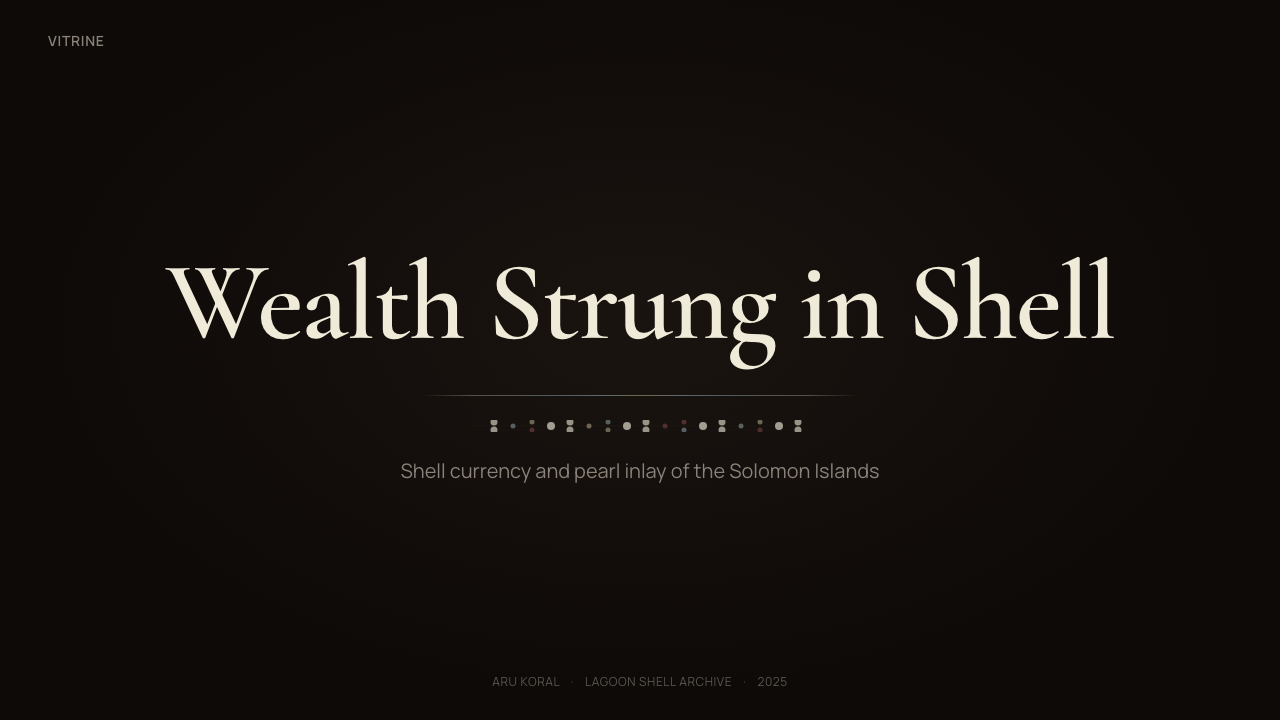
For presentation slides, the style works most powerfully as a full-bleed dark-ground system. A cover slide in this aesthetic places the title in cream or pearl-toned type on a near-black background, with a single horizontal band of geometric patterning — drawn from the step-meander or interlocking triangle vocabularies — running across the lower third. Content slides maintain the dark ground, with section headings in a pearl-luminous tone and body text in a slightly warmer off-white that reads as distinct from the heading without introducing a third colour family. Data visualization in this system uses the pearl tones for positive or primary values and a warm red accent — used once, sparingly — for the single most important data point.
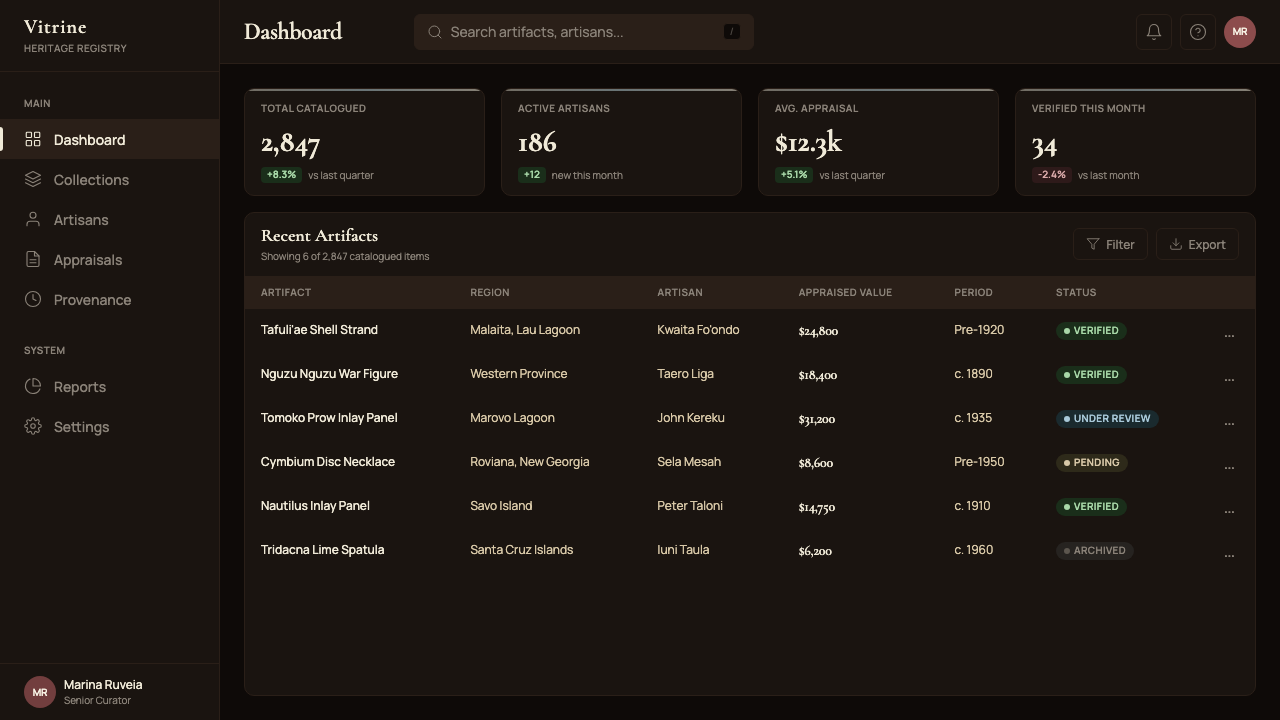
For web interfaces and dashboards, this style suits products where authority and cultural depth are brand values — luxury goods, cultural institutions, premium hospitality, or any product where the dark-ground aesthetic signals considered restraint rather than aggressive trendiness. The approach: a near-black or very dark warm-brown base colour, navigation and headers in cream-to-pearl type, interactive elements highlighted by the iridescent accent rather than by conventional blue-link conventions. Cards in this system should carry no border — the depth contrast between the card surface (slightly lighter than the darkest background) and the ground creates natural separation without the bordered look that would undercut the premium quality of the aesthetic.
For editorial and marketing work, the style's strongest application is in contexts where a vertical full-height composition can be achieved — a tall mobile screen, a printed broadsheet cover, a poster — because the sense of accumulated layering that gives this aesthetic its authority depends on vertical extent. A full-height marketing page in this system alternates between near-black feature sections with pearl-band accents and transitional sections in a deep mid-tone that prevents the reading experience from becoming visually exhausting. Pull quotes and call-to-action elements carry the warm red accent, appearing no more than twice per full-page composition.
The most common mistake in applying this style is treating it as a pearl-on-black colour story without absorbing its underlying discipline of bands and registers. Scattering luminous elements at random across a dark background produces the visual effect of a starfield — atmospheric, perhaps, but carrying none of the structural authority that this tradition embodies. The second frequent error is brightening the background out of concern that the design appears too dark for screen reading. This style depends on depth; a background that has been lightened to ease legibility concerns typically needs to be lightened all the way to a mid-tone, at which point the composition is no longer this style at all. Commit to the darkness, and solve legibility through type size, weight, and the careful selection of the cream-to-pearl foreground register rather than by compromising the ground.
Solomon Shell Money & Pearl Inlay — FAQ
Is this style appropriate for products targeting Western markets, or does it risk cultural appropriation?
The question deserves serious consideration. Solomon Islands shell money and canoe inlay are living traditions with ongoing ceremonial, economic, and social functions — tafuli'ae remain in active use for brideprice and compensation payments in Malaita today. Applying this aesthetic in commercial contexts requires informed intentionality: the more superficial the engagement (borrowing the dark-ground-and-shimmer look without understanding or crediting the source), the more likely it reads as appropriation. Deeper engagement — explicitly acknowledging the tradition, working with Solomon Islands artists and craftspeople, or supporting organisations involved in cultural preservation — transforms the dynamic. At minimum, any deployment of this style should be accompanied by accurate cultural attribution in supporting materials.
How is this style different from other Pacific island dark-ground aesthetics?
Several Pacific traditions use dark grounds — Maori ta moko, Hawaiian featherwork, and Fijian tapa cloth all involve dark-field patterning. What distinguishes the Solomon Islands aesthetic is its specific combination of features: the extreme depth and warmth of the hardwood black (rather than the cooler blacks of volcanic or carbon sources), the iridescent cool-shifting quality of the pearl and nautilus inlay (rather than the ochre and earth tones of many other traditions), and the strict horizontal band discipline (rather than the more fluid spiral or symmetrical motif arrangements common in Eastern Polynesian work). The warm-dark-plus-cool-iridescent combination is nearly unique in the Pacific material record.
Can this style work effectively in a light-background context?
A true light-background inversion of this style loses its essential character, because the entire value system of the tradition is built on the primacy of the dark ground as the prestige surface. However, a partial inversion is workable: a cream or very pale warm ground with dark woodgrain-toned typography and pearl-toned graphic accents preserves some of the material warmth of the original without committing to the full dark-ground approach. This lighter variant reads as referencing the tradition rather than fully inhabiting it, which may be appropriate in contexts where a full dark composition would impair usability — long-form reading environments, for instance.
What is the difference between tafuli'ae and other types of Pacific shell jewellery?
Tafuli'ae are functional currency, not merely ornament — this is the essential distinction. While shell necklaces and pendants exist across the Pacific as personal adornment, tafuli'ae strings are standardised exchange media with defined value grades based on shell species, colour, polish quality, and string length. They are stored, accumulated, transferred, and displayed in ways that resemble the behaviour of money more than jewellery. A long, dense string of high-grade red Chama shell tafuli'ae represents a store of value that can be converted into bride wealth, compensation payments, or political alliance — it is worn publicly on significant occasions precisely to make this value visible. This dual nature — simultaneously medium of exchange and aesthetic object — gives the visual system derived from tafuli'ae a gravity that purely decorative Pacific shell traditions do not carry.
How should typographic choices support this style?
Typography in this style serves the dark ground rather than competing with it. The preferred typographic approach uses type with a warm, slightly rounded quality — serifs with bracketed terminals, or humanist letterforms rather than geometric sans-serifs — because the mechanical precision of geometric type reads as anachronistic against a tradition defined by hand-placed inlay. Type colour follows the pearl logic: headings in the lightest, most luminous cream or white-shifting tone; body text in a warm off-white that distinguishes itself from the heading without introducing a new hue; accent elements in the warm red that also governs graphic accents. Type should never appear to float — it should feel placed, as if each line has been fitted into its own register within the composition.
Related design styles
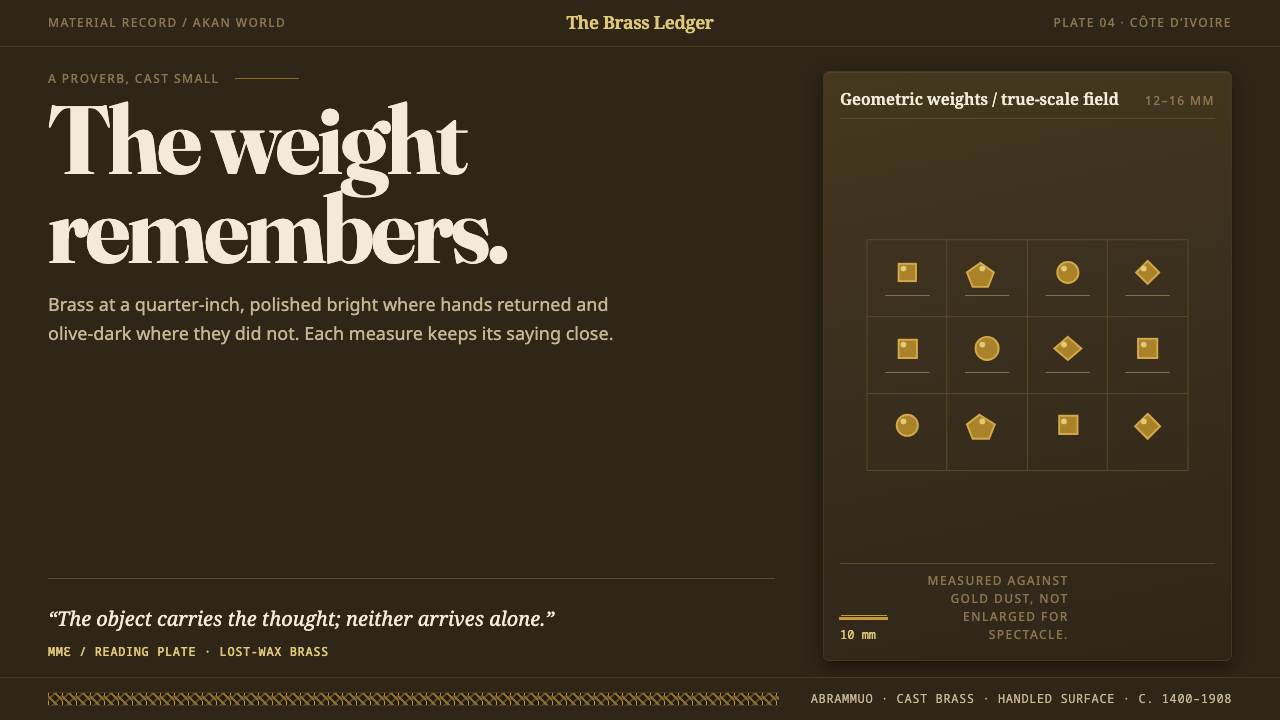 Baule GoldweightWear is the ornament. Burnished brass and olive recesses make every small wei…
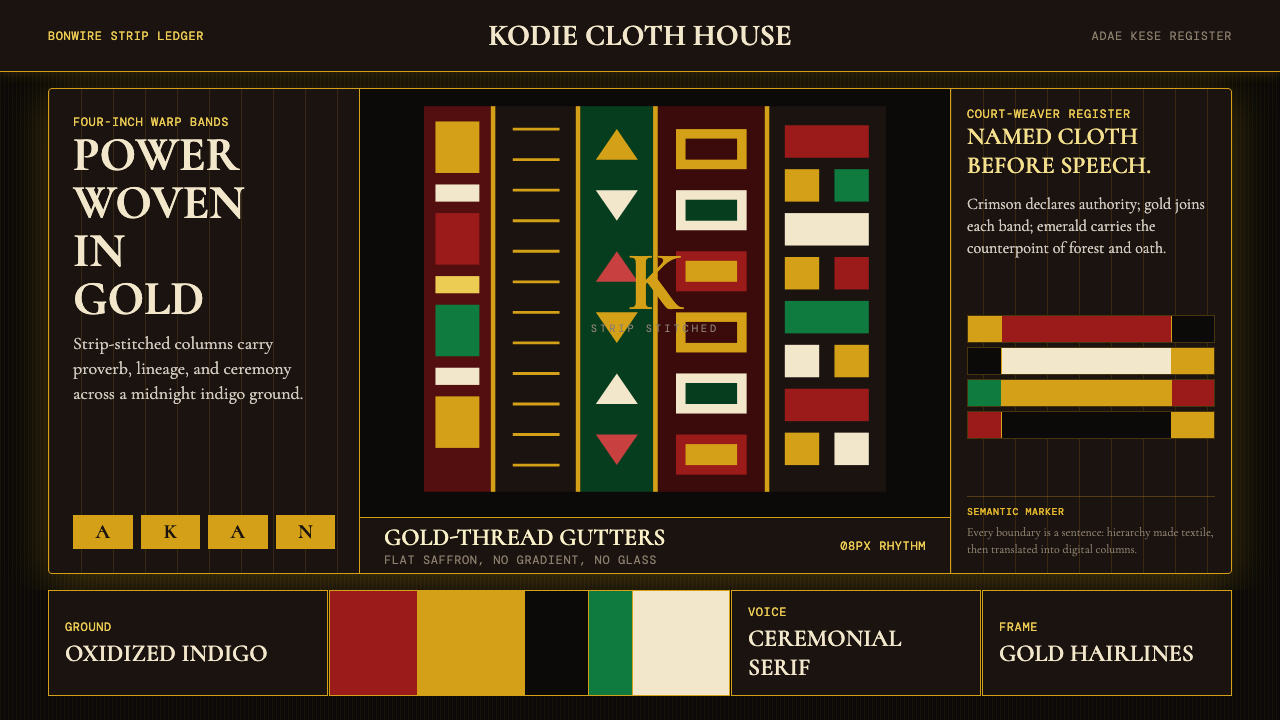 Ghanaian Kente (Asante Royal Gold)Royal authority, woven dark. Gold gutters stitch crimson and indigo strips in…
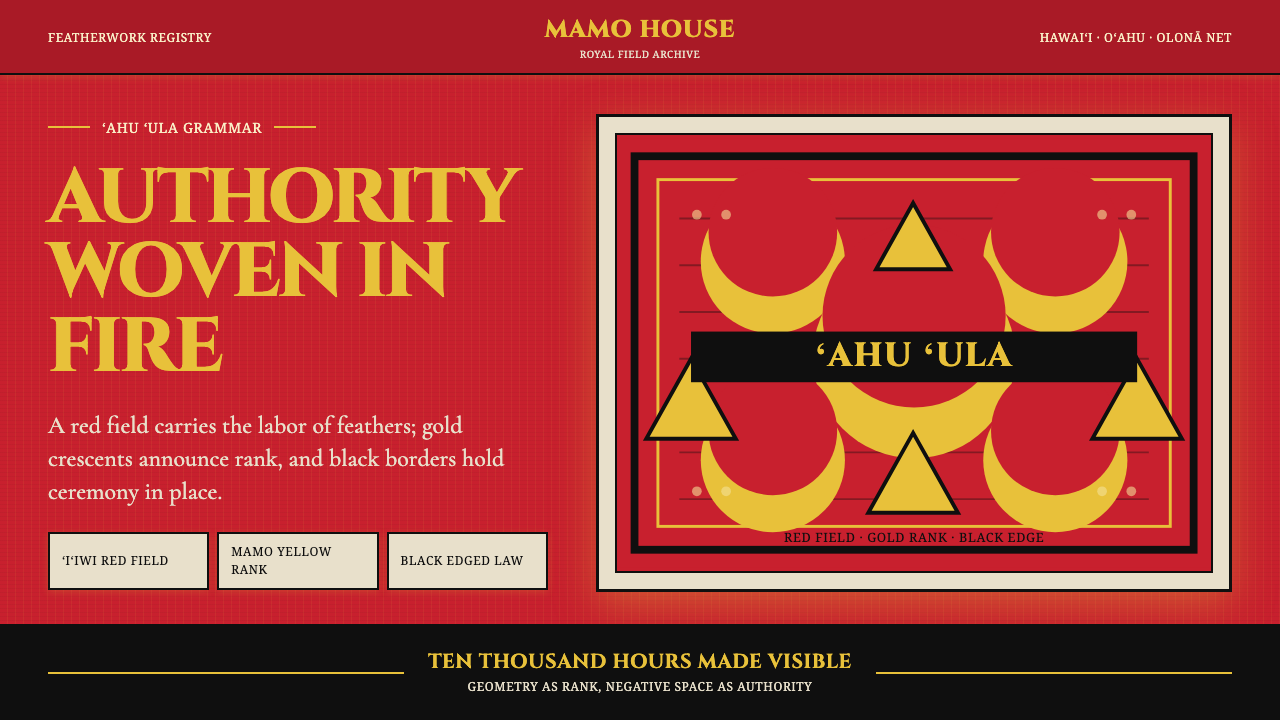 Hawaiian Feather Cape (ʻAhu ʻUla)Ceremony has weight. Red feather fields, mamo yellow crescents, black borders.
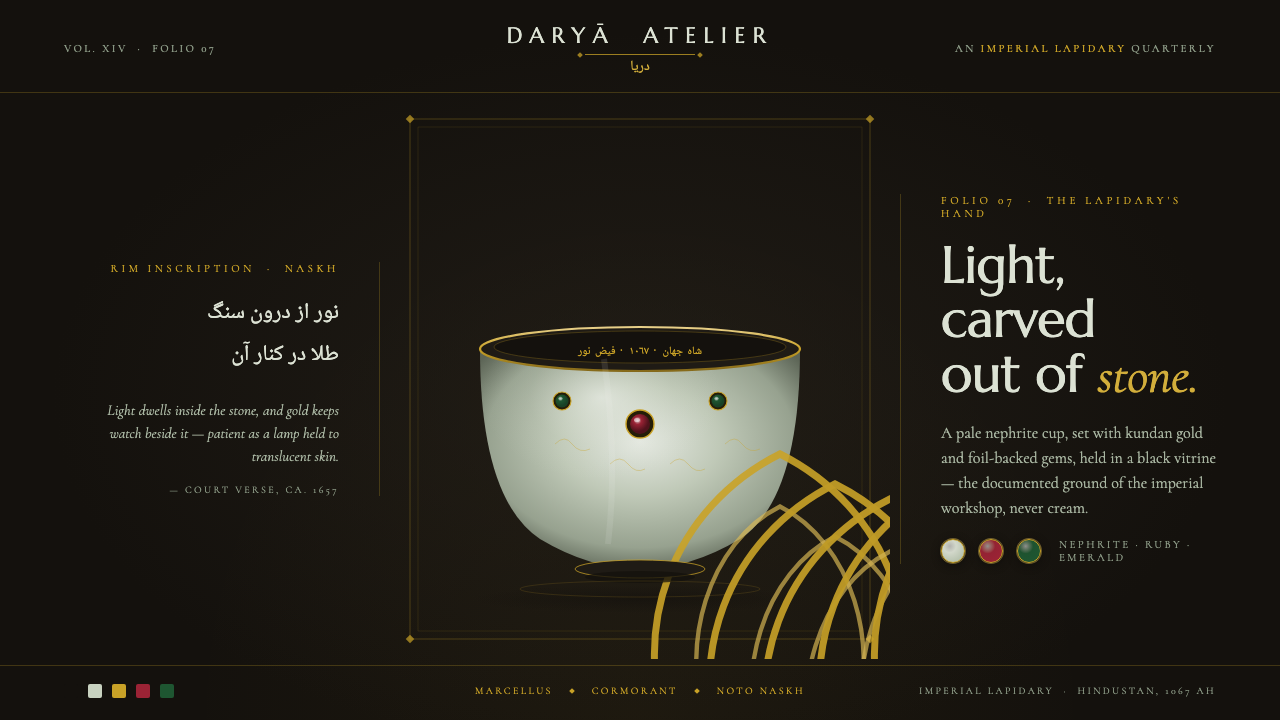 Mughal Jade CarvingImperial luxury, lit from inside. Pale nephrite glows on black, kundan gold f…
 Tuareg Agadez Cross SilverSilver refuses warmth. Cool chased geometry cuts across ebony-dark surfaces.
 Albanian Bektashi Sufi (Tekke)Sacred quiet in cypress green. Gilt stars and Cormorant type frame a dusk tek…