What is Scottish Tartan?
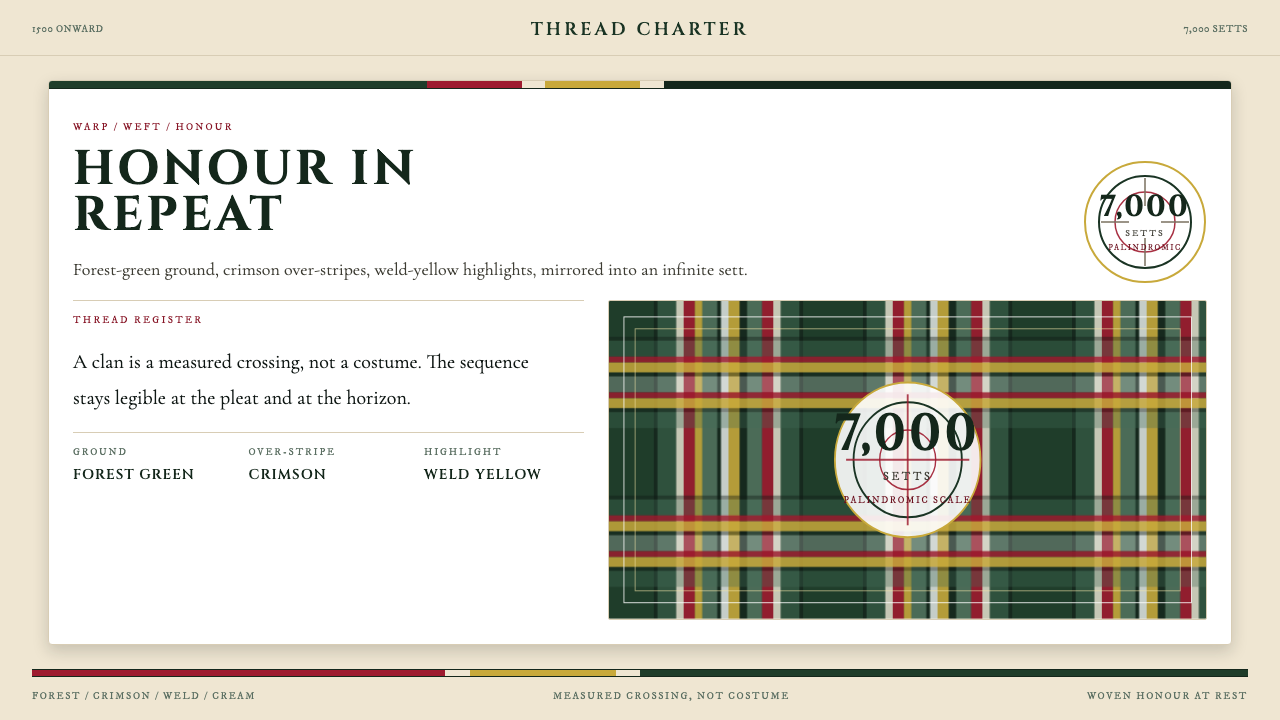
Scottish tartan is the world's most systematic identity woven in thread — every clan's honour encoded in a repeating sequence of crossed coloured stripes that scales from a kilt hem to a cathedral ceiling.
Scottish Tartan in brief
Scottish tartan is a woven textile tradition in which interlocking horizontal and vertical stripes of dyed wool — laid over and under one another in a precise numerical sequence — produce a distinctive checked or plaid surface. The defining unit of any tartan is its sett: the ordered count of threads in each colour, which, when woven on a twill loom, generates the characteristic diagonal weave lines and the subtle colour-mixing that occurs where two different stripes cross. Over seven thousand officially registered setts exist, catalogued in the Scottish Register of Tartans and the Lyon King of Arms records, making tartan the most extensively documented textile identity system in the world.
The visual language of tartan is simultaneously mathematical and deeply symbolic. A sett is not merely a pattern — it is a cipher. The specific sequence of forest green, deep navy, crimson, weld yellow, and off-white threads identifies a particular clan, regiment, institution, or region as precisely as a coat of arms. Because the warp and weft use the same sequence, every tartan has a natural pivot symmetry: stripes that move outward from any thread count reflect back identically, creating the balanced, grid-like geometry that makes tartan instantly readable at a distance. This reflective repetition is the engine of tartan's scalability — the same sett reads clearly whether woven into a narrow ribbon or a broad cape.
As an aesthetic system, tartan occupies an unusual position: it is simultaneously ancient in origin, rigidly codified in structure, and endlessly extensible in application. Its palette tends toward saturated naturalistic tones — the dyes historically derived from local plants, mosses, and lichens — giving it an organic warmth that synthetic colour systems rarely replicate. The result is a design language that feels simultaneously heraldic and handmade, authoritative and intimate.

Where does Scottish Tartan come from?
The origins of tartan weaving in the Scottish Highlands stretch back to at least the sixteenth century, when simple two-colour checks were a common fabric throughout northern Europe and the British Isles. The earliest documented reference to a specifically Scottish variant dates to 1538, in a treasury entry recording payment for tartan cloth for King James V. At this stage, however, tartan was a generic term for a particular style of woven twill — regional variation existed, but the systematic link between a specific sett and a specific clan identity had not yet crystallised. Highland weavers produced fabrics whose colour choices reflected local dyestuffs and individual taste rather than prescribed clan codes.
The clan-pattern identification system as it is understood today is substantially a product of the eighteenth and nineteenth centuries, and its history is entangled with Scotland's political upheavals. The Jacobite rising of 1745 and the subsequent Battle of Culloden in 1746 ended in catastrophic defeat for the Highland clans. The Dress Act of 1746, passed by the British Parliament, outlawed the wearing of Highland dress — including tartan — for all except military personnel, in a deliberate effort to suppress the cultural identity of the defeated clans. The ban lasted until 1782. During those thirty-six years of prohibition, tartan retained its symbolic power precisely because it had been forbidden: when the ban was lifted, Highland dress was reasserted not merely as costume but as political statement.
The pivotal moment in the modern codification of clan tartans came in 1822, when King George IV visited Edinburgh — the first British monarch to visit Scotland in nearly two centuries. The visit was orchestrated by Sir Walter Scott, the Scottish novelist and antiquarian, who stage-managed the entire affair as a Highland spectacle. Scott encouraged the Highland clan chiefs to appear in tartan dress, and the event transformed tartan from regional weaving tradition into national symbol. The commercial weaving firm Wilsons of Bannockburn, which had been producing tartan for military contracts since the mid-eighteenth century, supplied much of the cloth and catalogued setts with clan names in an effort to meet sudden aristocratic demand. James Logan's 1831 book The Scottish Gael attempted to systematise the clan-tartan correspondences, drawing partly on oral tradition and partly on invention — a pattern that would be extended, controversially, by the Sobieski Stuart brothers, whose 1842 Vestiarium Scoticum claimed to reproduce a sixteenth-century manuscript documenting the tartans of each clan, a claim that many scholars regard as a forgery.
The modern institutional infrastructure for tartan registration developed gradually. The Lord Lyon King of Arms, Scotland's heraldic authority, began exercising oversight over tartan registration in the twentieth century. The Scottish Register of Tartans Act 2008 established a formal statutory register, administered by the National Records of Scotland, which opened in 2009 and now serves as the definitive public archive. Any individual, institution, or organisation may register a tartan, provided the design is original and the application is accompanied by a thread count. This openness has produced a vast expansion in registered designs beyond the historic clan tartans — corporate tartans, national tartans for countries without Scottish heritage, memorial tartans, and individual family tartans all coexist in the register alongside the ancient setts.
What defines the Scottish Tartan look?
The Sett
The sett is the DNA of any tartan: an ordered thread count that specifies how many threads of each colour appear in each stripe, read from left to right (or top to bottom, since warp and weft share the sequence). A pivot point at each end of the sequence causes the pattern to reflect and repeat, producing the characteristic mirrored symmetry. The sett is simultaneously simple enough to be memorised and complex enough to be unique — most clan tartans involve between four and eight colours arranged in sequences of varying widths that create the layered visual rhythm of the finished cloth.
Palette
Traditional tartan palettes draw from the naturalistic spectrum of vegetable and mineral dyes: forest greens from weld and bracken, deep navies from woad and indigo, warm crimsons and scarlets from madder root, golden yellows from birch leaves and weld, and undyed off-white or cream from the natural wool. The colour relationships in a tartan are not arbitrary — darker anchor tones provide structural ground, while lighter or more saturated accent stripes carry the compositional energy. Modern tartans often extend into brighter synthetic dye ranges, but the classic setts retain a muted, organic warmth that reads as simultaneously formal and earthy.
Diagonal Twill Weave
Tartan is woven on a twill structure, which means each weft thread passes over two and under two warp threads, offset by one position with each successive row. This produces the characteristic diagonal ribbing that runs across every tartan surface and is responsible for the subtle shimmering quality of the cloth — as the weave angle catches light differently from different viewing positions. The twill weave also creates the colour-mixing effect at the crossing points of two different stripes, where the interleaving threads of both colours read visually as a third, intermediate tone.
Scale and Repetition
Tartan is one of the few historical textile patterns whose internal logic guarantees coherence across scales. Because the sett defines a proportional relationship among stripe widths rather than fixed measurements, scaling the entire sequence up or down preserves the visual identity of the pattern. A sett woven at miniature scale for a ribbon and the same sett woven at full scale for a kilt are recognisably the same tartan. This mathematical scalability — built into the pattern structure rather than grafted on — is what makes tartan so naturally compatible with digital design applications, where the same motif must work across screen sizes and resolutions.
Clan and Rank Identity
Each registered sett carries a designated purpose. Clan tartans identify the lineage and are typically worn by all members of that family and their adherents. Dress tartans are lighter variants — often substituting white for the ground colour — intended for formal occasions. Hunting tartans use muted, earthy tones to serve as natural camouflage in the field. Ancient, modern, and weathered categories distinguish dye recipes that approximate historical vegetable-dye palettes from those using contemporary synthetic dyes. The hierarchical specificity of tartan use — who may wear which sett, in which context, and in which variant — gives the system a heraldic rigour rarely found in other textile traditions.
Grid Geometry
Viewed abstractly, tartan is a grid: two identical linear sequences intersecting at right angles, generating a regular matrix of coloured rectangles and squares. The precise proportions of this grid — whether the stripes are wide and dramatic or narrow and dense — determine the overall visual weight of the pattern. Wide-set setts with high colour contrast read as bold heraldic statements; fine-set setts with closely related tones read as textured monochromes. This grid structure is what enables tartan to translate so directly into digital tile patterns, background textures, and modular layout systems, where its underlying geometry aligns naturally with the column and row structures of screens and grids.
Organic Warmth
Unlike many historical pattern systems, tartan carries a tactile warmth that survives the transition from textile to screen. This quality derives partly from the palette — the muted, naturalistic tones of traditional vegetable dyes give classical setts a depth and complexity that flat colour systems lack — and partly from the optical mixing produced by the twill weave, which means adjacent colours always appear slightly blended rather than sharply separated. This softness at the colour boundary is absent in digital reproductions of tartan, but it informs the aesthetic mood that tartan-inspired design work should aim to evoke: authoritative but not cold, structured but not mechanical.

Who shaped Scottish Tartan?
The commercial weaving firm Wilsons of Bannockburn was the dominant industrial force in the production and standardisation of tartan from the mid-eighteenth century through the early nineteenth. Based in the town of Bannockburn near Stirling, the company supplied tartan cloth to Highland regiments under military contracts — contracts that required consistent, reproducible setts — and their pattern books, which survive in archives, represent the first systematic commercial cataloguing of tartan designs. When the Highland fashion boom of 1822 created sudden demand for clan-identified tartans, Wilsons were positioned to supply cloth and assign clan names to setts, cementing the commercial-heraldic link that defines the modern tartan system.
The Scottish novelist, poet, and antiquarian Sir Walter Scott was the principal architect of tartan's transformation from regional folk tradition to national symbol. As the organiser of the 1822 royal visit of George IV to Edinburgh, Scott choreographed what he called a 'Highland pageant', dressing the occasion in tartan and urging clan chiefs to attend in full Highland dress. His historical novels — including Waverley and Rob Roy — had already created a mass-market appetite for romanticised Highland culture among English and European readers. Scott's genius was to channel that romantic appetite into a specific visual vocabulary: tartan as heraldic identity, the kilt as national dress, the Highland landscape as sublime backdrop. The commercial and cultural consequences of that channelling have never fully subsided.
James Logan was a Scottish antiquarian whose 1831 work The Scottish Gael; or, Celtic Manners, as Preserved among the Highlanders was the first serious attempt to document clan-specific tartans in systematic form. Logan compiled his information through correspondence with clan chiefs, visits to Highland communities, and examination of existing cloth samples, and his book included coloured illustrations of tartans alongside historical and ethnographic text. Although later scholarship has questioned the accuracy of some of his clan-tartan attributions — distinguishing between genuinely old family patterns and those invented or assigned in the early nineteenth century — Logan's work established the scholarly template for tartan documentation that all subsequent registers and dictionaries have followed.
The Sobieski Stuart brothers — John and Charles Edward — were perhaps the most colourful and controversial figures in the history of tartan codification. Claiming descent from Bonnie Prince Charlie, they presented themselves as custodians of authentic Highland tradition and in 1842 published Vestiarium Scoticum, which purported to reproduce a sixteenth-century manuscript itemising the tartans proper to each Scottish clan. The book was immediately influential, lending historical authority to dozens of clan-tartan attributions that collectors and manufacturers eagerly adopted. Subsequent investigation, however, strongly suggests that the supposed sixteenth-century manuscript never existed and that the brothers fabricated the attributions. Nevertheless, some of the tartans they published have become so embedded in commercial and heraldic practice that they persist in current use — an illustration of how invented tradition can acquire genuine cultural weight over time.
The Scottish Register of Tartans, established by Act of the Scottish Parliament in 2008 and opened to the public in 2009, represents the most significant institutional development in tartan governance since the nineteenth century. Administered by the National Records of Scotland, the Register accepts applications from any person or organisation worldwide, requires each entry to specify a thread count, and makes all registered setts publicly searchable online. The Register has effectively democratised tartan: what was once a system governed by hereditary right and commercial convention is now an open public archive in which a technology company, a national football federation, or an individual can register a design alongside the Campbells and the MacDonalds. As of the mid-2020s, the Register holds well over seven thousand entries.
How do you use Scottish Tartan today?
Tartan is among the most identity-laden pattern systems available to contemporary designers, and that identity-load is both its greatest asset and its chief risk. Applying tartan correctly means understanding that the pattern speaks of heritage, authority, and belonging — and ensuring that the context you place it in honours rather than parodies those associations. When tartan is used carelessly, it reads as kitsch: a shorthand for vaguely Scottish flavour. When used with structural intelligence, it becomes a powerful signal of craftsmanship, institutional weight, and cultural depth.
For presentation slides, tartan works best as a contained, purposeful element rather than an all-over background. A cover slide benefits from a bold tartan panel — occupying a full third or half of the frame — set against a clean near-white or deep charcoal field, with the title in a strong, unadorned typeface that contrasts clearly with the patterned area. The tartan should be large enough that the sett structure reads clearly; a tartan scaled so small that it becomes visual noise defeats the purpose. Content slides should step back from the pattern: a tartan-derived colour palette applied to charts, callout boxes, and dividers allows the visual system to persist without overwhelming the information. Data slides benefit from using the palette's dominant hue as the primary data colour and its accent stripe as the highlight or comparison colour.
For web interfaces, tartan suits products that want to signal craft, provenance, heritage, or premium quality — whisky brands, wool goods retailers, heritage institutions, high-end hospitality. On a dashboard or pricing page, the pattern itself rarely appears at scale; instead, the tartan-derived palette — deep greens, crimsons, navy, and warm neutrals — structures the colour system, and the grid geometry of the sett informs the underlying layout proportions. Borders, dividers, and card frames styled in tartan-weight stripes carry the visual register without requiring the full pattern. Interactive states can draw from the accent colours of the sett — the yellow or white stripe becoming the hover state, the crimson becoming a selected state.
For editorial and marketing applications, tartan's strong graphic quality suits feature spreads, campaign imagery, and packaging. A full-bleed tartan background for a hero image establishes an immediate sense of occasion and specificity. In print editorial, the pattern works well at the scale of a full spread or as a bordered frame element — the structured grid of the sett creates natural containment for typographic content. Marketing campaigns can use tartan as a repeating motif across multiple formats: packaging, digital banners, social cards, and event signage all carrying the same sett at different scales. Pairing tartan with straightforward, unornamented typography — avoiding scripts or display faces with decorative swashes — prevents the combination from reading as costume rather than brand.
A common mistake when applying tartan in design work is treating it as a generic check pattern interchangeable with gingham, houndstooth, or plaid. Tartan's specific value lies in its heraldic weight and its legible identity structure; using it as mere background texture squanders both. A second common error is scaling the sett too small, producing a visual buzz that reads as noise rather than pattern. A third is using multiple tartans simultaneously — each carrying its own identity signal — which creates visual conflict rather than richness. Choose one sett, understand its colour story, and build the surrounding design system outward from that palette and those proportions.

Scottish Tartan — FAQ
Does everyone have a clan tartan they can wear?
In contemporary practice, the conventions are considerably more relaxed than popular imagination suggests. While it is true that specific clan tartans are associated with specific family names and their historical adherents, there is no authority that enforces exclusive use, and the Scottish Register of Tartans explicitly notes that most tartans are available for general wear. Several universal tartans — including the Black Watch (used by the military since the eighteenth century), the Caledonian, and various national and district tartans — have no clan affiliation and are available to anyone. For those whose surname does not correspond to a documented clan, wearing a district tartan from an ancestor's region or a universal tartan is entirely appropriate.
How is tartan different from other plaid or check patterns?
The distinction is primarily structural and semantic. A plaid or check is any pattern produced by crossing stripes, and the term encompasses gingham, windowpane check, houndstooth, buffalo plaid, and countless others. Tartan is a specific subset defined by two conditions: it must be woven on a twill structure (not printed), and its sett must be registered or at minimum traceable to a documented source. The twill weave produces the diagonal ribbing and optical colour mixing that characterises authentic tartan; a printed check that mimics the visual appearance of tartan is technically plaid but not tartan. Semantically, tartan carries heraldic and identity freight that generic checks do not — using the word tartan implies lineage and codification, while plaid is neutral.
Can tartan work in digital design without referencing Scottish or Highland culture?
Yes, with careful handling. Tartan has long since entered the global visual lexicon as a pattern type, and its use does not inherently require a Scottish cultural claim — much as herringbone or chevron can be used without reference to their origins. What tartan always carries, regardless of context, is its structural qualities: mathematical regularity, grid geometry, and a palette with historical resonance. A design that draws on these structural qualities — using the sett geometry to inform layout proportions, or the muted naturalistic palette to build colour hierarchy — can benefit from tartan's visual logic without staging a Highland pageant. What should be avoided is deploying superficial tartan clichés — shorthand clan imagery, generic Scottish branding signals — unless the cultural reference is genuinely intentional and contextually appropriate.
Why does tartan look different depending on where it is woven and what era it comes from?
Several factors account for the visual variation in tartan across time and place. First, dye technology: tartans described as ancient use colour recipes intended to approximate pre-industrial vegetable dye palettes, which are typically softer and more muted; modern tartans use contemporary synthetic dyes that produce brighter, more saturated versions of the same sett; and weathered tartans apply a further aged treatment. Second, thread count precision: before industrialisation, hand-weaving produced slight variations in stripe width even within the same sett, giving antique tartans a more organic, slightly irregular quality. Third, wool preparation: the yarn's twist, the fleece's staple length, and the finishing process all affect how the final cloth reflects light and reads from a distance. The sett itself — the numerical sequence — is the constant; everything around it varies with materials, technology, and time.
Is it possible to create a new tartan today, and who can do it?
Creating and registering a new tartan is straightforward and open to anyone worldwide. The Scottish Register of Tartans accepts applications from individuals, families, businesses, institutions, and governments. The application requires a name for the tartan, a thread count specifying the colours and their sequence, and a brief description of the sett's purpose or association. There is no requirement that the applicant have Scottish heritage. Once registered, the sett is publicly searchable in the archive and the applicant receives formal documentation of the registration. The only condition is originality: the thread count must not duplicate an existing registered sett. This open system has produced registered tartans for organisations as varied as technology companies, sports clubs, national governments, and charitable foundations — expanding tartan's reach far beyond the Highland families that originated the tradition.
Related design styles
 Greek Antiquity (Attic Vase)Myth becomes architecture. Terracotta, black slip, and Greek-key borders fram…
 Aztec CodexSacred records stay severe. Ochre amatl ground, Cinzel capitals, black cartou…
 Gauguin — Tahiti SynthetismFlat color, hard edge. Cream canvas, coral, cobalt, and rust lock into a frie…
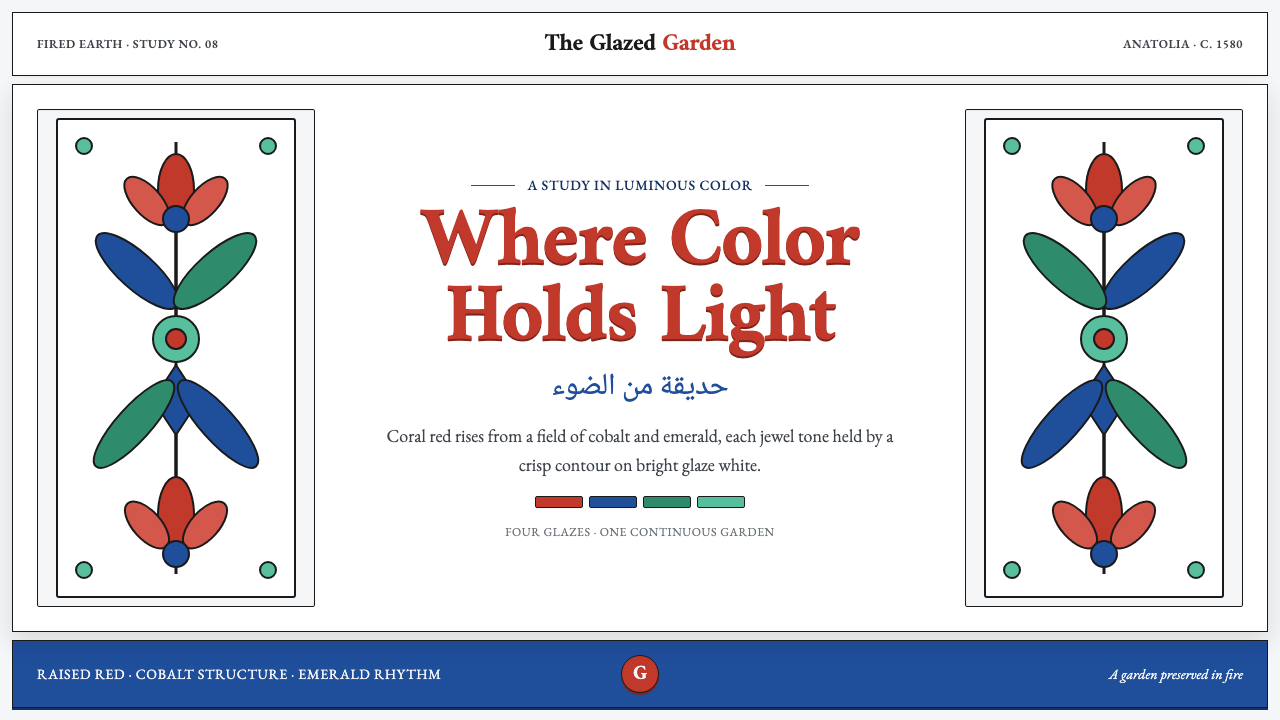 İznik Carnation PanelColor holds light. Raised coral red and cobalt ornament gleam against glaze w…
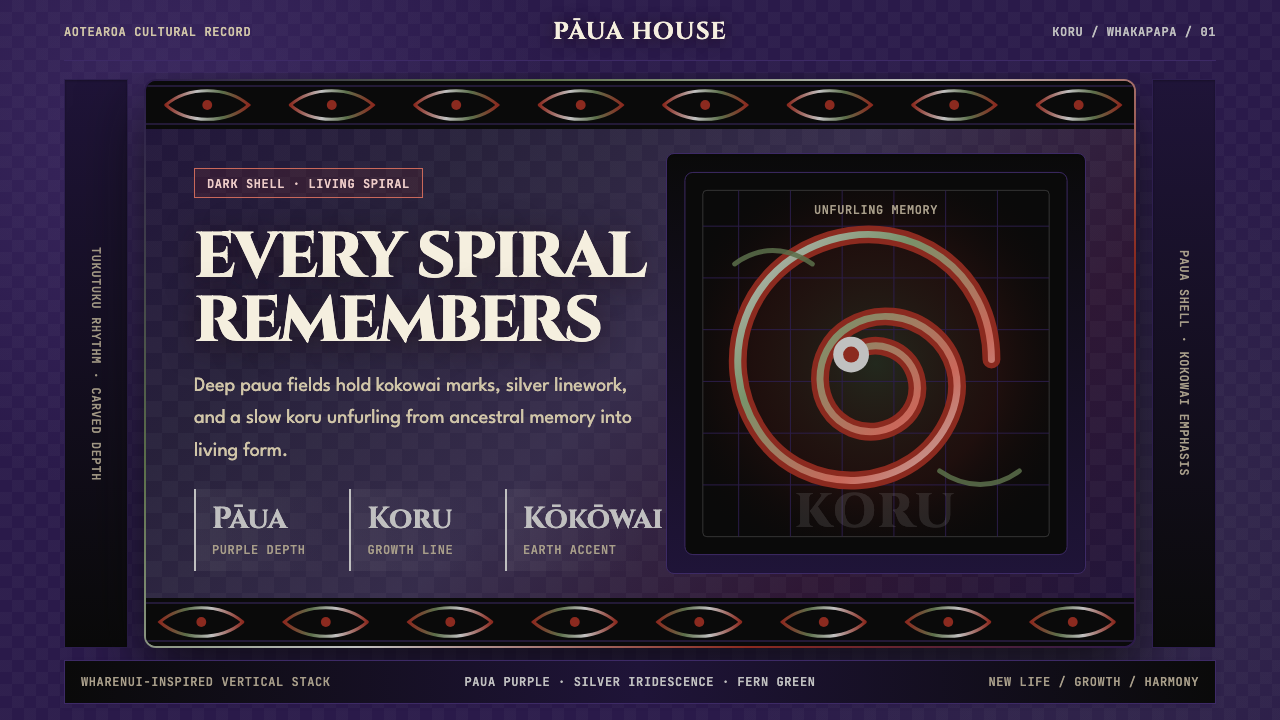 Māori Koru (Aotearoa)Ancestry glows in the dark. Paua purple, kokowai red, and silver koru frame t…
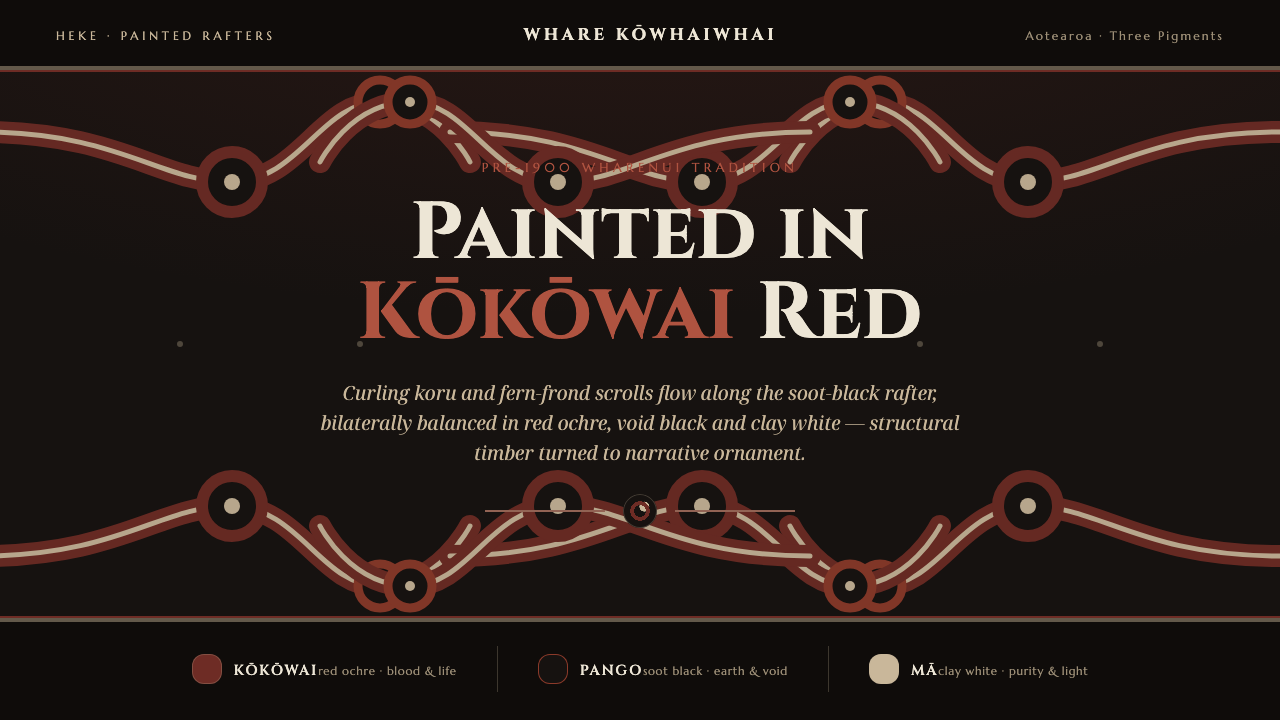 Māori Kōwhaiwhai RafterPainted timber, not pixels. Kōkōwai-red koru scrolls in mirrored balance on b…