What is Al-Qatt Al-Asiri?
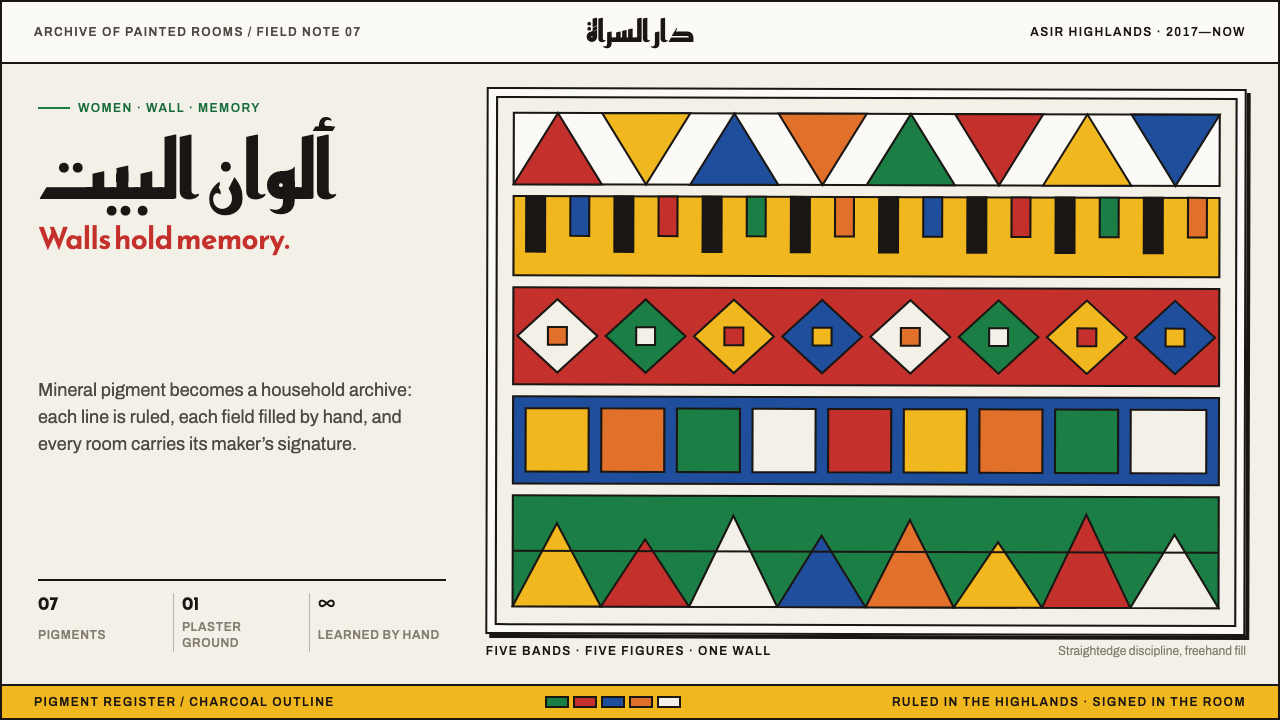
Al-Qatt Al-Asiri turns a plaster wall into a ruled page: stacked bands of flat mineral colour, outlined in charcoal, with no shading anywhere.
Al-Qatt Al-Asiri in brief
Al-Qatt Al-Asiri is the wall-painting tradition of the Asir highlands in south-western Saudi Arabia, made by the women of the region for the guest rooms of their own houses. White gypsum is plastered onto the wall, and over it go stacked horizontal bands of triangles, combs, rhombuses and banded squares, each band ruled to a straightedge and filled freehand in flat, opaque colour. UNESCO inscribed the practice on its list of intangible cultural heritage in 2017, and it has been in active revival since.
The result is a wall that works like a ruled page. Roughly seven pigments share a single wall, and every one of them comes from a named material: charcoal, iron-bearing stone, sedimentary rock, turmeric, pomegranate peel. The paint is flat, so colour is a field rather than a gradient, and charcoal draws the outlines. Nothing is shaded and nothing is blended. Patterns are built by repeating and varying a small vocabulary of shapes in rows.
As a design system the style keeps this logic whole: a plaster-coloured page, hard-edged colour fields, charcoal outlines, bands that stack like rows in a table, and the slight sway of a hand-ruled line left in on purpose. It is one of the most disciplined flat-colour traditions a designer can borrow from, and one of the most generous in the way it organizes a great deal of colour without chaos.
Where does Al-Qatt Al-Asiri come from?
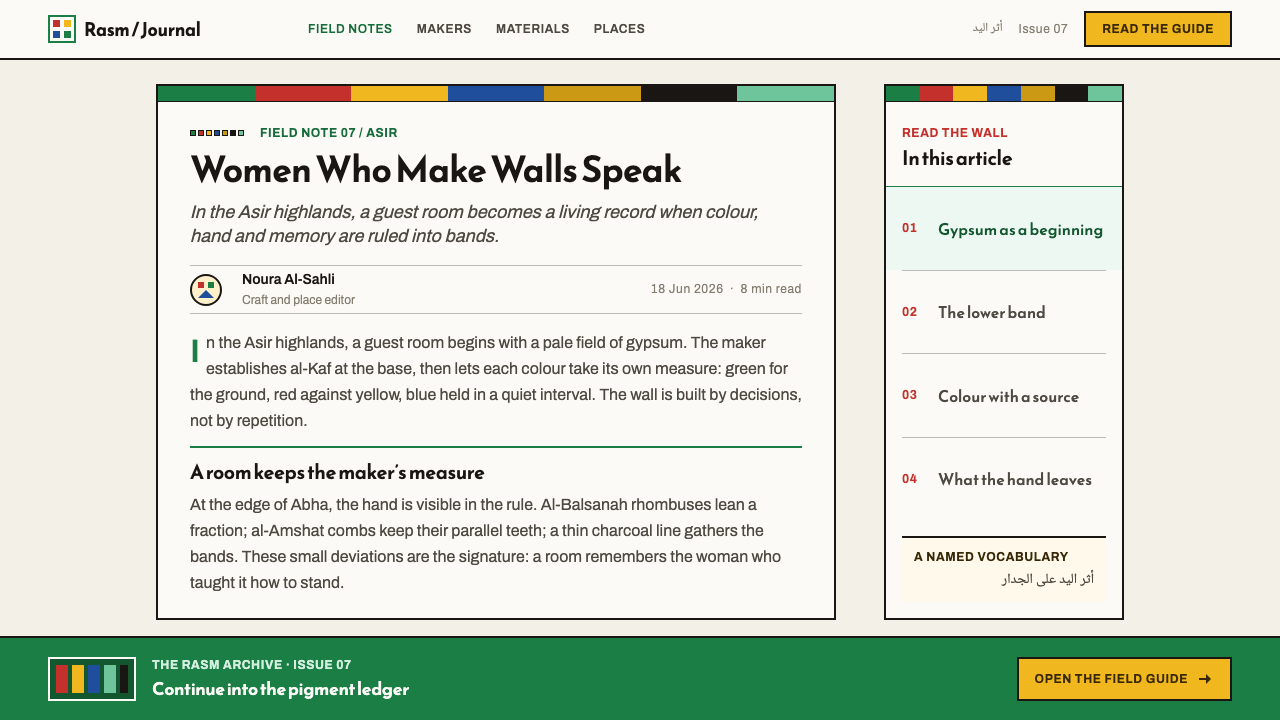
The Asir highlands are mountainous country in south-western Saudi Arabia, with villages around Abha and Rijal Almaa, and houses whose walls have long been surfaces for decoration. Al-Qatt Al-Asiri belongs to this vernacular architecture. It is women's work: the women of Asir paint the walls of their own homes, above all the guest room, the space where a house shows itself to visitors. The painting is therefore domestic, communal and personal at once, a long-standing house practice rather than a studio art.
Method is the heart of the tradition. Gypsum, mined in the mountains, is plastered onto the wall to make a white ground. Painters then lay out horizontal bands with a straightedge and fill them by hand, with brushes, fingers and palm fronds, in flat opaque colour. The pigments all have named sources: charcoal and plant resin for black, iron-bearing ore and cochineal for red, sedimentary rock for blue, alfalfa for green, and sulphur stone, turmeric and pomegranate peel for yellow. Colour is therefore tied to place and material, and the palette is limited by what the mountains and the kitchen can supply.
In 2017 the tradition was inscribed by UNESCO on its list of intangible cultural heritage, and the period from then to the present is described as one of active revival of a long-standing house practice. Fatima Abou Gahas is the name most often given when a single person has to stand for the tradition, though the practice belongs to the women of Asir collectively. The recognition has moved a domestic skill into public view, and with it comes a responsibility on anyone who borrows the look.
The design system takes the logic of the wall, not its specific patterns. A gypsum-coloured ground, hard-edged colour fields, charcoal outlines and a limited, named palette are the rules; the triangles, combs and rhombuses are a vocabulary the system draws on in spirit. It also keeps the telltale sway of hand ruling, because that sway is the proof that a person made the wall. Using the style well means treating it as the work of a particular community of women, crediting it, and resisting the urge to smooth it into vector perfection.
What defines the Al-Qatt Al-Asiri look?
Gypsum Plaster Ground
The page is a matt white plaster, slightly warm and slightly uneven, never a glossy screen white. It is the one calm surface against which every colour band is read, so it should stay large and quiet and free of textures that compete with the paint.
Stacked Horizontal Bands
Decoration is organized in horizontal bands, each ruled with a straightedge and stacked from one to the next like rows in a table. A band has its own internal logic, so a wall reads as a sequence of short, orderly sentences rather than one crowded picture.
Geometric Vocabulary
Triangles, combs, rhombuses and banded squares make up the working vocabulary. They repeat along a band, sometimes flipped or recoloured, so variation happens inside a strict small set. A designer can borrow the discipline of a limited kit that is used many times in many ways.
Flat, Opaque Colour Fields
Every colour is laid down as a flat, opaque field with a hard edge. There is no gradient, no tint ramp and no blending between neighbours. Because the colour does not change inside a field, each shape reads instantly, which is why the style stays legible even when it is richly coloured.
Charcoal Outline
A dark charcoal line draws the edge of shapes and the separations between bands. It holds the flat fields together, the way lead holds glass, and it gives colours that might otherwise clash a common border. The outline is what turns a pile of colours into a system.
A Palette With Named Sources
Roughly seven colours work a wall: a charcoal black, an iron red, a sedimentary blue, a plant green and a few yellows from turmeric and pomegranate. Each is earthy and a little muted, because it comes from a material. A palette with sources feels grounded, and it should be limited in the same way.
Hand-Ruled Sway
The lines are ruled to a straightedge, yet a hand still leaves a slight lean, a wobble at a corner, a small difference in band width. The system keeps this on purpose. It reads as warmth and proof of making, and removing it turns the wall into a template.
Who shaped Al-Qatt Al-Asiri?
The best-known individual name linked to Al-Qatt Al-Asiri, and the one most often given when a single person has to represent it. Her name is a useful reminder of authorship: the tradition is made by named painters, even when it is described as heritage.
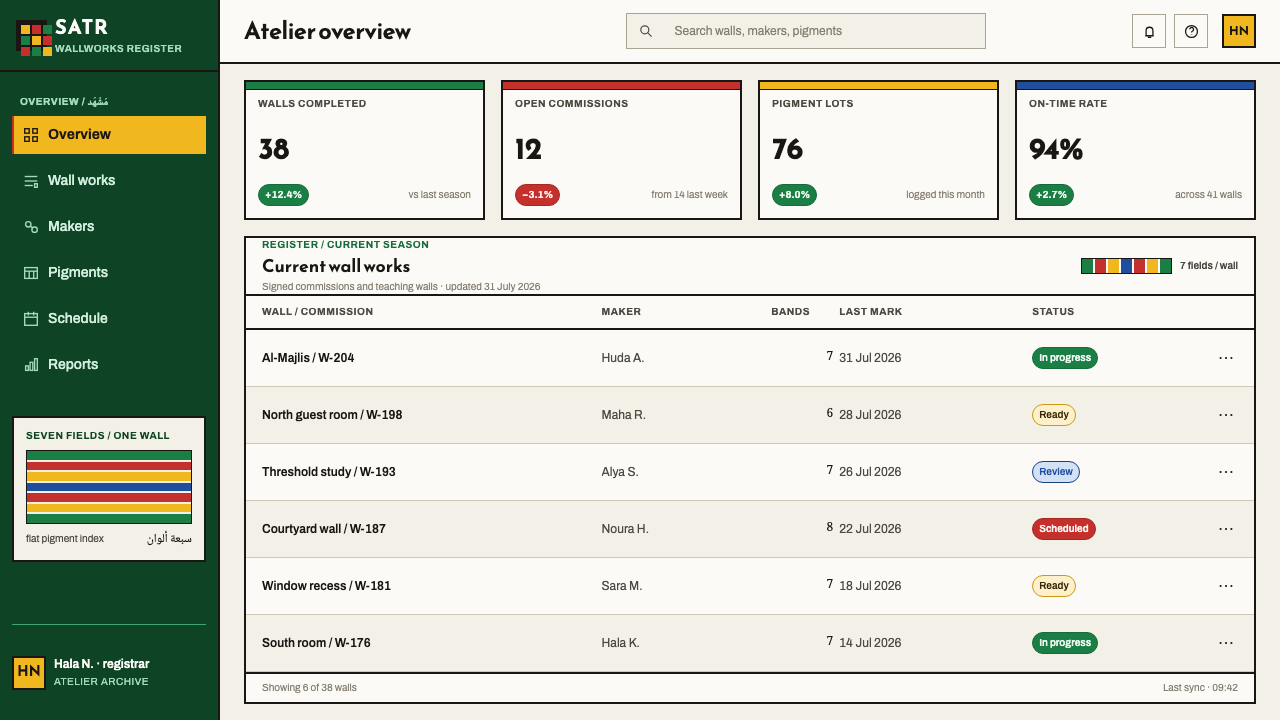
The tradition's real authors. Painting the guest rooms of their own houses, they developed and maintain the system of bands, motifs and pigments that this style borrows. In design terms they are the origin of every rule: the ground, the ruling, the palette and the outline.
The United Nations cultural organisation, which inscribed Al-Qatt Al-Asiri on its list of intangible cultural heritage in 2017. The inscription is the reason the practice has wider visibility today, and a good reason to treat the style as heritage rather than as mere ornament.
How do you use Al-Qatt Al-Asiri today?
Al-Qatt Al-Asiri suits work that wants to feel crafted, warm and rigorously organized at once. Its secret is that it carries a great deal of colour without chaos, because everything sits in a band, in a field, inside an outline. Keep that structure and you can use the style for anything that wants to feel handmade without feeling messy. A quick check: cover the colour with your hand, and the page should still read as a ruled sheet of bands.
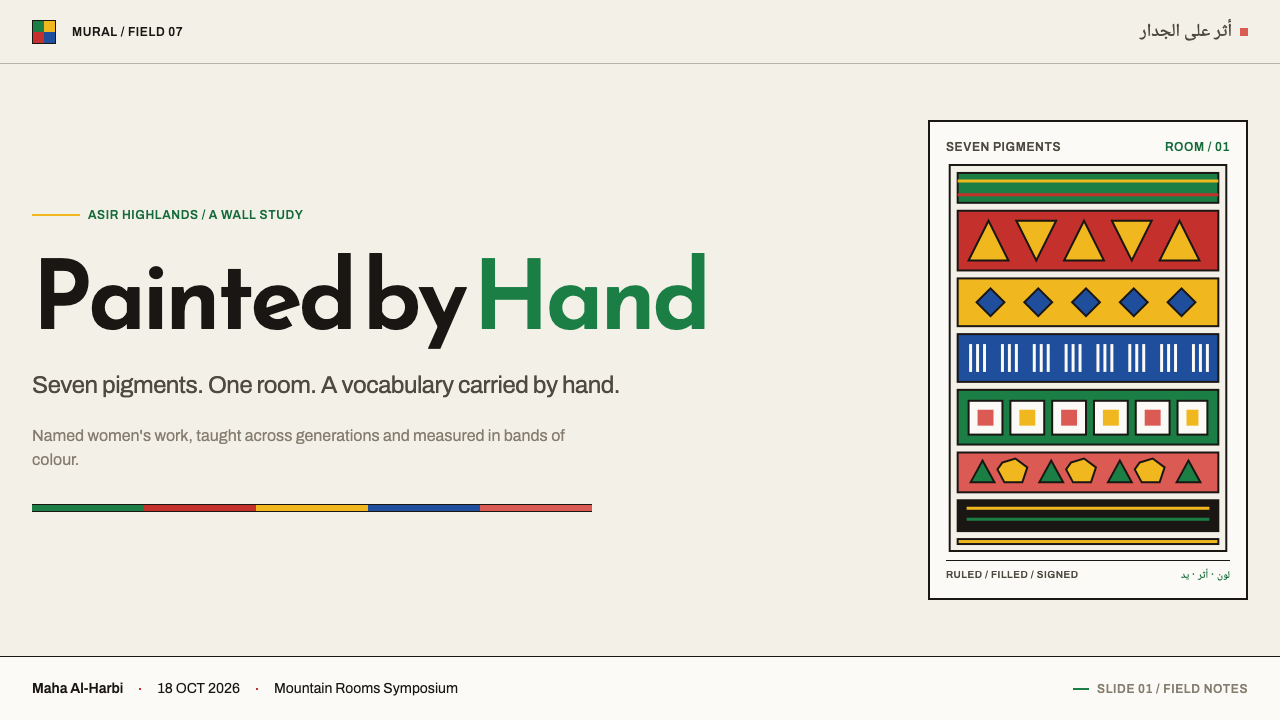
On slides, a cover can be a plaster-coloured field with one wide band of triangles and colour blocks along the top or bottom and a title in a heavy, plain face. Content slides are ruled pages: horizontal bands separate topics, each band is a flat colour field with a charcoal edge, and text sits inside clean fields. For data, treat charts as bands. Bar charts become stacked fields with outlines, each category takes its own flat colour from the palette, and no chart receives a gradient or a shadow.
In interfaces, the plaster ground is the page and sections are bands. Cards are flat fields with charcoal outlines, buttons are solid flat colour with the same outline, and badges and tags are small banded squares. Dashboards benefit, because categories are easy to tell apart when each one is a hard-edged field. There is no elevation in this style, so separation comes from outlines and bands. A pricing table can run as adjacent coloured columns, each outlined and flat.
Editorial and marketing work can use bands as dividers and headers: a running band of comb or triangle motifs between sections, a coloured band behind a pull quote. Photography sits in flat-edged frames. Because the palette comes from named pigments, imagery works best when it is also earthy and grounded: craft, landscape, food, homes. Body text stays in a plain face on the plaster ground, with the colour kept to the bands around it.
The usual mistake is treating the palette as a free-for-all. Roughly seven pigments share a wall, but they are organized: a band has a logic, and colours repeat within it. Bright saturated colour everywhere with no outline turns the style into a children's craft look. The second mistake is smoothing, because gradients, drop shadows and perfect vector geometry all remove what makes the style. The third is copying actual house patterns into logos or products; use the vocabulary as inspiration, and credit the women of Asir.
Al-Qatt Al-Asiri — FAQ
Is Al-Qatt Al-Asiri the same as Islamic geometric pattern?
No. It is a vernacular wall-painting practice with its own materials, made freehand and ruled by hand, and organized in horizontal bands rather than as continuous interlocking patterns. Its colours are flat, earthy and outlined in charcoal. Treat it as a specific Asiri tradition, not as a general Arabian or Islamic look.
Why does every shape have a charcoal outline?
The outline holds flat colour fields together and gives neighbouring colours a shared border, so many colours can sit side by side without clashing. It also keeps edges hard, which is central to the style. Without the outline, flat colour tends to look like a children's craft rather than a disciplined system.
How many colours should I use?
A single wall carries roughly seven pigments, so treat that as an upper limit for a page. Give each colour a job: black for outline, a red, a blue, a green and a few yellows for fields. Colours should repeat within a band so the page reads as ordered rather than busy.
Can I add gradients or shadows for depth?
No. The wall is a plaster page with flat paint on it, so there is no shading anywhere. Depth is replaced by order: bands, outlines and repetition. If you need to separate elements, use an outline or a band, not elevation or blur.
Does the style work in dark mode?
The ground is white plaster and the outline is charcoal, so the system is naturally light. A dark version loses the contrast that makes the outlines work. If you must, put the bands on a deep charcoal field and keep the colour fields bright and flat, and accept that it is an adaptation rather than the tradition itself.
Related design styles
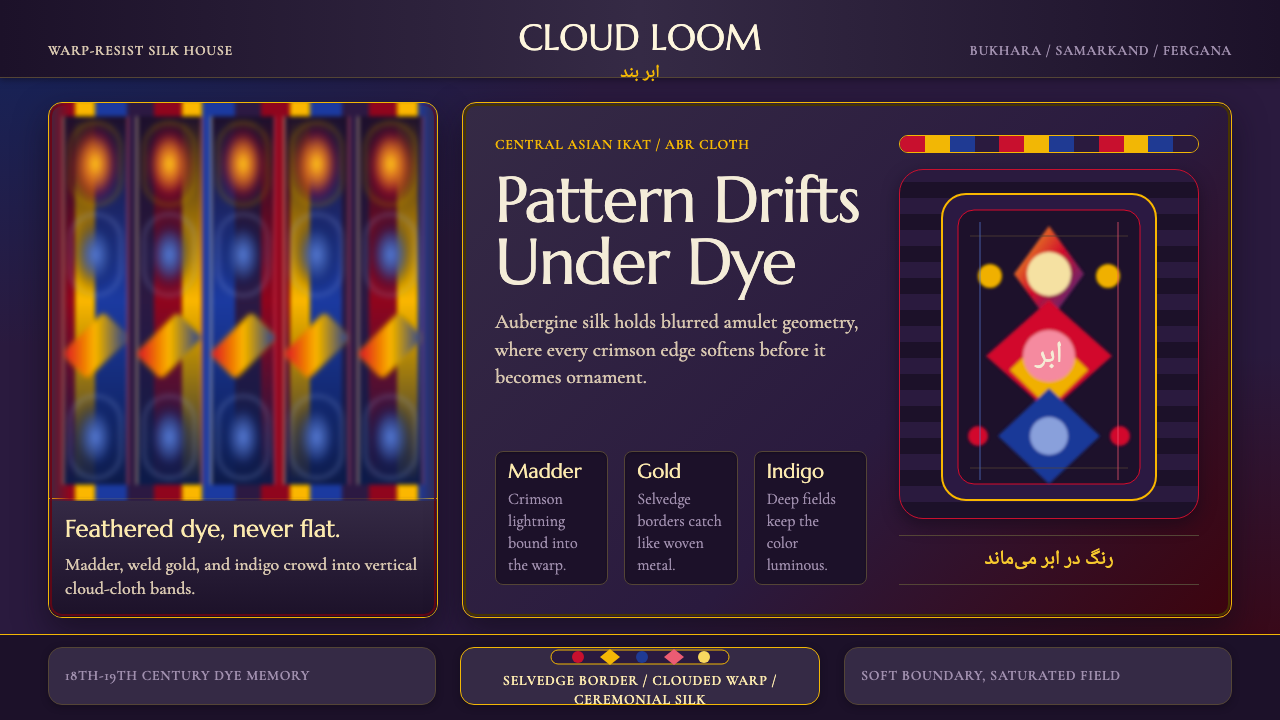 Central Asian IkatMaximal silk haze. Madder, gold, and indigo warp bands feather across aubergi…
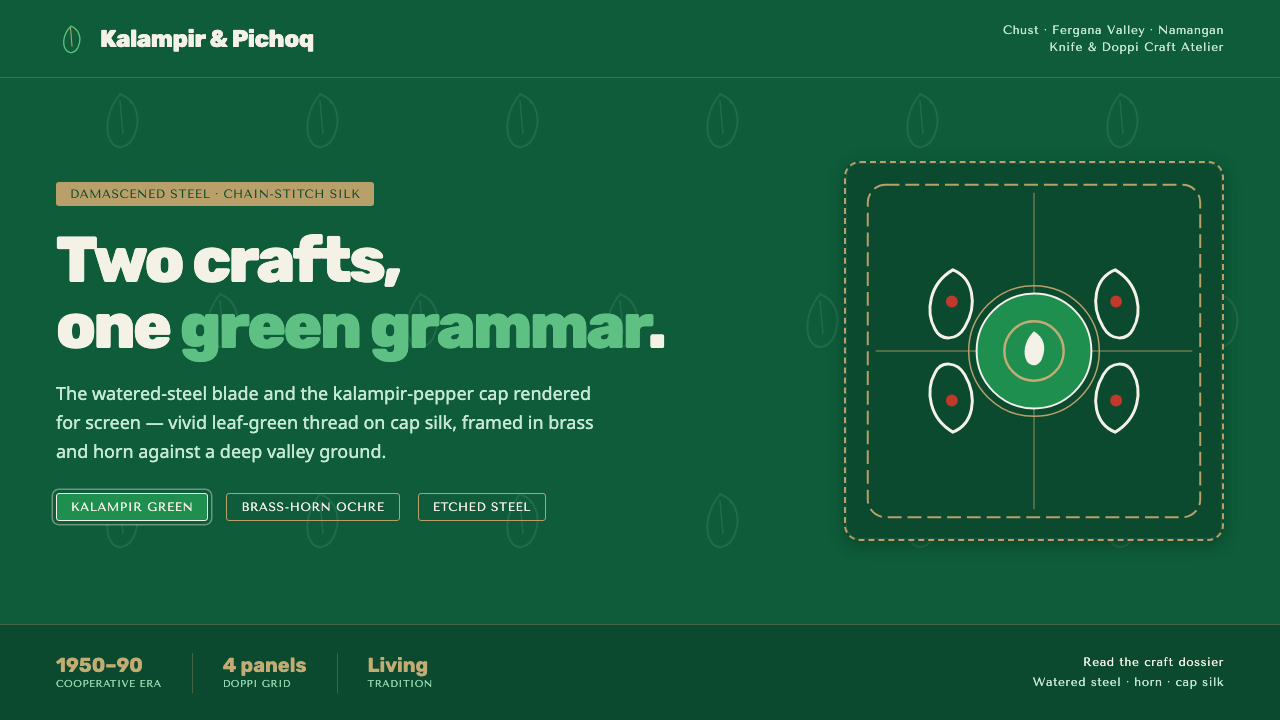 Chust Pichak Knife CraftTwo crafts, one green grammar. Vivid kalampir chain-stitch on cap silk, brass…
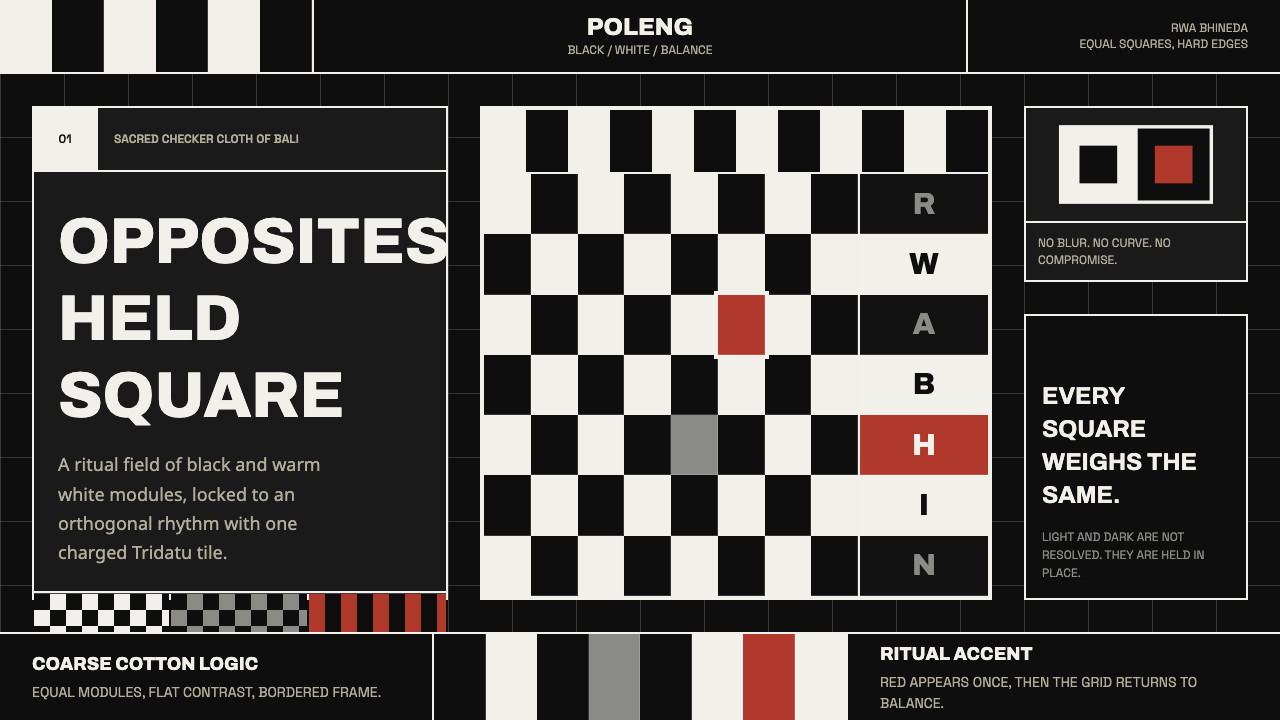 Balinese Poleng ClothSacred duality holds. Black-white squares lock the field; one red tile charge…
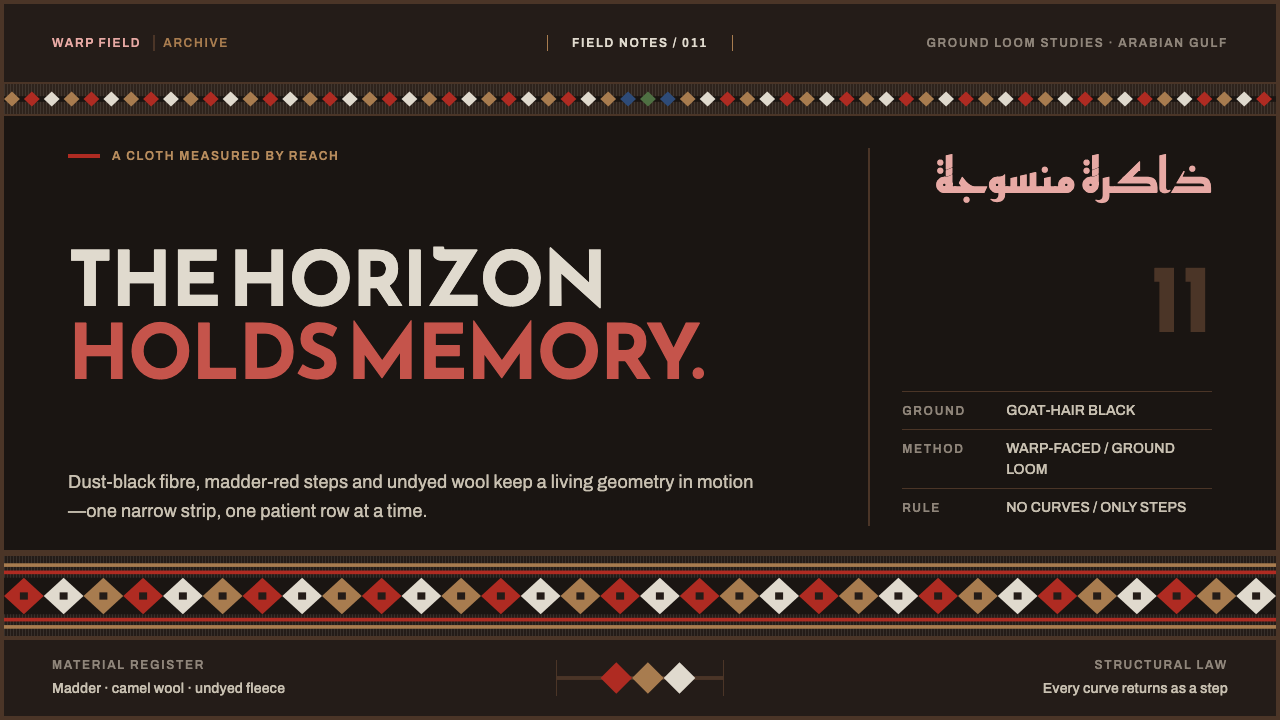 Emirati Sadu WeavingMemory runs in bands. Madder steps cross dusty goat-hair black with no curve…
 Ethiopian Injera Mesob SpreadHospitality is woven in. Berbere red, flag bands, and an injera field hold th…
 Fileteado Porteño Sign ArtBlack lacquer turns maximal. Gold scrolls, blue ribbons and Gothic shadows gl…