What is Ambalangoda Raksha Mask?
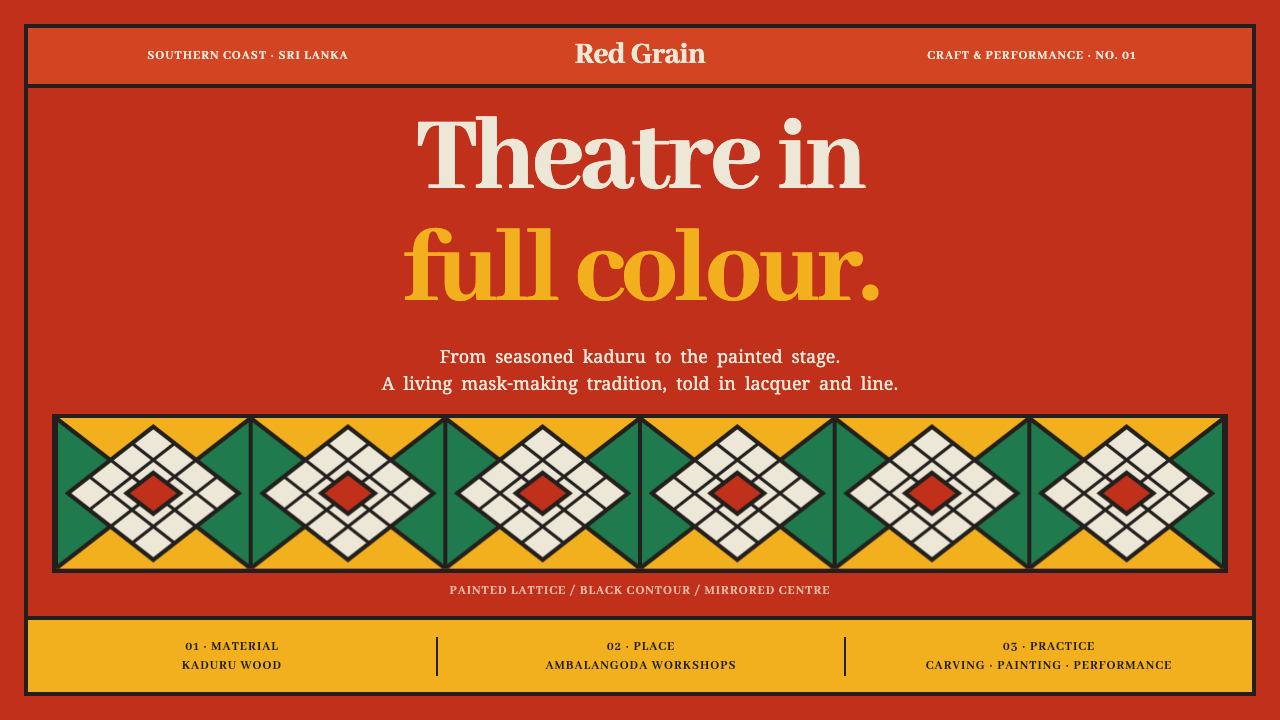
Ambalangoda Raksha Mask takes a carved Sri Lankan demon face literally: the page is vermilion lacquer, yellow carries every action, and nothing sits off the centre axis.
Ambalangoda Raksha Mask in brief
Ambalangoda Raksha Mask is a saturated, dark-valued system built from the colour logic of a carved Sri Lankan mask. Its page is vermilion lacquer. Chrome yellow is reserved for every action. Black contour separates every plane, bone white does the lattice work and the fangs, and the whole composition is mirrored around a central axis, so that nothing sits off-centre.
The key idea is that the object is taken literally. On a typical interface, red would be an accent laid over a neutral background. Here the vermilion is the surface itself, in the way a mask's face is the surface of the mask: the lacquer is the page, and everything else is carved, drawn or hatched onto it. That reversal gives the system its confidence. It does not decorate a page; it is the face.
The effect is carved authority. Colour is applied in flat, strongly saturated planes held apart by thick black contour, the way paint sits between cuts in wood. There are no gradients and no soft shadows, and depth comes from outline, overlap and the relief of repeated forms. The strict mirror symmetry gives every layout the stare of a mask: frontal, unblinking and impossible to ignore.
Where does Ambalangoda Raksha Mask come from?
Ambalangoda sits on the southwest coast of Sri Lanka, in the Southern Province, and is known as the island's mask town. Its workshops carve faces for three overlapping traditions that the source names: kolam, the masked folk theatre; raksha, the processional masks of demons and guardians; and sanni, the masks used in healing ritual. The craft predates 1900 and has not stopped since. It is a living workshop tradition, handed down within families and studios, not a revival staged for visitors.
The material is kaduru wood, seasoned for a week over a smoky hearth before a knife touches it. The seasoning is part of the craft: the wood is prepared by fire first, so that the mask begins its life already marked by the hearth. After carving come the paints. The source dates the current enamel palette to about the 1950s and onward, and notes that workshops now use synthetic enamel, which is why the reds and yellows are so loud. A final coat of oil is brushed over the finished mask to pull some depth back into the colour.
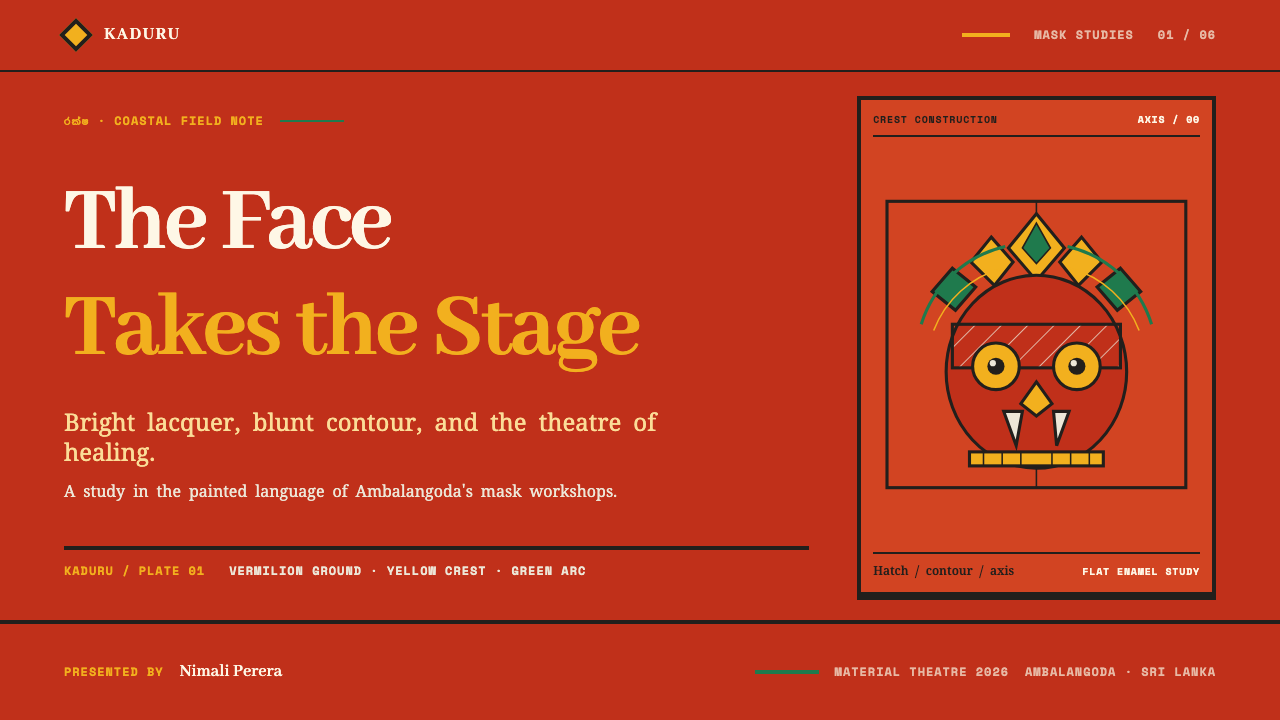
The icon of the tradition is the Naga Raksha, the cobra demon. It has a flat vermilion face, bulging eyes, bared fangs and a fan of cobras rising behind the crown, each cobra neck drawn with a crossing black-and-white lattice. Everything about the mask is built for impact at a distance: strong contour, high colour and absolute frontality. It is meant to be read quickly and felt strongly, whether it appears in a procession or on a stage, and that is exactly the quality a screen interface can borrow.
The source names Ariyapala Gurunnanse, the Ariyapala & Sons workshop lineage and the Ambalangoda Mask Museum among its key figures, together with the three traditions of kolam theatre, raksha processional masks and sanni healing masks. The design system does not reproduce any mask's face or its iconography. It adopts the colour logic and the symmetry, and should be handled with the same respect the objects receive in their own context: these are working pieces of theatre and ritual, not decorative scary faces.
What defines the Ambalangoda Raksha Mask look?
Lacquer as the page
The vermilion is the surface, not a background panel. Full-bleed fields, section grounds and cards are all lacquer-red, and neutral white is not the default canvas the red is added to. This gives every screen the density of a painted object. It also means the red must be handled as material, flat, even and deep, never lightened into a wash or fading toward the edges.
Chrome yellow for action
A bright chrome yellow carries every action: buttons, links in focus, selected states and the one thing the viewer is meant to do next. Because yellow is used for nothing else, it works as a signal on the red the way a painted eye does on a face. If yellow appears decoratively, the signal weakens, so the system treats it as functional and not as an accent for mood.
Black contour
Black outlines separate every plane, as black paint separates fields of colour on a carved face. Contours are confident and consistent, thick enough to read from across a room, and they do the work that a shadow or a gradient would do elsewhere. Every card, button, image and panel is cut out by a line, so the composition reads like a set of fitted pieces.
Bone-white lattice
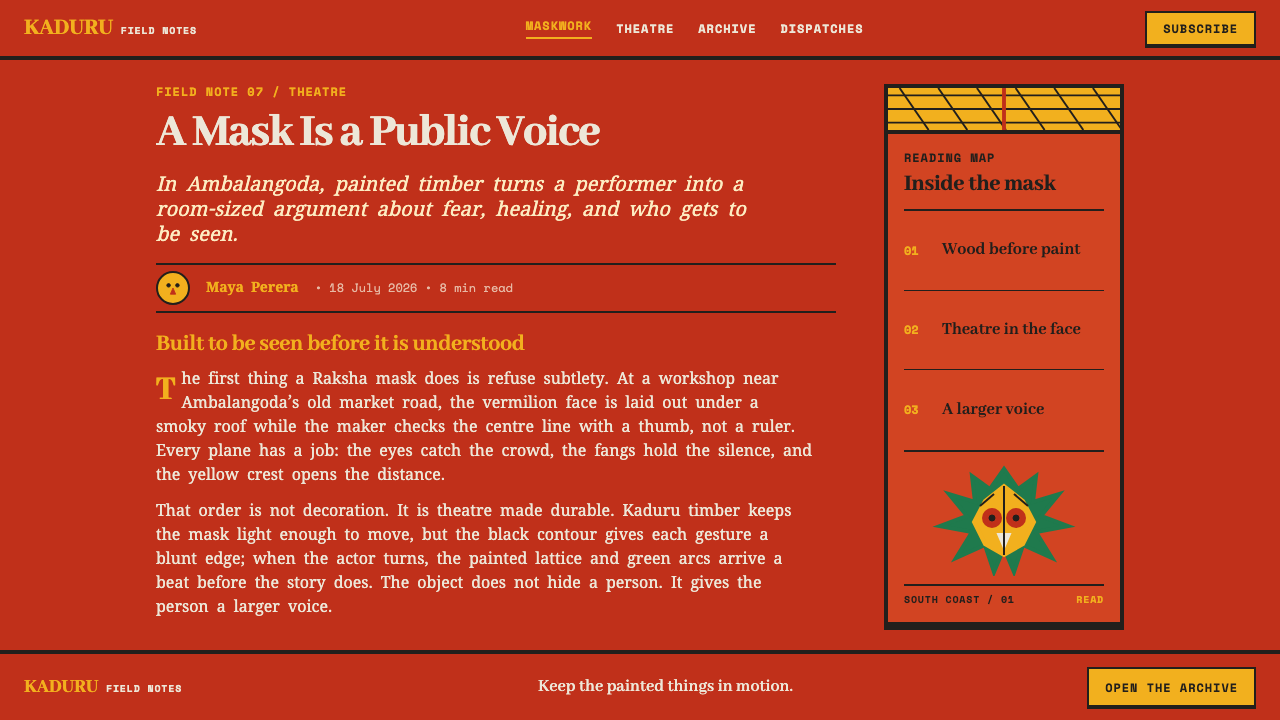
Bone white is used for hatching, lattice and teeth-like details rather than as a general light colour. A crossing lattice appears in borders, dividers and backgrounds of small areas, echoing the pattern drawn on the cobra necks. Used sparingly, it supplies texture and a sense of craft without breaking the flat planes of the lacquer.
Mirror symmetry
Everything is built about a central axis. Titles sit on it, ornaments mirror across it, and side panels are matched left and right. Symmetry here is not a neutral layout choice but the character of the mask: a frontal, balanced stare. Asymmetry is allowed only inside small areas such as a text column, and the frame around it stays mirrored.
The crowned top
The upper part of a composition often carries a crown: a fan of repeated forms rising behind the central element, like the row of cobras behind the mask. In layout terms, this becomes a radiating or stepped cluster of repeated shapes above the title or the key figure, giving the page a head. It is a structural device for creating a focal point, not a decorative flourish.
Enamel with depth
The finish is glossy enamel, but a coat of oil has pulled it back so that the red reads deep and the yellow reads warm instead of harsh. That balance matters: the colours are loud, but they are not neon. Contrast comes from value and outline, not from glow, and large reds should feel like a solid pigment, never like a light source.
Who shaped Ambalangoda Raksha Mask?
Named first among the source's key figures, Ariyapala Gurunnanse stands for the master carver of Ambalangoda. Gurunnanse is an honorific for a master-teacher of traditional arts, and the name points to the way knowledge in this craft passes: through apprenticeship and a single respected hand. In the design system, that authority is the sense of confident, unhesitating contour.
The workshop lineage shows that the tradition is carried within families and studios, with craft passing across generations. It is a reminder that the masks of Ambalangoda are not museum survivals but products of a working shop, still carved, painted and finished in the present day with the current enamel palette.
The museum represents the institutional side of the tradition: collecting, showing and explaining the masks and the traditions of kolam, raksha and sanni to a wider public. For designers, it is a useful pointer to where the real objects can be studied in context, rather than relying on a single image of the cobra demon.
The Naga Raksha is the icon of the tradition and the direct model for this system: a flat vermilion face, bulging eyes, bared fangs and a fan of cobras rising behind the crown. Its design shows how much meaning a mask can carry through colour, contour and symmetry alone, which is exactly the vocabulary the interface borrows.
How do you use Ambalangoda Raksha Mask today?
Ambalangoda Raksha Mask is a high-intensity system, so it works best where intensity is the point. Treat the vermilion page, the black contour and the single yellow signal as a fixed trio, and build everything else from the centre outward. Decide early where the axis runs, because every later decision depends on it.
For presentation slides, the cover is the natural showpiece: a full vermilion field, a centred title in bone white or black, a crown of repeated shapes rising above it, and a framed yellow element for the one thing to remember. Content slides keep the vermilion ground, set content in outlined panels mirrored left and right, and keep the text short. Data slides suit symmetrical layouts, such as paired bars growing from a central spine, with each shape outlined in black and filled with flat colour. A lattice can stand in for any gradient or shading.
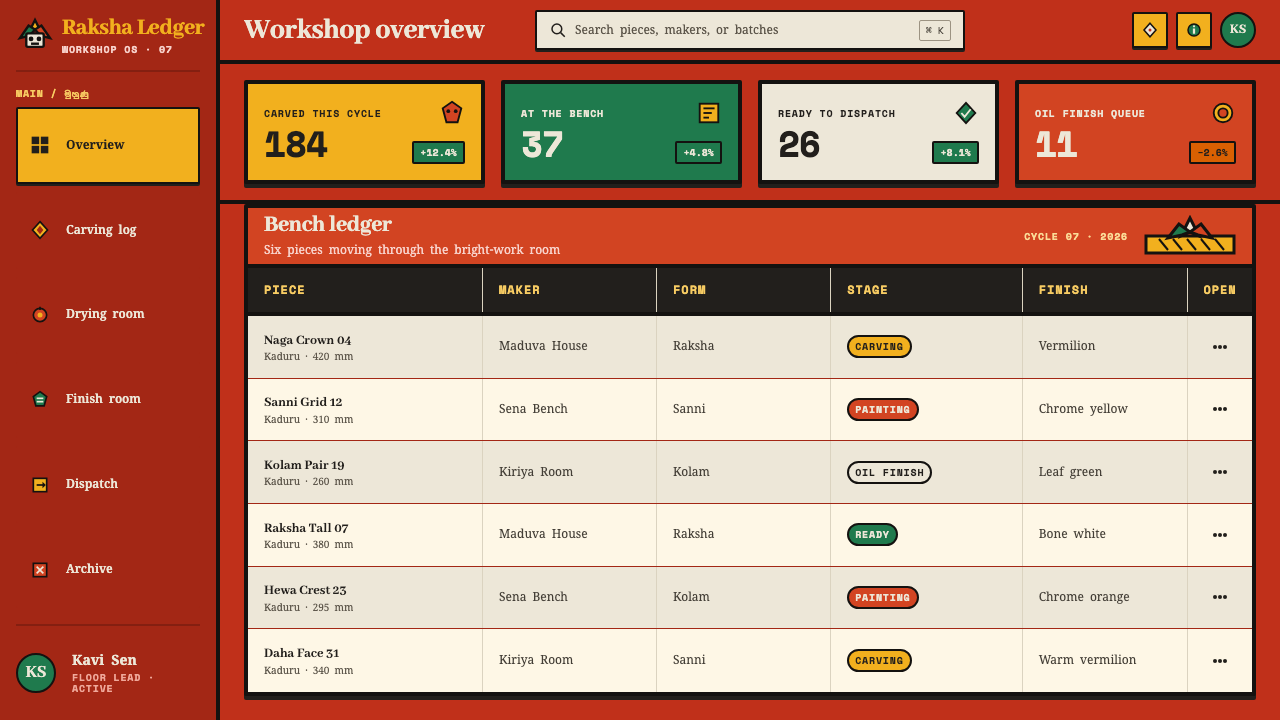
For web interfaces, the style is strongest on landing pages, event and festival sites, games, entertainment products and cultural platforms. A dashboard can adopt it in a restrained form, with vermilion on the shell and navigation and calmer outlined panels in the working area. Buttons are yellow with a black outline and black text, inputs are outlined bone-white fields, and focus is always yellow. Pricing pages work well when the plans are mirrored around a central highlighted tier, with the yellow call to action reserved for that choice.
For editorial and marketing work, the system suits poster-like pages, programme covers, launch announcements and campaigns for theatre, music, food or heritage. Layouts are built on a single vertical axis with mirrored ornament and bold central type. Long articles should move body text onto a bone-white panel to protect readability, with the vermilion framing it. When using the mask's cultural references, credit the craft and its sources, and avoid treating the demon face as horror decoration or a seasonal costume motif.
The most common mistake is to use vermilion only as a small accent on a white page. That loses the central idea, which is that the lacquer is the page. The second is to break the symmetry for the sake of a trendy layout, which turns the mask into a pattern. A third is spreading yellow across decorative details so that actions no longer stand out, and a fourth is softening the black contour with shadows or blur, which removes the carved authority the system is built on.
Ambalangoda Raksha Mask — FAQ
What is the Naga Raksha?
The Naga Raksha is the cobra demon, the best-known figure in the mask tradition of Ambalangoda. It has a flat vermilion face, bulging eyes, bared fangs and a fan of cobras rising behind its crown, with the cobra necks drawn in a black-and-white lattice. It is the direct model for this design system's colour and symmetry.
What are kolam, sanni and raksha masks?
They are the three traditions named in the source. Kolam is a masked folk theatre. Raksha masks are processional masks of demons and guardians. Sanni masks are used in healing ritual. Ambalangoda workshops carve faces for all of them from kaduru wood, which is seasoned a week over a smoky hearth before carving begins.
Why is vermilion the page rather than an accent?
Because on the mask, the vermilion lacquer is the face, not a highlight applied to something else. The system follows that literally. Making the red the surface gives every screen the weight of a painted object, and it frees the other colours to do specific jobs: black to separate planes, bone white for lattice and hatching, and chrome yellow for action.
What do I do with content that is not symmetrical?
Keep the frame symmetrical and let the content be asymmetrical inside it. A long text column, a table or a form can be left-aligned within a mirrored panel, as long as the panel itself sits on the central axis and has a matching counterpart. For reading-heavy content, place the text on a bone-white panel framed in black, so the lacquer remains the ground without hurting legibility.
Is it a good fit for every product?
No. It fits products that want intensity, ceremony and character, such as events, games, culture, food and entertainment. It is a poor fit for calm, long-session tools like dense editors or finance dashboards, and for contexts that call for soft, quiet reassurance. Handle the cultural source with care: use the colour logic and symmetry, not the face of the mask as decoration.
Related design styles
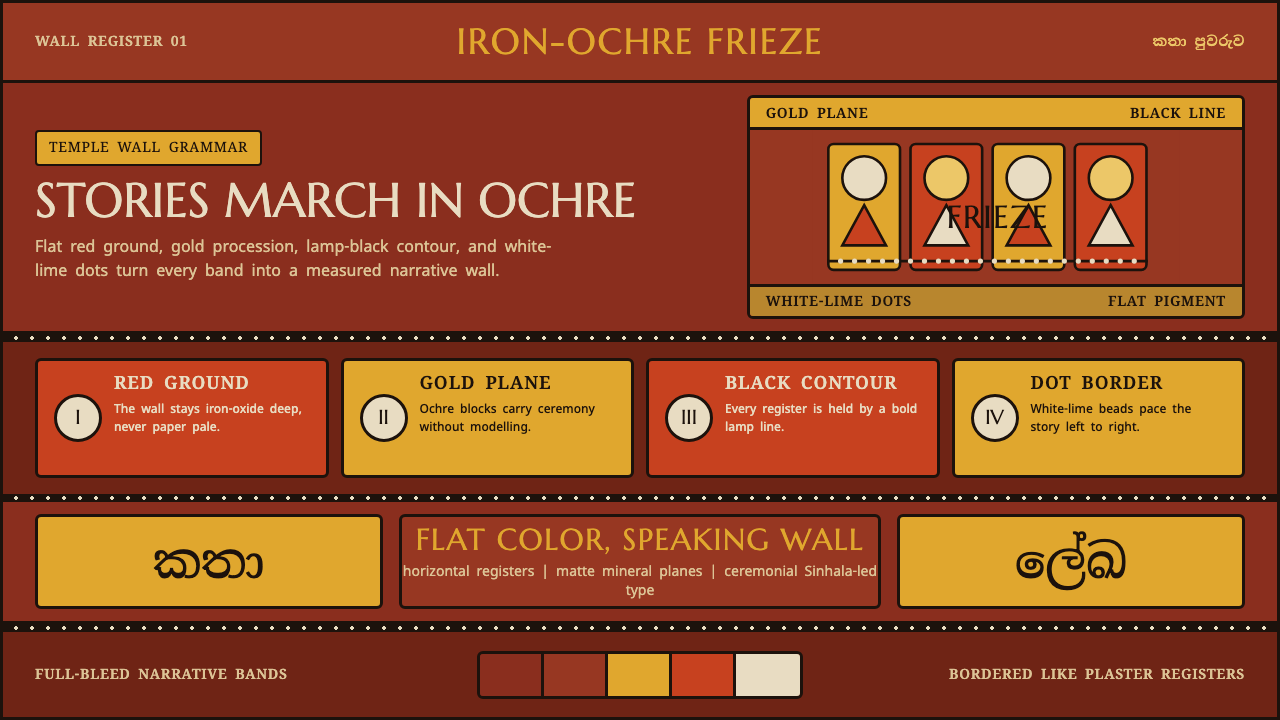 Kandyan Temple Mural FriezeTemple-wall gravity. Red ochre, gold planes, black contours, white-dot regist…
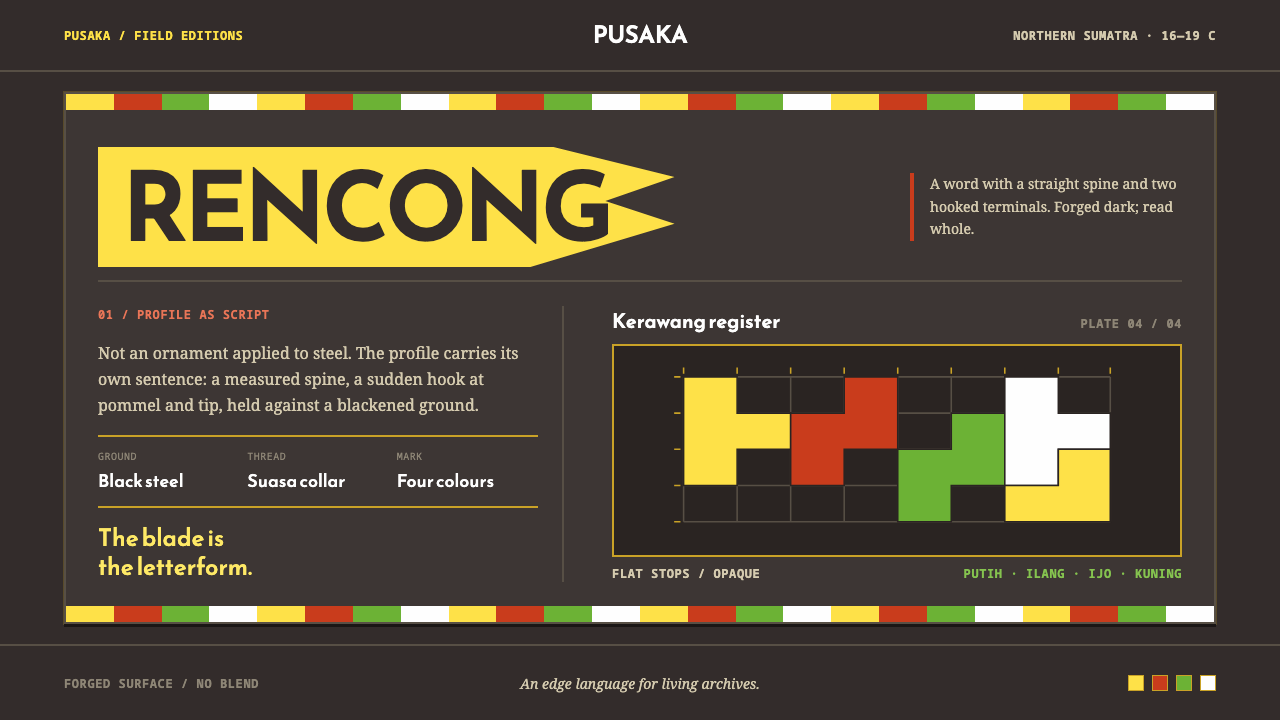 Acehnese Rencong MotifA blade that reads as a word. Flat kerawang red, white, green and yellow lock…
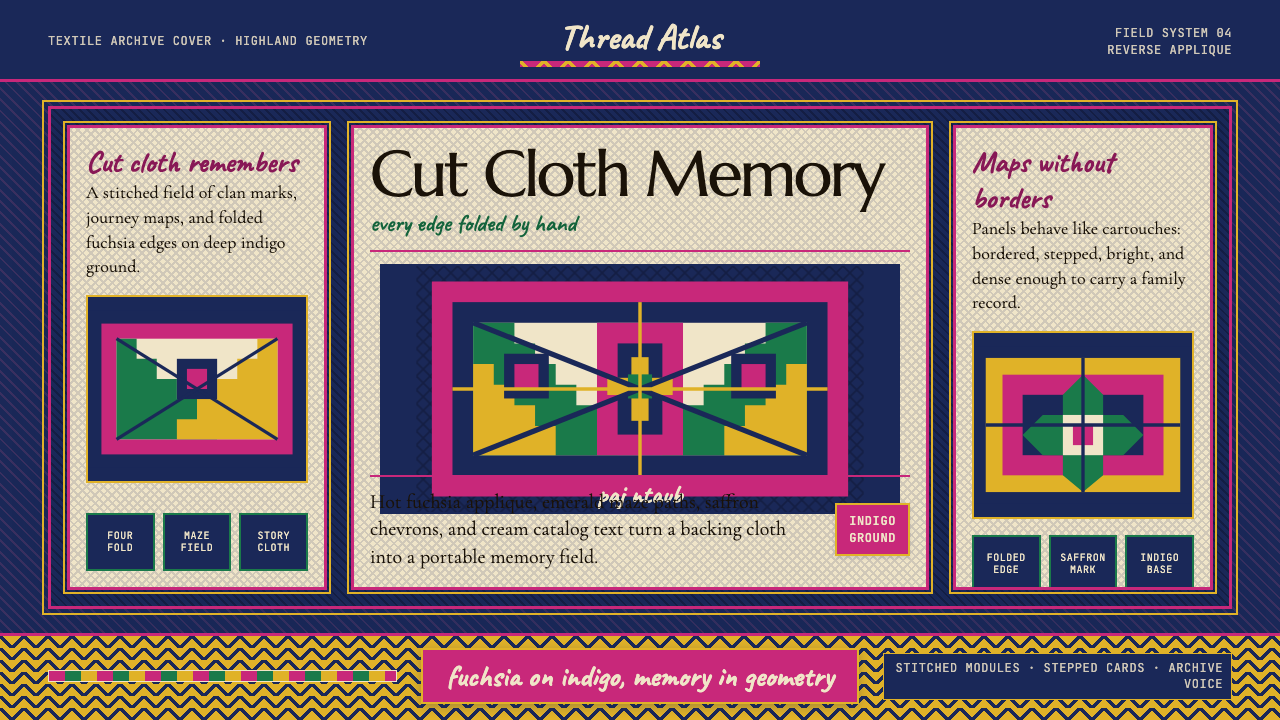 Hmong Paj Ntaub (Flower Cloth)Memory is geometric. Fuchsia applique on indigo forms stepped maze panels.
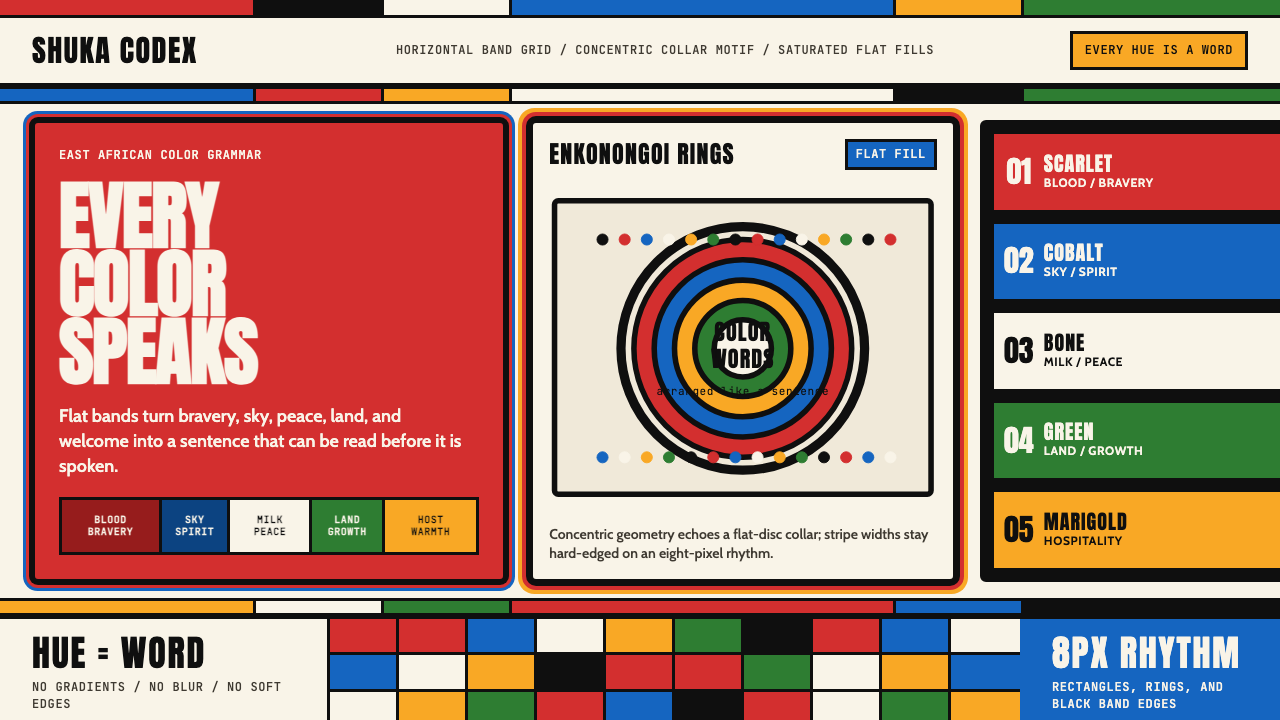 Maasai Shuka & BeadworkColor becomes language. Scarlet bands, cobalt panels, and concentric bead rin…
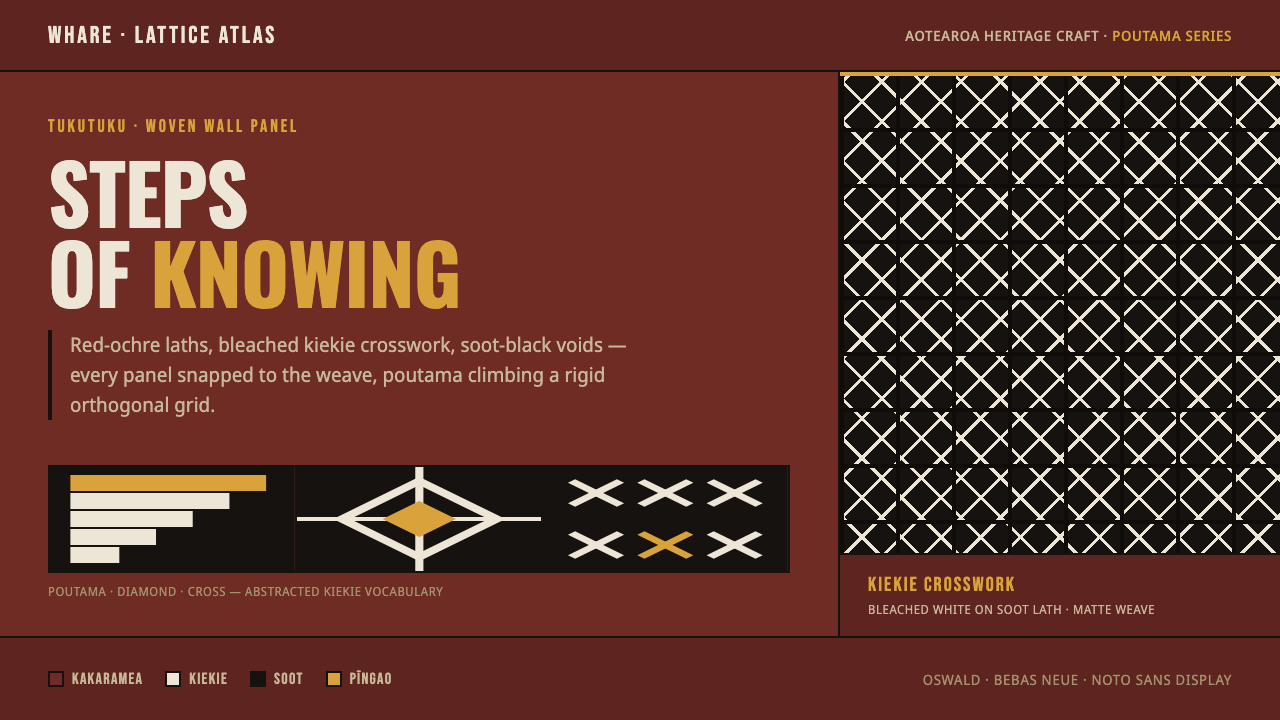 Māori Tukutuku PanelTukutuku weave, rendered strict. Bleached kiekie crosswork laces poutama step…
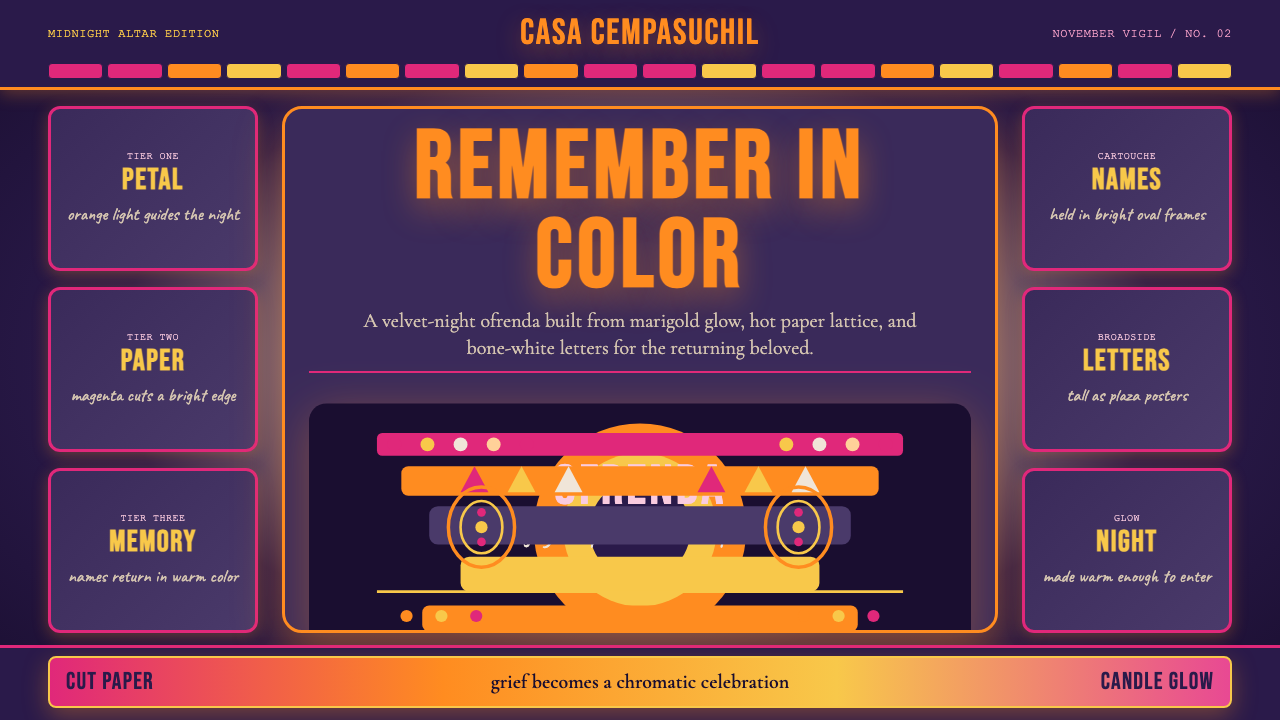 Mexican Día de Muertos (Marigold Ofrenda)Joy outruns mourning. Marigold orange and magenta lattice blaze on velvet pur…