What is Kalinga Batok Tattoo?
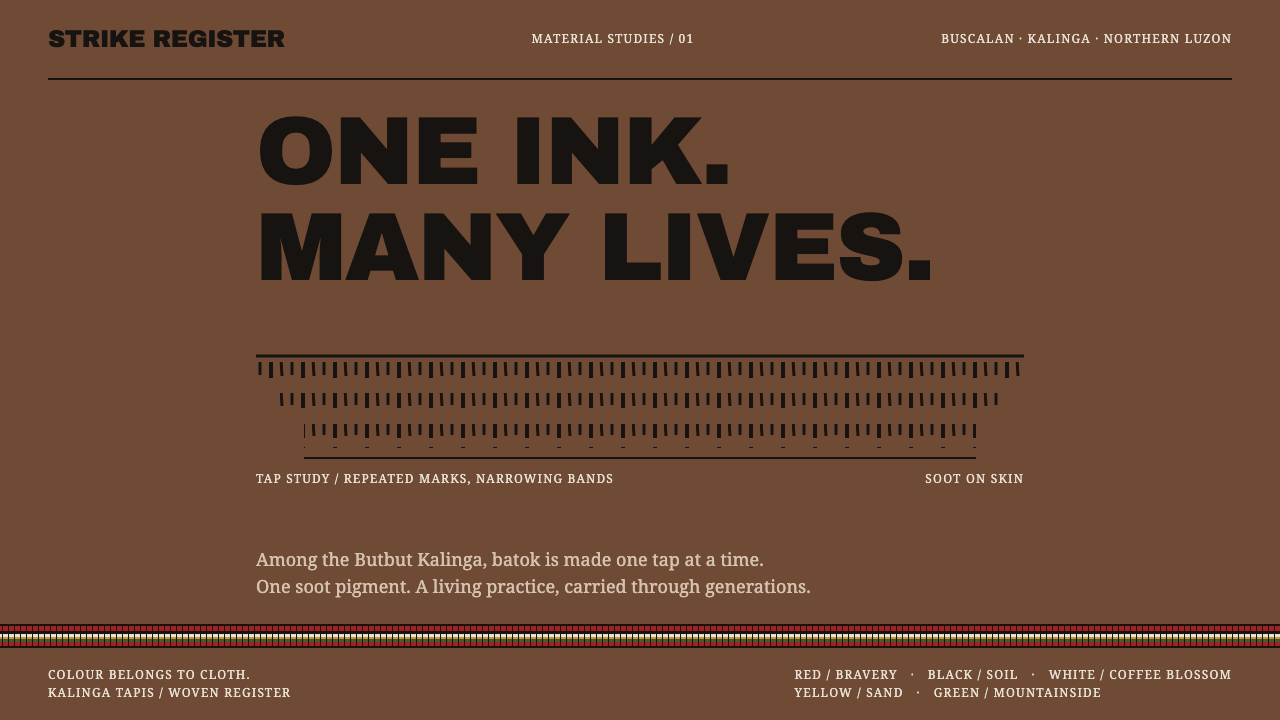
Batok is a design language with a single pigment: soot on skin, built one tap at a time, with colour surrendered entirely to cloth.
Kalinga Batok Tattoo in brief
Batok is the hand-tapped tattooing of the Butbut Kalinga, a mountain people of the Cordillera in the northern Philippines. In the Curio library it stands for a visual language built under one hard constraint: a single pigment and no second colour. The tools set the whole vocabulary. A citrus thorn is fixed into a short bamboo stick, a second stick strikes it so that the thorn passes through the skin, and the ink is soot scraped from the underside of a cooking pot.
The name is the sound of the work. Batok is what the tapping says, one stick on another, repeated until a pattern exists. That is why nothing in this style is drawn as a continuous stroke. Every mark is a discrete tap, and larger forms are assembled from them: rows of short dashes, stacked chevrons, and zigzag bands that run along an edge and narrow as the edge narrows.
As a design system, Batok reverses the usual relationship between page and mark. The page is skin, a mid-dark brown that never lightens toward paper, because a tattoo grows on a body rather than being printed on a sheet. Type and ornament are soot-black on that ground. Colour is not abolished but displaced: it appears only where woven tapis cloth appears, and it carries the meanings the weavers give it. The result is dark, warm, severe and oddly intimate, a style that treats restraint as a form of memory.

Where does Kalinga Batok Tattoo come from?
Batok is a pre-colonial practice, and the library places it in Buscalan, a village in Tinglayan, Kalinga province, in the Cordillera Administrative Region of Luzon. It belongs to the Butbut Kalinga, and it was never a fashion. Among them a man's tattoos were earned by guarding the village, which makes the skin a record of duty performed rather than a surface chosen from a catalogue. For women the marks were a matter of dignity and beauty. In both cases the ink is a social ledger carried on the body, readable by anyone who knows how to look.
The motifs translate the world around that body into the simplest possible units. In the system's vocabulary a row of short dashes reads as the legs of a centipede and a stack of chevrons reads as a ladder, while the zigzag band follows the edge of whatever it decorates and tapers with it. These are not illustrations. They are constructions, made by repeating the one gesture the tool permits, and that is the discipline the design system inherits.
The twentieth century was hard on the practice, which was near-extinct through the century and has been revived only since the 2000s as part of what the library calls the Cordillera tattoo revival. Two names recur in its record of that story. Whang-od Oggay is the tattooist of Buscalan whose work became the public face of the practice, and Lars Krutak is a researcher of indigenous tattooing who documented the tradition for a wider audience.
A second craft sits beside tattoo in the system: Kalinga laga backstrap weaving, and it is where colour lives. Reading the two together explains the style's central rule. The skin holds one pigment, and holds it for a lifetime; the cloth holds red, black, white, yellow and green, each with a stated meaning. A designer who understands that division understands why a Batok layout looks the way it does, and why adding a second ink to the marks would not enrich the page but break it.
What defines the Kalinga Batok Tattoo look?
Skin as ground
The page is a mid-dark brown, the colour of sun-weathered skin, and it never lightens toward paper white. This is the style's founding decision. Because the ground is a body rather than a sheet, every surface in a layout feels warm, matte and slightly worn, and contrast has to be earned by ink rather than granted by a white field.
One soot ink
All type and all marks are soot-black: one ink, no tints, no second hue. Letterforms should feel struck rather than drawn, sturdy and plain, carrying the weight of something that has to last on a surface that forgives nothing. Hierarchy comes from scale, spacing and repetition, never from switching colour.
Tapped units
Every shape is built from discrete short marks. Rules become rows of dashes, fills become dense fields of taps, and dividers become stacked chevrons. Looking closely, you should be able to count the units. This gives the style a granular, rhythmic texture that reads almost like speech, and it means a line is never simply a line.
Edge-following bands
Zigzag bands travel along an edge and taper with it, narrowing where the edge narrows. Ornament is therefore always attached to structure: it follows a border, a corner or a column and responds to it. Floating decoration that obeys no edge is foreign to the system.
Colour only from cloth
Colour enters only where woven tapis cloth enters, and each hue carries a meaning the weavers give it: red for courage, black for earth, white for the coffee blossom, yellow for sand, green for the hillside. In practice this means small, bounded fields of colour, like woven panels or stripes, set against the dark ground and kept away from the type and from the tapped marks themselves.
The drift of the hand
Lines wander and vary in thickness, and the guidance is explicit: do not straighten them. The unevenness is evidence of a hand and a rhythm, the same way a tapped row never has perfectly equal intervals. A layout that is too exact reads as a clean imitation of something hand-made, which is the opposite of what this style is for.

Who shaped Kalinga Batok Tattoo?
Whang-od Oggay is the tattooist of Buscalan whose name has become inseparable from the revival of Kalinga tattooing. The library lists her as a key figure because she represents the practice as living transmission rather than a museum object: a person, a village, a thorn and a stick. For a designer she is a reminder that this style comes from a specific place and a specific pair of hands, and that attribution is not optional.
Lars Krutak is named for his work as a researcher of indigenous tattoo traditions, which brought careful documentation of Kalinga practice into wider view. He stands outside the tradition as a witness rather than a practitioner, and that is worth remembering: much of what an international audience knows about batok reached it through writing and recording. Good design work cites the community first and its interpreters second.
The Butbut Kalinga are the people to whom batok belongs. In the reference material, men's tattoos were earned by guarding the village and women's marked dignity and beauty, so the marks carry social meaning that no layout can restate. The system borrows form and construction, not authority, and it should never present itself as a substitute for the community's own use of the marks.
Kalinga laga backstrap weaving is the second craft in the system's reference, and the only place where colour is allowed. Treat the weavers as co-authors of the palette: red, black, white, yellow and green are theirs, with their meanings attached. The relationship between tattooist and weaver, one pigment on skin and many in cloth, is the logic that organises the whole style.
How do you use Kalinga Batok Tattoo today?
On slides, Batok suits cover pages that want gravity. Set the title in soot-black type directly on the skin-brown ground, leave generous empty space around it, and run a single tapped band along one edge, tapering as the slide edge narrows. Content slides work best as sparse, single-message pages: one heading, a short run of text, and a row of dashes as the only divider. For data slides, build bars and series from tapped units so that a chart can be counted rather than merely read, and reserve a coloured field for the one comparison that truly needs a second hue, drawn as a small woven-looking panel rather than a bright fill.
On the web the style fits dashboards, archives and product pages that want a serious, grounded voice. Keep the page in the dark brown skin tone throughout and set all text in the single ink. Separate cards with tapped rules rather than shadows or lighter panels. A pricing page can use stacked chevrons to mark tier steps, a ladder that climbs. Show interactive states through weight, density of taps and underlining rather than recolouring, and if a status colour is genuinely required, treat it as a woven strip and keep it small.
For editorial and marketing work, Batok rewards long-form, quiet layouts: cultural features, heritage brands, documentary and craft-led storytelling. Use a tapped band to open a section, a simple row of dashes to close one, and photographs or textile close-ups as the only source of full colour on the page. Campaign pages can echo the process itself, with headlines that arrive as marks laid down one after another. The tone is declarative and unhurried.
Because the marks come from a living tradition with real meaning, use them with care. Where a project draws directly on Kalinga identity, say so, and name Buscalan and the Butbut Kalinga rather than leaving the pattern to read as generic texture. The construction principle (taps, bands that follow edges, a single ink) can be applied widely. Reproducing specific motifs as decoration is a different act and should carry the community's story with it.
The most common mistake is to treat the zigzag and chevron as a generic 'tribal' border and scatter it across a layout in several colours. That does the reverse of what the system says: colour belongs to cloth, marks belong to one ink, and ornament follows an edge. Almost as common is lightening the ground toward paper or cream to improve legibility. The ground is skin; if contrast is weak, make the type heavier or larger rather than the background paler. Finally, do not sharpen the lines. Perfectly straight, perfectly even rules turn a hand-tapped system into a cold imitation of one.

Kalinga Batok Tattoo — FAQ
What is batok?
Batok is hand-tapped tattooing among the Butbut Kalinga of the Cordillera in the Philippines, practised in villages such as Buscalan. A citrus thorn set in a bamboo stick is driven through the skin by a second stick, using ink made from soot scraped off a cooking pot. The word imitates the sound of the tapping. In Curio the name also labels a design style that borrows the practice's constraints: one ink, discrete marks, and a skin-toned ground.
Why does the style use only one ink colour?
Because the tradition does. Tattooing among the Butbut Kalinga uses a single pigment, soot, and the design system follows that constraint literally. Limiting yourself to one ink forces hierarchy to come from scale, spacing and repetition, which keeps layouts honest and legible. Colour is not banned, but it belongs to woven cloth, so it appears only in small woven-looking fields and never in the type or the tapped marks.
What do the colours in the style mean?
The colours come from woven tapis cloth and carry meanings the weavers give them: red stands for courage, black for earth, white for the coffee blossom, yellow for sand and green for the hillside. In a layout they work best as small bounded panels or stripes, so that each hue can keep its meaning instead of becoming general decoration.
Why must the background stay a dark brown instead of white?
The page in this system is skin, not paper. A tattoo is made on a body, and the ground tone of a mid-dark brown is what makes the soot-black marks feel part of a surface rather than printed on one. Lightening the ground toward paper dissolves that idea and turns the style into an ordinary dark-on-light layout. If readability suffers, adjust the weight and size of the type rather than the ground.
Can I use the zigzag and chevron patterns in my own project?
You can apply the construction principles freely: discrete taps, bands that follow an edge, one ink on a skin-toned ground. Reproducing specific motifs is different, because they come from a living tradition with social meaning for the Butbut Kalinga. If your project does draw on those motifs, credit Buscalan and the Kalinga community, and avoid using them as anonymous pattern fill.
Related design styles
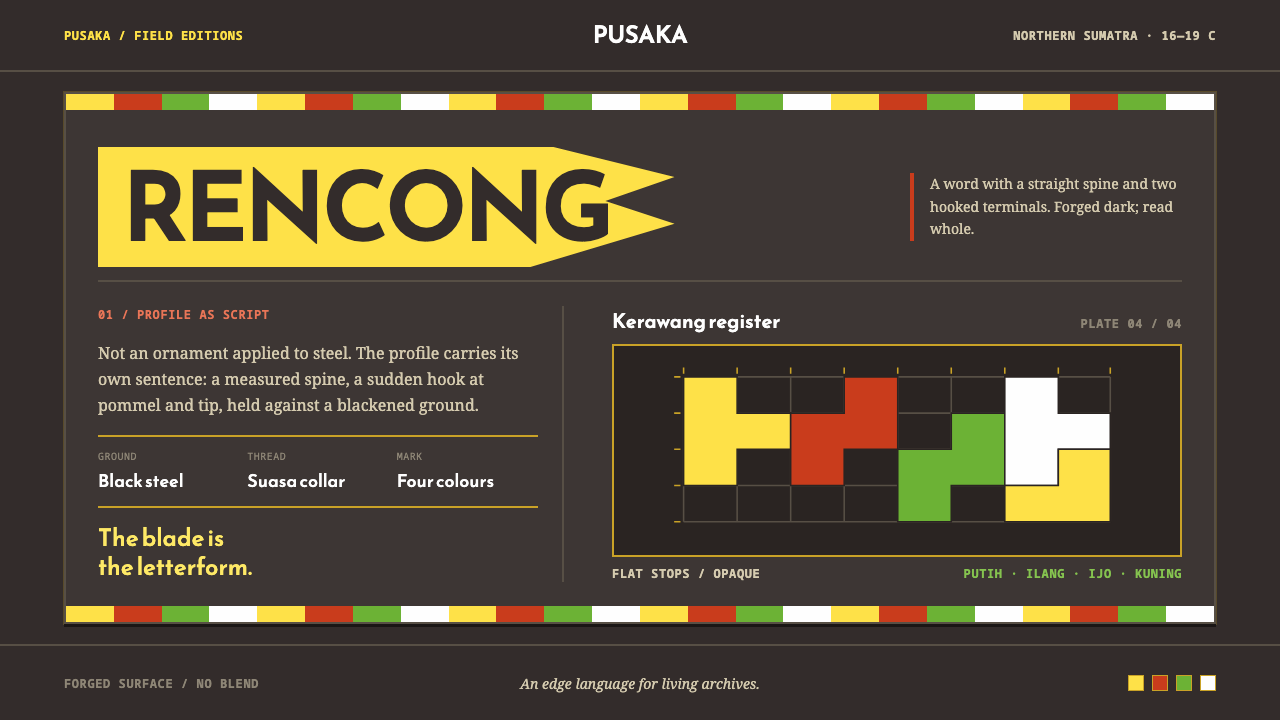 Acehnese Rencong MotifA blade that reads as a word. Flat kerawang red, white, green and yellow lock…
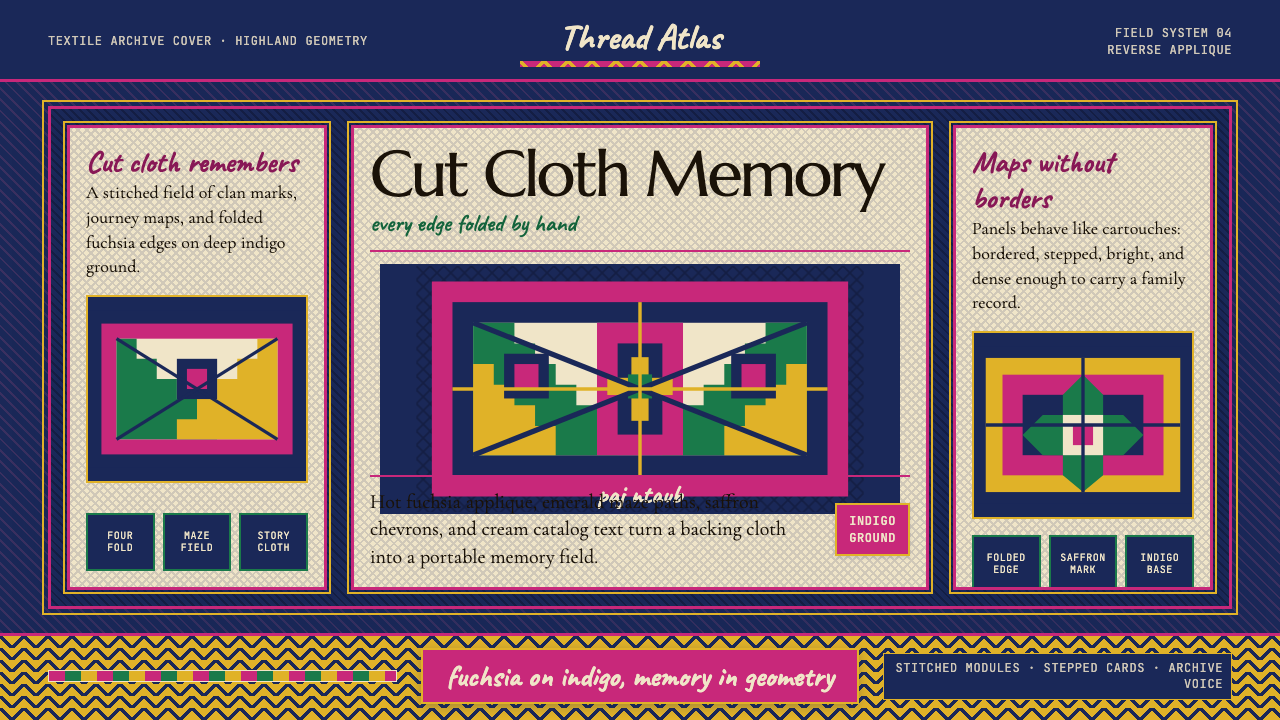 Hmong Paj Ntaub (Flower Cloth)Memory is geometric. Fuchsia applique on indigo forms stepped maze panels.
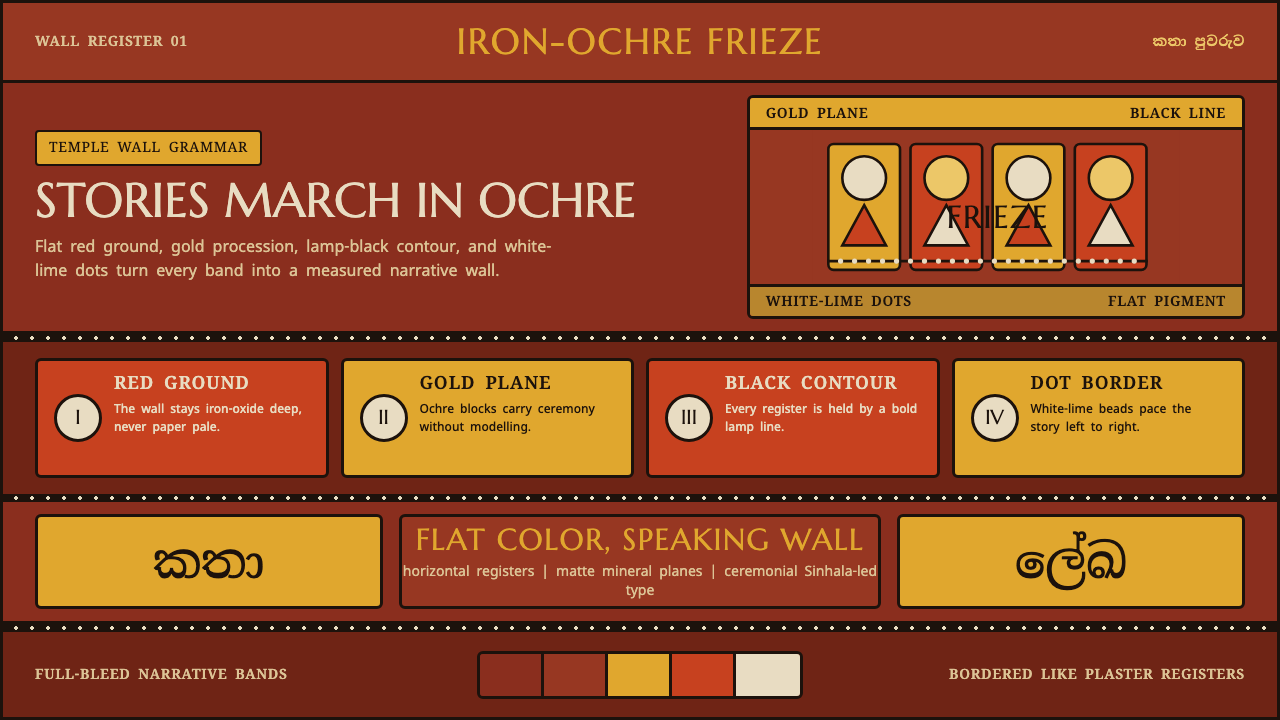 Kandyan Temple Mural FriezeTemple-wall gravity. Red ochre, gold planes, black contours, white-dot regist…
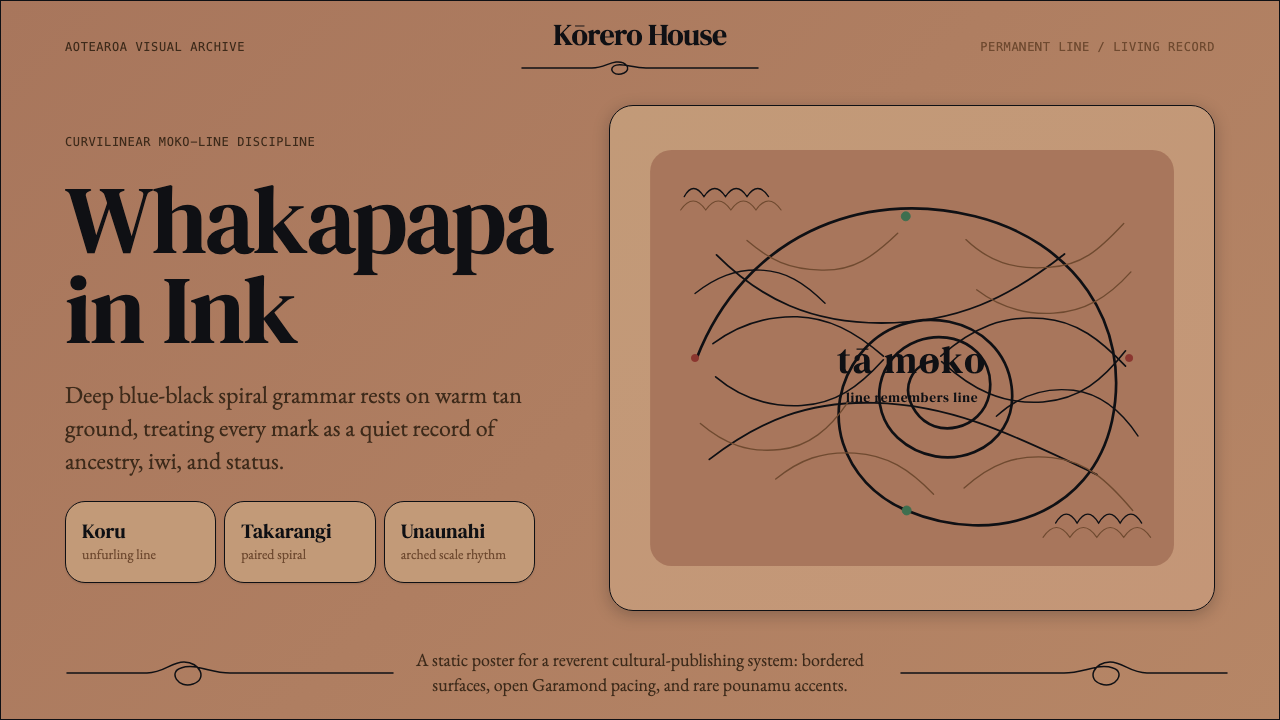 Māori Tā Moko (Facial Tattoo)Ancestry feels carved. Blue-black spirals on tan ground carry a restrained Ga…
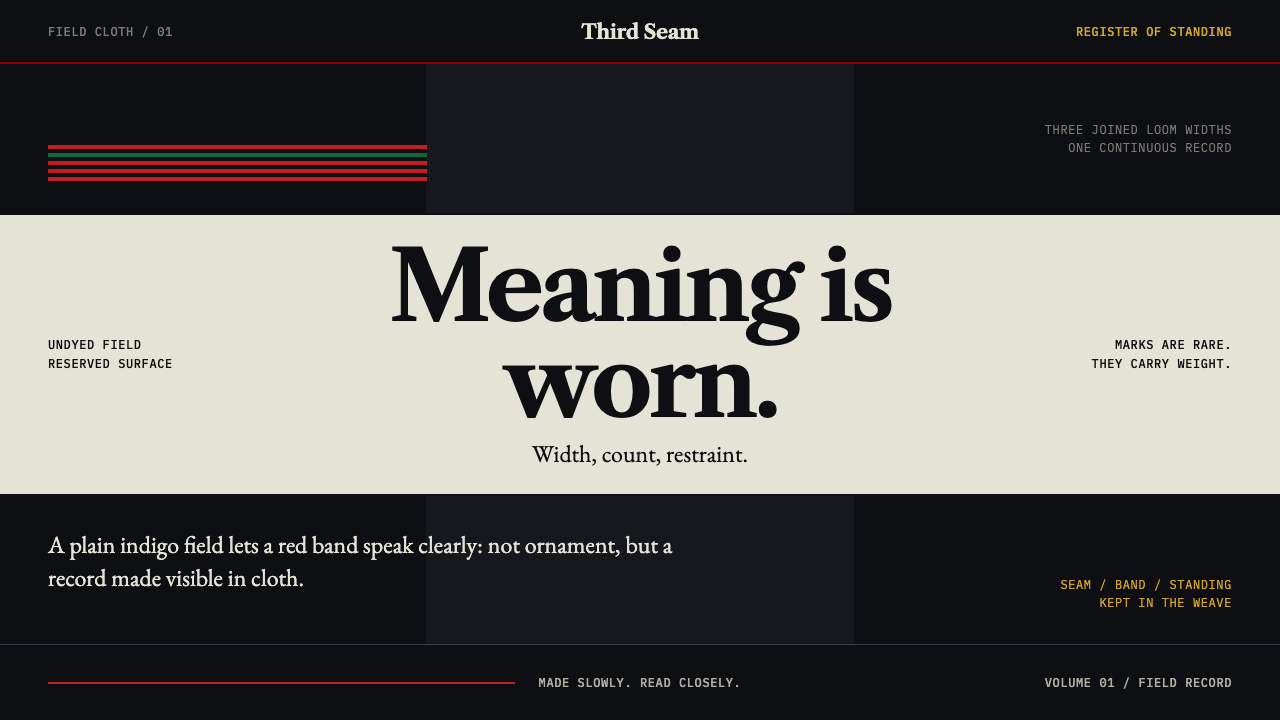 Naga Angami ShawlEvery stripe bears standing. Indigo seams frame rare red bands and one earned…
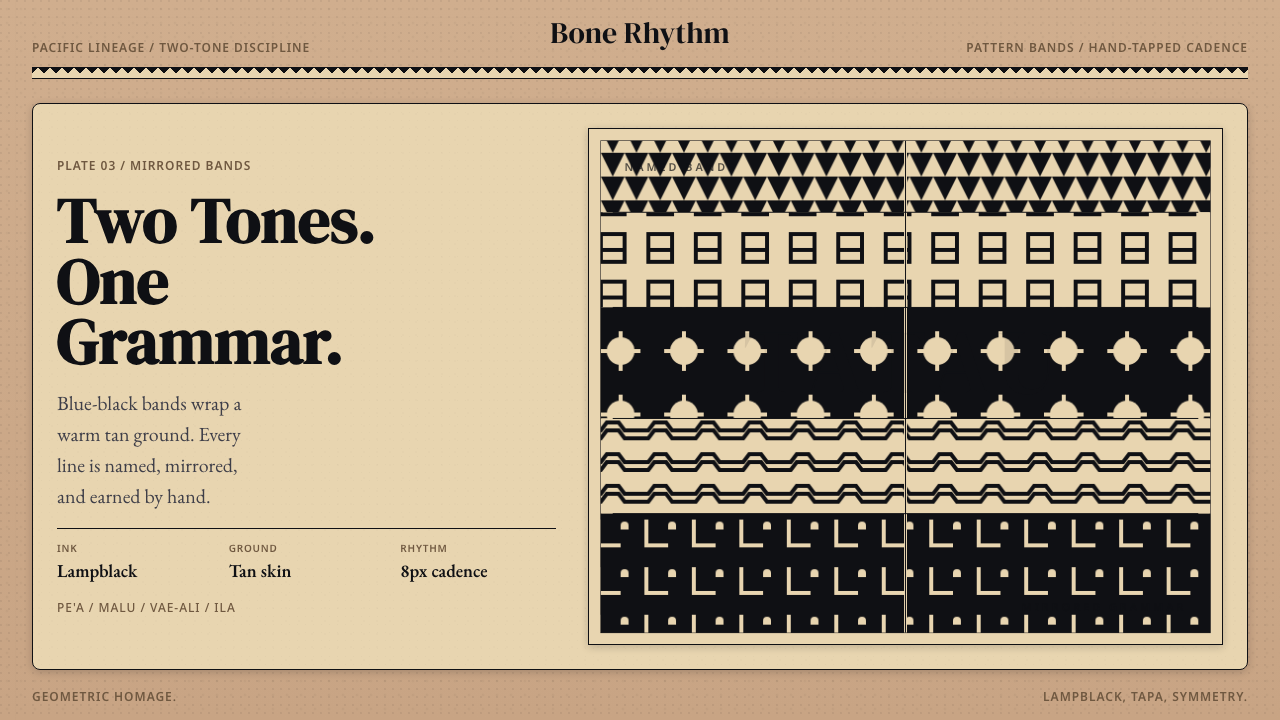 Samoan Tatau (Traditional Tattoo)Strict two-tone discipline. Tan ground, blue-black bands, hand-tapped symmetr…